Buyer Guide · commercial intent
Silicone Coaster Manufacturer — Engineering Sourcing Guide
 Buyer Guide
 A legitimate silicone coaster manufacturer is defined by three verifiable engineering signals — in-house compression or LSR injection tooling, an ISO 9001:2015 scope that explicitly names silicone molding, and master-batch-linked FDA 21 CFR 177.2600 plus LFGB §30/31 test reports on request. Trading companies fail on at least two of those three tells. This guide walks through how a US or EU buyer sourcing a custom coaster program should vet a factory, choose between compression and LSR injection, structure MOQ economics, and clear the four-tier compliance stack that determines retail eligibility.
Key takeaways
- Real factory vs trader: in-house press or LSR cell, ISO 9001 scope naming silicone molding, master-batch-linked FDA and LFGB reports — traders fail on at least two.
- Process choice: compression molding for runs under 50,000 pcs and thickness ≥ 3 mm; LSR injection above 100,000 pcs / year or thin-wall and dual-durometer geometries.
- Compliance stack for US retail: FDA 21 CFR 177.2600, ISO 9001:2015, per-batch PFAS non-detect, Prop 65, plus CPSIA Section 101 if children’s or promotional channel.
- Real MOQ: 500 pcs per custom-tooled SKU on a factory that owns its own steel — 100-piece MOQs signal pad-printed generics or trader aggregation.
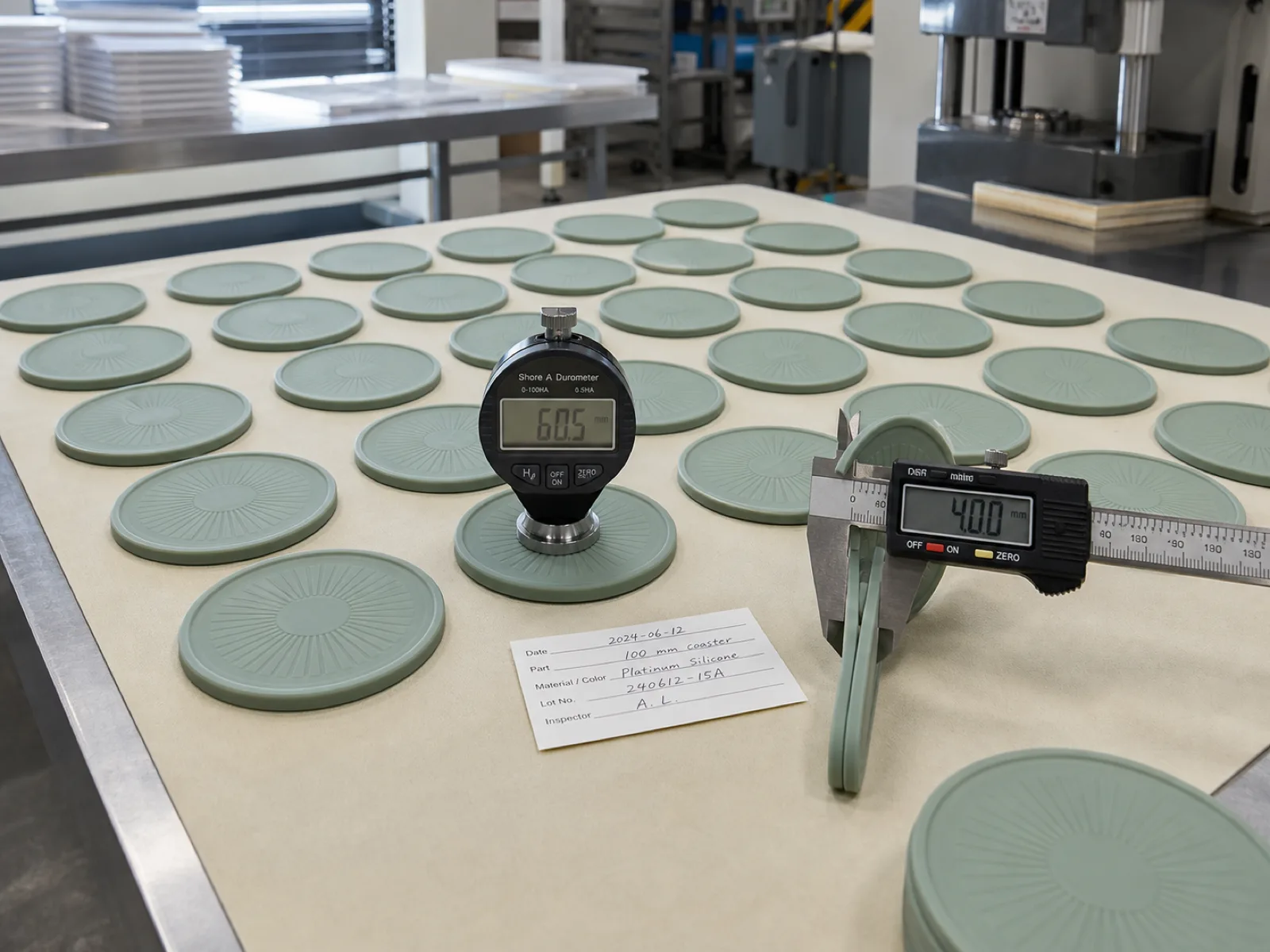
- Anti-slip physics: Shore A 55-65 at 3-4 mm with a textured underside delivers static coefficient of friction > 0.9 per ASTM D1894 on melamine or lacquered wood.
- Lead time: 21-45 days RFQ-to-first-article depending on new tooling vs existing geometry — 10-day quotes signal soft-aluminum sample tooling or stock-shape substitution.
What defines a legitimate silicone coaster manufacturer?
A legitimate silicone coaster manufacturer owns its compression presses or LSR injection cells, cuts its own steel tooling in-house or through a captive tool room, holds an ISO 9001:2015 certificate whose scope explicitly names silicone molding, and produces master-batch-linked FDA 21 CFR 177.2600 and LFGB §30/31 reports referenced to a lot number from the last 90 days on request.
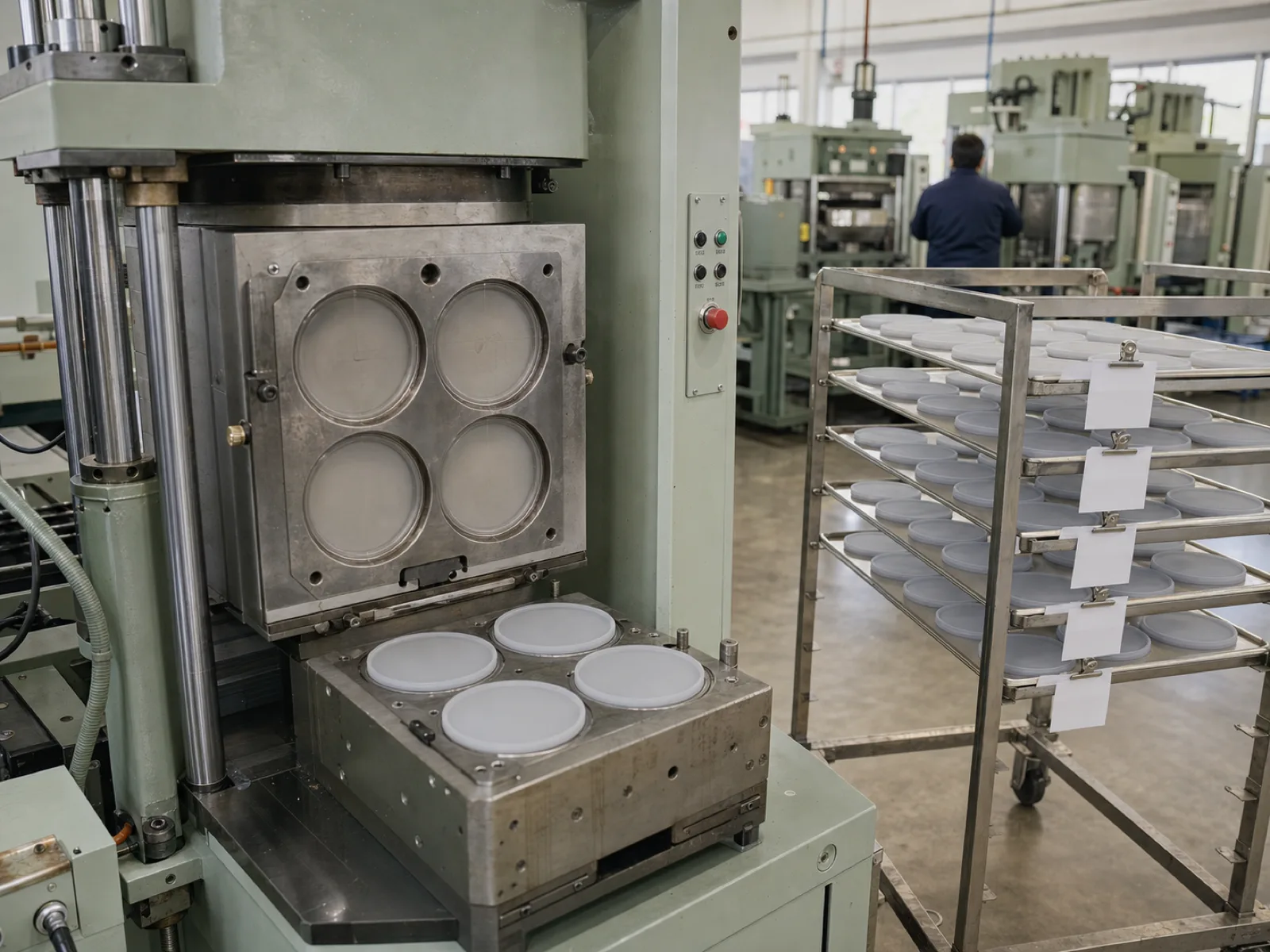
Four verification checkpoints separate a factory from a trading-company reseller listing coasters on an anonymous B2B marketplace. The first is a live 2-3 minute factory walkthrough video showing compression presses (typical: 100-300 ton hydraulic presses running 4-8 cavity molds) or LSR injection cells (Arburg, Engel, or Sumitomo Demag 50-100 ton with cold-runner integration) under production load with a placard displaying the current date and the buyer’s PO number. Trading companies deflect this request or send stock footage; a real factory records it while the presses are cycling.
The second checkpoint is the ISO 9001:2015 certificate itself. Cross-check the certificate number on the issuing body’s public register — SGS, TÜV Rheinland, Bureau Veritas, DNV, or DEKRA all publish searchable databases — and confirm the certified scope explicitly names silicone rubber compression molding or LSR injection. A generic “manufacture of rubber products” scope that does not name silicone is a common trader tell: the certificate is real but the scope does not cover the process the trader is claiming to run.
The third checkpoint is batch-specific compliance documentation. Ask for an FDA 21 CFR 177.2600 test report referencing a master-batch lot number from within the last 90 days, then ask for the matching post-cure oven log showing that same lot number ran through the 4-6 hour post-cure at 180-200°C. A trader cannot produce lot-traceable oven records because it does not run the oven. Fourth, verify that the exporter name on the pro-forma invoice matches the factory legal entity, not a Hong Kong or third-country intermediary — chain-of-custody breaks the moment the invoice routes through a different legal entity than the one running the molds.
Compression molding vs LSR injection: which process for a coaster program?
Compression molding (HTV silicone) is the default choice for coaster programs under 50,000 pcs / year, thicknesses of 3-5 mm, debossed logos, and textured undersides — tooling $600-$3,800, cycle 180-300 s, mandatory post-cure. LSR (liquid silicone rubber) injection makes economic sense above 100,000 pcs / year, thin-wall geometries under 2.5 mm, or dual-durometer overmolds — tooling $8,000-$25,000, cycle 25-60 s, no post-cure.
The engineering economics turn on annual volume, geometry complexity, and cure chemistry. Compression molding on peroxide-cured HTV (high-consistency rubber) silicone compound uses a preform placed into an open cavity, the press closes at 100-300 tons, and the silicone cures in 180-300 seconds at 170-180°C mold temperature. A mandatory 4-6 hour post-cure at 200°C follows to drive off residual dicumyl-peroxide or 2,4-dichlorobenzoyl-peroxide decomposition products — the BfR Recommendation XV requirement for LFGB compliance. Compression tooling is $2,200-$3,800 for a 4-8 cavity P20 hardened-steel mold with 300,000-1,000,000 shot life. Per-piece cost at 5,000 pcs on this process runs $0.22-$0.32 FOB Yantian for a 100 mm round coaster at Shore A 60.
LSR injection on platinum-cured two-part liquid silicone (Dow XIAMETER LIM 6000-series, Wacker ELASTOSIL LR 3003, or Momentive Silopren LSR 2000-series) meters the A/B components in a static mixer, injects into a hardened-steel cold-runner or cold-deck mold at 20-30°C runner temperature, and cures in 25-60 seconds against a mold cavity heated to 170-200°C. No post-cure is required — the platinum-catalyzed hydrosilylation reaction leaves no volatile byproducts. LSR tooling is 3-4x the cost of compression: $8,000-$14,000 for an 8-cavity mold, $18,000-$25,000 for 16 cavities, on H13 hardened steel with 1,000,000-3,000,000 shot life.
The break-even point for switching from compression to LSR sits between 80,000 and 150,000 pcs / year for a single-SKU coaster program, driven by tooling amortization vs cycle-time-driven labor cost. Below that volume, compression wins on lower tooling capex; above it, LSR wins on faster cycle and elimination of the post-cure step. Dual-durometer coasters (soft Shore A 30 grip ring overmolded onto a firm Shore A 65 base) are only economical on LSR because the two-shot process on compression tooling doubles cure time and quadruples labor content. Our what is liquid silicone rubber (LSR) explained reference details the platinum-catalyst chemistry behind the no-post-cure advantage.
The US retail compliance stack a silicone coaster manufacturer must clear
US mass-retail entry requires four documented certifications from a silicone coaster manufacturer: FDA 21 CFR 177.2600 per-master-batch extractables testing, ISO 9001:2015 scope covering silicone molding, per-batch PFAS non-detect analysis, and California Prop 65 warning screening. Add CPSIA Section 101 lead limits ≤ 100 ppm and phthalate testing per CPSC-CH-C1001-09.4 for children's or promotional-tier channels.
Silicone coasters are treated as food-contact articles under FDA 21 CFR 177.2600 because condensation, spilled beverage, and repeated wet-cleaning cycles put the coaster in the food-contact exposure envelope — even though the primary use case is glass-bottom or mug-bottom contact rather than direct food contact. The retailer’s onboarding audit rejects any coaster without a 177.2600 test report referencing the master-batch lot the finished coasters were molded from; a generic “silicone is food-safe” statement is not sufficient.
The full stack layers by channel. Mass US retail (Home Depot, Target, Walmart, BBB tier) enforces FDA 21 CFR 177.2600 + ISO 9001:2015 + PFAS non-detect + Prop 65. EU retail adds LFGB §30 (organic volatile) and §31 (peroxide value) testing per BfR Recommendation XV, plus a REACH SVHC declaration screening the 240+ substances on the ECHA candidate list. Children’s channels (any coaster marketed for use by children under 12) trigger CPSIA Section 101 total lead content ≤ 100 ppm and CPSC-CH-C1001-09.4 phthalate testing. Amazon retail adds retail-ready packaging requirements: FNSKU or GTIN label, polybag suffocation warning per CPSC 16 CFR 1500.121, master case ≤ 22.7 kg / 50 lb.
Missing any tier of the compliance stack fails the retailer’s incoming inspection and blocks the SKU from receiving. A silicone coaster manufacturer running retail programs at scale maintains all four US tiers as a running documentation refresh (90-day report validity) rather than testing per-order — the per-order model doubles compliance cost and adds 14-21 days to the lead time. The FDA vs LFGB silicone reference decomposes the clause-by-clause difference between the two food-contact regimes.
MOQ economics: why 500 pieces per SKU is the real number
Real MOQ at a factory that owns its custom tooling starts at 500 pieces per SKU because below that threshold, amortized compliance-test cost plus tooling amortization pushes finished unit cost above retail-competitive shelf price. Amortized test-report cost per piece drops from $1.96 at 500 pcs to $0.20 at 5,000 pcs to $0.05 at 20,000 pcs.
The math holds across pigment master-batch, ink pre-treatment, and packaging setup costs identically. A 500-piece SKU carries roughly $1,200-$1,800 of non-recurring engineering, compliance testing, and print setup that has to be amortized against the finished quantity: $2.40-$3.60 per piece at 500 pcs versus $0.24-$0.36 per piece at 5,000 pcs. The finished-unit-cost curve is convex against volume, which is why factories with real tooling refuse to quote below 500 pcs — the resulting FOB price is not defensible against the retail-tier landed cost the buyer needs to hit.
| Volume (pcs) | Amortized test cost / pc | Amortized NRE / pc | FOB range / pc | Landed DDP US / pc |
|---|---|---|---|---|
| 500 | $1.96 | $2.40-$3.60 | $0.42-$0.58 | $0.55-$0.75 |
| 1,000 | $0.98 | $1.20-$1.80 | $0.32-$0.44 | $0.44-$0.60 |
| 2,500 | $0.39 | $0.48-$0.72 | $0.26-$0.36 | $0.36-$0.50 |
| 5,000 | $0.20 | $0.24-$0.36 | $0.22-$0.32 | $0.33-$0.48 |
| 10,000 | $0.10 | $0.12-$0.18 | $0.17-$0.26 | $0.27-$0.40 |
| 20,000 | $0.05 | $0.06-$0.09 | $0.14-$0.22 | $0.24-$0.35 |
The 100-piece MOQ advertised on some B2B marketplace listings is one of three things: pad-printed logo on a stock generic coaster (not custom-tooled and therefore not “your” SKU for downstream compliance chain-of-custody), aggregated into a trading company’s larger batch shipping without lot traceability, or shipped without compliance testing entirely. Any of the three creates a downstream retail-audit failure that costs 5-20x the “savings” from the lower MOQ. Our MOQ and lead time · silicone OEM reference walks through the full amortization math.
Anti-slip performance: Shore A hardness, thickness, and texture engineering
A silicone coaster manufacturer engineers anti-slip performance through three coupled parameters: Shore A 55-65 durometer per ASTM D2240, 3-4 mm thickness, and a 0.3-0.5 mm pyramid or fine-grain EDM texture on the underside. This combination delivers static coefficient of friction > 0.9 against melamine, lacquered wood, or laminate desktops measured per ASTM D1894 methodology.
Silicone’s intrinsic surface energy and low elastic modulus (roughly 1-3 MPa across the Shore A 50-70 range) generate high real-contact-area against a mating surface at even modest normal load, which is the physical mechanism behind the anti-slip performance retail buyers price into the coaster. Above Shore A 75 the modulus rises enough that the underside texture cannot deform to fill the mating-surface microroughness, and the friction coefficient drops below 0.7 — the coaster begins to slide on smooth polymer laminates. Below Shore A 50 the material becomes gummy, picks up lint from surfaces, and takes a permanent set under sustained bottle-cap or mug-bottom pressure.
Thickness sets the thermal-shock envelope. A 4-5 mm coaster survives repeated cycling between a 2°C chilled glass and an 85°C hot mug on the same coaster within a bar or hospitality service window; a 3 mm coaster warps under the same load profile after 200-400 cycles. Consumer retail programs at $8-15 shelf price can run 3-4 mm at Shore A 55-65 because the use case is domestic (single beverage temperature, low-frequency cycling). Promotional-tier coasters at $0.30-$0.50 landed unit cost run 2.5-3 mm at Shore A 50-60 to hit the price point, which is why they fail commercial-dishwasher and thermal-cycling test protocols.
Texture geometry on the underside is EDM-tooled into the compression or LSR cavity: 0.3-0.5 mm pyramid or hex-grid patterns are standard, with fine-grain (SPI B-3, roughly VDI 30-36) matte finishes offering slightly lower friction but better lint-shed performance for dark colorways. The specified friction coefficient should reference ASTM D1894 test conditions (200 g normal load, 150 mm/min sled velocity, mated against a specified substrate) on the technical data sheet — a coaster spec claiming “anti-slip” without a referenced test method is a marketing statement, not an engineering spec.
RFQ-to-first-article: what a realistic lead time looks like
Realistic RFQ-to-first-article lead time engaging a new silicone coaster manufacturer is 21-45 days: 1-2 day engineering review, 5-10 days to tool cut kickoff post-PO, 21-35 days for new steel tooling (or 7-15 days on existing shapes), then 3-5 days for first-article inspection and sign-off. 10-day quotes signal soft-aluminum sample tooling with 300-shot life or stock-shape substitution.
The critical-path activity is steel tool cut. A new coaster geometry that requires a fresh 4-8 cavity P20 hardened-steel mold consumes 21-35 days depending on cavity count, EDM complexity for the debossed logo, and the tool room’s queue — Chinese tier-1 tool rooms (the kind supplying Dow, Wacker, and Momentive’s captive LSR programs) typically run a 2-3 week backlog against firm PO commitments. Existing-shape reuse where the buyer accepts a stock coaster geometry with a new logo engraved into an interchangeable insert compresses the tool activity to 7-15 days but limits the geometry to what the factory already has cut.
The 10-day cold-start-to-first-article quotes visible on some B2B marketplace listings are physically achievable only through soft-aluminum sample tooling (300-500 shot life, not production-viable — the mold will fail before completing a 5,000-piece run) or through stock-shape substitution where the “custom” coaster is a generic shape with the buyer’s logo silk-screened or pad-printed on top. Neither approach delivers a defensible retail program because the sample-quality parts do not represent the mass-production parts’ dimensional accuracy or compliance envelope.
Production lead time after first-article sign-off is 25-35 days for 5,000-20,000 pieces including compression molding, mandatory 4-6 hour post-cure at 200°C per BfR Recommendation XV, secondary decoration (pad print, silk-screen, or laser), retail-ready packaging assembly, and pre-shipment AQL 2.5 inspection per ISO 2859-1 general inspection level II. Add 14-18 days Yantian-to-US-West-Coast sailing (25-32 days East Coast, 30-38 days Northern Europe) for total RFQ-to-warehouse in the 55-85 day envelope on a first-order relationship with new tooling.
What to ask a silicone coaster manufacturer during factory qualification
Six engineering questions separate qualified silicone coaster manufacturers from unqualified ones during the RFQ phase: cure chemistry choice with rationale, post-cure oven log traceability, master-batch lot numbering, third-party test report validity dates, tool room ownership (in-house vs sub-contracted), and named compound-house supplier (Dow, Wacker, Momentive, Shin-Etsu). Vague or deflecting answers on any of these signal a trading-company middleman.
The cure-chemistry question — “For our 100 mm round coaster at Shore A 60 with debossed logo, do you recommend platinum or peroxide cure and why?” — checks whether the factory owns the engineering to recommend based on the geometry and volume rather than defaulting to whatever compound is cheapest that month. A capable manufacturer answers with the trade-off (platinum: no post-cure, higher unit material cost, LSR only for high-volume programs; peroxide: mandatory 4-hour post-cure, lower material cost, dominant choice for compression-molded coasters under 50k pcs / year) rather than “we can do both, whatever you want.”
The post-cure oven log question — “Can you send us the oven log for the master-batch lot our first-article samples were pulled from?” — is the most reliable trader filter. A real factory produces the log within 24-48 hours because the log is a running QMS record required under ISO 9001:2015 and referenced against the LFGB test report. A trader deflects, promises “we’ll send it next week,” or produces a generic log without the specific lot number.
The compound-house question — “Which platinum-cure LSR or peroxide-cure HCR compound will you run our coasters on?” — checks the material-supply chain. A qualified answer names a specific compound family (Dow XIAMETER LIM 6070, Wacker ELASTOSIL LR 3003/60, Momentive Silopren LSR 2670, Shin-Etsu KE-2090-60) with a technical data sheet reference. An unqualified answer is “we use good quality food-grade silicone” without naming the compound family. See the sourcing silicone factory checklist for the full 40-point qualification framework.
Ready to spec your silicone coaster program?
Wetop Silicone is a founder-led, ISO 9001:2015 certified silicone coaster manufacturer in Dongguan, China. We run 12 compression presses (100-300 ton) and 4 LSR injection cells (Arburg 50-100 ton) covering the coaster program envelope from 500-piece pilot runs to 200,000-piece annual retail programs. Every coaster ships with master-batch-linked FDA 21 CFR 177.2600 and LFGB §30/31 test reports, mandatory 4-6 hour post-cure per BfR Recommendation XV, and pre-shipment AQL 2.5 inspection per ISO 2859-1.
Send us your coaster drawing, target volume, and channel (US mass retail, EU retail, Amazon, promotional) and we’ll return a spec review, cure-chemistry recommendation, tooling quote, and MOQ-tier FOB pricing within 2 business days. Request a quote from our engineering team →
FAQ
-
How do I verify a silicone coaster manufacturer is a real factory and not a trading company?
Four verification steps separate factories from trading-company middlemen. First, request an unedited 2-3 minute walkthrough video showing compression presses or LSR injection cells under production load with a placard displaying the current date and PO number — traders deflect or send stock footage. Second, cross-check the ISO 9001:2015 certificate on the issuing body's public register (SGS, TÜV, Bureau Veritas, DNV, DEKRA) and confirm the certified scope explicitly names silicone rubber compression molding or LSR injection — traders often hold generic "manufacturing" scopes that don't cover silicone. Third, ask for a batch-specific FDA 21 CFR 177.2600 report referencing a master-batch lot from the last 90 days plus the matching post-cure oven log — a trading company cannot produce lot-traceable documentation because it does not run the oven. Fourth, verify that the exporter name on the pro-forma invoice matches the factory legal entity, not a Hong Kong or third-country intermediary that breaks chain-of-custody on any downstream compliance dispute. Our detailed process is documented in the [sourcing silicone factory checklist](/guide/sourcing-silicone-factory-checklist/).
-
Should a silicone coaster manufacturer use compression molding or LSR injection for my program?
Compression molding is the default for coaster programs under 50,000 pcs / year, thicknesses of 3-5 mm, debossed logos, and matte textured undersides. Tooling for a 4-8 cavity compression mold runs $2,200-$3,800 on P20 hardened steel with 300,000-1,000,000 shot life; cycle time is 180-300 s at 170-180°C press temperature, followed by a mandatory 4-hour post-cure at 200°C to drive off residual peroxide decomposition products (the BfR Recommendation XV requirement for LFGB compliance). LSR (liquid silicone rubber) injection makes economic sense above 100,000 pcs / year, thin-wall coasters under 2.5 mm, complex undercut geometries, or dual-durometer overmolds where a soft Shore A 30 grip layer bonds to a firmer Shore A 65 base. LSR tooling runs $8,000-$25,000 for a hardened 8-16 cavity mold; cycle time is 25-60 s with no post-cure required (platinum cure chemistry, per Dow specification for LIM 6000-series). See our [platinum-cured vs peroxide-cured silicone](/guide/platinum-cured-vs-peroxide-cured-silicone/) breakdown for the cure-chemistry economics.
-
What certifications must a silicone coaster manufacturer hold for US retail channel sale?
US mass-retail entry (Home Depot, Target, Walmart, BBB tier) requires four documented certifications from a silicone coaster manufacturer. First, FDA 21 CFR 177.2600 per-master-batch extractables testing — silicone coasters fall under food-contact articles because condensation, spilled beverage, and repeated wet-cleaning cycles put the coaster in the food-contact exposure envelope. Second, ISO 9001:2015 scope covering silicone molding, verifiable on the certifying body's public register. Third, per-batch PFAS non-detect analysis at method-detection limit ≤ 10 ng/g for PFOA, PFOS, and the EPA UCMR 5 short list. Fourth, California Proposition 65 warning screening for the OEHHA chemical list. If the coaster ships into children's or promotional channels, add CPSIA Section 101 total lead limit ≤ 100 ppm and phthalate testing per CPSC-CH-C1001-09.4. Missing any one of these fails the retailer's onboarding audit; a factory that produces retail-tier programs regularly maintains all four as a running compliance stack rather than testing per-order.
-
What is the real MOQ a legitimate silicone coaster manufacturer requires and why?
The real MOQ per custom-tooled SKU at a factory that owns its own compression or LSR tooling starts at 500 pieces. Below 500 pieces the amortized test-report cost — FDA 21 CFR 177.2600 at $350-$500, LFGB §30/31 at $450-$650 for EU or premium US programs, PFAS non-detect at $180-$280, and CPSIA at $220-$380 if children's-channel — combined with tooling amortization pushes finished unit cost above the shelf-competitive price point. At 500 pcs the amortized compliance test cost alone is $1.96 per piece; at 5,000 pcs it drops to $0.20; at 20,000 pcs it drops to $0.05. Suppliers advertising 100-piece MOQ are doing one of three things: pad-printing your logo on generic stock coasters (not custom-tooled and therefore not "your" SKU for compliance chain-of-custody), aggregating your order into a trading-company batch that ships without lot traceability, or skipping compliance testing entirely and hoping the retailer's incoming inspection misses the gap. Read the tooling economics behind this in [real factory MOQ · the math](/guide/real-factory-moq-the-math/).
-
How much does a silicone coaster manufacturer charge for tooling and how long does a mold last?
A single-cavity compression sample mold for prototype validation runs $600-$1,400 depending on geometry complexity; a 4-8 cavity mass-production compression mold on P20 hardened steel runs $2,200-$3,800; a 16-cavity family mold with multiple SKU inserts runs $5,500-$9,500. LSR injection tooling for the same coaster geometry runs 3-4x higher because of the tighter hardened-steel tolerance requirement, cold-runner or cold-deck integration, and the shut-off face polish required for platinum-cure LSR: $8,000-$14,000 for 8-cavity, $18,000-$25,000 for 16-cavity. Compression tool life on P20 hardened steel with proper release-agent management and quarterly polish is 300,000-1,000,000 shots; LSR tool life on H13 hardened steel is 1,000,000-3,000,000 shots. A silicone coaster manufacturer running your program at 20,000 pcs / year on a 4-cavity compression mold consumes roughly 5,000 shots per year (4 cavities × 5,000 cycles), meaning the tool has a 60-200 year service life against usage — the practical failure mode is design obsolescence, not mold wear.
-
What Shore A hardness and thickness should the silicone coaster manufacturer spec for anti-slip performance?
For desktop and consumer retail, spec Shore A 55-65 durometer per ASTM D2240 at 3-4 mm thickness. Coefficient of static friction against melamine, lacquered wood, or laminate desktops measured per ASTM D1894 methodology exceeds 0.9 in that hardness range with a textured underside (0.3-0.5 mm pyramid texture or 45-shore fine-grain EDM finish) — the coaster does not slide under normal beverage-handling force. For bar and hospitality service, spec Shore A 60-70 at 4-5 mm to survive thermal cycling between a 2°C chilled glass and an 85°C hot mug on the same coaster within a service window; the thicker cross-section resists compression-set warping under repeated thermal shock. Below Shore A 50 the coaster becomes gummy, picks up lint, and deforms permanently under sustained bottle-cap pressure; above Shore A 75 the anti-slip coefficient drops below 0.7 and the coaster begins to slide on smooth polymer laminates. Promotional-tier bulk giveaways at $0.30-$0.50 landed unit cost commonly run 2.5-3 mm at Shore A 50-60 — that spec envelope works for domestic hand-washing but will not survive commercial dishwashers at 65-75°C.
-
What quality control protocol does a silicone coaster manufacturer run per production batch?
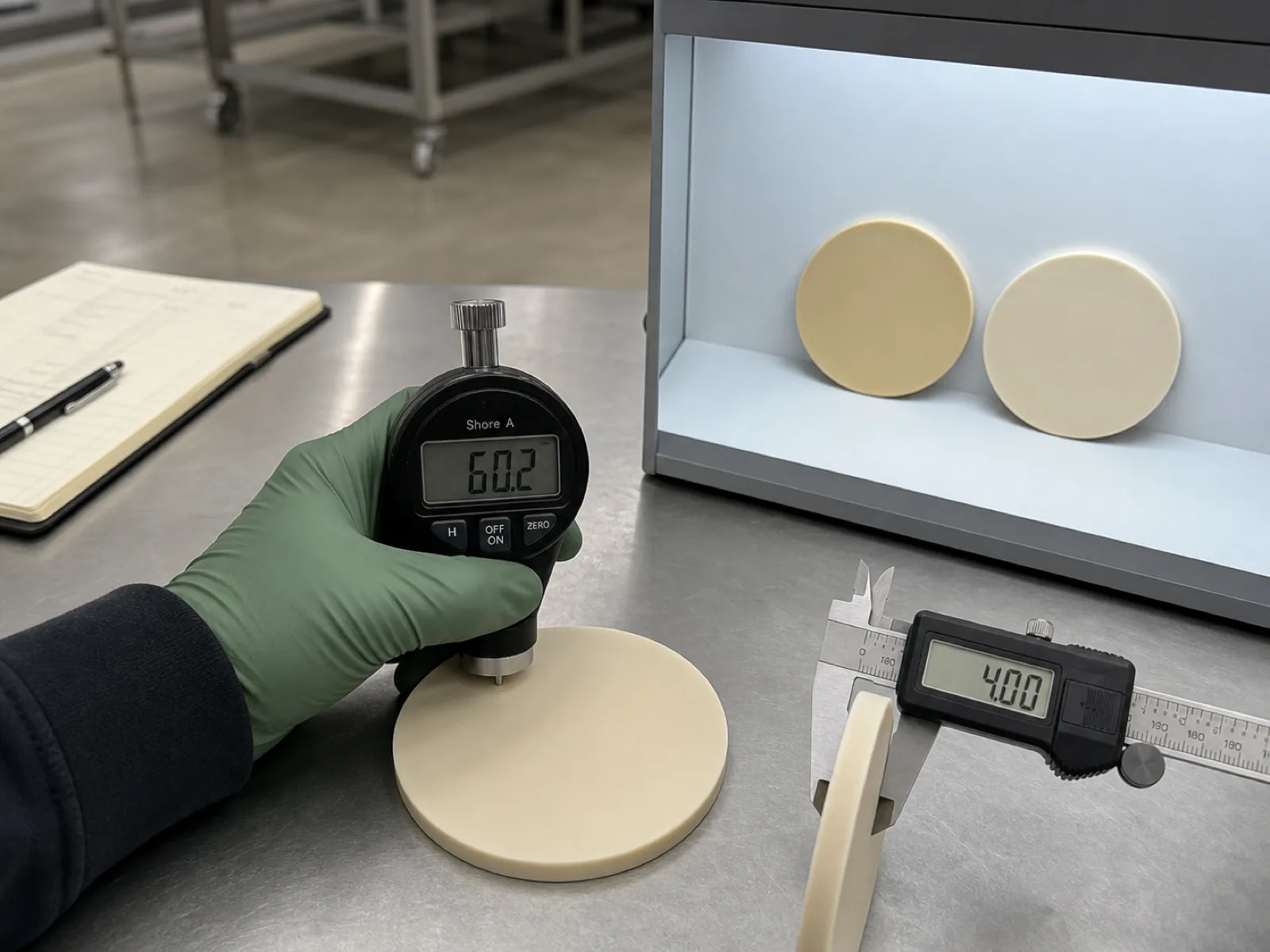
A production-tier silicone coaster manufacturer runs a four-stage QC protocol per batch. Stage one, incoming raw material verification: each master-batch lot of platinum-cure or peroxide-cure silicone compound arrives with a Certificate of Analysis from the compound house (Dow, Wacker, Momentive, Shin-Etsu) and is spot-tested on-site for Shore A hardness, specific gravity, and volatile content before release into production. Stage two, in-process inspection: first-article validation at cycle 1, 10, and 50 of each production run against the approved gold sample — dimensional check with digital calipers (±0.1 mm on flat dimensions, ±0.05 mm on Ø critical features), durometer per ASTM D2240, and visual inspection under D65 light for flash, cavity number legibility, and color-strike consistency. Stage three, post-cure verification: oven log records temperature (180-200°C) and duration (4-6 hours) for every cured batch and ties the log to the master-batch lot number for downstream LFGB/BfR traceability. Stage four, pre-shipment AQL 2.5 per ISO 2859-1 general inspection level II: statistical sample of the finished lot inspected for critical, major, and minor defects with pass/fail thresholds documented on a signed inspection report — third-party inspection (BV, SGS, TÜV) is booked on top of internal QC for programs above 10,000 pcs or first-order relationships with retail buyers.
-
How does a silicone coaster manufacturer handle logo customization — deboss vs pad print vs laser?
A capable silicone coaster manufacturer offers four logo decoration processes with different durability and cost curves. Debossed logo: mold-integrated impression in the coaster body, zero recurring per-piece cost beyond the initial tooling engraving ($150-$400 to add the logo to the cavity), survives dishwasher cycles indefinitely because there is no ink or coating to abrade. Pad print or silk-screen: silicone-compatible ink with corona or plasma pre-treatment of the substrate, $0.04-$0.09 per piece per color, 150-300 dishwasher cycles before edge delamination. Laser-etched: CO2 or fiber laser marking the silicone surface, $0.05-$0.11 per piece, 300-500+ dishwasher cycles with slight edge softening at the 500-cycle mark. Dual-color overmold: soft grip layer of a second color/durometer molded onto the base part in a second shot on LSR tooling, $0.08-$0.18 per piece uplift, permanent bond. The detailed durability data and process selection matrix is in our [customize silicone logo · deboss, print, laser](/guide/customize-silicone-logo-deboss-print-laser/) reference.
-
What is the RFQ-to-first-article lead time when engaging a new silicone coaster manufacturer?
Realistic RFQ-to-first-article lead time engaging a new silicone coaster manufacturer is 21-45 days depending on whether new tooling is required. Day 1-2, engineering review of the 2D drawing and 3D STEP file, tolerance clarification, cure chemistry recommendation (platinum vs peroxide), and formal quote issued. Day 3-7, PO plus 50% tooling deposit received, tool design freeze, and steel or aluminum cut kickoff. Day 8-25 (existing-shape reuse) or Day 8-35 (new geometry), CNC or EDM tool cut, first-shot trial, tool tuning for flash and dimensional accuracy, and first-article samples pulled from cavity 1 and cavity N of a multi-cavity mold. Day 26-30, first-article samples ship air express to the customer's engineering desk for physical inspection, dimensional QC, durometer verification, and gold-sample sign-off. Day 31-45, mass-production release, material procurement for the full PO quantity, and start of the 25-35 day production run for 5,000-20,000 pieces. Suppliers quoting 10-day cold-start-to-first-article are either cutting a soft aluminum sample mold (300-shot life, not production-viable) or reusing a stock generic shape and passing it off as custom-tooled — neither approach delivers a defensible retail program.
-
What packaging and labeling does a silicone coaster manufacturer handle for Amazon retail-ready shipments?
A silicone coaster manufacturer running retail programs typically handles the full Amazon retail-ready packaging stack in-house: individual polybag with suffocation warning per CPSC 16 CFR 1500.121 (bag thickness ≥ 0.038 mm / 1.5 mil, warning text ≥ 3.2 mm / 10 pt), FNSKU or GTIN barcode label placed on the outer polybag with 5 mm margins and print quality Grade C or better per ISO/IEC 15416, retail header card with brand logo and product callouts (single-set, dual-set, or four-set configurations), master carton meeting Amazon FBA labeling requirements including Ship-From, Ship-To, master case quantity, and box weight ≤ 22.7 kg / 50 lb. California Prop 65 warning sticker on the polybag if selling into California retail. UPC or GS1-registered EAN if shipping to European channels. Origin marking "Made in China" per US Customs 19 CFR 134 in a permanent format (either mold-integrated on the coaster underside or printed on the polybag — mold-integrated is preferred because it survives repackaging by third-party sellers). Country-of-origin marking is a common miss on first-time programs that generates customs holds at US ports.
References
Authoritative sources cited in this guide
- US Food and Drug Administration. 21 CFR 177.2600 — Rubber articles intended for repeated use. https://www.ecfr.gov/current/title-21/chapter-I/subchapter-B/part-177/subpart-C/section-177.2600 — The primary US food-contact regulation any silicone coaster manufacturer serving retail channels tests every master-batch lot against.
- German Federal Institute for Risk Assessment. BfR Recommendation XV — Silicones. https://www.bfr.bund.de/en/bfr_recommendations_on_food_contact_materials-7498.html — The technical standard behind LFGB §30 and §31 organic volatile testing — governs the mandatory 4-6 hour post-cure step on every peroxide-cure coaster batch.
- International Organization for Standardization. ISO 9001:2015 — Quality Management Systems — Requirements. https://www.iso.org/standard/62085.html — The certified quality management standard a legitimate silicone coaster manufacturer holds with a scope explicitly naming silicone molding.
- ASTM International. ASTM D2240-15 — Standard Test Method for Rubber Property — Durometer Hardness. https://www.astm.org/d2240-15r21.html — The Shore A durometer test method behind every hardness spec (55-70 for coasters) on a silicone coaster manufacturer's technical data sheet.
- ASTM International. ASTM D1894-14 — Standard Test Method for Static and Kinetic Coefficients of Friction of Plastic Film and Sheeting. https://www.astm.org/d1894-14.html — The friction-coefficient test methodology behind anti-slip performance claims on textured-underside silicone coasters.
- International Organization for Standardization. ISO 2859-1:1999 — Sampling procedures for inspection by attributes. https://www.iso.org/standard/1141.html — The AQL 2.5 sampling standard a silicone coaster manufacturer applies to pre-shipment inspection on every finished lot.
- US Consumer Product Safety Commission. Consumer Product Safety Improvement Act — Section 101 Lead Limits. https://www.ecfr.gov/current/title-16 — The US federal statute governing total lead content ≤ 100 ppm for children's-channel and promotional-tier silicone coaster programs.
- California Office of Environmental Health Hazard Assessment. California Proposition 65 — Chemicals Known to the State. https://oehha.ca.gov/proposition-65 — The California-specific chemical warning list a silicone coaster manufacturer screens against for any coaster program shipping into California retail.
- European Chemicals Agency (ECHA). REACH Regulation — Substances of Very High Concern candidate list. https://eur-lex.europa.eu/legal-content/EN/TXT/?uri=CELEX%3A32006R1907 — The EU substances-of-very-high-concern list a silicone coaster manufacturer screens for any program entering EU retail.
Start a custom program
Send a brief. Get an engineer’s reply in one business day.
Every Wetop program is tooled from a customer’s specification. Send a CAD file (STEP · IGES · DWG) or a written brief and we’ll reply with a mold cost estimate, price brackets at MOQ 500 / 1,000 / 5,000, and any engineering questions.