Buyer Guide · commercial intent
Silicone Earplug OEM Manufacturer — Specs, NRR, MOQ
What changed: First publication under v3 anti-navel-gazing standard — benchmarked against top-ranking supplier pages (SZSunmed, TogoHK, Consumer Silicone Products, Made-in-China listings) and rewritten with FDA 21 CFR 177.2600 / ISO 10993 / ANSI S3.19 / EN 352-2 citations, Shore A comfort math, LSR-vs-HCR cost breakdown, and an RFQ-to-shipment flow those pages do not disclose.
 Buyer Guide
 A silicone earplug manufacturer that can defend a skin-contact reusable program molds liquid silicone rubber (LSR) at Shore A 10-40 in an ISO 14644-1 Class 8 cleanroom, holds ISO 9001 with FDA 21 CFR 177.2600 compound clearance, and can produce ISO 10993-5 cytotoxicity and ISO 10993-10 skin sensitization reports referencing the specific compound lot. Custom LSR earplug MOQ typically starts at 5,000 pairs per SKU with tooling of $3,500-28,000 depending on cavitation and geometry. NRR is measured by an accredited acoustic lab per ANSI S3.19 or SNR per EN 352-2 — not by the factory.
Sourcing a silicone earplug OEM manufacturer is where a lot of consumer, hearing-protection, and medical-adjacent brands quietly lose 20-40% margin — a wrong durometer drives complaint rates, a missing ISO 10993 report kills a Target or Walmart onboarding, and a $2,000 tooling saving on the RFQ turns into $40,000 of flange-fit rework three months later. This guide is written from our engineering desk in Dongguan, benchmarks the top-ranking supplier pages (SZSunmed, TogoHK, Consumer Silicone Products, and a stack of Made-in-China listings), and fills the gaps those pages leave open: the Shore A comfort math, the LSR-vs-HCR economics, the actual acoustic standards the factory cannot self-certify, and the RFQ-to-shipment flow.
What is a silicone earplug OEM manufacturer?
A silicone earplug OEM manufacturer designs and molds custom silicone earplugs to a brand's specification — geometry, durometer, color, logo, packaging — under an ISO 9001 (and often ISO 13485) quality system, then delivers finished pairs with a per-lot Certificate of Conformance and biocompatibility test packet. The compound is almost always platinum-cured LSR molded in a Class 8 cleanroom at Shore A 10-40.
The OEM scope is broader than “we cut the mold and press the plug.” A defensible partner owns four things: (1) the compound decision — LSR vs HCR, platinum vs peroxide cure, master-batch color and pigment food-grade compliance; (2) the tooling — single-cavity for prototype, 4-8 cavity production molds with the collapsible-core or multi-slide action needed for tri-flange geometry; (3) the environment — Class 8 cleanroom, gowning, particle-count logs, and lot-traceable material records; and (4) the paperwork — FDA 21 CFR 177.2600[^fda-177-2600] compound clearance from the raw-silicone supplier, ISO 10993-5[^iso-10993-5] cytotoxicity, ISO 10993-10[^iso-10993-10] skin sensitization / irritation, and (for regulated hearing protection) an accredited acoustic lab report per ANSI S3.19[^ansi-s3-19] or EN 352-2[^en-352-2].
An OEM that only owns (1) and (2) is a moldshop, not a program partner. Ask about (3) and (4) on the first call.
LSR injection molding vs HCR compression molding — which one for earplugs?
For any reusable, comfort-driven, precision-flange earplug program the defensible answer is liquid silicone rubber (LSR) injection molding. LSR holds ±0.05 mm on the flange OD that drives seal and NRR, cycles in 30-90 seconds per shot, and clears USP Class VI on standard formulations. HCR compression molding is only cost-defensible for very high-volume commodity plugs where flange precision is not the value.
The two processes shape the entire program economics. LSR uses a two-part platinum-cured silicone metered by a servo-driven injection unit into a heated mold; the mold typically runs at 170-200°C with cycle times of 30-90 seconds and cavitation of 4-16 for production. Tooling is more expensive per cavity ($3,500-8,500 for a single-cavity prototype, $12,000-28,000 for a 4-8 cavity production mold) but the per-part cost drops fast at volume and the process is fully automated — zero peroxide by-products, tighter geometry, cleaner surface finish.
HCR (high-consistency rubber, sometimes called HTV — high-temperature vulcanizing) is compression- or transfer-molded from a putty-like uncured silicone. Cycle times are 2-5 minutes, tolerance is ±0.10-0.20 mm, and if the compound is peroxide-cured it needs an 8-hour post-cure at 200°C to drive off residual peroxide by-products. HCR tooling can be 30-50% cheaper on a single-cavity basis but the labor and cycle-time premium usually erase the savings above 20,000 pairs. For deeper coverage of the cure-chemistry decision see the platinum-cured vs peroxide-cured silicone guide.
| Process | LSR injection | HCR compression |
|---|---|---|
| Tolerance | ±0.05 mm on flange OD | ±0.10-0.20 mm |
| Cycle time | 30-90 sec | 2-5 min |
| Cavitation (production) | 4-16 | 1-4 |
| Peroxide by-products | None | Requires 8 h post-cure |
| Prototype tooling | $3,500-8,500 | $2,500-6,000 |
| Production tooling (4-cav) | $12,000-18,000 | $6,000-10,000 |
| Cost-defensible above | 5,000 pairs | 100,000+ commodity pairs |
| Skin-contact reusable | Yes (default) | Only with full post-cure + ISO 10993 clearance |
The one nuance: some very-low-durometer sleep-plug formulations run better in HCR because the LSR injection unit has trouble metering compounds below Shore A 15. Confirm the durometer target before the mold decision.
Shore A hardness — the comfort-and-seal tradeoff
Shore A 10-25 is the comfort-and-seal sweet spot for sleep and travel earplugs — the flange deforms into the canal geometry under low insertion pressure and stops feeling like a foreign body inside 90 seconds. Shore A 30-40 is the range for musician and shooter plugs that carry an acoustic-filter insert. Specify durometer per ASTM D2240 with a ±5 Shore A tolerance.

The physics is simple: an earplug seals when the flange deforms enough to bridge the elliptical, off-axis, individually-variable ear-canal cross-section. Under Shore A 10 the flanges collapse under insertion pressure and lose contact with the meatus; above Shore A 45 the flange transmits pressure to the canal wall, which the wearer feels as a foreign body and reports as pain within 20-40 minutes. The measurement standard is ASTM D2240[^astm-d2240] with a 15-second read; the practical tolerance is ±5 Shore A points and should be written into the RFQ that way.
Musician and shooter plugs sit higher (Shore A 30-40) because they carry a Mylar-diaphragm or acoustic-filter insert that needs a stable seat — a Shore A 15 flange around a rigid filter port fails at the interface. See the Shore A hardness silicone chart for the full durometer map across silicone application classes.
NRR, SNR, and the acoustic test the factory cannot certify
Noise Reduction Rating (NRR) is measured per ANSI S3.19-1974 by an accredited acoustic lab on 10+ subjects using the real-ear attenuation at threshold (REAT) method — not by the factory. SNR uses EN ISO 4869-1/-2 for EU CE-marked plugs under EN 352-2. Consumer sleep plugs typically deliver NRR 22-28 dB; industrial and shooter plugs NRR 28-33 dB.
This is where earplug supplier due diligence falls apart most often. NRR and SNR are not molding parameters — they are the output of a psychoacoustic test run on human subjects in an accredited lab. The US regulation is 40 CFR Part 211 Subpart B[^epa-40-cfr-211], which requires an NRR label on any hearing-protection earplug sold in the US and grounds the test method in ANSI S3.19-1974[^ansi-s3-19] (increasingly supplemented by the subject-fit method ANSI S12.6-2016). The EU regulation is PPE Regulation 2016/425 with harmonized standard EN 352-2:2020[^en-352-2] governing SNR and the H/M/L high/medium/low-frequency attenuation triplet.
A defensible acoustic test report has: (1) the accredited lab’s name and accreditation reference (NIOSH-recognized US labs; notified body number for EU); (2) the specific mold ID and compound lot the samples came from; (3) the octave-band attenuation curve from 125 Hz to 8 kHz with mean and standard deviation across subjects; (4) the calculated NRR or SNR headline number; (5) test date — report older than 5 years should be re-tested when the mold or compound has changed. Cross-check the headline number against the NIOSH HPD Compendium[^niosh-hpd] to see whether the format and geometry are consistent with the claimed attenuation.
The factory does not run this test. Any supplier that hands you an “in-house NRR test” is not qualified for a regulated hearing-protection program.
The compliance stack for skin-contact reusable earplugs
The baseline compliance stack for a skin-contact reusable silicone earplug program is FDA 21 CFR 177.2600 compound clearance, ISO 10993-5 cytotoxicity, and ISO 10993-10 skin sensitization/irritation testing on the specific compound lot. Medical-adjacent programs add ISO 13485:2016 with a certificate scope naming silicone molding, and regulated hearing protection adds ANSI S3.19 or EN 352-2 acoustic test reports.
FDA 21 CFR 177.2600[^fda-177-2600] is written as a food-contact regulation, but it is the practical baseline for skin-contact silicone compound qualification — it defines the allowed monomer residuals, extractable limits, and polymerization aids that a compliant compound must meet. Every serious raw-silicone supplier (Wacker, Momentive, Dow Silicones, Shin-Etsu, KCC) issues a per-compound 177.2600 clearance letter; ask the OEM to hand it over on the compound they will actually run.
ISO 10993-5[^iso-10993-5] is the first-tier biocompatibility screen — cytotoxicity on cultured mammalian cells — and is required on any skin-contact silicone compound lot. ISO 10993-10[^iso-10993-10] adds skin sensitization and irritation testing and is the practical requirement for sustained ear-canal contact. Both reports must reference the specific compound lot number, not the compound family. Report age older than 3 years should be re-qualified.
For medical-adjacent programs — custom-molded audiologist earplugs, in-ear medical-device housings, hearing-aid dome tips — add ISO 13485:2016[^iso-13485] with the certificate scope explicitly naming silicone molding (not only assembly or packaging). The certifying body matters: BSI, TÜV SÜD, DNV, and DEKRA are defensible; certificates from unnamed local Chinese bodies without IAF MLA membership are not. For a plain-English walk-through of the food-contact vs skin-contact vs medical-grade distinction see the FDA vs LFGB silicone guide.
Custom geometry — flanged, mushroom, tri-flange, and moldable putty
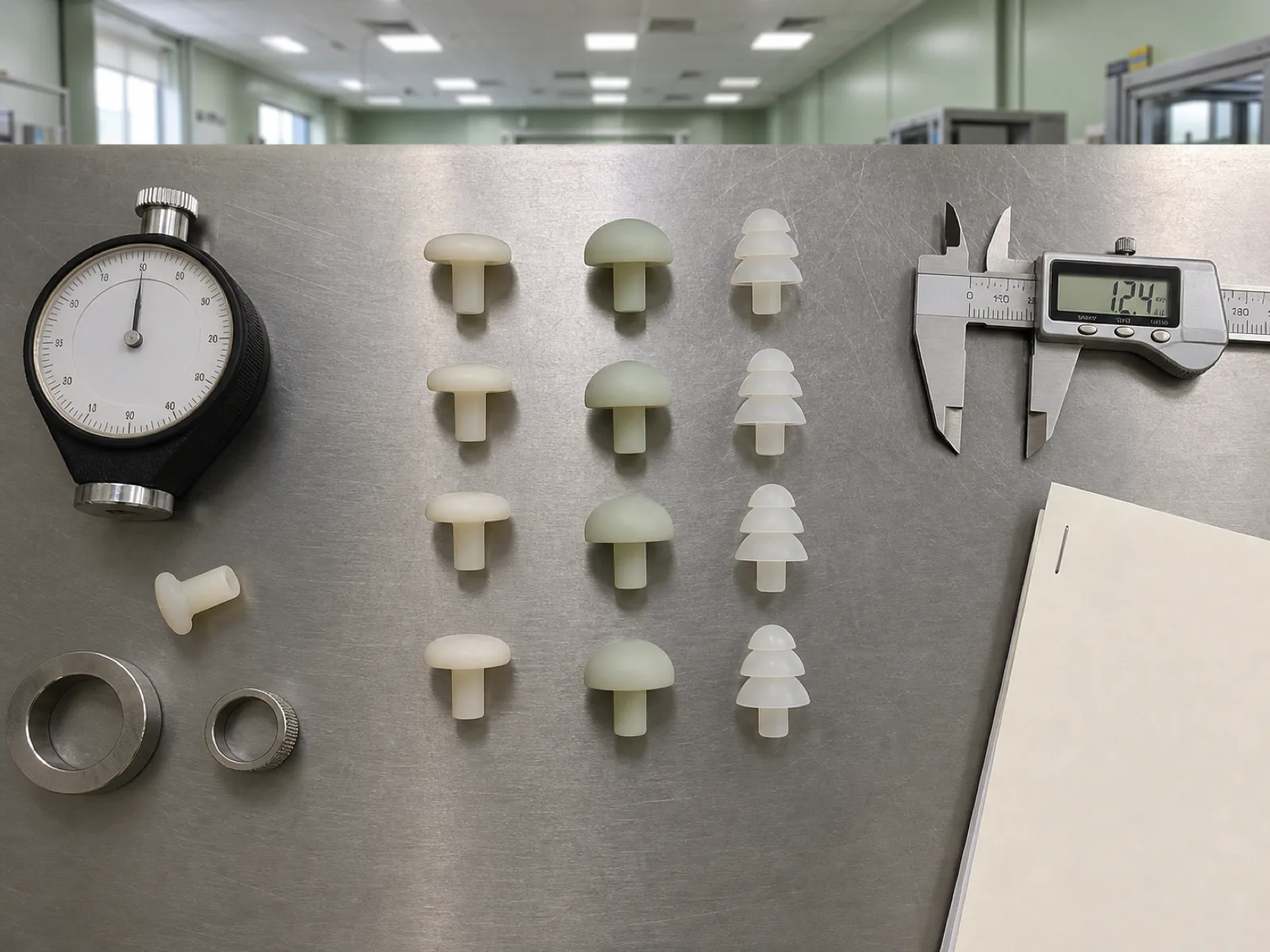
The four dominant reusable silicone earplug geometries are single-flange (12-14 mm OD, low-attenuation and daily-carry), mushroom (single-body cap on a stem, sleep and travel), tri-flange (three stacked flanges, industrial NRR 28-33 dB) and quad-flange (specialty aviation and shooter). Moldable silicone-putty is a separate category — extruded from a low-durometer silicone-and-wax compound, hand-rolled and single-use.
Flanged and mushroom geometries mold on straight-pull tooling — a two-plate mold with vertical parting line and a straightforward ejection stroke. Tri-flange and quad-flange geometries need collapsible-core or multi-slide action to release the flange stack without tearing, which adds $4,000-8,000 to the mold cost and 5-10 days to the tooling cut. Confirm the mold builder has run the geometry before — a mold shop that has only cut two-plate straight-pull tooling will underprice a collapsible-core job and deliver a plug that tears at demold.
Moldable silicone-putty earplugs (the swimming and shooting-range format) are a different animal — they are extruded from a very-low-durometer silicone-and-microcrystalline-wax compound, packaged in individual foil, and hand-rolled by the wearer to fit. The “silicone content” varies from 15% to 40% depending on the formulation, and the format is regulated as a single-use consumer product. Do not conflate the RFQ line items: reusable specifies durometer and mold, moldable specifies a Shore 000-scale softness and a compound formula.
MOQ, tooling amortization, and lead-time economics
Custom LSR earplug MOQ at Wetop starts at 5,000 pairs per SKU. Prototype tooling runs $3,500-8,500 (7-15 day cut); 4-cavity production tooling $12,000-18,000 (20-30 day cut); 8-cavity $18,000-28,000. Sample lead 15-25 days including a USP Class VI and ISO 10993-5 test packet against the master-batch lot. Production lead 25-35 days for 5,000-30,000 pairs.
| Program stage | Timeline | Cost driver |
|---|---|---|
| RFQ + spec lock | 3-5 days | Drawing, durometer, color, packaging spec |
| Prototype mold cut | 7-15 days | Single-cavity tooling $3,500-8,500 |
| First-article sample + biocomp packet | 15-25 days total | USP Class VI + ISO 10993-5 report |
| Design iteration (typical 1-2 rounds) | 5-10 days each | Flange-fit adjustment, durometer tune |
| Production mold cut (4-8 cavity) | 20-30 days | Tooling $12,000-28,000 depending on cavitation |
| Acoustic test (if regulated) | 15-30 days | Accredited lab, 10+ subjects, $8,000-18,000 |
| First production run 5,000-30,000 pairs | 25-35 days | Amortize tooling over first PO or split 50/50 |
| Subsequent runs | 25-30 days | Steady-state manufacturing |
The tooling amortization decision matters. On a 5,000-pair first PO the tooling absorbs $2.40-5.60 per pair on a $12,000-28,000 mold — the RFQ should show unit price with and without tooling amortization so the brand can decide whether to prepay tooling and take a lower unit or roll tooling into unit and preserve cash. For the general shape of MOQ, tooling, and lead-time economics across silicone OEM programs see the MOQ and lead time for silicone OEM guide.
Cleanroom environment and manufacturing controls
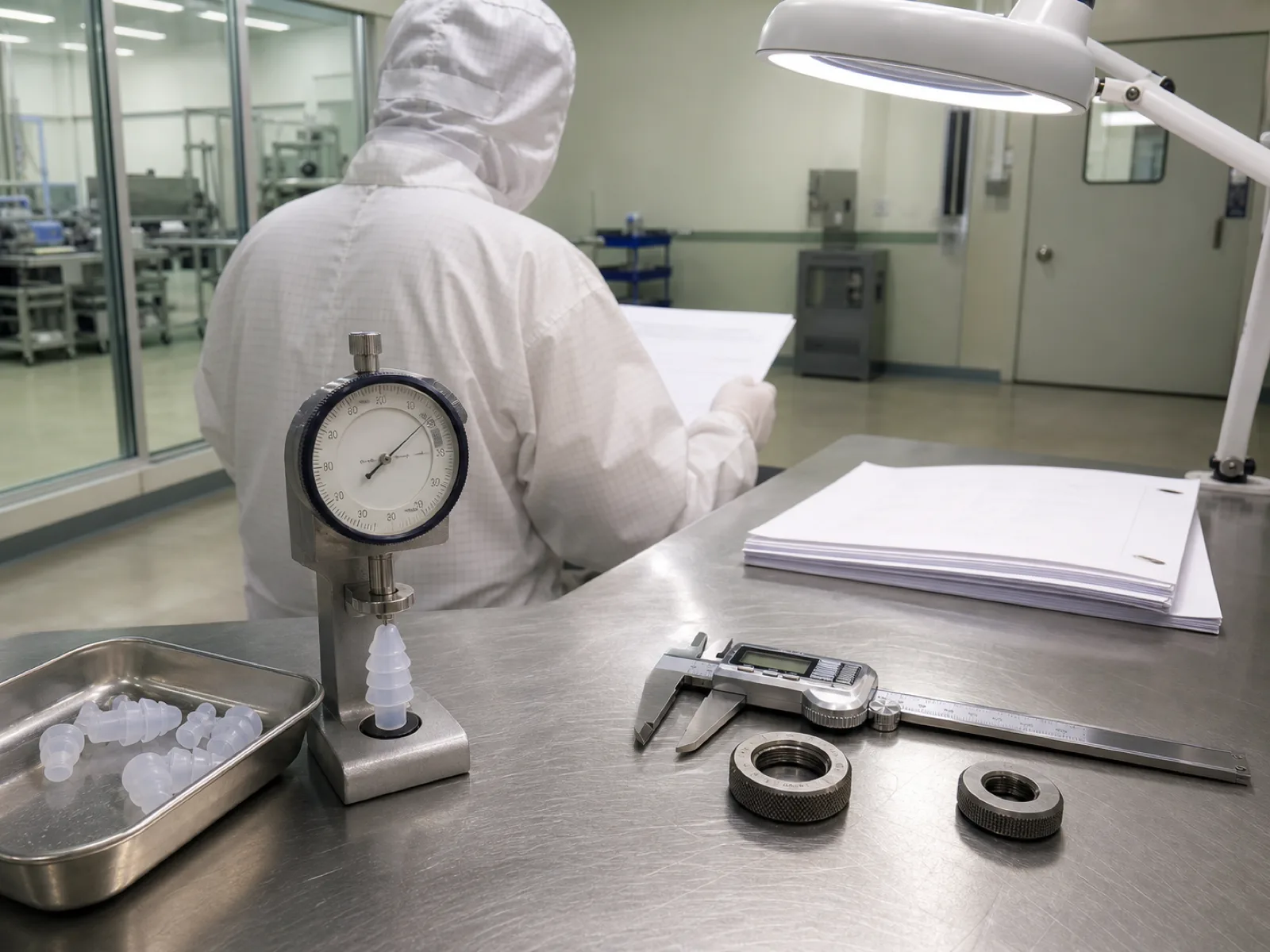
ISO 14644-1 Class 8 (≤ 3,520,000 particles ≥ 0.5 μm per m³) is the standard cleanroom class for skin-contact silicone earplug molding. Class 7 is defensible for medical-adjacent programs. On audit, verify per-shift particle-count logs, gowning protocol, HVAC HEPA replacement records, and the ISO 13485 certificate scope explicitly covers molding — not only assembly or packaging.
The cleanroom is not decorative. A silicone earplug is a skin-contact reusable product with an ear-canal contact area of roughly 1.5-3 cm² and a wear duration of hours per day; airborne particulate embedded in the surface during demold becomes a foreign-body irritant the wearer feels within a wear cycle. ISO 14644-1[^iso-14644-1] Class 8 sets the airborne particle-count limit that mold and demold operations must run under; Class 7 is the tighter tier required for any program that markets as “medical grade” or ships under an ISO 13485 scope.
On audit, do not accept a photograph of a cleanroom. Ask for: current per-shift particle-count logs; the gowning protocol document and the actual airlock discipline (do operators re-gown after a break?); the HVAC HEPA filter replacement log with dates; the ISO 13485 certificate PDF with the scope wording legible and matched against the process step (molding, not “assembly”); and a sample Device Master Record (DMR) handover from a prior PO. A supplier that cannot produce three of those five items within a working day is running an aspirational cleanroom, not a certified one.
Custom branding — logo, color, packaging
Color: any Pantone match via master-batch pigment, ΔE ≤ 2 on cured silicone, 3-7 days added to sample lead for a first-time color. Logo: pad print (1-4 spot colors on the storage case or stem, 20,000+ cycle abrasion life), laser marking (case only — silicone laser marks are unreliable), or in-mold pigmented text on the flange stem. Packaging: paper-card blister, clamshell, aluminum pill case, or fabric pouch.
Color is a master-batch pigment decision, not a post-mold surface treatment. A first-time Pantone match runs 3-7 days of sample lead ahead of the mold trial; the color tolerance on cured silicone is typically ΔE ≤ 2 against the PMS coated reference. Note that silicone is inherently translucent — deep saturated colors need higher pigment loading (3-6% by weight) and can shift durometer by 1-3 Shore A points, which the RFQ should acknowledge.
Logo methods differ by surface: pad print with food-grade ink cured at 150°C is the workhorse for stems and storage cases (1-4 spot colors, tight registration, 20,000+ cycle abrasion life against a rubbing test); laser marking is limited to the storage case (aluminum or PP) because monochrome laser on silicone is unreliable; in-mold pigmented text on the flange stem needs a mold-side engraving of the logo negative and typically bumps the mold cost by $800-2,500. Packaging follows a similar spectrum from paper-card blister (lowest cost, 3-5 day blister tool) through clamshell (5-10 day) to custom aluminum pill case (7-15 day custom print on stock components) and fabric pouch (7-15 day sourcing). See the customize silicone logo — deboss, print, laser guide for the process-selection matrix.
The Alibaba trap — how to audit a silicone earplug supplier
Many earplug listings claim "medical grade hypoallergenic" with zero ISO 10993 test report on file. Demand ISO 10993-5 cytotoxicity and ISO 10993-10 skin sensitization reports referencing the specific compound lot from the last 3 years, plus the accredited-lab acoustic test report, plus the ISO 13485 certificate scope explicitly naming silicone molding — before wire-transferring a deposit.
The failure pattern is consistent. A listing shows a photo of a cleanroom, a Shore A number, and a claimed NRR. Ask for the ISO 10993-5 report on the specific compound lot and the response is a compound family datasheet from Dow or Wacker (the raw-material supplier’s marketing sheet is not a compound test report). Ask for the acoustic test report and the response is an “internal NRR measurement” (the factory does not have a NIOSH-recognized acoustic chamber). Ask for the ISO 13485 certificate PDF and the scope wording is “manufacture of silicone products” without naming molding — the certificate covers a downstream assembly line the supplier does not own.
The Alibaba trap is not that the platform is fraudulent — it is that the platform makes it very cheap to publish a listing that looks credentialed without actually holding any of the paperwork. A defensible earplug supplier can produce, within 48 hours of a serious RFQ: (1) the FDA 21 CFR 177.2600 compound-clearance letter from the raw-silicone supplier; (2) ISO 10993-5 and ISO 10993-10 reports on the specific compound lot from the last 3 years; (3) the ISO 9001 (and if applicable ISO 13485) certificate PDF with legible scope; (4) an accredited-lab NRR or SNR acoustic test report if the plug is marketed as hearing protection; (5) a prior-PO Certificate of Conformance example. A supplier that cannot produce items 1-3 in that window is an unqualified vendor for a skin-contact reusable program.
Closing — what a first RFQ conversation looks like
A serious first RFQ specifies eight things: (1) geometry (single-flange, mushroom, tri-flange, quad-flange, or custom); (2) target durometer (Shore A 10-40 with ±5 tolerance per ASTM D2240); (3) target NRR / SNR range and the regulatory market (US NIOSH / EPA labeling, EU CE under EN 352-2, or unregulated consumer); (4) cure system (platinum-cured LSR is the default for skin-contact reusable); (5) color and logo method; (6) packaging format; (7) annual volume estimate for MOQ-tier pricing; (8) required documentation packet (CoA, CoC, ISO 10993-5/-10 reports, acoustic test report, ISO 13485 scope if medical-adjacent). Wetop turns a complete RFQ into a specced quote in 3-5 working days and a first-article sample in 15-25 days on new tooling.
Start the conversation on the contact page — attach a drawing or a reference plug, note the regulatory market and annual volume, and we will come back with tooling, unit price at three volume tiers, and the biocompatibility test packet list against the specific compound we would run.
FAQ
-
What is the best silicone for a reusable earplug — LSR, HCR, or HTV?
For any reusable, skin-contact, comfort-driven earplug program the defensible answer is platinum-cured liquid silicone rubber (LSR). LSR is a two-part addition-cure silicone that injects into a heated mold and cures in 30-90 seconds per cycle, holding ±0.05 mm on the critical flange geometry that drives seal and acoustic attenuation. LSR is odor-free, leaves no peroxide by-products, and clears USP Class VI and ISO 10993-5 cytotoxicity on standard formulations. HCR (high-consistency rubber, also called HTV — high-temperature vulcanizing) is compression- or transfer-molded, has higher cycle time (2-5 min), looser tolerances (±0.1-0.2 mm), and is only cost-defensible for very high-volume commodity plugs where flange precision is not the value. Peroxide-cured HCR is disqualified for skin-contact reusable use without an 8-hour post-cure and is generally rejected in medical-adjacent programs.
-
What Shore A hardness should I specify for a comfortable but effective earplug?
Shore A 10-25 is the sweet spot for sleep, travel, and general hearing-protection plugs — the material deforms into the ear canal geometry under low insertion pressure, seals the flanges against the meatus, and stops feeling like a foreign body after 60-90 seconds. Shore A 30-40 is used for musician and shooter earplugs that carry a Mylar or acoustic-filter insert and need dimensional stability around the filter port. Below Shore A 10 (very soft gel-like formulations) the flanges collapse and lose attenuation; above Shore A 45 the plug transmits pressure to the canal wall and drives complaint rates. Publish the durometer in your RFQ with a tolerance (typical ±5 Shore A points per ASTM D2240 with a 15-second read).
-
What NRR or SNR should I target, and how is it actually tested?
Consumer sleep and travel plugs: NRR 22-28 dB (ANSI S3.19-1974) or SNR 21-27 dB (EN 352-2). Industrial hearing-protection and shooter plugs: NRR 28-33 dB / SNR 27-32 dB. Musician plugs with filters: NRR 12-20 dB with a flat frequency response. NRR is calculated from real-ear attenuation at threshold (REAT) measured on 10+ subjects in an accredited acoustic lab per ANSI S3.19-1974 (or the newer subject-fit method S12.6-2016 — increasingly required by US procurement). SNR uses EN ISO 4869-1/-2 with H/M/L high/medium/low-frequency attenuation values. The factory does not do this test — insist on the accredited lab's report (NIOSH-recognized US labs, or notified bodies in the EU) and check the report date; older than 5 years should be re-tested when the mold or compound changes.
-
What certifications should a silicone earplug OEM manufacturer hold?
Baseline: ISO 9001:2015 quality management. Skin-contact-defensible: FDA 21 CFR 177.2600 rubber compound clearance (used as the food-contact analog for skin-contact silicone), ISO 10993-5 (cytotoxicity) and ISO 10993-10 (skin sensitization / irritation) test reports on the specific compound lot. Medical-adjacent programs (custom-molded audiologist earplugs, in-ear medical devices): ISO 13485:2016 with the certificate scope explicitly naming silicone molding. Regulatory hearing protection: EU CE marking under PPE Regulation 2016/425 with EN 352-2 type approval; US NIOSH labeling per 42 CFR Part 84 for occupational plugs. A supplier that offers only a self-issued "SGS test" without ISO 10993 reports on the specific compound is not qualified for skin-contact reusable use.
-
What is the MOQ, tooling cost, and lead time for custom silicone earplug OEM?
Wetop MOQ for custom LSR earplug programs starts at 5,000 pairs per SKU. Tooling: single-cavity prototype mold $3,500-8,500 (7-15 day cut), 4-cavity production mold $12,000-18,000 (20-30 day cut), 8-cavity mold $18,000-28,000. Sample lead: 15-25 days on new tooling including a USP Class VI + ISO 10993-5 test packet against a defined master-batch lot. Production lead: 25-35 days for 5,000-30,000 pair programs, 35-45 days for 50,000+. Tri-flange geometry needs multi-slide or collapsible-core tooling that adds $4,000-8,000 to the mold cost and 5-10 days to the cut. Amortize tooling over the first PO or split 50/50 depending on program economics.
-
What custom-branding options exist — logo, color, packaging?
Color: any Pantone match via master-batch pigment (add 3-7 days to sample lead for a first-time color; PMS coated tolerance is typically ΔE ≤ 2 on cured silicone). Logo: pad print (1-4 spot colors, food-grade ink cured at 150°C, 20,000+ cycle abrasion life on a stem or storage case), laser marking (grayscale monochrome on the storage case, zero on the plug itself — silicone laser marks are unreliable), or in-mold pigmented text on the flange stem. Packaging: paper card + blister (lowest cost, 3-5 day tooling for the blister), clamshell (5-10 day tool), aluminum pill case (stock components, 7-15 day custom printing), or fabric pouch (7-15 day sourcing). Bundle with a corded lanyard, filter insert, or NRR label per your regulatory market.
-
How do reusable and disposable silicone earplugs differ in material and manufacturing?
Reusable silicone earplugs are injection- or compression-molded from platinum-cured LSR or HCR at Shore A 10-40, are washable, and are rated for 30-100 wear cycles depending on care and geometry. Disposable "moldable" silicone-putty earplugs (the classic swimming plug format) are extruded or hand-rolled from a very-low-durometer mixed silicone-and-microcrystalline-wax compound; the "silicone" content is often 15-40% and the format is regulated as a single-use consumer product. The two are not interchangeable in an RFQ — reusable specifies a durometer and a mold, moldable specifies a Shore 000-scale softness and a compound formula. For occupational hearing protection reusable is the defensible spec; disposable foam earplugs (PU foam, not silicone) still dominate industrial single-use.
-
What cleanroom class is needed to manufacture skin-contact silicone earplugs?
ISO 14644-1 Class 8 (≤ 3,520,000 particles ≥ 0.5 μm per m³) is the standard for skin-contact silicone earplug molding; Class 7 is defensible for medical-adjacent programs (custom-molded audiologist plugs, in-ear device housings) and is required if the certificate scope claims medical device molding. Verify on the audit: (1) current particle-count logs per shift; (2) gowning protocol and airlock discipline; (3) HVAC HEPA replacement records; (4) the ISO 13485 certificate scope explicitly covers molding, not only assembly; (5) DMR handover process — the supplier hands over lot-traceable material certs, molding parameter logs, and QC records tied to a specific PO. A supplier that shows a cleanroom photo but has no logs is not running one.
-
How do I audit a silicone earplug supplier before placing an order — the Alibaba trap?
Eight documents cover the risk: (1) ISO 9001:2015 certificate; (2) ISO 13485:2016 if medical-adjacent (check the certificate body — BSI, TÜV, DNV, DEKRA are defensible — and confirm the scope names silicone molding); (3) FDA 21 CFR 177.2600 compound clearance letter from the raw-material supplier (Wacker, Momentive, Dow, Shin-Etsu, KCC); (4) ISO 10993-5 cytotoxicity report on the specific compound lot from the last 3 years; (5) ISO 10993-10 skin sensitization / irritation report on the same lot; (6) accredited-lab NRR (ANSI S3.19) or SNR (EN 352-2) acoustic test report referencing the specific mold and compound; (7) cleanroom class certification with recent particle logs; (8) a specific PO example showing the CoC / CoA delivered with a prior shipment. If a listing claims "medical grade hypoallergenic" and cannot produce items 4 and 5 within 48 hours, treat it as an unqualified vendor.
References
Authoritative sources cited in this guide
- US Food and Drug Administration. 21 CFR 177.2600 — Rubber articles intended for repeated use. https://www.ecfr.gov/current/title-21/chapter-I/subchapter-B/part-177/subpart-C/section-177.2600 — Baseline compound-clearance regulation used as the skin-contact analog for reusable silicone earplug material qualification.
- International Organization for Standardization. ISO 10993-5:2009 — Biological evaluation of medical devices — Part 5: Tests for in vitro cytotoxicity. https://www.iso.org/standard/36406.html — First-tier biocompatibility screen required on any skin-contact silicone earplug compound lot.
- International Organization for Standardization. ISO 10993-10:2010 — Biological evaluation of medical devices — Part 10: Tests for irritation and skin sensitization. https://www.iso.org/standard/40884.html — Skin sensitization / irritation test tier required for any earplug with sustained ear-canal contact.
- International Organization for Standardization. ISO 13485:2016 — Medical devices — Quality management systems. https://www.iso.org/standard/59752.html — QMS scope required for medical-adjacent earplug OEM (custom-molded audiologist plugs, in-ear device housings). Certificate scope must name silicone molding, not only assembly.
- American National Standards Institute / Acoustical Society of America. ANSI S3.19-1974 — Method for the Measurement of Real-Ear Protection of Hearing Protectors. https://webstore.ansi.org/standards/asa/ansis3191974 — The REAT method underlying the NRR labeling required on US hearing protectors per 40 CFR 211 Subpart B.
- US Environmental Protection Agency. 40 CFR Part 211 Subpart B — Hearing Protective Devices. https://www.ecfr.gov/current/title-40/chapter-I/subchapter-G/part-211/subpart-B — Federal regulation requiring the NRR label on hearing-protection earplugs sold in the US.
- European Committee for Standardization (CEN). EN 352-2:2020 — Hearing protectors — General requirements — Part 2: Earplugs. https://www.cencenelec.eu/ — EU harmonized standard for CE-marked earplugs under PPE Regulation 2016/425. Defines SNR and H/M/L attenuation values.
- International Organization for Standardization. ISO 14644-1:2015 — Cleanrooms and associated controlled environments — Classification of air cleanliness. https://www.iso.org/standard/53394.html — Defines Class 7 / Class 8 particle-count limits referenced for skin-contact and medical silicone molding.
- ASTM International. ASTM D2240 — Standard Test Method for Rubber Property — Durometer Hardness. https://www.astm.org/d2240-15r21.html — The Shore A / Shore 00 durometer method that governs any earplug hardness spec.
- US National Institute for Occupational Safety and Health. NIOSH Hearing Protector Device (HPD) Compendium. https://www.ecfr.gov/current/title-29 — Public database of NRR-tested hearing protectors — the reference point buyers use to sanity-check supplier acoustic claims.
Start a custom program
Send a brief. Get an engineer’s reply in one business day.
Every Wetop program is tooled from a customer’s specification. Send a CAD file (STEP · IGES · DWG) or a written brief and we’ll reply with a mold cost estimate, price brackets at MOQ 500 / 1,000 / 5,000, and any engineering questions.