Buyer Guide · commercial intent
Silicone Laundry Ball Wholesale Sourcing Guide
 Buyer Guide
 A silicone laundry ball is a reusable, food-grade silicone ball used in a washer or dryer — a spiky anti-tangle ball that grips lint and pet hair in the wash, or a firmer sphere that tumbles between garments in the dryer to cut drying time and static as a reusable alternative to single-use sheets. The first decision in wholesale sourcing is the route: buy marketplace stock at 100–500 pieces with no branding, or run a custom OEM/ODM program at 500–3,000 pieces that buys your own geometry, Pantone color, and debossed logo. The specification choices that separate a laundry ball buyers reorder — from a returns problem — are the cure system, the Shore A hardness matched to washer versus dryer, the size and temperature envelope, and the finished-good compliance packet, and every one is locked before the first sample is cut.
To a housewares buyer, a silicone laundry ball looks like a commodity — a soft rubber ball, a dollar landed, five on the shelf. Then the first container arrives with a wash ball too stiff to grip lint, a dryer ball that smells of rubber when the load comes out warm, and a color that drifts two shades from the master sample. None of that is bad luck. Each maps to a decision the factory made — or skipped — during cure-system selection, durometer targeting, and color-desk discipline. This guide is written from the engineering desk at Wetop’s Dongguan floor for brand owners and private-label buyers who need the sourcing and manufacturing math behind a silicone laundry ball wholesale program, from terminology through certification.
What is a silicone laundry ball, and how does it differ from a dryer ball and a washing ball?
Buyers use three names for one shelf category. A silicone washing ball runs in the washer and is a soft, spiky anti-tangle finger cluster that grips loose fibers, lint, and pet hair so they do not knot around clothes. A silicone dryer ball runs in the dryer and is a firmer, heat-stable sphere that tumbles between garments to separate the load, cut drying time, and reduce static. "Laundry ball" is the umbrella term shoppers type for either, and the two are not interchangeable in hardness or geometry.
The category is one manufacturing logic wearing two very different bodies, and knowing which one you are quoting is the first fork in the RFQ. The washer anti-tangle ball is built around a cluster of soft, flexible silicone fingers or nubs. As the drum turns, the fingers flex and catch loose threads, human and pet hair, and lint that would otherwise knot around sleeves and drawstrings. The load-bearing engineering is a soft Shore A so the fingers grab without abrading fabric, plus a geometry that sheds the collected fiber when you peel it off by hand.
The dryer ball solves a different problem. It is a firmer sphere — often lightly spiked — that bounces between wet garments in a hot drum, breaking up the clumped load so hot air circulates, which shortens drying time and physically reduces the static cling that a dryer sheet chemically suppresses. Its engineering problem is heat stability and mass: it must hold a stable, firm shape at dryer temperature across thousands of cycles. Because these two products share a search term but not a spec, the single most useful line in an RFQ is naming the drum (washer or dryer) and the job (anti-tangle versus load-separating). The cure system and certification path are shared; the Shore A and shape are not.
| Product | Drum | Primary job | Shape | Load-bearing spec |
|---|---|---|---|---|
| Silicone washing ball | Washer | Anti-tangle, grip lint and pet hair | Soft finger / nub cluster | Soft Shore A, fiber shed |
| Silicone dryer ball | Dryer | Separate load, cut drying time, reduce static | Firm sphere, light spikes | Firm Shore A, heat stability |
| Hybrid spiky ball | Both | General agitation + anti-tangle | Medium spiky sphere | Mid Shore A compromise |
Should you source silicone laundry balls as wholesale stock or custom OEM/ODM?
Match the route to your volume, margin, and branding need. Buy wholesale stock when you need small quantities fast, are testing a listing, and accept the seller's shape, color, and no logo — typically 100–500 pieces off existing inventory. Move to custom OEM/ODM when you want your own geometry, a Pantone-matched color, a debossed brand mark, and a compliance packet in your name, which starts to pay off at 500 pieces on existing tooling or 3,000 pieces on a new mold.
This is the decision that determines everything downstream — price, lead time, and how defensible your listing is — so make it deliberately rather than by default. Wholesale stock means buying a seller’s finished, already-molded ball out of inventory. You get speed and a low entry quantity, and you pay for it in sameness: the shape, the color, and often the exact ball are shared with every other buyer pulling from the same shelf, so you compete only on price and photography. It is the right move to validate demand before you commit tooling money, and the wrong move to build a brand on, because a competitor can source the identical ball tomorrow.
Custom OEM/ODM inverts that trade. ODM means you customize the factory’s existing laundry-ball platform — its proven shape — with your color, logo, and packaging, skipping new-mold cost and lead time. OEM means the factory molds to your own finished design and dedicated tooling, so the geometry is yours outright. Both put a compliance packet in your name and let you defend a higher retail price with a differentiated product. Most first-time buyers should start ODM to reach market fast, then graduate to an OEM mold once annual volume justifies owning the shape. The economics of that graduation — how tooling amortizes and where the break-even sits — are laid out in the MOQ and lead time silicone OEM guide.
| Sourcing route | Entry quantity | Branding | Lead time | Best for |
|---|---|---|---|---|
| Wholesale stock | 100–500 pcs | None (seller’s product) | Fastest (ships from stock) | Listing tests, tiny volume, price play |
| ODM (customize existing platform) | 500–1,000 pcs | Color + logo + packaging | 2–4 weeks | Private-label test, fast market entry |
| OEM (own mold and geometry) | 3,000 pcs+ | Full — shape, color, logo, pack | 4–6 weeks incl. tooling | Differentiated brand, higher margin |
Which food-grade material and cure system belong in a silicone laundry ball?
A silicone laundry ball should be molded from platinum-cured, food-grade silicone that clears FDA 21 CFR 177.2600 and EU 10/2011 or LFGB. Platinum cure is a clean addition reaction that leaves no odor-causing byproducts; peroxide cure leaves benzoic-acid residues that off-gas a rubber smell into warm laundry and make a load smell "off." Silicone contains no BPA, BPS, phthalates, or PVC by chemistry, so the decisive spec is the cure system, not a generic "food-grade" label.
There are two crossroads in the material decision, and both get skipped in the lowest-cost quotes. The first is cure chemistry. Platinum (addition) cure crosslinks vinyl- and hydride-functional silicone with a platinum catalyst in a stoichiometrically clean reaction that generates no volatile byproducts, which is why platinum-cured silicone ships into infant-feeding and skin-contact applications with minimal residual odor. Peroxide cure uses a free-radical initiator whose reaction leaves benzoic acid and related volatiles that a proper 4-hour, 200 °C post-cure is meant to drive off — but a factory protecting throughput often shortens that bake, and the volatiles stay in the part. On a ball that gets tumbled in a hot dryer against a load of clean clothes, those volatiles release as a rubber odor into warm laundry, which is one of the most common one-star complaints on this category. The full breakdown of the two systems is in the platinum-cured vs peroxide-cured silicone guide.
The second crossroad is proving the grade on the finished good. A listing that says “food-grade silicone” almost always means the raw compound carries a supplier certificate — not that the finished ball was lot-tested. Silicone is inherently free of BPA, BPS, phthalates, and PVC because none are part of its chemistry, so the honest safety story is the migration test on the actual part plus platinum cure, not a badge. A laundry ball is handled with bare hands, shares a drum with items worn against skin, and in the case of a washing ball is briefly immersed with detergent, so the food-and-skin-contact grade is the correct baseline. Which certificate matters in which market — FDA versus LFGB versus EU 10/2011 — is spelled out in the FDA vs LFGB silicone guide.
| Attribute | Peroxide-cured silicone | Platinum-cured silicone |
|---|---|---|
| Odor / off-gas into warm laundry | High without full post-cure | Very low |
| Byproducts of cure reaction | Benzoic acid, volatiles | None |
| BPA / BPS / phthalate / PVC content | None (chemistry) | None (chemistry) |
| Repeated hot-drum clearance path | Difficult | Standard |
| Best fit for a laundry ball | Avoid | Default |
| Relative raw-material cost | Lowest | Mid |
What Shore A hardness, size, and temperature range should a laundry ball hit?
Match Shore A to the drum: a washer anti-tangle ball wants a soft Shore A 30–45 so the fingers flex and grab lint without abrading fabric, while a dryer ball wants a firmer 50–65 to hold a sphere and separate a load under heat. Common diameters run 45–75 mm. Platinum-cured silicone holds a service range of roughly −40 °C to 230 °C, so any household dryer cycle sits well inside the material's envelope with margin.
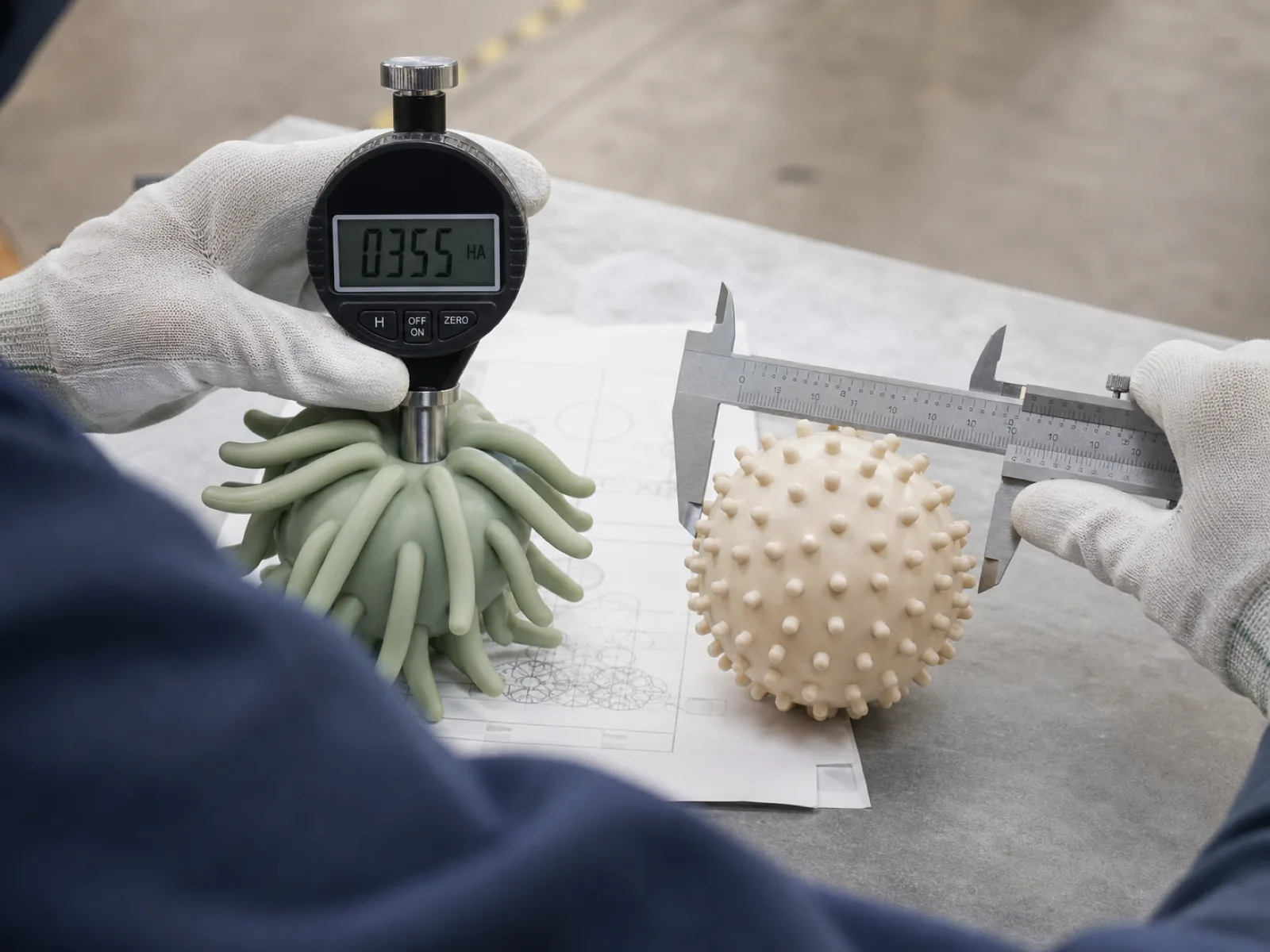
“Soft,” “medium,” and “firm” are not a spec — they are how two people end up arguing over a rejected lot. Perceived firmness is driven by three variables: the durometer of the cured silicone (measured on the Shore A scale per ASTM D2240[^astm-standards]), the wall or spike thickness, and the geometry. This is why a laundry-ball spec must name a Shore A target and a tolerance for the functional part, not one vague word for “the silicone.” A washing ball’s whole function is soft, flexible fingers, so it lives low on the scale; a dryer ball’s function is firm tumbling mass, so it lives higher.
The durometer and size map Wetop uses to translate a laundry-ball design into a moldable spec:
| Product / element | Shore A target | Diameter band | Why this band | Verification at lot release |
|---|---|---|---|---|
| Washer anti-tangle fingers | 30–45 | 45–65 mm | Fingers flex to grab lint, no fabric abrasion | Durometer on the field, ±5 |
| Dryer ball body | 50–65 | 55–75 mm | Firm sphere, tumbles and separates under heat | Durometer + tumble sample |
| Hybrid spiky ball | 40–55 | 50–70 mm | Compromise for both drums | Durometer, ±5 |
| Solid vs hollow core | n/a | mass-driven | Mass affects tumble energy and drying performance | Weight check per lot |
Temperature range is the spec that lets a brand make a hot-dryer claim with a straight face. Platinum-cured silicone stays flexible and dimensionally stable from about −40 °C to 230 °C in continuous service, and a household dryer’s drum air rarely exceeds 60–75 °C, so the ball operates with a huge thermal margin and will not melt, deform, or leach across thousands of cycles — an envelope no injection-molded polypropylene ball can match without going brittle. If your team wants the full durometer scale mapped to tactile feel across product classes, the Shore A hardness silicone chart is the reference. The mistake to avoid: approving a hand-feel prototype without recording the Shore A and the ball weight, then having no objective way to hold production to the same firmness and tumble behavior.
Compression molding or LSR injection — how is a silicone laundry ball actually made?
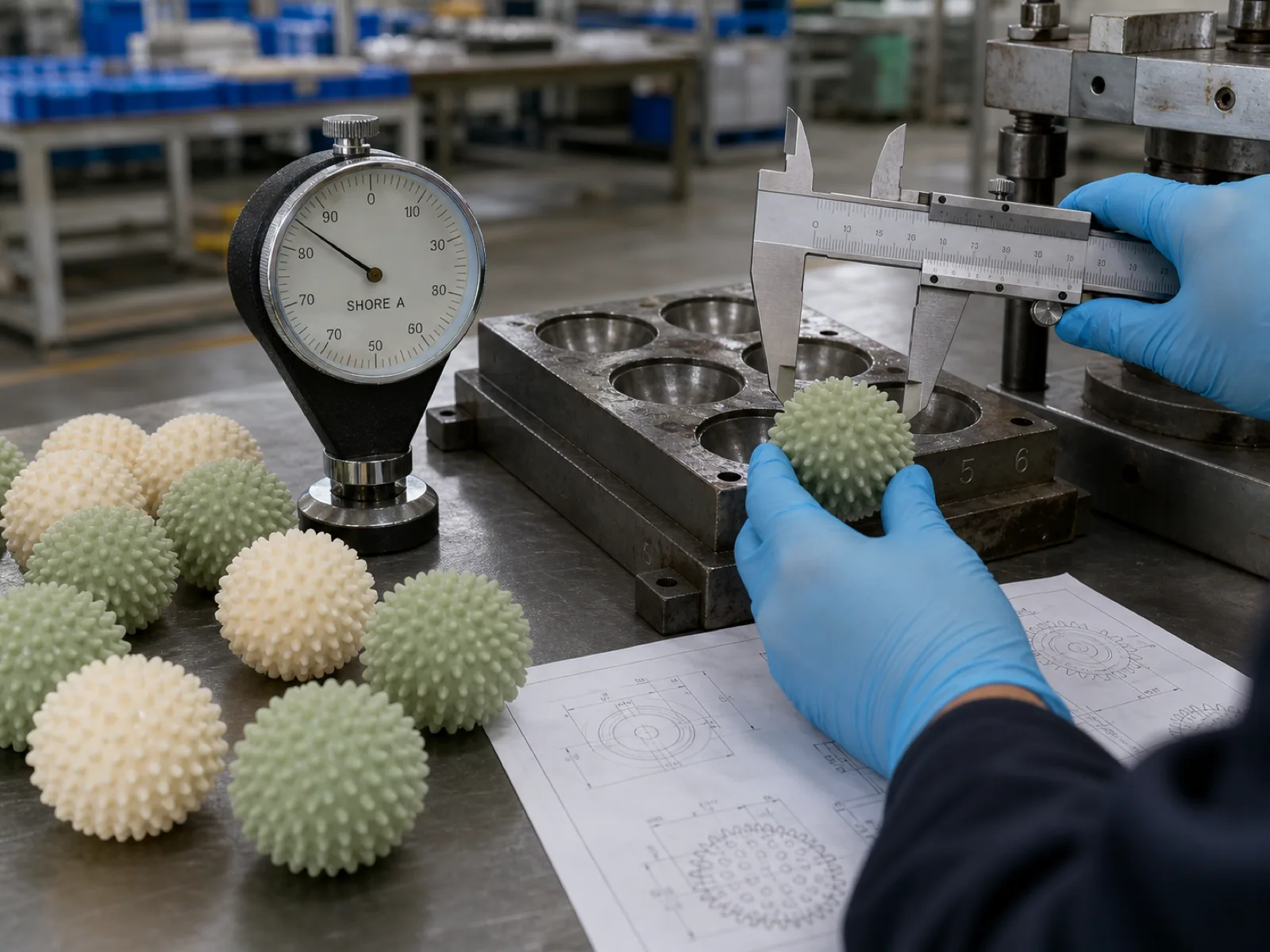
Silicone laundry balls are usually compression-molded from high-consistency rubber (HCR): a pigmented silicone slug is cured inside a heated, cavity-engraved mold under press tonnage in a few minutes, then deflashed and post-cured. LSR injection molding is reserved for very high volumes or fine, repeatable spike geometry, because its higher tooling cost only pays back above roughly 200,000 pcs/year. For a hot-drum product, the critical step is the 4-hour, 200 °C post-cure that clears residual volatiles.
The process choice is an economic decision disguised as a technical one. Compression molding places a pre-weighed slug of pigmented HCR into an open, heated cavity; the press closes under tonnage, the silicone flows to fill the ball body and its fingers or spikes, and it cures in place. It is the right method for most laundry-ball programs because the tooling is comparatively cheap, color changes are fast, and the round-plus-spike geometry molds cleanly. The trade-offs are a longer cycle and a manual deflash step, both absorbed easily at these volumes and this price point.
LSR injection molding pumps two-part liquid silicone into a closed, heated mold where it cures in 15–90 seconds, fully automated, holding tight tolerance. It shines on ultra-high volumes and on fine, consistent spike geometry where dimensional repeatability matters. But the tooling is multiples more expensive and color changes are slower, so for a typical laundry-ball program under roughly 200,000 pcs/year the automation savings never catch the tooling premium. Most laundry-ball SKUs stay on compression molding for their entire life.
| Factor | Compression molding (HCR) | LSR injection molding |
|---|---|---|
| Tooling cost (laundry ball) | USD 1,500 – 6,000 | USD 12,000 – 40,000+ |
| Cycle time per part | 2 – 5 min | 15 – 90 s |
| Color changeover | Fast (slug swap) | Slower (purge cycle) |
| Best volume band | up to ~200,000 pcs/yr | 200,000 pcs/yr and up |
| Fine-spike dimensional repeatability | Good | Excellent |
| Right call for a laundry ball | Default | Only at very high volume |
After the ball is demolded, the make-or-break step for a hot-drum product is the post-cure: a 4-hour bake at 200 °C that drives off residual volatiles. On a ball that will tumble against warm, clean laundry, this is the difference between an odor-free load and a rubber smell, so a factory that shortens it to protect throughput is disqualifying itself for a laundry program.
What MOQ, tooling cost, per-unit price tiers, and landed cost apply?
Wetop's silicone laundry ball wholesale MOQ starts at 500 pcs per color on existing tooling and 3,000 pcs on a new compression mold, with tooling at roughly USD 1,500–6,000 amortized across the run. FOB unit prices run about USD 0.35–1.60 depending on size, hardness, and volume. Because a laundry ball is a lightweight, high-count SKU, packing density and FOB-versus-DDP terms move landed cost more than the unit price does.
Most first-time buyers should start with an ODM program — pick a proven ball platform, then customize color, size, and branding on top — because it reaches market months faster and avoids sinking tooling money before the SKU proves itself. Once annual volume justifies the investment, move to a dedicated OEM mold for a ball geometry you own. The reason tooling ranges as widely as it does is cavity intricacy: a simple round dryer ball is a cheap cavity, while a multi-finger anti-tangle ball with fine undercut spikes is a more complex mold and sits at the top of the band. How that tooling charge folds into unit price at different volumes is worked through in the silicone OEM pricing structure guide.
MOQ and tooling tier structure at Wetop (2026 pricing):
| Program tier | MOQ per color | Tooling cost | Unit price band (FOB) | Best for |
|---|---|---|---|---|
| Stock platform, Wetop packaging | 500 pcs | USD 0 | USD 0.40 – 1.60 | Sample orders, listing tests |
| Stock platform, custom Pantone + logo deboss | 1,000 pcs | USD 150 – 350 (logo insert) | USD 0.38 – 1.45 | Private-label test runs |
| Custom shape, new compression mold | 3,000 pcs | USD 1,500 – 6,000 | USD 0.35 – 1.30 | Brands wanting a distinct ball |
| Full private-label — mold + color + retail carton | 3,000 – 5,000 pcs | USD 2,500 – 8,000 all-in | USD 0.55 – 1.75 all-in | Retail PL programs |
Because a laundry ball is light and small but sold in high counts, the number that quietly decides your margin is not the FOB unit price — it is packing density and freight terms. A ball that nests or ships loose in a poly bag fills a carton far more efficiently than one blister-packed one-per-clamshell, and a denser carton means more units per cubic meter and a lower per-unit ocean freight cost. For a lightweight, high-volume SKU, sea freight is almost always the right mode; air freight only makes sense for an urgent top-up. On terms, FOB hands you control of freight and customs (better once you have a forwarder), while DDP buys a single delivered price with the supplier managing logistics (simpler for a first order). Spec the retail pack format early, because a clamshell-per-ball decision made for shelf appeal can cost more in freight than it earns at the register.
What private-label branding, color, and packaging options exist?
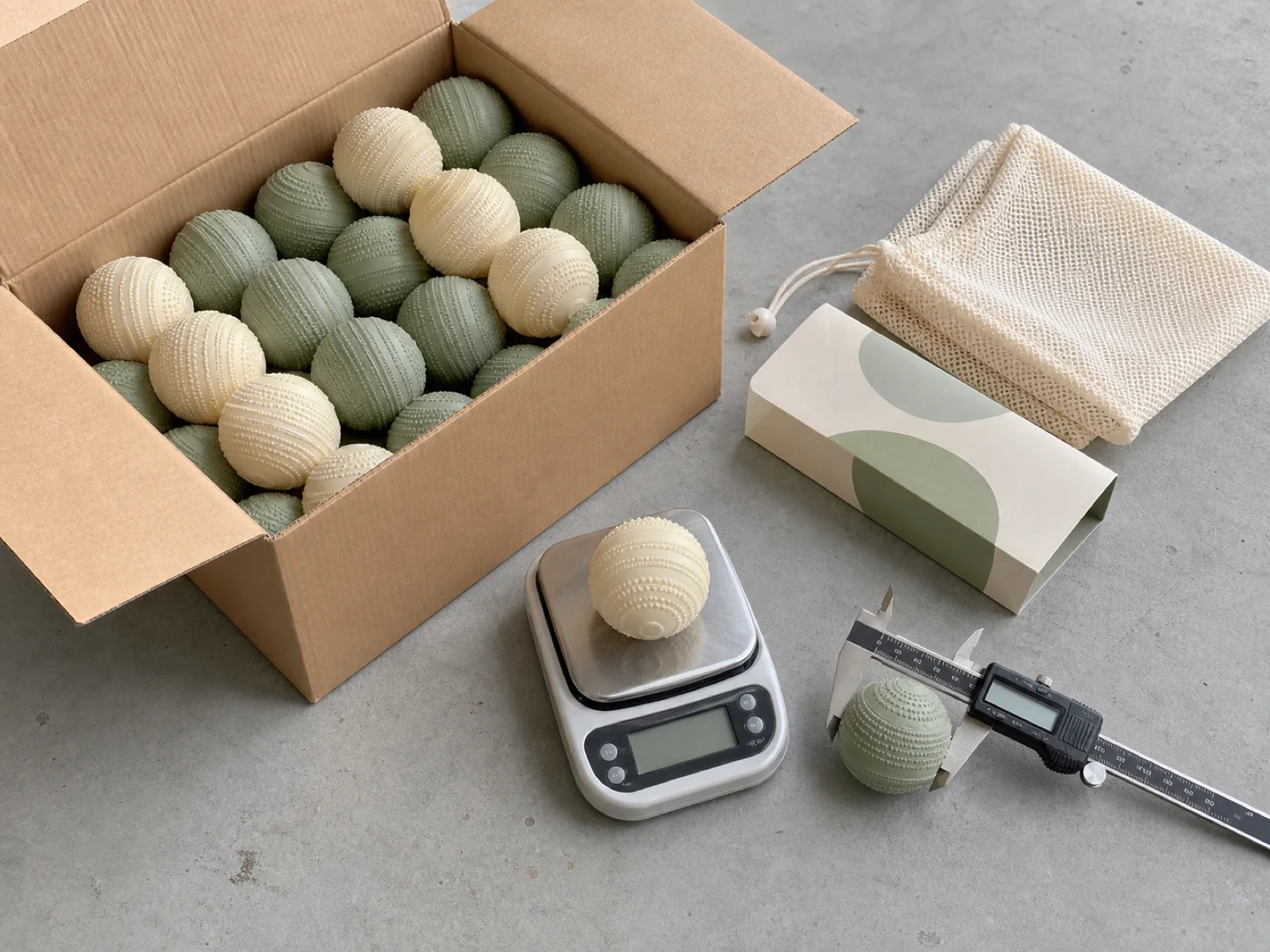
A silicone laundry ball takes a brand color via Pantone-matched platinum-cured masterbatch (ΔE ≤ 1.5 on a D65 light box), a debossed or embossed logo engraved into the mold cavity at USD 150–350 per insert with zero unit-cost adder, and packaging spanning polybag, kraft hang card, mesh drawstring bag, printed sleeve, and full-color retail box. Debossing is the durable choice on a product tumbled wet and hot; pad printing and laser marking suit artwork but wear faster.
Branding a laundry ball is a decision about what survives the drum. A debossed or embossed logo is cut directly into the mold cavity, so the mark is part of the silicone itself — it cannot peel, fade, or wash off across thousands of hot, wet cycles, and it adds nothing to the per-unit cost after the one-time insert charge. That makes it the default for a product whose entire life is spent tumbling. Pad printing and laser marking can place multi-color artwork or fine detail a deboss cannot, but on a dryer-tumbled surface they abrade over time, so reserve them for the packaging or for a secondary decorative accent rather than the primary durable mark. The full comparison of decoration methods is in the customize silicone logo deboss, print, and laser guide.
Color is a color-desk discipline, not a guess: Wetop matches Pantone solid-coated within ΔE ≤ 1.5 on a D65 light box using platinum-cured masterbatch, so a sage, charcoal, or brand-specific ball comes out lot-to-lot consistent instead of drifting a shade between runs. On packaging, the format is a merchandising-versus-freight trade covered above — a mesh drawstring bag reads eco and packs dense, a kraft hang card is retail-ready and recyclable, and a full-color box with a hangtag maximizes shelf presence at the cost of carton efficiency. Spec the pack alongside the ball, because the two decisions interact on landed cost.
What certifications, import documents, and defensible eco claims does a program need?
A US/EU laundry-ball program needs FDA 21 CFR 177.2600 extractables clearance and EU Regulation 10/2011 or LFGB §30/31 on the finished ball, REACH SVHC screening on every pigment and additive, California Prop 65 for US retail, RoHS on any printed element, and an ISO 9001 supplier certificate. Screen the finished-good report, not the raw-compound COA. A reusable claim must rest on a replacement-rate number, not an unqualified "eco" badge.
The documentation trap that catches first-time buyers is the finished-good versus compound distinction. A “FDA certified” claim on a listing almost always means the base silicone carries 21 CFR 177.2600[^fda-177-2600] clearance from its supplier, not that the finished ball was lot-tested by an accredited third-party lab. Because the ball is handled by hand and shares a drum with worn garments, the migration and extractables test on the actual part is what a US Customs review and a retailer supplier audit will demand[^fda-food-packaging]. The minimum documentation packet:
- Finished-good FDA 21 CFR 177.2600[^fda-177-2600] migration report from an accredited lab (Intertek, SGS, or Eurofins), per lot or per quarter
- EU Regulation 10/2011[^eu-10-2011] or LFGB §30/31 batch report for the European market, with BfR Recommendation XV[^bfr-xv] as the technical basis for the silicone case
- REACH SVHC screening[^echa-reach] on every pigment, masterbatch, and additive against the current candidate list
- California Prop 65[^oehha-prop65] statement covering the compound and colorants for US retail listings
- RoHS declaration on any printed, coated, or metallic element (a plain uncoated ball is low-risk, but a printed one needs it)
- ISO 9001[^iso-9001] certificate — Wetop is certified since 2008
On marketing claims, the discipline is to say what you can defend. An “eco” or “reusable” badge with no number behind it is exactly the kind of unqualified claim that draws regulatory and marketplace scrutiny. The defensible version is a replacement-rate: a durable platinum-cured silicone ball is chemically inert, non-porous, and does not craze or go brittle, so one ball realistically displaces single-use dryer sheets across 1,000-plus loads — a substantiated figure a category buyer can print rather than a vibe. Likewise, avoid an “antibacterial” line built on a silver-ion additive, because that turns the additive into a regulated biocide under US EPA and the EU Biocidal Products Regulation, a registration liability you inherit if you copy a competitor’s copy. The honest, science-backed position is the inherent property — non-porous silicone gives residue and biofilm far less to cling to than a textured plastic ball, and it rinses or dishwashes clean. Substantiating the sustainability story with real material data is covered in the silicone PFAS-free sustainability guide.
Sourcing a silicone laundry ball wholesale program?
Wetop runs one compression cell and one LSR injection cell on a 7,500 m² floor in Dongguan, molding platinum-cured, food-grade silicone against FDA 21 CFR 177.2600, EU 10/2011, LFGB §30/31, and ISO 9001 — with every laundry ball held to a durometer and diameter check at lot release. Bring the drum (washer or dryer), the target Shore A, the size, the color, and your markets, and the engineering desk will quote tooling, unit price, packing density, and a 7–25 day first sample. Talk to the engineering desk to start a silicone laundry ball wholesale RFQ.
FAQ
-
What is the wholesale MOQ for silicone laundry balls?
It depends on the sourcing route. Marketplace stock inventory typically moves at 100–500 pieces with the seller's existing shape, color, and no branding. A custom molded program is different: Wetop's silicone laundry ball wholesale MOQ starts at 500 pcs per color on existing tooling, and 3,000 pcs when a new compression mold is cut for your own geometry, so you amortize the tooling. A full private-label run with a custom shape, Pantone color, debossed logo, and retail packaging usually lands at 3,000–5,000 pcs to hit landed-cost targets. Below 500 pcs you are buying somebody else's product with your sticker on the polybag; above 3,000 pcs you own the mold and the shape.
-
What is the difference between a silicone laundry ball, a dryer ball, and a washing ball?
They are three names buyers use, but the engineering differs. A silicone washing ball (or wash-drum ball) goes in the washer and is usually a soft, spiky, anti-tangle finger cluster that grips loose fibers, hair, and lint so they do not knot around clothes. A silicone dryer ball goes in the dryer and is a firmer, heat-stable sphere that tumbles between garments to separate the load, cut drying time, and reduce static — a reusable alternative to a single-use dryer sheet. 'Laundry ball' is the umbrella term shoppers type for either. When you RFQ, name the drum it runs in (washer or dryer) and the job (anti-tangle vs load-separating), because the Shore A hardness and geometry are not interchangeable.
-
Should I source silicone laundry balls as wholesale stock or custom OEM?
Match the route to your volume and branding need. Buy wholesale stock when you need small quantities fast, are testing a listing, and do not need your own shape or logo — you accept the seller's mold and color. Move to custom OEM/ODM when you want a distinct geometry, a Pantone-matched color, a debossed brand mark, and a compliance packet in your name — which starts to pay off at roughly 500 pcs on existing tooling or 3,000 pcs on a new mold. The tie-breaker is margin: a differentiated, branded ball defends a higher retail price and blocks copycats, while a generic stock ball competes only on price.
-
What silicone hardness (Shore A) is best for a laundry ball?
Match the durometer to the drum and the job. A washer anti-tangle ball with flexible gripping fingers wants Shore A 30–45 so the fingers bend and catch lint and pet hair without abrading fabric. A dryer ball wants a firmer Shore A 50–65 so it holds a stable sphere, tumbles with authority to separate garments, and resists deforming under heat. A hybrid spiky ball meant for both sits around Shore A 40–55. Write the target Shore A with a ±5 tolerance and require a durometer reading at lot release; 'soft' and 'firm' are not a spec and are how a rejected lot becomes an argument.
-
Are silicone dryer balls safe to use in a hot dryer?
Yes, when they are platinum-cured, food-grade silicone. Platinum-cured silicone holds a continuous service range of roughly −40 °C to 230 °C, and a household dryer runs far below that ceiling, so the ball will not melt, deform, or degrade across thousands of cycles. The safety failure mode to design out is the cure system, not the heat: a peroxide-cured ball can retain benzoic-acid byproducts that off-gas a rubber smell into warm laundry, which reads as a defect and generates returns. Specify platinum cure and a finished-good migration report, and a hot-dryer claim is defensible.
-
What is the tooling cost for a custom silicone laundry ball?
A new compression mold for a custom silicone laundry ball runs roughly USD 1,500–6,000, depending on cavity count and geometry complexity. A simple round dryer ball is at the low end; a multi-finger anti-tangle ball with fine, undercut spikes is a more intricate cavity and sits higher. Tooling is a one-time charge, amortized across the run — at 3,000 pcs a USD 4,000 mold adds about USD 1.33 per unit, and at 20,000 pcs it drops under USD 0.20. That amortization is exactly why the custom route only makes sense once your annual volume justifies owning the mold.
-
Can a factory add our logo, color, and private-label packaging to a laundry ball?
Yes. Wetop's color desk matches Pantone solid-coated within ΔE ≤ 1.5 on a D65 light box using platinum-cured masterbatch, so the ball can carry a brand color. A debossed or embossed logo is engraved into the mold cavity at roughly USD 150–350 per insert with zero unit-cost adder and full wash-and-dry durability, which is the correct method on a product tumbled wet and hot; pad printing and laser marking are available for artwork but wear faster in a dryer. Packaging spans polybag, kraft hang card, printed sleeve, mesh bag, and full-color retail box with a custom hangtag.
-
What certifications do imported silicone laundry balls need for the US and EU?
Screen for FDA 21 CFR 177.2600 and EU Regulation 10/2011 or LFGB §30/31 for the food-and-skin-contact silicone grade, REACH SVHC screening on every pigment and additive, California Prop 65 for US retail, RoHS on any printed or coated element, and an ISO 9001 supplier certificate. Because a laundry ball is a repeated-use household product handled with bare hands and tumbled with clothing, request the migration and extractables report on the finished ball, not just the raw-compound certificate — customs and retailer audits reject the compound COA in place of a finished-good report.
-
How long do silicone laundry balls last and how do you clean them?
A platinum-cured silicone laundry ball lasts for years and many thousands of cycles because the material is chemically inert, non-porous, and does not craze, cloud, or go brittle the way a plastic ball does under repeated heat and moisture. To clean it, peel off collected lint and hair by hand, then rinse or run it top-rack in a dishwasher; the non-porous surface does not absorb detergent residue or harbor biofilm. That durability is the substance behind a reusable claim — one ball replacing single-use dryer sheets across 1,000-plus loads is a replacement-rate you can print and defend.
References
Authoritative sources cited in this guide
- US Food and Drug Administration. 21 CFR 177.2600 — Rubber articles intended for repeated use. https://www.ecfr.gov/current/title-21/chapter-I/subchapter-B/part-177/subpart-C/section-177.2600 — The controlling US extractables limit for repeated-use silicone in food- and skin-contact articles — total extractives in n-hexane ≤ 20 mg/in² — used here as the baseline migration standard for a silicone laundry ball handled by hand and tumbled with clothing.
- EUR-Lex — Publications Office of the European Union. Commission Regulation (EU) No 10/2011 on plastic materials and articles intended to contact food. https://eur-lex.europa.eu/legal-content/EN/TXT/?uri=CELEX%3A32011R0010 — The EU migration framework a household silicone article is screened against for the European market, complementary to LFGB §30/31 for the silicone-specific case.
- International Organization for Standardization. ISO 9001:2015 — Quality Management Systems — Requirements. https://www.iso.org/standard/62085.html — The QMS Wetop is certified against — the documented quality system a retail-supplier audit and a durometer lot-release protocol for a laundry ball are built on.
- ASTM International. ASTM International — Standards & Publications. https://www.astm.org/products-services/standards-and-publications/standards.html — Source for ASTM D2240 durometer methodology used to bench-verify the Shore A hardness spec that separates a soft anti-tangle wash ball from a firm dryer ball.
- German Federal Institute for Risk Assessment (BfR). BfR Recommendations on Food Contact Materials — Recommendation XV, Silicones. https://www.bfr.bund.de/en/bfr_recommendations_on_food_contact_materials-7498.html — The technical basis for LFGB §30/31 clearance on repeated-contact silicone — sets peroxide residual and volatile-matter limits relevant to the rubber-odor-in-warm-laundry failure mode of a dryer ball.
- European Chemicals Agency (ECHA) / EUR-Lex. REACH Regulation (EC) No 1907/2006 — Registration, Evaluation, Authorisation and Restriction of Chemicals. https://eur-lex.europa.eu/legal-content/EN/TXT/?uri=CELEX%3A32006R1907 — Screening framework for every masterbatch, pigment, and additive used in a silicone laundry ball sold into the EU — the SVHC candidate-list check an importer must file.
- California Office of Environmental Health Hazard Assessment (OEHHA). Proposition 65 — The Safe Drinking Water and Toxic Enforcement Act. https://oehha.ca.gov/proposition-65 — The California list a household-product importer must screen a laundry ball's compound and colorants against before a US retail listing.
- US Food and Drug Administration. Food Ingredients & Packaging. https://www.fda.gov/food/food-ingredients-packaging — FDA's landing page for food-contact substance regulation — the authority context for why a repeated-use, hand-handled silicone article is graded under 21 CFR 177.2600.
Start a custom program
Send a brief. Get an engineer’s reply in one business day.
Every Wetop program is tooled from a customer’s specification. Send a CAD file (STEP · IGES · DWG) or a written brief and we’ll reply with a mold cost estimate, price brackets at MOQ 500 / 1,000 / 5,000, and any engineering questions.