Buyer Guide · commercial intent
Silicone Molded Parts OEM Guide
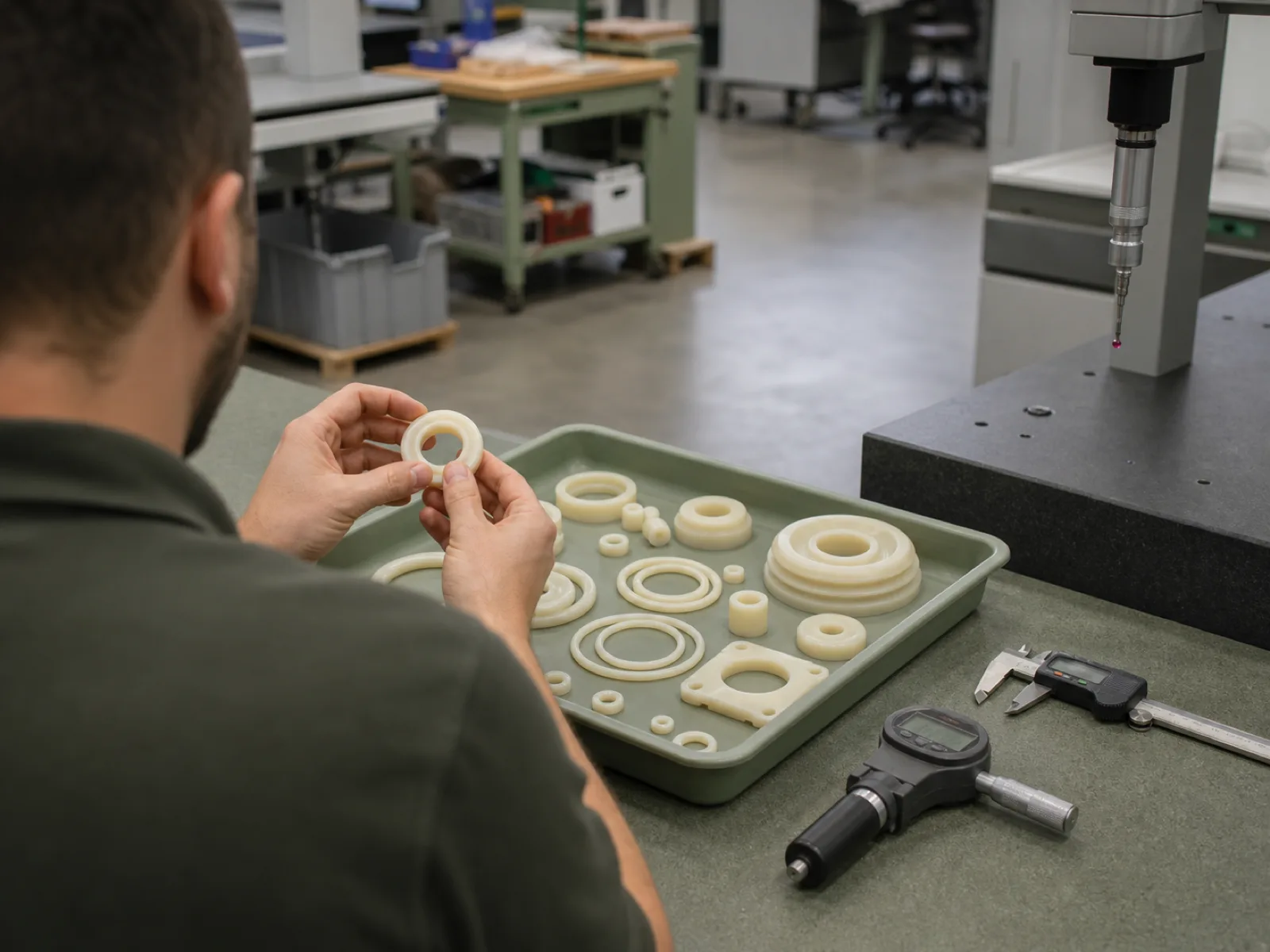 Buyer Guide
 Silicone molded parts are precision elastomer components — gaskets, seals, grommets, keypads, valves, and overmolded grips — produced by injection molding liquid silicone rubber (LSR), compression molding solid silicone (HCR), or transfer molding. Standard platinum-cured parts serve -60°C to +230°C continuous across a Shore A 20-80 hardness range, holding ISO 3302-1 tolerances from ±0.05 mm on LSR injection to ±0.10 mm on compression. Wetop molds custom silicone parts at MOQ 500 with 35-55 day drawing-to-First-Article lead time from a 7,500 m² ISO 9001 factory in Dongguan.
This guide is the engineering-desk reference for sourcing custom silicone molded parts — what they are and where they fit, the three molding processes and when each wins, material selection between LSR and solid HCR silicone, the full Shore A and mechanical-property envelope, tolerance grades by process, tooling economics, food and medical certification depth, and the MOQ, lead-time, and RFQ math that most competitor pages omit entirely. Every recommendation attaches to a number, a cert clause, or a process step. Write it into your drawing before the next RFQ and the factory prices it correctly on the first pass.
What are silicone molded parts and where are they used?
Silicone molded parts are elastomer components shaped in a heated mold from platinum- or peroxide-cured silicone rubber. They seal, cushion, insulate, and transmit motion across industrial, medical, automotive, and consumer products — gaskets, O-rings, grommets, keypads, valves, tubing connectors, bushings, diaphragms, and overmolded soft-touch grips are the highest-volume examples.
Silicone earns its dominance in molded elastomer parts by decoupling properties that other rubbers force you to trade against each other: a -60°C to +230°C service window, food and medical certifiability, UV and ozone stability, and long-term compression-set recovery all live in one base polymer. That is why a single platinum-cured VMQ compound can serve a food-processing gasket, a medical valve, an automotive sensor seal, and a consumer-electronics keypad with only durometer and geometry changing.
Application categories break down into four buyer types. Sealing parts — gaskets, O-rings, grommets, diaphragms — trade on compression set and durometer. Consumer soft-goods — keypads, grips, spouts, baby-care parts — trade on color, feel, and food/skin safety. Industrial functional parts — bushings, dampers, valve seats, tubing connectors — trade on tear strength and dimensional stability. Medical and lab parts — septa, stoppers, tubing, sealing components — trade on USP Class VI and ISO 10993 biocompatibility. Each category pushes a different property to the front of the spec, but all share the same molding physics covered below.
Where silicone loses is a short and predictable list: petroleum fuels, oils, and aromatic hydrocarbons swell standard VMQ 30-50%, so a molded seal in diesel or hydraulic-oil contact needs fluorosilicone (FVMQ) or a fluorocarbon (FKM) instead. Abrasion-heavy dynamic duty — a molded wheel or a high-cycle wiper — favors polyurethane over silicone on wear life. And where cost is the only driver and the service window is mild, a molded nitrile or EPDM part undercuts silicone on material price. Knowing these four exclusions up front stops a buyer from over-specifying silicone where a cheaper elastomer would carry the duty, and stops the more expensive error of under-specifying it where nothing else survives the temperature or certification requirement.
Which molding process should I choose — LSR injection, compression, or transfer?
LSR injection molds two-part liquid silicone in a heated hardened-steel tool, curing in 15-90 seconds — fully automated, ±0.05 mm, best above 20,000 units. Compression molding presses a pre-weighed solid-silicone slug in an aluminum tool over 3-6 minutes — lowest tooling cost, ±0.10 mm, best at 500-20,000 units. Transfer molding suits thin-wall parts and bonded metal inserts.
The process choice is often forced by geometry and volume before the buyer has any say. A thick custom-profile seal at 2,000 pcs annual is a compression part — no rational factory tools LSR for it. A 30 mm keypad at 100,000 pcs annual with tight flash control is an LSR injection part — no rational factory compression-molds it. Transfer molding fills the narrow band between them: thin-wall parts, parts with delicate overmolded metal inserts, and low-to-mid volumes where compression flash would be excessive but LSR tooling cannot be justified.
For a deeper mechanical walk-through of each cycle, our silicone molding process explainer covers the heat, pressure, and cure-chemistry differences step by step.
Molding process comparison for silicone parts
| Attribute | LSR injection | Compression molding | Transfer molding |
|---|---|---|---|
| Material state | Two-part liquid (LSR) | Solid slug (HCR) | Solid pre-form (HCR) |
| Cycle time | 15-90 seconds | 3-6 minutes | 2-5 minutes |
| Tolerance (ISO 3302-1) | M1 (±0.05 mm) | M2 (±0.10 mm) | M2 (±0.10 mm) |
| Tooling | Hardened steel, multi-cavity | Aluminum, single/low-cavity | Steel or aluminum, pot + cavities |
| Tooling cost | $12,000-45,000 | $2,500-6,000 | $5,000-15,000 |
| Automation | Full (lights-out capable) | Manual load/unload | Semi-automated |
| Break-even volume | 20,000+ units | 500-20,000 units | 2,000-30,000 units |
| Best-fit part | Precision, high-volume, overmold | Custom profile, thick section | Thin-wall, insert-bonded |
Rule of thumb from the engineering desk: default to compression molding for any custom part under 20,000 annual units unless the drawing demands ±0.05 mm tolerance, a fully automated flash-free finish, or an overmolded insert that only LSR can hold to position. Those three triggers — precision, flash control, or insert overmolding — are what justify the 5-8× tooling premium of LSR.
LSR or solid HCR silicone — which material do molded parts use?
LSR (liquid silicone rubber) is a two-part platinum-cured liquid that pumps into injection tools and cures fast — the material for high-volume, precision, automated parts. HCR (high-consistency rubber, or solid silicone) is a gum-like solid milled into slugs for compression and transfer molding — the material for custom profiles, thick sections, and lower volumes at lower tooling cost.
The material and the process are coupled: you cannot compression-mold LSR or injection-mold HCR without changing equipment. So choosing the material is really choosing the process economics. LSR runs almost exclusively platinum-cured, giving low compression set, no cure by-products, and clean USP Class VI biocompatibility straight off standard formulations. HCR is available in both platinum- and peroxide-cured grades — peroxide is cheaper but leaves cure by-products that require a post-cure bake, and it cannot bond cleanly to some substrates in overmolding.
Both material families reach the same certification ceiling — FDA, LFGB, USP Class VI — on platinum-cured grades, so the food/medical decision does not force the material choice. Volume and geometry do. Our platinum-cured vs peroxide-cured comparison covers the cure-chemistry trade in detail; the short version is that platinum is mandatory for food, medical, and any part that skips a post-cure bake.
One material subtlety catches buyers who compare quotes across suppliers: LSR and HCR at the same nominal Shore A do not always feel or perform identically, because LSR grades are compounded for flow and fast cure while HCR grades are compounded for milling and green strength. An LSR Shore A 50 keypad and an HCR Shore A 50 keypad can differ measurably in rebound and tear resistance. When a program migrates from a compression prototype to LSR production for volume, re-qualify the mechanical properties against the drawing rather than assuming durometer parity carries across the process change — this is the single most common cause of “the production part feels different from the sample” complaints.
What Shore A hardness and mechanical properties should I specify?
Molded silicone parts run Shore A 20-80. Shore A 40-70 covers roughly 90% of parts. Beyond durometer, specify tensile strength (typically 7-11 MPa per ASTM D412), tear strength (15-40 kN/m per ASTM D624), elongation at break (300-800%), and compression set (≤ 25% at 175°C / 22 hr per ASTM D395 Method B for sealing parts).
Shore A hardness is the single most-abused number on a silicone drawing. Buyers copy “Shore A 70” from a template because it sounds durable, then wonder why a soft-conformance seal weeps or a keypad feels wrong under the thumb. Durometer is a selection, not a default: soft parts conform and cushion, hard parts resist extrusion and hold shape under load. Match it to the mechanical duty, not to a habit.
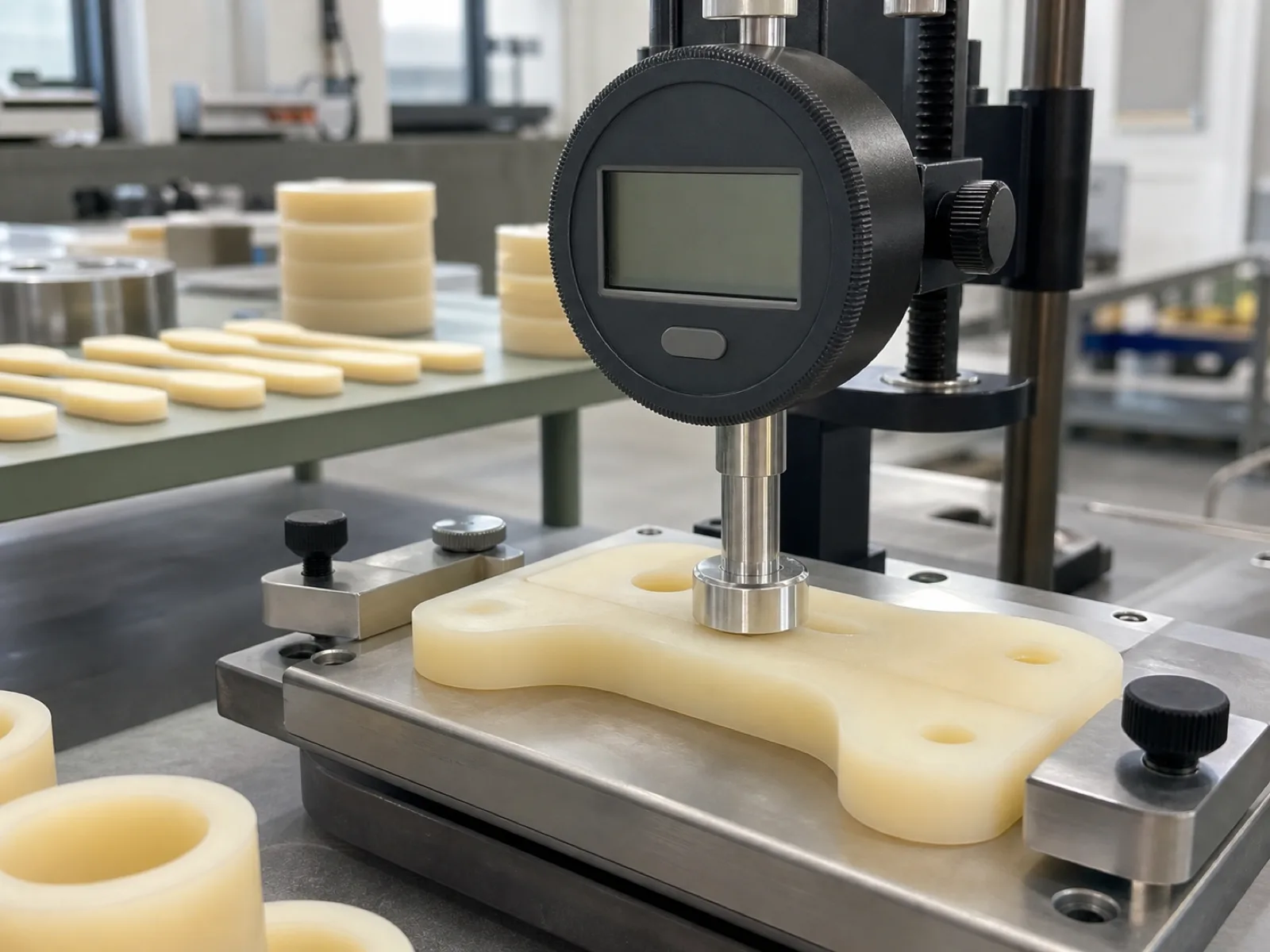
Shore A durometer-to-application map for silicone molded parts
| Shore A | Feel / behavior | Typical molded parts | Property to watch |
|---|---|---|---|
| 20-30 | Gel-soft, high conformance | Vibration dampers, ultra-soft seals, cushioning pads | Tear strength (low) |
| 30-40 | Soft, flexible | Baby-care spouts, soft-touch grips, gap fillers | Elongation |
| 40-50 | Standard soft | Conformance gaskets, keypads, diaphragms | Compression set |
| 50-60 | General purpose | O-rings, grommets, food-contact seals, valve seats | Compression set |
| 60-70 | Firm | High-load gaskets, bushings, dynamic seals | Extrusion / tear |
| 70-80 | Rigid | Structural grommets, rigid bushings, wheels | Tensile / modulus |
Cross-check the deflection-versus-load behavior of each durometer against our Shore A hardness silicone chart before locking the number into a drawing — the difference between Shore A 50 and 70 is roughly 40% more load to reach the same conformance depth.
What temperature range do molded silicone parts survive?
Standard platinum-cured VMQ silicone molded parts serve -60°C to +230°C continuous, with intermittent spikes to +260°C for under 100 hours cumulative and peaks to +315°C for under 30 minutes. Fluorosilicone (FVMQ) extends the ceiling to +260°C continuous with fuel/oil resistance; phenyl silicone (PVMQ) drops the floor to -100°C for cryogenic and Arctic-service parts.
Temperature range is where silicone molded parts beat every commodity elastomer. Nitrile hardens and cracks below -30°C; standard silicone stays flexible to -60°C. EPDM tops out near 150°C in continuous service; silicone holds mechanical integrity to 230°C. That combined span — a 290°C-wide window on one standard grade — is why a single molded-part supplier can serve appliance seals running hot and outdoor grommets running cold from the same compound family.
Write four temperatures into the drawing: continuous service (>1000 hr cumulative), intermittent (<100 hr), peak (<30 min), and the low-temperature limit below which the part glasses out. Then pair each with the compression-set target at that temperature so the factory can compound-select and set the post-cure schedule correctly on the first pass rather than discovering the requirement at First Article.
The failure mode that temperature under-specification hides is thermal cycling, not steady-state heat. A molded seal rated for 230°C steady-state can still fail early if the application swings it repeatedly between -20°C and 200°C, because each cycle works the compression-set drift a little further and the part loses recovery height faster than a constant-temperature service life would predict. If the duty cycles, say so on the drawing — the number of cycles and the swing range let the factory pick a low-compression-set grade and a longer post-cure, which is the difference between a five-year field life and a warranty return in month eight.
What tolerances and DFM rules apply to molded silicone parts?
LSR injection holds ISO 3302-1 class M1 (±0.05 mm on small features); compression molding holds class M2 (±0.10 mm) as the default. Silicone shrinks 2-4% from mold temperature to ambient, so tolerances scale with feature size. Core DFM rules: maintain uniform wall thickness, radius all sharp corners, avoid deep blind holes, and design draft into vertical walls.
Silicone tolerance grades are a function of feature size because shrinkage is proportional, not absolute — a 4 mm feature and a 100 mm outside diameter cannot share one tolerance band. ISO 3302-11 formalizes this into four classes (M1-M4) that scale with dimension and distinguish molded features (crossing a parting line) from non-molded features (in one cavity half). Specifying M1 on a compression tool is a common and costly error: the process cannot hold it consistently, so the factory either quotes 3× on a hardened tool or silently ships M2 parts.
ISO 3302-1 tolerance grades — molded silicone features
| Feature size | M1 (LSR precision) | M2 (compression standard) | M3 (general commercial) |
|---|---|---|---|
| 0-4 mm | ±0.08 mm | ±0.10 mm | ±0.20 mm |
| 4-6.3 mm | ±0.10 mm | ±0.15 mm | ±0.25 mm |
| 10-16 mm | ±0.20 mm | ±0.25 mm | ±0.40 mm |
| 25-40 mm | ±0.40 mm | ±0.50 mm | ±0.80 mm |
| 100-160 mm | ±0.90 mm | ±1.20 mm | ±2.00 mm |
DFM checklist for molded silicone parts: keep wall thickness within a 3:1 max-to-min ratio to avoid differential shrink and sink; radius internal corners to ≥ 0.5 mm to prevent tear-initiation points; add 1-2° draft on vertical walls to ease demolding; avoid blind holes deeper than 2× their diameter; and locate the parting line on a non-sealing surface so flash removal never touches a functional face. Feeding these into the drawing early cuts one full DFM revision round out of the sampling timeline.
What does tooling cost and how does cavity count affect price?
Compression tooling runs $2,500-6,000 for a single-cavity aluminum mold; LSR injection tooling runs $12,000-45,000 for a hardened multi-cavity steel mold. Cavity count is the primary driver — an 8-cavity LSR tool costs more upfront but slashes per-piece labor and cycle cost, so it amortizes only across high volume. Tooling folds into per-piece price over the first production run.
Tooling is the line item that decides whether a molded-part program makes financial sense at your volume. The trade is fixed cost versus variable cost: a cheap aluminum single-cavity compression tool has low upfront cost but higher per-piece labor and cycle time, while an expensive hardened multi-cavity LSR tool has high upfront cost but near-zero marginal labor. The crossover is why volume dictates process — below 20,000 units the aluminum tool wins on total landed cost; above it, the multi-cavity steel tool wins.
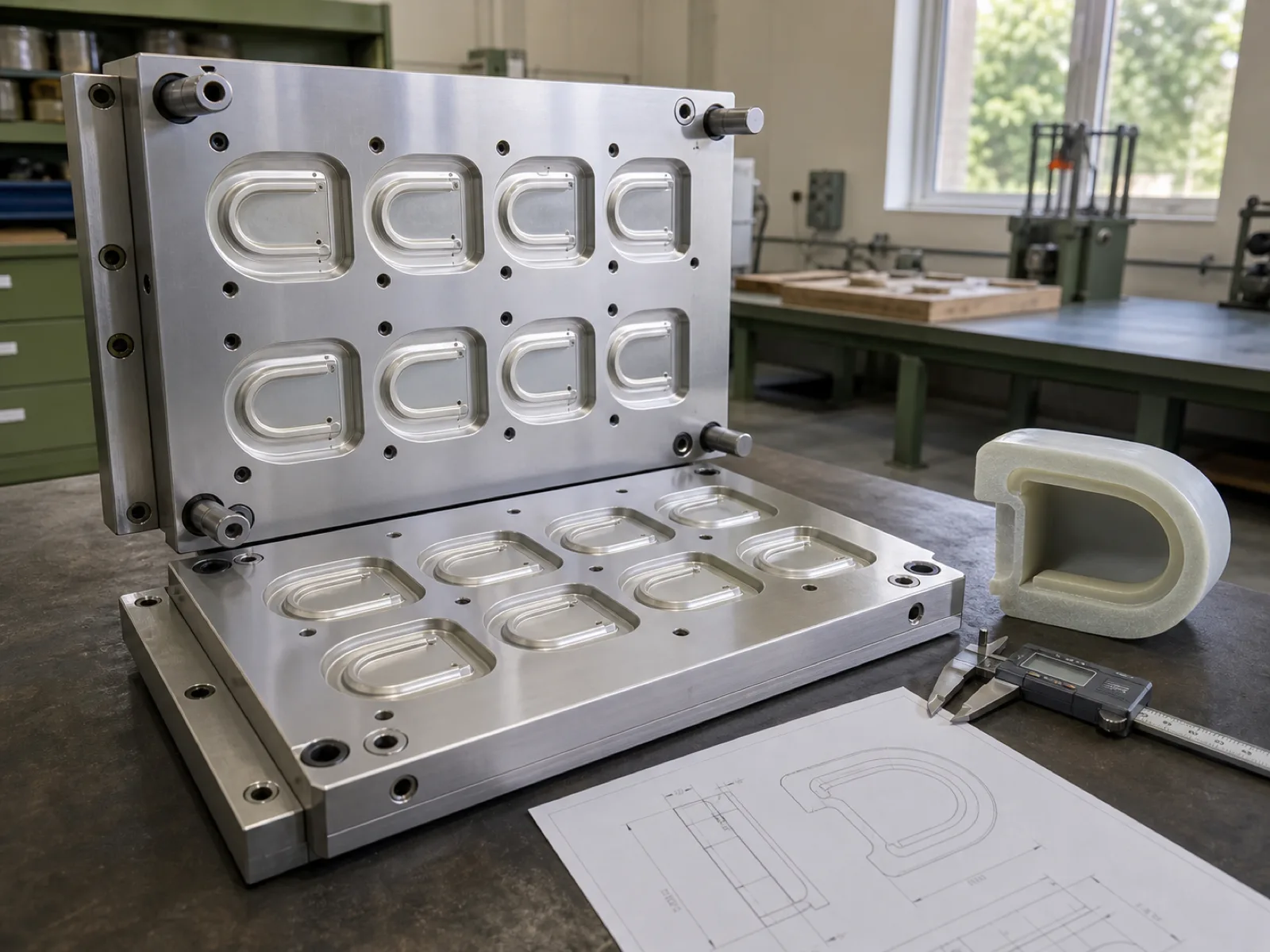
Tooling and cost-crossover math by process
| Process | Tooling cost | Cavities (typical) | Per-piece variable | Break-even volume |
|---|---|---|---|---|
| Compression (aluminum) | $2,500-6,000 | 1-8 | $0.30-2.50 | 500-20,000 units |
| Transfer (steel/aluminum) | $5,000-15,000 | 4-16 | $0.20-1.50 | 2,000-30,000 units |
| LSR injection (hardened steel) | $12,000-45,000 | 4-32 | $0.15-1.20 | 20,000+ units |
At MOQ 500 with a 60-day payback expectation, compression molding is the only method whose tooling-amortization math closes cleanly for most custom parts. Our MOQ and lead-time guide walks through the 60-day payback logic and how tiered volume pricing lowers per-piece cost as the tool amortizes across larger runs.
Two hidden tooling variables move the quote more than buyers expect. Undercuts — any geometry that traps the part in the cavity — force a bumped, split, or collapsible core, which can add 30-60% to tool cost and lengthen build by a week. Overmolded inserts — a metal stud, a plastic housing, a fabric layer bonded into the silicone — require loading fixtures, shut-off surfaces around the insert, and adhesion-primer validation, and they push most programs toward LSR or transfer molding regardless of volume. Flag both on the drawing at RFQ. A part that looks like a simple seal but hides a back-draft undercut will re-quote at tool-cutting time, and a re-quote after a purchase order is the most expensive surprise in the whole program.
What certifications do food and medical silicone parts need?
Food-contact silicone molded parts clear FDA 21 CFR 177.2600 and LFGB §30/31 on platinum-cured VMQ post-cured 4 hours at 200°C. Medical parts add USP Class VI biocompatibility and ISO 10993 cytotoxicity, sensitization, and irritation data on the same base compound. Both require documented extractables control and per-lot certification traceable to the batch record under an ISO 9001 quality system.
Certification for molded silicone parts is a documentation chain, not a single stamp. FDA 21 CFR 177.26002 governs extractable limits for rubber articles in repeated food contact — the post-cure bake is the process step that drives residual volatiles below the extractable thresholds. LFGB §30/31 adds the European food-contact requirement with sensory and migration testing. For medical parts, USP Class VI3 plus ISO 10993-14 biological evaluation qualifies the compound for patient-contact devices, tubing, and sealing components.
The requirements stack on one platinum-cured base compound: a food-grade part and a medical part can share the same silicone, differing only in the depth of the test panel and the documentation retained. Wetop runs an ISO 90015 quality system that logs every certification field against the batch record, so the compliance chain is auditable at the SKU-and-lot level — the difference between a factory that has certification on file and one that can prove it for your specific lot.
What is the MOQ, lead time, and RFQ checklist for OEM silicone parts?
MOQ 500 per SKU on compression-molded custom silicone parts — the floor where single-cavity aluminum tooling amortizes on a 60-day payback. LSR injection needs MOQ 20,000 to spread hardened multi-cavity steel tooling. Lead time is 35-55 days on compression and 45-70 days on LSR from drawing lock to First Article Inspection, then 15-25 days on existing-tool re-orders.
Below MOQ 500, tooling cost dominates the unit price on compression and the factory declines to quote on LSR — the tool simply cannot amortize. Above MOQ 500, the factory folds tooling into the first production run and the buyer sees a landed cost competitive with off-the-shelf parts, but with a proper molded profile, tighter tolerances, and per-lot certification. This concrete MOQ and lead-time transparency is exactly what most molded-parts pages omit; the numbers below are the ones the engineering desk quotes against.
RFQ checklist — what to send for a silicone molded parts quote
- Drawing — 2D PDF with dimensions and tolerances (M1/M2/M3 per ISO 3302-1), or a 3D STEP file.
- Material and hardness — VMQ / FVMQ / PVMQ, cure system (platinum for food/medical), Shore A ± range per ASTM D22406.
- Service conditions — continuous and peak temperature, sealed medium (name the chemistry, not “fluid”), pressure, dynamic or static duty.
- Mechanical targets — tensile per ASTM D4127, tear per ASTM D6248, compression set per ASTM D3959 where the part seals.
- Certifications — FDA 21 CFR 177.2600, LFGB §30/31, USP Class VI, ISO 10993, UL 94, RoHS/REACH.
- Volume and color — annual units and forecast horizon, Pantone or RAL target with ΔE tolerance.
Feed all six into the RFQ on the first pass and the factory picks process, cavity count, and compound correctly the first time — the FAI sample lands in 35-55 days. Skip any of them and the RFQ takes two extra clarification rounds before tooling can start.
References
Talk to the engineering desk about your silicone molded parts program
Send a drawing plus the six RFQ-checklist fields above and we come back inside 48 hours with a process recommendation, cavity-count concept, tooling estimate, and unit-price bracket at MOQ 500 / 5,000 / 20,000. First Article Inspection sample lands 35-55 days after drawing lock on compression, 45-70 days on LSR. Start an RFQ with the engineering desk or download our mutual NDA if drawings need coverage before we begin.
Footnotes
-
ISO 3302-1:2014 — Rubber — Tolerances for Products — Dimensional Tolerances, International Organization for Standardization, https://www.iso.org/standard/61812.html ↩
-
21 CFR 177.2600 — Rubber Articles Intended for Repeated Use, US Food and Drug Administration, https://www.ecfr.gov/current/title-21/chapter-I/subchapter-B/part-177/subpart-C/section-177.2600 ↩
-
USP <88> Biological Reactivity Tests, In Vivo — Class VI Plastics, United States Pharmacopeia, https://www.usp.org/harmonization-standards/pdg/excipients/plastic-materials ↩
-
ISO 10993-1 — Biological Evaluation of Medical Devices — Part 1, International Organization for Standardization, https://www.iso.org/standard/68936.html ↩
-
ISO 9001:2015 — Quality Management Systems — Requirements, International Organization for Standardization, https://www.iso.org/standard/62085.html ↩
-
ASTM D2240 — Standard Test Method for Rubber Property — Durometer Hardness, ASTM International, https://www.astm.org/d2240-15r21.html ↩
-
ASTM D412 — Standard Test Methods for Vulcanized Rubber and Thermoplastic Elastomers — Tension, ASTM International, https://www.astm.org/d0412-16r21.html ↩
-
ASTM D624 — Standard Test Method for Tear Strength of Conventional Vulcanized Rubber, ASTM International, https://www.astm.org/d0624-00r20.html ↩
-
ASTM D395 — Standard Test Methods for Rubber Property — Compression Set, ASTM International, https://www.astm.org/d0395-18.html ↩
FAQ
-
What are silicone molded parts used for?
Silicone molded parts seal, cushion, insulate, and transmit motion across industrial and consumer products — gaskets, O-rings, grommets, keypads, valves, tubing connectors, bushings, overmolded grips, and food-contact seals. Platinum-cured VMQ is the default because it survives -60°C to +230°C, resists UV and ozone, and clears food and medical certification on one base compound.
-
What is the difference between LSR injection and compression molded silicone parts?
LSR injection meters two-part liquid silicone into a heated hardened-steel tool and cures in 15-90 seconds — fully automated, ±0.05 mm, best above 20,000 units. Compression molding presses a pre-weighed solid-silicone (HCR) slug in an aluminum tool over 3-6 minutes — lower tooling cost, ±0.10 mm, best at 500-20,000 units for custom profiles and thick sections.
-
What tolerances can I hold on custom silicone molded parts?
LSR injection holds ISO 3302-1 class M1 (±0.05 mm on small features) with a hardened matched-metal tool. Compression molding holds class M2 (±0.10 mm) as the default. Silicone shrinks 2-4% from mold temperature to ambient, so tolerances scale with feature size — a 4 mm feature and a 100 mm outside diameter cannot share one absolute tolerance.
-
What Shore A hardness is available for molded silicone parts?
Molded silicone parts run Shore A 20 (ultra-soft gel-like seals and dampers) through Shore A 80 (rigid bushings and structural grommets). Shore A 40-70 covers roughly 90% of parts: 40-50 for soft conformance seals, 50-60 for general-purpose molded parts, 60-70 for high-load gaskets and dynamic seals resisting extrusion.
-
How much does tooling cost for silicone molded parts?
Compression tooling runs $2,500-6,000 for a single-cavity aluminum mold; LSR injection tooling runs $12,000-45,000 for a multi-cavity hardened-steel mold. Cavity count, part complexity, undercuts, and overmolded inserts drive the spread. Tooling amortizes into per-piece price over the first production run at MOQ 500 (compression) or 20,000 (LSR).
-
What is the MOQ for custom silicone molded parts?
MOQ 500 per SKU on compression-molded custom silicone parts — the floor where single-cavity aluminum tooling amortizes cleanly on a 60-day payback. LSR injection programs need MOQ 20,000 to spread the hardened multi-cavity steel tool across a first run. Below 500, tooling cost dominates unit price and the math stops closing.
-
How long does it take to produce OEM silicone molded parts?
Lead time is 35-55 days on compression molding and 45-70 days on LSR injection from drawing lock to First Article Inspection sample: 5 days DFM review, 15-30 days tool build, 7 days T0 sample, 5-10 days customer approval, then 3-10 days first production run. Existing-tool re-orders ship in 15-25 days.
-
Are molded silicone parts food-safe and medical-grade?
Platinum-cured VMQ silicone parts, post-cured 4 hours at 200°C, clear FDA 21 CFR 177.2600 and LFGB §30/31 for repeated food contact. Adding USP Class VI biocompatibility and ISO 10993 cytotoxicity data qualifies the same base compound for medical devices, tubing, and sealing components in patient-contact use.
-
What information do I need to quote silicone molded parts?
Send a 2D drawing with tolerances or a 3D STEP file, target Shore A hardness, service temperature and sealed medium, required certifications (FDA / LFGB / USP / UL), annual volume, and color target. Those six fields let the factory pick process, cavity count, and compound on the first pass and quote without a clarification round.
References
Authoritative sources cited in this guide
- International Organization for Standardization. ISO 3302-1:2014 — Rubber — Tolerances for Products — Dimensional Tolerances. https://www.iso.org/standard/61812.html
- ASTM International. ASTM D395 — Standard Test Methods for Rubber Property — Compression Set. https://www.astm.org/d0395-18.html
- ASTM International. ASTM D2240 — Standard Test Method for Rubber Property — Durometer Hardness. https://www.astm.org/d2240-15r21.html
- ASTM International. ASTM D412 — Standard Test Methods for Vulcanized Rubber and Thermoplastic Elastomers — Tension. https://www.astm.org/d0412-16r21.html
- ASTM International. ASTM D624 — Standard Test Method for Tear Strength of Conventional Vulcanized Rubber. https://www.astm.org/d0624-00r20.html
- US Food and Drug Administration. 21 CFR 177.2600 — Rubber Articles Intended for Repeated Use. https://www.ecfr.gov/current/title-21/chapter-I/subchapter-B/part-177/subpart-C/section-177.2600
- United States Pharmacopeia. USP <88> Biological Reactivity Tests, In Vivo — Class VI Plastics. https://www.usp.org/harmonization-standards/pdg/excipients/plastic-materials
- International Organization for Standardization. ISO 9001:2015 — Quality Management Systems — Requirements. https://www.iso.org/standard/62085.html
- International Organization for Standardization. ISO 10993-1 — Biological Evaluation of Medical Devices — Part 1. https://www.iso.org/standard/68936.html
Start a custom program
Send a brief. Get an engineer’s reply in one business day.
Every Wetop program is tooled from a customer’s specification. Send a CAD file (STEP · IGES · DWG) or a written brief and we’ll reply with a mold cost estimate, price brackets at MOQ 500 / 1,000 / 5,000, and any engineering questions.