Buyer Guide · commercial intent
Silicone Pacifier Manufacturer — OEM Sourcing Guide
 Buyer Guide
 A silicone pacifier manufacturer worth sourcing from runs one-shot LSR injection inside a Class 100,000 cleanroom, documents EN 1400 nitrosamine and pull-test results per batch, and hands over a Children's Product Certificate with lead, phthalate, and PFAS reports before the first container ships. Realistic MOQ sits at 500-1000 per SKU per color with $2,500-$5,000 in tooling on 2-4 cavity S136 molds. Anything cheaper is compression-molded with a seam, and a seam is a choking-hazard recall waiting to happen.
The infant category is unforgiving. A pacifier that fails EN 1400 nitrosamine testing costs the buyer a full-container recall plus a listing suspension at buybuy BABY or Target. Cheap suppliers survive because inspection is intermittent — until it isn’t. This guide is written for Tier 2 US baby-brand sourcing managers who need to vet a silicone pacifier manufacturer on engineering evidence, not on a marketing PDF. Everything below is the packet an audit-ready factory can produce in a week.
What separates a real silicone pacifier manufacturer from a trading company?
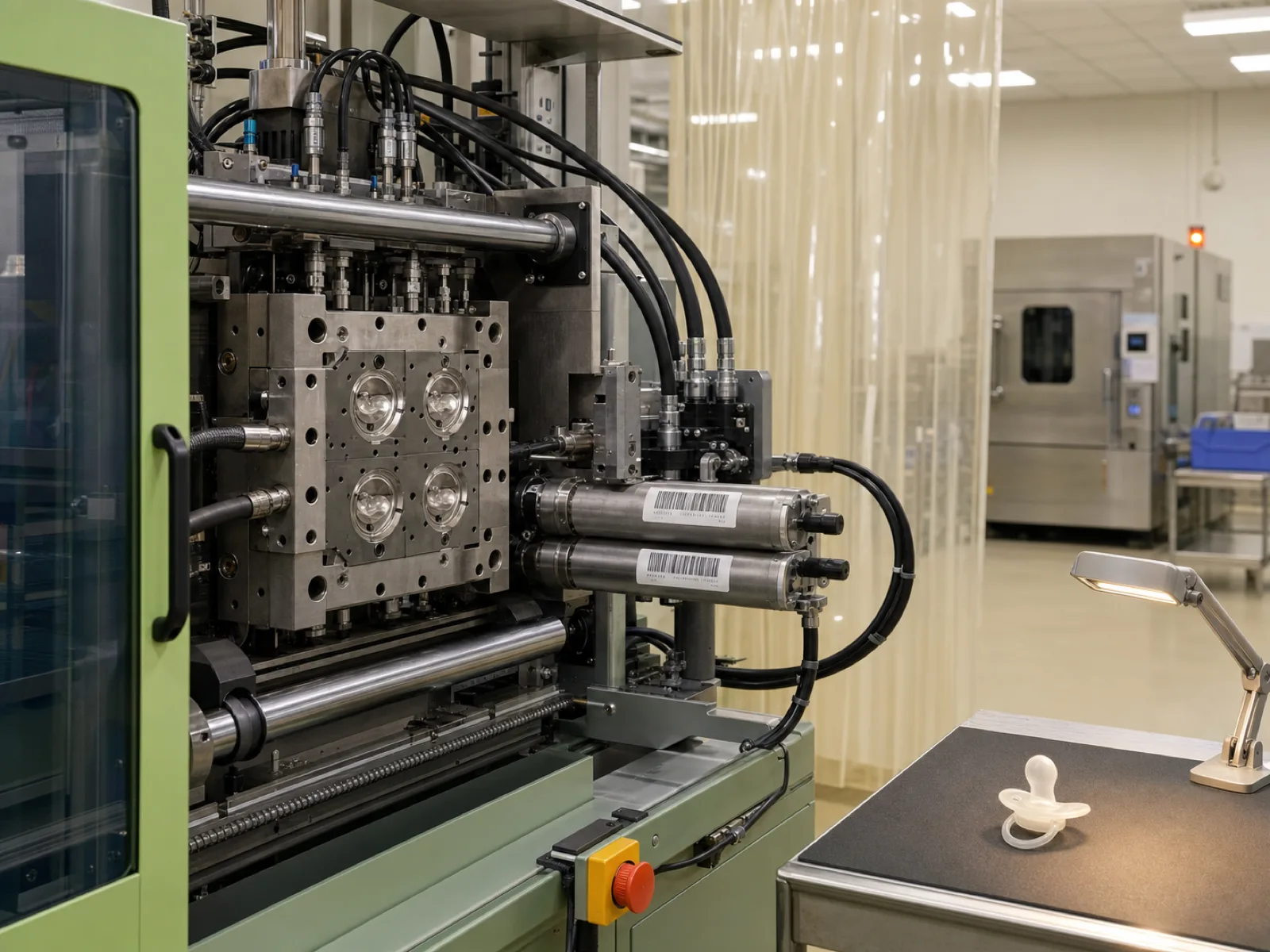
A real silicone pacifier manufacturer owns the LSR injection cell, the cold-runner tooling, the post-cure oven, and the Class 100,000 cleanroom on one floor. They can walk you through cavity numbers, hand you a per-batch EN 1400 test report, and reference the exact CFR section that governs your compliance packet. A trading company forwards your RFQ to a third factory and marks up 15%.
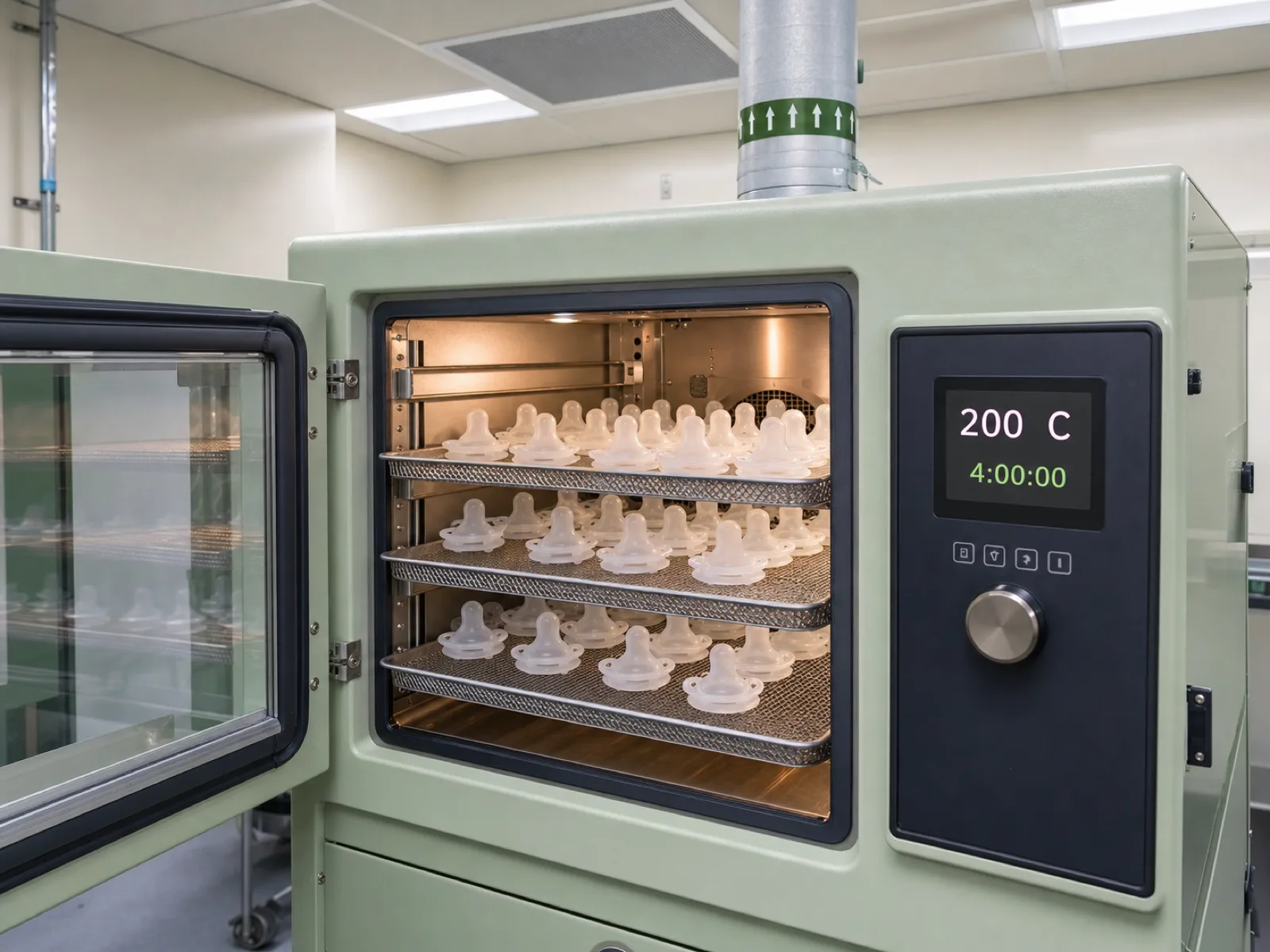
The tell is the vocabulary. Ask any candidate three questions. First: “What’s your nipple mold cavitation and cold-runner delta-T?” A factory answers in seconds — “4-cavity, 12 °C delta-T on the cold runner, 165 °C mold temp, 22 s cycle.” A trader stalls. Second: “Show me the last EN 1400 batch report and match the lot code to a shipping invoice.” A factory pulls both from an ERP. A trader emails you next Tuesday. Third: “What’s your post-cure schedule and how do you verify volatile content?” A factory says “200 °C × 4 h, GC-MS on a coupon per lot.” A trader says “we follow international standards.”
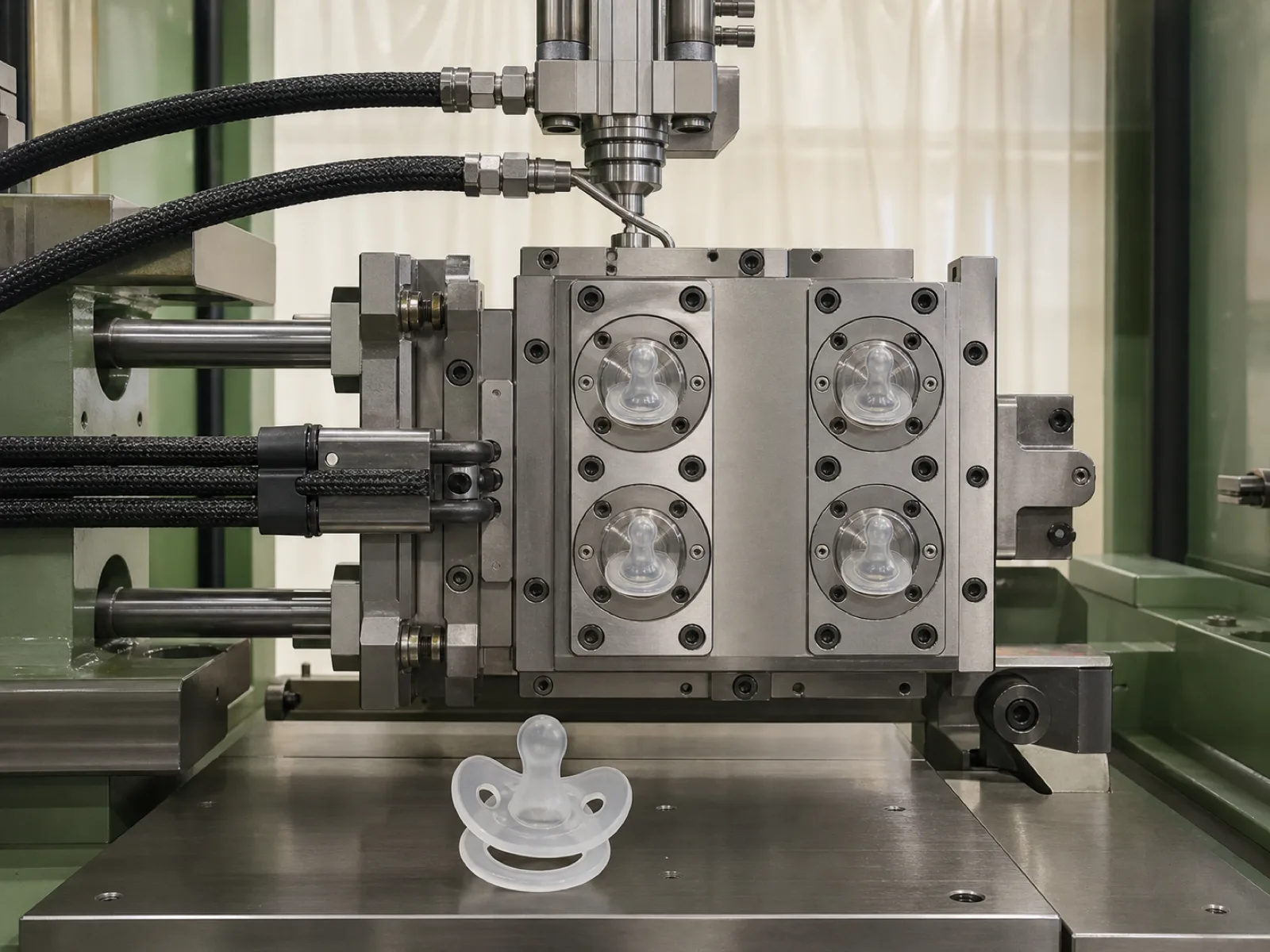
The Wetop engineering desk runs one LSR cell dedicated to infant-contact SKUs and separates it from the general kitchenware compression line with a physical curtain, not just paperwork. Cross-contamination on a pacifier line is a career-ending mistake for a sourcing manager, and the isolation matters.
What material spec should the pacifier compound hit?
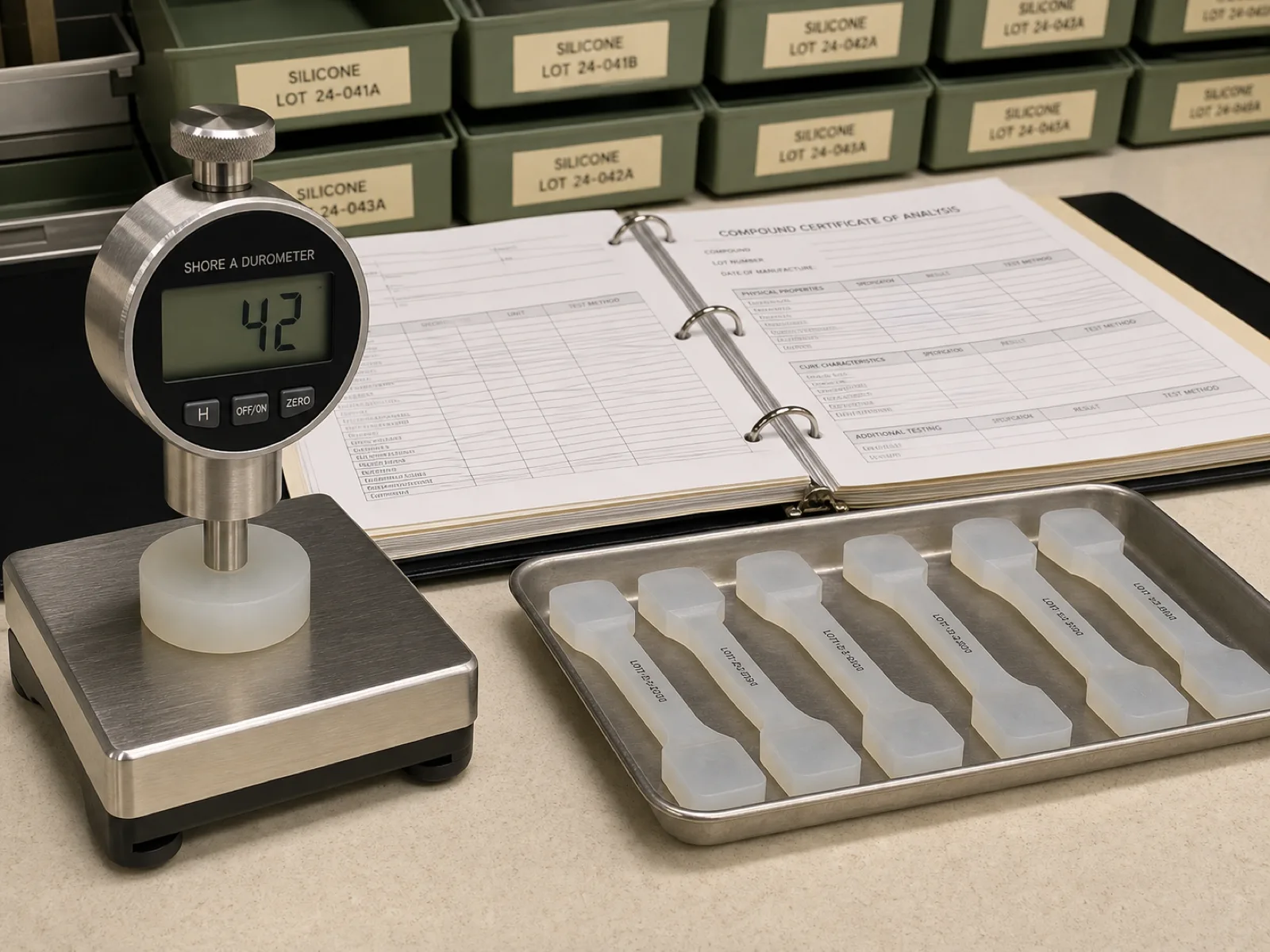
Infant-contact pacifier compound must be platinum-cured (addition-cured) liquid silicone rubber, food-grade per FDA 21 CFR 177.2600[^fda-177-2600] and LFGB §30/§31 (the [FDA vs LFGB comparison](/guide/fda-vs-lfgb-silicone/) explains what each certification actually tests), with nipple durometer Shore A 30-50 and shield durometer Shore A 40-60. Peroxide-cured HCR is not acceptable — it leaves residual 2,4-dichlorobenzoic acid byproducts that fail EN 1400 volatile testing, a difference the [platinum-cured vs peroxide-cured comparison](/guide/platinum-cured-vs-peroxide-cured-silicone/) breaks down in chemistry-level detail.
The engineering baseline for a compliant silicone pacifier manufacturer compound looks like this:
| Property | Nipple compound | Shield compound | Test method |
|---|---|---|---|
| Cure system | Platinum-cured LSR | Platinum-cured LSR | — |
| Shore A hardness | 30-50 (newborn 30-40, 6mo+ 40-50) | 40-60 | ASTM D2240 |
| Tensile strength | ≥ 8.5 MPa | ≥ 9.0 MPa | ASTM D412 |
| Elongation at break | ≥ 550 % | ≥ 450 % | ASTM D412 |
| Tear resistance (Die B) | ≥ 25 kN/m | ≥ 28 kN/m | ASTM D624 |
| Specific gravity | 1.10-1.14 | 1.12-1.16 | ASTM D792 |
| Volatile content (post-cure) | ≤ 0.5 % | ≤ 0.5 % | 200 °C × 4 h loss |
| Regulatory | FDA 21 CFR 177.2600 / LFGB §30 / EN 1400 | FDA 21 CFR 177.2600 / LFGB §31 | — |
Tensile and tear numbers are not cosmetic. EN 1400[^en-1400] pull-off resistance requires the nipple-to-shield bond to survive 90 N tensile for 10 seconds without separation. Compound with tensile below 8 MPa can pass on a good day and fail on a hot summer day when the mold ran 6 °C over target — that variance is what recalls are made of. Insist on the compound supplier’s certificate of analysis (Momentive, Wacker, Shin-Etsu, or Elkem are the four suppliers a serious factory uses) with every lot.
How is EN 1400 nitrosamine and pull-force testing actually run?
EN 1400 nitrosamine testing extracts the pacifier in artificial saliva at 40 °C for 24 hours, then analyzes the eluate by GC-MS for N-nitrosamine (limit 0.01 mg/kg) and nitrosatable substances (limit 0.1 mg/kg)[^pubmed-nitrosamine]. Pull-force testing clamps the shield and applies 90 N tensile to the nipple for 10 seconds — the assembly must not separate or tear.
Nitrosamine is the silent recall. It comes from residual amines in cheap peroxide-cured silicone reacting with atmospheric nitrogen oxides during storage. Platinum-cured LSR with a proper 4-hour post-cure at 200 °C drives the volatiles off before the pacifier is packed, which is why a silicone pacifier manufacturer running the correct process barely thinks about nitrosamine — it’s a non-event on their line. A supplier who skips post-cure to shave 40 minutes off cycle time will fail this test at random, and the recall lands on your brand, not theirs.
The pull-force test is more physical. In a one-piece molded LSR pacifier there is no bond — the nipple and shield cure as a single continuous elastomer, so pull force fails only if the geometry is wrong or the compound is under-spec. In two-piece pacifiers (nipple molded separately, shield overmolded or mechanically clipped) the bond is a distinct failure mode. Ask the manufacturer to demonstrate the pull test on a random three-unit sample from the current production lot, not on the golden sample they mailed you six months ago.
What does the US retail-audit compliance packet look like?
A US retail-audit-ready packet from a silicone pacifier manufacturer contains: a Children's Product Certificate[^cpsc-cpc], CPSIA 16 CFR 1307 phthalate lab report[^cpsia-1307], CPSIA lead report (16 CFR 1500), 16 CFR 1130 tracking-label sample[^cpsia-1130], EN 1400 batch report, PFAS-free declaration for California AB 1200, ISO 14644 cleanroom certification[^iso-14644], and a Sedex SMETA 4-Pillar audit report dated within 12 months.
Every US retailer’s baby-buyer runs the same checklist. Target’s vendor onboarding is the strictest — they will ask for the CPC, the underlying third-party lab reports (accredited by the CPSC per 16 CFR 1112), the ASTM F963-23 general-toy-safety report[^astm-f963], and a tracking-label sample showing the manufacturer name, lot code, cohort, and date-in-cavity code — the same vetting rigor the factory sourcing checklist walks through end to end. buybuy BABY additionally checks EN 1400 conformity because they distribute pacifiers into Canadian and international markets. Walmart’s audit adds Sedex SMETA social compliance and — for private-label programs — a Higg FEM environmental profile.
A prepared silicone pacifier manufacturer ships this packet as a single PDF bundle, referenced by lot number. An unprepared one emails you a stack of type-approval certificates from 2019 and hopes you don’t notice they don’t match the shipping invoice. The audit trail matters more than any single certificate — CPSC investigators look for the paper chain from compound CoA to per-lot GC-MS report to signed CPC to shipping BOL. Break that chain anywhere and the retailer pauses the PO.
What’s the realistic MOQ, tooling cost, and lead time?
Custom silicone pacifier programs run MOQ 500-1000 units per SKU per color on 2-4 cavity S136 stainless tooling costing $2,500-$5,000. Existing-geometry samples ship in 7-15 days; custom nipple tooling adds 30-45 days for T1 samples. Production runs 25-35 days for 10,000-50,000 units, plus 30-35 days ocean freight from Yantian Port to US West Coast.
Here is the pricing math the engineering desk uses for pacifier RFQs — the underlying logic is the same MOQ and lead-time framework that governs every custom silicone program:
| Program stage | Timeline | Cost basis |
|---|---|---|
| DFM review + tooling quote | 3-5 days | Free |
| S136 4-cavity nipple tool | 30-45 days | $2,500-$5,000 amortized |
| T1 sample + EN 1400 pre-test | 7-15 days after T0 | $150-$400 sample cost |
| Compound + Pantone match approval | 5-10 days | Included on MOQ ≥ 5,000 |
| Production run (10k-50k) | 25-35 days | Unit cost FOB Yantian |
| Full compliance testing per lot | Concurrent | $600-$1,200 per lot |
| Ocean freight Yantian → LGB | 30-35 days | LCL or 20’/40’ FCL |
| Air freight (launch SKUs) | 5-8 days | 3-5× ocean cost per kg |
Unit FOB pricing for a one-piece LSR pacifier in orders of 10,000-50,000 units lands in the $0.55-$1.20 range depending on nipple complexity, compound Shore A dual-durometer, packaging (blister vs box vs polybag), and color count — the silicone OEM pricing structure guide breaks down where each cent goes. A silicone pacifier manufacturer who quotes $0.28 FOB is either compression-molding with a seam or planning to skip post-cure. Both catch up with you at customs.
What DFM issues sink first-time pacifier tooling?
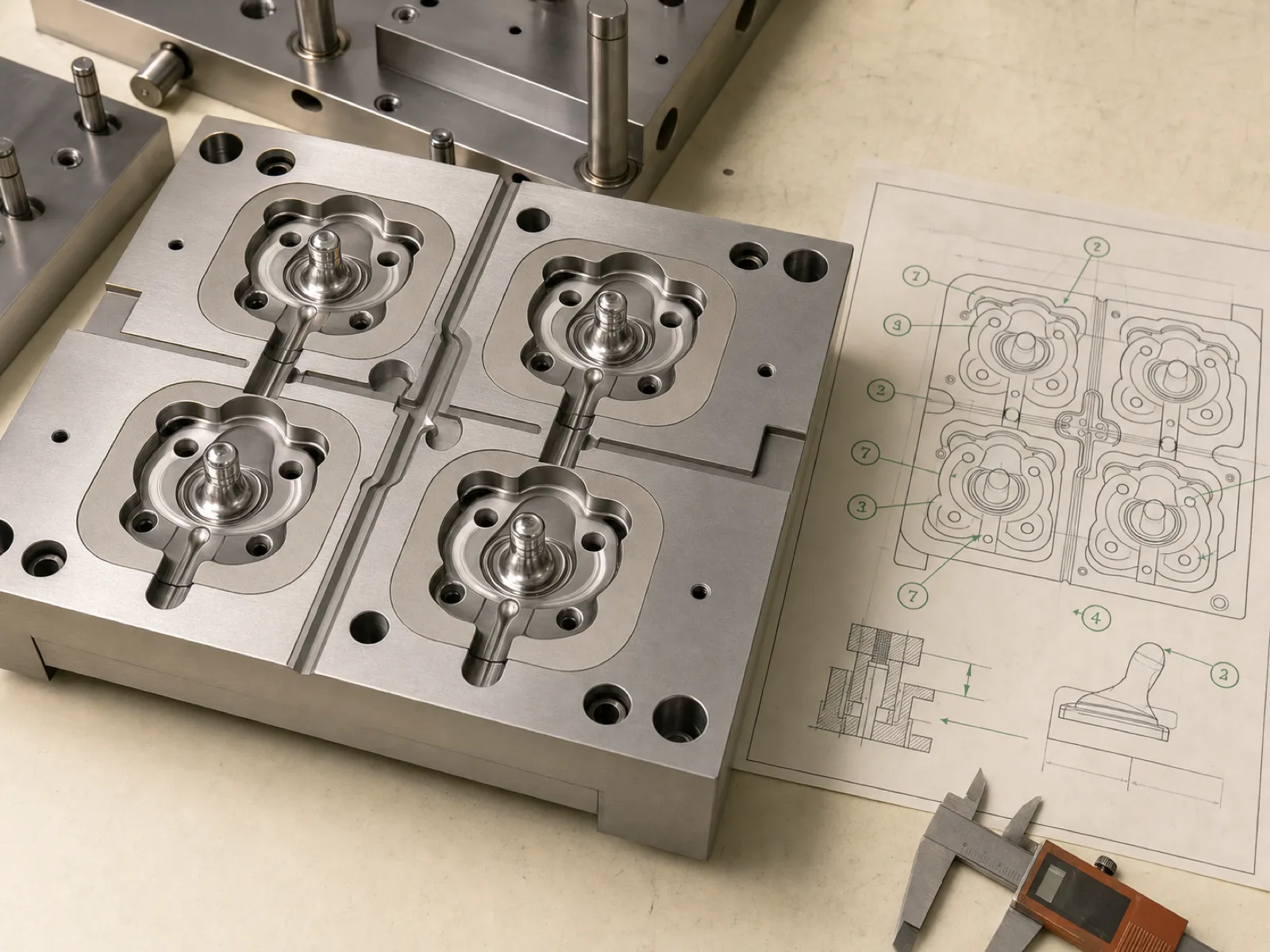
Three DFM issues sink most first-time silicone pacifier tooling: undercut geometry on the shield ventilation holes that traps compound during demolding, air-trap on the nipple tip that causes voids under EN 1400 pull test, and cold-runner temperature drift that produces per-cavity durometer variance beyond ±3 Shore A. A DFM review before cutting steel prevents all three.
The engineering desk’s DFM review catches these before quoting. Shield ventilation holes must be at least two, minimum 4 mm diameter, positioned so the shield can’t seal against a child’s face — EN 1400 defines this geometry. If the industrial designer draws holes smaller or off-axis, the tool cuts them anyway and the pacifier fails the ventilation test at final QC. Air-trap on the nipple tip shows up as a matte spot inside an otherwise translucent nipple; it’s a stress concentrator that fails pull-off tests at 60-75 N instead of 90 N. Cold-runner delta-T over 15 °C between cavities produces a spread of nipple durometers — one cavity molds at Shore A 42, the next at Shore A 48, and the retail QC engineer rejects the whole lot when they run a random Shore A sweep.
A serious silicone pacifier manufacturer builds a DFM report before quoting tooling: 3-5 pages with annotated CAD, cavity layout, gate location, vent placement, ejector strategy, laser-mark position, and a call-out on any geometry that will need a design revision to pass EN 1400. Ask for it. If they can’t produce one, they don’t own the tooling — they broker it.
How does a factory prevent nitrosamine drift across a 12-month program?
A qualified silicone pacifier manufacturer prevents nitrosamine drift by running a GC-MS check on a coupon from every production lot, holding 200 °C × 4 hour post-cure as a non-skippable ERP-locked step, sourcing compound only from Momentive / Wacker / Shin-Etsu / Elkem with CoA validation, and re-testing full EN 1400 nitrosamine per quarter on stored retail samples for 18 months post-ship.
Nitrosamine drift is the sleeper risk on a rolling PO. First shipment tests clean, months six and seven test clean, and then month eight fails because the compound supplier switched a stabilizer without telling anyone, or because a factory quietly cut post-cure to 3 hours to hit a rush order. The controls are boring but they work: lock the compound supplier and require lot-level CoA, lock the post-cure recipe in the ERP so operators can’t shorten it, run a GC-MS coupon per production lot, and archive three retail-format sealed samples per lot for 18 months so if a retailer complains you can pull the exact cohort and re-test it.
The Wetop engineering desk runs this cadence as the default on infant-contact SKUs — it’s cheap compared to a recall. Ask a candidate silicone pacifier manufacturer for their SOP on post-cure lock-out and their retention-sample protocol. If they say “we don’t need one because we test every batch,” they don’t understand what recall investigations look like.
How does one-piece LSR pacifier molding compare to two-piece assembly?
One-piece LSR pacifiers cure the nipple and shield as a continuous elastomer in a single injection cycle, eliminating the bond line that is the single most common EN 1400 failure point. Two-piece assemblies mold the nipple and shield separately then clip, glue, or overmold — every added interface is a choking-hazard risk and a QC step. A serious silicone pacifier manufacturer will steer new tooling toward one-piece unless the geometry demands otherwise.
The trade-off is real but weighted heavily toward one-piece. Two-piece designs are cheaper on simple tooling (one nipple mold plus one shield mold instead of a dual-durometer LSR cell) and let the buyer swap nipple hardnesses on a shared shield SKU. But every clip-and-latch assembly must survive the EN 1400 90 N pull test, and clip fatigue after 200 boil-sterilization cycles is the recall pattern that killed several 2018-2022 pacifier lines. One-piece LSR eliminates the interface entirely — the failure mode has to become tearing of the silicone itself, which happens at 120-150 N in a well-molded pacifier.
The cost premium for one-piece is 15-25 % at unit level and roughly $1,200-$2,000 additional on tooling for the dual-durometer cavity block. For a Tier 2 US baby brand shipping 40,000-80,000 units a year, the recall-risk delta pays for the premium in the first 12 months. Insist on one-piece molded LSR unless your industrial designer has a specific reason otherwise, and get that reason on paper.
What payment terms and Incoterms should a first-order buyer expect?
First-order silicone pacifier manufacturer terms typically run 30% deposit on PO, 70% balance against copy of BL, FOB Yantian on containers ≥ 20 CBM, or DDP on air-freight launch quantities. Tooling is billed 100% upfront and amortized over the first 20,000 units — a serious factory will refund 50% of tooling if the program cancels before T1 approval.
Payment terms tighten on the second order once the factory sees the compliance packet clear customs and the retailer accept a first shipment. Second orders often move to 20% deposit / 80% BL copy, and enterprise buyers negotiate to 100% on 60-day open terms after the fourth successful shipment. Incoterms matter more than most buyers realize: FOB Yantian is standard for FCL container programs, EXW Dongguan for buyers with a US-based freight forwarder, and DDP for launch quantities where the retailer needs stock at a US 3PL by a fixed date. A qualified silicone pacifier manufacturer can quote all three and will walk you through the compliance-doc hand-off (CPC, tracking-label print sample, EN 1400 batch report) at each Incoterm change.
Tooling amortization is the pricing lever most sourcing managers miss. Standard practice is 100% tooling paid upfront by the buyer, which means the buyer owns the mold — a serious factory ships the tooling drawing set with the first PO and can transfer physical possession on request. If a factory asks you to amortize tooling into the unit price and refuses to disclose the amortization schedule, they are marking up a mold they already own from a previous customer. That’s fine when the geometry is genuinely stock; it’s a red flag when you thought you were buying a custom nipple.
What packaging, sterilization instructions, and tracking labels does US retail require?
US retail packaging for a silicone pacifier must carry a permanent 16 CFR 1130 tracking label on both the product and the retail package, a CPSIA choking-hazard warning per ASTM F963-23, sterilization instructions per EN 1400 for cross-border SKUs, and — for GS1-registered retailers — a UDI-compatible lot code laser-marked on the shield. A qualified silicone pacifier manufacturer prints and marks all four in-line.
The mechanical detail matters. 16 CFR 1130 says “permanent” — pad-printed labels that rub off after 30 dishwasher cycles do not qualify. Best-practice execution is laser-marking the shield with a 3-line code (manufacturer prefix + YYMMDD lot + cavity number) and printing the retail package with a matching lot band and QR code that resolves to the manufacturer’s product-registration URL. The tracking label lets CPSC investigators isolate a recall to a single cavity of a single production day — the difference between recalling 8,000 units and 800,000.
Sterilization instructions on-pack are an EN 1400 requirement for European sale and a best-practice for US launch. Language must specify boil sterilization (5 minutes rolling boil, max 3 cycles per week), steam-sterilizer compatibility, and a “replace every 4-6 weeks or at first sign of wear” cadence. Skipping this text is one of the fastest ways to fail a Health Canada import review.
How do sample rounds, T1/T2 tooling revisions, and PPAP work for a pacifier program?
A pacifier program moves through T0 (kickoff + DFM) → T1 (first-shot samples, 30-45 days) → T2 (revised samples after DFM tweaks, 10-15 days) → PPAP (production-part-approval process, 5-10 days) → mass production. Expect 2-3 sample rounds before PPAP sign-off; a factory that promises single-shot approval is usually shipping a stock geometry with your logo added.
The Wetop engineering desk quotes T1 with EN 1400 pre-testing bundled in — nitrosamine, pull-force, ventilation geometry, small-parts choke test — so the buyer sees a full pass/fail on the first shot instead of discovering a failure after tooling is committed. T2 usually addresses one of three things: a durometer tweak (compound blend adjust), a vent-hole geometry revision (mold insert swap), or a Pantone color correction (master-batch reformulation). PPAP is the formal sign-off packet: material CoA, dimensional report on 10 units across all cavities, EN 1400 full report, CPC draft, tracking-label print sample, and the retail-package artwork proofed against final die-lines.
A silicone pacifier manufacturer who runs this cadence keeps the launch on schedule. A supplier who skips T2 and jumps to production usually lands a T1 defect into the first 5,000 units and burns a Target sell-through window recovering.
Frequently asked questions
The FAQ block above is mirrored into the page’s FAQPage JSON-LD verbatim — every question and answer you see in frontmatter is what an AI answer engine or a Google People Also Ask surface can extract without ambiguity.
Next step — talk to the engineering desk
If you are sourcing a silicone pacifier manufacturer for a Tier 2 US baby brand, a private-label retail chain program, or a European market SKU, the Wetop engineering desk will run a DFM review on your CAD and hand back a tooling quote, an EN 1400 test plan, and a compliance-packet outline within 5 business days. No RFQ mill, no trading-company handoff — one factory floor in Dongguan with an LSR cell dedicated to infant-contact molding and the paperwork to prove it.
Start a conversation on /contact/ with your target unit volume, Shore A preference, and target retail-chain audit body. A signed mutual NDA precedes any DFM disclosure on both sides.
FAQ
-
What EN 1400 tests must a silicone pacifier manufacturer document per batch?
EN 1400:2013+A2:2018 requires per-batch documentation of nipple pull-off resistance (90 N × 10 s), nipple tear, shield ventilation-hole geometry, small-parts choke test, and N-nitrosamine plus nitrosatable-substance release (limits 0.01 mg/kg and 0.1 mg/kg respectively). A competent manufacturer supplies the third-party test report referencing lot code and cure date, not a one-time type-approval certificate.
-
Do silicone pacifier manufacturers use LSR injection or HCR compression molding?
Serious infant-contact silicone pacifier manufacturers run [liquid silicone rubber (LSR)](/guide/what-is-liquid-silicone-rubber-lsr-explained/) injection with cold-runner tooling. LSR gives one-piece molded pacifiers with no seam between nipple and shield — critical because a seam is a choking-hazard failure point. HCR compression molding is cheaper but leaves a visible flash line and fails EN 1400 pull tests more often.
-
What's the realistic MOQ and tooling cost for a custom silicone pacifier?
Expect MOQ 500-1000 units per SKU per color, mold cost $2,500-$5,000 for a 2-4 cavity S136 stainless-steel tool, and 4-6 weeks tooling lead time. Samples on an existing nipple geometry ship in 7-15 days; a fully custom nipple with new cold-runner design runs 30-45 days from PO to T1 sample.
-
Which US retail chains audit silicone pacifier manufacturers before onboarding?
Target, Walmart, buybuy BABY, and Amazon Baby Registry all require a Children's Product Certificate (CPC), CPSIA lead and phthalate lab reports (16 CFR 1500 / 1307), 16 CFR 1130 tracking labels, and a Sedex SMETA 4-Pillar social audit within 12 months. buybuy BABY additionally checks EN 1400 for cross-border SKUs. A qualified silicone pacifier manufacturer preloads this packet before an audit.
-
Do silicone pacifier manufacturers need a cleanroom for infant-contact molding?
Yes. Best-practice silicone pacifier manufacturers run LSR injection inside a Class 100,000 (ISO 8) cleanroom curtain with HEPA-filtered packaging tables. This isn't regulatory — it's how you keep airborne particulates and mold-release residues off the nipple surface, which shows up as failing GC-MS scans during EN 1400 volatile-content testing.
-
What Shore A hardness range does a silicone pacifier manufacturer use for the nipple versus the shield?
The nipple is molded at Shore A 30-50 for infant suck comfort (softer at 30-40 for newborn, 40-50 for 6+ months). The shield molds at Shore A 40-60 for structural rigidity so it can't be pulled through the mouth opening. One-piece LSR pacifiers use dual-shot or co-molded compounds to hit both durometers in a single cycle.
-
How long does a silicone pacifier manufacturer take to deliver a first production run?
From signed PO to DDP-delivered US warehouse: 7-15 days for T1 samples on existing tooling, 30-45 days for custom nipple tooling, then 25-35 days production for 10,000-50,000 units including EN 1400 batch testing, CPC issuance, and 30-35 day ocean freight from Yantian. Air-freight compresses the total to 55-70 days for launch SKUs.
-
What packaging and tracking-label standards apply to silicone pacifiers sold in the US?
16 CFR 1130 requires a permanent tracking label on the pacifier and on the retail package identifying manufacturer, production date, cohort, and batch. CPSIA also requires the choking-hazard warning per ASTM F963. EN 1400 adds a sterilization instruction on-pack. A silicone pacifier manufacturer laser-marks the shield with the lot code and prints the tracking label using GS1 UDI-compatible formatting when the buyer plans multi-retailer distribution.
-
Is a silicone pacifier manufacturer required to test for PFAS and phthalates?
Yes for the US market. CPSIA 16 CFR 1307 bans eight phthalates above 0.1 % in children's toys and childcare articles. California AB 1200 requires PFAS-free declarations for juvenile products from 2026. LFGB §30/§31 and EN 1400 also mandate volatile organic residue testing. A competent silicone pacifier manufacturer runs GC-MS on every lot for phthalates and adds a signed PFAS-free declaration to the compliance packet.
References
Authoritative sources cited in this guide
- European Committee for Standardization (CEN). EN 1400:2013+A2:2018 — Child use and care articles — Soothers for babies and young children — Safety requirements and test methods. https://www.cencenelec.eu/ — The pacifier safety bible — nitrosamine limits, pull-test force, ventilation-hole geometry all defined here.
- US Food and Drug Administration. 21 CFR 177.2600 — Rubber articles intended for repeated use in contact with food. https://www.ecfr.gov/current/title-21/chapter-I/subchapter-B/part-177/subpart-C/section-177.2600 — Governs the elastomer chemistry approvable for repeated infant-mouth contact.
- US Consumer Product Safety Commission. 16 CFR Part 1130 — Requirements for Consumer Registration of Durable Infant or Toddler Products. https://www.ecfr.gov/current/title-16/chapter-II/subchapter-B/part-1130 — Defines the tracking-label content and permanence rules pacifier packaging must meet for US retail.
- US Consumer Product Safety Commission. 16 CFR Part 1307 — Prohibition of Children's Toys and Child Care Articles Containing Specified Phthalates. https://www.ecfr.gov/current/title-16/chapter-II/subchapter-B/part-1307 — The eight-phthalate 0.1% limit that every pacifier lab report must certify against.
- ASTM International. ASTM F963-23 — Standard Consumer Safety Specification for Toy Safety. https://www.astm.org/f0963-23.html — US toy-safety baseline invoked by CPSIA for children's product certification.
- International Organization for Standardization. ISO 14644-1:2015 — Cleanrooms and associated controlled environments — Classification of air cleanliness by particle concentration. https://www.iso.org/standard/53394.html — Defines the ISO 8 (Class 100,000) cleanroom standard used for infant-contact LSR molding.
- US National Library of Medicine (PubMed). N-Nitrosamines in rubber teats and soothers — occurrence and analytical methods. https://pubmed.ncbi.nlm.nih.gov/2373737/ — Peer-reviewed background on why EN 1400 built the nitrosamine test into the pacifier standard.
- US Consumer Product Safety Commission. Children's Product Certificate (CPC) — Requirements and Guidance. https://www.ecfr.gov/current/title-16 — The certificate every US-sold silicone pacifier must ship with — manufacturer-issued, third-party-lab-backed.
Start a custom program
Send a brief. Get an engineer’s reply in one business day.
Every Wetop program is tooled from a customer’s specification. Send a CAD file (STEP · IGES · DWG) or a written brief and we’ll reply with a mold cost estimate, price brackets at MOQ 500 / 1,000 / 5,000, and any engineering questions.