Buyer Guide · commercial intent
Silicone Rubber Washer Specification Guide
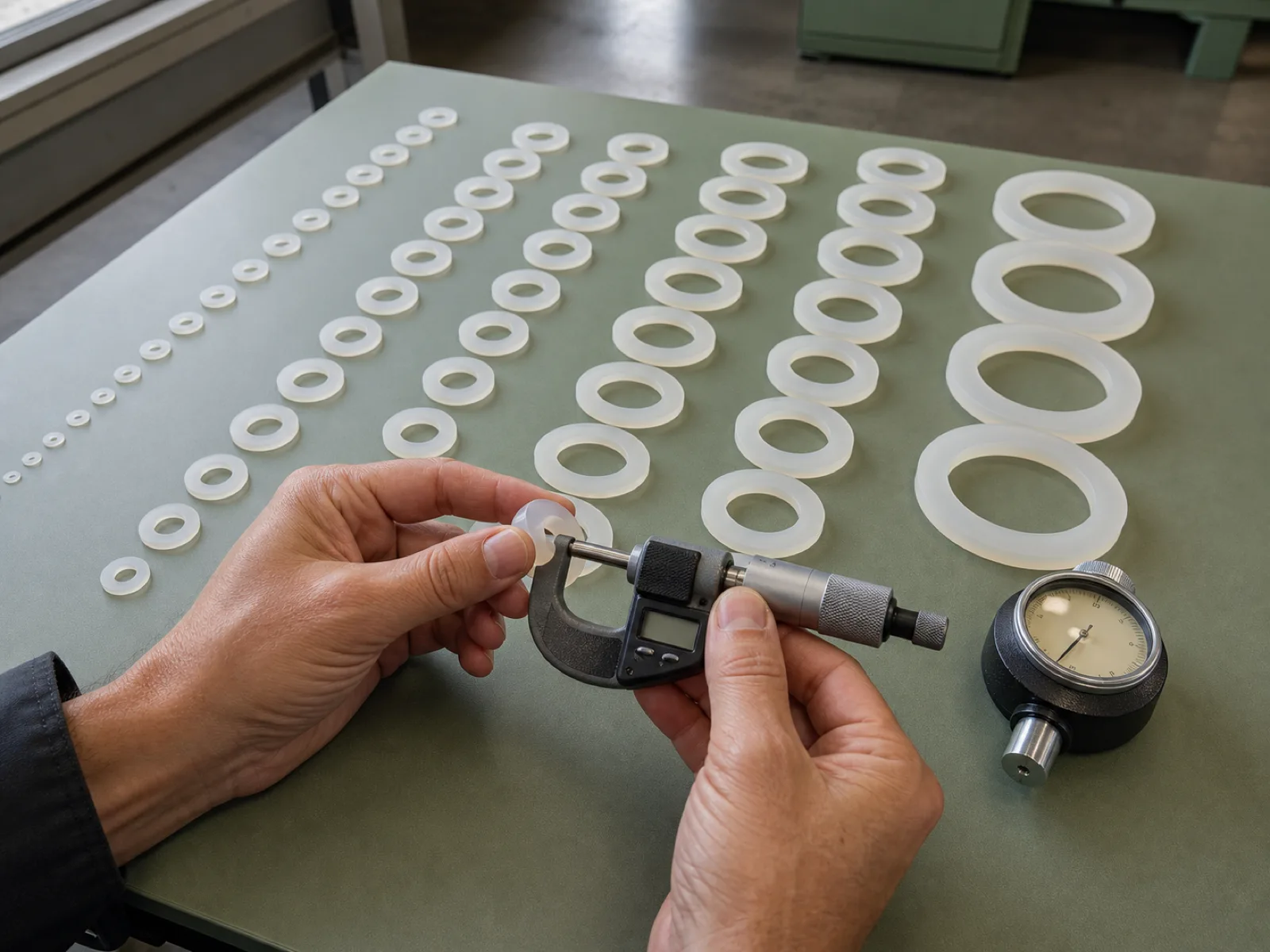 Buyer Guide
 A silicone rubber washer is a molded or die-cut VMQ elastomer ring that seats under a fastener head to seal, damp vibration, insulate, and distribute clamp load from -60°C to +230°C. Its specification stacks four numbers: inside diameter, outside diameter, thickness, and Shore A hardness — plus a compression-set target under 25% per ASTM D395 Method B that keeps the seal alive across thermal cycling. Wetop makes custom silicone washers by die-cutting at MOQ 100 and compression molding at MOQ 500 from a 7,500 m² ISO 9001 factory in Dongguan.
This guide is the engineering-desk reference for anyone writing a silicone rubber washer specification — inside/outside diameter and thickness sizing, Shore A durometer selection, the clamp-load and torque math that actually makes a washer seal, how hardness drifts with temperature, material selection across silicone, EPDM, neoprene, nitrile, and fluorosilicone, cure-system choice, manufacturing method, and the MOQ and RFQ fields a buyer must send. Every recommendation attaches to a number, a cert clause, or a process step. Write these into a drawing before your next RFQ and the factory prices it right the first pass.
What is a silicone rubber washer and when should you specify one?
A silicone rubber washer is a compliant elastomer ring that seats under a bolt head, nut, or threaded fitting to seal against fluid and gas ingress, spread clamp load over a wider area, damp vibration, and electrically insulate. Specify one over a metal or fiber washer whenever the joint must stay leak-tight, shock-isolated, or non-conductive across a wide temperature range with repeated assembly and service cycles.
The job of a silicone washer is different from the job of a gasket, even though both seal. A gasket seals along a flange line; a washer seals a single fastener penetration and carries the mechanical clamp load of that fastener. That dual role — seal plus load-spread — is why washer selection turns on inside diameter, thickness, and durometer far more than on outline shape. Get the bolt-hole clearance and the crush-under-torque right and the washer works; get them wrong and it either weeps or extrudes out from under the fastener.
Silicone earns the washer slot when the joint sees heat, cold, UV, ozone, or food contact that would defeat a cheaper rubber. Faucet and plumbing fittings, LED and electronics enclosures, appliance service panels, HVAC access ports, automotive sensor housings, and medical-device fasteners all specify silicone washers for that reason. When the sealed medium is fuel, oil, or an aromatic solvent, step up to fluorosilicone — covered in the material section below. For the annular-seal cousin that fits into a machined groove instead of under a fastener head, see our silicone O-ring specifying guide.
What are the standard silicone rubber washer sizes — ID, OD, and thickness?
Silicone sealing washers most commonly run 2-12 mm inside diameter to clear M2-M10 fasteners, with outside diameters of 5-30 mm and thickness of 0.5-3 mm. Flat washers for flanges and cover plates scale to 100 mm+ OD. There is no catalog ceiling — custom washers are made to any ID/OD/thickness on drawing. Inside diameter is sized to the fastener shank plus a clearance allowance.
Sizing a silicone washer starts at the inside diameter, because the ID must clear the fastener shank without binding, yet stay small enough that the washer body still seats fully under the fastener head. A practical rule: set the ID to the nominal fastener diameter plus a 0.2-0.5 mm clearance. The outside diameter is then set by the bearing face of the fastener head or the sealing land available on the mating part. Thickness is the third lever — it governs how much surface irregularity the washer can swallow and how much it will crush under clamp load.
Common metric silicone washer sizing reference
| Fastener | Washer ID | Washer OD (typical) | Thickness (typical) | Common use |
|---|---|---|---|---|
| M2 | 2.2-2.4 mm | 5-6 mm | 0.5-1.0 mm | PCB standoffs, small electronics |
| M3 | 3.2-3.5 mm | 7-8 mm | 0.5-1.5 mm | LED enclosures, sensor housings |
| M4 | 4.3-4.5 mm | 9-10 mm | 1.0-1.5 mm | Appliance panels, covers |
| M5 | 5.3-5.5 mm | 10-12 mm | 1.0-2.0 mm | HVAC ports, plumbing fittings |
| M6 | 6.4-6.6 mm | 12-14 mm | 1.5-2.0 mm | Faucet bodies, pump housings |
| M8 | 8.4-8.6 mm | 16-18 mm | 1.5-2.5 mm | Structural fasteners, flanges |
| M10 | 10.5-10.8 mm | 20-24 mm | 2.0-3.0 mm | Heavy flange, cover-plate seals |
Imperial washers follow the same logic against #4 through 3/8 in fastener sizes, with IDs from 0.12 in to 0.41 in. When a drawing needs both, specify the controlling dimension in metric and add the imperial fastener call-out as reference. Molded silicone washers hold their diameters to ISO 3302-11 class M2 (±0.10 mm on a 10 mm feature); die-cut sheet washers hold M3 (±0.20 mm) — precise enough for fastener sealing, not for a press-fit into a machined counterbore.
What Shore A hardness should a silicone rubber washer be?
Shore A 50-70 covers the sealing sweet spot for silicone washers. Choose 40-50A for soft sealing against rough, warped, or plastic faces at low torque, and 60-70A for machined metal faces and high-torque joints that need extrusion resistance. Below 40A the washer cold-flows and thins under sustained clamp load; above 70A it will not conform to an out-of-flat mating face and leaks on torque variance. Measured per ASTM D2240.
Durometer is the most-copied and least-thought-through number on a washer drawing. Buyers paste “Shore A 70” from a template because it sounds durable, then discover the washer weeps under a plastic housing that cannot deliver the bolt load a 70A washer needs. The physics is the same as for any elastomer seal but the consequence is sharper on a washer: a single fastener has to supply all the clamp load, so an over-hard washer starves for conformance pressure exactly where it matters.
The correct question is not “how hard should the washer be” but “what is the finish and stiffness of the face it seals against, and how much torque can that fastener deliver.” Soft, warped, or plastic faces want soft washers that conform. Rigid, machined metal faces can carry harder washers that resist extrusion. Cross-check the deflection-versus-load behavior at each durometer in our Shore A hardness silicone chart.
Shore A selection table for silicone washers
| Shore A | Behavior | Best-fit joint | Torque appetite |
|---|---|---|---|
| 30-40 | Ultra-soft, high conformance | Gap fill, vibration pads, fragile plastic | Very low |
| 40-50 | Soft sealing | Sheet metal, plastic housings, rough faces | Low |
| 50-60 | Balanced seal + load spread | General fastener sealing, faucet fittings | Medium |
| 60-70 | Firm, extrusion-resistant | Machined metal faces, pressure fittings | High |
| 70-80 | Hard, load-bearing | Structural washers, anti-vibration mounts | Very high |
How much clamp load and torque does a silicone washer need to seal?
A silicone washer seals when the fastener compresses it 15-25% of its thickness without extruding it out of the joint. A soft 50A washer reaches that compression at roughly 40% less bolt load than a 70A washer of the same size. Under-torque and the joint weeps; over-torque and the washer cold-flows out from under the head. Target the compression band, then set torque to hit it.
Sealing a washer is a compression problem, not a torque problem — torque is just the proxy a technician can measure on the line. The washer seals because it is squeezed into intimate contact across its full bearing face; that happens somewhere in the 15-25% thickness-compression band for most silicone durometers. Below that band there is not enough contact pressure to close surface leak paths; above it the washer starts to cold-flow and thin, and once it thins the clamp load relaxes and the seal is lost on the next thermal cycle. Compression set — the permanent thickness loss under sustained load — is what turns an over-compressed washer into a slow leak, which is why the ship-gate is ≤ 25% compression set at 175°C / 22 hr per ASTM D3952 Method B.
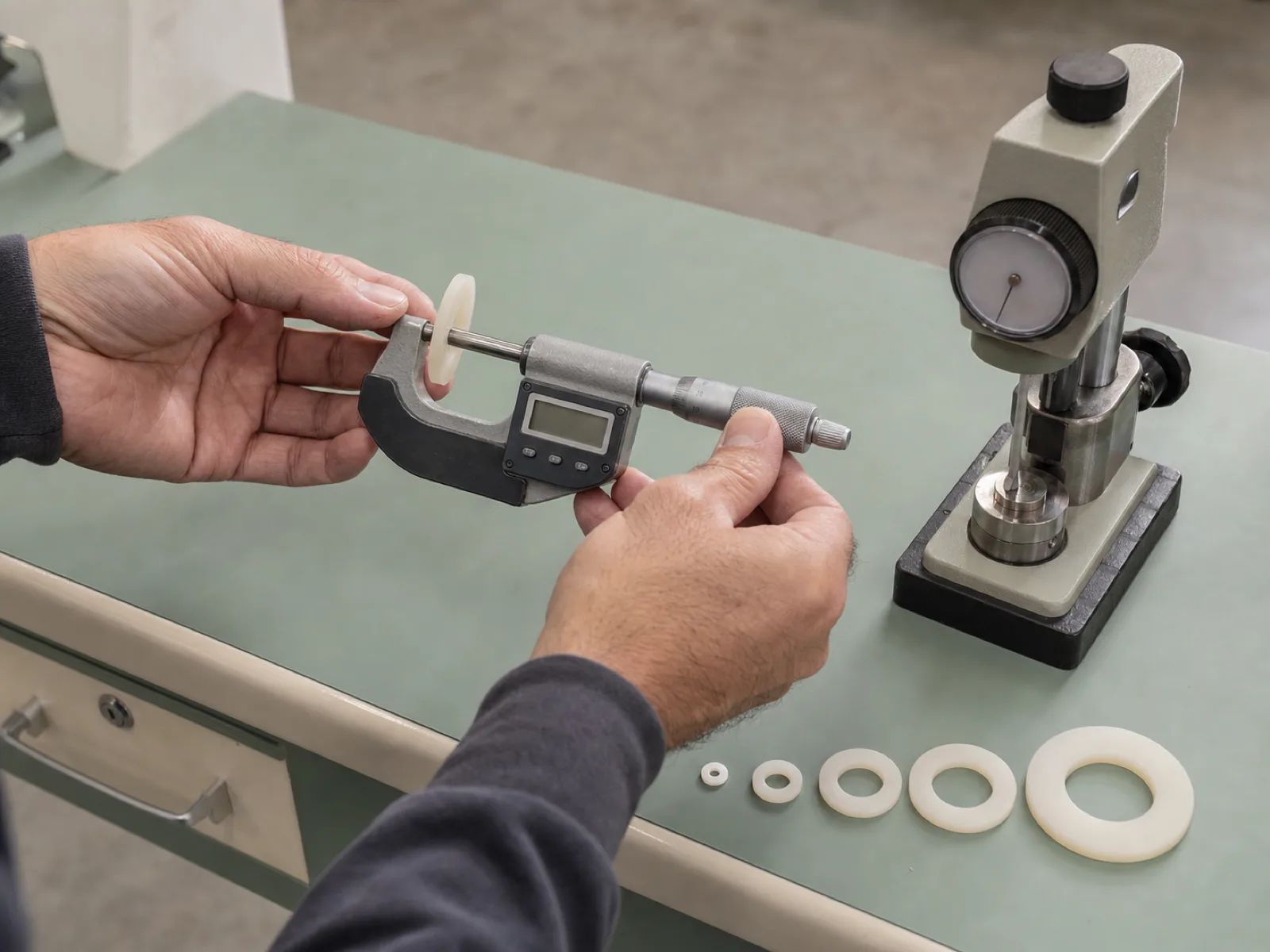
Approximate torque to reach 20% compression on a silicone sealing washer
| Washer size | Shore A 50 | Shore A 60 | Shore A 70 |
|---|---|---|---|
| M3 (7 mm OD, 1 mm thk) | 0.5-0.7 N·m | 0.7-0.9 N·m | 0.9-1.2 N·m |
| M5 (11 mm OD, 1.5 mm thk) | 1.5-2.0 N·m | 2.0-2.6 N·m | 2.6-3.4 N·m |
| M6 (13 mm OD, 2 mm thk) | 3.0-4.0 N·m | 4.0-5.2 N·m | 5.2-6.8 N·m |
| M8 (17 mm OD, 2.5 mm thk) | 6.0-8.0 N·m | 8.0-10.5 N·m | 10.5-14 N·m |
These are engineering-desk starting points for face-sealing washers on rigid joints, not a substitute for a bolted-joint calculation — actual torque depends on thread friction, mating-face stiffness, and whether a metal back-up washer caps the silicone. The takeaway is directional and it matters: a 70A washer needs 60-70% more torque than a 50A washer to reach the same seal, so a joint designed around soft washers will under-seal if a buyer silently substitutes a harder durometer.
How does temperature change a silicone washer’s hardness and seal?
Silicone hardness is temperature-dependent. A washer measured at Shore A 50 on the bench behaves near 70A at -50°C and softens 5-10 points toward 40-45A at +200°C. This thermal drift changes the clamp load required to keep the washer sealed — a washer that seals at room temperature can weep hot as it softens, or crush cold as it stiffens. Specify durometer for the service temperature, not the lab bench.
Every elastomer stiffens as it cools toward its glass-transition region and softens as it heats, but silicone’s drift is worth designing around because its service window is so wide. Near -60°C, standard VMQ approaches its low-temperature limit and a mid-durometer washer stiffens dramatically — it stops conforming to surface irregularity and can crack under assembly load if forced. Near +200°C it softens and loses extrusion resistance, so a washer sized for cold-torque may cold-flow out of a hot joint. This is the drift angle competitors almost never tabulate, and it is the difference between a washer that survives a thermal-cycling qualification and one that fails it in week two.
Approximate hardness drift of a nominal Shore A 50 silicone washer
| Service temperature | Effective Shore A | Sealing consequence |
|---|---|---|
| -50°C | ~68-70A | Stiff, low conformance — needs more assembly care |
| -20°C | ~58-62A | Firmer than rated, higher clamp load to seal |
| +23°C (bench) | 50A (nominal) | Rated behavior |
| +150°C | ~44-47A | Softer, seals at lower load, watch extrusion |
| +200°C | ~40-45A | Soft — risk of cold-flow under sustained torque |
The design move is to pick the durometer that lands in the 50-70A sealing sweet spot at the hottest and coldest service points the washer will actually see — not just at 23°C. A washer that spends its life at +180°C should often be specified 5-10 points harder on the bench so it lands near 55-60A hot. Our temperature range explainer covers the underlying siloxane-backbone behavior that drives this drift, plus the post-cure step that stabilizes it. Peak-temperature tolerance for silicone follows ASTM D5733 air-oven aging.
Silicone vs EPDM vs neoprene vs nitrile vs fluorosilicone — which washer material?
Silicone wins on temperature range (-60°C to +230°C), food/medical safety, and UV/ozone resistance. EPDM is cheaper for water, steam, and weathering but tops out near 150°C. Neoprene balances moderate oil and weather resistance mid-cost. Nitrile is the fuel-and-oil choice at low cost but degrades in heat and sunlight. Fluorosilicone bridges silicone's temperature range with oil resistance at a premium.
Material selection on a washer is decided by two questions the drawing must answer: what temperature does it see, and what fluid does it touch. Silicone owns the wide-temperature, clean-contact end of that space. It is the only one of these five that clears FDA 21 CFR 177.26004 and USP Class VI5 biocompatibility while holding -60°C to +230°C. What it does not do well is resist petroleum fuels and oils — those swell standard VMQ 30-50% and destroy the seal. That is where fluorosilicone (FVMQ) earns its cost premium, and where nitrile wins on price if temperature stays moderate.
Washer material comparison matrix
| Property | Silicone (VMQ) | Fluorosilicone (FVMQ) | EPDM | Neoprene (CR) | Nitrile (NBR) |
|---|---|---|---|---|---|
| Continuous temperature | -60 to +230°C | -55 to +260°C | -45 to +150°C | -40 to +120°C | -30 to +120°C |
| Fuel / oil resistance | Poor | Excellent | Poor | Moderate | Excellent |
| Water / steam | Good | Good | Excellent | Good | Fair |
| UV / ozone / weather | Excellent | Excellent | Excellent | Good | Poor |
| Food contact (FDA) | Yes (platinum) | Limited grades | Limited | No | No |
| Relative cost | 1.0× | 1.8-2.2× | 0.6× | 0.7× | 0.5× |
Engineering-desk rule: default to silicone when the washer sees heat, cold, UV, or food contact; step to fluorosilicone only when it also touches fuel or oil; drop to EPDM for cool water/steam duty on a budget; use nitrile only for oil contact at moderate temperature where UV exposure is nil. Specifying FVMQ when VMQ would work doubles material cost and stretches lead time, because the base compound is a specialty grade most factories do not stock.
Platinum-cured vs peroxide-cured silicone washers — which cure system?
Platinum-cured (addition-cure) silicone is the default for food, medical, and clean-contact washers because it leaves no cure by-products, has low compression set, and clears FDA 21 CFR 177.2600 and LFGB after post-cure. Peroxide-cured silicone is cheaper and fine for general industrial washers, but leaves trace acidic by-products and needs a longer post-cure to reach food-contact compliance. For sealing washers, platinum cure also holds tighter compression set.
The cure system a washer is molded with quietly determines whether it can go into a food, beverage, or medical joint and how well it holds clamp load over years of service. Platinum (addition) cure crosslinks cleanly with no volatile by-products, which is why it dominates food-contact and medical washers and why it delivers the lower compression set that keeps a sealing washer holding load. Peroxide cure is cheaper and perfectly serviceable for industrial washers where food contact and lowest-possible compression set are not requirements — but it leaves trace by-products that a 4-hour, 200°C post-cure must drive off before the part is food-safe.
For a sealing washer the compression-set difference is the decider more often than the food-contact question. Platinum-cured VMQ post-cured to spec holds ≤ 25% compression set at 175°C / 22 hr; a peroxide-cured or under-post-cured washer can drift to 35-45% under the same test — enough to lose sealing thickness inside one heat cycle. Our full platinum-cured vs peroxide-cured silicone breakdown covers the by-product chemistry and the compliance-packet implications in depth.
How are silicone washers manufactured — die-cutting vs compression vs LSR?
Die-cutting wins for flat washers under 2,000 units — a cheap steel-rule die stamps them from calendered sheet at MOQ 100, holding M3 tolerance. Compression molding wins at 500-20,000 units for washers with a raised sealing bead, tapered face, or M2 tolerance. LSR injection wins above 20,000 units and for tight-tolerance or insert-bonded washers where full automation and M1 precision pay off.
Washer geometry usually forces the method before the buyer has any say. A plain flat washer at low volume is a die-cut part — no rational factory tools a compression mold for a shape a steel-rule die can stamp. A washer with a molded sealing bead, a chamfered lead-in, a bonded metal back-up, or a 3D profile has to be molded, because die-cutting only cuts a flat outline from flat stock. The volume then decides between compression molding and LSR injection.
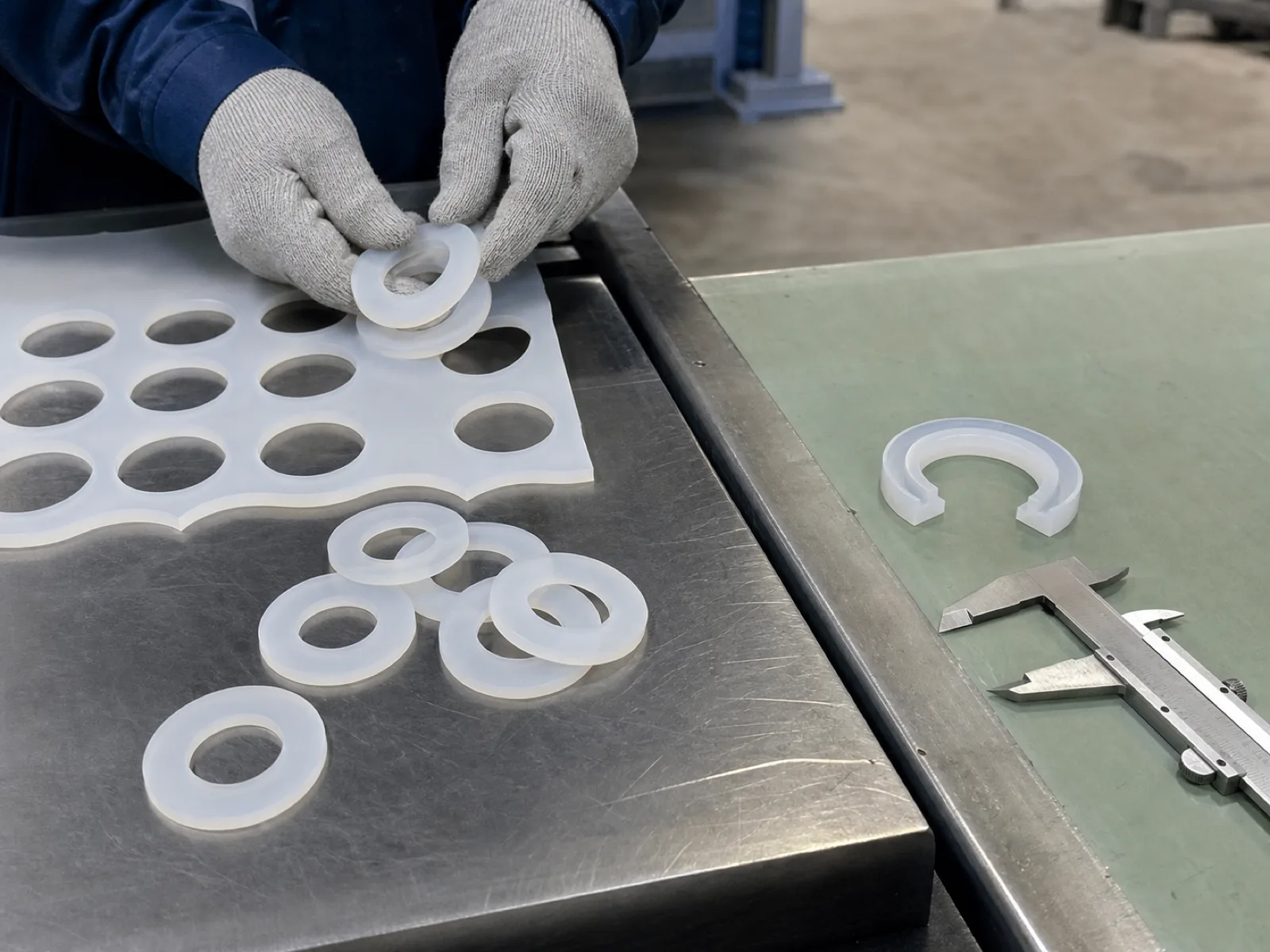
Cost-crossover by manufacturing method — silicone washers
| Method | Tooling cost | Per-piece variable | Break-even volume | Best-fit washer |
|---|---|---|---|---|
| Die-cut sheet | $150-500 (steel-rule die) | $0.05-0.40 | 0-2,000 units | Flat outline, M3 tolerance |
| Compression molding | $2,000-5,000 (single-cavity) | $0.15-1.50 | 500-20,000 units | Sealing bead, tapered face, M2 |
| LSR injection | $10,000-40,000 (multi-cavity) | $0.08-0.90 | 20,000+ units | Tight M1 tolerance, bonded insert |
At MOQ 500 with a 60-day payback target, compression molding closes the tooling-amortization math for any washer that cannot be die-cut. Below that, either the tool cost eats the unit price or the factory declines to quote a hardened LSR mold. The MOQ and lead-time guide walks through the 60-day payback logic behind these break-even volumes.
What MOQ, tolerances, and RFQ fields apply to a custom silicone washer?
MOQ 500 per SKU on compression-molded custom silicone washers; MOQ 100 on die-cut sheet washers with no tooling; MOQ 2,000 on LSR injection. Molded washers hold ISO 3302-1 M2 (±0.10 mm on 10 mm), die-cut hold M3 (±0.20 mm). The RFQ must fix ID, OD, thickness, Shore A, cure system, material grade, color, service temperature, sealed medium, certifications, and annual volume.
Below MOQ 500 the compression tooling cost eats the unit price; at or above it the factory folds tooling into the first production run and the buyer sees a landed cost competitive with commodity washers, but with the right profile, tolerance, and per-lot certification. Die-cut flat washers sidestep tooling entirely and ship at MOQ 100, which is why a plain flat silicone washer is almost always the cheaper path when the geometry allows it.
RFQ checklist — what to send for a custom silicone washer
- Dimensions — inside diameter, outside diameter, thickness, and the tolerance grade (M1/M2/M3 per ISO 3302-1). Name the controlling dimension.
- Hardness — target Shore A and the ± range, specified for the service temperature, not just the bench.
- Material and cure — VMQ / FVMQ / EPDM equivalent, platinum-cured for food/medical or peroxide for general industrial.
- Service conditions — continuous and intermittent temperature, sealed medium (name the chemistry), clamp torque or joint type.
- Certifications — FDA 21 CFR 177.2600, LFGB §30/31, USP Class VI, NSF/ANSI 51, UL 94 flame class, RoHS/REACH.
- Color — Pantone or RAL number with a ΔE target (ΔE < 2 achievable on masterbatch color).
- Annual volume — units per year, blanket-order commitment, and forecast horizon to size the method and tooling.
- Documentation — per-lot Certificate of Conformity, dimensional First Article report, material certification.
Feed all eight into the RFQ on the first pass and the factory quotes correctly the first time. Wetop runs an ISO 90016 quality system that logs each of these fields against the batch record per ASTM D20007 material classification, so the certification chain is auditable at the SKU-and-lot level. Durometer, thickness, and compression set are re-verified on every production lot per ASTM D22408.
References
Talk to the engineering desk about your silicone washer program
Send ID, OD, thickness, target Shore A, service temperature, and sealed medium, and we come back inside 48 hours with a cure-system and material recommendation, a die-cut-versus-molded verdict, and a unit-price bracket at MOQ 100 / 500 / 2,000. First Article samples land in your inbox 25-45 days after drawing lock. Start an RFQ with the engineering desk or download our mutual NDA if drawings need to move under coverage before we begin.
Footnotes
-
ISO 3302-1:2014 — Rubber — Tolerances for Products — Dimensional Tolerances, International Organization for Standardization, https://www.iso.org/standard/61812.html ↩
-
ASTM D395 — Standard Test Methods for Rubber Property — Compression Set, ASTM International, https://www.astm.org/d0395-18.html ↩
-
ASTM D573 — Standard Test Method for Rubber — Deterioration in an Air Oven, ASTM International, https://www.astm.org/d0573-04r19.html ↩
-
21 CFR 177.2600 — Rubber Articles Intended for Repeated Use, US Food and Drug Administration, https://www.ecfr.gov/current/title-21/chapter-I/subchapter-B/part-177/subpart-C/section-177.2600 ↩
-
USP <88> Biological Reactivity Tests, In Vivo — Class VI Plastics, United States Pharmacopeia, https://www.usp.org/harmonization-standards/pdg/excipients/plastic-materials ↩
-
ISO 9001:2015 — Quality Management Systems — Requirements, International Organization for Standardization, https://www.iso.org/standard/62085.html ↩
-
ASTM D2000 — Standard Classification System for Rubber Products in Automotive Applications, ASTM International, https://www.astm.org/d2000-18.html ↩
-
ASTM D2240 — Standard Test Method for Rubber Property — Durometer Hardness, ASTM International, https://www.astm.org/d2240-15r21.html ↩
FAQ
-
What is a silicone rubber washer used for?
A silicone rubber washer sits under a fastener head, bolt, or threaded fitting to seal against fluid and gas ingress, distribute clamp load, damp vibration, and electrically insulate. Unlike a metal washer it deforms to fill surface irregularity, which is why it is specified for faucet spouts, LED enclosures, appliance panels, and HVAC service ports where a leak-tight or shock-isolating fastener joint is required.
-
What sizes do silicone rubber washers come in?
Silicone sealing washers most commonly run 2-12 mm inside diameter for fastener sealing, with outside diameters from 5-30 mm and thickness from 0.5-3 mm. Larger flat washers reach 100 mm+ OD for flange and cover-plate duty. Custom molded and die-cut washers are made to any ID/OD/thickness combination on drawing — there is no fixed catalog limit.
-
How thick should a silicone sealing washer be?
Thickness is set by how much surface irregularity the washer must fill and how much crush the joint allows. 0.5-1 mm suits smooth machined faces at low torque; 1.5-2 mm handles sheet-metal or plastic housings with visible waviness; 2-3 mm gives vibration damping and gap fill. Thicker washers seal better on rough faces but need more clamp load to reach the same compression.
-
How do I choose the Shore A hardness for a silicone washer?
Match hardness to the mating-face finish and the available bolt torque. Shore A 40-50 for soft sealing on rough, warped, or plastic faces at low torque; Shore A 60-70 for machined metal faces and high-torque joints where extrusion resistance matters. Below 40A the washer cold-flows and loses thickness; above 70A it will not conform and leaks on any torque variance.
-
How much torque does a silicone washer need to seal?
Enough to compress the washer 15-25% of its thickness without extruding it out of the joint. A soft 50A washer reaches sealing compression at roughly 40% less bolt load than a 70A washer of the same size. Under-torque and the joint weeps; over-torque and the washer cold-flows out from under the fastener head — both are sealing failures, not just cosmetic.
-
Does a silicone washer get softer when it gets hot?
Yes. Silicone hardness is temperature-dependent — a washer measured at Shore A 50 at room temperature behaves near 70A at -50°C and softens 5-10 points toward 40-45A at +200°C. This thermal drift changes the clamp load needed to keep the washer sealed, which is why a washer that seals cold can weep hot, or one that seals hot can crush cold. Specify the durometer for the service temperature, not the bench.
-
Silicone vs EPDM vs nitrile rubber washer — which is best?
Silicone wins on temperature range (-60°C to +230°C), food/medical safety, and UV/ozone resistance. EPDM is cheaper and better for water, steam, and outdoor weathering but tops out near 150°C. Nitrile (NBR) is the choice for fuel and oil contact at low cost but degrades in sunlight and heat. Fluorosilicone bridges silicone's temperature range with oil resistance at a cost premium.
-
Are silicone rubber washers food-safe and FDA compliant?
Platinum-cured VMQ silicone washers, post-cured 4 hours at 200°C, clear FDA 21 CFR 177.2600 and LFGB §30/31 for repeated food contact while handling -60°C to +230°C. This is the standard grade for beverage-dispenser fittings, water-filter housings, and food-processing fastener seals. Peroxide-cured silicone can leave cure by-products and is not the default for food contact.
-
What is the MOQ for custom silicone rubber washers?
MOQ 500 per SKU on compression-molded custom silicone washers — the floor where single-cavity tooling amortizes on a 60-day payback. Die-cut sheet washers ship at MOQ 100 with no tooling because a steel-rule die is cheap. LSR injection programs need MOQ 2,000 to amortize a multi-cavity hardened mold across the first production run.
-
Can silicone washers be die-cut instead of molded?
Yes — flat silicone washers with generous tolerances are best die-cut from calendered sheet stock, which needs only an inexpensive steel-rule die and ships at MOQ 100. Die-cutting holds ISO 3302-1 M3 (±0.20 mm) and cannot produce 3D profiles, chamfers, or bonded inserts. Choose compression molding when the washer has a raised sealing bead, a tapered face, or needs M2 tolerance.
References
Authoritative sources cited in this guide
- ASTM International. ASTM D2240 — Standard Test Method for Rubber Property — Durometer Hardness. https://www.astm.org/d2240-15r21.html
- ASTM International. ASTM D2000 — Standard Classification System for Rubber Products in Automotive Applications. https://www.astm.org/d2000-18.html
- ASTM International. ASTM D395 — Standard Test Methods for Rubber Property — Compression Set. https://www.astm.org/d0395-18.html
- ASTM International. ASTM D573 — Standard Test Method for Rubber — Deterioration in an Air Oven. https://www.astm.org/d0573-04r19.html
- International Organization for Standardization. ISO 3302-1:2014 — Rubber — Tolerances for Products — Dimensional Tolerances. https://www.iso.org/standard/61812.html
- US Food and Drug Administration. 21 CFR 177.2600 — Rubber Articles Intended for Repeated Use. https://www.ecfr.gov/current/title-21/chapter-I/subchapter-B/part-177/subpart-C/section-177.2600
- International Organization for Standardization. ISO 9001:2015 — Quality Management Systems — Requirements. https://www.iso.org/standard/62085.html
- United States Pharmacopeia. USP <88> Biological Reactivity Tests, In Vivo — Class VI Plastics. https://www.usp.org/harmonization-standards/pdg/excipients/plastic-materials
Start a custom program
Send a brief. Get an engineer’s reply in one business day.
Every Wetop program is tooled from a customer’s specification. Send a CAD file (STEP · IGES · DWG) or a written brief and we’ll reply with a mold cost estimate, price brackets at MOQ 500 / 1,000 / 5,000, and any engineering questions.