Buyer Guide · commercial intent
Silicone Straws OEM Manufacturing Guide
 Buyer Guide
 Reusable silicone straws are extruded or injection-molded from platinum-cured food-grade silicone at 50-60 Shore A with 1.2-2.0 mm wall thickness, then post-cured at 200 °C for 4 hours to drive residual volatiles below 0.5%. Retail-tier OEM programs require FDA 21 CFR 177.2600, LFGB §30/31, and EU 10/2011 migration data on a per-lot COA, not a certificate photo. Wetop runs silicone straws at 500-piece MOQ on stock geometries and 5,000-piece MOQ on custom LSR cavity tooling from a 7,500 m² Dongguan floor, with 7-15 day sampling and 25-35 day production.
Silicone straws look like a commodity SKU until a Tier-2 retail buyer sends the paperwork checklist. Then the difference between a US$0.18 Alibaba straw and a US$0.42 Wetop straw becomes obvious: compound origin, cavity tolerance, post-cure discipline, and a COA that names the clause, the lab, and the mg/dm² value. This guide is written for OEM/ODM buyers running a private-label straw program at 20,000-500,000 pieces per year — the volume window where getting the material spec, tooling economics, and compliance stack right matters more than the unit price.
What compound and durometer belong in a silicone straws OEM spec?
Reusable silicone straws should be molded from platinum-cured LSR at 50-60 Shore A with 1.2-2.0 mm wall thickness. Peroxide-cured HCR is cheaper by 15-20% but leaves a metallic aftertaste and turns cloudy after ~60 dishwasher cycles because peroxide byproducts leach through the wall. Platinum cure with the correct filler load stays translucent 500+ cycles.
There are two cure systems for food-contact silicone, and they behave differently on a thin-walled straw geometry.
- Platinum-cured LSR (liquid silicone rubber) cures with a platinum catalyst at 180-210 °C in the mold. Zero byproducts. Approved by FDA 21 CFR 177.2600[^fda-177-2600] with no residue concern. This is the correct compound for reusable silicone straws — the full trade-off analysis is in the platinum-cured vs peroxide-cured silicone deep dive.
- Peroxide-cured HCR (high-consistency rubber) uses organic peroxides that decompose during cure and leave residual byproducts. Cheaper per kg but requires a longer post-cure to be food-safe. Byproducts are the metallic aftertaste on cheap straws.
Durometer selection is a lip-comfort vs lid-clamp trade-off. Below 45 Shore A the straw collapses when a tumbler lid clamps it (the straw won’t slide back down when the lid closes). Above 65 Shore A the straw feels hard on the lip and cracks at the bend after ~200 cycles. Wetop’s default is 55 A ±5 for 8-inch and 10-inch tumbler straws, and 50 A for 12-inch bent smoothie straws where the bend needs to survive being folded into a cabinet drawer.
Wall thickness follows the same logic. A 1.0 mm wall tears at the bend after ~30 dishwasher cycles because the bend radius amplifies stress. A 2.2 mm wall drops the internal diameter below 6 mm and thick shakes clog. The window is 1.2-2.0 mm — Wetop specs 1.5 mm for 8-inch straws and 1.8 mm for 12-inch smoothie straws with 8 mm ID.
| SKU family | Length | OD | ID | Wall | Shore A | Target pairing |
|---|---|---|---|---|---|---|
| Standard cocktail | 6” (152 mm) | 8 mm | 5 mm | 1.5 mm | 55 A | Mason jars, glassware |
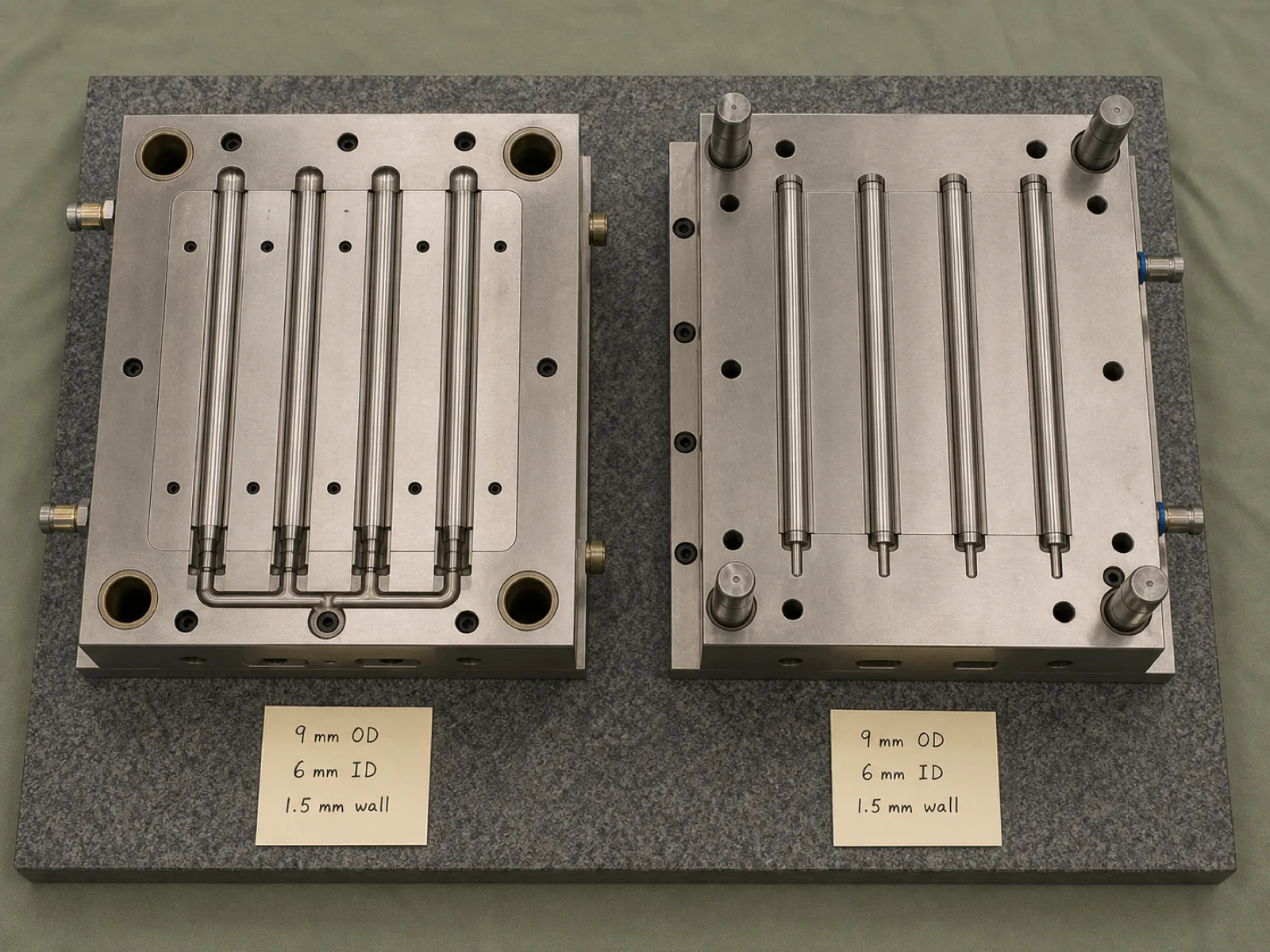
| Tumbler | 8” (203 mm) | 9 mm | 6 mm | 1.5 mm | 55 A | Yeti 20 oz, Stanley 20 oz |
| Tall tumbler | 10” (254 mm) | 10 mm | 7 mm | 1.5 mm | 55 A | Yeti 30 oz, Hydroflask 32 oz |
| Smoothie straight | 10” (254 mm) | 12 mm | 8 mm | 2.0 mm | 55 A | Blender bottles, thick shakes |
| Smoothie bent | 12” (305 mm) | 12 mm | 8 mm | 1.8 mm | 50 A | Stanley Quencher 40 oz |
| Kids’ short | 4.5” (114 mm) | 8 mm | 5 mm | 1.5 mm | 55 A | Kids’ cups, sippy replacements |
| Collapsible | 9” (229 mm) | 10 mm | 7 mm | 1.5 mm | 55 A | Reusable pocket straw |
Which compliance certificates should silicone straws carry for US and EU retail?
A defensible silicone straws compliance stack covers FDA 21 CFR 177.2600 for US, LFGB §30/§31 for Germany, EU Regulation 10/2011 for overall migration, BfR Recommendation XV for silicones, and California Prop 65. The COA must name the clause, the ISO 17025 accredited lab, and the actual mg/dm² migration value — not "FDA/LFGB certified" without a number.
Retail QA teams read compliance paperwork closely. A certificate photo attached to an Alibaba listing does not survive a Home Depot or Whole Foods onboarding review. The FDA vs LFGB silicone reference walks through the clause-by-clause differences US and EU buyers need to demand on the COA. What survives is a per-lot Certificate of Analysis (COA) that lists:
- The clause cited. FDA 21 CFR 177.2600[^fda-177-2600], LFGB §30/§31 backed by BfR XV[^bfr-xv], EU 10/2011[^eu-10-2011].
- The testing lab. Must be ISO 17025 accredited[^iso-17025]. Common accepted labs: SGS, Intertek, TÜV, Eurofins.
- The actual value. Overall migration ≤ 10 mg/dm² per EU 10/2011. Non-volatile matter ≤ 0.5%. Volatile organic compounds ≤ 0.5%. Total organic carbon in extractant ≤ 0.5 mg/dm².
- The extraction conditions. For repeat-use food-contact, distilled water at 100 °C for 30 minutes, and n-hexane at reflux for 7 hours per FDA method.
California Prop 65[^prop-65] is a US retail requirement, not a manufacturing requirement — it demands a statement covering the silicone compound plus any pigments and printed ink. Colored straws are the usual failure point: iron oxide reds and cadmium-free yellows must be documented. If the factory can’t produce a signed Prop 65 statement covering the exact Pantone masterbatch used, the retail buyer sends it back.
How do silicone straws molding processes compare — LSR injection vs HCR compression vs extrusion?
LSR injection is the correct process for silicone straws with bent geometry or tumbler-lid fitment because ±0.1 mm tolerance holds the OD/ID stack-up that lids demand. Extrusion suits long straight straws at high volume but cannot form bends. HCR compression is only appropriate for large-diameter smoothie straws where a slower cycle is acceptable and the cavity tool cost drops.
Three processes are used for silicone straws in production. Choosing the wrong one is expensive.
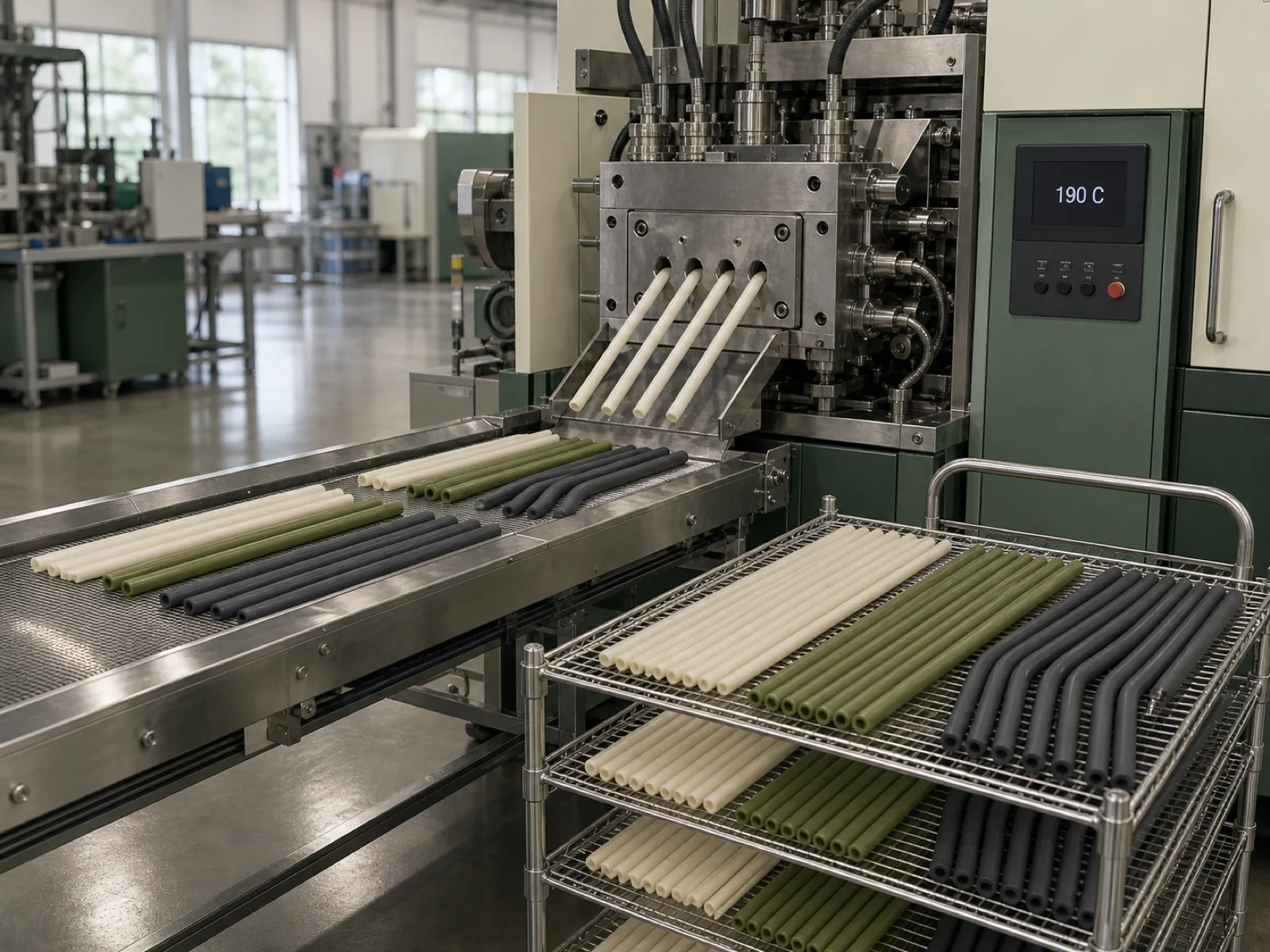
LSR injection molding is fully automated. Two-part LSR (A + B) meters into a heated cavity at 180-210 °C, cures in 30-45 seconds, and demolds automatically. Cavity tools run US$3,000-8,000 for a 4-cavity straw mold. Dimensional tolerance is ±0.1 mm on OD, ID, and length. This is the process for tumbler-lid straws and bent smoothie straws where OD must clamp tight against a silicone lid gasket without falling through.
HCR compression molding loads pre-weighed silicone slugs into an open compression mold. Cure is 60-90 seconds at 170-190 °C. Cavity tools are cheaper (US$2,000-4,000) because the geometry is simpler, but flash removal is manual and dimensional tolerance opens to ±0.2 mm. Appropriate for high-durometer smoothie straws where the extra 0.1 mm variance is invisible.
Extrusion pulls silicone compound through a heated die into an infinite length that gets cut. Very cheap per meter — the correct process for straight cocktail straws sold in bulk. Cannot form bends. Cannot mold a lip flare. Dimensional tolerance drifts as the die heats through the shift.
| Process | Cycle time | Tooling cost | Tolerance | Best for | MOQ economics |
|---|---|---|---|---|---|
| LSR injection (4-cavity) | 30-45 s | US$3,000-8,000 | ±0.1 mm | Tumbler, bent, kids’ straws | 5,000 pcs to amortize |
| HCR compression (8-cavity) | 60-90 s | US$2,000-4,000 | ±0.2 mm | Large-diameter smoothie | 3,000 pcs to amortize |
| Extrusion | Continuous | US$800-1,500 | ±0.15 mm | Long straight cocktail | 20,000 pcs minimum |
Why post-cure is the single most important step in silicone straws production
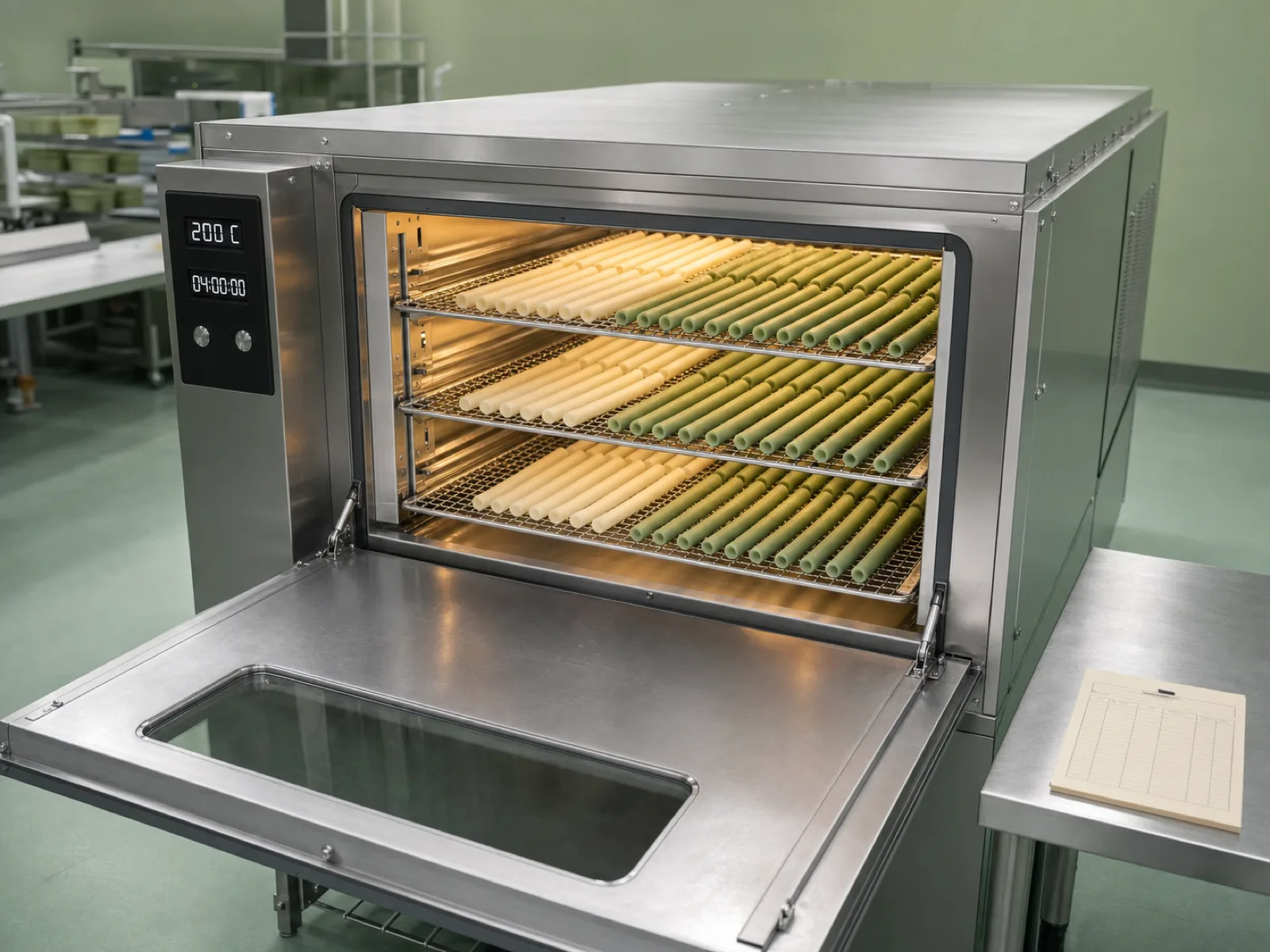
Post-cure is a 200 °C / 4-hour bake that drives residual volatile organic compounds below 0.5% and completes cross-linking that stopped short in the mold. Skipping it is the #1 cause of the "new-straw smell" complaint in retail returns and the #1 root cause of failed EU 10/2011 migration tests. Post-cure is not optional for retail-grade silicone straws.
Every silicone compound leaves the mold with 1-3% residual volatile organic compounds — low-molecular-weight siloxanes, cure byproducts, and traces of the platinum catalyst carrier. In a thick trivet these are trapped and don’t matter. In a 1.5 mm-walled straw with a huge surface-area-to-volume ratio, they migrate to the surface within days and hit the buyer’s nose the first time they open the retail pouch.
The fix is a post-cure bake. Wetop’s spec is 200 °C for 4 hours in a tunnel or batch oven, which drives:
- Volatile organic compounds from ~2% down to < 0.5% (LFGB §30 requirement).
- Non-volatile matter migration from ~0.8 mg/dm² down to < 0.5 mg/dm² (BfR XV requirement[^bfr-xv]).
- Overall migration below 10 mg/dm² (EU 10/2011 requirement[^eu-10-2011]).
The trade-off is throughput. Post-cure adds 4 hours plus load/unload to every batch, which is why the cheap end of the market skips it. A factory quoting US$0.18/straw at 8-inch length is skipping post-cure or reducing it to 60 minutes at 150 °C, which does not drive VOCs below the LFGB limit. The result is the “new-straw smell” that shows up in Amazon 3-star reviews and eventually kills the SKU.
What QC catches cheap silicone straws before they ship?
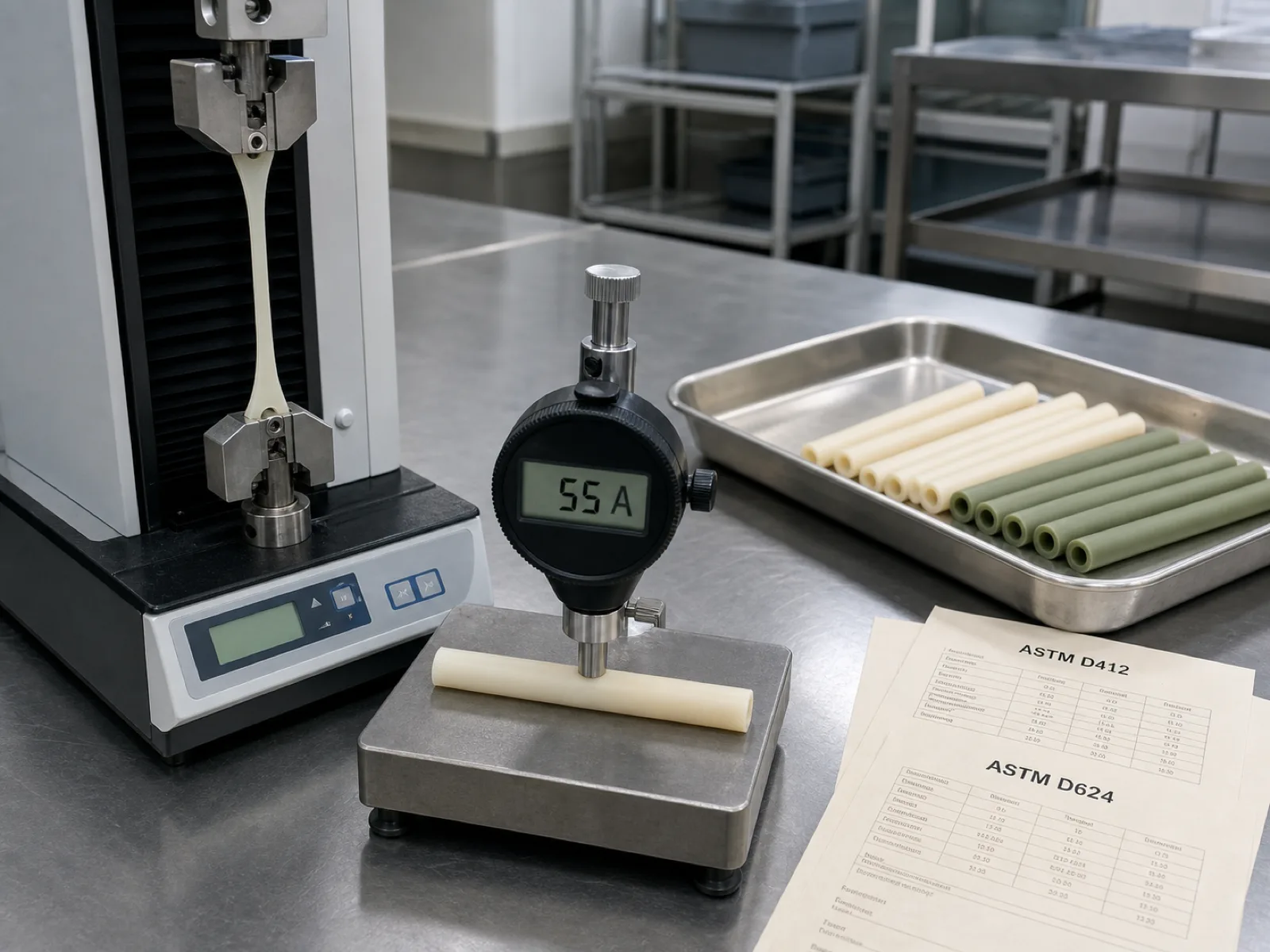
Cheap silicone straws hide behind fillers — calcium carbonate above 5% lowers cost but ruins clarity, tensile strength, and dishwasher survival. Wetop's QC pulls tensile ≥ 8 MPa per ASTM D412, elongation ≥ 400%, and tear strength ≥ 20 N/mm per ASTM D624 on every batch. Anything below these values fails the batch — the "pinch test turns white" folk test is a symptom, not a QC method.
The “pinch and twist — if it turns white, it’s fake” test that circulates on social media detects one specific defect: high calcium carbonate filler load. Real silicone stretches without whitening because the polymer chain aligns rather than fracturing filler particles. The test isn’t wrong, but it’s a symptom check. The QC method behind it is a mechanical pull on a dumbbell specimen.
| Test | Method | Pass line for retail-grade silicone straws | What failure means |
|---|---|---|---|
| Tensile strength | ASTM D412[^astm-d412] dumbbell pull | ≥ 8 MPa | Filler load too high, compound cost-cut |
| Elongation at break | ASTM D412 dumbbell pull | ≥ 400% | Under-cured or over-filled |
| Tear strength | ASTM D624[^astm-d624] trouser tear | ≥ 20 N/mm | Bend will fail after ~200 cycles |
| Shore A hardness | ASTM D2240, 3 s dwell | 50-60 A ±5 | Wrong compound or wrong cure temp |
| Overall migration | EU 10/2011[^eu-10-2011], 100 °C H₂O | ≤ 10 mg/dm² | Fillers or under-cured compound |
| VOC content | LFGB §30 chamber test | ≤ 0.5% | Post-cure skipped |
| Dimensional | Vision gauge on 10% AQL | OD ±0.1, ID ±0.1, length ±0.5 mm | Tool wear or cavity mismatch |
Wetop runs the mechanical trio (tensile, elongation, tear) on the first article of every batch and on every 50,000-piece increment thereafter. Migration tests are batch-level on the first-article and per-lot for retail-tier customers.
Custom color, logo, and retail-ready packaging on silicone straws
Custom silicone straws support Pantone-matched masterbatches (ΔE ≤ 2 vs target), laser-etched or debossed logos that survive 500+ dishwasher cycles, and retail-ready formats from blister card to FSC kraft sleeve to Amazon FBA polybag. Custom color adds a 3,000-piece MOQ per color; logo tooling adds US$300-600 one-time. Pad-print ink must be silicone-specific — standard pad-print ink flakes off within 100 washes.
Color and logo are where retail-grade silicone straws separate from generic. Three logo methods are viable on silicone:
- Debossing — cavity-cut into the LSR tool. Zero unit cost after the one-time US$300-600 tool modification. Survives indefinitely because it’s a geometry change, not applied. Best for a subtle brand mark on the straw base.
- Laser-etching — CO₂ laser vaporizes a thin surface layer to leave a matte mark. US$0.02-0.04 per straw. Survives 500+ dishwasher cycles because the mark is a texture, not ink. Best for URLs, batch codes, or fine graphics.
- Pad-printing — silicone-specific ink (Marabu Tampasil, not standard pad-print ink) transferred by a silicone pad. US$0.03-0.06 per straw. Survives 300-500 cycles. Best for multi-color logos. Standard pad-print ink from a general-purpose factory flakes off within 100 washes — the shortcut that kills brand-color straw programs. The full logo decoration decision matrix — deboss, laser, pad-print walks through unit-cost, wash cycles, and MOQ trade-offs across every viable method.
Color matching runs on Pantone chips referenced to a D65 light-box. Wetop’s cream (~Pantone 7527 C) and sage (~Pantone 5555 C) hold ΔE ≤ 2 across a 100,000-piece run because the masterbatch is compounded, not surface-dispersed. Custom Pantones require a 3,000-piece MOQ per color to justify masterbatch mixing.
Retail-ready packaging matters more than most OEM buyers plan for:
- Blister card — printed kraft or coated card + PET blister. Standard for Home Depot / Bed Bath & Beyond planogram. UPC placement per GS1 standard, typically bottom-right.
- Kraft sleeve + poly bag — Amazon FBA prep-friendly. FSC certification on the kraft adds ~US$0.02/unit.
- Retail pouch with cleaning brush — a straw brush + drawstring pouch. Typical Whole Foods checkout-lane SKU format.
- Amazon FBA prep — polybag with suffocation warning, UPC scannable through the bag, master carton with 25-50 units, palletized to Amazon’s height/weight rules.
Silicone straws MOQ, tooling, lead time, and landed cost
Silicone straws OEM runs at 500-piece MOQ per SKU on stock 8-inch, 10-inch, or 12-inch geometries with laser-etched logos and stock colors. Custom LSR cavity tooling costs US$2,000-8,000 with a 5,000-piece MOQ per SKU to amortize. Sampling is 7-15 days on existing tooling, 20-30 days on new tooling. Production is 25-35 days for 20,000-100,000 pieces including post-cure, QC, and packaging.
The MOQ conversation is the one that separates a real factory from a trading company. Two numbers matter:
MOQ on stock geometry. Wetop maintains cavity tooling for 8-inch, 10-inch, and 12-inch tumbler straws in three colors (translucent, cream, sage). Any customer can order 500 pieces per SKU with laser-etched logo. This is where a retail-brand-new startup places their pilot order.
MOQ on custom tooling. New length, new bend geometry, custom kids’ short, or collapsible design requires a new LSR cavity tool. Tool cost is US$2,000-8,000 depending on complexity and cavity count. To amortize the tool at a reasonable per-unit cost, MOQ is 5,000 pieces per SKU for the first run. After that, reorders on the same tool are again 500 MOQ. The unit-economics math behind these thresholds is broken down in the real factory MOQ math walkthrough.
| Order profile | MOQ | Tooling | Sampling | Production | Landed cost benchmark (FOB Yantian) |
|---|---|---|---|---|---|
| Stock 8-inch, 1 color, laser logo | 500 pcs | None | 7 days | 20-25 days | US$0.32-0.42 per straw |
| Stock 10-inch, custom Pantone, debossed | 3,000 pcs (color MOQ) | US$400 debossing | 10 days | 25-30 days | US$0.36-0.48 per straw |
| Custom bent smoothie, new tool | 5,000 pcs | US$4,500 tool | 20 days | 30-35 days | US$0.44-0.62 per straw |
| Full custom collapsible with pouch | 5,000 pcs | US$6,500 tool | 25-30 days | 35-45 days | US$1.20-1.80 per unit including pouch |
Ocean freight from Yantian Port is 12-18 days to US West Coast, 22-30 days to US East Coast, 25-35 days to Rotterdam. A 20,000-piece order fits in one pallet (~50 kg, ~0.8 m³) — the freight cost per unit is negligible at that volume. Buyers benchmarking a quote line-by-line will find the silicone OEM pricing structure breakdown useful for separating compound cost, tooling amortization, labor, and margin.
What retail-audit paperwork closes (or kills) a silicone straws OEM deal?
Retail programs from Home Depot, Target, Whole Foods, and Amazon FBA require a paperwork bundle that goes beyond the compliance certificate: per-lot COA with mg/dm² values, ISO 17025 lab reports, ISO 9001 factory certificate, BSCI or Sedex SMETA social-compliance audit, Prop 65 statement, UPC/barcode file, and retail-format spec sheet. 80% of silicone straws OEM inquiries die at PO stage because this bundle is incomplete.
This is where most Alibaba-to-retail transitions fail. The retail QA team wants:
- Per-lot COA — every production lot, signed by the factory QA lead, listing the FDA/LFGB clause and the actual mg/dm² value from that lot. Not a photo of a certificate issued three years ago.
- Third-party lab report — ISO 17025 accredited lab (SGS / Intertek / TÜV / Eurofins)[^iso-17025], report number traceable to the lab’s website, testing method named.
- Factory ISO 9001 certificate — current, not expired, issued by an IAF-recognized certification body[^iso-9001].
- Social-compliance audit — BSCI or Sedex SMETA for the manufacturing facility, dated within 24 months. Whole Foods and Home Depot check this first.
- Prop 65 statement — signed by the factory, covering silicone compound and every colorant used[^prop-65].
- UPC/barcode file — GS1-registered UPC, EPS/PDF barcode file at 100% scale, placement per retailer’s planogram guide.
- Retail-format spec sheet — length, weight, colors, care instructions, dishwasher safety, warranty terms, country of origin, RN number if apparel-adjacent.
Wetop assembles this bundle as a standard deliverable on any retail-tier silicone straws program. On our side, the paperwork takes ~3 business days after first-article approval. On the Alibaba side, it takes 3-6 months of back-and-forth and often stalls because the actual manufacturing site is not the entity holding the certificates — the silicone factory sourcing checklist covers the vetting steps that catch this before you cut a PO.
Failure modes and how they show up in a silicone straws production run
The four failure modes that kill silicone straws OEM programs are tear at the bend, cloudy film after washing, mold growth inside narrow-ID straws, and dimensional drift on the OD that breaks tumbler-lid fitment. Each has a specific root cause and a specific QC gate. Wetop catches all four before the container closes; a cost-cut factory catches none.
Tear at the bend. Root cause is inadequate tear strength — usually filler load above 5% or under-cure. Shows up as a split in the bend after 200-500 dishwasher cycles. QC gate is ASTM D624[^astm-d624] trouser tear at ≥ 20 N/mm on every first article. If the number is 15 N/mm, the batch does not ship.
Cloudy film after washing. Root cause is calcium carbonate migration. Cheap compound uses CaCO₃ to cut per-kg cost; hot dishwasher water leaches it to the surface as a haze. QC gate is a 50-cycle accelerated dishwasher test on the first article — 20 straws through a household dishwasher on the sanitize cycle. Cloudy at cycle 30 = compound rejected.
Mold growth inside narrow-ID straws. Root cause is a 5 mm ID that doesn’t dry completely between uses combined with a rough interior surface that traps moisture. Fix is a polished cavity core pin (Ra ≤ 0.4 μm) that leaves a smooth ID, and a cleaning-brush inclusion in the retail SKU. Cocktail straws at 5 mm ID need the polished pin; 7-8 mm ID straws are more forgiving.
Dimensional drift on OD. Root cause is cavity wear or thermal drift on a long production run. Wetop pulls 10 pieces per hour and checks OD on a vision gauge — spec is 9.0 mm ±0.1. Drift beyond ±0.15 mm means the tool goes to the mold shop for refurbishment. A tumbler-lid gasket is unforgiving of a 9.3 mm straw OD.
Anonymized program example — retail-chain kitchen-accessory pilot
A Tier-2 US home-improvement retailer ran a silicone straws pilot with Wetop at 12,000 pieces across two SKUs (10-inch tumbler + 12-inch bent smoothie), custom Pantone cream and sage, laser-etched brand mark. The program cleared retail QA on the first submission because the COA named the ISO 17025 lab, the FDA and LFGB clauses, and the actual migration values — the paperwork gap that kills 80% of factory-direct pilots.
The buyer had spent five months trying to source through an Alibaba supplier. Each iteration returned a different photo of a certificate but never the underlying lab report. The retail QA team rejected the submission three times for insufficient documentation. Wetop’s engineering desk quoted the same two SKUs, ran a 200-piece first article in 12 days, and delivered a paperwork bundle that satisfied retail QA on first pass. Production ran 28 days, shipped in one 20-foot container with retail-ready blister cards, and re-ordered at 3× volume the following quarter. The unit-cost delta versus the Alibaba quote was US$0.09/straw — well below the cost of the six-month delay the buyer had already absorbed.
FAQ
The FAQ block is rendered from frontmatter and mirrored to FAQPage JSON-LD — the answer to each buyer question is above in the relevant section, and the compact Q/A form is what AI answer engines quote.
Talk to the engineering desk
Silicone straws are the smallest, thinnest silicone product Wetop makes, which is why we treat them as the tightest test of our QC. If you’re evaluating a factory-direct silicone straws program at 20,000-500,000 pieces per year, talk to the engineering desk — we’ll return a compound spec sheet, an LSR tool quote, and a retail-audit paperwork bundle within 48 hours.
FAQ
-
What is the correct Shore A hardness for reusable silicone straws?
50-60 Shore A is the correct window for reusable silicone straws. Below 45A the straw collapses when a lid clamps it; above 65A it hurts the lip and cracks at the bend. Wetop specs 55A ±5 as the default for tumbler-lid straws and 50A for bent smoothie straws where flex matters more than lid-clamp resistance.
-
What wall thickness do silicone straws need to survive dishwasher cycles?
1.2-2.0 mm wall thickness is the survival window. Below 1.0 mm the straw tears at the bend after ~30 cycles; above 2.2 mm the internal diameter drops below 6 mm and thick shakes clog. Wetop's default is 1.5 mm wall for 8-inch tumbler straws and 1.8 mm for 12-inch smoothie straws with 8 mm ID.
-
What compliance certificates should silicone straws carry for US and EU retail?
US retail requires FDA 21 CFR 177.2600 conformance and California Prop 65. EU retail requires LFGB §30/§31 (Germany) plus EU Regulation 10/2011 overall-migration testing at ≤ 10 mg/dm². Amazon FBA also increasingly asks for third-party lab reports naming the exact clause and the mg/dm² result — a certificate photo is not enough.
-
Why do cheap silicone straws smell and how is it fixed?
The smell is residual volatile organic compounds from incomplete curing. Fix is a 200 °C / 4-hour post-cure bake in a tunnel or batch oven, which drives residual VOCs below 0.5%. Suppliers who skip post-cure to save 30 minutes per batch are the root cause of the 'new-straw smell' that shows up in Amazon 3-star reviews.
-
Why do silicone straws turn cloudy after being washed?
Cloudy film indicates calcium carbonate filler above 5%, used to cut compound cost. Real platinum-cured silicone stays translucent through 500+ dishwasher cycles. QC catches high filler content with tensile strength (should be ≥ 8 MPa), elongation (≥ 400%), and tear strength (≥ 20 N/mm) on ASTM D412 and D624 test pulls.
-
What is the MOQ for custom silicone straws with a logo?
MOQ is 500 pieces per SKU on stock 8-inch, 10-inch, or 12-inch geometries with laser-etched or pad-printed logos. Custom tooling (new length, bent shape, or child-safe short straw) requires a 5,000-piece MOQ per SKU to amortize the US$2,000-8,000 LSR cavity tool. Pantone-matched colors add a 3,000-piece MOQ per color.
-
How long does it take to manufacture a silicone straws production run?
7-15 days for first-article sampling on existing tooling, 20-30 days for a new LSR cavity tool, then 25-35 days for a 20,000-100,000 piece production run including post-cure, QC, and packaging. Add 3-5 days for FSC-certified retail blister-card packaging or Amazon FBA prep, and 12-18 days ocean freight from Yantian Port to US West Coast.
-
Which manufacturing process is best for silicone straws — LSR injection, HCR compression, or extrusion?
LSR injection is the correct process for tumbler-lid straws (±0.1 mm tolerance, 30-45 second cycle, cavity tool US$3,000-8,000). Extrusion suits long straight straws at high volume but cannot form bends. HCR compression is only appropriate for large-diameter smoothie straws where a 60-90 second cycle is acceptable and cavity tool cost drops to US$2,000-4,000.
-
Does laser-etched or pad-printed logo hold up on silicone straws through 500 dishwasher cycles?
Laser-etched logos on platinum-cured silicone straws survive 500+ dishwasher cycles because the mark is a texture change, not applied ink. Pad-printed logos using silicone-specific ink (not standard pad-print ink) survive 300-500 cycles. Debossing molded into the cavity survives indefinitely and adds no unit cost beyond the initial tool modification of about US$300-600.
-
What retail-audit paperwork do silicone straws need to pass a Home Depot or Target QA review?
The audit bundle is: per-lot COA with the exact FDA/LFGB clause and mg/dm² migration values, third-party lab report from ISO 17025 accredited lab, factory ISO 9001 certificate, social-compliance audit (BSCI or Sedex SMETA), Prop 65 statement, and UPC/barcode file. Missing any one of these stalls the PO — 80% of factory-direct sourcing programs die here, not at price negotiation.
References
Authoritative sources cited in this guide
- US Food and Drug Administration (eCFR). 21 CFR 177.2600 — Rubber articles intended for repeated use. https://www.ecfr.gov/current/title-21/chapter-I/subchapter-B/part-177/subpart-C/section-177.2600 — Defines the extraction limits (n-hexane, distilled water) that silicone straws must satisfy for repeated food contact — the clause every retail COA must cite.
- European Commission. Regulation (EU) No 10/2011 on plastic materials and articles intended to come into contact with food. https://eur-lex.europa.eu/legal-content/EN/TXT/?uri=CELEX%3A02011R0010-20230831 — Establishes the 10 mg/dm² overall migration limit and specific migration limits for EU-shipped silicone straws.
- German Federal Institute for Risk Assessment (BfR). BfR Recommendation XV — Silicones. https://www.bfr.bund.de/en/bfr_recommendations_on_food_contact_materials-7498.html — Underpins LFGB §30/31 conformity for silicone food-contact articles — cited on German-market silicone straws COAs alongside VOC ≤ 0.5% requirement.
- ASTM International. ASTM D412 — Standard Test Methods for Vulcanized Rubber and Thermoplastic Elastomers — Tension. https://www.astm.org/d0412-16r21.html — Tensile and elongation test method used to catch cheap silicone straws with excessive calcium carbonate filler.
- ASTM International. ASTM D624 — Standard Test Method for Tear Strength of Conventional Vulcanized Rubber and Thermoplastic Elastomers. https://www.astm.org/d0624-00r20.html — Tear-strength method used on straw bend-radius pulls; ≥ 20 N/mm is the QC pass line.
- International Organization for Standardization. ISO 9001:2015 — Quality Management Systems — Requirements. https://www.iso.org/standard/62085.html — The documented quality-management system Wetop's silicone straws line is certified against; the auditable spine behind per-lot COA discipline.
- California Office of Environmental Health Hazard Assessment. California Proposition 65 — Chemicals Known to the State to Cause Cancer or Reproductive Toxicity. https://oehha.ca.gov/proposition-65 — US retail (Home Depot, Target, Whole Foods) requires a Prop 65 statement covering the straw compound and any pigments.
- International Organization for Standardization. ISO/IEC 17025:2017 — General requirements for the competence of testing and calibration laboratories. https://www.iso.org/standard/66912.html — Accreditation standard third-party labs must hold for migration and mechanical test reports to count in retail-audit packets.
Start a custom program
Send a brief. Get an engineer’s reply in one business day.
Every Wetop program is tooled from a customer’s specification. Send a CAD file (STEP · IGES · DWG) or a written brief and we’ll reply with a mold cost estimate, price brackets at MOQ 500 / 1,000 / 5,000, and any engineering questions.