Buyer Guide · commercial intent
Silicone Teether Manufacturer — OEM Buyer's Guide
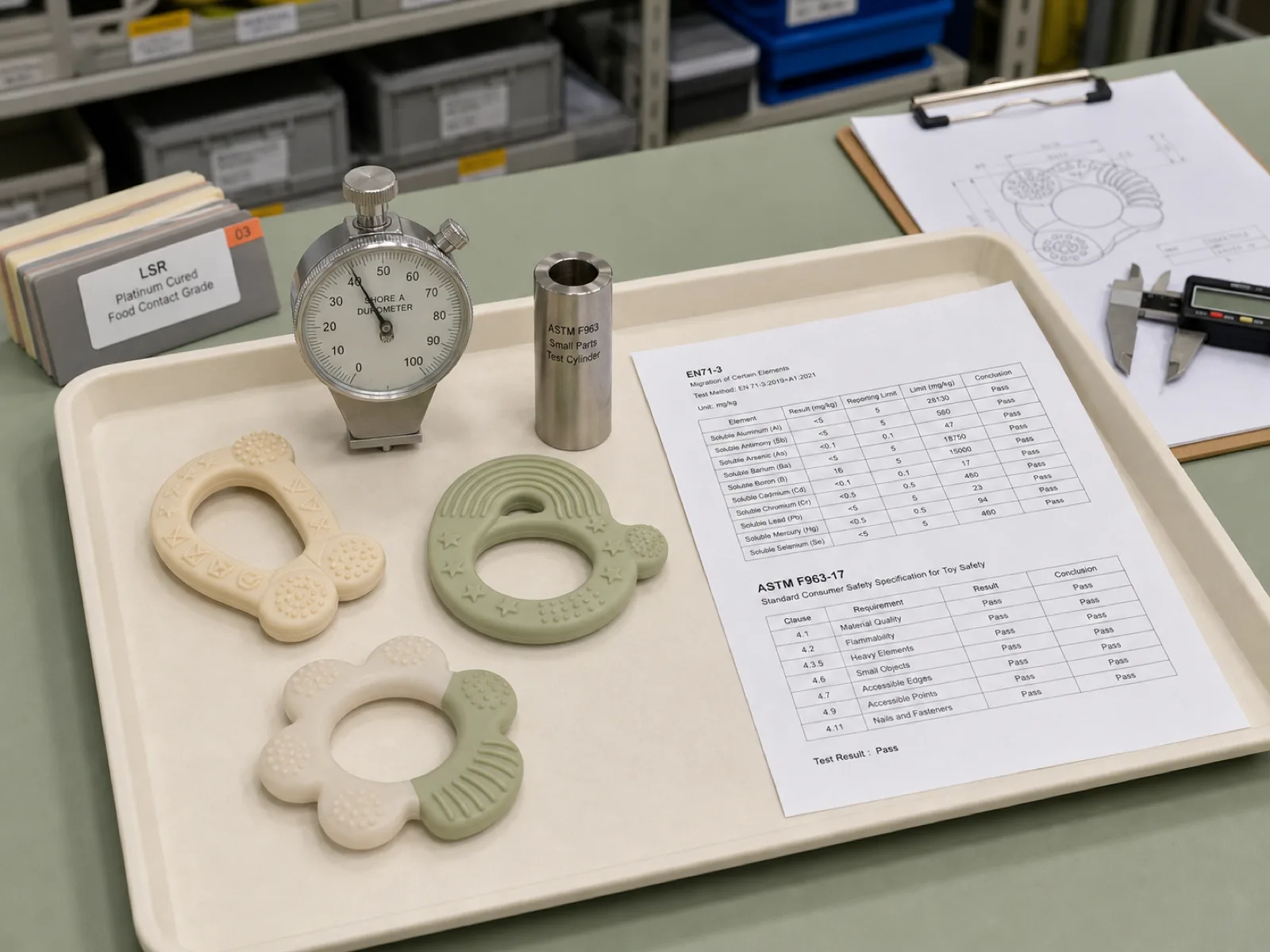 Buyer Guide
 A qualified silicone teether manufacturer runs platinum-cured liquid silicone rubber (LSR) injection molding inside a controlled cleanroom, ships every lot with FDA 21 CFR 177.2600, CPSIA, ASTM F963-17, and EN71-3 test reports, and proves the small-parts geometry with a bite-fatigue-then-cylinder video. Anything else is a trading company reselling a generic mold. This guide breaks down the material, molding, compliance, tooling, and retail-package decisions a private-label buyer needs to audit before signing a purchase order.
The infant-teether category is the least forgiving corner of silicone OEM — a single missed migration limit or a snapped tether ring puts the buyer on a CPSC recall list, not just a retailer’s return-to-vendor pile. The right factory reads like an engineering firm that happens to mold toys: quality manual on the wall, in-house rheometer, third-party lab account on file, and a project manager who talks about Shore A and cavity balance before talking about price. This guide is written from the engineering desk of a Dongguan silicone factory that has walked buyers through the Target, Walmart, and Amazon-vendor onboarding gauntlets — the audit questions below are the ones we would ask ourselves.
What separates a real silicone teether manufacturer from a trading company?
A real silicone teether manufacturer owns the mold shop, the LSR press cell, and the in-house lab under one roof, holds ISO 9001 and a business license printed with the factory address, and can produce a live 30-minute video walk from receiving dock to QC bench inside a business day. A trading company sends stock photos and stalls on the walk.
The single fastest test is asking for the ISO 9001 certificate PDF and the business license number, then cross-checking that the address on the certificate matches the address on the shipping labels of prior invoices[^iso-9001]. Trading companies frequently borrow certificates from a partner factory and hope the buyer never looks. The second test is a live video walk — request it at a specific time in the buyer’s afternoon (Dongguan business hours), and ask the operator to hold the phone camera on the mixer’s control panel, the LSR press’s mold-close cycle, the post-cure oven timer, and the QC bench durometer. A real factory has all four inside 15 minutes of walking.
Look for these five signals that the vendor is a genuine manufacturer, not a broker:
- Cleanroom class posted at the door. Class 100k (ISO 8) is the working minimum for infant-contact silicone. Class 10k (ISO 7) is what premium sink-brand OEMs run.
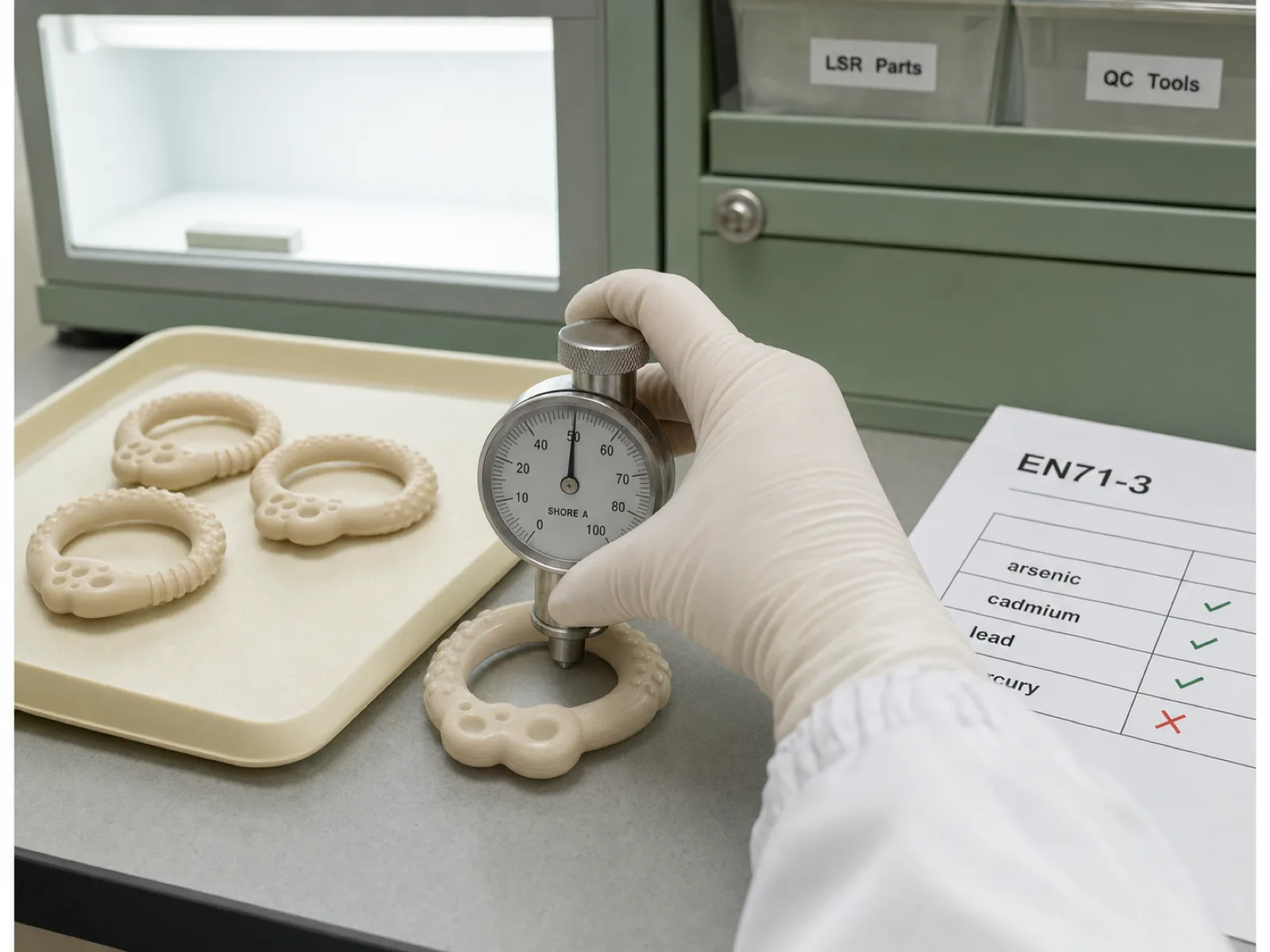
- In-house test equipment inventory. Rheometer (MDR), tensile tester (Shore A durometer + universal test machine), spectrophotometer for Pantone color, and a UV chamber for yellowing tests.
- Named engineering lead. A trading company hides its engineers; a factory puts the engineering lead on the introductory call. Buyers running their first audit should walk through the full sourcing silicone factory checklist before booking the video tour.
- Documented QMS revision history. Ask for the last three quality manual revisions with dates — a real ISO 9001 site produces them without hesitation.
- Third-party lab account. SGS, Intertek, or Bureau Veritas account numbers on file with a named account manager.
Which silicone material and durometer belong in an infant teether?
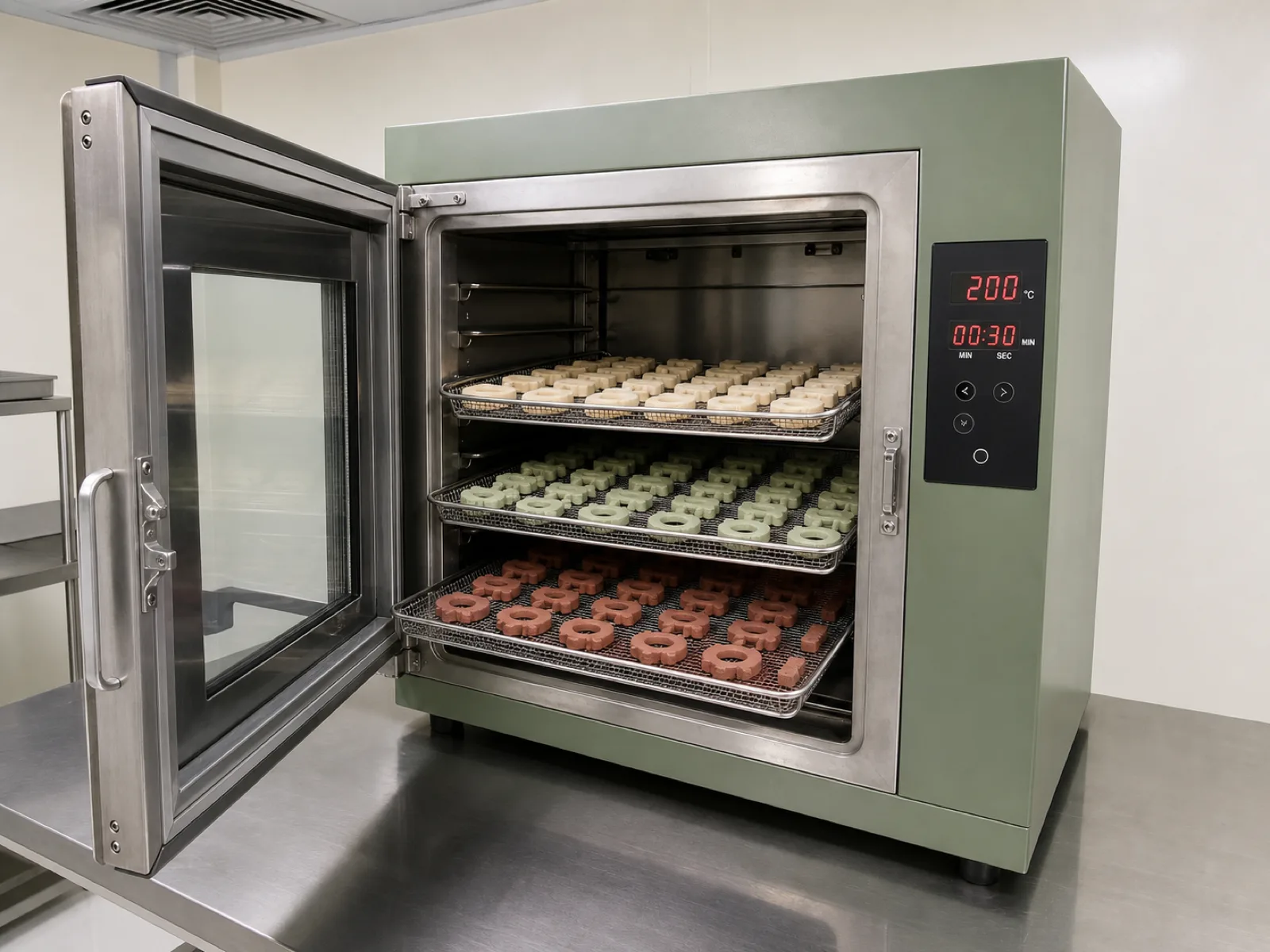
The correct material is platinum-cured (addition-cure) liquid silicone rubber compounded to Shore A 30–60, post-cured 4 hours at 200 °C, tested against USP Class VI biocompatibility, and pigmented only with FDA-listed inorganic master-batches. Peroxide-cured HTV, phthalate-plasticized rubber, and thermoplastic elastomers marketed as "silicone-like" are all disqualifying substitutes.
Platinum cure chemistry is a hydrosilylation reaction — no byproducts, no residual peroxide breakdown products, and no need to burn off aromatic hydrocarbons in a secondary process[^bfr-xv]. Peroxide-cured HTV silicone is cheaper by 8–15% at the compound level but leaves 2,4-dichlorobenzoic acid residues that require aggressive post-cure — the full chemistry trade-off is unpacked in our platinum-cured vs peroxide-cured silicone breakdown. For anything that goes in a baby’s mouth, the incremental cost of platinum cure is not negotiable.
Durometer is the single most-argued spec on a teether program. The functional band and its trade-offs:
| Shore A | Feel | Best for | Failure mode above/below |
|---|---|---|---|
| 20–30 | Very soft, marshmallow-like | Not recommended (tears under bite) | Below 20 rips at the tether ring root within 10 bite cycles |
| 30–40 | Soft chew | Pre-eruption gum surface, molar cheeks | Below 30 fails EN71-1 tension pull; above 40 too firm for pre-teeth infants |
| 40–50 | Balanced | Mixed-geometry teethers with soft and ridged zones | Sweet spot for most private-label SKUs |
| 50–60 | Structural | Tether rings, textured ridges, dumbbell shapes | Above 60 loses infant-jaw compressibility, fails caregiver push-tests |
| 60–70 | Rigid | Multi-material overmold with a soft chew core | On its own, too hard for solo teether SKUs |
The material story for buyers unfamiliar with LSR itself is unpacked in our what is liquid silicone rubber (LSR) explainer — worth reading before the first DFM review. Compound the base LSR with an FDA-compliant inorganic pigment master-batch — do not accept solvent-based dye systems. For color matching to a brand Pantone, expect a ΔE ≤ 1.5 tolerance on a spectrophotometer read, and demand a signed color-approval swatch before opening the mold[^iso-9001].
Which molding process fits — LSR injection or HTV compression?
Platinum-cured LSR injection is the professional default for infant teethers. It runs in a closed heated mold at ±0.05 mm tolerance, flashes cleanly, holds 15–90 second cycle times, and eliminates the hand-trim step that introduces particulate contamination. HTV compression is only defensible for oversized, low-cavity-count adult products.
The trade-off table below is the one to put in front of the buyer’s ops team before locking the process:
| Attribute | LSR injection | HTV compression |
|---|---|---|
| Cure system | Platinum (addition) | Peroxide (usually 2,4-DCBP) |
| Tolerance | ±0.05 mm | ±0.15 mm |
| Cycle time | 15–90 s | 180–360 s |
| Flash | Flash-free | Requires hand or cryogenic trim |
| Cleanroom | Class 100k standard | Open workshop typical |
| Post-cure | 2–4 h @ 200 °C | 4–8 h @ 200 °C mandatory |
| Tooling cost (4-cavity) | $6,000–$12,000 | $3,000–$6,000 |
| Piece cost @ 20g × 20k units | $0.32–$0.55 | $0.24–$0.42 |
| Suitable for infant contact | Yes (industry default) | Only with rigorous post-cure and clean-trim discipline |
| Auto-degating | Yes (cold runner) | No |
The economics look tempting for HTV until the buyer adds the hand-trim labor, the post-cure oven time, and the higher rejection rate at incoming inspection. On a 50,000-piece run of a 15 g teether, LSR is typically $0.03–$0.06/piece more expensive at the gate and $0.10–$0.15/piece cheaper by the time it passes final AQL 1.5 inspection.
What compliance stack does a US-market silicone teether require?
For US retail, the stack is FDA 21 CFR 177.2600 (food-contact silicone), CPSIA 2008 Section 101 lead limit (≤ 90 ppm), Section 108 phthalate ban (six phthalates ≤ 0.1%), ASTM F963-17 toy safety, and a signed General Certificate of Conformity per production lot. Target and Walmart both require CPSC-accepted third-party lab reports on top of the GCC.
The GCC is the single document a US retailer’s compliance team opens first[^cpsia-2008]. It must name the product, cite every rule the product complies with, name the third-party lab and the accreditation certificate, and be signed by the importer of record on the retail buyer’s side (not by the factory). A GCC signed by the Chinese factory alone is a red flag — it means the retailer’s import team never verified the compliance stack. Buyers new to the food-contact side of the same stack should read our FDA vs LFGB silicone comparison alongside the CPSIA reading here.
CPSC accepts test reports only from labs on the CPSC-accepted lab list published under 15 U.S.C. § 2063[^cpsc-small-parts]. Ask the factory which labs it routinely uses; the answer should include one or more of SGS, Intertek, Bureau Veritas, TÜV Rheinland, or QIMA. Small in-country labs that are not on the CPSC list produce reports that fail retailer intake.
ASTM F963-17 testing on a teether includes:
- Small-parts test. The finished teether after bite fatigue must not fit inside the CPSC small-parts cylinder — interior Ø 31.7 mm × 57.1 mm[^astm-f963].
- Tension test. 15 lbf pull for 10 seconds on any tab, ring, or protrusion.
- Torque test. 4 in-lbf for 10 seconds on any protrusion an infant can grasp.
- Drop test. 10 drops from 4.5 ft onto a vinyl-tile floor.
- Bite test. For toys intended for mouthing by children under 18 months, a specified compression cycle.
California Proposition 65 adds a labeling requirement for any product that contains listed chemicals above the safe-harbor level — for platinum-cured silicone compounded with FDA-listed pigments, Prop 65 warning is normally not required, but the buyer should still hold a written Prop 65 assessment on file.
What compliance stack does an EU-market silicone teether require?
For the EU, the stack is EU 1935/2004 framework, Commission Regulation 2023/2006 (GMP for food-contact materials), EN71-1 mechanical, EN71-2 flammability, EN71-3 migration of 19 elements, and BfR Recommendation XV for silicones. LFGB §30 and §31 test reports are the practical add-on for premium German-market SKUs, and CE marking with the manufacturer's EU representative address is mandatory on the retail package.
EN71-3 is the migration-limit test that catches the greatest number of failed teether shipments at EU border entry[^en71-3]. It measures how much of 19 elements (arsenic, barium, boron, cadmium, chromium III/VI, cobalt, copper, lead, manganese, mercury, nickel, selenium, strontium, tin, organic tin, and zinc) migrate from the toy material into simulated saliva. A properly compounded platinum-cured silicone with FDA/EU-listed inorganic pigments passes EN71-3 with typical results one to two orders of magnitude below the specific migration limit (SML).
The framework regulation EU 1935/2004 requires that any material intended to come into contact with food (a category the EU treats teethers as belonging to, because the infant will chew and salivate on the product) must not “endanger human health” or bring about “an unacceptable change in the composition of the food”[^eu-1935-2004]. Commission Regulation 2023/2006 layers GMP requirements on top — the factory must operate under a documented quality management system, which is why ISO 9001 is not optional[^iso-9001].
For German market entry specifically, BfR Recommendation XV is the technical guideline behind LFGB §30 and §31 testing of silicones for infant articles[^bfr-xv]. LFGB is not a legal requirement outside Germany, but German buyers and hard-discounter retail channels (Aldi, Lidl, Rossmann) demand it as a de facto standard.
How is small-parts and choke-hazard risk engineered out at the CAD stage?
Choke-hazard risk is designed out at the 3D CAD stage by choosing one-piece molding, integrating tether rings into the body geometry, avoiding attached beads or removable soft parts, and running an ASTM F963 small-parts cylinder virtual-fit check before tooling. Assembled multi-part teethers are the single most common CPSC recall category — a real manufacturer will refuse to tool one without a written buyer waiver.
The small-parts test cylinder (Ø 31.7 mm × 57.1 mm interior) is a truncated cone that simulates the airway of a child under three. The finished teether must not fit inside the cylinder after bite fatigue and tension pull tests[^cpsc-small-parts]. That constraint dictates three CAD-level decisions:
- One-piece molding beats assembly. A teether where the tether ring is part of the same LSR shot as the chew body cannot come apart. A teether where the ring is a separate part attached with a mechanical clip can fail the tension test and land in the cylinder.
- No hollow sealed cavities. Any enclosed void grows mold given the moisture cycles of an infant’s mouth. Design either as solid geometry or with an open drainage path.
- Minimum wall thickness ≥ 3 mm on any protrusion. Below 3 mm, the LSR flows unevenly and the protrusion snaps under fatigue.
What does realistic tooling, MOQ, and lead time look like?
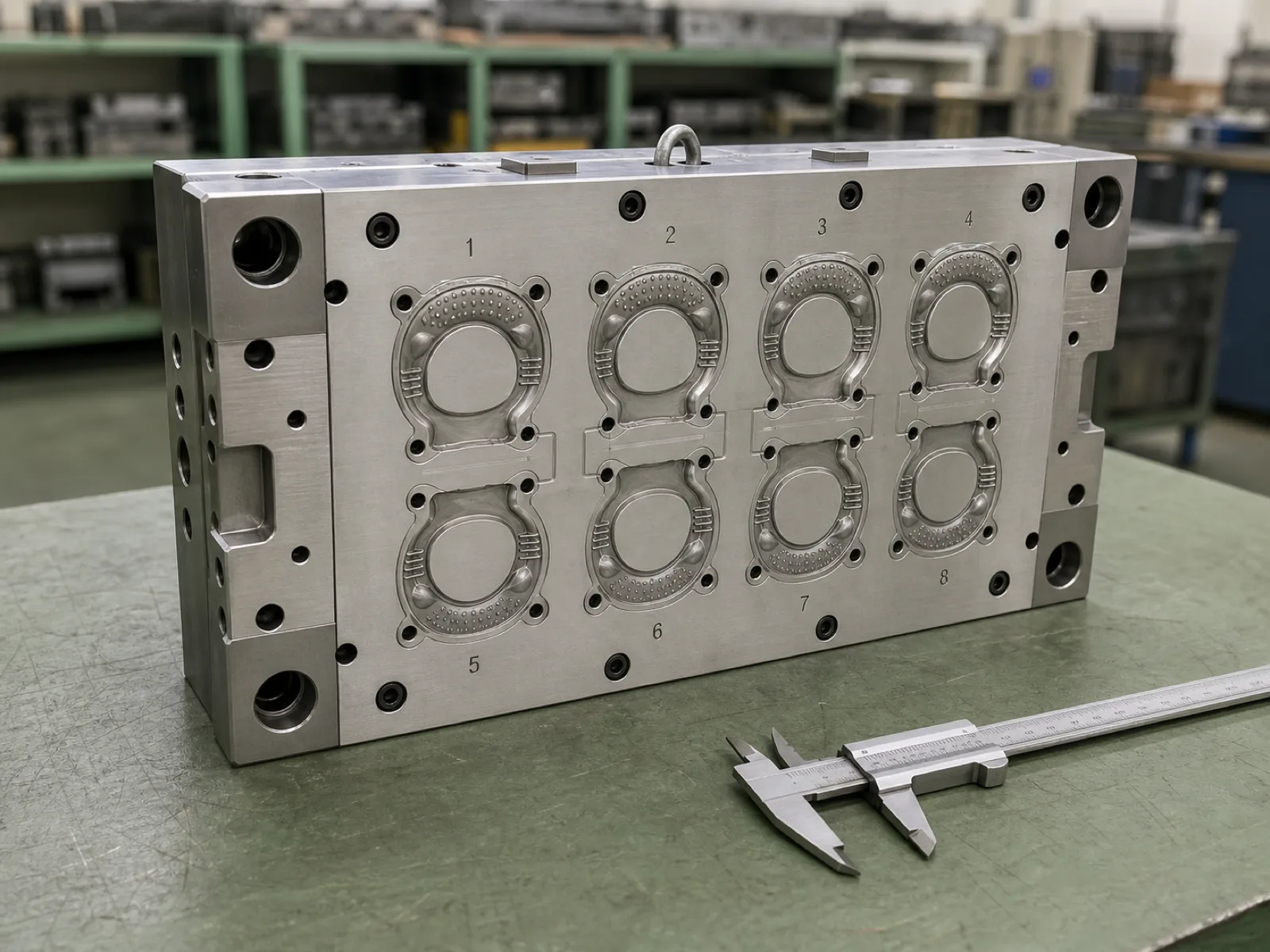
A silicone teether manufacturer running a real cost model quotes a 1–2 cavity aluminum sample tool at $600–$1,800 with 10–15 day delivery, a 4–16 cavity steel production tool at $3,500–$12,000 with 25–35 day delivery, and MOQ 3,000–5,000 units per SKU per color. Suppliers quoting MOQ 500 with no tooling charge are amortizing against a generic mold — expect legal exposure and inconsistent geometry.
The economics behind the numbers:
| Program stage | Deliverable | Lead time | Typical cost |
|---|---|---|---|
| 3D CAD review | DFM report, gate/vent plan, cavity plan | 3–5 days | Included |
| Aluminum prototype tool | 1–2 cavity T6 aluminum mold | 10–15 days | $600–$1,800 |
| EVT sample run | 200–500 pieces for compliance testing | 3–5 days after tool | $2–$4 / pc |
| DVT sample run | 500–1,000 pieces at production spec | 5–7 days | $1.20–$2.40 / pc |
| Steel production tool | 4–16 cavity S136 stainless mold | 25–35 days | $3,500–$12,000 |
| First mass production | 5,000–20,000 pieces | 12–18 days | $0.32–$0.85 / pc |
| Retail-ready packing | Blister + header card + carton | 3–5 days after MP | $0.08–$0.18 / pc |
| Total program (contract → FOB) | — | 60–75 days | — |
For per-piece cost, the drivers in order of magnitude are: cavity count (a 16-cavity tool cuts piece cost by 55–65% vs 4-cavity), part weight (silicone compound at ~$4.20/kg for a general-purpose LSR, ~$6.80/kg for a low-volatile FDA/USP Class VI grade), cycle time (a 30 g teether at 60 s cycle vs 90 s cycle is a 33% cost swing), and packaging complexity.
A realistic 30,000-unit contract for a 22 g Shore A 45 teether in one color with FSC blister-card packing lands in the FOB Yantian range of $0.62–$0.88 per finished packed piece — including tooling amortization over the first order. Buyers who want to sanity-check where a quote of “MOQ 500 with no tooling” actually breaks down should read the real-factory MOQ math before signing anything.
What retail-channel package prep does the factory actually own?
A capable silicone teether manufacturer produces the full retail package file: die-lined blister artwork, FSC-certified header card with UPC/GTIN and choking-hazard warning per 16 CFR 1500.121, GCC PDF template, master carton dimensioning to a retailer's pallet spec, and Amazon FBA-ready SIOC labeling. If the vendor asks the buyer to source packaging separately, budget an extra 10–14 days and a coordination line item.
The five retail-channel package requirements a Target or Walmart vendor onboarding will check line-by-line:
- Choking-hazard label. Required by 16 CFR 1500.121 for toys and games intended for children ages 3–6, and best-practice for any small item that could reach a younger sibling.
- UPC/GTIN barcode. Registered under the buyer’s GS1 prefix, printed at ≥ 80% magnification of the standard.
- Country of origin. “Made in China” or the applicable country marked on the retail package and the master carton, per 19 CFR 134.
- Age grading. Clearly stated (“0-6M” / “3M+”) in a font size ≥ 10 pt on the front face.
- Compliance seals. CE (EU), UKCA (UK), and any retailer-specific seal (Target Corporate Responsibility seal for select programs).
The factory’s job is to hold the packaging supplier under the same ISO 9001 QMS as the injection cell, so that the artwork approval, printing plate revisions, and packing-line first-article are all logged against the same batch record[^iso-9001]. When a buyer signs off on artwork, the factory should return a signed PDF with the artwork file hash, so any future revision is traceable[^iso-8124-1].
Buyer audit checklist — a printable pre-tooling gate
Before signing a tooling PO with a silicone teether manufacturer, verify twelve items across QMS, molding process, compliance, and packaging. Each item has a document or artifact the factory should be able to produce within a business day — if any single item stalls, treat it as evidence the vendor is a broker rather than a producer.
Print this list, tick it on the audit walk:
- ISO 9001:2015 certificate PDF, factory-address match with business license[^iso-9001].
- Cleanroom class posted at the door (target Class 100k or better).
- LSR injection cell photo with mold-close cycle visible, dated within 30 days.
- Post-cure oven with digital time-and-temp record for the last 30 days.
- In-house rheometer, tensile tester, durometer, spectrophotometer, and UV chamber — with calibration certificates within 12 months.
- Third-party lab account on file with SGS, Intertek, or Bureau Veritas.
- FDA 21 CFR 177.2600 declaration letter for the base silicone compound[^fda-177-2600].
- Master-batch pigment declaration (FDA-listed inorganic, EU-listed for EN71-3).
- Sample GCC PDF from a prior teether program (redact the customer name).
- Sample EN71-3 test report from a prior program, with element-migration numbers visible[^en71-3].
- DFM report format — a template the engineering lead will produce for a 3D CAD file[^iso-8124-1].
- Named engineering lead + named QA lead on the introductory call — with LinkedIn or credential PDF.
If eleven of twelve check out, negotiate. If eight of twelve check out, walk. If fewer, the vendor is a trading company.
Talk to the engineering desk
The teether category punishes buyers who source on unit price alone. The right factory reads like an engineering firm — quality manual on the wall, cleanroom class posted, third-party lab account on file, and an engineering lead who talks about Shore A, cavity balance, and post-cure protocol before talking about MOQ. If you have a 3D CAD file, a target retail channel, and a compliance stack in mind, the engineering desk at Wetop Silicone can turn it into a DFM report inside three business days.
FAQ
-
How do I verify a silicone teether manufacturer is a real factory and not a trading company?
Ask for the ISO 9001 certificate PDF with the factory address printed on it, the business license number, and photos of the mixer, LSR press, and cleanroom with a date-stamped watermark. Then request a 30-minute live video walk from the receiving dock to the QC lab. A factory produces this in a day; a trading company stalls or sends stock photos.
-
Should a silicone teether be molded from LSR injection or HTV compression?
For infant-mouth contact, platinum-cured LSR injection is the professional default. It cures flash-free at ±0.05 mm tolerance in a closed heated mold, eliminates hand-trim contamination risk, and holds USP Class VI biocompatibility. HTV compression is cheaper per shot but produces flash, requires manual trimming, and typically peroxide-cured — disqualifying for premium teether SKUs.
-
What Shore A durometer is correct for a silicone teether?
The functional band is Shore A 30–60. Shore A 30–40 gives a soft chew surface for pre-eruption gum stimulation. Shore A 50–60 gives structure for tether rings, ridges, and molar-targeting geometry. Below 30 tears under bite fatigue; above 70 becomes too rigid for infant jaw pressure and fails EN71 mechanical testing on protrusions.
-
Which compliance certificates do I need to sell a silicone teether in the US?
FDA 21 CFR 177.2600 for food-contact silicone, CPSIA 2008 Section 101 lead test (≤ 90 ppm) and Section 108 phthalate test (six phthalates ≤ 0.1%), ASTM F963-17 toy safety, California Prop 65 screen, and a signed General Certificate of Conformity (GCC) per production lot. Retailers such as Target and Walmart also require third-party CPSC-accepted lab reports (CPSC 15 U.S.C. § 2063).
-
Which EU certificates does a silicone teether need?
EN71-1 mechanical and physical, EN71-2 flammability, EN71-3 migration of 19 elements, plus food-contact compliance under EU 1935/2004 and Commission Regulation 2023/2006 GMP. LFGB §30 and §31 test reports for silicone are best practice for German-market SKUs. All packaging must carry the CE mark and the manufacturer's EU-authorized representative address.
-
What is the minimum order quantity (MOQ) for a custom silicone teether?
For a new mold with 4-cavity steel tooling, expect an MOQ of 3,000–5,000 units per SKU per color. Sampling from a 1–2 cavity aluminum prototype tool runs 200–500 pieces. If a supplier quotes MOQ 500 on a fresh mold with no tooling amortization, they are almost certainly a trading company reselling a generic mold — not a real teether manufacturer.
-
How long does silicone teether tooling and production take?
Aluminum prototype tool: 10–15 days. First articles (EVT samples): 3–5 days after tool completion. Steel production tool (4–16 cavities): 25–35 days. First mass-production run of 5,000 pieces: 12–18 days including post-cure, QC, and blister packing. A conservative program brief plans 60–75 days from signed 3D CAD to FOB Yantian.
-
How does a manufacturer prove a silicone teether has no small-parts / choke hazard?
The teether is tested with the ASTM F963-17 small-parts cylinder (interior Ø 31.7 mm × 57.1 mm) after bite fatigue and tension pull cycles. A one-piece molded teether with a tether ring integral to the body passes this test cleanly; multi-part assemblies with beads or attached rings are the most common failure mode. Insist on a video of the fatigue-and-drop-then-cylinder sequence.
-
Does silicone leach chemicals into an infant's mouth?
Platinum-cured, fully post-cured silicone tested to EN71-3 shows migration of the 19 regulated elements orders of magnitude below the specific migration limits (SML). Post-cure at 200 °C for 4 hours drives off residual volatiles (D4/D5/D6 cyclosiloxanes) to under 0.5%. Peroxide-cured silicone that skips post-cure can retain residues and yellow under UV — reject any supplier without a written post-cure protocol.
References
Authoritative sources cited in this guide
- US Food and Drug Administration / Electronic Code of Federal Regulations. 21 CFR 177.2600 — Rubber articles intended for repeated use. https://www.ecfr.gov/current/title-21/chapter-I/subchapter-B/part-177/subpart-C/section-177.2600 — Governs the food-contact silicone specification underlying every US-market teether.
- US Consumer Product Safety Commission. Consumer Product Safety Improvement Act of 2008 (Public Law 110-314). https://www.ecfr.gov/current/title-16 — Section 101 lead limit (≤ 90 ppm) and Section 108 phthalate ban that apply to any children's product including silicone teethers.
- ASTM International. ASTM F963-17 — Standard Consumer Safety Specification for Toy Safety. https://www.astm.org/f0963-17.html — The reference standard for small-parts, tension, torque, and drop testing that CPSC uses to evaluate teethers under 3 years.
- US Consumer Product Safety Commission. 16 CFR 1501 — Method for identifying toys and other articles intended for use by children under 3 years. https://www.ecfr.gov/current/title-16/chapter-II/subchapter-C/part-1501 — Codifies the small-parts test cylinder dimensions (Ø 31.7 mm × 57.1 mm) that every teether must clear.
- European Committee for Standardization (CEN). EN 71-3:2019+A1:2021 — Safety of toys — Part 3: Migration of certain elements. https://standards.iteh.ai/catalog/standards/cen/f9b8d7b0-9f1d-4a7e-b6a3-8f3f5d7c9e1a/en-71-3-2019-a1-2021 — Sets migration limits for 19 elements (arsenic, cadmium, lead, mercury, and others) in toy materials including silicone.
- European Union. Regulation (EC) No 1935/2004 on materials and articles intended to come into contact with food. https://eur-lex.europa.eu/legal-content/EN/TXT/?uri=CELEX%3A32004R1935 — The framework regulation any silicone teether sold in the EU must satisfy for food-contact behavior.
- German Federal Institute for Risk Assessment (BfR). BfR Recommendation XV. Silicones. https://www.bfr.bund.de/en/home.html — The German technical guideline behind LFGB §30/§31 testing on silicone infant articles.
- International Organization for Standardization. ISO 8124-1:2022 — Safety of toys — Part 1: Safety aspects related to mechanical and physical properties. https://www.iso.org/standards.html — The international counterpart to ASTM F963 and EN71-1 used in AU, JP, and cross-market programs.
- International Organization for Standardization. ISO 9001:2015 — Quality Management Systems — Requirements. https://www.iso.org/standard/62085.html — The QMS backbone any credible silicone teether manufacturer runs its process discipline against.
Start a custom program
Send a brief. Get an engineer’s reply in one business day.
Every Wetop program is tooled from a customer’s specification. Send a CAD file (STEP · IGES · DWG) or a written brief and we’ll reply with a mold cost estimate, price brackets at MOQ 500 / 1,000 / 5,000, and any engineering questions.