Comparison · commercial intent
Silicone vs EPDM Gasket — Engineering Comparison Guide
 Comparison
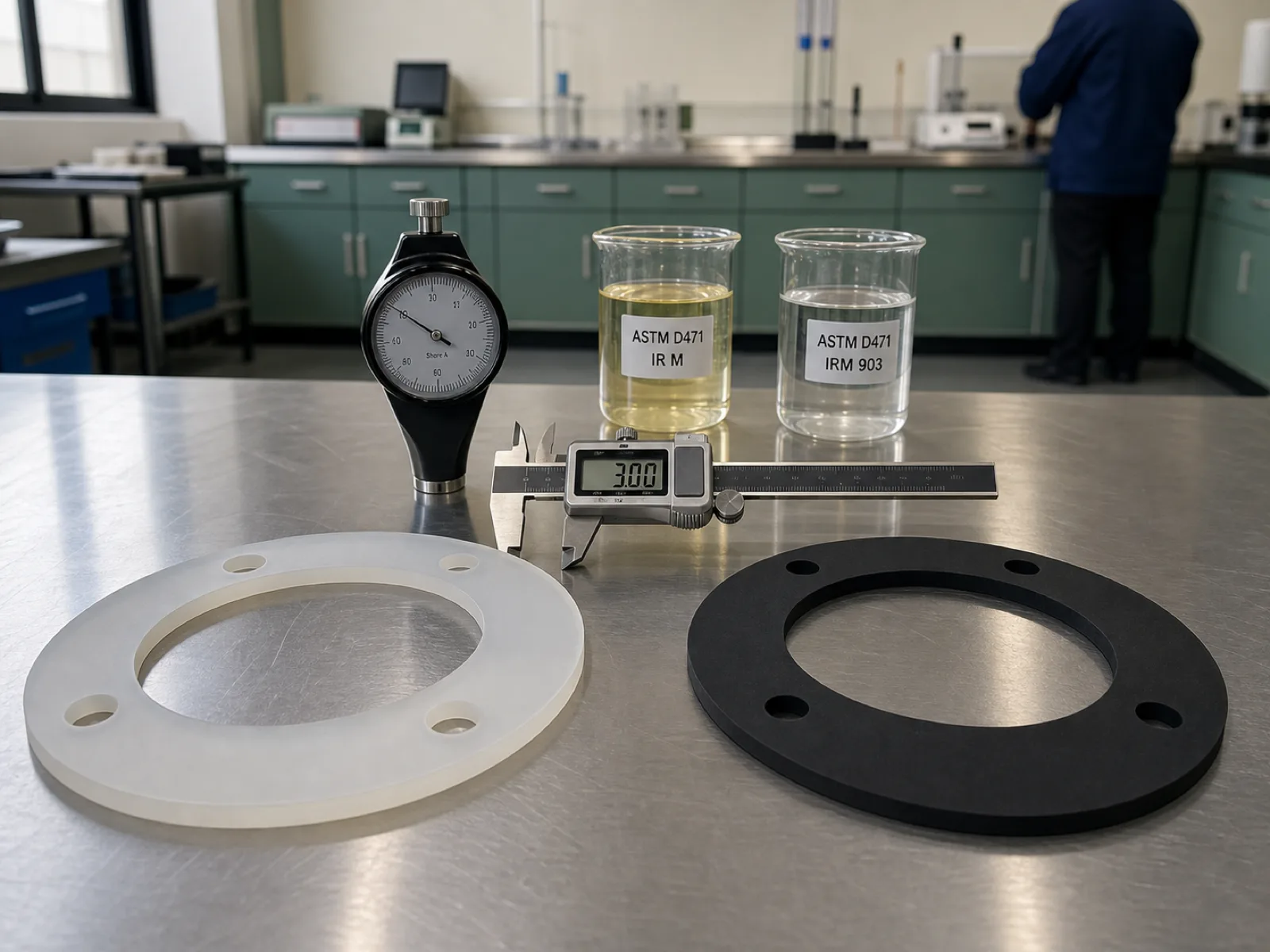
 Silicone (VMQ) and EPDM gaskets solve different problems. Silicone wins on temperature range and food-contact compliance — it seals from -60 °C to 230 °C, clears FDA 21 CFR 177.2600 on platinum cure, and survives steam autoclave. EPDM wins on cost, potable-water certification, and outdoor weather service — it holds NSF/ANSI 61 for drinking water, costs half as much per kilogram, and dominates ambient plumbing and roofing.
This guide is written for OEM procurement engineers and product-development leads deciding between silicone and EPDM gaskets for kitchen, HVAC, potable-water, food-processing, medical, or outdoor-equipment programs. It replaces the “just pick rubber” folklore with the numbers you need on the RFQ — temperature envelopes, ASTM D471 chemical-compatibility data, compression-set targets, ASME B16.21 flange sizing, compliance mapping, and the MOQ and lead-time economics we see on 500-pcs custom gasket runs.
Silicone vs EPDM gasket — what’s the fundamental difference?
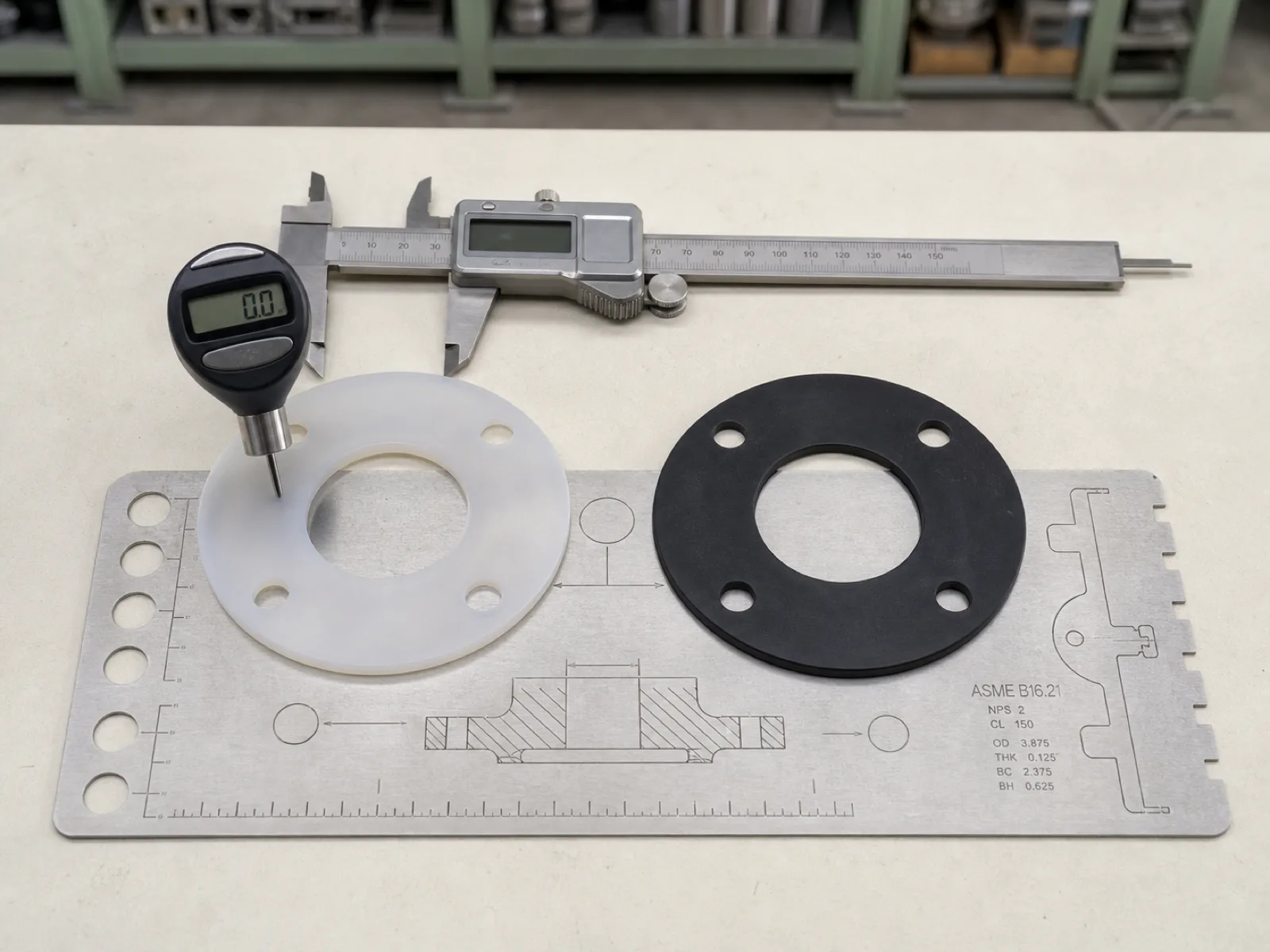
Silicone is a siloxane (Si-O backbone) elastomer designated VMQ under ASTM D1418. EPDM is ethylene propylene diene monomer — a saturated carbon-carbon backbone with a small diene comonomer for sulfur or peroxide curing. The chemistry decides everything downstream: silicone gives thermal range and food compliance, EPDM gives potable-water compliance, weather resistance, and low cost. They are not substitutes; they are different tools with overlapping mid-temperature service windows.
The naming trips up first-time buyers because both materials look and feel similar in black rubber form. On the RFQ, the ASTM D1418 designation (VMQ for silicone, EPDM for ethylene propylene diene) is the only unambiguous way to spec the material — trade names and colors are not reliable. Chinese-manufactured EPDM gaskets carry a wide range of compound quality; require the designation on the drawing so a supplier cannot substitute a cheaper SBR or NBR compound without a change order.
Silicone gaskets dominate any application where the sealed medium is hot air, steam under sanitization cycles, food, oven-door, or a biocompatible fluid. EPDM gaskets dominate anywhere the medium is ambient potable water, roofing membrane exposure, HVAC condensate, automotive weather-strip, or brake fluid. The silicone rubber gasket manufacturing guide walks through the drawing-note format for VMQ specifically; this guide is the material-selection layer that comes before that specification step.
What’s the temperature range difference between silicone and EPDM gaskets?
Silicone (VMQ) gaskets hold -60 °C to 230 °C continuous and 300 °C intermittent. EPDM gaskets hold -50 °C to 150 °C continuous and 175 °C intermittent. Silicone wins by 80 °C on the hot end and 10 °C on the cold end. For steam autoclave, oven-door seals, exhaust flanges, and hot-air ducts, silicone is the only correct answer; for ambient plumbing, HVAC, and outdoor weather seals under 120 °C, EPDM is more than adequate.
Temperature range is where the two materials genuinely diverge, and it’s the single most common reason a specification switches from EPDM to VMQ mid-program. Above 130 °C, peroxide-cured EPDM starts to lose elongation-at-break within weeks; above 150 °C, it chalks and hardens; above 175 °C, it’s cooked in hours. Platinum-cured VMQ stays stable to 200 °C for years.
| Metric | Silicone (VMQ) | EPDM |
|---|---|---|
| Continuous service, dry air | -60 to 230 °C | -50 to 150 °C |
| Continuous service, hot water | -60 to 100 °C (steam < 150 °C short-term) | -50 to 120 °C |
| Intermittent peak, < 30 min | 300 °C | 175 °C |
| Brittle point | -60 to -65 °C | -50 to -55 °C |
| Cold flexibility (TR-10, ASTM D1329) | -50 to -55 °C | -45 to -50 °C |
| Steam autoclave (121 °C, 30 min cycles) | Excellent | Marginal |
The cold-end gap is narrower than the hot-end gap — both materials handle household freezer service. The hot-end gap is where money changes hands: a food-processing plant running 140 °C CIP cycles will chew through EPDM gaskets in six months and specify VMQ from year two forward.
Silicone vs EPDM gasket chemical compatibility — where does each fail?
Silicone (VMQ) fails in petroleum, aromatic solvents, brake fluid, and concentrated acids — swelling 40-80 % in gasoline per ASTM D471. EPDM fails in petroleum, aromatic solvents, chlorinated organics, and hot mineral oil — for the same reason silicone does. Both perform well in water, steam under 150 °C, dilute acids and caustics, alcohols, ketones, and hydraulic brake fluid. Chemical compatibility overlaps heavily; the material decision is usually temperature-driven, not chemistry-driven.
Volume swell above 20 % is generally considered a gasket failure regardless of the retained mechanical properties — the sealing element extrudes, distorts the flange gap, and leaks under thermal cycling. The table below summarizes ASTM D471 volume-swell data at 70 h in the media at the noted temperature.
| Medium | Silicone (VMQ) swell | EPDM swell | Winner |
|---|---|---|---|
| Water, 70 °C | < 4 % | < 3 % | Both fine |
| Steam, saturated 150 °C | < 8 % (short-term) | Attacks within weeks | Silicone |
| Potable water (NSF 61), 23 °C | < 2 % | < 2 % | Both fine |
| Gasoline (Fuel B), 23 °C | 40-80 % | 60-100 % | Neither — spec FKM |
| Engine oil (ASTM IRM 903), 100 °C | 40-80 % | 100-200 % | Neither — spec FKM |
| Brake fluid (glycol), 100 °C | 30-60 % | < 8 % | EPDM |
| Ethanol, 23 °C | 5-10 % | 3-8 % | Both fine |
| Sulfuric acid, 30 %, 23 °C | Attacks | < 5 % | EPDM |
| Sodium hydroxide, 30 %, 70 °C | < 8 % | < 5 % | Both fine |
| MEK (ketone), 23 °C | 20-40 % | 15-30 % | EPDM (marginal) |
| Ozone, 200 pphm, 40 °C | No cracking | No cracking | Both fine |
| UV, 500 h QUV | No cracking | No cracking | Both fine |
The chemistry map explains why EPDM dominates brake-fluid seals, automotive weather-strip, and outdoor roofing membrane, while silicone dominates food-processing steam gaskets, oven-door seals, and medical device flanges. For a program that mixes ambient water with occasional steam sanitization above 130 °C, silicone is the safer specification even though EPDM handles the water portion cheaper.
What’s the compression set and mechanical property difference?
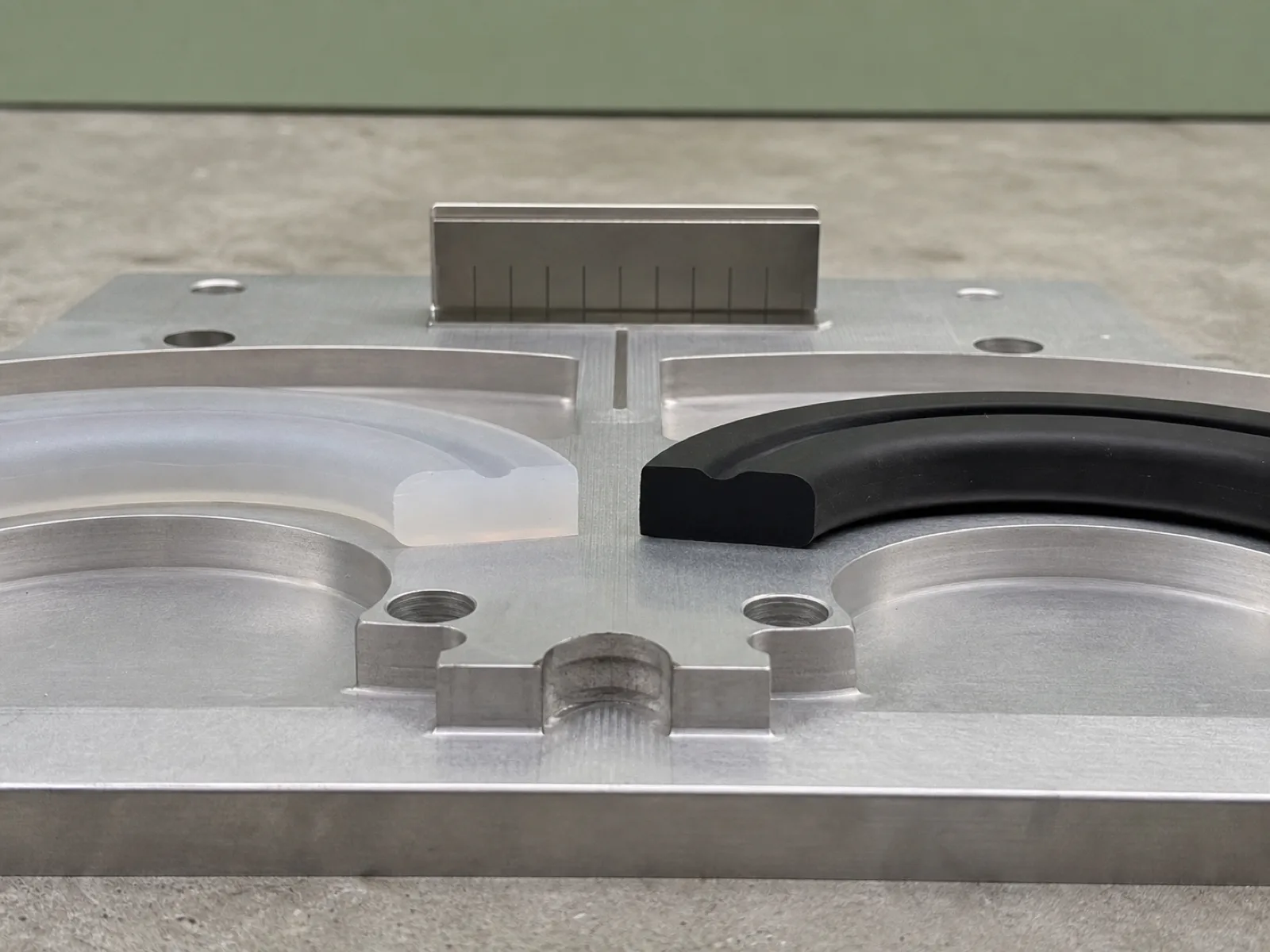
Compression set at 150 °C, 70 h per ASTM D395: platinum-cured VMQ lands 12-25 %, peroxide-cured EPDM lands 15-30 %. Tensile strength: VMQ 6-10 MPa, EPDM 8-15 MPa. Tear resistance per ASTM D624: VMQ 15-30 kN/m, EPDM 25-45 kN/m. EPDM is stronger and more tear-resistant at ambient; silicone recovers better from thermal cycling and stays flexible across a wider temperature range.
Mechanical properties are where EPDM shows its price advantage — on tensile, tear, and abrasion at ambient temperature, EPDM outperforms silicone by roughly 1.3-1.5×. On compression set at elevated temperature — the number that predicts whether a static gasket will hold pressure at 12 months — the gap narrows and inverts above 130 °C where silicone stays elastic and EPDM begins to take permanent set.
| Property | Silicone (VMQ) | EPDM |
|---|---|---|
| Shore A hardness range | 30-80 | 40-90 |
| Tensile strength (ASTM D412) | 6-10 MPa | 8-15 MPa |
| Elongation at break | 300-700 % | 300-600 % |
| Tear strength (ASTM D624) | 15-30 kN/m | 25-45 kN/m |
| Compression set (D395, 150 °C, 70 h) | 12-25 % | 15-30 % |
| Compression set (D395, 100 °C, 70 h) | 8-18 % | 10-20 % |
| Specific gravity | 1.10-1.20 | 0.86-1.10 |
| Abrasion resistance | Fair | Good |
| Weathering / ozone / UV | Excellent | Excellent |
| Dynamic seal suitability | Poor to fair | Fair |
The Shore A durometer range on EPDM extends higher (up to 90) than on standard VMQ (up to 80), giving EPDM an edge on high-pressure static seals where a stiffer gasket is required. For a soft face-seal that will conform to imperfect flange faces, VMQ at 40-50 Shore A remains the more forgiving choice. See the Shore A hardness chart for the full durometer-to-application mapping on silicone.
Silicone vs EPDM gasket — food, potable water, and certification comparison
Silicone (platinum-cured VMQ) is the volume standard for FDA 21 CFR 177.2600, USP Class VI, NSF/ANSI 51, and LFGB food-contact compliance. EPDM is the volume standard for NSF/ANSI 61 potable-water certification and dominates municipal drinking-water and plumbing gaskets. Both materials can clear the other's territory — food-grade EPDM and NSF-61 silicone both exist — but the industry defaults are silicone for food and EPDM for potable water at ambient temperature.
The compliance map is where procurement teams save the most money by picking the right material the first time. Silicone qualified for NSF 61 potable-water service exists but costs 30-50 % more than a comparable food-grade VMQ compound; food-grade EPDM cleared under FDA 21 CFR 177.2600 exists but is a smaller share of EPDM production and requires more upstream diligence on the compound source.
| Certification | Silicone (VMQ) | EPDM |
|---|---|---|
| FDA 21 CFR 177.2600 | Standard on platinum cure | Available (peroxide cure, food-grade) |
| USP Class VI | Standard | Available but uncommon |
| NSF/ANSI 51 (food equipment) | Standard | Available (food-grade) |
| NSF/ANSI 61 (potable water) | Available at premium | Standard — volume material |
| LFGB (Germany / EU food) | Standard | Available |
| WRAS (UK water) | Available | Standard |
| KTW / DVGW W270 (Germany water) | Available | Standard |
| UL 94 V-0 flame class | Available (FR grade) | Available (FR grade) |
| REACH SVHC | Screened | Screened |
| ASME BPE (biopharm) | Standard on select grades | Rarely qualified |
For a municipal drinking-water gasket that lives at ambient temperature in copper pipe for 25 years, EPDM under NSF 61 is the cheaper equal-performance choice. For a food-processing CIP gasket that sees 140 °C steam every 24 hours, silicone under FDA 21 CFR 177.2600 with the platinum-cure certification is the only material that lasts. The FDA vs LFGB compliance breakdown explains which clause number belongs on which market’s drawing for silicone-based food seals.
Silicone vs EPDM gasket — cost, MOQ, and lead time comparison
EPDM raw material runs 2-4 USD per kilogram; platinum-cured food-grade silicone runs 5-10 USD per kilogram. On a 500-pcs custom OEM gasket run of comparable geometry, delivered unit price typically drops 25-40 % moving from VMQ to EPDM. Tooling economics are identical (same compression-mold cavities work for both); sample lead times are within a few days of each other. The cost gap is a compound and cycle-time story, not a tooling one.
Cost separates into three buckets: raw material, tooling, and per-unit processing. EPDM wins raw material by roughly 2×; tooling is identical (same compression-mold cavities work for both); processing is roughly a wash with a slight EPDM advantage on cure time at 170 °C. On volume-normalized total cost, the OEM pricing structure guide walks through how tooling amortizes across a 500 or 5,000 piece run — the same amortization math applies whether the compound is VMQ or EPDM.
| Cost component | Silicone (VMQ) 500-pcs | EPDM 500-pcs |
|---|---|---|
| Compound cost per kg | 5-10 USD | 2-4 USD |
| Tooling (single-cavity aluminum) | 1,500-4,000 USD | 1,500-4,000 USD |
| Sample lead time (existing tool) | 7-15 days | 7-15 days |
| Sample lead time (new tool) | 15-25 days | 15-25 days |
| Compound lead time (standard) | 1-2 weeks | < 1 week |
| Cure cycle at 170 °C | 3-6 min | 4-8 min |
| MOQ (existing tooling) | 500 pcs | 500 pcs |
| MOQ (new tooling, amortized) | 2,000-5,000 pcs | 2,000-5,000 pcs |
| Typical delivered unit price (100 mm flange, 3 mm thick) | 0.40-0.80 USD | 0.25-0.55 USD |
Total cost of ownership can still favor silicone on programs where an EPDM gasket would fail at elevated temperature and force a warranty replacement — the gasket choice is almost never a pure per-part price contest. For a run under 130 °C at ambient chemistry, EPDM wins. Anywhere near or above 150 °C, silicone’s field lifetime justifies the premium.
When should I choose silicone over EPDM, and vice versa?
Choose silicone (VMQ) when service temperature exceeds 130 °C continuous, when steam autoclave or CIP sanitization is required, when FDA / LFGB / USP food or medical compliance is on the drawing, or when the flange sees repeated thermal cycling. Choose EPDM when the medium is potable water, ambient plumbing, brake fluid, roofing membrane, or automotive weather-strip; when NSF/ANSI 61 is required; or when unit cost is the dominant driver and service temperature stays under 120 °C.
The decision matrix reduces to five questions. Answer them in order and the material almost always picks itself.
1. What is the continuous service temperature? Above 130 °C → silicone. Above 150 °C without exception → silicone. Below 120 °C ambient → either works; default to EPDM on cost.
2. Is there a food, potable-water, or medical compliance requirement? Food or medical steam / CIP contact → silicone. Ambient potable water → EPDM. Ambient food contact (cold storage, beverage) → either; food-grade EPDM is cheaper.
3. What is the sealed medium? Petroleum, gasoline, aromatic solvent, hot oil → neither, spec FKM (Viton). Brake fluid, dilute acid → EPDM. Steam over 130 °C → silicone. Hot water 100-120 °C → either.
4. Is the gasket a static face seal or does it see thermal cycling? Repeated thermal cycling (freeze-thaw, sanitization cycles) → silicone. Steady-state static → either.
5. Is unit cost the dominant driver? Yes and the chemistry and temperature allow it → EPDM.
Seventy percent of B2B OEM gasket programs on our RFQ desk that reach us are silicone by the time step 2 finishes — they’re food, medical, or high-temperature applications where EPDM is off the table. The remaining thirty percent are usually potable-water or outdoor programs where EPDM is the cheaper equal-performance choice; we typically refer those to a qualified EPDM factory rather than substitute VMQ where the customer doesn’t need it.
What are the common failure modes on silicone and EPDM gaskets?
Silicone gaskets fail by chemical swelling (petroleum contact), extrusion under high pressure, and tear during installation on high-elongation grades. EPDM gaskets fail by high-temperature chalking above 150 °C, permanent set on hot-water service, and cracking on hot-oil contact. Both share compression-set failure when under-cured or over-temperature. The failure mode is usually diagnostic: chalked and hardened = EPDM at wrong temperature; swollen and soft = silicone in wrong fluid.
Failure diagnosis on a returned gasket is one of the fastest ways to confirm you had the wrong material. The five most common failures we see on customer returns:
- Chalked, hardened, cracked EPDM face — EPDM gasket exposed to continuous service above 150 °C. Out of temperature envelope; switch to VMQ.
- Swollen, soft, distorted VMQ — silicone gasket exposed to petroleum, aromatic solvent, or brake fluid. Wrong material; switch to FKM (fuel/oil) or EPDM (brake fluid).
- Flattened, taken permanent set — either material with high compression set. Under-cured compound or service temperature above rated. Require ASTM D395 data at actual service temperature on the material COA.
- Cut, nicked, or extruded — installation damage or excessive flange-fill. Gland or flange design issue, not a material issue; check ASME B16.21 or DIN 2690 tolerances.
- Cracked, crazed surface without chemical exposure — ozone or UV degradation on a non-elastomer-grade compound. Rare on both VMQ and EPDM; check for a cheaper substitute (SBR, NBR) that was silently swapped in.
What documentation should I demand on a silicone or EPDM gasket order?
Require Certificate of Analysis (COA) per lot with Shore A, specific gravity, tensile, and compression set; Certificate of Compliance (COC) citing the applicable standard (FDA 21 CFR 177.2600 for food VMQ, NSF/ANSI 61 for potable-water EPDM); first-article inspection with dimensional CMM per ASME B16.21 or DIN 2690; and material designation per ASTM D1418 (VMQ or EPDM) on every drawing and every packing list.
The paperwork stack is identical between VMQ and EPDM — same test methods, same first-article process, same lot-traceability requirement. The silicone factory sourcing checklist covers the full audit sequence we walk EU and North American buyers through; the abbreviated version for gasket programs:
- Material COA per lot — Shore A, specific gravity, tensile per ASTM D412, elongation, compression set per ASTM D395, ASTM D1418 designation.
- COC citing the standard on the drawing — FDA 21 CFR 177.2600, USP Class VI, NSF 51 (silicone) or NSF 61, WRAS, DVGW W270 (EPDM) as applicable.
- First-article inspection — dimensional CMM report per ASME B16.21 or DIN 2690, material properties, appearance photos.
- REACH SVHC declaration for EU delivery; California Prop 65 statement for CA delivery.
- Traceability from raw compound lot back to finished-goods carton on both VMQ and EPDM lots.
Any supplier who charges extra for standard COA/COC documentation on a production order is signaling a cash-flow problem, not a quality-system problem — the paperwork is a byproduct of a functioning ISO 9001 quality system, not a premium service.
Wetop’s silicone vs EPDM gasket OEM position
Wetop is a platinum-cured silicone specialist — we do not manufacture EPDM gaskets. When a program spec's EPDM (typically potable water or ambient plumbing at low cost), we refer the customer to a qualified EPDM factory rather than substitute VMQ where the customer doesn't need it. Our silicone gasket MOQ is 500 pcs on existing tooling, 2,000-5,000 pcs on new tooling amortized over 12 months, with 7-15 day sample lead time on catalog profiles.
The reason we don’t run EPDM: it’s a different chemistry, different cure system (peroxide or sulfur versus platinum), and mixing EPDM and food-grade VMQ compounds in the same facility is where cross-contamination incidents happen on food and medical programs. Specialization is why our platinum-cured VMQ compression-set numbers land 12-18 % rather than the industry-typical 20-25 %.
If your program is genuinely silicone (steam, food, medical, high-temperature dry heat, oven-door, biopharm, or CIP sanitization) and you need a 500-pcs to 500,000-pcs custom gasket run at ASME B16.21 or DIN 2690 tolerances with full FDA / LFGB / USP documentation, we can quote in 24 hours from a DXF or a 3D file. If your program needs EPDM for ambient potable water or outdoor weather service, we’ll tell you that on the first call rather than sell you a silicone gasket that’s over-specified for the job.
Request an OEM silicone gasket quote with your flange standard, target Shore A, service temperature, and sealed medium — we come back within one business day with a compound recommendation, unit price at 500 / 5,000 / 50,000 pcs, tooling amortization schedule, and sample lead time.
FAQ
-
Silicone vs EPDM gasket — which handles higher temperature?
Silicone (VMQ) wins clearly. Silicone gaskets hold -60 °C to 230 °C continuous with 300 °C intermittent peaks; EPDM holds -50 °C to 150 °C continuous with 175 °C short excursions. Above 150 °C, EPDM begins to chalk and lose elongation within weeks; silicone stays stable to 200 °C for years. For steam autoclave, oven-door seals, and hot-air ducts, silicone is the only correct answer.
-
Silicone vs EPDM gasket — which is better for potable water?
EPDM is the industry-standard choice for potable water and plumbing gaskets, and most EPDM compounds carry NSF/ANSI 61 certification for drinking-water contact. Platinum-cured silicone also clears NSF 61 but at higher cost. For municipal water, HVAC condensate, and ambient plumbing, EPDM wins on price. For hot potable water above 90 °C or steam-sanitized food-processing water, silicone wins on thermal stability.
-
Is silicone or EPDM gasket safer for food contact?
Both can clear food-contact compliance, but platinum-cured silicone (VMQ) is the default for FDA 21 CFR 177.2600 and LFGB food-grade programs. EPDM compounds cleared for food contact exist under FDA 21 CFR 177.2600 as well, but they are less common — most EPDM production is industrial. For a food-processing gasket that will see steam sanitization or oven heat, silicone is the safe pick; for cold-storage door seals or beverage-line static gaskets under 90 °C, food-grade EPDM is a valid lower-cost option.
-
Silicone vs EPDM gasket chemical resistance — how do they compare?
EPDM resists hot water, steam under 150 °C, ozone, dilute acid, dilute caustic, ketones, alcohols, and brake fluid well. Silicone resists ozone, UV, dry heat, and dilute chemicals but attacks in hot water and steam above 150 °C. Both fail catastrophically in gasoline, diesel, engine oil, and aromatic solvents — swelling 40-80 % per ASTM D471. For petroleum contact, spec FKM (Viton) or NBR, not silicone or EPDM.
-
What is the compression-set difference between silicone and EPDM gaskets?
At 150 °C for 70 hours per ASTM D395, platinum-cured VMQ typically lands 12-25 % and peroxide-cured EPDM lands 15-30 %. Both are acceptable for a 12-month static gasket. Silicone recovers faster from thermal cycling; EPDM holds set better at ambient temperature over multi-year outdoor service. For a critical face-seal, require compression-set data at your actual service temperature on the material COA.
-
Silicone vs EPDM gasket — which is cheaper for OEM buyers?
EPDM. Raw peroxide-cured EPDM compound runs 2-4 USD per kilogram; platinum-cured food-grade silicone runs 5-10 USD per kilogram. On a 500-pcs custom OEM gasket run of comparable geometry, delivered unit price typically drops 25-40 % moving from VMQ to EPDM. Tooling economics are identical (same compression-mold cavities), so the savings show up in the per-part material and cycle-time line.
-
Can silicone and EPDM gaskets be used interchangeably in the same flange?
Dimensionally, yes — both are manufactured to the same ASME B16.21 or DIN 2690 flange-gasket profiles. But swapping is a compound change, not a dimensional change: recalculate gland compression, verify chemical compatibility with the sealed medium, and confirm temperature envelope. A silicone gasket in an ambient potable-water flange is over-specified; an EPDM gasket in a steam autoclave will fail. Never substitute without engineering review.
-
What is the ASTM D1418 designation for silicone versus EPDM?
Silicone is ASTM D1418 designation VMQ (or MQ, PMQ, PVMQ variants for special grades). EPDM is designation EPDM (ethylene propylene diene monomer). Both codes carry onto every material Certificate of Analysis; require the designation on your drawing so the supplier cannot substitute a cheaper EPM or NBR compound without a change order. On ASTM D2000 line callouts, silicone maps to type G/E (GE) and EPDM maps to type A/C (CA).
-
Silicone vs EPDM gasket for outdoor UV, ozone, and weathering — which is better?
Both silicone (VMQ) and EPDM resist ozone, UV, and outdoor weathering well over a 10-20 year window — that is EPDM's core strength and where it earned dominance in automotive weather-strip and roofing membrane. For a purely outdoor weather seal under 120 °C with no aggressive chemistry, EPDM is the cheaper equal-performance choice. Above 150 °C or with steam exposure, silicone wins outright.
-
What is the MOQ and lead time for custom silicone vs EPDM gaskets?
Wetop OEM MOQ on custom silicone gaskets is 500 pcs on existing tooling and 2,000-5,000 pcs on new tooling amortized over 12 months. Sample lead time is 7-15 days on existing tooling and 15-25 days on new aluminum soft tooling. Custom EPDM gaskets carry similar tooling economics with slightly shorter compound lead time (1 week versus 1-2 weeks on standard VMQ) and comparable sample turnaround from a qualified EPDM factory.
References
Authoritative sources cited in this guide
- ASTM International. ASTM D1418 — Standard Practice for Rubber and Rubber Latices—Nomenclature. https://www.astm.org/d1418-22.html — The standard that assigns VMQ to silicone and EPDM to ethylene propylene diene on every material COA.
- ASTM International. ASTM D471 — Rubber Property—Effect of Liquids. https://www.astm.org/d0471-16a.html — Volume-swell test used to compare silicone vs EPDM gasket chemical compatibility.
- ASTM International. ASTM D395 — Standard Test Methods for Rubber Property—Compression Set. https://www.astm.org/d0395-18.html — The compression-set method both silicone and EPDM gasket datasheets cite.
- ASTM International. ASTM D2000 — Standard Classification System for Rubber Products in Automotive Applications. https://www.astm.org/d2000-18.html — The line-callout system used to specify silicone (GE) and EPDM (CA) gaskets on automotive drawings.
- US Food and Drug Administration. 21 CFR 177.2600 — Rubber articles intended for repeated use. https://www.ecfr.gov/current/title-21/chapter-I/subchapter-B/part-177/subpart-C/section-177.2600 — The federal food-contact rule silicone gaskets routinely clear and food-grade EPDM can clear.
- NSF International. NSF/ANSI 61 — Drinking Water System Components — Health Effects. https://www.ecfr.gov/current/title-21/chapter-I/subchapter-B/part-177 — The potable-water certification EPDM gaskets dominate and silicone can also carry.
- NSF International. NSF/ANSI 51 — Food Equipment Materials. https://www.ecfr.gov/current/title-21/chapter-I/subchapter-B/part-177 — The food-equipment materials standard silicone gaskets frequently carry.
- American Society of Mechanical Engineers. ASME B16.21 — Nonmetallic Flat Gaskets for Pipe Flanges. https://www.asme.org/codes-standards/find-codes-standards/b16-21-nonmetallic-flat-gaskets-pipe-flanges — The dimensional standard governing both silicone and EPDM flat gaskets on ASME flanges.
- Deutsches Institut für Normung. DIN 3535-6 — Gasket Materials for Gas Supply — Sealing Materials for Gas Fittings. https://www.din.de/en — European sealing-materials standard referenced on EPDM and silicone gas-fitting gaskets.
Start a custom program
Send a brief. Get an engineer’s reply in one business day.
Every Wetop program is tooled from a customer’s specification. Send a CAD file (STEP · IGES · DWG) or a written brief and we’ll reply with a mold cost estimate, price brackets at MOQ 500 / 1,000 / 5,000, and any engineering questions.