Comparison · commercial intent
Silicone vs Stainless Steel Dog Bowl: Compared
 Comparison
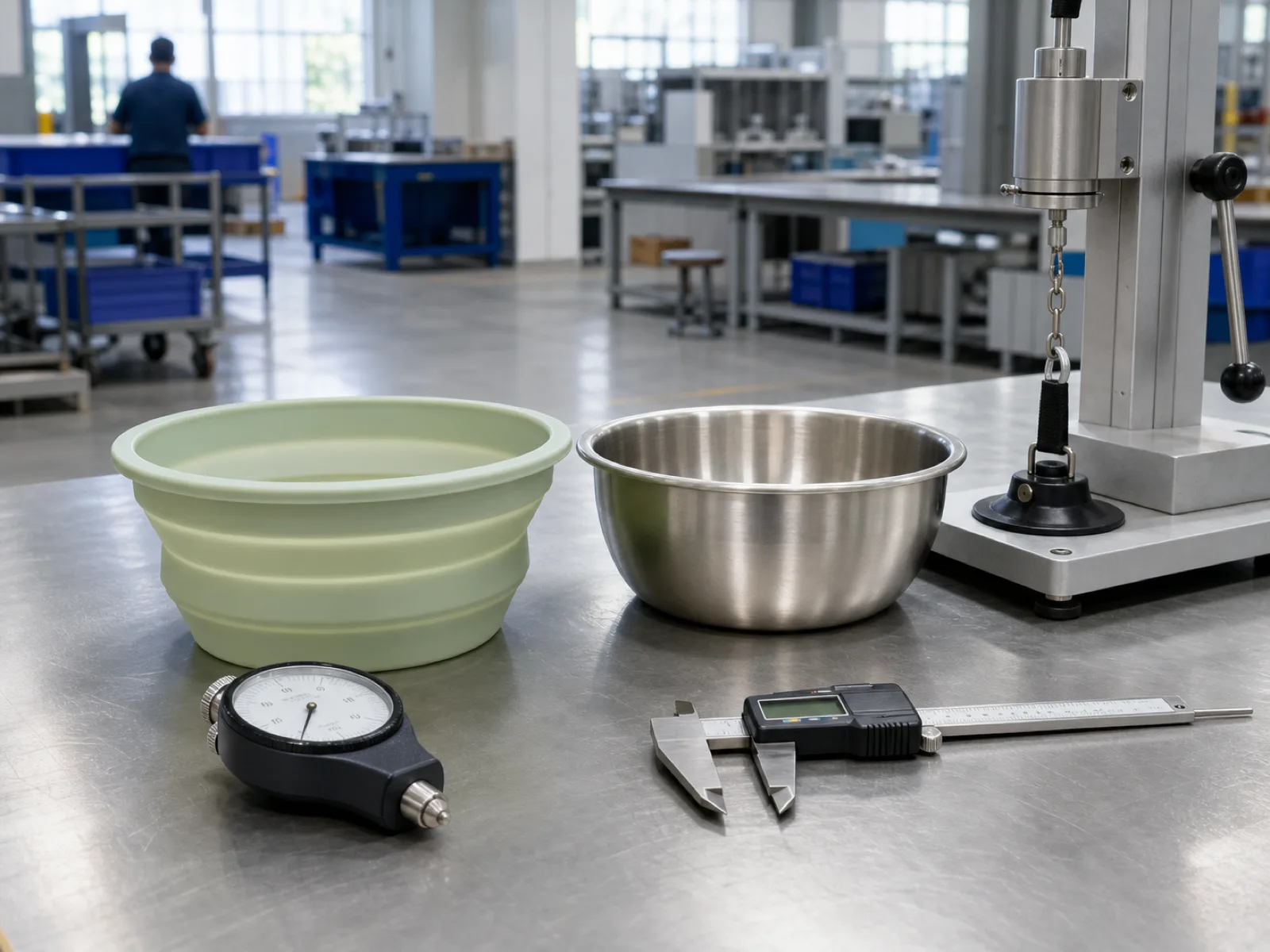
 A silicone dog bowl and a stainless steel dog bowl are both safe, non-porous ways to feed a dog, but they win different jobs. A silicone bowl folds flat, weighs almost nothing, grips the floor, and feeds quietly — built for travel, crates, and small spaces. A stainless steel bowl cannot be chewed apart and lasts a decade or more, making it the stronger permanent home bowl for chewers and aggressive eaters.
This guide is written for pet brands, private-label buyers, and product-development leads deciding whether to build a line around silicone bowls, stainless steel bowls, or both. It cuts past the vague “which is best” content that dominates the category and gives you the numbers a spec sheet needs: material grades and clause references, a quantified hygiene comparison, durometer and wall specs, temperature and dishwasher behavior, lifespan and cost-over-time, the failure modes that retire each material, and the OEM economics that separate a molded silicone bowl from a stamped steel one.
Silicone vs stainless steel dog bowl — which should you choose?
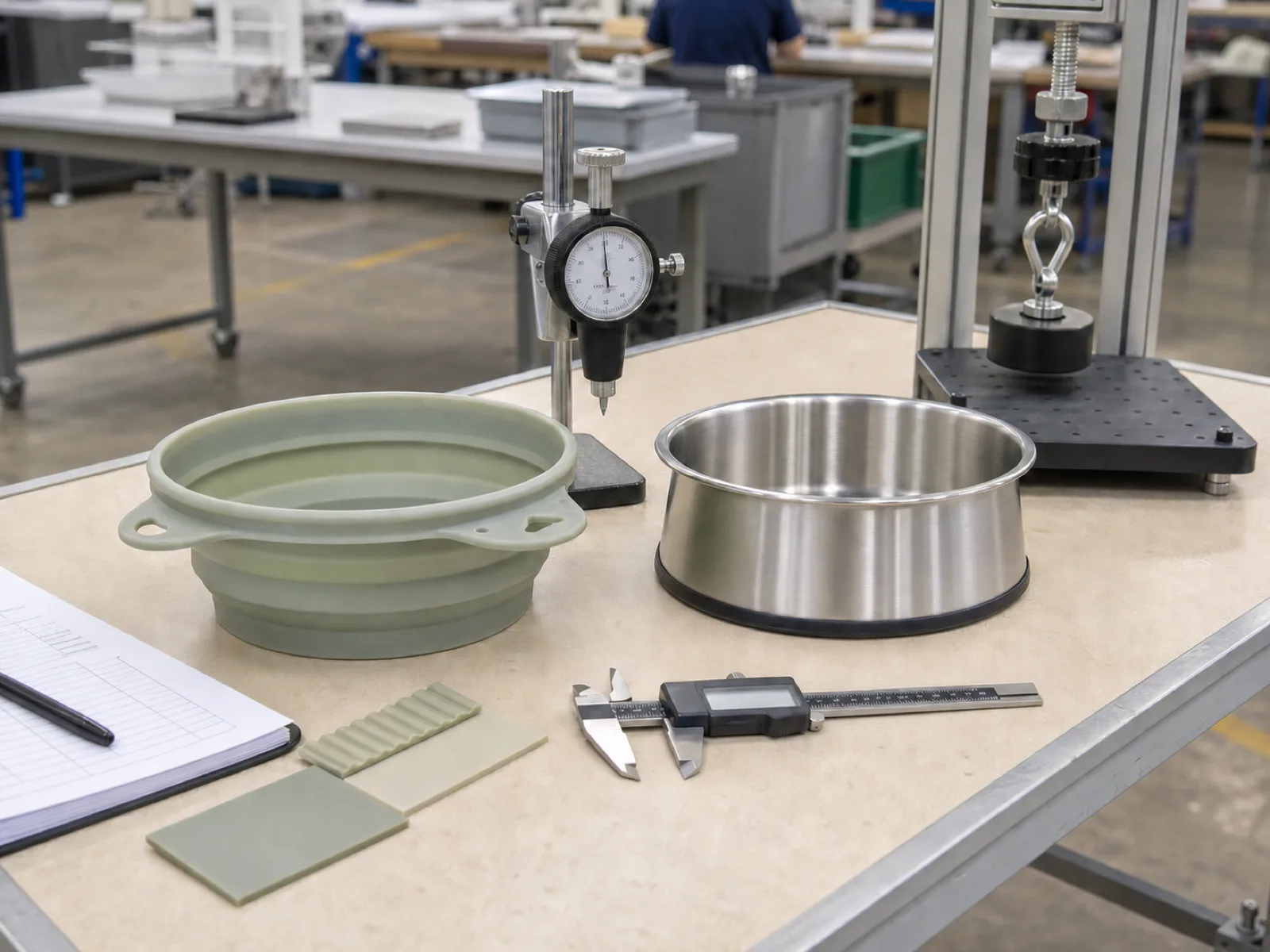
Choose a silicone dog bowl for travel, crates, small spaces, quiet feeding, and non-slip stability without a mat. Choose a stainless steel dog bowl for strong chewers, aggressive eaters, and permanent home stations where a decade-plus lifespan matters most. Both are safe and non-porous when correctly specified; the decision is driven by use case, not by one material being universally better.
The honest answer most category pages avoid is that neither material wins outright — they win different jobs. A silicone dog bowl is a molded flexible elastomer: it collapses, weighs a fraction of metal, silences the tag-and-bowl clatter dogs hate, and grips the floor on its own. A stainless steel dog bowl is a formed rigid metal: it shrugs off chewing, never tears, and outlasts almost everything else in the feeding aisle. The trade you are really making is portability and quiet, non-slip feeding on the silicone side versus raw chew resistance and multi-decade lifespan on the steel side.
The table below is the at-a-glance decision tool. Every row is expanded with hard numbers in the sections that follow.
| Factor | Silicone dog bowl | Stainless steel dog bowl |
|---|---|---|
| Material safety | Platinum-cured, FDA 21 CFR 177.2600 / LFGB | Food-grade 304 or 316 stainless |
| Non-porous / hygiene | Yes (non-porous elastomer) | Yes (passivated metal) |
| Chew resistance | Low — can tear or be bitten through | High — cannot be chewed apart |
| Typical lifespan | 3-5 years | 5-10+ years |
| Weight | Very light | Heavier |
| Collapsible / packable | Yes — folds flat | No — fixed shape |
| Non-slip base | Built in (high-friction / suction) | Only if a silicone ring is added |
| Quiet feeding | Yes — no metal clatter | No — noisy unless damped |
| Temperature range | -40 to 230 °C | Effectively unlimited |
| Dishwasher / boil safe | Yes | Yes |
| Best for | Travel, crates, small dogs, gentle eaters | Chewers, big dogs, home stations |
For most households the pragmatic outcome is not either/or — it is a stainless bowl at the home feeding station and a collapsible silicone bowl clipped to the leash for the car, the trail, and the crate. That two-bowl reality is also a merchandising insight for a brand: the materials are complements as often as competitors.
Is a silicone or stainless steel dog bowl safer?
Both are safe when specified correctly. A silicone dog bowl is safe when molded from platinum-cured silicone cleared under FDA 21 CFR 177.2600 and LFGB — inert, with no BPA, lead, latex, or phthalates. A stainless steel bowl is safe when made from food-grade 304 or 316 alloy. The danger in either material is a cheap grade: unmarked steel or filler-loaded silicone, not the material itself.
Safety is a grade question, not a material question, and this is where the biggest buyer mistakes happen. On the silicone side, the load-bearing phrase is platinum-cured (addition-cure). Platinum-cured silicone leaves no peroxide byproducts, passes food-contact extractables testing, and does not off-gas or smell. Cheap peroxide-cured or filler-loaded silicone — often bulked with non-food-grade fillers to cut cost — can leave a residue and fail migration limits. A genuine food-grade silicone dog bowl is molded to clear FDA 21 CFR 177.2600[^fda-177-2600] and, for European markets, the LFGB migration testing that sits under the EU food-contact framework[^eu-1935-2004]. If you want the full breakdown of what a safe compound requires, the is silicone safe for dogs materials guide walks through cure system, fillers, and the test reports that back the claim.
On the stainless side, “stainless steel” alone is not a safety spec — the grade is. Food-grade bowls should be 304 (18/8 chromium-nickel) or 316 stainless, the alloys defined in the ASTM A240 specification family[^astm-a240]. These grades form a passive chromium-oxide layer that resists corrosion and leaching. Lower-cost 200-series or unmarked alloys can carry higher manganese and less chromium, corrode faster, and are the source of most “my steel bowl is rusting” complaints. A rusted or pitted steel bowl is both a leaching and a hygiene problem.
| Safety factor | Silicone dog bowl | Stainless steel dog bowl |
|---|---|---|
| Correct grade | Platinum-cured food-grade silicone | 304 or 316 food-grade stainless |
| Governing clause | FDA 21 CFR 177.2600 / LFGB | ASTM A240 (304/316 composition) |
| BPA / lead / phthalate | None | None (food-grade alloy) |
| Leaching risk | Only from filler-loaded imitation | Only from low-grade / rusted alloy |
| Corrosion / rust | Does not corrode | 304/316 resist; low grades rust |
| Off-gassing / smell | None if platinum-cured | None |
| Failure that creates risk | Tearing (ingestion) | Pitting / rust (leaching) |
The practical takeaway for a brand: safety marketing on either material is only defensible with documentation. For silicone that means a compound Certificate of Compliance and a food-contact migration report; for steel that means a mill certificate naming the 304/316 grade. A bowl marketed as “food-safe” without either is a warranty exposure, not a feature.
Which is more hygienic — silicone or stainless steel dog bowls?
Both are highly hygienic because both are non-porous — platinum-cured silicone and passivated 304/316 stainless each resist the bacterial biofilm that drives canine chin acne far better than porous plastic. The real hygiene variable is surface damage: a scratched steel bowl or a gouged, filler-loaded silicone bowl both trap bacteria in the grooves. Keep either clean, and replace it once the surface is scratched or torn.
Hygiene is where pet-bowl content gets it half-right. Plastic bowls are the genuine villain — porous, easily scratched, and a documented reservoir for biofilm that redeposits onto a dog’s chin and drives the low-grade infection owners call chin acne. Both silicone and stainless are large improvements because both are non-porous: there is no fiber network or porous matrix for product and moisture to hide in. Peer-reviewed work on biofilm formation across pet-bowl surface materials consistently ranks smooth non-porous surfaces above porous ones for cleanability[^pubmed-biofilm].
But non-porous is not the same as scratch-proof, and this is the nuance competitors miss. Bacteria colonize grooves. A stainless bowl that has been scoured with steel wool develops micro-scratches that harbor biofilm; a low-grade silicone bowl bulked with fillers can develop surface gouges from chewing that do the same. A genuine platinum-cured silicone surface and an undamaged passivated steel surface are both easy to keep clean — the failure is a damaged surface of either material.
| Hygiene factor | Silicone dog bowl | Stainless steel dog bowl |
|---|---|---|
| Surface porosity | Non-porous elastomer | Non-porous passivated metal |
| Biofilm resistance (intact) | High | High |
| Scratch behavior | Resists; gouges only from chewing | Micro-scratches from abrasive scrubbing |
| Boil / steam sterilize | Yes (to 230 °C) | Yes |
| Dishwasher | Yes, top rack | Yes |
| Odor retention | None if platinum-cured | None |
| Main hygiene failure | Torn / gouged surface | Rust or deep scratches |
For a beauty-of-the-claim standpoint, a brand can honestly market either material as a hygienic upgrade over plastic — but the defensible version pairs the non-porous claim with a care instruction (wash daily, avoid abrasive scrubbers, replace when the surface is damaged). That is a claim you can stand behind, unlike a bare “antibacterial” label neither material earns on its own.
How long does each last — silicone vs stainless steel dog bowl durability?
A stainless steel dog bowl lasts longest — 5 to 10-plus years, frequently the dog's entire life — because 304/316 metal does not tear, degrade, or lose shape. A silicone dog bowl lasts roughly 3 to 5 years before the surface scuffs, stains, or a chewer damages it. Steel trades portability for longevity; silicone trades some lifespan for packability, quiet, and non-slip feeding.
Durability is a construction story. Stainless steel has effectively one slow failure mode in normal use: cosmetic denting from being dropped, which does not compromise safety or function. It does not tear, does not fatigue, and does not lose its shape. That is why a good steel bowl is often a once-in-a-dog’s-life purchase. Silicone’s durability is governed by tear strength and abrasion resistance — the tensile and tear properties measured by ASTM D412[^astm-d412] — and a well-formulated platinum-cured compound resists both well under normal feeding. Where silicone loses the lifespan race is deliberate abuse: a chewer treating the bowl as a chew toy can gouge or tear it in ways steel simply ignores.
| Durability factor | Silicone dog bowl | Stainless steel dog bowl |
|---|---|---|
| Chew / bite resistance | Low — can be torn | High — cannot be chewed apart |
| Tear / abrasion | Resists normal use (ASTM D412) | Not applicable — metal |
| Denting | Springs back | Dents cosmetically, stays safe |
| Shape retention | Permanent unless torn | Permanent |
| Typical service life | 3-5 years | 5-10+ years |
| Failure signal | Gouge, tear, deep stain | Rust (low grade) or dent |
| Replacement driver | Chewing damage | Rarely replaced |
The lifespan gap flows into cost-per-year, but not in the direction unit price suggests. A steel bowl amortized over 8 years can be cheaper per year than a silicone bowl replaced every 3 — for a home station. But the silicone bowl is not competing for that slot; it is competing for the travel and crate slot where a steel bowl’s weight and fixed shape disqualify it entirely. The correct cost comparison is per use case, not per material in the abstract.
Which dog bowl is better for travel and outdoor use?
A silicone dog bowl is decisively better for travel and outdoor use. It collapses to a fraction of its height, weighs almost nothing, clips to a leash or bag, grips uneven ground without a mat, and will not clatter or dent in a pack. Stainless steel is rigid, heavy, and fixed-volume — a fine home bowl but a poor travel companion. This portability gap is silicone's clearest win.
Portability is the single use case where the two materials are not close, and it is the reason the collapsible silicone bowl became a category of its own. A molded silicone bowl uses a living-hinge wall that compresses to a fraction of its standing height and springs back to full volume, so a full-size bowl packs down to something that fits a jacket pocket, a hiking pack, or a carabiner clip. Stainless steel holds exactly one shape and one volume, and a nested set of steel bowls still occupies real luggage volume and adds real weight.
Beyond folding, silicone stacks up several travel-specific advantages that steel cannot match without help:
Non-slip stability — a molded silicone base is inherently high-friction, and many designs add an integrated suction ring, so the bowl stays put on tile, a car floor, or a rock at camp. Bare steel slides and skates unless it has a bonded silicone ring on the base — which is itself a tacit admission that silicone grips better.
Quiet feeding — steel bowls broadcast every tag-tap and every push across a hard floor, a noise many dogs dislike and many small-space owners cannot tolerate. Silicone feeds silently.
Weight — for backpacking, cycling, or air travel, a silicone bowl’s weight is a rounding error next to a comparable steel bowl.
For a brand, this is why travel, camping, crate, and small-space lines lead with silicone and why a silicone slow feeder or collapsible bowl is a natural molded-product anchor. Steel owns the home; silicone owns everywhere the bowl has to move.
How do temperature tolerance and cleaning compare?
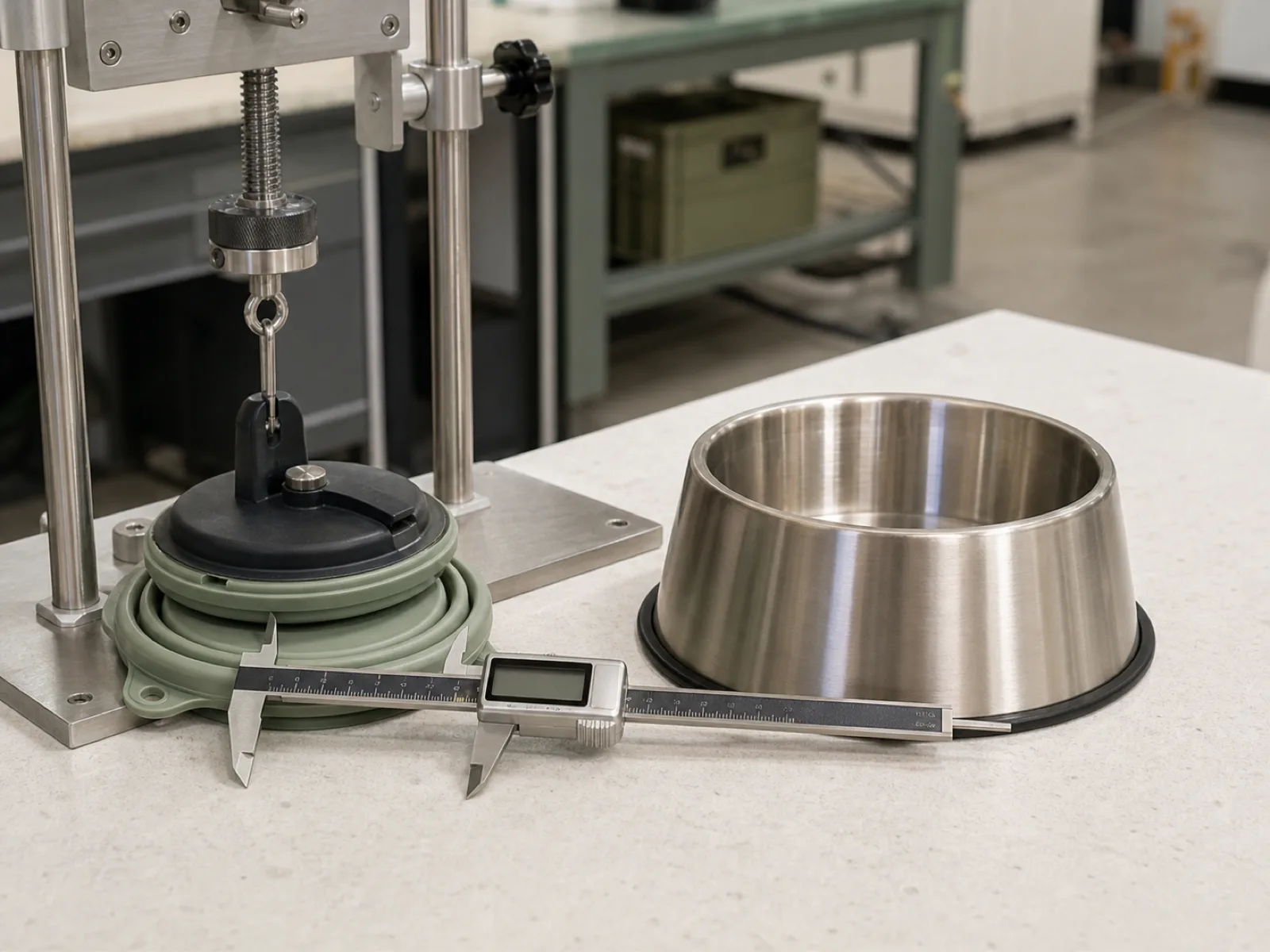
Both far outperform plastic on heat and cleaning. Food-grade silicone holds a -40 to 230 °C service window, so a silicone dog bowl is dishwasher-, boil-, and steam-safe without deforming. Stainless steel has an even higher heat ceiling and is equally dishwasher and boil safe. The practical difference is small — both let you sterilize between uses — and both beat plastic, which warps and scratches.
Temperature tolerance matters because it determines whether you can truly sterilize a bowl. Food-grade platinum-cured silicone is stable from roughly -40 °C to 230 °C, which is why a quality silicone dog bowl survives the dishwasher’s hot cycle, a boiling-water sanitize, and steam without warping, clouding, or leaching. The silicone temperature range explained guide details how that window is set by the cure system and compound. Stainless steel’s usable ceiling is far higher still — it is unbothered by any household cleaning temperature — but for pet-bowl purposes both materials clear the bar that plastic fails.
| Cleaning / heat factor | Silicone dog bowl | Stainless steel dog bowl |
|---|---|---|
| Service temperature | -40 to 230 °C | Effectively unlimited (household) |
| Dishwasher safe | Yes, top rack | Yes |
| Boil / steam sterilize | Yes | Yes |
| Warps under heat | No | No |
| Scratches from washing | Only from abrasives | Micro-scratches from steel wool |
| Cold behavior | Stays flexible to -40 °C | Conducts cold, feels icy |
| Stain / hard-water spotting | Can stain over years | Water-spots, wipes off |
One real-world nuance: stainless steel conducts temperature, so a steel bowl left in a hot car or a freezing yard takes on that temperature and holds it, while silicone insulates and stays closer to neutral. It is a minor point for most households but a genuine consideration for outdoor and climate-extreme use — another reason the two materials sort by environment.
When should you avoid silicone or stainless steel?
Avoid a silicone dog bowl for a determined power chewer — a dog that can bite through or tear silicone creates a choking and blockage risk from swallowed pieces. Avoid a bare stainless steel bowl where quiet, non-slip, portable feeding is the priority, or where a dog is nervous about metal noise and reflections. Match the material to the dog's behavior and the bowl's environment, not to a blanket "best" claim.
Every material has a disqualifying use case, and naming them is more useful than a generic recommendation. The failure modes below tell a buyer or a brand exactly when to switch materials.
Avoid silicone when:
- The dog is a power chewer who treats the bowl as a toy — a torn silicone bowl and swallowed fragments are a real ingestion and blockage hazard. Cured platinum silicone is inert if a small piece is swallowed, but a large fragment still warrants a vet call. Use stainless at home and offer silicone only under supervision.
- The bowl is a permanent, heavy-use home station where a 10-year lifespan is the priority over portability.
- The buyer cannot verify the grade — an unmarked or filler-loaded “silicone” bowl defeats every safety and hygiene advantage the material should have. Confirm the platinum cure and clause coverage, and cross-check the FDA vs LFGB clause breakdown for which standard belongs on which market.
Avoid bare stainless steel when:
- Quiet feeding matters — a noise-sensitive dog or a small apartment where bowl clatter carries.
- Non-slip stability matters and you do not want a separate mat — bare steel skates unless it carries a bonded silicone base ring.
- The bowl must travel — steel’s weight and fixed shape make it a poor pack bowl.
- The dog is anxious about reflections — some dogs are unsettled by their reflection in a shiny steel bowl, a small but real behavioral factor a brushed or matte finish partly solves.
The pattern across both lists is consistent: silicone fails on brute-force durability, steel fails on portability and quiet, non-slip feeding, and the buyer who tries to force one material into the other’s job gets a returned product.
What should pet brands spec for a private-label silicone dog bowl?
Spec platinum-cured food-grade silicone cleared under FDA 21 CFR 177.2600 and LFGB, a Shore A wall hardness of 40-60, wall thickness and collapse height, a Pantone-matched color, a branding method (debossed or in-mold), and require a compound Certificate of Compliance, a food-contact migration report, and lot traceability. Molded tooling means an MOQ near 500 pcs/SKU with a 7-25 day first sample — a different supply chain from stamped steel.
For the brands and buyers reading this as a sourcing decision, the silicone side is a molding program with a specific spec sheet. The single most important line is the compound: platinum-cured, food-grade, clause-covered. Everything else — feel, collapse, grip, color — is a downstream design choice, but the compound is the safety and the story. A silicone dog bowl wall is typically molded at Shore A 40-60, measured by the ASTM D2240 durometer method[^astm-d2240]: soft enough to collapse and grip, firm enough to hold volume and resist everyday chewing. The Shore A hardness chart shows where that lands on the touch scale.
| Spec line | Typical target for a silicone dog bowl |
|---|---|
| Compound | Platinum-cured (addition-cure) food-grade silicone |
| Clause coverage | FDA 21 CFR 177.2600 + LFGB |
| Wall hardness | Shore A 40-60 (ASTM D2240) |
| Wall thickness | 1.5-3.0 mm depending on size and collapse |
| Base grip | Integrated high-friction ring or suction cup |
| Color | Pantone-matched master-batch |
| Branding | Debossed logo or in-mold graphic |
| MOQ (new tooling) | 500 pcs/SKU |
| First sample | 7-25 days |
| Documentation | CoC + food-contact migration report + lot traceability |
The documentation column is where a serious buyer separates a real factory from a trading desk. Insist on a compound Certificate of Compliance citing the applicable clause, a food-contact migration test report, and lot traceability so a recall or a retail audit can be answered. A supplier that cannot produce those on request is selling on price, not on a defensible safety position — and a pet bowl is a product a chain retailer will audit.
Wetop’s silicone dog bowl OEM position
Wetop is a platinum-cured silicone specialist — we mold custom silicone dog bowls, collapsible travel bowls, and slow feeders, not stamped steel bowls. MOQ is 500 pcs/SKU on new tooling with a 7-25 day first sample from our Dongguan factory, molded under ISO 9001 from FDA 21 CFR 177.2600 / LFGB food-grade compound at a Shore A you specify. If your program needs a steel bowl, that is a different supply chain and we will say so.
The two products come from different factories for a structural reason. A stainless steel bowl is stamped and formed from sheet metal, then polished and passivated — a metal-forming operation set by steel suppliers and press tooling. A silicone dog bowl is molded — a machined cavity, a platinum-cured compound, a cured one-piece bowl with an integrated non-slip base and, if collapsible, a living-hinge wall. We run the molding side. That specialization is why we can hold a Shore A 50 target and a repeatable collapse height lot after lot and put full FDA / LFGB documentation behind every batch, certified under ISO 9001[^iso-9001].
If your line is silicone — a collapsible travel bowl, a non-slip feeding bowl, a slow feeder, or a paired set that ships alongside a steel home bowl you source elsewhere — we can quote from a sketch or a 3D file within one business day, including a durometer recommendation, unit price at 500 / 5,000 / 50,000 pcs, tooling amortization, and sample lead time. The MOQ and lead-time math shows exactly how the mold cost spreads across your first run so the per-unit price makes sense at each volume tier.
Request a custom silicone dog bowl quote with your target bowl size, collapse height, Shore A, color (Pantone), branding method, and order volume — we return a compound recommendation, tooling plan, and price schedule within one business day from the engineering desk in Dongguan.
FAQ
-
Are silicone dog bowls safe for dogs to eat and drink from?
A silicone dog bowl is safe when it is molded from platinum-cured (addition-cure) silicone cleared for repeated food contact under FDA 21 CFR 177.2600 and LFGB. That grade contains no BPA, latex, lead, or phthalates and leaches nothing into food or water. The risk is not the material but the grade: unmarked, filler-loaded, or peroxide-cured silicone can smell and leave residue. Always confirm the compound and a food-contact test report on any bowl you buy or spec.
-
Which is better for my dog, a silicone or stainless steel bowl?
Choose stainless steel for a strong chewer, an aggressive eater, or a permanent home feeding station where lifespan matters most. Choose silicone for travel, camping, crates, small spaces, quiet feeding, and non-slip stability without a mat. Many owners keep a stainless bowl at home and a collapsible silicone bowl for the car and walks. The material is a use-case decision, not a universal winner.
-
Do silicone dog bowls cause chin acne or hold more bacteria than stainless steel?
Neither material causes chin acne on its own — biofilm on a dirty or scratched surface does. Both food-grade platinum-cured silicone and passivated 304/316 stainless are non-porous and resist bacterial colonization when kept clean. The real driver is grooves and scratches: a gouged plastic-filled silicone bowl or a rusted low-grade steel bowl both trap bacteria. Wash daily and replace either bowl once the surface is visibly scratched or torn.
-
Can a dog chew through a silicone bowl, and is it dangerous if they do?
A determined chewer can bite through or tear a silicone dog bowl, and swallowed silicone pieces are a choking and blockage risk, so silicone is the wrong bowl for a power chewer. Stainless steel cannot be chewed apart. If a dog treats the bowl as a toy, use stainless at home and only offer silicone under supervision during travel. Cured platinum silicone is inert if a small piece is swallowed, but large fragments still require a vet call.
-
Is a silicone dog bowl dishwasher safe and can you sterilize it?
Yes. Food-grade silicone holds a -40 to 230 °C service window, so a quality silicone dog bowl is top-rack dishwasher safe and can be boiled or steam-sterilized without deforming or leaching. Stainless steel is also fully dishwasher and boil safe with an even higher heat ceiling. Both beat plastic, which warps and scratches. For a puppy or an immune-compromised dog, the ability to boil-sterilize is a real hygiene advantage of both materials over plastic.
-
Why do silicone dog bowls fold flat and stainless steel bowls do not?
A collapsible silicone bowl folds because cured silicone is a flexible elastomer with a molded living-hinge wall that compresses to a fraction of its height and springs back. Stainless steel is a rigid formed metal that holds one shape. That flexibility is why silicone dominates travel, hiking, and crate lines — a folded bowl fits a pocket or leash clip — while steel stays a fixed-volume home bowl.
-
Do silicone or stainless steel dog bowls slide around less during feeding?
Silicone grips the floor better on its own. A molded silicone dog bowl has an inherently high-friction base and often an integrated suction or wide non-slip rim, so it stays put without a separate mat. Bare stainless steel slides and clatters unless it has a bonded silicone ring on the base — which many premium steel bowls now add, borrowing silicone's grip. For a messy or enthusiastic eater, silicone's quiet, no-skid feeding is a clear edge.
-
Which lasts longer, a silicone or stainless steel dog bowl?
A stainless steel dog bowl lasts longer — 5 to 10-plus years, often the dog's whole life, because 304/316 steel does not tear, degrade, or lose shape. A silicone dog bowl lasts roughly 3 to 5 years before the surface scuffs, stains, or a chewer damages it. Silicone trades some lifespan for portability and quiet, non-slip feeding, so the right choice depends on whether longevity or packability matters more for that bowl's job.
-
What should a pet brand spec when sourcing a private-label silicone dog bowl?
Spec platinum-cured (addition-cure) food-grade silicone cleared under FDA 21 CFR 177.2600 and LFGB, a Shore A hardness in the 40-60 range for a bowl wall, wall thickness and collapse height, a Pantone-matched color, branding method (debossed logo or in-mold), and require a compound Certificate of Compliance plus a food-contact migration test report and lot traceability. MOQ on molded tooling is typically 500 pcs/SKU with a 7-25 day first sample.
References
Authoritative sources cited in this guide
- US Food and Drug Administration. 21 CFR 177.2600 — Rubber articles intended for repeated use. https://www.ecfr.gov/current/title-21/chapter-I/subchapter-B/part-177/subpart-C/section-177.2600 — The federal food-contact rule that a platinum-cured silicone dog bowl is molded to clear.
- US Food and Drug Administration. Food Ingredients & Packaging — Food Contact Substances. https://www.fda.gov/food/food-ingredients-packaging — FDA framework governing materials that contact food and water, covering both silicone and metal food-contact articles.
- EUR-Lex, Publications Office of the European Union. Regulation (EC) No 1935/2004 on materials intended to come into contact with food. https://eur-lex.europa.eu/eli/reg/2004/1935/oj — The EU food-contact framework behind LFGB migration testing that a silicone bowl for European markets must satisfy.
- ASTM International. ASTM Standards for Chromium and Chromium-Nickel Stainless Steel (A240). https://www.astm.org/products-services/standards-and-publications/standards.html — The specification family defining the 304 and 316 stainless grades used in food-grade pet bowls.
- ASTM International. ASTM D2240 — Standard Test Method for Rubber Property—Durometer Hardness. https://www.astm.org/d2240-15r21.html — The Shore A durometer method used to spec a silicone dog bowl wall at 40-60.
- ASTM International. ASTM D412 — Standard Test Methods for Vulcanized Rubber—Tension. https://www.astm.org/d0412-16r21.html — The tensile and tear method behind the tear-resistance and chew-durability discussion for silicone.
- International Organization for Standardization. ISO 9001:2015 — Quality Management Systems — Requirements. https://www.iso.org/standard/62085.html — The quality-system standard Wetop's silicone dog bowl production is certified against.
- US National Library of Medicine (PubMed). Microbial Biofilm Formation on Pet Feeding Bowls and Surface Materials. https://pubmed.ncbi.nlm.nih.gov/ — Peer-reviewed literature on bacterial biofilm on pet bowl surfaces — the hygiene axis of this comparison.
Start a custom program
Send a brief. Get an engineer’s reply in one business day.
Every Wetop program is tooled from a customer’s specification. Send a CAD file (STEP · IGES · DWG) or a written brief and we’ll reply with a mold cost estimate, price brackets at MOQ 500 / 1,000 / 5,000, and any engineering questions.