Buyer Guide · commercial intent
Silicone Whisk OEM Manufacturing Guide
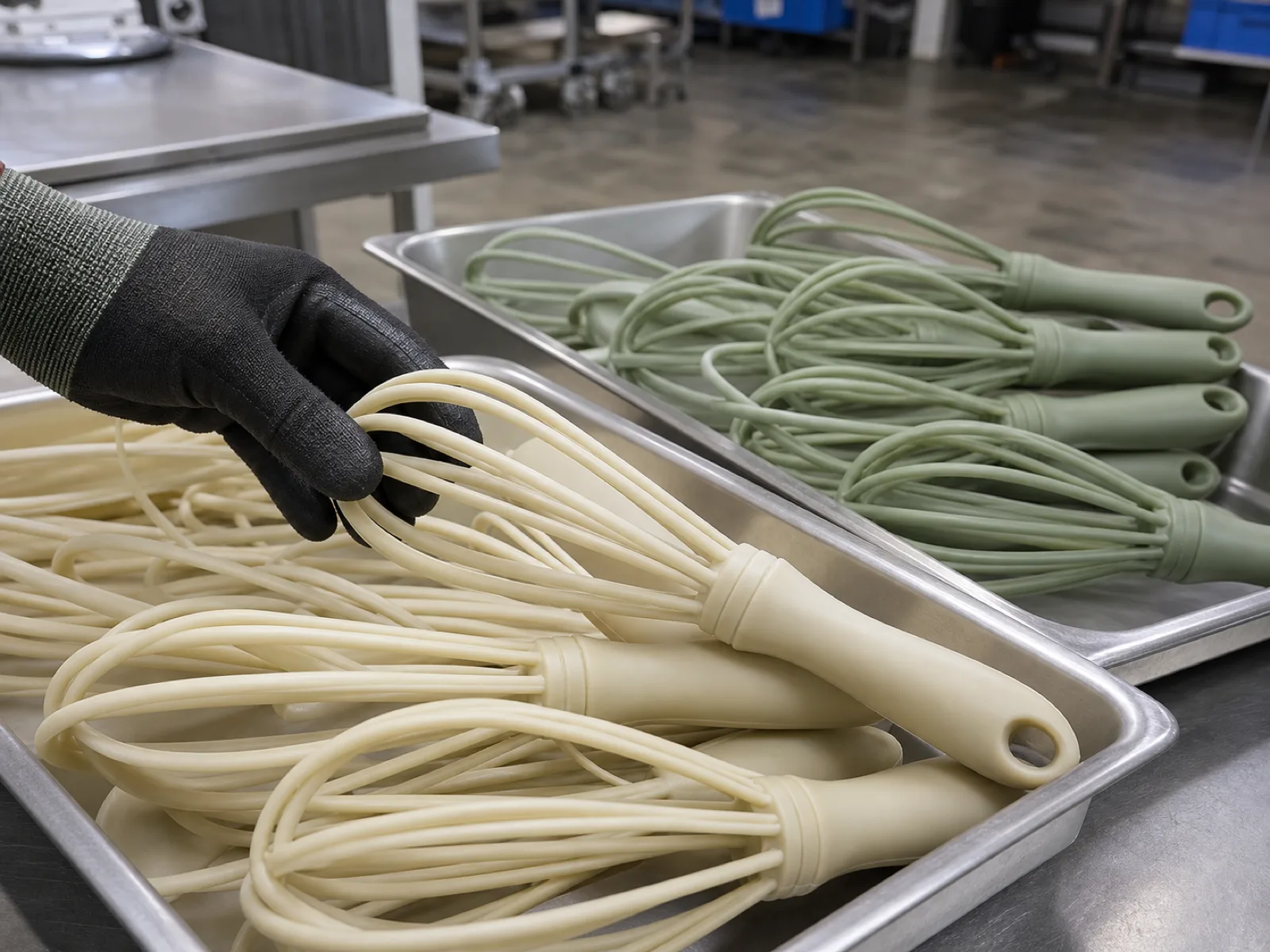 Buyer Guide
 A silicone whisk is a food-contact kitchen tool built by over-molding platinum-cured silicone around a stainless-steel wire core, engineered to hold a continuous working range of −40 °C to 230 °C and clear FDA 21 CFR 177.2600 extractables. Retail-grade OEM builds pair a primer-bonded coating at Shore A 50–60 with 304 stainless wire, so the loops stay non-scratch on nonstick cookware and the coating never peels off the wire. This guide is the engineering-desk brief for buyers running a whisk program at 5,000 to 500,000 pcs, with the whisk-type selection, wire-core specs, silicone-to-steel bonding math, MOQ tiers, compliance packet, and landed cost a founder-led factory puts in front of a program manager on day one.
The silicone whisk looks like a solved product from a retail buyer’s seat — until the first container comes back with coating peeling off the wire loops on 4 % of units, a scent-panel fail on the second lot, and consumer reviews complaining the whisk “smells like burnt rubber” after a month of dishwasher cycles. None of those failures are random. They map to a small number of decisions the factory made — or skipped — at wire-core selection, adhesion priming, cure system, over-mold process, and post-cure. This guide is written from the engineering desk at Wetop’s Dongguan floor for buyers at housewares brands, sink-adjacent retail chains, and private-label programs who want the manufacturing math, not marketing copy.
What is a silicone whisk, and what does a retail-grade one need to deliver?
A silicone whisk is a food-contact utensil built by over-molding platinum-cured silicone rubber around a stainless-steel wire core, then post-curing at 200 °C for 4 hours to drive off volatiles. A retail-grade unit must clear FDA 21 CFR 177.2600[^fda-177-2600] extractables, hold −40 °C to 230 °C continuous, protect nonstick cookware, and survive 200+ dishwasher cycles with no coating delamination, odor, or stain.
The category splits into four common wire geometries — balloon, flat/roux, spiral/ball, and mini — each with its own use case and coating Shore A sweet spot. What sits under all four is the same materials science: a stainless-steel wire core formed into loops and set into a handle, then enrobed in a two-part silicone compound cured by either a platinum-catalyst addition reaction or a peroxide free-radical reaction, and bonded to the wire through a primer-adhesive interface rather than a mechanical undercut. That last point is what makes a whisk harder to build than a spatula: a spatula’s steel core is a flat blade with room for anchor holes, while a whisk’s core is thin round wire with no undercut geometry — the coating has to hold on by chemical adhesion alone.
The failure economics are unforgiving. Retail return rates on silicone whisks run 2.0–3.5 % in the first 12 months for well-specified programs, and 5.0–8.0 % for programs that skipped the adhesion primer or dip-coated instead of over-molding. On a 100,000-unit annual program at USD 6 retail, a three-point return-rate swing is roughly USD 15,000 in reverse logistics plus the shelf-space penalty that a poor review score triggers.
Which whisk type should you spec — balloon, flat/roux, mini, or spiral/ball?
Spec the whisk type to the end-use: a balloon whisk for whipping cream and eggs, a flat/roux whisk for sauces and pan deglazing, a spiral/ball whisk for small bowls and dressings, and a mini whisk for spices and single-serve mixing. Each type needs a different wire gauge and coating hardness — a blanket spec across a line is the most common OEM error.
The four geometries are not interchangeable, and the wire spec follows the mechanical load each one carries. A balloon whisk has 8–10 flexible loops that need to aerate — soft enough to whip, stiff enough not to collapse. A flat/roux whisk lays 4–6 loops in a plane for scraping the bottom of a pan, so the wire runs a heavier gauge to resist deflection under a thick sauce. A spiral/ball whisk uses a coiled wire with a free-rolling ball for emulsifying in narrow vessels. A mini whisk shrinks the whole geometry for spice pastes and single-egg jobs.
| Whisk type | Wire gauge (304) | Coating Shore A | Loop count | Primary use |
|---|---|---|---|---|
| Balloon | 1.6 – 2.0 mm | 52 – 58 | 8 – 10 | Whipping cream, egg whites, aeration |
| Flat / roux | 2.0 – 2.4 mm | 55 – 62 | 4 – 6 | Sauces, gravy, pan deglazing |
| Spiral / ball | 1.4 – 1.8 mm | 50 – 55 | Coil + ball | Dressings, small-bowl emulsifying |
| Mini | 1.2 – 1.6 mm | 50 – 55 | 6 – 8 | Spices, single-serve, matcha |
The engineering call: a retail line should carry at least a balloon and a flat/roux SKU, because they cover the two dominant home-cooking jobs and let the buyer price two shelf tiers off one shared handle tool. Specifying a single Shore A across all four types — a shortcut cheap factories take — leaves the balloon whisk too stiff to aerate and the flat whisk too soft to scrape. Buyers building a broader assortment can layer these SKUs onto the tiering in the silicone kitchen utensils OEM guide.
What is the real temperature range of a silicone whisk, and how does the coating degrade?
Platinum-cured silicone whisk coatings hold −40 °C to 230 °C (−40 °F to 446 °F) as a continuous working range. The 500 °F claims on retail packaging are short spike ratings on the coating, not sustained temperatures. Above 250 °C the methyl side groups oxidize, producing a chalky surface film and a slow upward Shore A drift that stiffens the loops before they turn brittle.
Silicone degrades along two independent pathways. Above 230 °C the Si–O backbone stays stable but the methyl side groups start oxidizing, producing a chalky film on the loops and an upward Shore A drift — the coating goes stiffer, then crack-prone. Below −55 °C the compound approaches its glass transition and the coating goes brittle under flex. Neither is instant; both are cumulative dose-response curves, which is why a “safe for hot caramel” claim can be technically true and operationally misleading if a cook parks the whisk resting in a 200 °C pan for ten minutes.
| Rating | Continuous working | Short spike (< 5 min) | Notes |
|---|---|---|---|
| Coating (platinum-cured, Shore A 55) | −40 °C to 230 °C | 260 °C | Above 230 °C, log cumulative hours |
| Wire-to-coating bond line | −40 °C to 215 °C | 235 °C | Weakest thermal link — expansion mismatch stresses the bond |
| Handle (if TPE overmold) | −20 °C to 120 °C | 140 °C | Add-on grip carries a lower rating than the loops |
| Dishwasher cycle (thermal + detergent) | 71 °C peak, pH 10.5 | n/a | Rated 500+ cycles at spec; drift begins near cycle 800 |
The bond line is the thermal weak point unique to whisks. Because the coating and the wire expand at very different rates — silicone at roughly 3.1 × 10⁻⁴ /°C versus stainless at 1.7 × 10⁻⁵ /°C, an 18× mismatch — every heat cycle shears the adhesion interface a little. A primer-bonded over-mold absorbs that shear for thousands of cycles; a dip-coated whisk with no chemical bond starts lifting at the loop tips within weeks. This is why the temperature spec and the bonding spec are the same conversation on a whisk.
Silicone-over-wire vs full-silicone body — which construction belongs on a retail whisk?
A silicone-over-wire whisk over-molds the coating onto a stainless steel wire core, giving the loops structural spring plus a non-scratch surface. A full-silicone whisk has no metal — the loops are molded silicone alone, which stays soft but collapses under a stiff batter. Retail whipping and sauce whisks need the wire core; full-silicone bodies suit only light mini and children's whisks.
The construction choice is a mechanical trade, not a cost trade. A wire core gives the whisk its working spring — the loops flex and snap back to aerate or scrape. A full-silicone whisk with no wire has no restoring force: the loops deflect under load and stay deflected, so it can stir a thin liquid but cannot whip cream or fold a thick batter. Full-silicone bodies exist for a reason — they are the safest choice for a toddler’s baking set and for ultra-soft mini whisks — but they are the wrong answer for any whisk marketed on performance.
| Construction | Working spring | Non-scratch | Coating failure risk | Best fit |
|---|---|---|---|---|
| Silicone over 304 wire, primer-bonded | High | Yes | Low — bond holds 150 N+ | Balloon, flat/roux, retail performance whisks |
| Silicone over 430 wire, primer-bonded | Medium (work-hardens) | Yes | Medium — wire fatigue | Sub-USD-3 imports (not recommended) |
| Silicone over wire, dip-coated (no primer) | High | Yes | High — peels below 40 N | Avoid — the dominant return-driver |
| Full silicone body (no wire) | Low | Yes | None (no bond line) | Mini, children’s, ultra-soft whisks |
The retail spec that wins is silicone over 304 stainless wire with a primer-adhesive interface. The engineering payoff shows up in year-one returns: primer-bonded over-mold programs run 0.9–1.6 % coating-related returns, versus 4.5–7.0 % on dip-coated whisks from the same buyers before they switched.
Platinum-cured vs peroxide-cured silicone — which cure system for the whisk coating?
Platinum-cured silicone is the only cure chemistry that passes retail scent-panel and taste-transfer testing on a whisk coating. Peroxide-cured compounds leave 0.3–1.2 % residual benzoic acid and vinyl byproducts that off-gas over the first 30 wash cycles — the "smells like burnt rubber" complaint. Platinum-cured runs 12–18 % higher in raw-material cost and pays back within 200 units of return savings.
The chemistry difference is decisive but rarely explained on factory brochures. Peroxide cure uses dicumyl peroxide or 2,4-dichlorobenzoyl peroxide as a free-radical initiator; the crosslink reaction generates volatile byproducts — benzoic acid, acetophenone, chlorobenzoic acid — that a proper 4-hour, 200 °C post-cure is supposed to drive off. In practice, factories running compression cells on tight cycles skip the post-cure to protect throughput, and 40–60 % of the volatile load stays in the whisk coating, waiting to off-gas over dishwasher cycles at the buyer’s kitchen sink.
Platinum cure uses a Pt-catalyst addition reaction between vinyl-terminated PDMS and hydride-functional PDMS. No byproducts — the reaction is stoichiometrically clean, which is why platinum-cured silicone ships to infant-nipple and medical-device applications with minimal post-cure[^nih-silicone-review].
| Attribute | Peroxide-cured HCR | Platinum-cured HCR | Platinum-cured LSR |
|---|---|---|---|
| Raw-material cost (USD/kg, 2026) | 5.20 – 7.00 | 6.80 – 9.20 | 9.50 – 14.00 |
| Requires post-cure to pass FDA? | Yes (4 h @ 200 °C) | Recommended | No |
| Volatile matter after cure | 0.4 – 1.2 % | 0.05 – 0.15 % | 0.02 – 0.08 % |
| Scent-panel pass rate (unaged) | 60 – 75 % | 96 – 100 % | 98 – 100 % |
| BfR XV[^bfr-xv] compliance path | Difficult — often fails | Standard | Standard |
| Best-fit process | Compression over-mold | Compression over-mold | Injection over-mold |
| Typical use in whisks | Sub-USD-3 retail | USD 5 – 14 retail | Premium USD 14+ retail |
For any whisk spec above USD 5 shelf price, Wetop only quotes platinum-cured — the reject-rate math kills peroxide before the raw-material savings pay in. The full chemistry teardown lives in the platinum-cured vs peroxide-cured silicone comparison if you need to defend the spec choice to a category buyer.
Why silicone-to-steel-wire bonding is the core quality driver
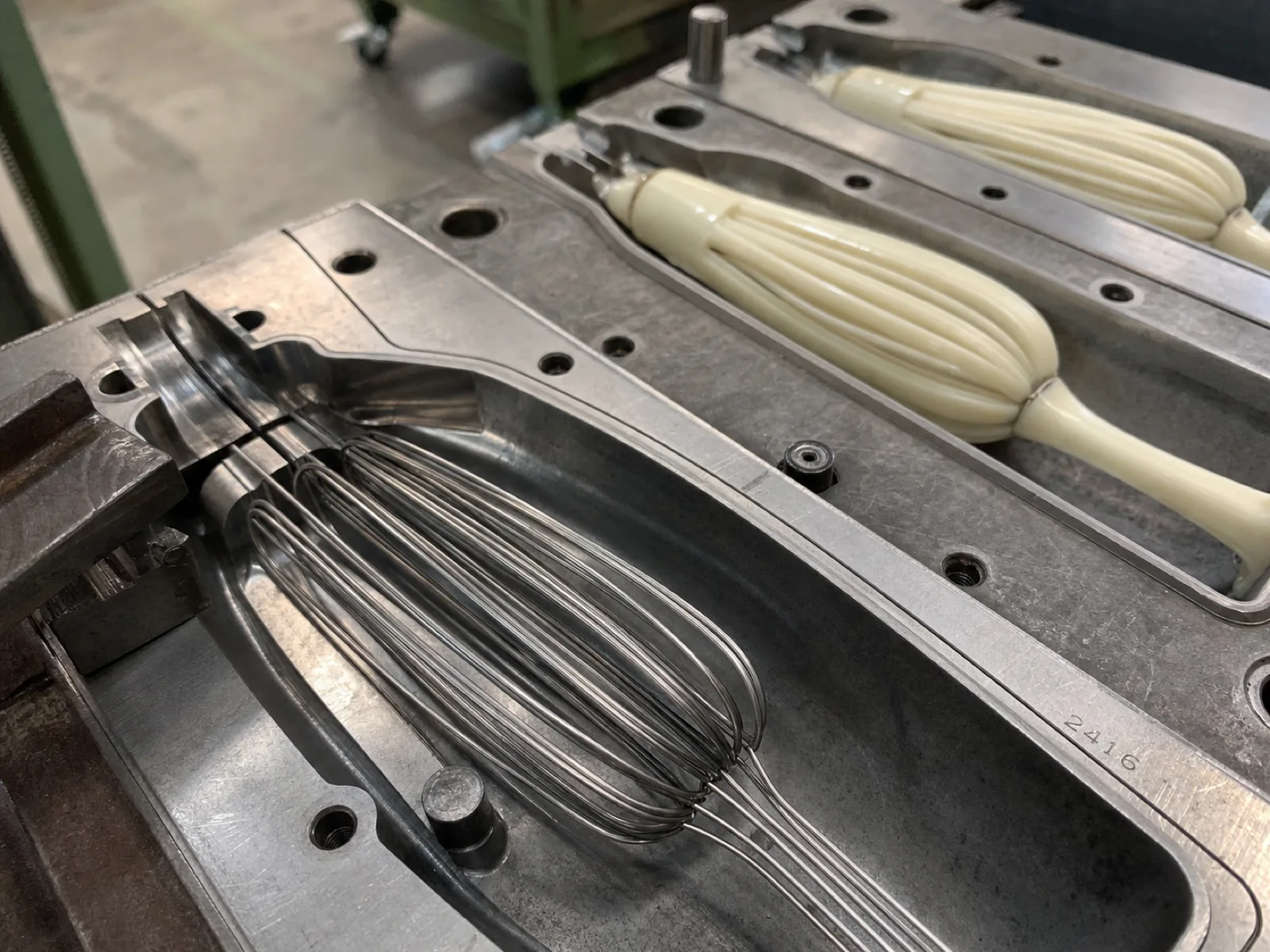
The silicone-to-steel-wire bond is the single highest-leverage decision on a whisk, driving roughly 81 % of return complaints through two failure modes: coating delamination (the silicone lifts off the wire) and wire pull-out (the wire slides out of the handle). A cleaned, primer-treated 304 wire over-molded in a single cycle clears a 150 N+ pull test; a dip-coated wire fails below 40 N.
A whisk has no undercut geometry to mechanically lock the coating in place — unlike a spatula’s flat blade with anchor holes, a whisk core is thin round wire. That means adhesion is chemical, not mechanical, and the process discipline around the bond is the whole ballgame. Three variables decide it:
- Wire surface prep. The stainless must be degreased and, on retail-grade builds, plasma- or primer-treated so the silicone forms a covalent bond to the metal. Skip it and the coating is only mechanically gripping a smooth rod — it lifts under thermal cycling.
- Over-mold vs dip. Over-molding shoots silicone into a closed cavity at pressure, filling voids and forming a uniform wall bonded to the primed wire. Dip-coating pulls the wire through a silicone bath, leaving an uneven wall, trapped air pinholes, and a weak interface. Pinholes are where delamination nucleates.
- Handle anchoring. The wire ends must be crimped, welded, or over-molded into the handle so they cannot pull out under a firm whipping load. Wire pull-out — the loops coming free of the handle — is the second most-cited failure after coating peel.
The pull-test data Wetop shares with buyers on request:
| Bonding method | Coating pull-off force | Wire pull-out force | Delamination risk |
|---|---|---|---|
| Dip-coated, no primer | 25 – 40 N | 60 – 110 N | High |
| Over-molded, no primer | 50 – 90 N | 180 – 260 N | Medium |
| Over-molded, primer-bonded 304 wire | 150 – 240 N | 300 – 450 N | Low |
| Over-molded, primer + crimped handle anchor | 150 – 240 N | 500 – 700 N | Lowest |
The engineering call: any whisk above a USD 3.99 shelf price needs a primer-bonded over-mold on 304 wire with a crimped or over-molded handle anchor. The cost delta versus dip-coating runs USD 0.10–0.18 per unit at 10,000-pc scale — recovered in returns savings before the second lot ships.
What Shore A hardness should the whisk coating be, and why it matters for non-scratch?
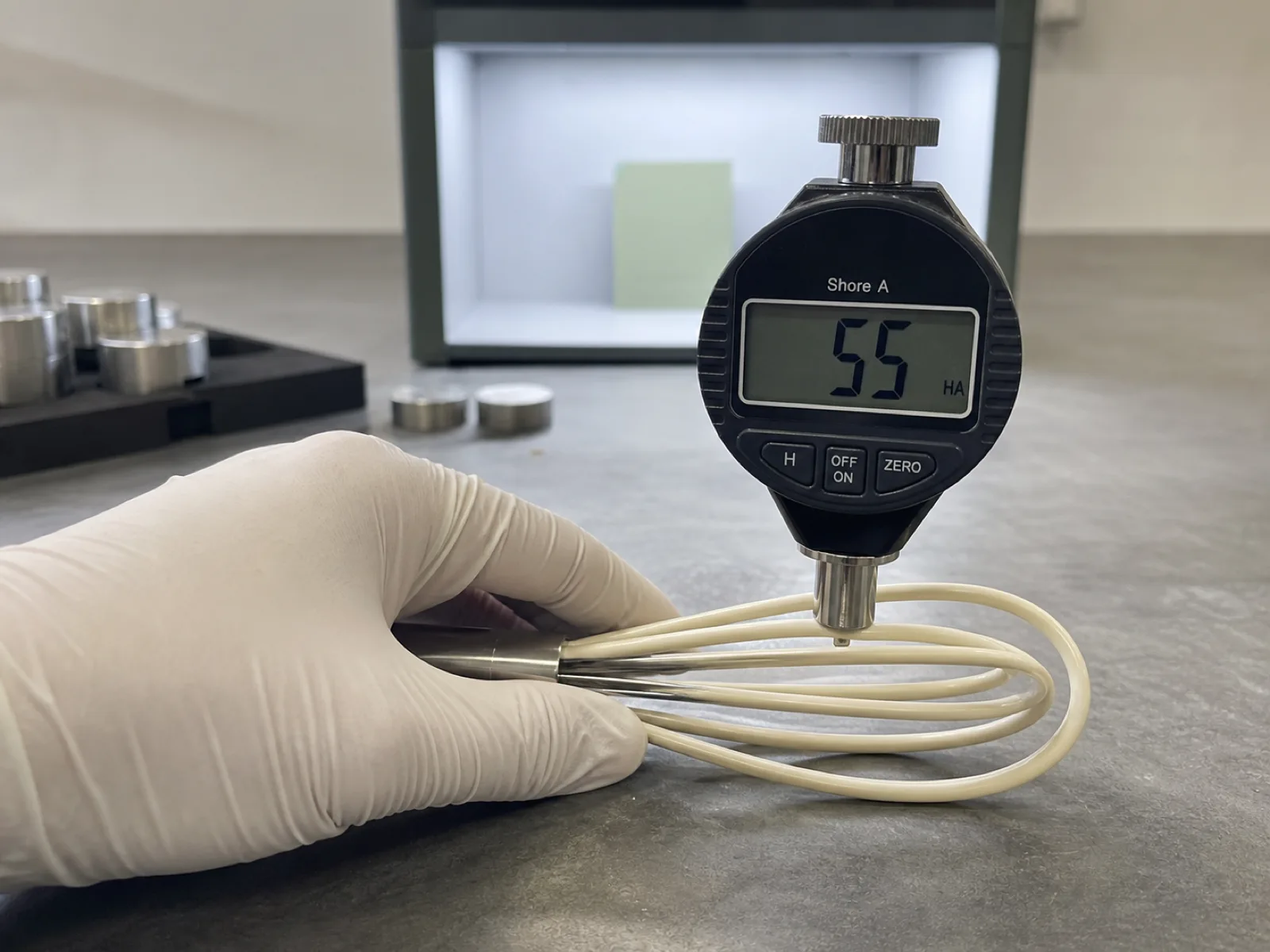
A silicone whisk coating should run Shore A 50–60. Softer than 50 and the loops feel flimsy and deflect under a stiff batter; harder than 65 and the coating loses the non-scratch benefit that justifies a silicone whisk over bare wire. Wetop's default retail coating is Shore A 55 ± 3, verified by durometer at lot release after the 200 °C post-cure.
Shore A hardness is the spec that ties the whisk’s cooking feel to its cookware-protection claim. The whole reason a buyer specs a silicone whisk over a cheaper bare-wire one is the non-scratch surface on nonstick, ceramic, and enamel cookware. That benefit lives in a hardness window: too soft and the loops smear rather than whisk; too hard and the coating behaves like a rigid tool that can score a nonstick surface over time.
| Shore A | Coating feel | Non-scratch on nonstick | Best whisk type |
|---|---|---|---|
| 45 – 50 | Very soft, flexible | Excellent | Mini, children’s, spiral |
| 50 – 58 | Soft, springy | Excellent | Balloon (aeration) |
| 55 – 62 | Firm, controlled | Good | Flat / roux (scraping) |
| 65 – 75 | Stiff | Marginal — can score | Not recommended for whisks |
The durometer reading is a lot-release gate, not a design suggestion. A coating that drifts outside Shore A 55 ± 3 at post-cure signals either an under-cure or a compound-batch problem, and Wetop holds the lot for a compound review before release. For the full hardness reference across silicone kitchenware, the Shore A hardness silicone chart maps every kitchen-tool coating to its durometer band.
What FDA and LFGB clauses apply to a silicone whisk?
The silicone coating falls under FDA 21 CFR 177.2600[^fda-177-2600] — total extractives ≤ 20 mg/in² in n-hexane after 7 hours at 66 °C — plus BfR Recommendation XV[^bfr-xv] for LFGB clearance. The stainless wire and any plastic handle carry their own compliance documents. Buyers who assume one FDA cert covers the whole whisk get held at customs when components carry different paths.
A silicone whisk is a multi-material product — silicone coating, stainless wire, and often a TPE or PP handle — and each material has its own FDA sub-part. The retail compliance packet needs a document per material, not one blanket statement.
For US-only programs, the minimum documentation packet is:
- Silicone coating: 21 CFR 177.2600 migration test from an accredited lab (Intertek, SGS, or Eurofins), per production lot or per quarter
- Steel wire core: mill test certificate declaring 304 or 316 grade, plus corrosion-resistance statement
- Plastic / TPE handle (if applicable): 21 CFR 177.1520 or 177.2600 statement + Prop 65 phthalate screen
- Assembly-level: CPSIA General Certificate of Conformity[^cpsc-cpsia] listing every applicable rule and the third-party lab that verified it
- Business-level: ISO 9001[^iso-9001] certificate (Wetop is certified since 2008)
For EU programs, add LFGB §30/31 batch testing (BfR XV as the technical basis[^bfr-xv]), a REACH SVHC declaration[^echa-reach] against the current candidate list, and an EU 1935/2004 Declaration of Compliance.
The trap first-time buyers hit: an Alibaba “FDA certified” listing usually means the base-silicone compound has 177.2600 clearance from the material supplier — not that the finished whisk has been lot-tested by an accredited third-party lab. US Customs FDA import review does not accept a compound COA in place of a finished-good migration report. Buyers running into both markets should read the FDA vs LFGB silicone breakdown to understand where the two frameworks diverge on extractables and per-batch reporting.
OEM buyer flow — MOQ tiers, tooling cost, sample lead time, mold ownership
Wetop's silicone whisk MOQ starts at 500 pcs/color on existing tooling and 3,000 pcs on a new over-mold tool. Custom over-mold tooling runs USD 3,200–5,500 for a multi-cavity compression tool and USD 9,500–20,000 for an LSR injection tool. Sample lead time is 7–15 days on existing tools; new tools take 28–38 days. Buyers own the mold after full amortization or explicit purchase.
The MOQ / tooling / mold-ownership triangle is where first-time whisk buyers get burned by unclear factory quotes. A whisk tool is more complex than a spatula tool because it must hold the wire core precisely in the cavity during the shot — cavity registration is tighter, which nudges tooling cost above the equivalent spatula tool.
| Program tier | MOQ per color | Tooling cost | Unit price band (FOB) | Best for |
|---|---|---|---|---|
| Wetop stock whisk, Wetop packaging | 500 pcs | USD 0 | USD 1.10 – 2.20 | Sample orders, small retailers |
| Wetop stock whisk, custom Pantone + deboss | 1,000 pcs | USD 180 – 350 (logo insert) | USD 1.00 – 2.00 | Private-label test runs |
| Custom loop / handle geometry, new over-mold tool | 3,000 pcs | USD 3,200 – 5,500 | USD 0.80 – 1.75 | Housewares brands with distinct identity |
| Custom LSR-injected whisk, new injection tool | 10,000 pcs | USD 9,500 – 20,000 | USD 0.65 – 1.45 | Premium USD 14+ retail, high volume |
| Full private-label — tool + handle + packaging + carton | 5,000 – 10,000 pcs | USD 4,000 – 22,000 all-in | USD 0.90 – 1.90 all-in | Retail chain PL programs |
Sample timeline (existing tooling): color-matched pre-production sample in 7–10 days; retail-ready first-article sample in 12–15 days. Sample timeline (new tooling): T1 sample off the new over-mold tool in 28–34 days; T2 corrections in 5–7 days; production release after T2 approval.
Mold ownership: the tool is the buyer’s asset upon full payment of tooling cost. Wetop’s standard contract transfers title after the first production run ships, and we do not withhold molds as end-of-program leverage. If the 500-pc floor still feels aggressive, the real-factory MOQ math shows why sub-500 runs bleed money on cure-cycle setup and post-cure oven loading.
Customization — Pantone color, logo methods, handle options, private label
Wetop matches Pantone solid-coated within ΔE ≤ 1.5 on a D65 light box using platinum-cured masterbatch. Whisk logos are debossed on the handle (USD 180–350 per insert, zero unit-cost adder, unlimited durability), laser-marked (permanent, monochrome), or pad-printed (multi-color, wears within 40–60 cycles). Handle options span full-silicone, stainless, and soft-grip TPE overmold; packaging spans polybag to FSC full-print box.
The customization decisions on a whisk program are color, logo, handle, and packaging — each with its own economics.
Color matching. Silicone masterbatch pigments are inorganic (iron oxide, titanium dioxide, chrome oxide) for heat stability, which limits the gamut versus injection-molded plastics. Deep saturated blues, purples, and neons are hard to hit within retail ΔE tolerances; muted earth tones, sage, cream, terracotta, and classic red/black hit ΔE ≤ 1.5 cleanly. Wetop runs a Pantone match trial on a lab press before committing a production masterbatch — trial cost USD 120–180, absorbed into tooling.
Logo methods, ranked by durability:
| Method | Cost | Dishwasher durability | Best use |
|---|---|---|---|
| Deboss (mold-cavity engraved) | USD 180 – 350 per insert | Unlimited | Best-in-class — logo is a physical handle feature |
| Laser mark | USD 0.20 – 0.35 per unit | 200+ cycles | Second-choice — permanent but monochrome |
| Pad print | USD 0.08 – 0.15 per unit | 40 – 60 cycles | Multi-color logos, budget programs |
Handle options. A full-silicone handle keeps the whole tool dishwasher-tolerant and single-material for the simplest compliance packet. A stainless handle reads premium and adds heft. A soft-grip TPE overmold improves ergonomics but adds a third material — and a lower temperature rating — to the compliance packet. The full method-by-method economics live in the silicone logo customization guide.
Packaging. Polybag (USD 0.02–0.04/unit), kraft sleeve with hangtag (USD 0.18–0.35, e-commerce-ready), blister card (USD 0.35–0.75, big-box standard), or FSC full-print box (USD 0.85–1.80, premium). The Pantone + deboss + kraft-sleeve combination is Wetop’s most-run private-label whisk spec for new US housewares brands.
QC defect modes and dishwasher-safe, stain, and odor claims
Silicone whisks fail in four documented modes: coating delamination and wire pull-out (~81 % of complaints combined), odor absorption (~9 %), staining and discoloration (~6 %), and Shore A drift toward tacky (~4 %). A platinum-cured, fully post-cured whisk is dishwasher safe to 500+ cycles, stain-resistant, and odor-resistant; every one of the four modes traces to a specific process shortcut.
Each failure mode has a manufacturing cause and a fix. The engineering desk’s map:
1. Coating delamination + wire pull-out (81 % combined). Root cause: dip-coating or over-molding without an adhesion primer, plus an un-anchored handle. Fix: primer-bonded over-mold on cleaned 304 wire with a crimped handle anchor. Cost delta USD 0.10–0.18/unit; cuts bond-related returns from ~3 % to under 0.5 %.
2. Odor absorption (9 %). Root cause: incomplete cure crosslinking leaves free polymer chains that absorb kitchen aromatics. Fix: platinum cure plus a full 4-hour, 200 °C post-cure. Cost delta USD 0.03–0.05/unit; eliminates the mode.
3. Staining and discoloration (6 %). Root cause: peroxide-cured compound or a pigment package incompatible with dishwasher temperatures, absorbing turmeric and tomato chromophores. Fix: platinum-cured compound with an inorganic pigment package. Cost delta USD 0.05–0.10/unit; eliminates the mode.
4. Shore A drift toward tacky (4 %). Root cause: residual solvents not driven off by post-cure, usually a compression cell skipping the step. Fix: enforce the post-cure oven step, verified by durometer at lot release. Cost delta USD 0.02–0.04/unit.
On the claims: “dishwasher safe,” “stain resistant,” and “odor resistant” are all downstream of the same two decisions — platinum cure and a real post-cure. A whisk built that way clears all three claims; a peroxide-cured, post-cure-skipped whisk fails all three within a month of home use. Wetop’s lot-release gate runs a 200-cycle dishwasher soak, a blind scent panel, and a turmeric-stain soak on first-article samples before any lot ships.
Landed cost breakdown — FOB Yantian to US West Coast
A 40HQ of mixed silicone whisk SKUs holds 22,000–40,000 pcs depending on loop size and inner-carton density. Landed cost to Los Angeles / Long Beach in 2026 runs USD 0.95–1.85 per piece: FOB Yantian USD 0.80–1.60, ocean freight USD 2,800–4,200 per container, 3.4 % duty under HTS 3924.10.4000[^hts-3924], and USD 300–500 brokerage. Alibaba single-piece pricing misleads first-time buyers by 300–500 %.
The landed-cost math is the most underexplained variable in whisk procurement, and whisks fill a container less efficiently than flat utensils — the loop geometry traps air, so cubic-per-unit runs higher and the per-piece freight is heavier than a spatula’s. Alibaba MOQ-1 listings quote USD 2.00–4.50 per piece — nominally cheap on the sample order, but structured to reprice at the container conversation, when small-order buyers discover the “wholesale” price is 40 % above what they expected.
Wetop’s landed-cost table for a typical retail spec (11-inch balloon whisk, 304 wire, primer-bonded platinum coating, Pantone-matched, deboss handle logo, kraft sleeve, retail-ready):
| Line item | Cost per piece | Cost per 40HQ (30,000 pcs) |
|---|---|---|
| FOB Yantian (unit price, spec above) | USD 1.20 | USD 36,000 |
| Ocean freight, Yantian → LA/LB | USD 0.117 | USD 3,500 |
| Duty (HTS 3924.10.4000, 3.4 %) | USD 0.041 | USD 1,224 |
| Customs brokerage + ISF filing | USD 0.013 | USD 400 |
| Drayage (port → CA warehouse) | USD 0.040 | USD 1,200 |
| DDC (destination delivery, avg) | USD 0.033 | USD 1,000 |
| Landed cost, LA/LB warehouse | USD 1.44 | USD 43,324 |
At a 3× retail markup, the 30,000-unit lot supports a USD 4.99 to USD 6.99 shelf price with room for retailer margin and MAP protection. The container-fill variable that changes the math: an 11-inch balloon whisk packs at roughly 30 pieces per 6,000 cc inner carton, while a 6-inch mini whisk packs at 90+. Mixed-SKU containers optimize freight per unit but require careful pack-list engineering — Wetop’s shipping team runs a cubic-optimization pass on every mixed-SKU whisk program before booking.
Ready to run a silicone whisk program?
Wetop is a founder-led, ISO 9001 silicone factory in Dongguan running one platinum-cured compression cell and one LSR injection cell dedicated to kitchenware. We ship silicone whisk programs to US and EU housewares brands, sink-adjacent retail chains, and private-label programs at 500-pc to 500,000-pc annual scale, with primer-bonded over-mold as the standard construction.
If you have a spec sheet, an RFQ, or a competitor whisk you want teardown-benchmarked, talk to the engineering desk. We’ll return a first-pass spec review, a wire-core and bonding assessment, a tooling estimate, and an MOQ / lead-time / FOB unit-price band inside two business days.
FAQ
-
Are silicone-coated whisks safe on nonstick cookware?
Yes — a silicone-coated whisk is the non-scratch tool for nonstick, ceramic, and enamel surfaces. The coating must fully enrobe the wire with zero exposed metal at the loop tips, and run at Shore A 50–60. Bare stainless wire whisks scratch nonstick coatings; a properly over-molded silicone whisk leaves the surface intact through normal service life.
-
What is the real temperature range of a silicone whisk?
Platinum-cured silicone whisk coatings hold −40 °C to 230 °C (−40 °F to 446 °F) as a continuous working range. The '500 °F' figures on retail packaging are short-duration spike ratings on the coating, not sustained temperatures. Above 250 °C the methyl side groups oxidize, producing a chalky film and upward Shore A drift on the whisk loops over cumulative exposure.
-
How is a silicone whisk actually manufactured — over-molding or dipping?
Retail-grade silicone whisks are over-molded: the pre-formed stainless wire core is loaded into a mold cavity and platinum-cured silicone is injected or compression-molded around it in one cycle, bonded through a primer-adhesive interface. Cheaper whisks are dip-coated, which leaves an uneven wall, weak adhesion, and the pinhole voids where delamination starts.
-
Why do silicone whisk loops peel or the coating pull off the wire?
Coating delamination and wire pull-out trace to three causes: no adhesion primer on the wire before over-mold, a thermal-expansion mismatch stressing the bond under dishwasher cycling, and pinhole voids from dip-coating instead of molding. A primer-bonded over-mold on cleaned 304 wire clears a 150 N+ pull test; dip-coated whisks fail below 40 N.
-
What wire gauge and stainless grade does a silicone whisk core need?
A balloon whisk needs 304 stainless wire at 1.6–2.0 mm gauge; a stiffer flat/roux whisk runs 2.0–2.4 mm. 304 is austenitic and holds ductile through 100,000+ flex cycles. 430-grade — magnetic, nickel-free, common on sub-USD-3 imports — work-hardens and cracks inside the coating between 30,000 and 40,000 cycles, often invisibly until the wire snaps mid-use.
-
What Shore A hardness should a silicone whisk coating be?
The whisk coating should run Shore A 50–60. Softer than 50 and the loops feel flimsy and deflect under a stiff batter; harder than 65 and the coating loses the non-scratch benefit that justifies a silicone whisk over bare wire. Wetop's default retail coating spec is Shore A 55 ± 3, verified by durometer at lot release after the 200 °C post-cure.
-
What MOQ and tooling cost should I expect for a custom silicone whisk?
Existing Wetop whisk tooling runs at 500 pcs per color. A custom loop geometry or handle profile needing a new over-mold tool starts at 3,000 pcs to amortize a USD 3,200–5,500 tooling cost. Full private-label programs — custom handle, Pantone match, printed packaging, master-carton — carry 5,000–10,000 pcs to hit retail landed-cost targets.
-
Which compliance certifications does a silicone whisk program need for US and EU retail?
US retail baseline is ISO 9001, BSCI or Sedex social audit, CPSIA General Certificate of Conformity, California Prop 65 statement, and a third-party FDA 21 CFR 177.2600 migration report on the coating. EU-bound programs add LFGB §30/31 per-batch reports (BfR XV basis) and REACH SVHC screening. The steel wire carries its own mill test certificate.
-
Are silicone whisks dishwasher safe, and do they stain or hold odor?
A platinum-cured, fully post-cured silicone whisk is dishwasher safe to 500+ cycles at 71 °C. Staining from turmeric or tomato and odor retention are cure-quality signals: under-cured or peroxide-cured coatings absorb aromatics and pigments through free polymer chains. A properly crosslinked platinum coating resists both — any tackiness or off-note at lot testing is a fail.
-
Can Wetop match a Pantone color and add a logo on a silicone whisk handle?
Yes. Wetop matches Pantone solid-coated within ΔE ≤ 1.5 on a D65 light box using platinum-cured masterbatch. Handle logos are debossed in the mold cavity (USD 180–350 per insert, zero unit-cost adder, unlimited dishwasher durability), laser-marked (permanent, monochrome), or pad-printed for multi-color at the cost of wearing within 40–60 cycles.
References
Authoritative sources cited in this guide
- US Food and Drug Administration. 21 CFR 177.2600 — Rubber articles intended for repeated use. https://www.ecfr.gov/current/title-21/chapter-I/subchapter-B/part-177/subpart-C/section-177.2600 — The controlling US extractables limit for silicone kitchen tools including whisk coatings — total extractives in n-hexane ≤ 20 mg/in² over 7 hours at 66 °C.
- International Organization for Standardization. ISO 9001:2015 — Quality Management Systems — Requirements. https://www.iso.org/standard/62085.html — The QMS Wetop is certified against — the framework retail chain audits (BSCI / Sedex) build upon for whisk programs.
- ASTM International. ASTM F963-23 — Standard Consumer Safety Specification for Toy Safety. https://www.astm.org/f0963-23.html — Referenced in CPSIA conformity where a mini silicone whisk is marketed to children or bundled with a baking-for-kids set with small detachable parts.
- German Federal Institute for Risk Assessment (BfR). BfR Recommendation XV — Silicones. https://www.bfr.bund.de/en/bfr_recommendations_on_food_contact_materials-7498.html — The technical basis for LFGB §30/31 clearance on silicone whisk coatings — sets peroxide residual and volatile matter limits.
- European Chemicals Agency (ECHA). REACH Regulation (EC) No 1907/2006 — SVHC Candidate List. https://eur-lex.europa.eu/legal-content/EN/TXT/?uri=CELEX%3A32006R1907 — Screening list for any masterbatch or adhesion primer used in silicone whisks sold into the EU — updated twice yearly.
- US Consumer Product Safety Commission. Consumer Product Safety Improvement Act (CPSIA) — General Certificate of Conformity. https://www.ecfr.gov/current/title-16 — Required accompanying document for silicone kitchen tools imported into the US — declares which CPSC-enforced rules the whisk meets.
- US International Trade Commission. Harmonized Tariff Schedule (HTS) 3924.10 — Tableware and Kitchenware, of plastics. https://hts.usitc.gov/ — The correct HTS classification for silicone-coated whisks imported into the US — 3.4 % duty under the general column.
- US National Library of Medicine (PubMed). Silicone in medical and food-contact applications — safety review. https://pubmed.ncbi.nlm.nih.gov/23256725/ — Peer-reviewed migration and biocompatibility data underpinning FDA and LFGB clearance of platinum-cured silicone whisk coatings.
Start a custom program
Send a brief. Get an engineer’s reply in one business day.
Every Wetop program is tooled from a customer’s specification. Send a CAD file (STEP · IGES · DWG) or a written brief and we’ll reply with a mold cost estimate, price brackets at MOQ 500 / 1,000 / 5,000, and any engineering questions.