Top-5 US premium sink brand caliber (Kraus / Ruvati / VIGO / Kohler / Blanco / Elkay accessory-line tier) · Silicone Drying Mats · Multi-color platinum-cured silicone sink mat OEM, 4 SKUs across two sink families
Sink Brand · Silicone Sink Mat Multi-Color OEM Program
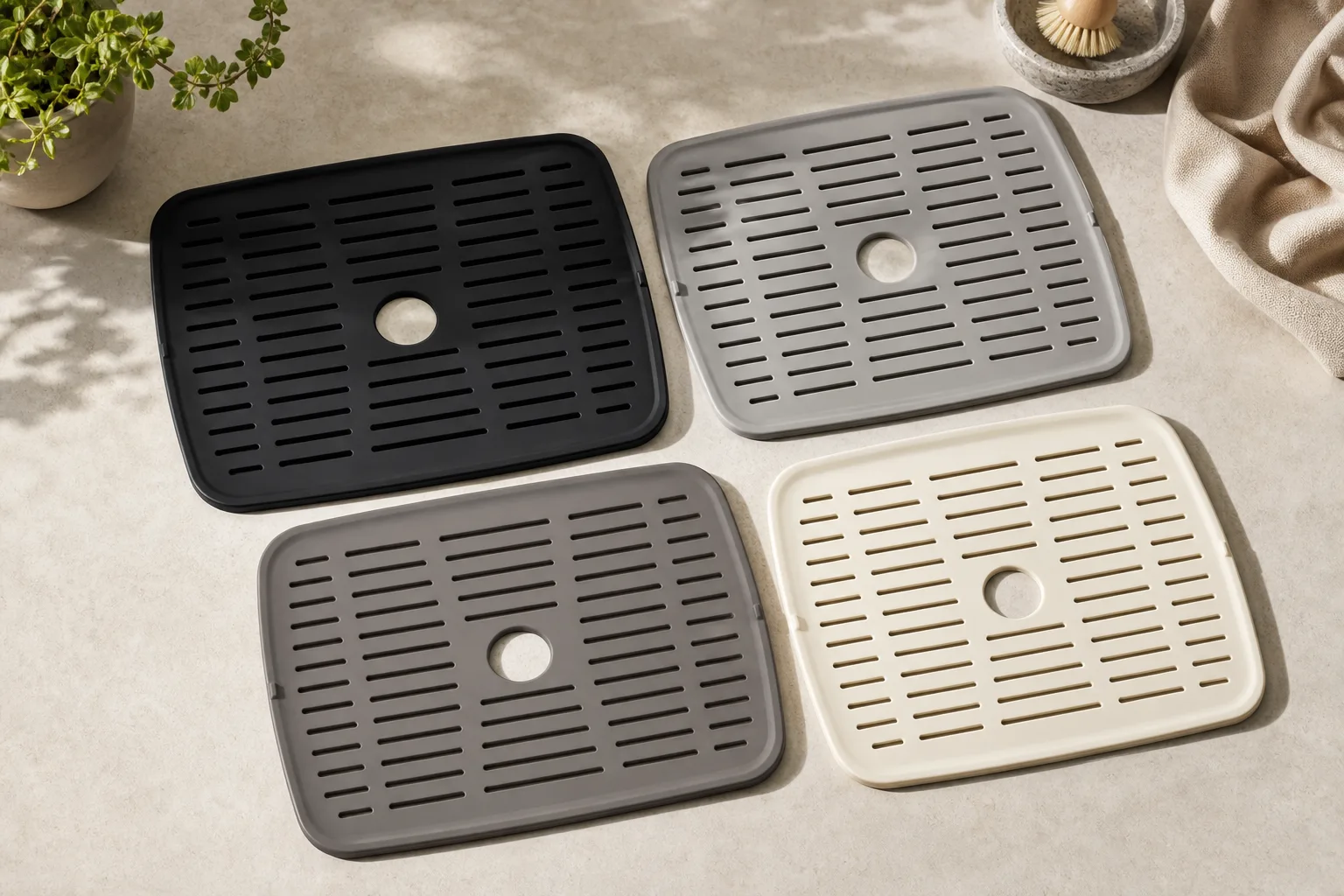
What the sink brand needed
The brand needed a single OEM factory for a 4-SKU multi-color silicone sink mat program at 45,000 pcs/yr, holding Pantone color across batches, running platinum-cured silicone to remove first-heat odor, and shipping a full FDA / LFGB / ISO 10993 / Prop 65 / PFAS compliance packet per lot at a price that supported $18-$34 shelf.
The accessory-line procurement team walked into the RFQ with two failure modes to fix and one strategic question to answer. The failure modes were color drift on the pigmented SKUs (sand and sage) and a low-rate first-heat odor complaint traced to insufficient post-cure on the incumbent’s peroxide-cured product. The strategic question was whether to keep sourcing through a trading intermediary or move to a direct factory relationship for the entire accessory line. Silicone drying mats and sink grids sit close enough in the brand’s shelf logic that a single factory with in-house tooling made procurement sense — if the factory could hold quality across formats. That is what the sink-mat program was structured to test.
Program scope and SKU architecture
Four SKUs across two sink families — 32×19 in and 30×17 in inner-basin footprints — each in a base charcoal plus one accent color (sand, sage, or translucent). Steady-state annual volume 45,000 pcs after the 90-day PPAP-style ramp, split roughly 12k / 12k / 11k / 10k across the SKUs.
The two sink families were the brand’s largest-volume workhorse SKUs in the undermount stainless and workstation-style lines that map to the Kraus / Ruvati / VIGO / Kohler / Blanco / Elkay premium accessory tier. Each family got a charcoal base mat (the volume mover) and one accent color positioned to the accessory-line’s finish story. The drain-hole layout was custom-cut for each family — a peripheral hole pattern with the largest holes located at each sink’s known low point, so water clears without pooling under the mat. Corner radius and edge rise were designed against the inner-basin CAD the brand supplied under NDA; we don’t work off the visible-face measurement, we work off the drawn geometry.
Compliance stack shipped with every batch
FDA 21 CFR 177.2600 (US food contact for rubber articles intended for repeated use), LFGB §30/31 organic-volatile testing per BfR Recommendation XV (EU), ISO 10993-1 biocompatibility screen at procurement's request, Prop 65 non-detect on lead / cadmium / phthalates, PFAS non-detect from an accredited third-party lab — all keyed to the production master-batch lot code stamped on the polybag.
The regulatory stack for a US-listed premium sink brand is thicker than the standard FDA-plus-LFGB pairing that clears most retail programs. Procurement requested ISO 10993-1 biocompatibility as a risk-reduction layer because the sink mat sits in a wet food-contact zone that occasionally touches raw meat prep runoff — the medical-device biocompatibility screen is overkill for the use case, but it’s cheap insurance against a downstream category re-classification. The FDA endpoint is the 21 CFR 177.2600 clause for rubber articles intended for repeated use, run on 8-hour reflux extractives plus repeat-exposure protocols. The EU endpoint runs against BfR Recommendation XV on Silicones, which is the technical basis LFGB §30/31 testing actually uses. PFAS non-detect is now a hard requirement across Tier 2 US home-improvement chain audits; the accredited-lab report goes into the on-file audit packet at the brand’s largest retail account. See our FDA vs LFGB explainer for the clause-level breakdown of what those two documents actually cover.
Cure system: why platinum over peroxide
Platinum-cured silicone was specified over peroxide-cured on this program to eliminate the first-heat odor pathway the incumbent had failed on, to clear LFGB §30/31 organic-volatile testing without dependence on post-cure discipline, and to remove PFAS process-aid verification burden — cost delta 15-25% per unit versus disciplined post-cured peroxide, absorbed by the retail-tier pricing.
Peroxide-cure with a rigorously executed 4-6 hour post-cure at 180-200°C can clear the same regulatory endpoints as platinum-cure at 15-25% lower per-unit cost. On a sink mat that sees room-temperature and warm-water contact but rarely oven heat, the case for peroxide is technically defensible. The problem is that peroxide-cure programs are as good as their post-cure discipline batch-to-batch, and the incumbent’s failure had been on that exact axis. Platinum-cure removes the variable. It also cleans up the PFAS process-aid conversation — some peroxide-cure programs use PFAS-family process aids at the mixing stage, and the burden of demonstrating non-detect batch-to-batch against the OEHHA Prop 65 listed chemicals is nonzero. Our full framework is in the platinum-cured vs peroxide-cured decision guide.
Shore A hardness, thickness, and drain geometry
Shore A 60 ±5 per ASTM D2240 was selected as the durometer sweet spot: firm enough for the sink-grid-adjacent tactile feel the brand wanted at premium shelf, flexible enough for the mat to conform to sink-basin corner radii without cupping. Thickness 3.5 mm at the mat body, 4.2 mm at the peripheral raised rib, drain holes on an 18-22 mm center-to-center peripheral grid tuned per sink family.
Sink mats live at a different durometer than baking mats and drying mats. A baking mat wants Shore A 55-65 for release-surface flex; a drying rack wants a firmer 65-70 for structural stability; a sink mat sits between them because it needs enough hand feel to sell in-store against the sink brand’s own faucet and grid accessories. Shore A 60 measured per ASTM D2240-15 lets the mat feel substantial in the hand at retail while still conforming to the basin. The 3.5 mm base body and 4.2 mm rib profile gives enough sacrificial silicone under repeated pot placement without pushing carton weight into the shipping-cost penalty band. Drain-hole layout gets tuned per sink family because low-point geometry moves 5-8 mm across manufacturers — a generic hole pattern is why aftermarket sink mats pool.
Multi-color workflow: Pantone matching under CIE D65
Color-matching workflow: brand supplied Pantone Solid Coated chip references for sand and sage, we developed master-batch pigment loadings against the chips read under CIE D65 illumination with a spectrophotometer, qualified against ΔE ≤ 2.5 target, and every subsequent production lot is checked against the same reference chip pre-shipment. Achieved batch-to-batch ΔE ≤ 1.8 across three years.
Color drift on pigmented silicone comes from three sources: master-batch pigment lot variability, cure-cycle temperature drift, and inspection-light inconsistency at the check station. We control all three. Master-batch qualification is signed off by our color lab before it ever goes to the mixing line. Cure temperature is logged per press per shift and the log ships with the batch. The inspection station uses CIE Standard Illuminant D65 as the reference (matching the CIE colorimetry standard the brand’s own retail-facing photography is graded against), not shop fluorescent. The translucent SKU is the trickiest one — small residual-catalyst or filler variability shows up more visibly on translucent than on any pigmented shade, and it drove the tightest process controls on the program.
MOQ and pricing tiers, tooling amortization
MOQ 500 pcs/SKU for tooling qualification, then production tiers of 1,000 / 5,000 / 10,000 units per PO. Delivered FOB Yantian: $2.40-$3.10 at 500 pcs / $2.05-$2.55 at 1,000 / $1.65-$2.05 at 5,000 / $1.40-$1.75 at 10,000 for the standard platinum-cure 3.5 mm mat with 1-color debossed logo. Tooling: $3,800-$5,200 per mold, 4 molds total, amortized 50/50 across PO#1 and PO#2.
The pricing tiers are structured against real cost breaks: at 500 pcs you’re paying for a single press cycle setup plus full third-party test packet on a low denominator, at 5,000 pcs the fixed costs get diluted and material cost dominates. The brand ran PO#1 at 1,500 pcs per SKU for launch inventory and moved to 3,000-4,000 per SKU per PO at steady state. Tooling in P20 steel with EDM-finished drain-hole and logo-deboss detail costs more up front than aluminum but survives 200,000+ cycles without dimensional drift — cheaper per unit over the 3-year program. Deeper structure in the silicone OEM pricing guide and the MOQ and lead time guide.
Retail-tier audit fit and buyer-side QC
The program cleared ISO 9001:2015 process audit, SMETA 4-pillar social compliance audit, and buyer-side incoming AQL 1.5 inspection per ISO 2859-1 on the Tier 2 US home-improvement chain that carries the accessory line. Zero rejected batches across 11 POs / 3 years. Audit documentation and PFAS non-detect report renewed annually on the buyer's on-file schedule.
Tier 2 retail chains — the Home Depot / Wayfair / BBB / Tesco / Carrefour tier — run structured on-file supplier audits with three consistent pillars: quality management system evidence (ISO 9001:2015 or equivalent), social compliance evidence (SMETA / SEDEX or BSCI), and product test evidence per batch (FDA / LFGB / PFAS / Prop 65 depending on category). Sampling for buyer-side incoming inspection follows ISO 2859-1 attribute-sampling plans at AQL 1.5, which is the retail-tier default for finished consumer goods in this price band. Wetop’s audit-packet-per-batch discipline is designed against this exact audit shape, which is why the sink brand’s own annual chain-side audit renewal has been documentary rather than site-visit for two consecutive years. What that audit stack actually looks like from the sourcing side is walked through in the sourcing checklist and the real-factory MOQ math.
Lead time delivered vs quoted
Quoted 60-70 days PO-to-warehouse receipt, delivered 62-70 days across 11 POs (±3 day variance). Breakdown: 32-38 day production, 16-day sailing Yantian → Los Angeles port, 4-6 day drayage-to-warehouse. New color qualification adds 10-14 days before first production draw; the sand color qualification in year one ran 12 days, the sage in year two ran 11 days.
Lead-time discipline is a documentation habit as much as a production habit. Every PO gets a production plan committed against a specific press-shift allocation on day 3, and the plan gets updated weekly against the actual output-per-shift log. Missed presses on any given shift trigger reallocation across the other 8 compression presses on the floor, not a lead-time push to the customer. That is the mechanism behind the ±3 day variance across three years — it’s not that we run faster than quoted, it’s that the buffer is real and it’s protected in scheduling. Sink-grid-fit compatibility for the drain-hole layouts is discussed in the sink grid fit guide alongside the sink-family footprint reference we use on the sink-mat side.
Where the program goes next
Year-4 scope adds two SKUs in translucent and a limited-run seasonal color, plus a companion silicone dish-drying mat program that has already run one qualification cycle on the same tooling floor. Volume forecast steady at 45,000 pcs/yr on the existing 4 SKUs and 15,000-20,000 pcs/yr additive on the year-4 expansion.
The brand’s product team has moved from an annual line review to a rolling 18-month roadmap, which lets us schedule tool cutting and color qualification in the slack windows between production POs rather than compressing them against ship dates. On our side the sink-brand accessory-line program has become the anchor volume on 4 of our 22 compression presses. For sourcing managers evaluating whether a mid-scale sink-brand silicone accessory program should sit inside a founder-led OEM factory rather than a trading structure, the underlying deliverables are documented on our capabilities page and the RFQ intake is at contact; NDA templates for CAD and finish-spec exchange live at /nda/. Similar program structures across sink-adjacent categories are archived at /case-studies/.
Sourcing a similar program?
Get a CAD review and quote in one business day.
MOQ 500 per SKU. Samples in 7-25 days. We can share a more detailed reference (under NDA) for an adjacent program. Email inquiry@wetopsilicone.com or use the form.