Buyer Guide · commercial intent
Food Grade Silicone Tubing — OEM Sourcing Guide
 Buyer Guide
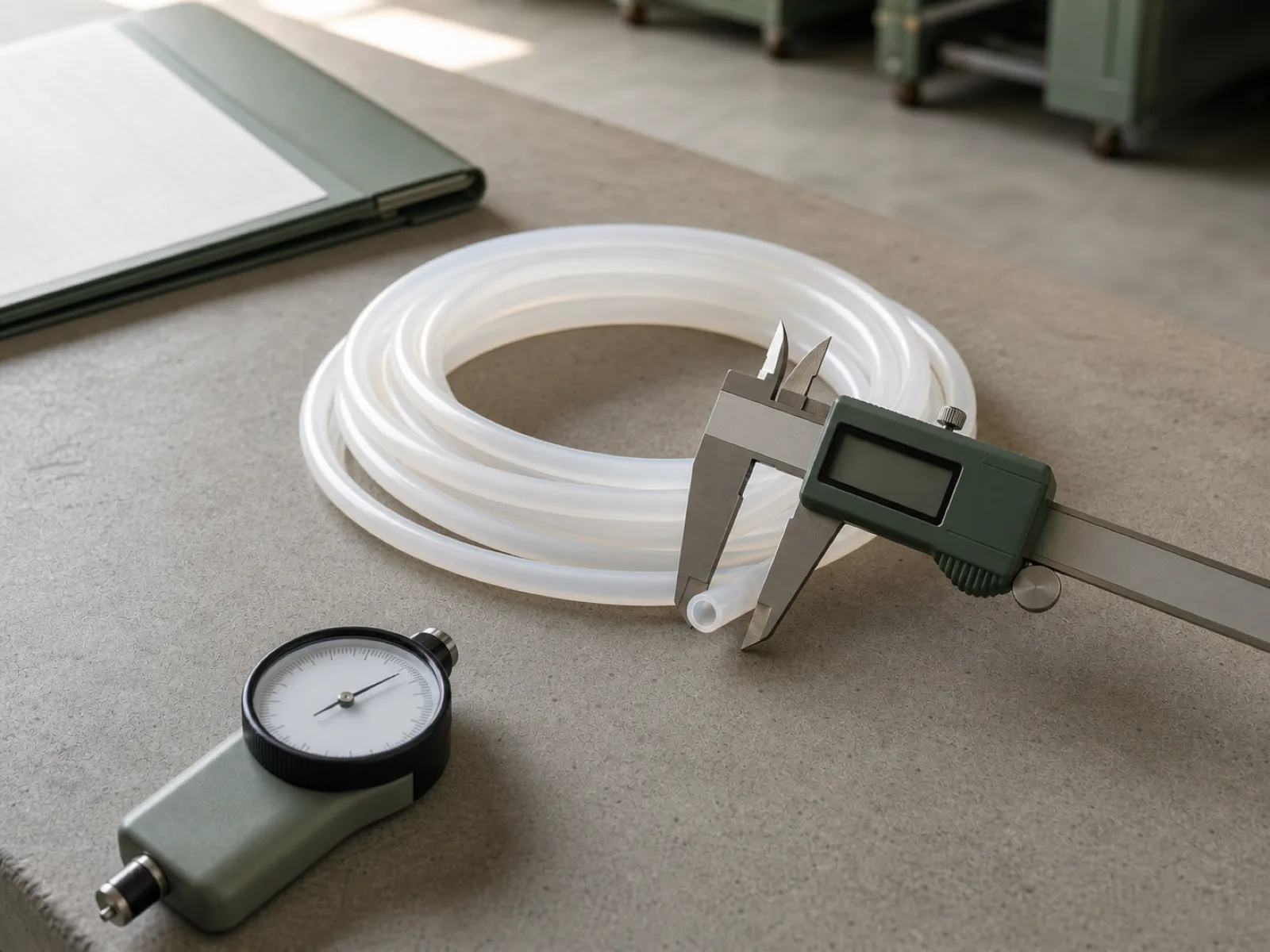
 Food grade silicone tubing is platinum-cured silicone extruded to FDA 21 CFR 177.2600 and LFGB §30/31 for repeated food and beverage contact, with a working range of -60 °C to 230 °C. OEM buyers should specify inner diameter, outer diameter, durometer (typically 40-80 Shore A), and cure system before requesting a quote. Wetop runs OEM programs at 500 meters per SKU, holding ±0.15 mm dimensional tolerance with per-lot Certificates of Analysis and annual 177.2600 restatement.
Sourcing food grade silicone tubing is not the same task as sourcing food grade silicone parts. Extrusion is a continuous process with its own tolerance envelope, its own tooling economics, and its own failure modes — a tubing supplier that also molds gaskets is not automatically a good tubing supplier. This guide is written for OEM buyers specifying tubing for beverage dispensers, coffee equipment, dairy CIP lines, brewery transfer, peristaltic dosing, and appliance water paths. It covers the compliance stack, the dimensional specs the drawing must carry, the cure-system decision, MOQ economics, and the QC packet you should expect on every shipment.
What qualifies silicone tubing as “food grade”?
Silicone tubing qualifies as food grade when the finished extruded article clears FDA 21 CFR 177.2600 for repeated-use rubber, LFGB §30/31 for EU food contact, or both. The compound must be platinum- or peroxide-cured silicone with post-cure applied, and the finished tubing must show extractable levels below the CFR limits after water and hexane immersion at 66 °C.
The label “food grade” without a cited test report is meaningless. Three specific compliance frames matter for tubing:
- FDA 21 CFR 177.2600 — the US baseline for any rubber article that contacts food repeatedly. It requires a total extractables limit after 7-hour water reflux and 7-hour hexane reflux, plus a subsequent-extraction ceiling on the same sample. Silicone tubing passes cleanly when it is fully post-cured; unpost-cured tubing frequently fails the hexane extraction because residual siloxane oligomers wash out.1
- LFGB §30/31 (Germany / EU) — the EU tightens FDA’s frame with sensory testing (BfR guideline 62.00-8 for silicone), which detects off-taste and off-odor migration into food. Every batch destined for EU distribution should ship with a current LFGB certificate dated within 12 months.
- EU Regulation 1935/2004 — the umbrella regulation for all food-contact materials in the EU. LFGB compliance rolls up to 1935/2004, but declarations of compliance (DoC) reference 1935/2004 explicitly.2
The three frames overlap but are not identical. A supplier that only carries an old 177.2600 test on a compound they no longer run is not a food grade supplier — they are a supplier with a marketing PDF. Ask for the test report, check the compound name matches the tubing you are quoting, and check the date.
Platinum-cured vs peroxide-cured food grade silicone tubing
Platinum-cured silicone tubing is the default for food and beverage OEM programs because it leaves no peroxide by-products, tastes and smells neutral, and passes USP Class VI without reformulation. Peroxide-cured tubing costs 15-20 % less per meter but requires a 4-hour post-cure to remove 2,4-dichlorobenzoic acid residue and still carries a faint yellow tint that beverage brands reject.
The cure system determines the tubing’s taste, odor, and biocompatibility ceiling. Wetop runs platinum-cured on every food and beverage program as the standing recommendation:
| Attribute | Platinum-cured | Peroxide-cured |
|---|---|---|
| Curing agent | Platinum catalyst (Karstedt’s) | 2,4-dichlorobenzoyl peroxide |
| Post-cure required | Optional (recommended for tubing) | Mandatory 4 hours at 200 °C |
| Taste / odor | Neutral | Faint peroxide residue if under-cured |
| Color | Water-clear or clean opaque | Slight yellow tint |
| USP Class VI | Passes on standard formulation | Requires reformulation |
| Per-meter cost | Baseline | ~15-20 % lower |
| Best for | Food, beverage, pharma, dairy | Industrial hose, non-taste-critical |
For any tubing that contacts beverages a consumer will taste — coffee, tea, juice, dairy, beer — specify platinum-cured with post-cure applied. See the dedicated platinum-cured vs peroxide-cured silicone guide for the full engineering breakdown, including cure kinetics and post-cure temperature profiles.
How to specify silicone tubing on the drawing
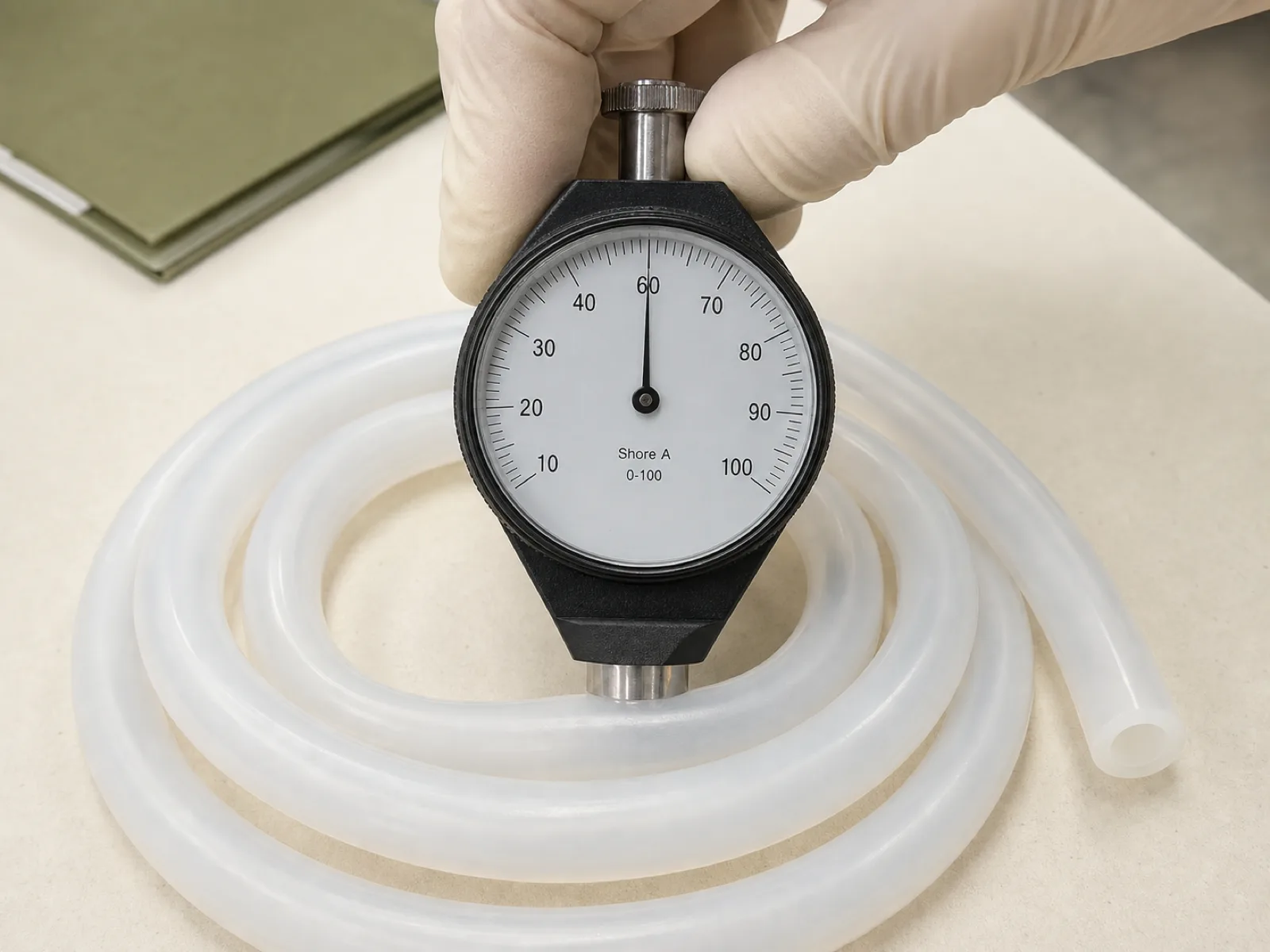
A complete food grade silicone tubing drawing carries five specifications: inner diameter with tolerance, outer diameter with tolerance, wall thickness (implied but call it out for extrusion), Shore A durometer, and cure system. Add color (or "translucent"), length per coil, compliance frame (FDA 21 CFR 177.2600 and/or LFGB), and any reinforcement layer if the application demands it.
The single most common quoting problem is a drawing that lists only OD and durometer. Extrusion is set up around the die and the tip — if the ID is not on the drawing, the supplier will guess based on nominal wall thickness, and the first article will miss. A properly specified line reads:
Tubing, silicone, platinum-cured, food grade ID 6.35 mm ±0.15 · OD 9.53 mm ±0.15 · Wall 1.59 mm ±10 % Shore A 60 ±5 · Translucent · Extruded per FDA 21 CFR 177.2600 and LFGB §30/31 Coil length 30 m per bag · Labeled with lot number and Wetop PO ref
Standard dimensional conventions:
| Application | Typical ID | Typical OD | Wall | Durometer |
|---|---|---|---|---|
| Coffee / espresso water line | 4.0-6.35 mm | 6.4-9.5 mm | 1.2-1.6 mm | 60-65 Shore A |
| Beverage dispenser | 6.35-9.5 mm | 9.5-12.7 mm | 1.6-1.6 mm | 55-60 Shore A |
| Peristaltic dosing pump | 1.6-6.35 mm | 3.2-9.5 mm | 0.8-1.6 mm | 55-65 Shore A |
| Dairy transfer / brewery | 12.7-25.4 mm | 19.0-31.8 mm | 3.2-3.2 mm | 60-70 Shore A |
| Vacuum / reinforced hot-fill | Custom | Custom + braid | 4.8-6.4 mm | 65-75 Shore A |
For durometer selection theory across all silicone parts, the Shore A hardness silicone chart guide covers the full range and typical use-case mapping.
Reinforced vs unreinforced silicone tubing
Unreinforced silicone tubing handles low-pressure food-contact transfer up to about 25 psi at room temperature. Add polyester-braid reinforcement for pressurized hot-fill, steam-in-place, or any line running above 30 psi at temperature. Wire-helix reinforcement is used only for full-vacuum applications where the tubing must not collapse under negative pressure.
The three reinforcement tiers and where each earns its cost:
- Unreinforced platinum-cured silicone — the default for gravity-fed and low-pressure transfer, coffee equipment, small peristaltic pumps, and countertop appliances. Working pressure drops sharply above 100 °C (roughly 8-10 psi at 180 °C).
- Polyester-braid reinforced — a knit polyester sleeve embedded between two silicone extrusion passes. Working pressure jumps to 100-150 psi at ambient and 40-60 psi at 180 °C. Used for CIP loops, hot-fill beverage lines, and brewery / dairy transfer. Adds 40-60 % to the per-meter price.
- Wire-helix reinforced — a stainless-steel helix embedded in the wall. Used exclusively for vacuum service (tanker truck transfer, high-vacuum food processing). Adds 90-120 % to per-meter price and moves lead time out 5-7 days for the wire-forming step.
If the specification is ambiguous — “we want it to handle hot water” — push the buyer for a working pressure and a temperature. “Hot water at 15 psi” and “hot water at 60 psi” are different SKUs.
MOQ, tooling, and pricing bands for OEM tubing
Wetop's OEM MOQ for food grade silicone tubing is 500 meters per SKU on standard dimensions and stock colors, and 1,000 meters per SKU for custom Pantone colors, reinforced constructions, or precision tolerances. Tooling for a new ID/OD combo (die + tip + spool tooling) runs $600-1,200 and amortizes over the first two POs at $0.30-0.60 per meter.
Extrusion tooling economics differ from injection molding — the tool is a die and a tip pair, not a multi-cavity aluminum block. That keeps entry costs low but makes each new ID/OD its own MOQ event:
| Item | Standard SKU | Custom SKU |
|---|---|---|
| MOQ per SKU | 500 meters | 1,000 meters |
| Die tooling | $600-1,200 (buyer keeps) | $600-1,200 |
| Sampling lead time | 15-20 days | 20-25 days |
| Production lead time | 20-25 days | 25-35 days |
| Indicative FOB Yantian | $0.85-2.20 / meter | $1.10-3.40 / meter |
| Pantone color matching | +$0.15-0.30 / meter | +$0.15-0.30 / meter |
| Polyester braid reinforcement | +40-60 % on base | +40-60 % on base |
Pricing spread reflects ID, wall thickness, durometer, and quantity. A 6.35 mm ID unreinforced 60 Shore A tubing at 2,000 meters lands near the bottom of the band; a 25.4 mm ID braid-reinforced 65 Shore A tubing at 500 meters lands near the top. For the full pricing methodology across silicone OEM programs, the silicone OEM pricing structure guide breaks down compound, labor, tooling, and testing line items.
What certifications and test reports should ship with the tubing?
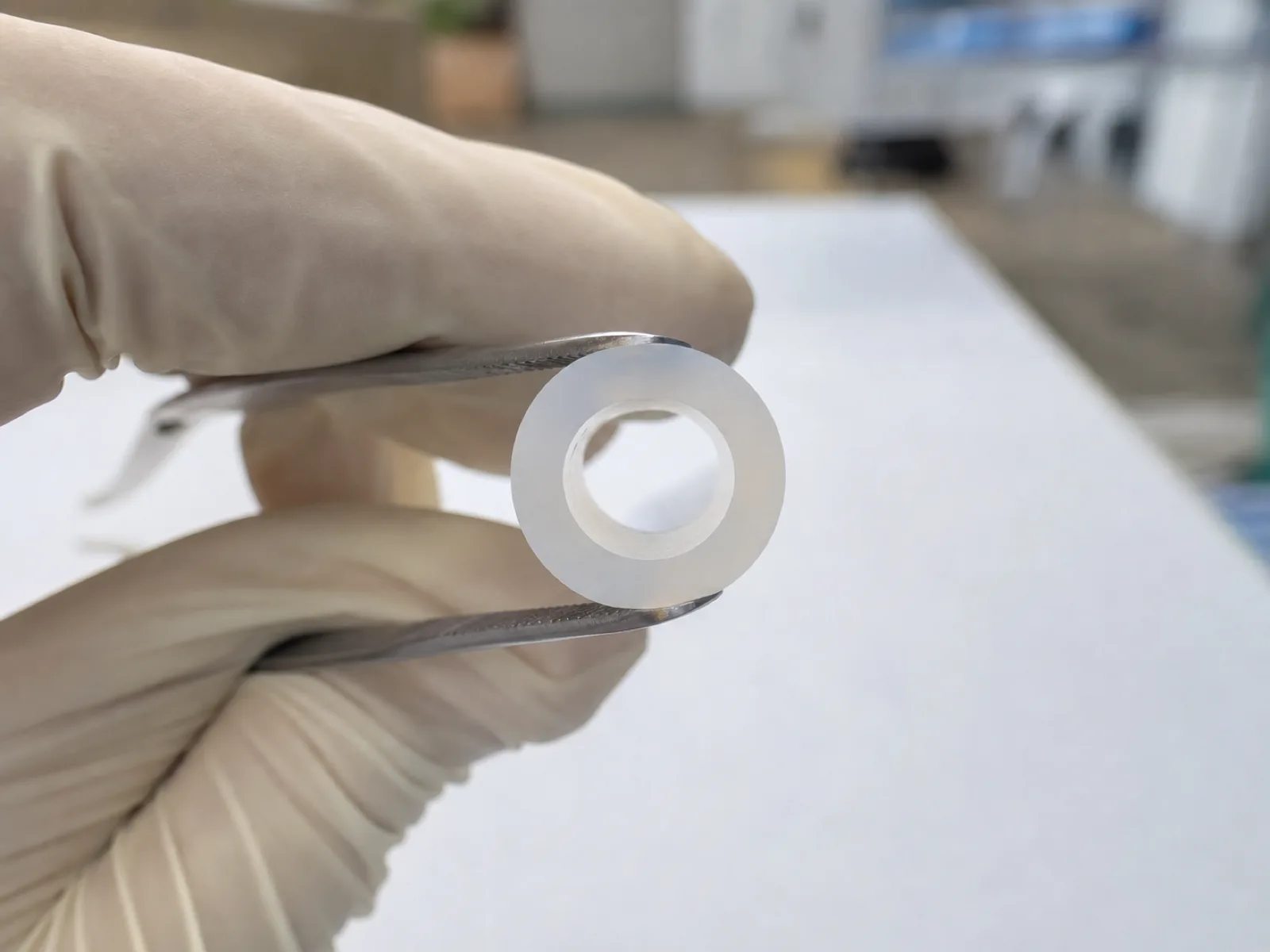
Every food grade silicone tubing shipment should carry a Certificate of Conformance (CoC), a Certificate of Analysis (CoA) with lot-specific durometer and dimensional readings, an FDA 21 CFR 177.2600 test report on the compound, and an LFGB §30/31 report for EU-bound goods. Pharma programs add per-lot Extractables & Leachables data and USP Class VI restatement.
The complete compliance packet on a Wetop food grade tubing PO contains:
- Certificate of Conformance — one page, references PO number, drawing revision, lot number, and quantity. Signed by the QC lead.
- Certificate of Analysis — lot-specific readings: Shore A durometer (three samples), tensile strength, elongation at break, ID/OD dimensional check per ASTM D2240 for hardness3 and internal SOP for dimensions.
- FDA 21 CFR 177.2600 test report — annual, on the compound identity, dated within 12 months.1
- LFGB §30/31 report — annual, for EU-bound goods, includes BfR sensory testing.
- REACH SVHC declaration — checks the shipment against the current candidate list, including SCCPs, phthalates, and PFAS.4
- Prop 65 / AB 1200 PFAS-free declaration — for California-destined goods.
- ISO 9001 certificate — the underlying quality system that produced the lot.5
Pharma-track tubing additionally includes USP Class VI restatement6 and, when the program spec demands it, per-lot Extractables & Leachables (E&L) reports run against water, ethanol, and hexane extractants. E&L testing on a new formulation is a one-time cost of $1,800-2,400 and is reusable across every SKU that shares the compound.
For the full compliance frame comparison between US and EU regulatory routes, the FDA vs LFGB silicone guide walks through clause-by-clause requirements.
Steam-in-place, CIP, and sterilization cycle life
Platinum-cured food grade silicone tubing survives 200-300 steam-in-place cycles at 121 °C and 20 psi for 30 minutes before the inner wall shows tackiness or dimensional drift. Peroxide-cured tubing tolerates about half that. Autoclave sterilization at 134 °C shortens life by another 30-40 %. Design the tubing lifecycle around the cleaning schedule, not the pressure rating.
Silicone’s temperature envelope (-60 °C to 230 °C) makes it the elastomer of choice for CIP loops, brewery hot-fill transfer, and dairy pasteurization return lines. The failure mode is not thermal degradation — it is cumulative surface hydrolysis from repeated exposure to wet heat and cleaning chemistry. Three cleaning routines set the operational floor:
- Clean-in-place (CIP) at 60-80 °C — caustic + acid + rinse cycles. Silicone shrugs off dilute NaOH and HNO3 at this temperature; life exceeds 5,000 cycles in most beverage lines.
- Steam-in-place (SIP) at 121 °C / 20 psi — the standard sterilization cycle for dairy, brewery, and pharma-adjacent food. Platinum-cured tubing at 60-65 Shore A holds 200-300 cycles before the wall shows haze on inspection.
- Autoclave at 134 °C / 30 psi — used for pharma and specialty food. Shortens life 30-40 % versus 121 °C SIP.
Cleaning-chemistry compatibility is worth calling out on the drawing. Silicone is compatible with caustic (up to 10 % NaOH), dilute acids, ethanol, isopropanol, and hydrogen peroxide sanitizers. It is not compatible with non-polar organic solvents (toluene, xylene, mineral spirits) — those swell the tubing to failure. Chlorinated cleaning agents are borderline: dilute sodium hypochlorite (bleach) at ambient is tolerated; hot chlorine service is not.
For any tubing on a validated CIP/SIP loop, require the supplier to disclose the post-cure schedule in writing. A 4-hour 200 °C post-cure removes residual siloxane oligomers that would otherwise volatilize during the first 20-30 SIP cycles, and the tubing tastes and smells better from cycle one. Wetop applies the 4-hour post-cure standard on all platinum-cured food and pharma tubing regardless of whether the customer requests it — it is baked into the process route.
Extractables & leachables (E&L) testing — when it earns its cost
E&L testing quantifies the compounds that migrate out of silicone tubing under solvent challenge, typically water, ethanol at 20-50 %, and hexane. A full E&L study on a new compound costs $1,800-2,400 and takes 3-4 weeks. The study is one-time and reusable across every SKU that shares the compound, making it a cheap insurance line for pharma-adjacent food programs and any tubing shipped into regulated infusion adjacencies.
E&L testing sits above the FDA 177.2600 baseline. The 177.2600 test asks “does the total extractable mass fall under the CFR limit?” — a pass/fail on a bulk number. An E&L study asks “which specific compounds migrate, and at what concentration?” — a chromatographic profile of every siloxane oligomer, cyclic D4/D5/D6 species, catalyst residual, and processing aid trace.
The three cases where E&L testing earns its cost:
- Pharma-adjacent food — infant formula preparation lines, medical nutrition, sports supplement extraction. Buyers often want the pharma-grade compliance frame even when the finished product is a food.
- Aggressive-flavor beverages — carbonated beverages, citrus concentrates, and coffee at 90+ °C accelerate migration. E&L data lets the buyer’s food safety team model migration into the specific product.
- Regulatory audits — some Tier-1 US and EU beverage brands run their supplier programs through an E&L review as a matter of policy, independent of the product’s regulatory frame.
E&L reports comply with USP <1663> and USP <1664> methodology when the tubing is destined for regulated pharma; food-only programs typically run a scoped version of the same methodology without the biocompatibility overlay.6
Ordering, packaging, and traceability
Food grade silicone tubing ships in sealed polyethylene bags at 25-50 meter coils, packed into export cartons of 200-500 meters. Every coil carries a barcode label with lot number, PO reference, compound identity, dimensions, and cure date. Packaging is food-contact clean; no oiled or waxed paper touches the tubing. Cartons ship on treated pallets meeting ISPM 15.
Traceability is where most low-cost suppliers fail. A properly traceable shipment lets the buyer’s food safety team trace a specific meter of tubing back to a specific compound batch, a specific extrusion run, a specific operator, and a specific date. Wetop’s traceability route:
- Compound batch record — every 200 kg silicone base receives a unique batch ID. The record captures raw material lot numbers, mixing time, dispersion check, and durometer sample.
- Extrusion run log — every extrusion run captures date, operator, die/tip ID, line speed, cure oven temperature profile, and post-cure profile. Each 500-meter run is tagged with a unique lot ID that inherits the compound batch ID.
- QC sample retention — three samples per lot are pulled at start / middle / end of the run and retained for 24 months. The retention library lets Wetop retest against a customer complaint months after shipment.
- Shipment manifest — the packing list references every carton by lot ID, and every coil label carries the same lot ID as a barcode.
The packaging spec matters as much as the tubing. Coils should ship in food-contact-clean sealed polyethylene bags, not the oiled kraft paper that some industrial hose suppliers reuse from rubber extrusion lines. Wetop’s food and pharma cell runs a segregated packaging line — the same polyethylene film used for direct food contact wraps every coil, and the workstation is downwind of any oiled or lubricated equipment.
Peristaltic pump tubing — a specialty within food grade
Peristaltic pump tubing is a specialty subclass of food grade silicone tubing designed to survive continuous mechanical occlusion at the pump head. Life expectancy is measured in hours, not years — a 60 Shore A platinum-cured tubing at 3.2 mm ID x 6.4 mm OD runs 350-500 hours at 200 rpm before wall thickness creep exceeds 15 %. Beyond that point, flow accuracy drifts and the tubing must be replaced.
Three variables dominate peristaltic tubing life:
- Wall-to-ID ratio — thicker walls last longer but cost more to pump. A 2:1 OD-to-ID ratio (e.g., 3.2 mm ID x 6.4 mm OD) is the industry sweet spot.
- Durometer — 55-65 Shore A on platinum-cured compound. Softer tubing wears the roller side faster; harder tubing under-occludes.
- Post-cure quality — under-post-cured tubing shows accelerated creep in the first 100 hours as residual volatiles cook out under mechanical stress. Wetop applies a 4-hour 200 °C post-cure on all peristaltic-spec tubing regardless of the food or pharma frame.
For programs where the pump head is proprietary (dosing pumps in coffee equipment, dairy CIP systems), send a sample of the pump head along with the RFQ. The extrusion team will pick the tubing wall against the roller radius and occlusion depth rather than shipping a generic spec.
Supplier vetting — what to ask before you PO
Before placing a first PO on food grade silicone tubing, vet the supplier against six checkpoints: current 21 CFR 177.2600 test report, ISO 9001 certificate, cure-system disclosure, extrusion tolerance data, retention sample policy, and a plant-audit-friendly attitude. Any supplier that hesitates on any of these is not a food-grade-track supplier — they are an industrial hose supplier moonlighting on food work.
The vetting checklist for a first-time food grade tubing supplier:
- Ask for the 21 CFR 177.2600 test report by compound name. The report must be within 12 months and must match the compound they propose for your PO — not a different compound they used to run.
- Ask for ISO 9001 certificate scope. The scope line must include silicone extrusion. A certificate scoped to “silicone products” without extrusion listed is a red flag.
- Ask which cure system they run and where the post-cure oven is. A supplier that “sometimes platinum, sometimes peroxide” without a segregated line has cross-contamination risk.
- Ask for extrusion tolerance data on ID / OD / wall. ±0.15 mm on OD under 12 mm is the industrial baseline. If they quote ±0.30 mm as their default, they are shipping generic hose, not tubing.
- Ask about retention sample policy. Two-year retention on three samples per lot is the pharma-adjacent standard. Food-only retention can be 12 months, but there must be a retention library.
- Ask if they welcome a customer or third-party plant audit. A supplier that resists a plant visit is hiding something — usually a rented facility or a subcontracted extrusion cell.
For a broader framework on qualifying a Chinese silicone factory across all product lines, the sourcing silicone factory checklist walks through the full vetting process, including audit red flags and the difference between a factory and a trading company posing as one.
Common failure modes and how to avoid them
The five most common food grade silicone tubing failure modes are wall creep under peristaltic occlusion, dimensional drift on unqualified extrusion, off-taste from under-post-cured compound, tackiness after repeated SIP cycles, and burst failure on unreinforced tubing pushed above rated pressure. Each has a specification-time fix, not an operational fix.
Failure mode economics — the specification-time cost of avoiding each mode is always cheaper than the field cost of encountering it:
- Wall creep on peristaltic tubing — cause: durometer too low, or wall too thin, or non-post-cured compound. Fix: 60-65 Shore A, 2:1 OD:ID ratio, 4-hour post-cure. Cost delta at spec: 0-5 %. Cost delta in field: full tubing loop replacement plus flow-accuracy recalibration.
- ID / OD dimensional drift over a run — cause: die-tip wear, no inline gauging, no first-article check. Fix: laser micrometer inline, first-article dimensional check on every run, replace die tips at 8,000 meter intervals. Cost delta at spec: $0.05 per meter. Cost delta in field: rejected lot.
- Off-taste in beverage service — cause: unpost-cured platinum-cured tubing or under-cured peroxide-cured tubing. Fix: mandatory 4-hour 200 °C post-cure on beverage lines regardless of frame. Cost delta at spec: $0.10-0.20 per meter. Cost delta in field: consumer complaints and brand damage.
- Tackiness after repeated SIP — cause: platinum catalyst residual accelerated by wet heat, most common on low-catalyst formulations. Fix: use a food-grade platinum-cured compound with the platinum content tuned for wet heat service. Cost delta at spec: modest. Cost delta in field: replacement cycle halved.
- Burst on unreinforced tubing — cause: system pressure spec did not account for pump surge or dead-head events. Fix: braid reinforcement for any line running above 30 psi at temperature, or a pressure-relief bypass at the pump. Cost delta at spec: 40-60 % on the tubing, one-time. Cost delta in field: line rupture and cleanup.
Every one of these is a specification-time decision. A supplier can produce excellent food grade tubing on excellent equipment and the buyer can still fail in the field because the drawing was under-specified. Push the specification early.
Working with color, opacity, and printing on food grade silicone tubing
Food grade silicone tubing can be extruded translucent, water-clear, opaque white, or Pantone-matched to a customer color. Pigment master-batches must themselves clear FDA 21 CFR 178.3297 or the equivalent EU migration limits. Direct-print or laser marking on the tubing surface requires food-grade ink and adds a QC step for line-speed compatibility. Most beverage OEM programs stay translucent for in-line flow verification.
Color and marking choices carry compliance consequences that surprise first-time OEM buyers:
- Translucent (default) — no pigment master-batch needed. Lets QC and end-users see fluid flow and any air-lock condition. This is the beverage industry default.
- Opaque white — titanium dioxide master-batch, food-grade. Standard for dairy and where light-blocking is functional (light-sensitive product paths).
- Pantone-matched — a custom color master-batch, tested against migration limits. Adds $0.15-0.30 per meter and moves MOQ to 1,000 meters because the master-batch itself is a minimum-quantity item.
- Silicone-safe surface printing — a food-grade ink applied inline post-cure. Used for lot numbering, brand marking, and directional flow arrows on visible line segments.
For any custom logo or surface treatment on a silicone part, the customize silicone logo (deboss, print, laser) guide covers the process options and cost implications across molded and extruded parts.
Regulatory update cadence — keeping the compliance packet current
FDA 21 CFR 177.2600 test reports should be refreshed annually on the compound, not per lot. LFGB §30/31 refreshes annually. REACH SVHC screening refreshes when ECHA updates the candidate list, twice per year. USP Class VI is one-time per compound. PFAS-free declarations refresh annually or when the supply chain of the raw silicone base changes.
The compliance packet is not a static document set — it decays if it is not refreshed on cadence. A supplier that has not refreshed their 177.2600 report in three years is shipping expired documentation, even if the compound has not changed. Wetop’s refresh cadence:
| Document | Refresh cadence | Trigger |
|---|---|---|
| FDA 21 CFR 177.2600 | Annually per compound | Anniversary date |
| LFGB §30/31 | Annually per compound | Anniversary date |
| USP Class VI | One-time per compound | New compound |
| REACH SVHC screening | Twice yearly | ECHA candidate list update |
| PFAS-free declaration | Annually | Or on raw material change |
| ISO 9001 recertification | Every 3 years, annual surveillance | Certification body cadence |
| Extractables & Leachables | One-time per compound | New compound or formulation change |
Buyers should ask for the compliance packet with the RFQ and again with the first PO. If any document is more than 12 months old at PO time, request a refresh before shipment. The refresh cost is bundled into the annual compound qualification and does not surface as a per-PO line item.
FAQ
For frequently asked technical questions, see the FAQ list at the top of the frontmatter block — the same questions render below in the deployed page. Common items include compliance frame differences, durometer selection, peristaltic life, and sterilization cycle counts.
Sourcing food grade silicone tubing — next step
Wetop runs food grade silicone tubing OEM programs from a 7,500 m² factory in Dongguan, 90 minutes from Yantian Port. Every program clears the same compliance packet (177.2600, LFGB §30/31, ISO 9001, REACH SVHC, PFAS-free declaration), and the extrusion cell is dedicated to platinum-cured silicone — no cross-contamination with peroxide compounds or non-food elastomers. For an RFQ with drawing, durometer, and target volume, talk to the engineering desk.
Footnotes
-
21 CFR 177.2600 — Rubber articles intended for repeated use. US FDA. See references. ↩ ↩2
-
Regulation (EC) No 1935/2004. EUR-Lex. See references. ↩
-
ASTM D2240 durometer standard. See references. ↩
-
REACH SVHC Candidate List. ECHA. See references. ↩
-
ISO 9001:2015 Quality Management. See references. ↩
-
USP <88> Biological Reactivity Tests, In Vivo — Class VI. See references. ↩ ↩2
FAQ
-
Is all food grade silicone tubing FDA compliant?
No. FDA compliance for silicone tubing means the finished part meets 21 CFR 177.2600 for repeated-use rubber articles — which requires specific extractable limits after water and hexane immersion. Peroxide-cured tubing often fails without a 4-hour post-cure, and unpost-cured or generic 'food-safe' silicone from unqualified suppliers usually does not carry current test data. Always ask for a batch-specific 21 CFR 177.2600 test report dated within 12 months.
-
What is the difference between food grade and pharma grade silicone tubing?
Food grade silicone tubing clears 21 CFR 177.2600 (US) and LFGB §30/31 (EU) for repeated food contact. Pharma grade adds USP Class VI biocompatibility (six-way animal and cytotoxicity testing per USP <88>), plus ISO 10993-5/-10 in most cases, and typically ships with per-lot E&L reports. Pharma grade tubing costs 30-45 % more per meter and is only required when the tubing contacts injectable or infusion fluids.
-
What Shore A hardness should I specify for peristaltic pump tubing?
Peristaltic pump tubing lives longest in the 55-65 Shore A range on platinum-cured silicone. Below 50 Shore A, the tubing collapses too fully and the wall creeps; above 70 Shore A, the pump head cannot fully occlude the bore, dropping flow accuracy. For 3.2 mm ID x 6.4 mm OD tubing on a typical lab peristaltic head at 200 rpm, a 60 Shore A platinum-cured compound gives 350-500 hours of service life before wall thickness drops 15 %.
-
How tight are ID / OD tolerances on extruded silicone tubing?
Extrusion holds ID and OD to ±0.15 mm on tubing under 12 mm OD and ±0.25 mm above at Wetop's extrusion cell — that is the industrial baseline for platinum-cured food and beverage tubing. Wall thickness tolerance is typically ±10 % of the nominal wall. Tighter tolerances (±0.05 mm) are achievable on precision beverage / analytical lines with laser-micrometer inline gauging, but require a dedicated tooling package and 500-meter-per-run minimum.
-
Do I need reinforced (braided) silicone tubing for hot-fill lines?
Unreinforced silicone tubing handles -60 °C to 230 °C at low pressure — up to about 25 psi at room temperature and 8-10 psi at 180 °C. For hot-fill CIP lines, steam-in-place cycles, or any pressurized transfer above 30 psi at temperature, polyester-braid-reinforced silicone tubing is required. Wire-helix reinforcement is used only where full-vacuum resistance is needed. Both add 40-60 % to per-meter cost but roughly triple burst pressure at temperature.
-
What certifications should ship with every lot of food grade silicone tubing?
For food-contact OEM programs, every shipment should include: (1) a Certificate of Conformance (CoC) referencing the PO and drawing revision; (2) a Certificate of Analysis (CoA) with actual durometer, tensile, elongation, and ID/OD dimensional readings from the lot; (3) an FDA 21 CFR 177.2600 test report on the compound (annual, not per-lot); and (4) LFGB §30/31 report if selling into the EU. Pharma programs add per-lot E&L or USP Class VI restatement.
-
What is the OEM MOQ for custom food grade silicone tubing?
Wetop's OEM MOQ for custom food grade silicone tubing is 500 meters per SKU on a standard ID/OD/durometer combination in translucent or a stock color. Custom Pantone color-matched runs move the MOQ to 1,000 meters (color master-batch minimum). Reinforced tubing and precision-tolerance runs also carry a 1,000-meter floor. Split-durometer or split-color runs on the same die combine toward the compound minimum.
-
Can silicone tubing be steam-sterilized (SIP) and how many cycles?
Platinum-cured food grade silicone tubing withstands steam-in-place (SIP) at 121 °C / 20 psi for 30 minutes across roughly 200-300 cycles before the inner wall shows visible tackiness or dimensional drift. Peroxide-cured tubing tolerates about half that (100-150 cycles) because residual peroxide by-products accelerate at high wet heat. For dedicated CIP/SIP loops, always specify platinum-cured and require the supplier to disclose their post-cure schedule.
-
Does REACH or California Prop 65 apply to food grade silicone tubing?
REACH SVHC screening applies for any silicone tubing shipped into the EU — Wetop compounds pass current SVHC candidate list screening including SCCPs, phthalates, and PFAS. California Prop 65 has no silicone-specific listing, but shipments to California need PFAS-free declarations under AB 1200 for food-contact articles, which Wetop compounds satisfy. Both declarations ship as PDF with the compliance packet.
References
Authoritative sources cited in this guide
- US Food and Drug Administration. 21 CFR 177.2600 — Rubber articles intended for repeated use. https://www.ecfr.gov/current/title-21/chapter-I/subchapter-B/part-177/subpart-C/section-177.2600
- US Food and Drug Administration — CFSAN. Guidance for Industry: Preparation of Food Contact Notifications. https://www.fda.gov/food/food-ingredients-packaging
- United States Pharmacopeia. USP <88> Biological Reactivity Tests, In Vivo — Class VI. https://www.usp.org/harmonization-standards/pdg/excipients/plastic-materials
- European Union — EUR-Lex. Regulation (EC) No 1935/2004 on materials intended to come into contact with food. https://eur-lex.europa.eu/legal-content/EN/TXT/?uri=CELEX%3A32004R1935
- International Organization for Standardization. ISO 10993-5:2009 — Biological evaluation of medical devices — Tests for in vitro cytotoxicity. https://www.iso.org/standard/36406.html
- ASTM International. ASTM D2240 — Standard Test Method for Rubber Property — Durometer Hardness. https://www.astm.org/d2240-15r21.html
- ASTM International. ASTM D412 — Standard Test Methods for Vulcanized Rubber and Thermoplastic Elastomers — Tension. https://www.astm.org/d0412-16r21.html
- European Chemicals Agency (ECHA). REACH Candidate List of substances of very high concern (SVHC). https://eur-lex.europa.eu/legal-content/EN/TXT/?uri=CELEX%3A32006R1907
- International Organization for Standardization. ISO 9001:2015 — Quality Management Systems — Requirements. https://www.iso.org/standard/62085.html
Start a custom program
Send a brief. Get an engineer’s reply in one business day.
Every Wetop program is tooled from a customer’s specification. Send a CAD file (STEP · IGES · DWG) or a written brief and we’ll reply with a mold cost estimate, price brackets at MOQ 500 / 1,000 / 5,000, and any engineering questions.