Buyer Guide · commercial intent
Silicone Baby Bib Manufacturer — OEM Engineering Guide
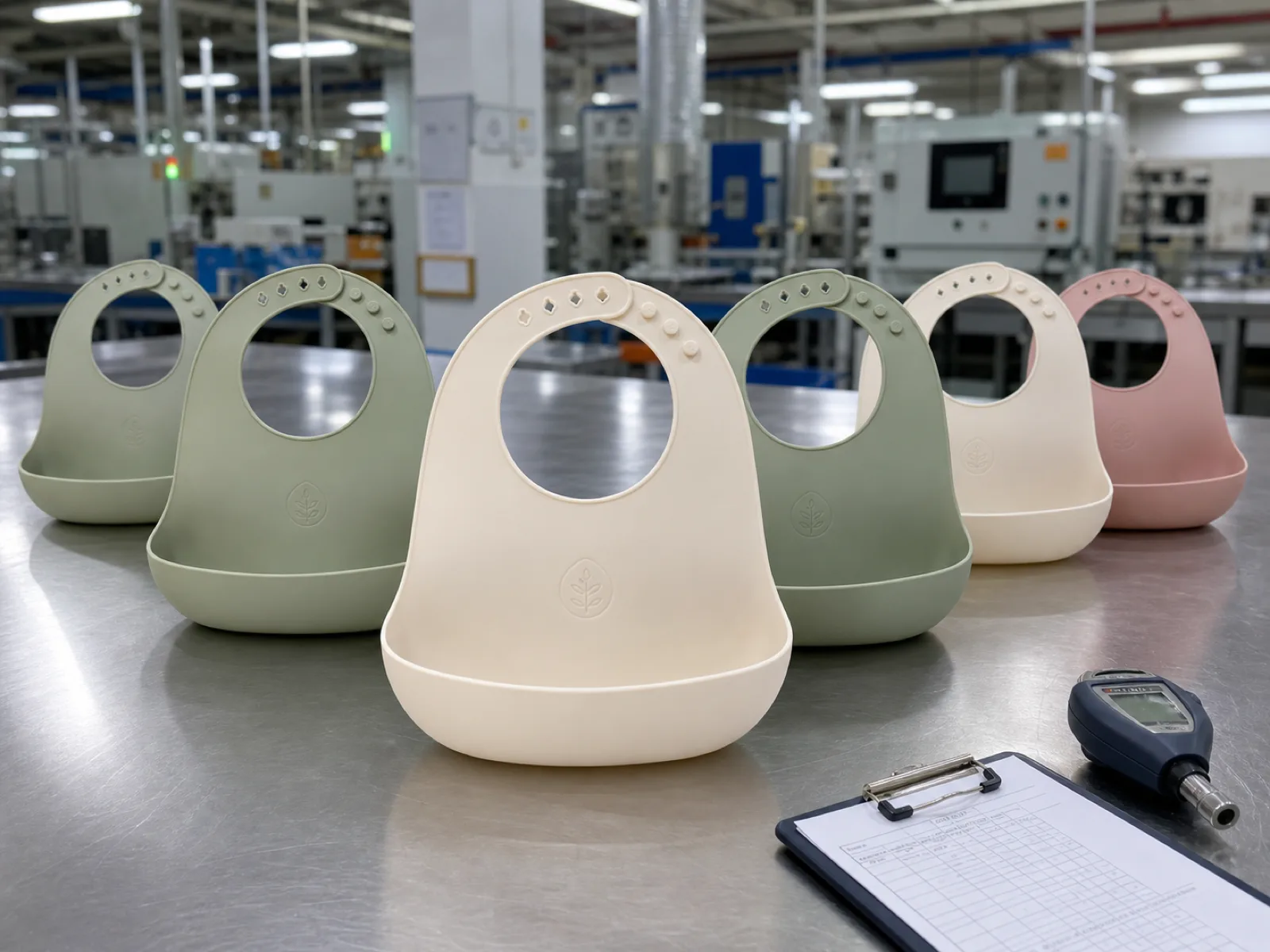 Buyer Guide
 A defensible silicone baby bib manufacturer is not a mold shop that also stocks catalog bibs — it is a factory that clears FDA 21 CFR 177.2600, LFGB §30/§31, CPSIA lead and phthalate limits, CA Prop 65, and EN 14372 on the same production lot, backed by CPSC-accredited third-party lab reports. That compliance stack, not a low quote, is what carries a bib SKU past Amazon vendor onboarding, Walmart FCCA, and Sedex SMETA. Everything downstream — Shore A hardness, pocket geometry, decoration method, MOQ economics — is engineering choice architecture on top of that regulatory floor.
This guide walks the buyer-side decisions that separate a hobby-scale bib supplier from a factory that a Tier-2 housewares brand or baby-category buyer can actually vendor-onboard. It covers the compliance stack, material engineering, pocket geometry, MOQ and tooling math, decoration methods against wash-cycle contracts, retail-audit readiness, and the failure modes a program manager needs designed out before PO. All numbers below come from Wetop’s Dongguan LSR injection cell and compression cell — the same equipment we run for kitchen-sink and housewares brands.
What compliance stack must a silicone baby bib manufacturer actually clear?
A silicone baby bib for the US and EU retail market must clear five stacks on the same lot: FDA 21 CFR 177.2600[^fda-177-2600] for food-contact rubber, LFGB §30/§31 backed by BfR XV[^bfr-xv] for EU food-contact silicone, CPSIA[^cpsia] lead and phthalate limits with a CPSC-registered CPC[^cpsc-cpc], California Prop 65[^prop65] warning-list clearance, and EN 14372[^en-14372] for childcare feeding articles. Miss one, lose the retail slot.
Buyers new to the category assume “food-grade silicone” is one certification. The FDA vs LFGB silicone breakdown unpacks the two headline food-contact stacks in more depth. It is a stack of five, and every stack has its own test panel and lab-report cadence. FDA 21 CFR 177.2600 governs extractables from repeat-use rubber articles — the standard silicone-shop line-item. LFGB §30/§31 layers on migration limits derived from BfR Recommendation XV, which is why platinum-cured post-cure at 200 °C for four hours exists. CPSIA layers on total-lead (≤ 100 ppm in substrate, ≤ 90 ppm in coating) and 8-phthalate (≤ 0.1%) limits enforced per SKU with a CPSC-accredited lab report and an importer-issued CPC[^cpsc-cpc]. California Prop 65 is a separate warning list that catches soluble antimony, cadmium, and several dyes that ordinary silicone bibs never see but house-brand additions can smuggle in. EN 14372 governs the EU-side mechanical and migration requirements when the bib is marketed for infant feeding — retailers like Amazon.de and REWE ask for it by name.
The food-grade silicone bibs FDA and LFGB explainer walks the two most-cited stacks specifically for the bib category. A factory that only produces the FDA 177.2600 line-item and calls the bib “food-grade” cannot pass Amazon vendor onboarding. The vendor packet asks for CPC, CPSC-accredited test report ID, and often SMETA. If your candidate supplier cannot produce all four in a single reply, the program will die at PPS.
How do you engineer material choice — LSR vs HCR — for baby-contact parts?
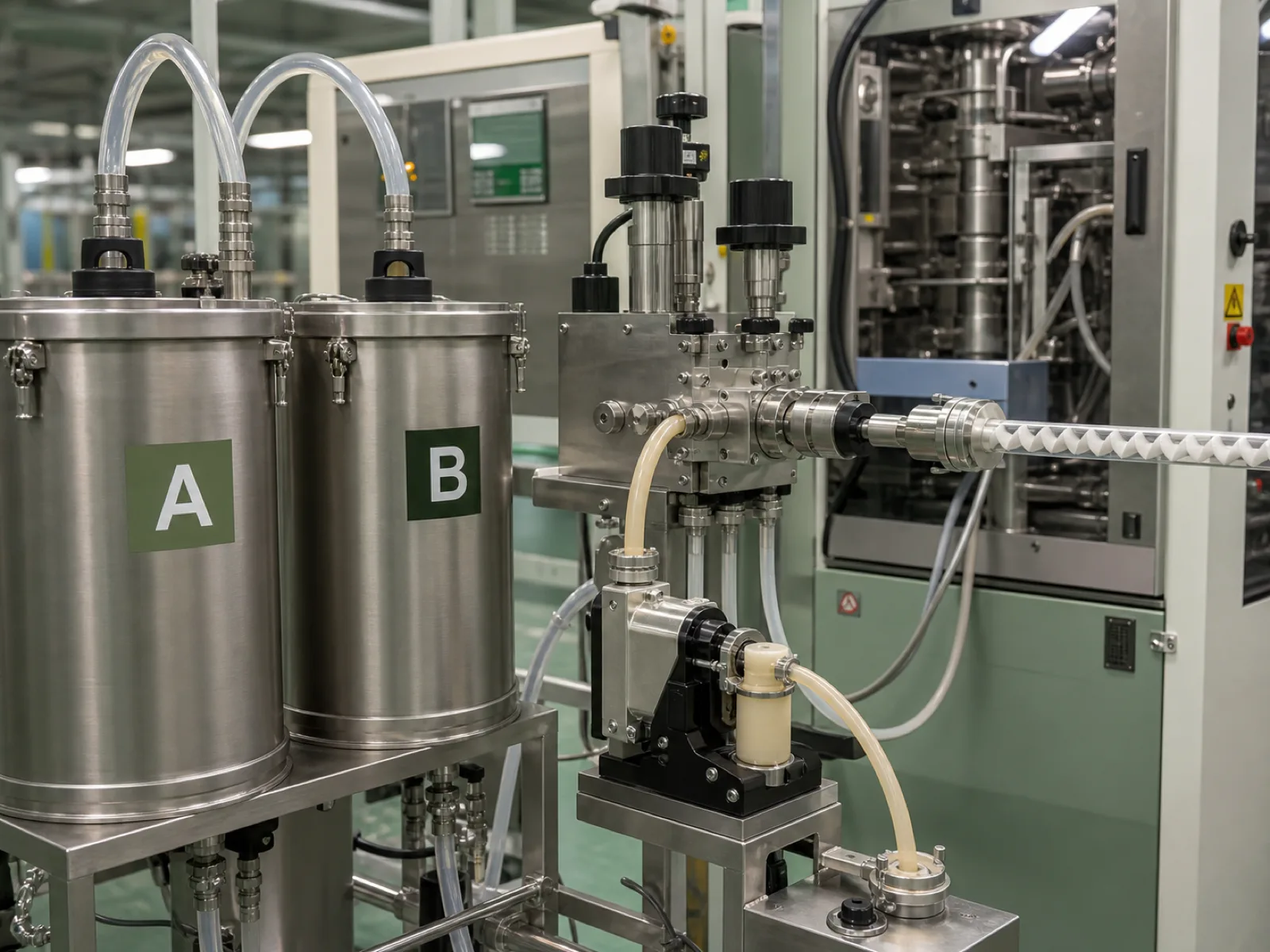
For baby bibs, platinum-cured liquid silicone rubber (LSR) injection wins over peroxide-cured high-consistency rubber (HCR) compression on every axis that matters. LSR runs fully automated, holds ±0.05 mm tolerance on the pocket rim, post-cures to below 20 ppm residual siloxane on a 200 °C / 4 h cycle, and leaves no peroxide-decomposition residues[^bfr-xv]. HCR is cheaper per gram but slower to clear LFGB migration limits.
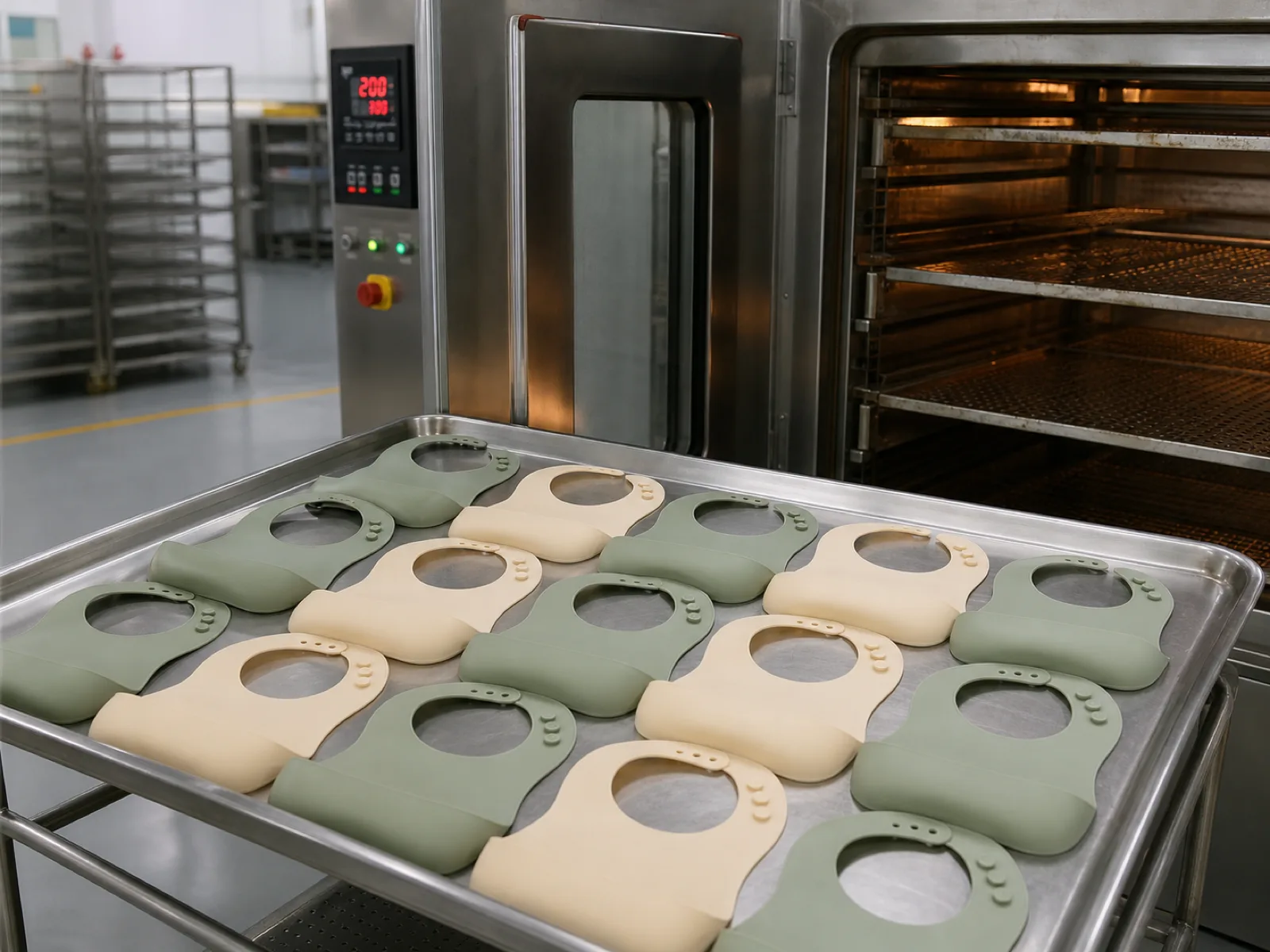
The material choice is not a taste question — it drives the compliance timeline. Platinum-cured LSR uses a hydrosilylation cure with no by-products beyond a small amount of ethanol. Post-curing at 200 °C for four hours drives residual siloxane below LFGB migration thresholds and eliminates the volatile-organic complaint stream that shows up in Amazon reviews as “chemical smell out of box.” Peroxide-cured HCR uses a benzoyl-peroxide or dicumyl-peroxide decomposition cure that leaves benzoic-acid or acetophenone residues; those clear with a longer post-cure but the lab reports come in tighter, and any process drift shows up as failed migration testing at the retail-buyer’s re-audit.
The trade-offs between the two cure chemistries are worked through in more depth in the platinum-cured vs peroxide-cured silicone comparison. For the pocket-shape geometry, LSR injection also holds tighter tolerance. A 2-cavity LSR tool holds ±0.05 mm on the pocket rim; the equivalent HCR compression tool holds ±0.15 mm. That 0.1 mm matters when the retail spec says “catches food, does not gap at the neck.” Wetop runs a dedicated LSR injection cell for the baby-contact program family — kitchen-sink and drying-rack SKUs stay on the compression floor.
What Shore A hardness and pocket geometry does a bib actually need?
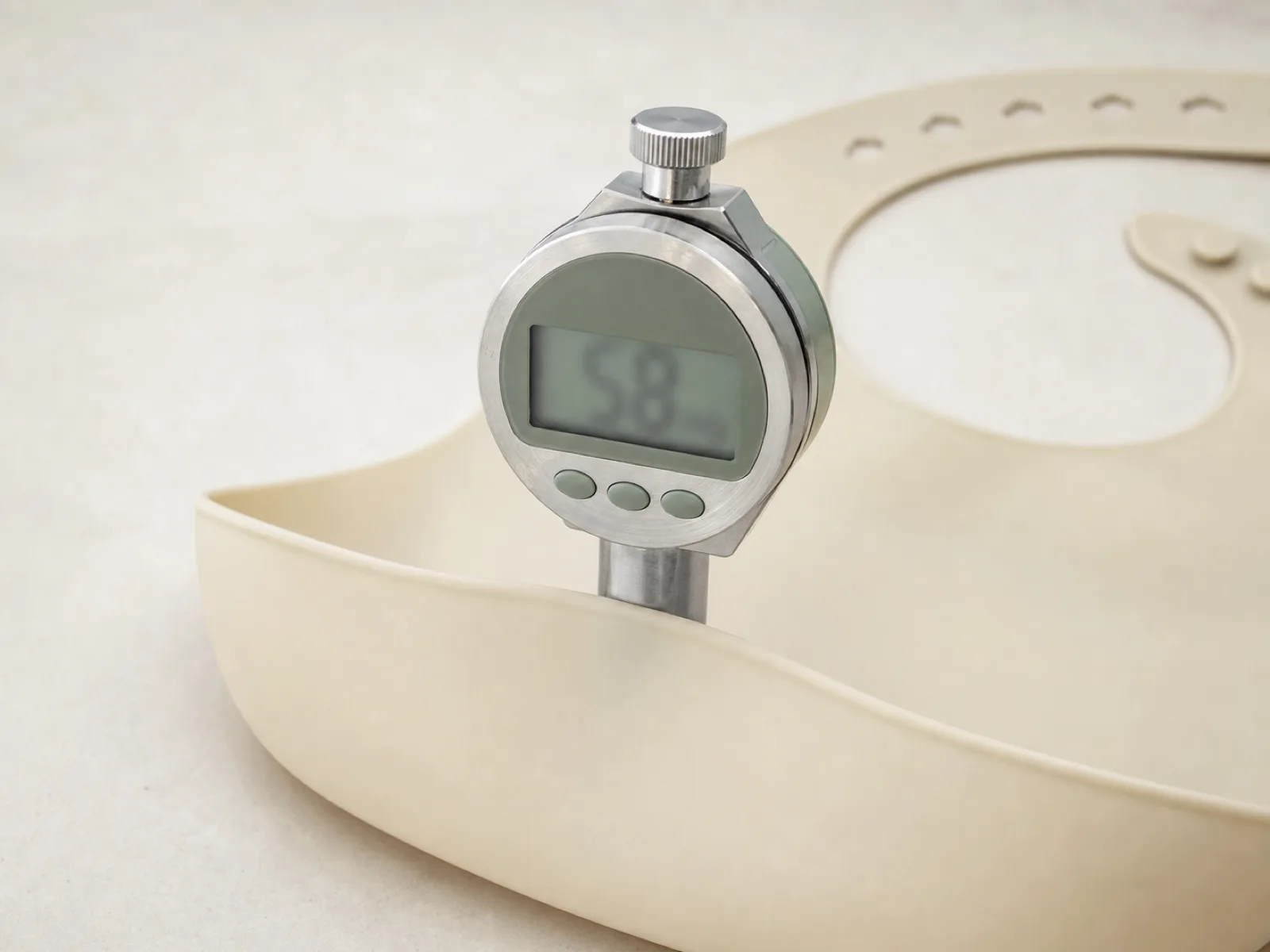
Target Shore A 40–55 on the neck band and 50–65 on the catch-pocket rim, with tear strength ≥ 25 kN/m per ASTM D624[^astm-d624]. Below 40 Shore A the pocket collapses under a spoonful of yogurt within 30 wash cycles; above 70 Shore A on the neck band chafes an infant's collarbone. The pocket floor slopes 3–5° toward two 4 mm relief slots to shed water.
The three engineering variables that dictate a bib’s field performance are durometer, tear strength, and pocket drainage geometry. Buyers who spec a single Shore A number for the whole part (“60 Shore A silicone bib”) get a part that either chafes the neck or slouches in the pocket. The right spec is a two-durometer part — a 45 Shore A band overmolded or co-molded with a 55–60 Shore A pocket. LSR co-injection makes that a single-shot part rather than a bonded assembly.
Tear strength is the number the neck-strap button hole survives on. Parents yank crusted purée off bibs; ASTM D624 tear strength below 20 kN/m tears within three months. Wetop specs 25–30 kN/m minimum on the strap section and adds a 1.5 mm bump ring around the button hole as a stress-crack arrestor. The pocket-floor slope is not cosmetic — pooled water is the substrate for the mold and mildew complaints that dominate one-star reviews in the category. A 3–5° slope toward two 4 mm relief slots at the outer pocket edges drains the pocket in under 30 seconds after rinsing.
What is the honest MOQ, tooling, and unit-cost math?
Realistic MOQ is 500–3,000 pieces per SKU on a 2- to 4-cavity LSR tool. Below 500 pieces per SKU, the SGS or Intertek full-panel LFGB + CPSIA test report (USD 1,200–2,400) cannot amortize under USD 0.40 per unit. Tooling for a 2-cavity LSR mold runs USD 4,500–7,500; a 4-cavity mold runs USD 8,000–12,000 and cuts cycle time from 55 to 45 seconds per shot.
The MOQ conversation gets muddled because two different numbers get called MOQ. Injection-molding MOQ is set by the run-time economics of the cavity — filling and setup makes a 500-piece run inefficient but not impossible on a 2-cavity mold. Compliance MOQ is set by amortization of the third-party lab report cost, which is fixed per SKU per material lot. That is the actual floor. The real-factory MOQ math walks through the same amortization arithmetic across other SKU families.
| SKU volume | Cavity count | Unit price band (FOB) | Tooling paid | Lab report per unit |
|---|---|---|---|---|
| 500 pcs | 2 | USD 1.85–2.40 | 3-year amortize | USD 2.40 |
| 1,000 pcs | 2 | USD 1.55–1.95 | 2-year amortize | USD 1.20 |
| 3,000 pcs | 2 or 4 | USD 1.15–1.55 | 1-year amortize | USD 0.40 |
| 10,000 pcs | 4 | USD 0.95–1.25 | Full amortize | USD 0.12 |
| 30,000 pcs | 8 | USD 0.80–1.05 | Full amortize | USD 0.04 |
Buyers running a six-color family at 500 pieces each hit MOQ per SKU while pooling tooling amortization across the family — the color change is a 20-minute purge on the cell, not a new tool. Wetop quotes this as a “colorway family” program: one tool, six colorway pulls, one master lab report annotated per pigment lot. For the wider view on how tooling, material, and overhead stack into a quote, the silicone OEM pricing structure guide breaks the line items apart.
Which logo decoration method survives the retail wash-cycle contract?
Debossed logos (cut into the mold cavity) and two-color co-injection survive 1,000+ dishwasher cycles indefinitely because the logo is part geometry. Laser engraving holds 500–1,000 cycles. Silk-screen with food-safe binder ink holds 150–300 cycles. Pick decoration by wash-cycle contract, not by lowest-quote — silk-screen quoted against a 1,000-cycle retail warranty is a returns event waiting to happen.
The decoration-method choice is often the least-scrutinized line item at RFQ and the most-scrutinized line item after the first customer-return wave. The four methods have different underlying physics.
| Method | Wash-cycle life | Setup cost | Per-unit cost delta | Best fit |
|---|---|---|---|---|
| Debossed (cavity-cut) | Indefinite | +USD 250–450 (mold edit) | +USD 0.00 | Retail primary logo, food-contact side |
| Embossed (cavity-cut) | Indefinite | +USD 250–450 (mold edit) | +USD 0.00 | Retail primary logo, outward-facing |
| Two-color co-injection | Indefinite | +USD 2,000–3,500 (dual-shot tool) | +USD 0.08–0.15 | Brand accent panels, care icon |
| Laser engraving | 500–1,000 cycles | +USD 15,000 (laser cell) OR outsource | +USD 0.10–0.18 | Serial number, small mark |
| Silk-screen (food-safe ink) | 150–300 cycles | +USD 350 per screen | +USD 0.05–0.12 | Promotional / limited-run only |
If the retail contract says “warranted 1,000 wash cycles,” debossed or co-injection is the only defensible pick. If the retail contract is silent and the buyer just needs the logo to survive the merchandising photo shoot, silk-screen is the cheapest path. For a fuller side-by-side of the decoration methods and their tooling costs, see the customize silicone logo — deboss, print, laser breakdown.
How does a bib factory pass Amazon, Walmart, Target, and Sedex audits?
The overlap between Amazon vendor onboarding, Walmart FCCA, Target vendor spec, and Sedex SMETA is: CPSC-accredited test report, CPC[^cpsc-cpc], ISO 9001[^iso-9001] QMS, SMETA 4-pillar audit, and a documented recall protocol. A factory that produces those five items in one email closes the vendor-onboarding loop in one week; a factory that has to source them opens a two-month bottleneck.
Retail-audit readiness is where a factory’s operations discipline shows. Amazon’s vendor packet asks for the CPC, an accredited lab report (SGS, Intertek, BV), CPSIA-compliant labeling, and a warehouse-ready barcode setup. Walmart’s FCCA layers a Sedex SMETA 4-pillar audit (labor, health & safety, environment, ethics), a factory-issued BSCI, and a Walmart-formatted item setup sheet. Target’s vendor spec adds an ICTI Ethical Toy Program audit if the SKU is classed as a toy accessory. All of these overlap on the same five artifacts.
Wetop maintains those five continuously — SMETA is re-audited annually, ISO 9001 surveillance is annual, the CPC gets issued per SKU per import, and the recall protocol is documented in the QMS. A Tier-2 US home-improvement chain audit that Wetop passed in 2024 walked through this stack in one on-site day.
What does the RFQ-to-FOB timeline actually look like?
Realistic timeline: RFQ to first-article 7–15 days on existing tooling family, 20–30 days on new tooling; PPS + third-party lab test 10–15 days; mass production 30–45 days on a 2-cavity tool at 800 pieces per day; pre-shipment inspection + FOB Yantian 4 days. Total 65–95 days from PO to on-the-water for a new SKU, 45–60 days for a repeat order.
Buyers who assume “silicone is fast” get burned on the compliance timeline. The mold and cure cycle is fast; the third-party lab-report cycle is not. SGS or Intertek run 10–15 business days on a full LFGB + CPSIA panel. Skipping that step to hit a Q4 retail-slot date is the single most common way a Tier-2 buyer loses a program at the retail-buyer’s SQA gate. The right sequencing is: first-article sample lands, third-party samples ship to the lab the same day, mass production kicks off after the lab clears — not before.
Wetop’s default program cadence for a repeat SKU on existing tooling is: PO Monday, material stage Tuesday, cell setup Wednesday, first shots Thursday, full production run Friday through week 6, inspection week 7, FOB Yantian week 7-8. First-time SKUs add tooling (weeks 1–4) and lab report (weeks 5–6) to the front of that cadence. The MOQ and lead-time breakdown for silicone OEM generalizes this cadence across categories.
Which failure modes must the design engineer out before PO?
Design out five failure modes: neck-strap tearing (bump-ring stress-arrestor + ≥ 25 kN/m tear per ASTM D624[^astm-d624]), pocket mildew (3–5° drainage slope + relief slots), silicone bloom (extended 4 h / 200 °C post-cure), color migration (pre-dispersed liquid pigment master-batch, never dry powder), and out-of-box odor (24 h ambient vent bay after post-cure). All five are process-controlled, not luck.
Every failure mode above shows up in Amazon one-star reviews for competing SKUs. Every one has a documented engineering fix in Wetop’s QMS. The failure modes are not silicone-material weaknesses — they are process shortcuts. Neck-strap tearing correlates with skipped tear-strength verification on the material COA. Pocket mildew correlates with pocket geometry that pools water because the mold designer copied a competitor’s low-cost tool. Silicone bloom correlates with shortened post-cure. Color migration correlates with dry-pigment addition to save USD 0.02 per unit. Out-of-box odor correlates with skipped ambient venting to hit a same-week ship date.
A factory that produces a documented CAPA log against each of those five failure modes has a story to tell at PPS. A factory that does not, does not.
References
The Tier-1 sources cited in this guide are listed in the References block at the end of the page — each one anchors a specific claim in the body via footnote marker. Buyers running vendor due diligence should verify every claim against the linked standard before PO.
Ready to spec a silicone baby bib program?
Wetop runs a dedicated LSR injection cell for baby-contact SKUs from a 7,500 m² ISO 9001 facility in Dongguan. If you need a quote against an existing spec, a design review on a target retail slot, or an anonymized reference program from a US home-improvement or housewares buyer, the fastest path is a direct message to the engineering desk.
FAQ
-
What certifications should a silicone baby bib manufacturer actually hold?
At minimum: FDA 21 CFR 177.2600 compliance for repeated food-contact rubber, LFGB §30/§31 migration test reports (EU market), CPSIA total-lead and phthalate compliance with a CPSC-registered CPC, California Prop 65 warning stack, and EN 14372 (Childcare articles — Cutlery and feeding utensils) for European retail. ISO 9001 and BSCI/Sedex SMETA are operational rather than product certs but retail buyers ask for them by name.
-
What is the realistic MOQ for a custom silicone baby bib OEM program?
500–3,000 pieces per SKU is the honest range. Below 500 the third-party test report cost (SGS full-panel LFGB + CPSIA runs USD 1,200–2,400) cannot amortize under about USD 0.40 per unit. Above 3,000 per SKU we can drop to a 4-cavity tool and cut unit cost 18–25%. Buyers running six colorways at 500 each hit MOQ per SKU while pooling tooling amortization across the family.
-
Should a silicone baby bib be made with LSR injection or HCR compression?
For baby-contact parts, LSR injection wins. Platinum-cured LSR clears post-cure below 20 ppm volatile siloxanes on a standard 200 °C / 4 h protocol, holds ±0.05 mm on the pocket rim, and runs fully automated so no operator touches the melt. Peroxide-cured HCR compression is cheaper per gram but leaves acid decomposition residues that require a longer post-cure and slightly higher LFGB migration values. HCR is fine for adult-market drying racks; bibs are LSR territory.
-
What Shore A hardness range is right for a silicone baby bib?
Neck band 40–55 Shore A so it flexes without chafing the clavicle; catch-pocket rim 50–65 Shore A so the pocket holds its scoop shape after 300 wash cycles. Anything below 40 Shore A on the pocket collapses under a spoon of yogurt within a month; anything above 70 on the neck band leaves red marks on infants under 12 months. Tear strength should hit ≥ 25 kN/m per ASTM D624 to survive parents yanking off crusted purée.
-
Which logo decoration method survives 1,000 dishwasher cycles on a silicone bib?
Debossed and embossed logos (cut into the mold cavity) survive indefinitely — the logo is the part. Two-color co-injection also survives indefinitely. Laser engraving lasts 500–1,000 cycles depending on depth. Silk-screen with food-safe binder ink typically holds 150–300 cycles before edges fade. If the retail spec says '1,000-cycle warranty,' specify debossed or co-injection at RFQ stage — silk-screen will not pass.
-
How do you prevent mold and mildew in the catch pocket of a silicone bib?
Three engineering controls: (1) drain the pocket floor with a 3–5° internal slope toward two 4 mm relief slots at the outer edges so water sheds; (2) run the platinum-cured LSR at 60 Shore A on the pocket walls so wet food does not embed in soft micro-porosity; (3) hand every retail carton a 'top-rack dishwasher safe' care card. Field mildew complaints drop 80–90% when the geometry drains rather than pools.
-
How does a silicone baby bib factory pass Amazon, Walmart, and Target audits?
Amazon requires CPC, a CPSC-accredited lab test report (usually SGS/Intertek/BV), and product images that show the CPSIA choking-hazard disclosure. Walmart FCCA adds a Sedex SMETA 4-pillar audit and a factory-issued BSCI. Target requires an ICTI Ethical Toy Program audit if the SKU is classed as a toy accessory. The overlap is: SMETA 4-pillar, CPC + accredited lab report, ISO 9001 QMS, and a documented recall protocol. Wetop maintains all five continuously.
-
What tests are required for CPSIA and how often does a bib factory re-run them?
CPSIA requires total lead ≤ 100 ppm in accessible substrate (CPSC-CH-E1002-08.3), lead in surface coating ≤ 90 ppm (CPSC-CH-E1003-09.1), and 8-phthalate content ≤ 0.1% (CPSC-CH-C1001-09.4). ASTM F963 mechanical + flammability tests apply if the bib is marketed to under-three. Re-test cadence: per material lot for the silicone compound, and per finished-goods production lot for a random SKU pull — most retail buyers spot-audit annually or on material-change events.
-
What is the typical lead time from RFQ to FOB Yantian for a silicone baby bib program?
RFQ to first-article sample: 7–15 days (existing tooling family) or 20–30 days (new tooling). Pre-production sample + third-party lab test: 10–15 days. Mass production: 30–45 days on a 2-cavity tool at 800 pieces/day. Pre-shipment inspection: 2 days. FOB Yantian truck-and-load: 2 days. Total 65–95 days from PO to on-the-water for a new SKU, 45–60 days for a repeat order on existing tooling.
-
How do you engineer out the failure modes buyers see most on silicone bibs?
Neck-strap tearing: reinforce the button hole with a 1.5 mm bump ring and specify tear strength ≥ 30 kN/m ASTM D624. Silicone bloom (white haze): extend post-cure to 4 h at 200 °C to drive off residual siloxane. Color migration from pigments: use pre-dispersed liquid color master-batches from a Wacker-, Momentive-, or Elkem-qualified supplier, never dry pigment powder. Odor complaints: post-cure plus a 24 h ambient vent bay before packaging cuts residual VOC below the human detection threshold.
References
Authoritative sources cited in this guide
- US Food and Drug Administration. 21 CFR 177.2600 — Rubber articles intended for repeated use. https://www.ecfr.gov/current/title-21/chapter-I/subchapter-B/part-177/subpart-C/section-177.2600 — The federal rule that governs food-contact silicone extractable limits — the floor a compliant baby-bib factory clears on every SKU.
- US Consumer Product Safety Commission. Consumer Product Safety Improvement Act of 2008 — Public Law 110-314. https://www.ecfr.gov/current/title-16 — Sets total-lead ≤ 100 ppm and 8-phthalate ≤ 0.1% limits enforced on every children's product SKU sold in the US.
- US Consumer Product Safety Commission. Children's Product Certificate (CPC) — 16 CFR Part 1110. https://www.ecfr.gov/current/title-16 — The certificate a US importer of record must issue per SKU, based on a CPSC-accredited third-party lab report — required for retail entry.
- German Federal Institute for Risk Assessment (BfR). BfR Recommendation XV — Silicones. https://www.bfr.bund.de/en/bfr_recommendations_on_food_contact_materials-7498.html — The technical basis behind LFGB §30/§31 for silicone food-contact articles — cites the peroxide-decomposition and volatile-siloxane migration limits that platinum-cure post-cure exists to defeat.
- European Committee for Standardization (CEN). EN 14372:2004 — Child use and care articles. Cutlery and feeding utensils. Safety requirements and tests. https://standards.iteh.ai/catalog/standards/cen/2b23a03e-4a1c-4f6b-95a2-5c2f13d9a89a/en-14372-2004 — Governs mechanical, migration, and warning-label requirements for feeding utensils placed on the EU market — silicone bibs fall under scope when marketed for infant feeding.
- ASTM International. ASTM D624 — Standard Test Method for Tear Strength of Conventional Vulcanized Rubber and Thermoplastic Elastomers. https://www.astm.org/d0624-00r20.html — The tear-strength method Wetop specifies at 25–30 kN/m minimum on the neck-strap section to prevent parent-pull tearing.
- International Organization for Standardization. ISO 9001:2015 — Quality Management Systems — Requirements. https://www.iso.org/standard/62085.html — The QMS Wetop's engineering documentation, process control, and CAPA workflow are certified against — the operational floor a retail buyer's SQA team audits.
- California OEHHA. California Office of Environmental Health Hazard Assessment — Proposition 65 Chemical List. https://oehha.ca.gov/proposition-65/proposition-65-list — The chemical warning list that governs California retail labeling — silicone bibs cleared for Prop 65 avoid the reformulation-or-warn decision at retail level.
Start a custom program
Send a brief. Get an engineer’s reply in one business day.
Every Wetop program is tooled from a customer’s specification. Send a CAD file (STEP · IGES · DWG) or a written brief and we’ll reply with a mold cost estimate, price brackets at MOQ 500 / 1,000 / 5,000, and any engineering questions.