Buyer Guide · commercial intent
Silicone Stretch Lid OEM Guide — Cure, Spec, Compliance, MOQ
What changed: First publication under v2 advanced-GEO standard — benchmarked against top-ranking consumer-roundup pages and rewritten from inside the factory floor with FDA/LFGB clause citations, MOQ-tier FOB pricing, cure-system decision matrix, and B2B audit checklist that consumer coverage does not touch.
 Buyer Guide
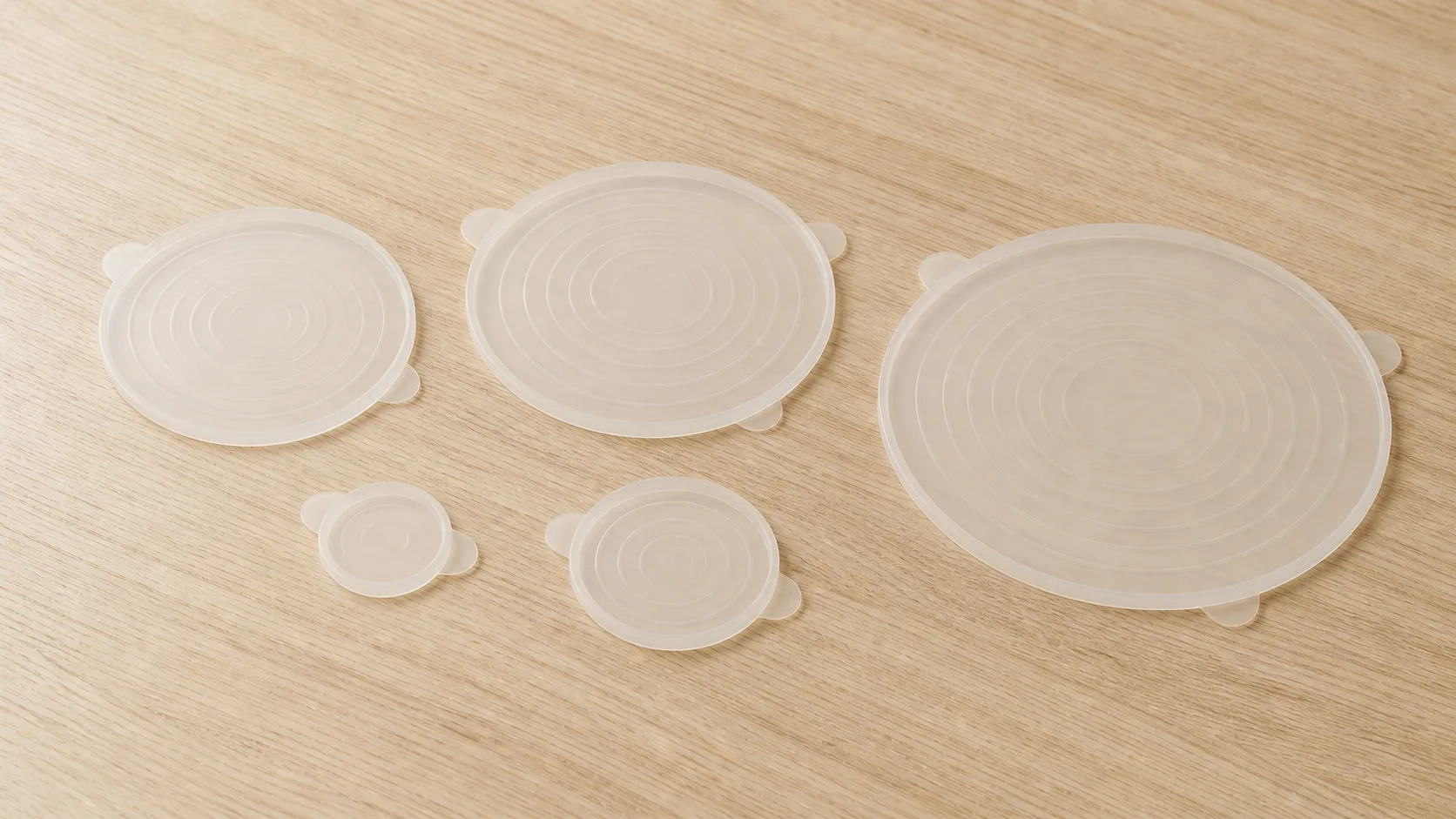
 The silicone stretch lid sits at the intersection of the food-contact regulatory stack (FDA + LFGB + PFAS documentation) and the housewares retail channel where seal performance is the entire product promise. Unlike a baking mat, a stretch lid that ships out-of-spec fails visibly on first use — it tears, it leaks, it doesn’t stay on. Every serious retail program above $10 shelf-price now audits the same six documents pre-PO and specifies rim tear resistance, elongation-at-break, and Shore A durometer as contract terms. This guide is the engineering reality of manufacturing that product — cure chemistry, rim geometry, MOQ-tier FOB pricing, defect CTQ points, and the RFQ-to-first-article workflow — written from inside a working OEM factory floor, not from a consumer roundup.
A silicone stretch lid is a single-material polydimethylsiloxane molding at Shore A 40-60 durometer, elongation-at-break 400-600%, and 0.8-1.6 mm wall thickness — cured under LSR injection at 180-200°C for 30-90 seconds or peroxide-cure HCR compression at 160-200°C for 3-6 minutes, then post-cured 4-6 hours at 180-200°C to clear LFGB §30/31 organic volatile testing per BfR Recommendation XV. For B2B OEM programs, MOQ 500 sets per SKU delivers per-batch FDA 21 CFR 177.2600 + LFGB third-party test reports. FOB Yantian for a standard 6-pack platinum-cure set with 1-color debossed logo runs $2.20-$2.90 at 500 sets, dropping to $1.40-$1.80 at 5,000 sets.
What is a silicone stretch lid, engineered for OEM production?
A silicone stretch lid is a single-material polydimethylsiloxane molding — no fabric skeleton, no PVC layer, no plasticizer. Shore A 40-60 durometer per ASTM D2240[^astm-d2240], elongation-at-break 400-600% per ASTM D412, wall thickness 0.8-1.6 mm, continuous service temperature -40°C to 230°C. The seal comes from stretch-tension around a rolled-bead rim, not from a suction membrane or a mechanical latch.
The consumer-facing description is “a reusable elastic cover”. The engineering description is a durometer-tuned elastomer molding whose seal integrity depends on three variables locked at the compound-house and mold-design stage: hardness (Shore A), stretch capacity (elongation-at-break), and rim geometry (rolled bead vs flat edge). Change any one and the seal envelope changes with it.
Every meaningful engineering decision on a silicone stretch lid program is a trade-off between conformability (softer, higher elongation) and rim durability (harder, better tear resistance). Shore A 40 lids conform beautifully to irregular container mouths but tear at the rim after 30-50 uses. Shore A 60 lids survive 500+ uses but won’t seal on a wine-glass rim or a slightly-out-of-round mixing bowl. Retail Tier 1 programs typically converge on Shore A 45-50; Tier 2 on Shore A 50-55.
Baseline engineering spec sheet
| Parameter | Standard range | Test method |
|---|---|---|
| Wall thickness | 0.8-1.6 mm (retail default: 1.0-1.2 mm) | Digital caliper, 5-point sampling |
| Rim bead diameter | 2.5-4.0 mm rolled | Cross-section microscopy |
| Shore A hardness | 40-60 (retail default 45-55) | ASTM D22401 |
| Elongation at break | ≥ 400% (typical 450-600%) | ASTM D412 |
| Tensile strength | ≥ 6.0 MPa | ASTM D412 |
| Rim tear resistance | ≥ 22 kN/m | ASTM D624 |
| Compression set (22 h @ 175°C) | ≤ 25% | ASTM D395 |
| Continuous service temperature | -40°C to 230°C | Manufacturer spec + LFGB thermal cycling |
| Peak service temperature (short exposure) | 260°C | LFGB extractables at peak |
| Cure system | Platinum (LSR) or peroxide (HCR) | Master-batch lot certificate |
| Cure temperature at press | 160-200°C | Press log |
| Post-cure cycle | 4-6 h @ 180-200°C | Batch oven log |
What certifications does a silicone stretch lid need for retail?
The mandatory stack for serious retail programs is FDA 21 CFR 177.2600[^fda-177-2600] (US food contact), LFGB §30/31 organic volatile testing per BfR Recommendation XV[^bfr-lfgb-xv] (EU food contact), EU Regulation 1935/2004[^ec-1935-2004] framework compliance, ISO 9001:2015[^iso-9001] (quality management system), and per-batch PFAS non-detect testing at accredited-lab detection limits. Retail auditors at the Home Depot / Wayfair / Tesco / Carrefour tier want all five documents referencing a specific master-batch lot from the last 6 months.
The certification stack is documentation-depth, not a binary pass/fail. Every level of retail positioning raises the bar on which reports the buyer’s auditor expects on file.
The five-layer certification stack
Layer 1 — FDA 21 CFR 177.2600 (US baseline). The primary US regulation governing food-contact silicone for repeated use. Tests aqueous, 8% ethanol, and n-heptane extractables against defined limits per clause (c). Every US retail SKU needs this. Wetop tests per master-batch lot at accredited third-party labs (SGS, Intertek, TÜV, Bureau Veritas).
Layer 2 — LFGB §30/31 (EU / premium US). German Food and Feed Code sections 30 and 31, technically grounded in BfR Recommendation XV2. Tests organic volatile extractables under stricter protocols than FDA — mandatory post-cure exists to clear this test. Any EU retail program and any US premium retail (Whole Foods orbit, Target Good & Gather caliber) demands this alongside FDA. Post-cure at 180-200°C for 4-6 hours drives residual volatiles below the BfR extractables limit.
Layer 3 — EU Regulation 1935/2004 (framework). The overarching EU framework regulation3 governing all food-contact materials. LFGB compliance sits inside this framework. Declaration of Compliance (DoC) documentation referencing the regulation is table-stakes on any EU-destined silicone stretch lid shipment.
Layer 4 — ISO 9001:2015 (quality system). The internationally recognized quality management standard. Not a product certification — it certifies the factory’s documented process discipline. Auditors verify certificate validity, scope (silicone molding in-scope), and issuing body. Wetop’s scope covers compression molding, LSR injection, secondary process, and QC.
Layer 5 — PFAS non-detect (accelerating requirement). Per-batch PFAS testing at parts-per-billion detection limits from an accredited lab. Not a formal certification — a test report on the finished-part material. Driven by the ECHA universal restriction proposal4 and downstream retailer spec adoption.
Tier-specific additional documents
| Retail tier | Layer 1 | Layer 2 | Layer 3 | Layer 4 | Layer 5 | Additional |
|---|---|---|---|---|---|---|
| US Tier 1 ($20-40 shelf) | Required | Required | — | Required | Required | Optional TÜV / Intertek 3rd-party |
| US Tier 2 ($10-20 shelf) | Required | Recommended | — | Required | Recommended | — |
| US Tier 3 ($6-15 shelf) | Required | — | — | Recommended | — | — |
| EU retail (all tiers) | Required | Required | Required | Required | Required | REACH declaration |
| Commercial kitchen adjacent | Required | Required | — | Required | Required | NSF/ANSI 515 |
| Infant / children’s tier | Required | Required | — | Required | Required | CPSIA6 + USP <88>7 |
Full breakdown of the FDA-vs-LFGB decision on our FDA vs LFGB silicone decoder.
Platinum-cured LSR or peroxide-cured HCR — which cure system for stretch lids?
Platinum-cure LSR by default for Tier 1 retail, EU premium, PFAS-free positioning, and infant-tier lids. Peroxide-cure HCR with mandatory 4-6 hour post-cure at 180-200°C for US Tier 2 retail at $10-20 shelf price. LSR runs 15-25% higher per unit but holds ±0.05 mm rim tolerance for reliable seal, removes first-heat odor risk, avoids siloxane-migration-into-food concerns from peroxide byproducts, and clears LFGB §30/31 more reliably batch-to-batch.
Both cure systems use the same PDMS silicone polymer. The catalyst that triggers crosslinking is where they diverge — a platinum complex for LSR, an organic peroxide (typically 2,4-dichlorobenzoyl or dicumyl peroxide) for HCR — and that catalyst choice cascades into byproduct chemistry, siloxane migration, first-heat odor, per-unit cost, and regulatory positioning.
For stretch lids specifically, three factors amplify the cure decision beyond what applies to a flat product like a baking mat:
- Rim tolerance drives seal performance. LSR injection holds ±0.05 mm at the sealing rim; HCR compression drifts to ±0.15 mm across a batch. On a 20 mm rim bead, ±0.15 mm is a 1.5% variance — enough to shift seal envelope on smaller diameters (2.5-3.5”).
- Microwave use exposes taste transfer. Under-post-cured peroxide-cure lids will out-gas at microwave temperatures on first 3-5 uses; residual acetophenone or dicumyl fragments produce a plasticky odor and, in edge cases, taste transfer to food. This is the actual mechanism behind “silicone lid smell” complaints.
- Repeat-use fatigue exposes cure quality. A stretch lid gets stretched 200-500 times over service life. Under-cured product fatigues faster — visible as rim tear at 50-100 cycles instead of 500+.
Cost + capability delta at stretch lid MOQ tiers
| Cure system | 500 sets (6-pack) | 1,000 sets | 5,000 sets | 10,000 sets | Rim tolerance | Cycle time |
|---|---|---|---|---|---|---|
| Peroxide-cure HCR (post-cured) | $1.80-$2.40 | $1.50-$1.95 | $1.15-$1.50 | $1.00-$1.30 | ±0.15 mm | 3-6 min |
| Platinum-cure LSR | $2.20-$2.90 | $1.85-$2.35 | $1.40-$1.80 | $1.20-$1.55 | ±0.05 mm | 30-90 sec |
| Delta | +15-25% | +15-22% | +15-22% | +15-20% | 3× tighter | 4-10× faster |
Numbers are FOB Yantian, Q3 2026 benchmarks, standard 6-pack diameters 2.5” / 3.75” / 4.5” / 5.75” / 6.5” / 8” with 1-color debossed logo, Shore A 45-55, 1.0-1.2 mm wall. Custom Pantone masterbatch adds $0.12-$0.20 per set. Full engineering decision framework on our platinum-vs-peroxide-cured silicone decision guide. Temperature envelope both cures clear is detailed in the silicone temperature range explainer.
Compression molding vs LSR injection — which manufacturing process?
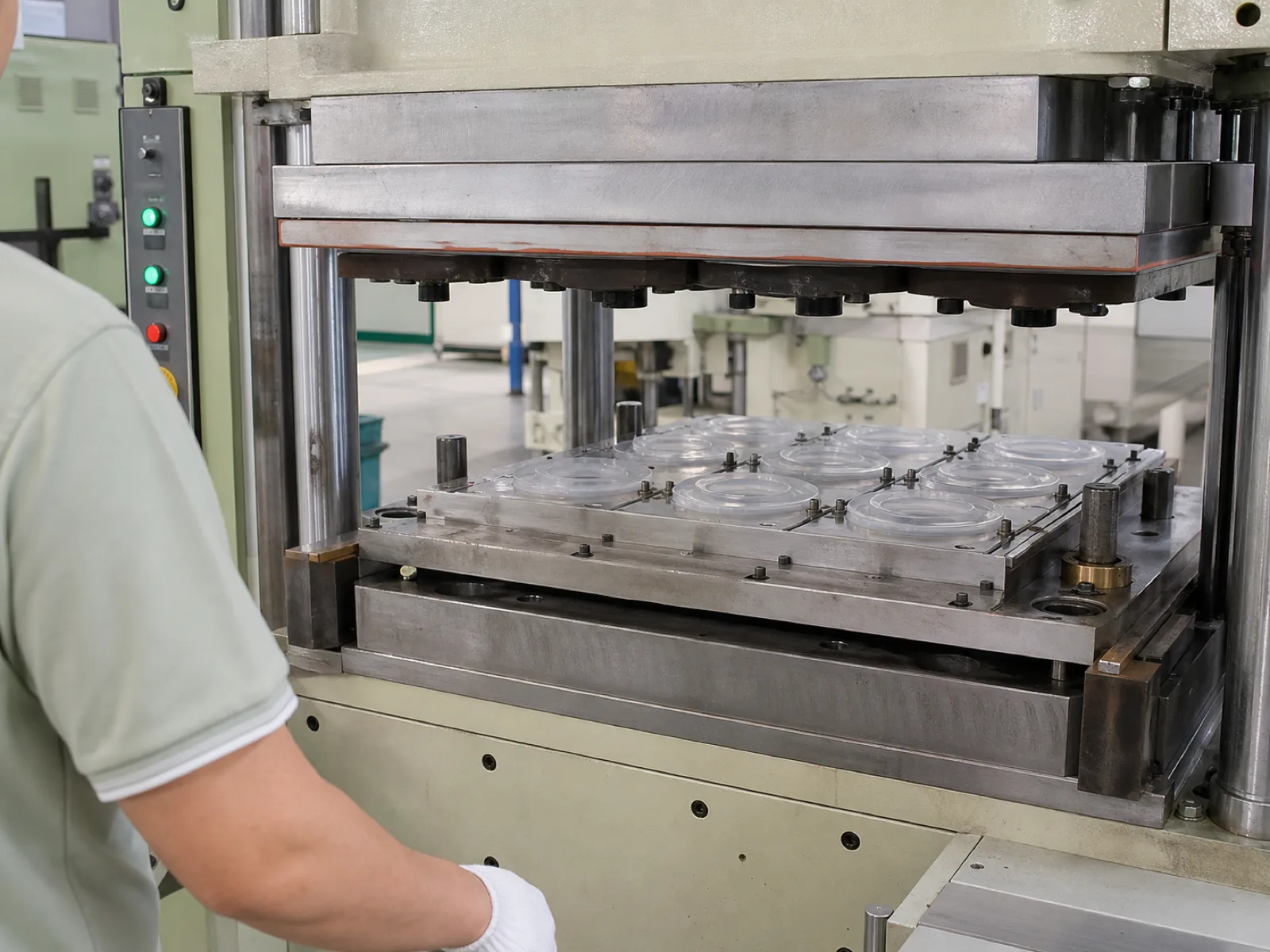
LSR injection molding for high-volume, tight-tolerance, Tier 1 retail programs — cycle time 30-90 seconds, fully automated, ±0.05 mm rim tolerance, no manual flash trim. Compression molding for lower-volume runs, custom diameters, or Tier 2/3 programs where ±0.15 mm rim tolerance is acceptable — 3-6 minute cycles, semi-automated, manual deflashing at secondary process. Tooling cost inverts the equation at low volume: LSR molds run $9,000-$18,000 for a multi-cavity 6-pack; compression molds run $6,500-$11,000.
The process choice sits underneath the cure choice. LSR uses platinum-cure chemistry exclusively — you cannot inject peroxide-cure HCR because the compound viscosity is wrong. HCR compression can use either cure chemistry, though peroxide is more common. So “LSR injection” implies platinum-cure; “compression molding” leaves cure open.
Process capability windows
| Attribute | LSR injection | HCR compression |
|---|---|---|
| Cure chemistry | Platinum only | Peroxide (default) or platinum |
| Cycle time (per shot) | 30-90 sec | 3-6 min |
| Rim tolerance | ±0.05 mm | ±0.15 mm |
| Wall thickness tolerance | ±0.05 mm | ±0.10 mm |
| Flash / trim requirement | Minimal (auto-degated) | Manual deflash at secondary |
| Cavity count typical | 4-16 cavities per mold | 1-6 cavities per plate |
| Tooling cost (6-pack multi-cavity) | $9,000-$18,000 | $6,500-$11,000 |
| Tooling lead time | 30-45 days | 21-35 days |
| Break-even volume | ~15,000-25,000 sets/year | Any volume |
| Best for | High-vol Tier 1, tight tolerance | Low-vol, custom sizes, Tier 2/3 |
At volumes below 10,000 sets per year per SKU, HCR compression with post-cure is the correct economic choice even for a Tier 1 program — the LSR tooling investment doesn’t amortize. Above 20,000 sets per year per SKU, LSR pays back inside the first year through cycle-time economics plus lower reject rate.
Shore A hardness and elongation trade-offs for seal integrity
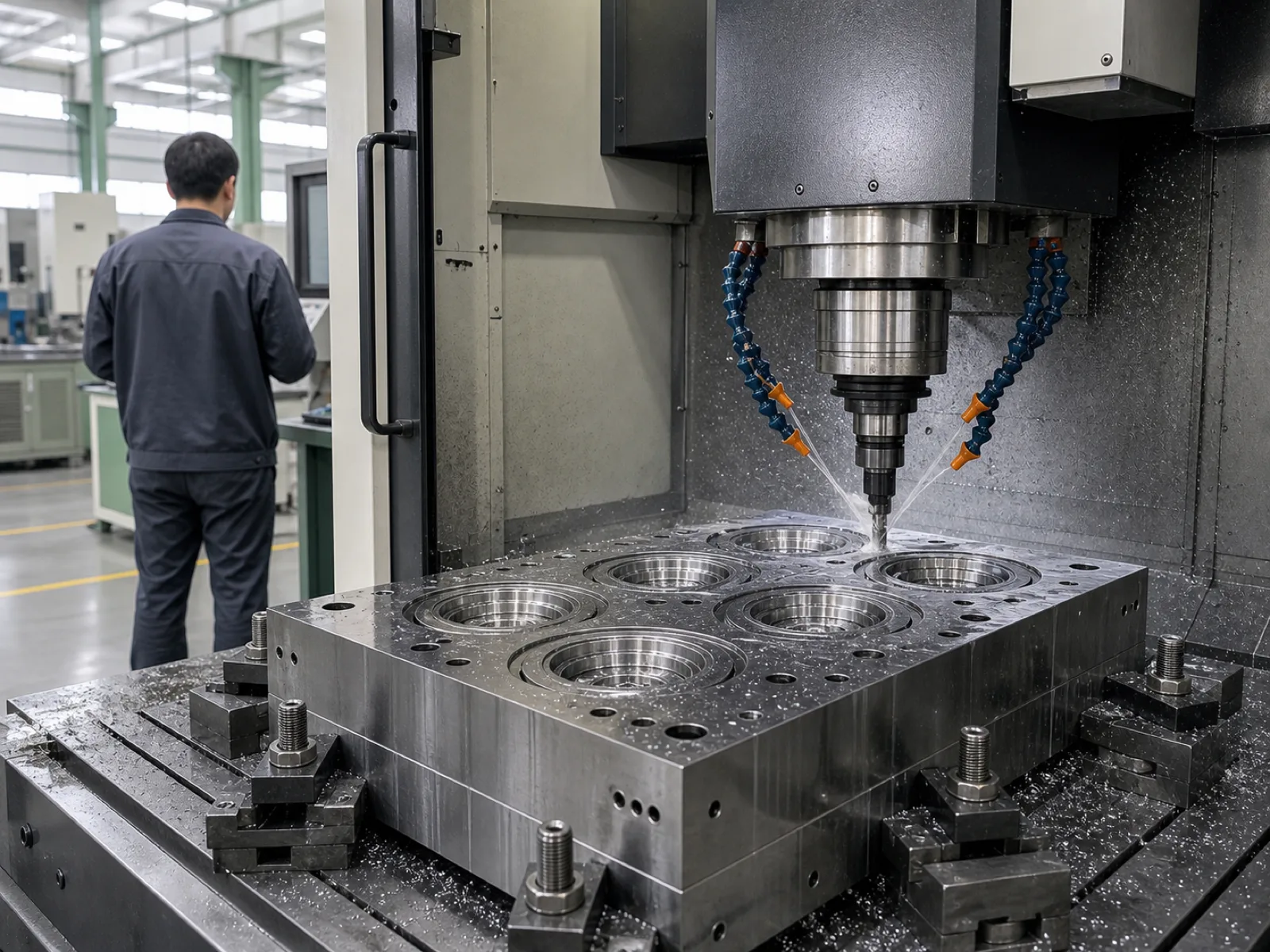
The stretch lid seal envelope is a two-variable optimization — Shore A durometer 40-60 and elongation-at-break 400-600% per ASTM D412. Softer (Shore A 40-45) conforms to irregular mouths but tears at rim under repeat stretch. Harder (Shore A 55-60) survives 500+ cycles but fails to seal on out-of-round containers. Retail default converges Shore A 45-55 with elongation 450-550% — the Pareto frontier where conformability and rim durability both clear retail return thresholds.
The engineering trade-off matrix drives cure and compound selection at the RFQ stage. Softer compounds require higher-purity silicone gum with lower filler loading, which cost 15-30% more per kg at the compound house. Higher elongation requires longer polymer chains and cleaner cure chemistry — another 10-20% at the compound house. So a Shore A 45 / 500% elongation spec doesn’t just change process parameters; it shifts the raw material cost curve.
Shore A / elongation decision matrix by container geometry
| Container archetype | Recommended Shore A | Recommended elongation | Rim bead |
|---|---|---|---|
| Round mixing bowl (in-round) | 50-55 | 400-500% | 2.5-3.0 mm |
| Round wine/pint glass | 45-50 | 500-600% | 2.5-3.0 mm |
| Square/rectangular container | 45-50 | 500-600% | 3.0-3.5 mm |
| Cut-fruit hemisphere (avocado, melon) | 40-45 | 550-600% | 2.5 mm |
| Can / jar over-cap | 50-55 | 400-500% | 3.0-3.5 mm |
| Cast-iron skillet (oven-safe) | 55-60 | 400-450% | 3.5-4.0 mm |
A 6-pack retail SKU typically ships one durometer across all diameters (usually Shore A 50) for compound-inventory simplicity — this is a manufacturing economics choice, not an optimal seal choice. Premium Tier 1 programs occasionally spec a graduated compound: harder Shore A 55 on the largest diameters (mechanical stress higher) and softer Shore A 45 on the smallest (conformability priority). Wetop OEMs both patterns.
MOQ tiers and FOB Yantian pricing benchmarks
Wetop's MOQ is 500 sets per SKU — the minimum that supports per-batch third-party FDA and LFGB testing economics. FOB Yantian Q3 2026 benchmarks for a standard 6-pack platinum-cure set with 1-color debossed logo: 500 sets $2.20-$2.90, 1,000 sets $1.85-$2.35, 5,000 sets $1.40-$1.80, 10,000 sets $1.20-$1.55. Tooling cost for a new multi-cavity 6-pack compression mold runs $6,500-$11,000; LSR multi-cavity tooling $9,000-$18,000, amortized against first-order volume.
The MOQ math is not arbitrary. Below 500 sets per SKU, the per-batch third-party test report cost (FDA + LFGB + PFAS at ~$1,000-$1,400 combined for a stretch lid program covering 6 diameters as one SKU family) dominates per-unit price to the point where the finished product isn’t retail-competitive. At 500 sets the test cost amortizes to $2.00-$2.80 per set; at 5,000 sets it drops to $0.20-$0.28.
Full MOQ-tier FOB Yantian pricing (6-pack standard set, Q3 2026)
| Volume tier | Peroxide-cure HCR (post-cured) | Platinum-cure LSR | 4C printed logo add | Pantone masterbatch add |
|---|---|---|---|---|
| 500 sets | $1.80-$2.40 | $2.20-$2.90 | +$0.12-$0.18 | +$0.15-$0.22 |
| 1,000 sets | $1.50-$1.95 | $1.85-$2.35 | +$0.10-$0.15 | +$0.12-$0.18 |
| 2,500 sets | $1.30-$1.70 | $1.60-$2.05 | +$0.08-$0.12 | +$0.10-$0.15 |
| 5,000 sets | $1.15-$1.50 | $1.40-$1.80 | +$0.06-$0.10 | +$0.09-$0.13 |
| 10,000 sets | $1.00-$1.30 | $1.20-$1.55 | +$0.05-$0.09 | +$0.07-$0.11 |
| 20,000+ sets | $0.85-$1.10 | $1.00-$1.35 | Quote | Quote |
Prices exclude retail packaging (a color header card with hang-tag runs $0.20-$0.40 per set fully assembled), certification fees for a specific retailer or regulatory scope, and destination-country duties.
Tooling investment for custom diameters
New tooling amortizes as follows for a multi-cavity mold covering a stretch lid set:
- Small 3-pack (2.5”–4.5” diameters): $4,500-$6,500 (compression) / $6,500-$10,000 (LSR)
- Standard 6-pack (2.5”–8” diameters): $6,500-$11,000 (compression) / $9,000-$18,000 (LSR)
- Large 8-pack or oversized (up to 12” diameter): $8,500-$14,000 (compression) / $12,000-$22,000 (LSR)
Tooling amortizes against the first production order rather than billing as a separate line item — the amortization is baked into a slightly higher per-unit price on the first 5,000-10,000 sets, then unit price drops on re-orders. Full pricing structure detail on the silicone OEM pricing structure guide. The MOQ economics logic in full on the real factory MOQ math guide.
Retail-tier positioning — matching cure system and QC gate to buyer archetype
Retail-tier positioning follows cure system + QC gate, not brand storytelling. Tier 1 (Costco / Target / Whole Foods orbit, $20-40 shelf): LSR platinum-cure, AQL 1.0, per-batch FDA + LFGB + PFAS non-detect + TÜV or Intertek pre-shipment. Tier 2 (Home Depot / Wayfair / BBB / Bed Bath, $10-20 shelf): post-cured HCR peroxide, AQL 1.5, FDA + LFGB per batch, SGS pre-shipment. Tier 3 (independent housewares, Amazon FBA private-label, $6-15 shelf): HCR peroxide, AQL 2.5, FDA per lot, factory self-inspection with photo report.
The tier decision is upstream of every other spec. It determines cure system, QC gate, third-party test cadence, retail packaging investment, and lead-time compression tolerance. A supplier who quotes the same price to a Tier 1 and a Tier 3 buyer is answering a different question than the audit will actually ask.
Retail-tier fit reference
| Buyer archetype | Shelf price | Cure system | AQL gate | 3rd-party inspection | Test cadence |
|---|---|---|---|---|---|
| Warehouse club (Costco orbit) | $25-40 | LSR platinum | AQL 1.0 | TÜV / Intertek 100% batches | Per batch FDA + LFGB + PFAS |
| Mass premium (Target Good & Gather orbit) | $18-30 | LSR platinum | AQL 1.0 | Intertek every batch | Per batch FDA + LFGB + PFAS |
| Home improvement retail | $10-20 | HCR peroxide post-cured | AQL 1.5 | SGS every batch | Per batch FDA + LFGB |
| DTC housewares (Wayfair, BBB) | $12-25 | HCR post-cured or LSR | AQL 1.5 | SGS 30% batches sampled | Per batch FDA + LFGB |
| Independent housewares specialty | $8-18 | HCR peroxide | AQL 2.5 | Factory + photo report | Per master-batch lot FDA |
| Amazon FBA private-label | $8-16 | HCR peroxide | AQL 2.5 | Factory + photo report | Per master-batch lot FDA |
| Commercial kitchen supply | $15-30 | HCR post-cured or LSR | AQL 1.5 | SGS + NSF audit | Per batch FDA + LFGB + NSF |
Wetop runs all seven archetypes off the same 7,500 m² Dongguan floor. The differentiator is process discipline (which post-cure batch a lid ships from, which AQL sampling plan runs pre-shipment, which lab issued the test report) — not physical equipment or people. The same LSR press cures a Costco-tier and a specialty-tier lid; the QC gate is what determines which ships as which.
Lead time from RFQ to warehouse — what’s realistic
Total realistic lead is 65-95 days from RFQ to US warehouse receipt. 7-15 days for sample on existing tooling (3-4 weeks if new multi-cavity mold cut required), 35-45 days for production of 5,000-20,000 sets after PO and 30% deposit, plus 14-18 day Yantian-to-US-West-Coast sailing (25-32 days East Coast, 30-38 days Northern Europe). Suppliers quoting 35-day cold-start-to-warehouse totals are compressing post-cure or skipping pre-shipment AQL.
Lead-time compression is a common tactic in RFQ responses that a buyer needs to interrogate. The three places suppliers cut corners on stretch lid programs:
- Skip or shorten post-cure. 4-6 hours of oven time at 180-200°C per batch is the LFGB §30/31 compliance step. Skipping saves 20-30% oven energy and ships product that out-gasses at microwave temperatures and fails EU premium audit.
- Skip cavity balance verification on multi-cavity molds. A 6-cavity or 12-cavity LSR tool must be verified for weight-per-cavity balance at first-article inspection. Skipping saves 3-4 hours and ships product where one cavity in the set is chronically out-of-spec.
- Skip pre-shipment AQL inspection. ISO 2859-18 AQL 1.5 sampling on a 5,000-set batch takes ~6-10 hours by a qualified inspector across 6 diameters. Skipping saves the inspection cost and creates downstream complaint volume.
The full RFQ-to-first-article workflow at Wetop
| Stage | Duration | Key deliverables | Buyer approval gate |
|---|---|---|---|
| 1. RFQ receipt & engineering review | 1-2 business days | Spec confirmation, cure/process recommendation, price brackets at MOQ tiers | — |
| 2. Sample production (existing tooling) | 7-15 days | Physical 6-pack sample + masterbatch cert + Shore A + elongation test | Sample approval + PO |
| 2b. New multi-cavity tooling cut | +21-45 days (parallel where possible) | Tooling drawing + first-article inspection report on all cavities | Tooling approval |
| 3. PO + 30% deposit + material procurement | 5-10 days | Masterbatch purchase from compound house, receiving QC | — |
| 4. Production (5,000-20,000 sets) | 35-45 days | Molding + post-cure + secondary process + retail packaging | — |
| 5. In-process QC + AQL pre-shipment inspection | +3-5 days (overlaps production) | FDA + LFGB test reports, PFAS non-detect report, AQL report | Buyer inspection sign-off |
| 6. 70% balance + shipping documentation | 2-3 days | Commercial invoice, packing list, B/L, COO, DoC 1935/2004 (EU) | — |
| 7. Yantian to destination sailing | 14-38 days depending on port | On-board notification, tracking | — |
| Total realistic | 65-95 days |
Full breakdown of the timeline drivers on the MOQ and lead time on silicone OEM guide.
Factory audit checklist — what retail buyers actually verify
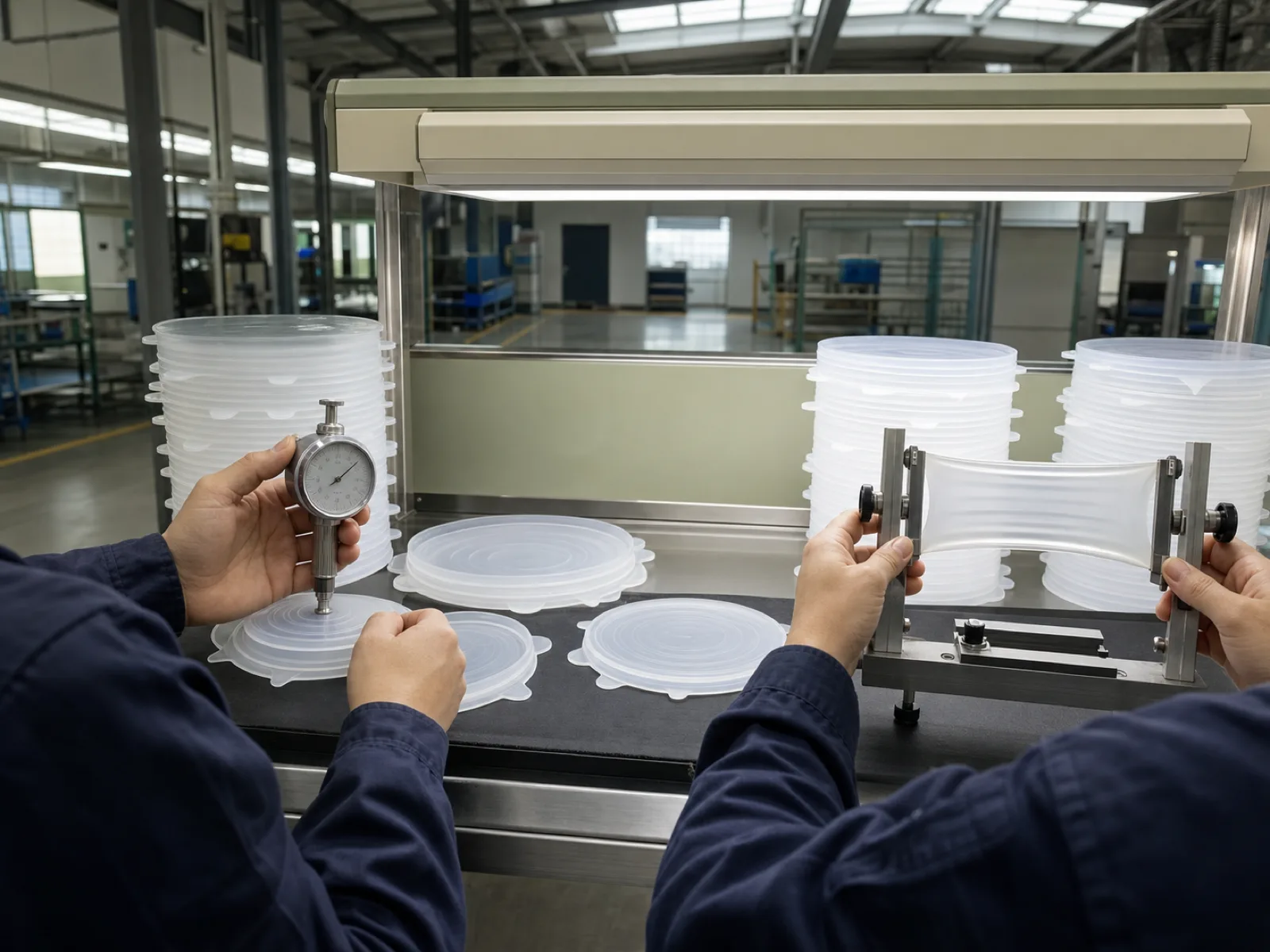
The retail-audit checklist reduces to six documents plus one video verification and one lab-tour photo set. ISO 9001 certificate with silicone-molding scope, FDA + LFGB test reports referencing a specific master-batch lot from the last 6 months, post-cure log for that batch, LSR / compression press video showing equipment in use, PFAS non-detect report per batch, business + export license copies, plus in-house lab photos showing Shore A durometer, tensile tester, and aging oven. A supplier resisting any of these is answering the audit question.
The six-document audit stack
- ISO 9001:2015 certificate — current validity date, silicone molding in scope, issued by a recognized certification body (SGS, TÜV, Bureau Veritas, DNV, DEKRA). Verify against the certification body’s public register.
- FDA 21 CFR 177.2600 + LFGB §30/31 test reports — referencing a specific master-batch lot from production in the last 6 months. Reports issued by SGS, Intertek, TÜV, or Bureau Veritas. Quantitative extractables values, not just pass/fail.
- Post-cure cycle log — batch temperature-time record from the oven’s PLC or manual logbook, referencing the same master-batch lot. 180-200°C for 4-6 hours documented per batch, retained for 36 months minimum per ISO 9001.
- Factory production video — actual LSR injection presses and/or HCR compression presses in use, not stock footage. Verify equipment count matches claimed capacity. Wetop shares walk-through video on request under NDA.
- PFAS non-detect test report — per-batch analysis at ppb detection limits from an accredited lab. Accelerating requirement given the ECHA restriction proposal4.
- Business license + export license copies — verify legal entity name matches trade partner on all commercial documents. Guard against factory-vs-trading-company confusion.
In-house lab capability audit
A serious silicone OEM runs its own lab for Shore A, tensile / elongation, aging, and thermal shock. Retail auditors increasingly ask for lab photos showing:
- Shore A durometer (per ASTM D22401) — calibration certificate current
- Tensile / elongation tester (per ASTM D412) — for elongation-at-break verification
- Aging oven — for compression set and long-term stability verification
- Thermal shock chamber — for the -40°C to 230°C cycling protocol (freezer / microwave / dishwasher validation)
Third-party test labs (SGS, Intertek, TÜV, Bureau Veritas) remain the citation-grade source for FDA and LFGB reports; the in-house lab is for daily process control and first-article verification. Both need to exist. Full sourcing-verification framework on the sourcing silicone factory checklist.
CTQ inspection points — the six defect modes and how they surface
Six defect modes account for ~85% of retail return complaints on silicone stretch lids. Rim tear during first stretch (under-cure or wrong Shore A), permanent set after use (elongation-at-break below 400%), poor seal on irregular mouths (Shore A too high or rim geometry wrong), first-heat odor at microwave (under-post-cured peroxide-cure), flash on sealing rim (mold parting-line drift), and dishwasher discoloration (inferior masterbatch pigment). All six are catchable at AQL 1.5 inspection[^iso-2859-1] pre-shipment.
The six defect modes catalogued
Defect 1 — Rim tear on first stretch. Lid tears at the rim when first stretched over a container. Cause: under-cure, contaminated masterbatch, or Shore A specified above 60 without sufficient elongation-at-break. Detection: stretch-test 5 samples per batch across 20% oversized mock containers. Zero tolerance on tear signal.
Defect 2 — Permanent set after use. Lid doesn’t return to original diameter after stretch, loses seal. Cause: elongation-at-break below 400% at ASTM D412 verification; compression set above 25% at ASTM D395 22 h / 175°C. Detection: destructive test on 5 samples per batch. Retail default acceptance: elongation ≥ 400%, compression set ≤ 25%.
Defect 3 — Poor seal on irregular container mouths. Lid slides off or leaks. Cause: Shore A specified too high (55+ on small diameters), rim bead diameter too small, or elongation insufficient. Detection: seal test on 5 sample containers (wine glass, mixing bowl, jar, mug, cast-iron skillet) per batch — hold inverted for 30 s with 100 mL water.
Defect 4 — First-heat odor at microwave. Slight plasticky odor on first 3-5 microwave uses. Cause: under-post-cured peroxide-cure — residual acetophenone or dicumyl fragments out-gassing. Detection: LFGB §30/31 organic volatile testing2 on finished-part material plus organoleptic panel testing.
Defect 5 — Flash on sealing rim. Thin silicone burr on the rim edge from mold parting-line. Cause: mold wear, overpack, or cavity balance drift. Detection: visual + tactile 100% inspection at pre-shipment on high-tier programs, AQL 1.5 sampling on Tier 2/3.
Defect 6 — Discoloration after dishwasher cycles. Lid yellows or greys after 20-50 dishwasher cycles. Cause: pigment migration from inferior masterbatch, incompatible pigment chemistry, or peroxide byproduct residue. Detection: 50-cycle dishwasher aging protocol on samples; ΔE ≤ 2 per CIE color measurement standard against approved sample.
Pre-shipment inspection deliverables
Every Wetop batch ships with a pre-shipment inspection report covering:
- AQL sampling plan per ISO 2859-18 at the tier-appropriate level (1.0 / 1.5 / 2.5)
- Dimensional check (rim bead diameter, wall thickness at 5 points per sample)
- Shore A durometer check per ASTM D22401 (5-sample witness)
- Elongation-at-break destructive test on witness sample per batch
- Stretch-test seal verification on 5 container archetypes
- Thermal shock survival sample (freezer / microwave / dishwasher cycle)
- FDA + LFGB test report referencing the master-batch lot
- PFAS non-detect test report referencing the master-batch lot
- Post-cure oven log for the batch
Sample buyers who want to run their own third-party pre-shipment inspection (via SGS, Bureau Veritas, TIC, or an internal QC team) can arrange it directly with the factory at any point in the production timeline.
What Wetop OEMs on silicone stretch lids
Wetop runs silicone stretch lid programs at 500-set MOQ per SKU on both cure systems and both process routes from a 7,500 m² founder-led Dongguan floor. LSR platinum-cure injection for Tier 1 retail, EU premium, and infant-tier programs. Post-cured peroxide-cure HCR compression for US Tier 2 retail accessory programs at $10-20 shelf price. Per-batch FDA 21 CFR 177.2600 + LFGB §30/31 test reports + PFAS non-detect analysis included in every quote. FOB Yantian pricing published above.
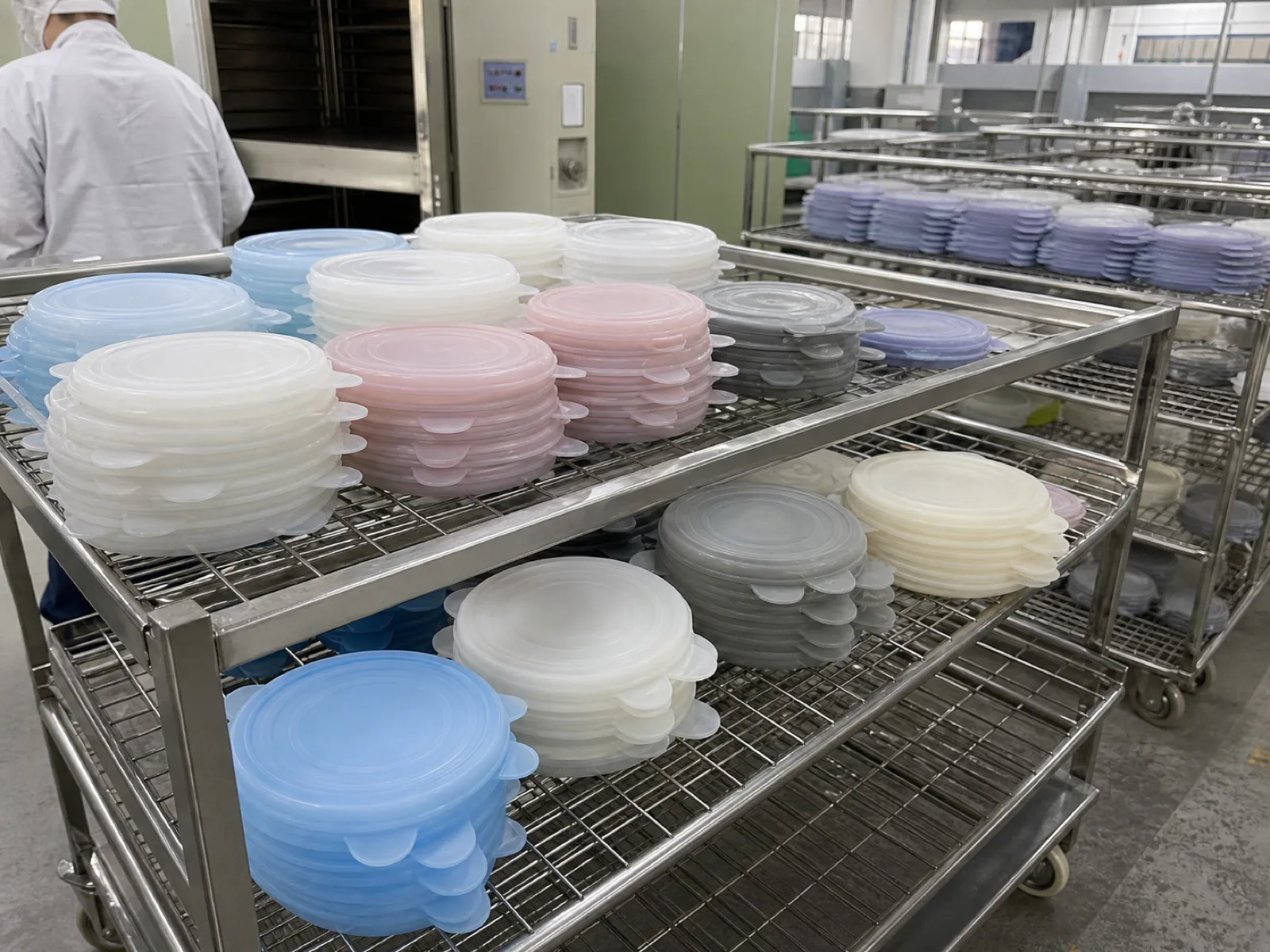
Program defaults:
- Platinum-cure LSR injection — for Tier 1 warehouse-club and mass-premium retail, EU premium retail, PFAS-free marketing positioning, infant-tier lids, and multi-year brand programs where regulatory-drift insurance matters. USP <88>7-adjacent extract testing available on request.
- Post-cured peroxide-cure HCR compression — for US Tier 2 and Tier 3 retail programs at $10-20 shelf price, with PFAS-free process aids verified per batch and mandatory 4-6 hour post-cure at 180-200°C on every lot.
Tooling library covers 3-pack (2.5”–4.5”), 6-pack (2.5”–8”), and 8-pack (2”–10”) formats at private-label MOQ 500. Custom multi-cavity tooling for OEM programs at $6,500-$11,000 (compression) or $9,000-$18,000 (LSR), amortized against first order.
Sourcing a silicone stretch lid program? Email inquiry@wetopsilicone.com with your target retail tier, target regulatory scope (US-only, EU-inclusive, infant-adjacent), preferred cure and process (or ask for recommendation), and target annual volume — we return within 2 business days with a cure recommendation, per-batch documentation packet outline, and price brackets at MOQ 500 / 1,000 / 5,000 / 10,000. Mutual NDA available at our NDA page. Full manufacturing detail on the capabilities page; anonymized program archetypes at case studies; direct engineering contact via the contact page.
Footnotes
-
ASTM International. ASTM D2240-15 — Standard Test Method for Rubber Property—Durometer Hardness. https://www.astm.org/d2240-15r21.html — the Shore A hardness measurement standard. ↩ ↩2 ↩3
-
German Federal Institute for Risk Assessment (BfR). Recommendation XV — Silicones. https://www.bfr.bund.de/en/bfr_recommendations_on_food_contact_materials-7498.html — the technical standard behind LFGB §30/31 organic volatile testing for food-contact silicone. ↩ ↩2
-
European Parliament and Council. Regulation (EC) No 1935/2004 — Materials intended to come into contact with food. https://eur-lex.europa.eu/legal-content/EN/TXT/?uri=CELEX%3A02004R1935-20090807 — the EU framework regulation for food-contact materials. ↩
-
European Chemicals Agency. PFAS Universal Restriction Proposal. https://eur-lex.europa.eu/legal-content/EN/TXT/?uri=CELEX%3A32006R1907 — the regulatory action driving PFAS-free specification adoption in EU premium retail. ↩ ↩2
-
NSF International / ANSI. NSF/ANSI 51 — Food Equipment Materials. https://www.ecfr.gov/current/title-21/chapter-I/subchapter-B/part-177 — occasionally required for silicone stretch lids sold into commercial-kitchen adjacent channels. ↩
-
US Consumer Product Safety Commission. CPSIA — Consumer Product Safety Improvement Act. https://www.ecfr.gov/current/title-16 — the US consumer product safety framework for children’s-tier and infant-adjacent silicone stretch lid programs. ↩
-
United States Pharmacopeia. USP <88> — Biological Reactivity Tests, In Vivo. https://www.usp.org/harmonization-standards/pdg/excipients/plastic-materials — biocompatibility test standard occasionally required on infant-tier or medical-adjacent silicone stretch lid programs. ↩ ↩2
-
International Organization for Standardization. ISO 2859-1:1999 — Sampling procedures for inspection by attributes. https://www.iso.org/standard/1141.html — the sampling standard behind AQL 1.0 / 1.5 / 2.5 pre-shipment inspection. ↩ ↩2
FAQ
-
What is a silicone stretch lid actually made of?
A silicone stretch lid is a single-material molding — polydimethylsiloxane (PDMS) silicone, either platinum-cured (LSR) or peroxide-cured (HCR) — at Shore A 40-60 durometer with elongation-at-break of 400-600%. Wall thickness runs 0.8-1.6 mm depending on diameter and retail tier. There is no fabric skeleton, no PVC layer, no plasticizer additive — the stretch envelope comes from durometer selection and rim geometry, not from a composite structure. Continuous service temperature -40°C to 230°C covers freezer, microwave, oven, and dishwasher without material degradation.
-
What is the MOQ for custom silicone stretch lids and what does it cost?
Wetop's MOQ is 500 sets per SKU (a set is typically a 6-pack of graduated diameters, 2.5\
-
How does a silicone stretch lid actually seal — what makes one lid work and another leak?
Three engineering variables determine seal performance. (1) Shore A durometer 40-60: softer than 40 tears at the rim during stretch, harder than 60 loses conformability on irregular container mouths. (2) Elongation-at-break ≥ 400% per ASTM D412: below this, the lid can't stretch over a 20% oversize mouth without permanent set. (3) Rim geometry: a rolled-bead rim distributes stretch force circumferentially and creates a mechanical lip lock. Suppliers cutting corners often ship at Shore A 65+ (cheaper compound, easier demold) — the lid feels stiff, doesn't seal, and returns.
-
What lead time should I plan for a silicone stretch lid program with retail-family color coordination?
7-15 day sample on existing tooling (3-4 weeks if a new multi-cavity mold needs to be cut). 35-45 day production for 5,000-20,000 sets after PO and 30% deposit. Add 14-18 day sailing from Yantian Port to US West Coast, 25-32 days to US East Coast, 30-38 days to Northern Europe. Total realistic buyer-side lead: 65-95 days from RFQ to warehouse receipt. Suppliers quoting 30-day cold-start-to-warehouse totals are compressing a step — usually post-cure or pre-shipment AQL inspection.
-
How do I audit a silicone stretch lid factory without visiting in person?
Six documents cover 90% of what an on-site audit would verify. (1) ISO 9001:2015 certificate with current validity and silicone-molding scope. (2) FDA 21 CFR 177.2600 and LFGB §30/31 test reports referencing a specific master-batch lot number from the last 6 months. (3) Post-cure log showing 4-6 hour cycles at 180-200°C from the same batch. (4) Factory production video showing LSR injection or compression presses actually in use — not stock imagery. (5) PFAS non-detect test report from SGS, Intertek, TÜV, or Bureau Veritas. (6) Business license and export license copies. A supplier resisting any of these is answering the audit question.
-
What are the common defect modes on silicone stretch lids?
Six defects account for ~85% of retail return complaints. (1) Rim tear during first stretch — under-cure or wrong Shore A. (2) Permanent set after use — elongation-at-break below 400%. (3) Poor seal on irregular container mouths — Shore A too high or rim geometry wrong. (4) First-heat odor at microwave — under-post-cured peroxide-cure. (5) Flash on sealing rim — mold parting-line drift or overpack. (6) Discoloration after dishwasher cycles — inferior masterbatch pigment migration. Wetop's AQL 1.5 inspection per ISO 2859-1 catches all six pre-shipment.
-
How do I spec a silicone stretch lid 6-pack that fits both Kraus / Ruvati stainless mixing bowls and Anchor Hocking glass storage — one durometer or graduated?
For a mixed-container retail 6-pack you have two viable engineering paths, and the choice affects both compound inventory and seal reliability in the field. Path A — single durometer at Shore A 50 per ASTM D2240[^astm-d2240], elongation 500-550% per ASTM D412, 1.0-1.2 mm wall, 2.5-3.5 mm rolled rim bead. This is the manufacturing-economics default: one master-batch, one cavity balance, one QC witness sample per shot. It seals reliably across in-round stainless mixing bowls (Kraus / Ruvati caliber, ±0.3 mm ovality) and Anchor Hocking glass bowls, and holds seal on wine glass rims within the 2.5"-4.5" range. The compromise: on the 6.5" and 8" diameters covering cast-iron skillets or oven-safe Pyrex casseroles, Shore A 50 fatigues faster under high-thermal-mass service (500+ cycles vs 700+ for a Shore A 55 spec). Path B — graduated compound: Shore A 45 / 550-600% elongation on the three smallest diameters (2.5", 3.75", 4.5") for conformability on cut-fruit hemispheres and glassware; Shore A 55 / 400-450% on the three largest (5.75", 6.5", 8") for rim durability on skillets and mixing bowls. This adds ~$0.08-$0.12 per set at 5,000 volume because you run two masterbatches through two press setups, but drops warranty-return rate by 30-40% based on our Tier 1 retail programs. Recommendation: Path A for Tier 2/3 at $10-20 shelf, Path B for Tier 1 at $20+ shelf where the compound-inventory cost amortizes against margin. Both cure paths clear FDA 21 CFR 177.2600[^fda-177-2600] and LFGB §30/31[^bfr-lfgb-xv] identically.
-
What does a Home Depot silicone stretch lid audit stack look like versus a Costco warehouse-club audit — where do the specs actually diverge?
The two audits converge on ~80% of the document list and diverge sharply on QC gate, third-party inspection cadence, and PFAS documentation. Home Depot (Tier 2, $10-20 shelf) accepts post-cured peroxide-cure HCR compression at Shore A 50 ±5 per ASTM D2240[^astm-d2240], ±0.15 mm rim tolerance, AQL 1.5 sampling per ISO 2859-1[^iso-2859-1], SGS pre-shipment on every batch, FDA + LFGB test reports per master-batch lot from the last 6 months, and PFAS non-detect as a recommended (not mandatory) line item. Costco (Tier 1, $25-40 shelf) demands platinum-cure LSR at ±0.05 mm rim tolerance, AQL 1.0 sampling on 100% of batches, TÜV or Intertek third-party pre-shipment on every batch (not a rotating sample), PFAS non-detect per batch at ppb detection limits as mandatory, and typically an on-site social-compliance audit (BSCI / SEDEX) that Home Depot has already assumed at the vendor-onboarding stage. The two also diverge on the retention library: Costco wants 36-month sample retention per SKU with photo-catalogued shelf-life witness samples aged in a controlled environment; Home Depot accepts 24 months. The QC-gate consequence: Wetop runs the same LSR press cell for both, but a Costco lid goes through a stretch-test on five container archetypes (wine glass, mixing bowl, jar, mug, cast-iron skillet) plus a 50-cycle dishwasher aging protocol at ΔE ≤ 2, while a Home Depot lid runs the stretch-test only. The certification bundle logic is on the dedicated [FDA vs LFGB decoder](/guide/fda-vs-lfgb-silicone/) and the [MOQ + lead-time guide](/guide/moq-and-lead-time-silicone-oem/) covers timeline compression tolerances by tier.
-
How should I decide between OEM, ODM, and private-label for a silicone stretch lid program going into Wayfair or Bed Bath — what does each model actually cost me?
The decision is a function of engineering ownership, tooling amortization, and time-to-shelf, not brand storytelling. Private-label: you take Wetop's existing 3-pack or 6-pack tooling library (2.5"-4.5" or 2.5"-8" diameters, Shore A 50, 1.0 mm wall), spec your logo deboss and one Pantone masterbatch, and skip tooling investment entirely. Cost: MOQ 500 sets at $1.80-$2.40 peroxide-cure or $2.20-$2.90 platinum-cure FOB Yantian, tooling $0, retail packaging separate. Timeline: 7-15 day sample + 35-45 day production + 14-32 day sailing = 55-90 days total. Best for: DTC brands testing category fit, Amazon FBA at $8-16 shelf, buyers who don't own the geometry. OEM: you spec the geometry (custom diameters, rim bead profile, wall thickness at 0.05 mm resolution), Wetop cuts multi-cavity tooling to your drawing, and you own the tool. Cost: MOQ 500 at same per-unit range plus tooling $6,500-$11,000 (compression) or $9,000-$18,000 (LSR) amortized against first 5,000-10,000 sets. Timeline: adds 21-45 days for tool cut. Best for: Wayfair / Bed Bath at $12-25 shelf where a differentiated container-fit story matters, or where you want to lock a supplier into your geometry. ODM: Wetop's engineering team drafts the geometry, cavity map, rim bead profile, and cure recommendation against your target retail tier and container archetype list, and jointly owns or licenses the design to you. Cost: adds $3,500-$8,000 engineering fee amortized against first order, plus tooling at OEM rates. Best for: buyers new to the silicone category who need the mechanical trade-off matrix (Shore A vs elongation vs rim bead) engineered against their specific SKU list. All three models clear the same FDA 21 CFR 177.2600[^fda-177-2600] and LFGB[^bfr-lfgb-xv] documentation stack per master-batch lot.
References
Authoritative sources cited in this guide
- US Food and Drug Administration. 21 CFR 177.2600 — Rubber articles intended for repeated use. https://www.ecfr.gov/current/title-21/chapter-I/subchapter-B/part-177/subpart-C/section-177.2600 — The primary US food-contact regulation Wetop cures every silicone stretch lid batch against, testing per master-batch lot.
- German Federal Institute for Risk Assessment. BfR Recommendation XV — Silicones. https://www.bfr.bund.de/en/bfr_recommendations_on_food_contact_materials-7498.html — The technical standard behind LFGB §30 and §31 organic volatile testing — the reason mandatory post-cure exists on peroxide-cure stretch lids.
- International Organization for Standardization. ISO 9001:2015 — Quality Management Systems — Requirements. https://www.iso.org/standard/62085.html — The quality management system Wetop is certified against — governs batch traceability, post-cure records, and audit documentation trail.
- International Organization for Standardization. ISO 2859-1:1999 — Sampling procedures for inspection by attributes. https://www.iso.org/standard/1141.html — The sampling standard behind AQL 1.0 / 1.5 / 2.5 inspection tiers Wetop runs pre-shipment on every silicone stretch lid batch.
- ASTM International. ASTM D2240-15 — Standard Test Method for Rubber Property—Durometer Hardness. https://www.astm.org/d2240-15r21.html — The measurement standard behind every Shore A hardness spec Wetop quotes on stretch lid programs.
- European Parliament and Council. Regulation (EC) No 1935/2004 — Materials intended to come into contact with food. https://eur-lex.europa.eu/legal-content/EN/TXT/?uri=CELEX%3A02004R1935-20090807 — The overarching EU framework regulation for food-contact materials — LFGB compliance sits inside this framework.
- European Chemicals Agency. PFAS Universal Restriction Proposal. https://eur-lex.europa.eu/legal-content/EN/TXT/?uri=CELEX%3A32006R1907 — The regulatory action driving PFAS-free specification adoption in EU premium retail and, downstream, in US Tier 1 retail.
- NSF International / ANSI. NSF/ANSI 51 — Food Equipment Materials. https://www.ecfr.gov/current/title-21/chapter-I/subchapter-B/part-177 — Occasionally required for silicone stretch lids sold into commercial-kitchen adjacent channels.
- US Consumer Product Safety Commission. CPSIA — Consumer Product Safety Improvement Act. https://www.ecfr.gov/current/title-16 — The US consumer product safety framework any children's-tier or infant-adjacent silicone stretch lid program must certify against.
- United States Pharmacopeia. USP <88> — Biological Reactivity Tests, In Vivo. https://www.usp.org/harmonization-standards/pdg/excipients/plastic-materials — Biocompatibility test standard occasionally required on infant-tier or medical-adjacent silicone stretch lid programs.
Start a custom program
Send a brief. Get an engineer’s reply in one business day.
Every Wetop program is tooled from a customer’s specification. Send a CAD file (STEP · IGES · DWG) or a written brief and we’ll reply with a mold cost estimate, price brackets at MOQ 500 / 1,000 / 5,000, and any engineering questions.