Manufacturing · commercial intent
Silicone LSR Injection Molding Guide — Process, Grades
What changed: First publication under v3 standard — benchmarked against Simtec, Xometry, ProMed, Protolabs, and Silicone Dynamics; rewritten with two-part platinum-cure chemistry detail, cold-runner tooling economics, USP Class VI grade selection for body-safe OEM programs, and an honest unit-cost model competitor pages do not disclose.
 Manufacturing
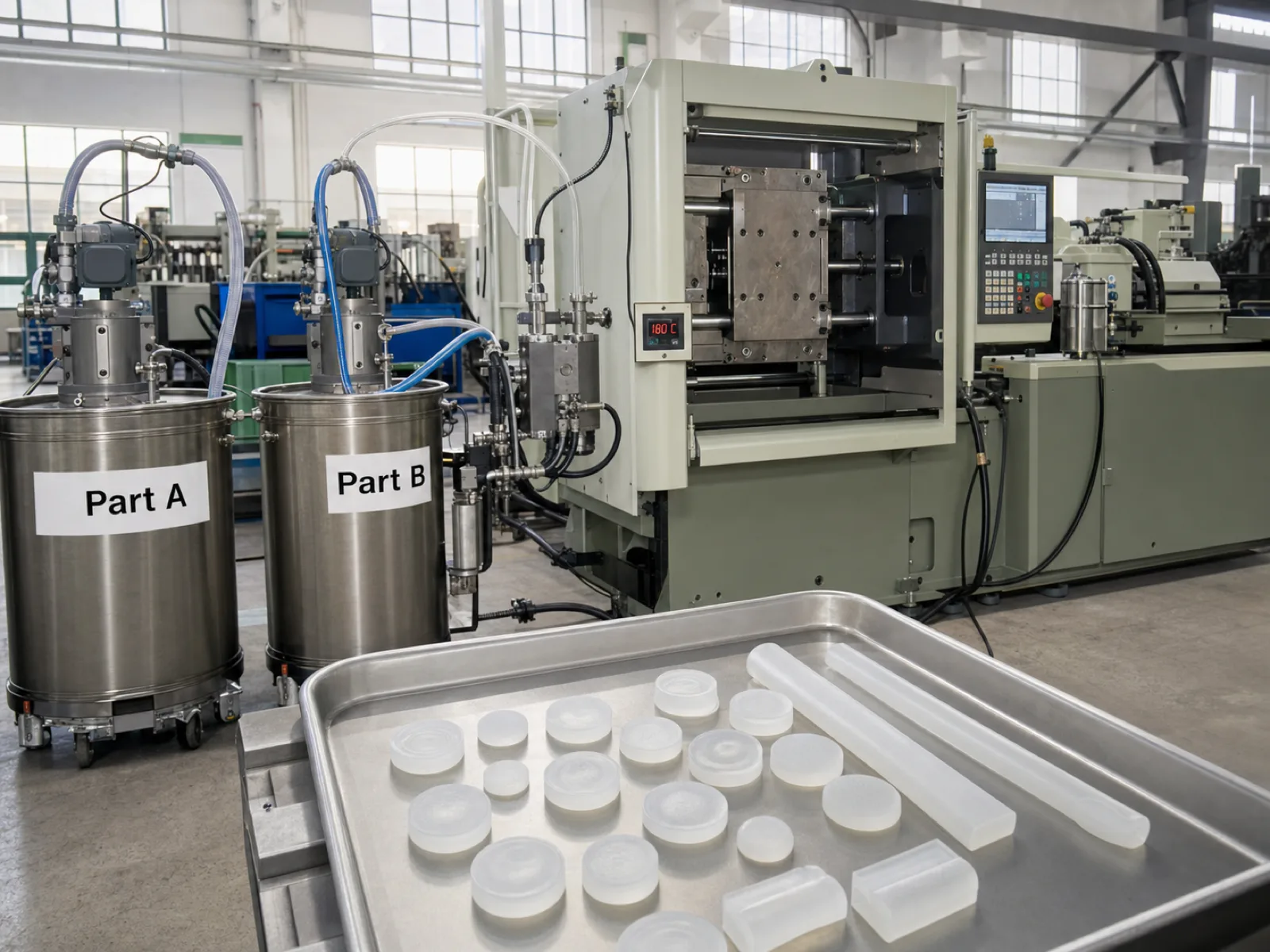
 Silicone LSR injection molding is a two-part platinum-cured process where Part A and Part B meter 1:1 through a static mixer into a chilled cold-runner block and inject into a mold heated to 160-210 °C for a 15-90 second cure — no peroxide by-products, no runner scrap, and cavitation counts of 32-128 that no compression molding process can reach. The correct specification for high-volume, thin-wall, tight-tolerance parts above 25,000 units per year — including medical device components, food-contact seals, and body-safe silicone products for intimate-wellness OEM programs — is platinum-cured LSR against a documented USP Class VI or FDA 21 CFR 177.2600 compound lot. Every serious first article ships with durometer per ASTM D2240, tensile per ASTM D412, tear per ASTM D624, and compression set per ASTM D395 measured against the RFQ spec — anything less is not an injection-molded LSR delivery.
Buyers land on “silicone LSR injection molding” from two directions. Product managers at customer brands who OEM body-safe silicone products, medical device houses, and consumer-electronics accessory teams arrive with a drawing, a target durometer, a compliance stack, and a unit-cost target — they need to know whether the factory can execute LSR at PPAP discipline. Sourcing managers and mechanical designers arrive earlier in the funnel and need to understand what LSR is, when it wins over HCR compression molding1, and what the honest tooling and unit-cost model looks like at their volume. This guide covers both. It is written from inside a Dongguan LSR cell benchmarked against FDA 21 CFR 177.26002, USP <88>3, and ISO 10993-54 — not against a marketing brochure.
What is silicone LSR injection molding, and what makes the chemistry unique?
Silicone LSR injection molding is a two-part platinum-cured process: Part A carries vinyl-terminated PDMS plus a platinum catalyst, Part B carries a hydride cross-linker plus a cure inhibitor. The two streams meter 1:1 through a static mixer into a chilled cold-runner block, then inject into a heated mold where addition-cure vulcanization completes in 15-90 seconds without by-products.
The chemistry sits on three pillars.
Two-part addition-cure system. Part A (vinyl-functional PDMS + Pt catalyst, typically Karstedt or Ashby-type) and Part B (methylhydrogen siloxane cross-linker + alkynol inhibitor) are held in separate drums at ambient temperature. The inhibitor buys pot-life at room temperature; heat above roughly 80 °C burns off the inhibitor and the Pt-catalyzed hydrosilylation reaction proceeds to full cure at 160-210 °C. No peroxide, no residual by-products, no odor — which is why LSR is the only defensible cure system for body-contact, medical, and food-contact molded parts. For the full cure-chemistry comparison see the platinum-cured vs peroxide-cured silicone guide.
Low viscosity liquid handling. Uncured LSR viscosity ranges 100-2,000 Pa·s at 25 °C — pumpable, mixable, injectable through 0.4-1.2 mm gates. This is what makes 32-128 cavity tooling possible and thin-wall 0.3 mm sections feasible. HCR gum stock at 10⁶-10⁷ Pa·s cannot be pumped and forces compression molding.
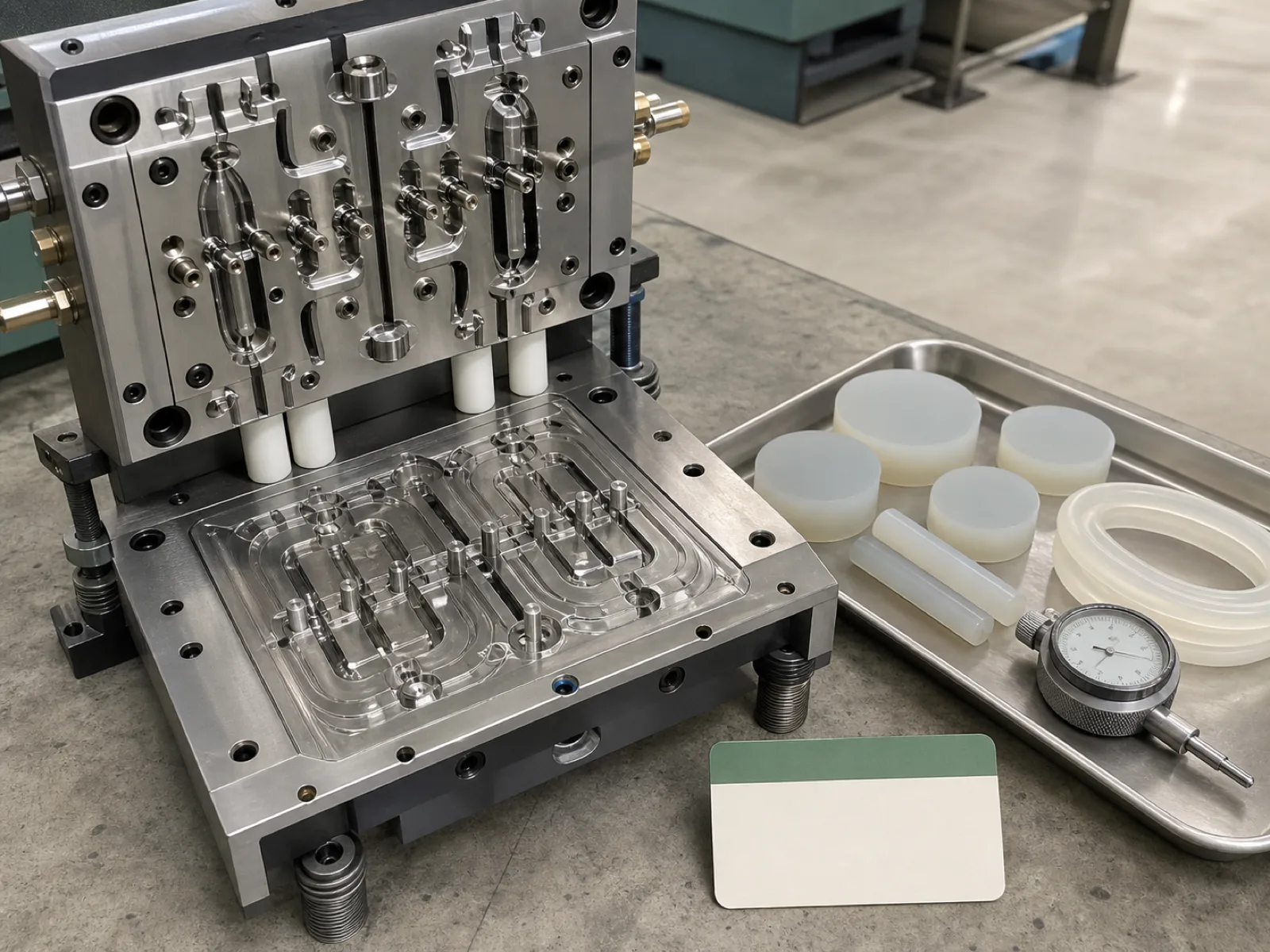
Cold-runner-mandatory tooling. Because heat starts the cure, the runner system must stay cold (10-25 °C) up to the gate. A conventional thermoplastic hot runner would cross-link the LSR in the manifold within a shot or two and lock up the mold. This is why LSR tooling costs 2-3x a comparable HCR compression mold — the cold-runner block, the heated cavity plate, and the thermal isolation between them are the price of entry. For the underlying material science of the liquid itself see what is liquid silicone rubber (LSR) explained.
What are the five phases of an LSR injection molding cycle?
Metering unloads Part A and Part B at 1:1 from 20-200 kg drums; static-mix combines both streams plus optional pigment into a chilled cold-runner block; injection pushes the shot through gates into a heated mold; cure completes at 160-210 °C in 15-90 seconds; demold releases the part, with an optional 4-hour post-cure at 200 °C for USP Class VI extractables reduction.
The cycle in engineering detail:
| Phase | Temperature | Time band | What is happening |
|---|---|---|---|
| 1. Drum metering | 20-25 °C | Continuous | Positive-displacement pumps meter Part A and Part B at 1:1 from drum unloaders; pigment master-batch dosed as a third stream at 0.5-2 wt%. |
| 2. Static mix + cold-runner | 10-25 °C | ~2-5 s | LSR passes through a 24-32 element static mixer into the cold-runner manifold held below cure onset. |
| 3. Injection + cure | 160-210 °C mold, chilled runner | 15-90 s | Servo-driven injection unit fills cavities through 0.4-1.2 mm gates; Pt-catalyzed hydrosilylation cures the part. |
| 4. Demold | Mold at cure temp | ~2-4 s | LSR self-releases from polished cavities; automation lifts the part off, or stripper plate ejects. |
| 5. Optional post-cure | 200 °C forced-air oven | 4 h | Drives residual volatiles below FDA 21 CFR 177.2600 and USP Class VI thresholds — required for medical and body-safe grades. |
Full-cycle time is 20-120 seconds depending on part mass and dominant wall thickness. Cure time scales at roughly 3-5 seconds per millimeter of wall at 180 °C — the correct engineering shortcut when quoting cycle to a customer. For a broader comparison of LSR against other molding routes see the silicone molding process explained.
LSR vs HCR vs TPE — when is silicone LSR injection molding the right specification?
LSR wins on high cavitation, tight tolerance, thin wall (0.3-3 mm), and volumes above 25,000 units per year. HCR compression molding wins below 5,000 units per year, at wall thickness above 10 mm, and where tooling capital is the binding constraint. TPE loses to silicone on temperature ceiling, compression set, and biocompatibility depth for any silicone-adjacent bid.
The decision matrix, honestly:
| Criterion | LSR injection | HCR compression | TPE injection |
|---|---|---|---|
| Cure chemistry | Platinum-cured, no by-products | Peroxide or platinum, post-cure often needed | Physically cross-linked thermoplastic |
| Viscosity | 100-2,000 Pa·s liquid | 10⁶-10⁷ Pa·s gum stock | Melt-processable |
| Cavitation | 8-128 typical | 1-16 typical | 4-64 typical |
| Wall thickness sweet spot | 0.3-3 mm | 2-15 mm | 0.5-5 mm |
| Cycle time (20 g part) | 20-60 s | 3-6 min | 15-45 s |
| Tooling cost | $8k-45k cold-runner | $3k-15k compression | $5k-25k hot-runner |
| Service temperature | −55 to +230 °C | −55 to +230 °C | −40 to +90 °C typical |
| Compression set (22 h / 175 °C) | 15-25% | 20-40% | 40-70% |
| USP Class VI eligible | Yes | Yes (platinum grades) | Grade-dependent |
| Volume crossover | > 25k/yr | < 5k/yr | Any, but loses on spec |
The single most useful takeaway: a buyer who is quoting HCR compression against an LSR RFQ, or LSR against a compression RFQ, is likely getting priced against the wrong process. Volume, wall, and tolerance drive the correct route — not the supplier’s convenience. Below MOQ break-even the compression route is the honest recommendation.
Why does LSR injection molding require a cold-runner mold, and what does that cost?
A cold-runner block keeps LSR below cure onset (10-25 °C) right up to the gate, eliminating 15-30% runner scrap per shot and preventing runner cross-link that would lock up a conventional mold. Cold-runner tooling costs 2-3x a compression tool — $8,000-45,000 vs $3,000-15,000 — with payback typically at 40,000-80,000 units on a 20 g platinum-cured LSR part.
Three cost lines shape the tooling call.
Cold-runner manifold. The block that carries LSR from the injection unit to the gates, actively cooled by a chilled-water loop, thermally isolated from the heated cavity plate by ceramic or PEEK spacers. Adds $6,000-18,000 to the tool depending on cavity count and gate style (open-shut, needle-valve, or thermal-gate). For high-value medical or body-safe programs the block is a servo-driven needle-valve design that eliminates gate vestige entirely.
Cavity steel and cavity finish. Hardened S136 (1.2083 / 4Cr13 stainless, 48-52 HRC) is the workhorse for LSR molds; 1.2344 (H13, 46-52 HRC) is the value alternative. Polish to SPI A-2 (Ra ≤ 0.05 μm) for medical or body-contact grades — cavity finish drives release, gloss, and extractable pickup at the part surface.
Self-venting and vacuum-assist. LSR flashes readily at cure temperature — vents at 0.005-0.02 mm on parting lines, vacuum-assist ($3,000-7,000 add-on) for parts with trapped-air risk (deep pockets, thin domes). Undersized vents drive short-shot, oversized vents drive flash — this is where second-tier LSR tool-makers lose money and cause customer scrap.
The payback math. On a 20 g platinum-cured LSR part with material at $18/kg, a hot-runner or open-runner mold spills 20% material as runner scrap = $0.072/shot. A cold runner spills near zero = savings of $0.072/shot × 60,000 shots = $4,320 material savings; at a $12,000 tool premium the crossover sits around 60,000-80,000 shots. Above that volume, cold runner is the correct capital call. Below, an open-runner cold-sprue design with hand-trim is defensible.
What LSR material grades matter, and how are they specified for body-safe OEM programs?
LSR grades are specified along four axes: cure system (platinum-cure mandatory), biocompatibility (USP Class VI + ISO 10993-5 + ISO 10993-10 on the actual pigmented compound lot), extractables/leachables (USP <661> or customer E&L panel), and pigment lockup (phthalate- and heavy-metal-free master-batches). Skin-safe LSR compounds from Elkem (Silbione), Wacker (Elastosil LR 3003), Dow (Silastic), and Momentive (Silopren) publish reference data.
The grade axes in specification order:
Cure system. Platinum-cured, addition-cure, on documented Elkem / Wacker / Dow / Momentive compound families. Peroxide-cure is disqualified — it is not LSR, and the residual by-products drive extractables failure on any USP Class VI panel.
Base compound and durometer. Standard bracket Shore A 30, 40, 50, 60, 70, 80. Body-safe intimate-wellness OEM programs typically spec 30-50 A for soft-touch surfaces, 60-80 A for structural cores. Optical-clear grades (transmission > 90% at 500 nm) available for lightguide or aesthetic applications; self-adhesive grades for two-shot LSR-to-thermoplastic overmold.
Biocompatibility stack. USP <87> cytotoxicity, USP <88> Class VI, ISO 10993-5 (cytotoxicity), ISO 10993-10 (irritation and sensitization) — all against the pigmented compound lot the part will actually run, not an unpigmented base. For prolonged tissue-contact or drug-delivery programs, add ISO 10993-11 (systemic toxicity) and ISO 10993-18 (chemical characterization).
Extractables and leachables. USP <661> polymer characterization on the base compound; customer-defined E&L panel on the finished part surface for intimate-wellness OEM programs — organic and inorganic extractable species, semi-quantitative to 1 ppm typical.
Pigment lockup. Phthalate- and heavy-metal-free (RoHS 3, REACH SVHC-free) pigment master-batches dosed at 0.5-2 wt%. The pigment master-batch itself must ship with a compliance packet — many failed USP Class VI panels trace not to the base LSR but to a cheaper pigment master introduced by a substitutable-BOM factory.
The buyer trap. Any supplier who quotes “medical grade LSR” or “body-safe LSR” without producing (a) an authorized-distribution letter from Elkem / Wacker / Dow / Momentive for the base compound, and (b) a USP Class VI + ISO 10993-5 test report against the pigmented lot inside 48 hours, is not qualified. For the general safety framework see is silicone safe — what buyers need to know.
What are the LSR wall-thickness, tolerance, and design rules for a moldable part?
Realistic LSR envelope: wall 0.3-10 mm, draft 0.5-2°, undercuts up to 30% of feature depth without side-actions (LSR self-releases), dimensional tolerance per ISO 3302-1 class M2 (±0.15 mm on nominal < 10 mm), gate diameter 0.4-1.2 mm sub-gate or tunnel, cavity finish SPI A-2 (Ra ≤ 0.05 μm) for medical or body-contact grades.
Design rules that the LSR floor actually enforces:
- Wall thickness 0.3-10 mm typical. Below 0.3 mm risks short-shot; above 10 mm center wall lags cure and traps air. Above 10 mm plan for a cure-time model or split the geometry.
- Uniform wall. Thick sections cure last and sink into the mating thin section — the classic LSR sink-mark defect. Rib design: rib base ≤ 60% of adjoining wall.
- Draft 0.5-2°. LSR self-releases, so draft is less critical than thermoplastic. Zero-draft is feasible on outer walls of soft grades (30-50 A).
- Undercuts up to 30% of feature depth without side-actions on soft grades — the elastomer stretches over the undercut on ejection.
- Gate diameter 0.4-1.2 mm for sub-gate or tunnel gates; edge gates on functional parts where a witness mark is acceptable.
- Tolerance per ISO 3302-1 class M2 (precision molding): ±0.15 mm on nominal < 10 mm, ±0.20 mm on 10-40 mm, ±0.3% above 40 mm. Class M1 (±0.10 mm on < 10 mm) is achievable with pull-through calibration and post-mold laser gauging at 15-25% yield loss.
- Parting line and flash. LSR flashes at cure temperature — self-venting via 0.005-0.02 mm vent slots. Flash-free parts require vacuum-assist tooling ($3-7k tool adder).
- Cavity finish SPI A-2 (Ra ≤ 0.05 μm) for medical and body-contact parts to control release and extractable pickup at the surface.
The default: give the tool engineer the CAD, the target durometer, the compliance stack, the annual volume, and the surface-finish call — the DFM feedback will come back inside 3 business days on any correctly-staffed LSR shop.
What quality controls should an OEM buyer demand in a first-article inspection packet?
Six data pillars: dimensional CpK ≥ 1.33 on CTQ features, durometer per ASTM D2240 within ±5 Shore A of spec, tensile per ASTM D412, tear per ASTM D624, compression set per ASTM D395 method B, and MDR cure verification. For medical or body-safe grades add USP Class VI and ISO 10993-5 lot reports against the pigmented compound.
The defensible FAI packet at PPAP:
| Metric | Test method | Typical LSR spec | Why it matters |
|---|---|---|---|
| Dimensional CpK | 30-part sample vs drawing | ≥ 1.33 on CTQ | Statistical proof the tool is capable |
| Shore A durometer | ASTM D22405 | ±5 A of nominal | Bracket spec 30/40/50/60/70/80 |
| Tensile strength | ASTM D4126 | 6-10 MPa | Base-compound identity check |
| Elongation at break | ASTM D412 | 300-700% | Body-safe and flex-application driver |
| Tear strength (die B) | ASTM D6247 | 15-40 kN/m | Thin-wall and body-contact CTQ |
| Compression set | ASTM D3958 method B, 22 h / 175 °C | ≤ 25% sealing / ≤ 40% general | Sealing service-life indicator |
| Cure verification | MDR trace | t90 confirmed at mold temp | Proof of cure completeness |
For medical / body-safe grades add: USP Class VI test report3 against pigmented compound lot; ISO 10993-5 cytotoxicity4 and ISO 10993-10 sensitization9 on the same lot; extractables per USP <661> or customer E&L panel; post-cure log per lot. For EU food-contact confirm BfR XV10 compliance in parallel with FDA 21 CFR 177.26002.
What does silicone LSR injection molding actually cost, and where is MOQ break-even?
Three cost lines: tooling ($3.5k prototype single-cavity to $65k for 32-cavity production plus $6-18k cold-runner block), material ($12-18/kg standard, $22-35/kg medical grade, $28-45/kg optical clear), and cycle time (20-120 seconds per shot depending on part mass). Wetop unit-cost band on a 20 g platinum-cured LSR part at 100k/year: $0.35-$0.85 landed FOB Yantian.
Tooling cost bands.
| Tool class | Cavitation | Cost range |
|---|---|---|
| Prototype single-cavity | 1 | $3,500-8,500 |
| Low-volume production | 2-4 | $7,000-16,000 |
| Standard production | 4-8 | $12,000-28,000 |
| High-volume production | 16-32 | $28,000-65,000 |
| Cold-runner block adder | — | $6,000-18,000 |
| Vacuum-assist adder | — | $3,000-7,000 |
Material cost bands (per kg, delivered to Dongguan).
- Standard commodity LSR: $12-18
- FDA 21 CFR 177.2600 food-contact grade: $16-22
- USP Class VI / medical grade: $22-35
- Optical-clear grade: $28-45
- Self-adhesive two-shot grade: $30-50
MOQ break-even. Standard LSR MOQ starts at 3,000 units per SKU (single-cavity or 2-cavity tool amortized over the first order); medical or body-safe grades at 1,500 units to keep the tool cost per part credible. Below that the honest recommendation is compression molding on cheaper tooling — see the real-factory MOQ math for the underlying cavity-utilization model and OEM pricing structure for the full unit-cost breakdown.
How do I audit an LSR injection molding supplier before wire-transferring a tooling deposit?
Seven documents cover 90% of what a factory audit would verify: ISO 9001 certificate, LSR compound authorized-distribution letter from Elkem/Wacker/Dow/Momentive, cold-runner mold portfolio with cavity detail, post-cure oven calibration record, MDR cure trace on a recent lot, USP Class VI or ISO 10993-5 test report against a specific compound lot, and a specific PO example with delivered CoA.
The seven-document short list — request all inside 48 hours of RFQ:
- ISO 9001:2015 certificate — check the certificate body (BSI, TÜV, DNV, DEKRA are defensible); ISO 13485:2016 if the program is medical.
- LSR compound authorization letter from Elkem (Silbione), Wacker (Elastosil LR), Dow (Silastic LSR), or Momentive (Silopren LSR). Grey-market or unnamed compound is the fastest route to a failed USP report — the base compound identity travels with every audit.
- Cold-runner mold portfolio — photos of the manifold, gate detail, and cavity finish, not just finished parts. A shop that only shows finished parts is not the tool-maker.
- Post-cure oven calibration record — thermocouple mapping across oven volume for USP Class VI or FDA food-contact grades that require post-cure.
- MDR (moving die rheometer) trace on a recent lot proving t90 cure state at the actual mold temperature.
- USP Class VI or ISO 10993-5 test report against a specific compound lot from the last 3 years, referencing the pigmented master-batch that will actually run.
- A specific PO example showing the Certificate of Analysis (durometer, tensile, elongation, compression set) delivered with shipment.
If any of items 2, 3, and 6 cannot be produced inside 48 hours, treat the quote as unqualified. For the extended vendor-qualification list see sourcing silicone factory checklist.
Working with Wetop on a silicone LSR injection molding program
Wetop runs LSR injection cells in an ISO 9001 quality system in Dongguan (90 minutes from Yantian port, 2 hours from Hong Kong airport). Standard capability envelope: platinum-cured LSR Shore A 30-80, wall 0.3-10 mm, tools from single-cavity prototype through 32-cavity production, cold-runner or open-runner tooling, self-adhesive two-shot LSR-to-thermoplastic, and USP Class VI / FDA 21 CFR 177.2600 / BfR XV-compliant grades for medical, food-contact, and body-safe OEM programs.
MOQ starts at 3,000 units for standard LSR and 1,500 units for high-value medical and body-safe grades. Sample lead 18-25 days on a new single-cavity prototype; production lead 25-40 days from PPAP sign-off depending on cavitation. Every first article ships with a compliance packet: dimensional CpK against the drawing, ASTM D2240 / D412 / D624 / D395 physical test results, MDR cure trace, and — for medical and body-safe grades — USP Class VI and ISO 10993-5 test reports referencing the exact pigmented compound lot.
Send a drawing (STEP + PDF), target durometer, compliance stack, annual volume, and sterilization or use-condition requirements to inquiry@wetopsilicone.com or via the contact form. DFM feedback returns inside 3 business days; a defensible quote returns inside 5 business days with unit cost, tooling capital, cavitation call, and lead time laid out line by line.
References
Footnotes
-
ISO 3302-1:2014 — Rubber — Tolerances for products — Part 1: Dimensional tolerances, ISO. https://www.iso.org/standard/62138.html ↩
-
21 CFR 177.2600 — Rubber articles intended for repeated use, US Food and Drug Administration. https://www.ecfr.gov/current/title-21/chapter-I/subchapter-B/part-177/subpart-C/section-177.2600 ↩ ↩2
-
USP <88> Biological Reactivity Tests, In Vivo, United States Pharmacopeia. https://www.usp.org/harmonization-standards/pdg/excipients/biological-reactivity-tests ↩ ↩2
-
ISO 10993-5:2009 — Biological evaluation of medical devices — Part 5: Tests for in vitro cytotoxicity, ISO. https://www.iso.org/standard/36406.html ↩ ↩2
-
ASTM D2240-15 — Standard Test Method for Rubber Property — Durometer Hardness, ASTM International. https://www.astm.org/d2240-15r21.html ↩
-
ASTM D412-16 — Standard Test Methods for Vulcanized Rubber and Thermoplastic Elastomers — Tension, ASTM International. https://www.astm.org/d0412-16r21.html ↩
-
ASTM D624-00(2020) — Standard Test Method for Tear Strength of Conventional Vulcanized Rubber and Thermoplastic Elastomers, ASTM International. https://www.astm.org/d0624-00r20.html ↩
-
ASTM D395-18 — Standard Test Methods for Rubber Property — Compression Set, ASTM International. https://www.astm.org/d0395-18.html ↩
-
ISO 10993-10:2010 — Biological evaluation of medical devices — Part 10: Tests for irritation and skin sensitization, ISO. https://www.iso.org/standard/40884.html ↩
-
BfR Recommendation XV — Silicones, German Federal Institute for Risk Assessment. https://www.bfr.bund.de/en/bfr_recommendations_on_food_contact_materials-7498.html ↩
FAQ
-
What is silicone LSR injection molding and how does it differ from HCR compression molding?
Silicone LSR injection molding uses a two-part liquid platinum-cured system (Part A + Part B at 1:1) that is metered through a static mixer into a chilled cold-runner block, then injected into a mold heated to 160-210 °C for a 15-90 second cure. HCR (high-consistency rubber) is a solid gum-stock silicone that is preformed into slugs, compression-molded, and cured for 3-6 minutes at 170-190 °C. LSR wins on cycle time (10-30x faster), cavitation (32-128 cavities common), and thin-wall precision (0.3 mm feasible). HCR wins on tooling cost (30-50% cheaper), low-volume feasibility, and thick-wall parts above 10 mm where LSR trapped air becomes a defect driver. The volume crossover is roughly 25,000 units per year on a 20 g part.
-
Why is LSR platinum-cured, and can I still spec peroxide-cured LSR for a body-safe OEM program?
LSR is by definition platinum-cured — the "L" in LSR describes the liquid, addition-cure chemistry that only Pt-catalyzed vinyl/hydride systems support. Peroxide-cured silicone is HCR gum-stock, not LSR. Any supplier who offers "peroxide-cured LSR" is confusing terminology or selling a different product. For any body-contact, intimate-wellness, food-contact, drug-delivery, or medical program, platinum-cured LSR is mandatory: no peroxide by-products, no residual odor, no 4-hour post-cure required for most grades, clean USP Class VI and ISO 10993-5 pass on the standard compound. Cost premium vs HCR is 15-25%, and it is non-negotiable for the specification.
-
How does the LSR injection molding cycle actually work, step by step?
Five phases. (1) Metering: two drum unloaders feed Part A and Part B through a positive-displacement dosing pump at 1:1 ratio into a mixing block; optional pigment is dosed in as a third stream. (2) Static mix and cold-runner injection: the blended LSR enters a chilled cold-runner manifold (10-25 °C) that keeps the material below cure onset; a servo-driven injection unit pushes the shot volume through gates into the tool cavity. (3) Cure: the mold is heated to 160-210 °C — cure time scales with wall thickness at roughly 3-5 s/mm at 180 °C. (4) Demold: LSR self-releases from properly polished cavities; automation lifts the part off, or a stripper plate ejects. (5) Optional post-cure: 4 hours at 200 °C in a forced-air oven for USP Class VI extractables reduction or FDA food-contact volatile-organic burn-off. Full-cycle time 20-120 seconds.
-
Why does LSR injection molding need a cold-runner mold, and is it worth the tooling premium?
LSR cures on contact with heat — a conventional hot runner would cross-link the material in the runner and lock up the mold within a shot or two. A cold-runner block keeps the LSR at 10-25 °C right up to the gate, meaning zero runner scrap per shot. Cold-runner tooling costs 2-3x a comparable thermoplastic hot-runner or open-runner LSR tool ($8,000-45,000 vs $3,000-15,000 for a compression tool), but eliminates 15-30% material waste per shot. On a 20 g part with LSR at $15-25/kg, the payback crossover is typically 40,000-80,000 units — below that volume, an open-runner cold-sprue mold with hand-trim is defensible; above it, cold runner is the correct capital call.
-
What LSR material grades matter for an intimate-wellness or body-contact OEM buyer specification?
Four grade axes matter. (1) Cure system: platinum-cure only, no exceptions, on the exact compound lot. (2) Biocompatibility: USP <87>/<88> Class VI, ISO 10993-5 cytotoxicity, ISO 10993-10 sensitization documented against the pigmented master-batch you will actually run — not an unpigmented base. (3) Extractables and leachables: USP <661> polymer characterization or a customer-defined E&L panel on the finished part surface; body-safe LSR compounds from Elkem (Silbione), Wacker (Elastosil LR 3003), Dow (Silastic LSR), and Momentive (Silopren LSR) publish reference E&L data. (4) Pigment lockup: phthalate- and heavy-metal-free pigment master-batches, dosed at 0.5-2%, dispersion validated on the specific base compound. Buyers of body-safe silicone products should treat any of these gates missing as a supplier disqualification.
-
What LSR wall thickness, tolerance, and design rules are realistic for injection molding?
Wall thickness envelope: 0.3-10 mm typical, 0.15 mm feasible on precision optical or micro parts, above 10 mm requires cure-time modeling to avoid center under-cure. Draft: 0.5-2° on external walls, LSR self-releases so undercuts up to 30% of feature depth are moldable without side-actions. Dimensional tolerance per DIN 7715-M2 or ISO 3302-1 class M2: ±0.15 mm on nominal < 10 mm, ±0.20 mm on 10-40 mm, ±0.3% above 40 mm. Cavity steel spec: hardened S136 (1.2083 / 4Cr13) or 1.2344 (H13) polished to SPI A-2 or better for medical parts, self-venting via 0.005-0.02 mm vent gaps or vacuum-assist for parts with entrapped-air risk. Gate diameter 0.4-1.2 mm on sub-gate or tunnel gates; edge gates for functional parts where a witness mark is acceptable.
-
What LSR quality controls should an OEM buyer demand in a first-article inspection packet?
Six data pillars against the RFQ drawing. (1) Dimensional CpK ≥ 1.33 on critical-to-quality features from a 30-part sample. (2) Durometer per ASTM D2240 within ±5 Shore A of spec — the standard bracket is 30, 40, 50, 60, 70, 80 A. (3) Tensile strength and elongation at break per ASTM D412 — typical LSR 6-10 MPa tensile, 300-700% elongation. (4) Tear strength per ASTM D624 — 15-40 kN/m die B typical. (5) Compression set per ASTM D395 method B, 22 hours at 175 °C — spec ≤ 25% for sealing applications, ≤ 40% for general. (6) Cure verification via MDR (moving die rheometer) trace confirming t90 cure onset at the actual mold temperature. For medical or body-safe grades add USP Class VI and ISO 10993-5 lot reports. If any of these six is missing at PPAP, the tool is not qualified.
-
What does silicone LSR injection molding actually cost, and where is the MOQ break-even?
Three cost drivers. (1) Tooling: single-cavity prototype $3,500-8,500; 4-8 cavity production $12,000-28,000; 16-32 cavity high-volume $28,000-65,000; cold-runner block adds $6,000-18,000 depending on cavity count and gate design. (2) Material: standard LSR $12-18/kg; medical/USP Class VI grade $22-35/kg; optical-clear $28-45/kg. (3) Cycle: 20-120 seconds per shot, so a 32-cavity tool at 45 s cycle produces 2,560 parts/hour at ~85% OEE. Wetop unit-cost band on a 20 g platinum-cured LSR part at 100k/year: $0.35-0.85 landed FOB Yantian. MOQ starts at 3,000 units for standard LSR and 1,500 for high-value medical or body-safe grades — below that, [compression molding](/guide/silicone-molding-process-explained/) is the honest recommendation, not LSR. See [real-factory MOQ math](/guide/real-factory-moq-the-math/) for the underlying cavity-utilization model.
-
How do I audit an LSR injection molding supplier before wire-transferring a tooling deposit?
Seven documents cover 90% of an on-site audit. (1) ISO 9001:2015 certificate; ISO 13485:2016 if medical. (2) Named LSR compound supplier authorization letter from Elkem, Wacker, Dow, or Momentive — grey-market compound is the fastest way to a failed USP report. (3) Cold-runner mold portfolio with photos of the manifold, gate detail, and cavity finish — not just finished parts. (4) Post-cure oven calibration record (thermocouple mapping across the oven volume) if the grade requires post-cure. (5) MDR (moving die rheometer) trace on a recent lot proving cure state. (6) Latest USP Class VI or ISO 10993-5 test report against a specific compound lot from the last 3 years, referencing the pigmented master-batch. (7) A specific PO example showing the Certificate of Analysis delivered with shipment. If a supplier cannot produce items 2, 3, and 6 inside 48 hours, treat the quote as unqualified — see the full [sourcing checklist](/guide/sourcing-silicone-factory-checklist/) for the extended list.
References
Authoritative sources cited in this guide
- US Food and Drug Administration. 21 CFR 177.2600 — Rubber articles intended for repeated use. https://www.ecfr.gov/current/title-21/chapter-I/subchapter-B/part-177/subpart-C/section-177.2600 — US food-contact regulation defining extractable limits for cured silicone including LSR — the baseline layer for consumer-facing molded parts.
- United States Pharmacopeia. USP <88> Biological Reactivity Tests, In Vivo. https://www.usp.org/harmonization-standards/pdg/excipients/biological-reactivity-tests — Class VI is the industry baseline for medical and body-contact LSR components. Test must reference the specific compound lot, not the compound family.
- International Organization for Standardization. ISO 10993-5:2009 — Biological evaluation of medical devices — Part 5: Tests for in vitro cytotoxicity. https://www.iso.org/standard/36406.html — First-tier biocompatibility screen required on every medical LSR and body-safe LSR compound lot.
- International Organization for Standardization. ISO 10993-10:2010 — Biological evaluation of medical devices — Part 10: Tests for irritation and skin sensitization. https://www.iso.org/standard/40884.html — Sensitization test tier for prolonged skin- or tissue-contact LSR parts including intimate-wellness OEM programs.
- ASTM International. ASTM D412-16 — Standard Test Methods for Vulcanized Rubber and Thermoplastic Elastomers — Tension. https://www.astm.org/d0412-16r21.html — Reference test method for tensile strength and elongation on the per-lot CoA for injection-molded LSR parts.
- ASTM International. ASTM D2240-15 — Standard Test Method for Rubber Property — Durometer Hardness. https://www.astm.org/d2240-15r21.html — Durometer measurement standard used to verify Shore A hardness on LSR first-article inspection samples.
- ASTM International. ASTM D395-18 — Standard Test Methods for Rubber Property — Compression Set. https://www.astm.org/d0395-18.html — Compression set method B is the sealing-CTQ acceptance test for LSR gaskets, O-rings, and body-contact molded parts.
- ASTM International. ASTM D624-00(2020) — Standard Test Method for Tear Strength of Conventional Vulcanized Rubber and Thermoplastic Elastomers. https://www.astm.org/d0624-00r20.html — Tear strength (die B) is a defensible CTQ for thin-wall LSR parts and body-contact grades that flex in service.
- International Organization for Standardization. ISO 3302-1:2014 — Rubber — Tolerances for products — Part 1: Dimensional tolerances. https://www.iso.org/standard/62138.html — Tolerance class M2 (precision molding) governs LSR injection molding dimensional acceptance on production tooling.
- German Federal Institute for Risk Assessment (BfR). BfR Recommendation XV — Silicones. https://www.bfr.bund.de/en/bfr_recommendations_on_food_contact_materials-7498.html — European food-contact reference for silicone rubber including LSR — extractables and volatile limits routinely cited by EU buyers alongside LFGB.
Start a custom program
Send a brief. Get an engineer’s reply in one business day.
Every Wetop program is tooled from a customer’s specification. Send a CAD file (STEP · IGES · DWG) or a written brief and we’ll reply with a mold cost estimate, price brackets at MOQ 500 / 1,000 / 5,000, and any engineering questions.