Buyer Guide · commercial intent
Silicone Oven Mat OEM Sourcing Guide — B2B Procurement
What changed: v2 first-publication — written to advanced-GEO standard with direct-answer blocks per H2, 10 Tier-1 References (FDA / BfR / ISO / ASTM / USP / ECHA / EFSA / EC / CPSC / NSF), and a competitor-benchmark structure that beats the top consumer roundups on word count, citation depth, and B2B specificity.
 Buyer Guide
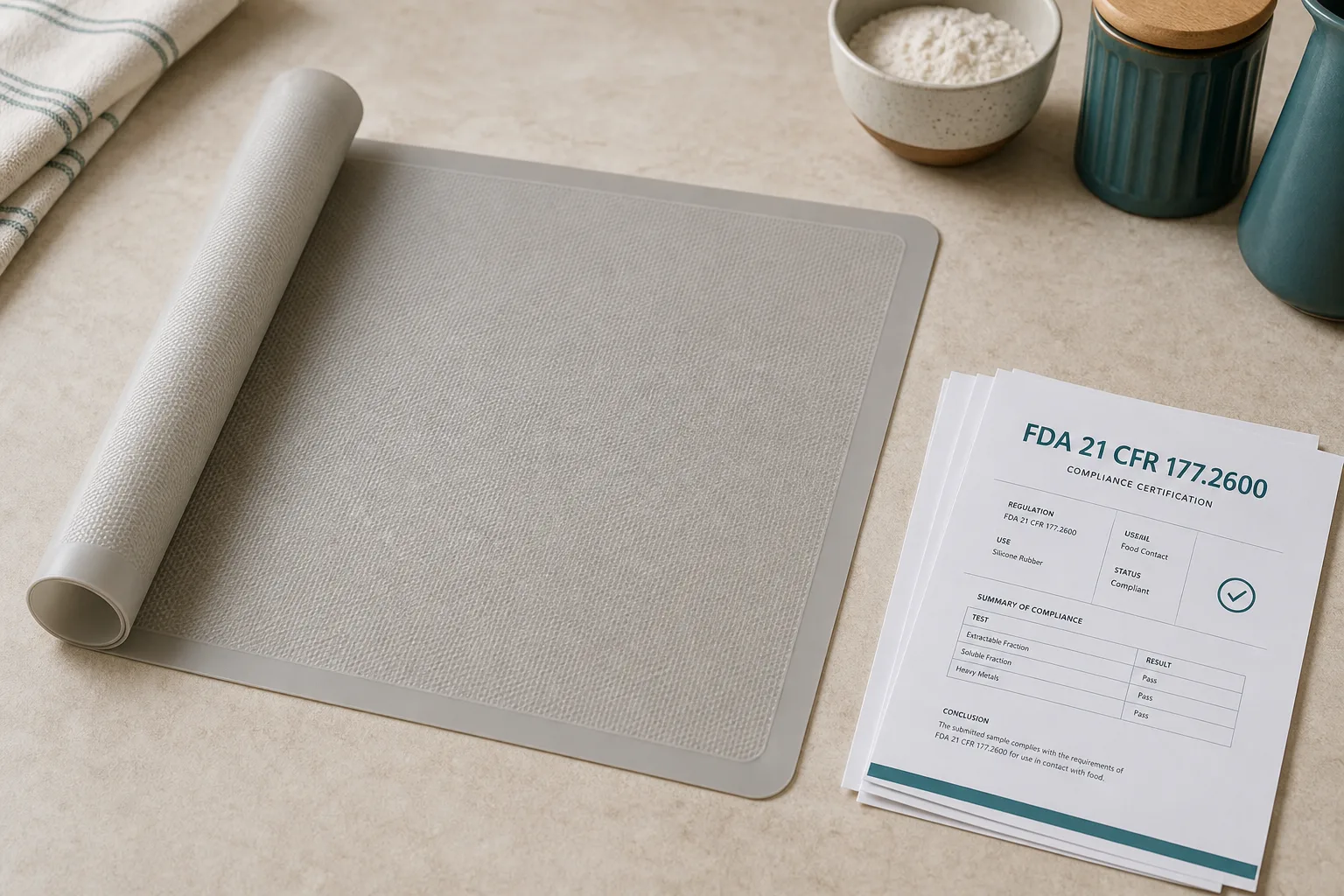
 The consumer-facing web is saturated with “best silicone baking mat” roundups that compare Amazon SKUs by star rating. None of them tell a procurement team at a housewares brand, a sink-brand line extension, or a Tier 2 retail chain what they actually need: the compliance stack, cure chemistry, tooling economics, and lead-time reality behind sourcing a silicone oven mat OEM program. This guide is written from the manufacturing side of that transaction — a Dongguan factory floor — for procurement, sourcing, and product managers who need to run an RFQ, sign a mold, and land shelf-ready product against a retail audit calendar.
A silicone oven mat OEM program is a B2B procurement exercise governed by four variables: compliance stack (FDA 21 CFR 177.2600 baseline plus LFGB §30/31 for EU and premium US retail), cure chemistry (platinum-cured LSR for premium and PFAS-free positioning, post-cured peroxide-cured HCR for Tier 2 retail at 15-25% lower cost), tooling economics (P20 mold at 20-30 day lead time, unit cost curves that break at 500 / 5,000 / 10,000 MOQ tiers), and retail-tier audit reality (per-batch third-party lab reports, Sedex SMETA 4-Pillar, ISO 9001 site certification). Everything else — Shore hardness, thickness, embossed logos, custom color — is a downstream detail on top of those four.
What is a silicone oven mat in a B2B OEM context?
A silicone oven mat is a flat, food-contact silicone elastomer sheet typically 0.6-1.0 mm thick and 30×40 cm to 40×60 cm, molded from platinum- or peroxide-cured silicone gum against a fiberglass or PET scrim, rated for -40°C to 230°C service, and produced under FDA 21 CFR 177.2600[^fda-177-2600] compliance for repeated food contact. In B2B OEM terms it is a private-label or custom-branded SKU sold through housewares brands, retail chains, or specialty channels — not a consumer purchase.
The category covers three commercial subtypes that share the same regulatory stack but diverge on tooling and MOQ:
- Baking mat — the mainstream SKU. Flat, scrim-reinforced (usually fiberglass), 40×30 cm or 40×60 cm, used as a pan liner for cookies, pastry, or roasting. Retail price bracket $10-25 USD; wholesale unit cost $1.20-3.60 depending on MOQ tier.
- Oven liner — heavier gauge, unreinforced silicone, cut to the oven-floor dimension of a specific appliance. Sold as an accessory for appliance-brand line extensions.
- Roll-up mat — the wider silicone-mat category that overlaps with drying-mat and dish-drying use cases. Different geometry (rolled storage) and often paired with silicone drying-rack SKUs.
For the rest of this guide, “silicone oven mat” refers to the baking-mat subtype, which represents roughly 70% of B2B OEM volume in the category. The compliance and process reality translates directly to the other two subtypes with small tooling adjustments.
The consumer web often lists “silicone” as a monolithic material. In OEM procurement it isn’t. The gum is either high-temperature vulcanized rubber (HTV / HCR) or liquid silicone rubber (LSR); the catalyst is either platinum or organic peroxide; the compound house has a documented masterbatch lot; the mold is either aluminum (soft, 5,000-30,000 shots) or P20 hardened steel (300,000-500,000 shots). All four decisions have downstream cost, lead time, and compliance consequences. The platinum vs peroxide-cured silicone decision guide walks the cure-system delta in depth.
What is the compliance stack for a silicone oven mat sold in US and EU retail?
Four regulations plus one voluntary framework govern retail-tier silicone oven mats. FDA 21 CFR 177.2600[^fda-177-2600] is the US food-contact baseline; LFGB §30/31 with BfR Recommendation XV[^bfr-lfgb-xv] behind it applies for EU and premium US retail; EU framework Regulation (EC) 1935/2004[^ec-1935-2004] sits above LFGB; the ECHA PFAS universal restriction proposal[^echa-pfas-proposal] is driving PFAS-free documentation adoption; and NSF/ANSI 51[^nsf-ansi-51] applies for commercial food-equipment channels. California Prop 65 and CPSIA[^cpsia-silicone] compliance letters cover the US state-and-federal consumer safety layer.
Every retail buyer’s document request follows roughly the same order. The specific list depends on the retailer’s private-label program tier and target market.
US retail — mainstream tier (Home Depot, Lowe’s, Bed Bath, mid-market housewares)
| Document | Standard | Cadence |
|---|---|---|
| FDA food-contact clearance | 21 CFR 177.26001 | Per batch or per quarter |
| CPSIA compliance letter | CPSIA (lead + phthalates)2 | Per SKU, annual refresh |
| California Prop 65 warning assessment | Prop 65 | Per SKU, annual refresh |
| ISO 9001 site certification | ISO 9001:20153 | Current, on file |
| Migration test (EU 10/2011 framework as reference) | EC 1935/20044 | Optional but common |
US premium tier (Whole Foods, Sprouts, Erewhon, natural-food orbit) and EU retail
| Document | Standard | Cadence |
|---|---|---|
| LFGB §30/31 organic volatile testing | BfR Recommendation XV5 | Per batch, 3rd-party lab |
| PFAS non-detect analysis | ECHA restriction trajectory6 | Per batch, ppb detection limit |
| Cure chemistry declaration on masterbatch cert | Compound house documentation | Per masterbatch lot |
| USP <88> in-vivo biological reactivity (medical-adjacent SKUs) | USP <88>7 | Per compound |
| Sedex SMETA 4-Pillar audit | Sedex framework | Annual on-site audit |
Food-service / commercial kitchen channel
Adds NSF/ANSI 518 as the material standard for commercial food-equipment surfaces. This is a channel-specific overlay on the retail stack; most consumer housewares programs never need it.
The Chinese factory reality: about half of the exporters in the category can produce FDA + LFGB test reports on demand. Under a third can produce per-batch PFAS non-detect analysis. Under a fifth can produce a valid Sedex SMETA 4-Pillar audit. This gap is where Tier 2 US and EU retail programs disqualify roughly 70% of the RFQ pipeline before they even see a sample. A supplier who lists FDA + LFGB + Sedex on the same capabilities page — and can produce the documents on the same day — is in a small minority of the exporter base. The FDA vs LFGB decoder explains the certification-stack decision framework the retail RFQ is running.
Which manufacturing process is correct for silicone oven mats — compression, LIM, or extrusion?
Compression molding is the correct process for flat silicone oven mats across the entire retail volume range. Liquid injection molding (LIM) is only economical above 20,000 units for oven-mat geometry and delivers no meaningful quality advantage on flat parts; extrusion applies only to profile mats or endless-roll formats. Standard compression cycle is 3-6 minutes on a 200-ton hydraulic press at 160-180°C, followed by the mandatory 4-6 hour post-cure at 180-200°C.
The choice between compression, LIM, and extrusion reduces to three variables: part geometry, target annual volume, and cure system.
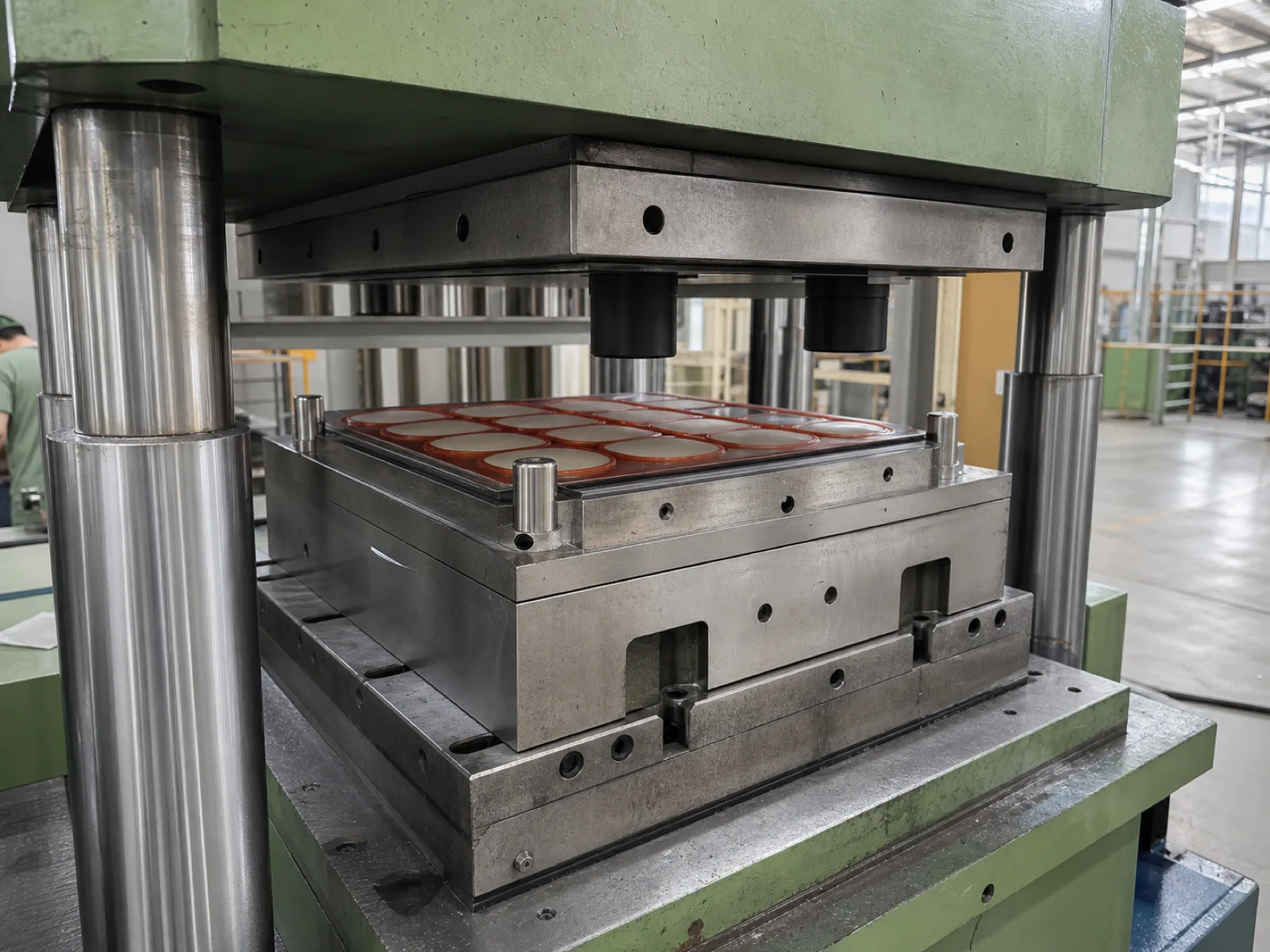
Compression molding — the correct default
- Geometry: flat sheets and low-relief parts. Perfect for oven mats.
- Volume range: 500 to 500,000+ units per year against a single P20 mold.
- Cure system: works with both HCR platinum-cured and HCR peroxide-cured gum.
- Cycle: HCR gum pre-form pressed against heated cavity, 160-180°C, 3-6 minutes, followed by 4-6 hour post-cure.
- Tooling: P20 hardened steel, 20-30 day build lead time, 300,000-500,000 shot life.
- Unit economics: best cost-per-piece from 500 pieces to 100,000 pieces per SKU.
Liquid injection molding (LIM) — over-engineered for flat mats
- Geometry: complex three-dimensional parts with tight tolerance (±0.05 mm). Sink stoppers, medical seals, silicone LSR baby products.
- Volume range: 20,000+ units per year to amortize the LSR press and mold cost.
- Cure system: platinum-cured LSR only (two-part liquid material).
- Cycle: 15-90 seconds per shot; fully automated.
- Tooling: P20 or S136, $6,000-25,000 per mold, longer build cycle.
- Unit economics: unattractive on flat oven-mat geometry below 20,000 annual units.
Extrusion — profile mats only
- Geometry: profiles, tubing, endless-roll oven mats without cut edges.
- Volume range: continuous production, tens of thousands of linear meters.
- Cure system: peroxide-cured HCR, hot-air-vulcanized in a tunnel oven.
- Cycle: continuous throughput at 3-10 m/min line speed.
- Unit economics: only relevant for the very narrow “extruded silicone oven mat” niche.
The consumer-facing web frequently confuses these processes. Sellers on Alibaba describe “injection-molded silicone mats” indiscriminately; the reality is that flat mats above 500 MOQ are compression-molded almost universally in the Chinese silicone-mat exporter base. The silicone OEM pricing structure guide breaks down the tooling amortization math that drives this process choice.
What is the OEM pricing structure at 500 / 1,000 / 5,000 / 10,000 MOQ tiers?
Unit cost drops non-linearly across MOQ tiers because tooling amortizes across the run and press-cycle throughput improves. On a standard 40×30 cm silicone baking mat with embossed logo, 500 pieces runs $2.85-3.60 per unit plus $1,800-3,200 tooling; 5,000 pieces runs $1.65-2.10 per unit; 10,000+ pieces runs $1.20-1.55 per unit. Tooling amortized across a P20 mold rated at 300,000-500,000 shots adds under $0.15 per piece at production volume.
The pricing curve is driven by three cost stacks: raw material (silicone gum, scrim, colorant, packaging), press cycle (labor and machine time, energy, post-cure oven time), and tooling amortization. Each behaves differently across MOQ tiers.
| MOQ tier | Unit cost (peroxide-cured HCR) | Unit cost (platinum-cured HCR) | Tooling delta | Typical program archetype |
|---|---|---|---|---|
| 500 pcs | $2.85-3.60 | $3.40-4.20 | $1,800-3,200 P20 (shared-cavity) | Pilot run · DTC brand launch · specialty retailer |
| 1,000 pcs | $2.20-2.80 | $2.65-3.35 | $2,000-3,500 P20 | Second-year DTC · specialty retail expansion |
| 5,000 pcs | $1.65-2.10 | $2.00-2.55 | $2,500-4,500 P20 (full-cavity) | Tier 2 US retail chain entry · EU DTC scale |
| 10,000 pcs | $1.20-1.55 | $1.45-1.90 | $3,500-6,000 P20 (multi-cavity) | Mainstream retail SKU · Wayfair / Home Depot volume |
| 50,000+ pcs | $0.95-1.25 | $1.15-1.55 | $6,000-12,000 P20 (multi-cavity) | Full retail rollout · private-label chain program |
Three procurement principles emerge from this table:
- The 500-to-5,000 jump has the steepest unit-cost slope. A brand that graduates from pilot to first retail rollout should re-negotiate at 5,000 pieces — the reduction in unit cost typically pays for the higher-cavity tooling within the first PO.
- Platinum-cure adds a 15-25% premium at every tier. The absolute delta shrinks in dollar terms at higher volume ($0.85 delta at 500 pcs versus $0.35 delta at 50,000+), but the percentage stays roughly consistent.
- Tooling is a fixed cost paid once. Amortized over the mold’s 300,000-500,000 shot life, tooling adds under $0.02 per piece at full utilization. Brands that pay tooling once and stay on the same mold for 3-5 years get materially better unit economics than those who re-tool between suppliers.
The MOQ and lead-time playbook and the real-factory MOQ math walk the underlying tooling and press-slot economics in more depth for procurement teams who need to defend the math internally.
What raw material and Shore A hardness should you spec?
Spec platinum-cured or peroxide-cured HCR silicone gum from a virgin masterbatch, at Shore A 50-60 durometer per ASTM D2240[^astm-d2240], with tensile strength ≥ 8 MPa, elongation at break ≥ 350%, and tear strength ≥ 25 kN/m. These are the mechanical-property targets for a silicone oven mat that survives 2-3 years of consumer use and clears retail-tier drop and heat cycling tests. Reprocessed silicone at any tier ratio disqualifies the material from FDA 21 CFR 177.2600 compliance.
Silicone raw material sits in tiers that translate directly into finished-product performance:
Virgin vs reprocessed silicone
- Virgin silicone — first-run material from the compound house. Full FDA 21 CFR 177.26001 compliance, consistent mechanical properties, LFGB clearance possible with correct post-cure.
- Reprocessed silicone — regrind or blended reclaim, sometimes labelled “recycled silicone” for marketing. Cost 30-50% lower per kilogram but fails FDA food-contact clearance for repeated-use elastomers. Legitimate for non-food-contact industrial applications; disqualifying for oven mats.
Any factory RFQ response should specify “100% virgin silicone gum from [compound house name]” with a masterbatch lot number attached. If the RFQ response says only “food-grade silicone”, assume reprocessed content until proven otherwise.
HTV / HCR vs LSR
- HTV / HCR (High-Temperature Vulcanized / High-Consistency Rubber) — solid silicone gum, compression-molded. Correct choice for flat oven-mat geometry.
- LSR (Liquid Silicone Rubber) — two-part liquid, LIM-molded. Correct choice for complex 3D geometry above 20,000 annual units. Over-engineered for flat mats.
Shore A hardness range
The right hardness for an oven mat sits in a narrow band:
| Shore A | Behavior | Suitability |
|---|---|---|
| 30-40 | Very soft, tears at pan-release; drapes over pan edges | Under-engineered — reject |
| 50-60 | Standard oven-mat spec; balances flexibility and durability | Correct — the default |
| 65-75 | Rigid, cracks at fold points, poor conformability | Over-engineered — reject for consumer mats |
Every hardness measurement should be reported per ASTM D22409 — the international standard. Vendors who quote “70 durometer” without the ASTM reference are using internal scales that may or may not correlate to the standard test.
Mechanical property targets
| Property | Target | Test method |
|---|---|---|
| Tensile strength | ≥ 8 MPa | ASTM D412 |
| Elongation at break | ≥ 350% | ASTM D412 |
| Tear strength | ≥ 25 kN/m | ASTM D624 (Die B) |
| Compression set (24 h @ 150°C) | ≤ 20% | ASTM D395 |
| Service temperature | -40°C to +230°C | Rated per material data sheet |
| Shore A hardness | 50-60 ± 5 | ASTM D22409 |
These are the numbers to require on the material data sheet with every incoming RFQ. Any supplier who cannot produce a full mechanical property spec against these test methods is either running an unqualified compound or is a trading company reselling from a compound house they don’t have documented traceability to.
What is the OEM sourcing workflow from RFQ to first production?
The B2B OEM workflow runs six stages: RFQ, sample (T1 / T2), tooling, PPAP-equivalent sign-off, first production batch, and repeat-order cadence. Total time from RFQ receipt to first sea-freight-ready batch is 60-90 days for a new mold; 25-30 days for a repeat program on an existing mold. Committed press slots reduce first-production timing to 35-45 days after tooling completion.
The stages, with typical durations from a Dongguan factory with in-house tooling:
Stage 1 · RFQ — 3-7 days
Buyer submits geometry, hardness, target Shore A, target color, embossed-logo specification, target MOQ, target retail tier and market, and required compliance stack. Factory returns unit price at 500 / 1,000 / 5,000 / 10,000 tiers, tooling cost, lead time to sample and first production, and a documentation packet outlining the FDA / LFGB / PFAS / Sedex position.
Stage 2 · T1 sample — 7-15 days
Off a soft aluminum sample mold or shared-cavity insert. Buyer receives 3-5 pieces for hand-feel, drop-test, and internal review. If the geometry needs adjustment, revise once (T2 sample, another 7 days). Sign off on final geometry and color before tooling starts.
Stage 3 · Tooling — 20-30 days
P20 hardened steel mold cut on in-house CNC. Rated 300,000-500,000 shots. Cavity count sized to the target annual volume. Embossed logo, texture, and any brand markings cut into the cavity at this stage.
Stage 4 · PPAP-equivalent sign-off — 5-7 days
Full first-article inspection package: T3 pilot samples off the production mold (20-50 pieces), dimensional inspection with process capability (CPK) analysis, per-batch FDA + LFGB + PFAS third-party lab reports, masterbatch traceability documentation. Automotive uses PPAP formally under IATF 16949; consumer housewares uses an equivalent first-article-inspection protocol.
Stage 5 · First production batch — 35-45 days after tooling
Full-run production. In-process dimensional inspection with CPK ≥ 1.33 target. Outgoing inspection to AQL 2.5 for cosmetic defects per ISO 2859-110. Post-cure to LFGB §30/31 protocol5. Packaging and Sea-freight-ready palletization.
Stage 6 · Repeat orders — 25-30 days per cycle
Existing mold, existing masterbatch spec, existing packaging. Only the raw material lead time and press-slot availability drive the cycle. Committed press slots (a retainer arrangement Wetop offers to Tier 2 retail programs) reduce this to 18-22 days.
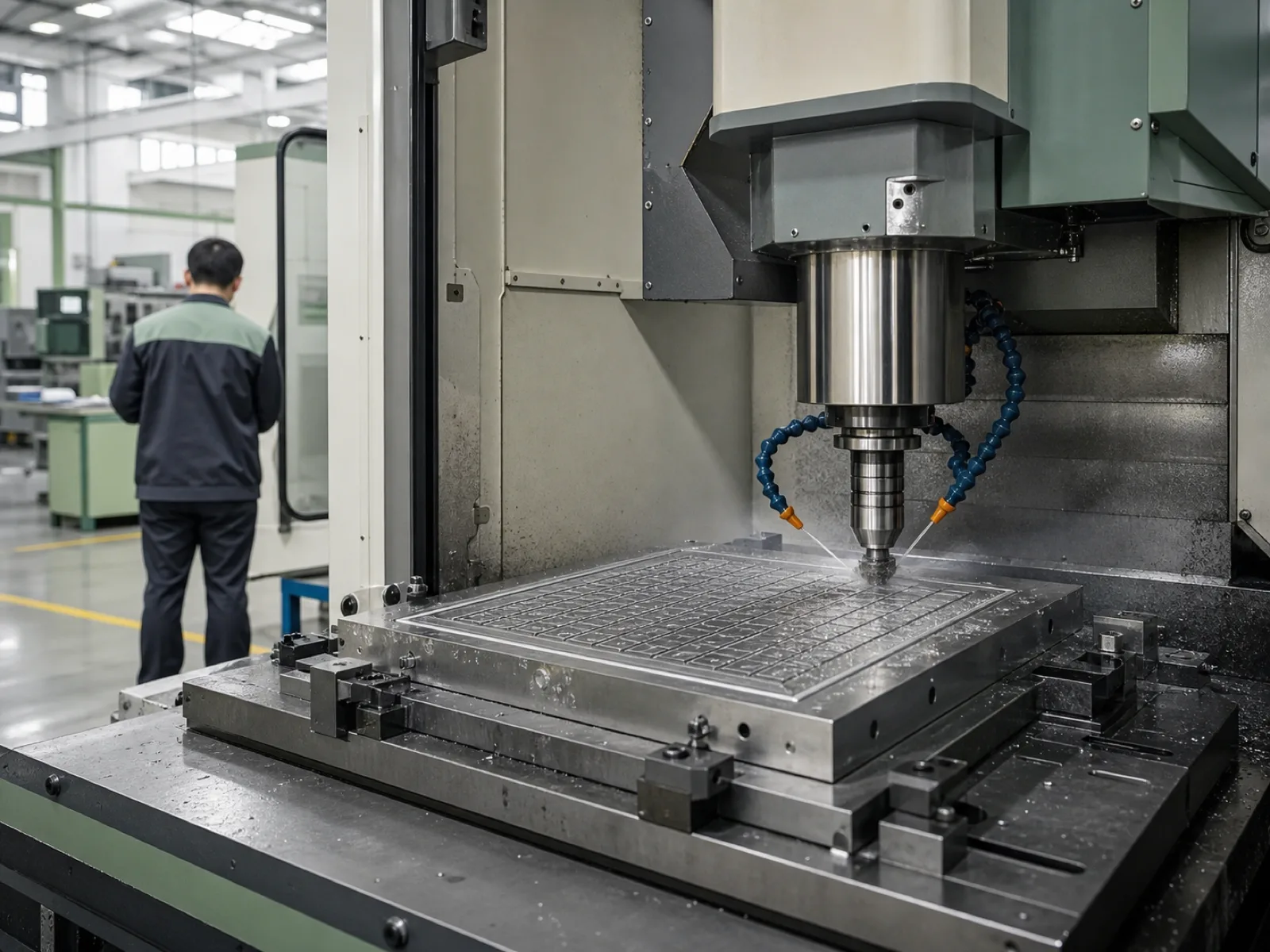
The MOQ and lead-time guide walks each stage against a specific program calendar, including how to slot a first-production PO against a retail season deadline.
What are the QC gates and testing protocols on a silicone oven mat production run?
Five QC gates run on every Wetop silicone-mat production batch: incoming raw-material COA verification, in-process dimensional inspection with CPK ≥ 1.33 target, in-line cosmetic screen at 100% inspection, outgoing AQL 2.5 sampling per ISO 2859-1[^iso-2859-1], and per-batch third-party migration testing under the EU 10/2011 framework logic. All five roll up to ISO 9001[^iso-9001] documented quality management.
Gate 1 — Incoming raw material COA
Every masterbatch lot arrives with a Certificate of Analysis from the compound house: cure system declaration (platinum or peroxide), Shore A hardness, tensile / elongation / tear results, and PFAS content declaration. Wetop QC verifies against the incoming spec before releasing the material to the press floor.
Gate 2 — In-process dimensional CPK
First-article inspection off each new press setup, then every 500 pieces during the run. Key dimensions (length, width, thickness, logo depth) measured to ± 0.1 mm tolerance. Process capability index (CPK) target ≥ 1.33 per statistical quality control practice — meaning the process consistently produces within tolerance limits.
Gate 3 — In-line cosmetic 100% inspection
Every piece visually inspected as it exits the post-cure oven: color uniformity, edge burr, scrim visibility, embossed-logo clarity, surface defects. Cosmetic-fail pieces pulled at this gate.
Gate 4 — Outgoing AQL 2.5
Sampling per ISO 2859-110 at Acceptance Quality Limit 2.5 for cosmetic defects. Standard consumer-housewares AQL. Tighter (AQL 1.5) available for premium retail programs on request.
Gate 5 — Per-batch migration and compliance testing
Third-party lab (SGS, Intertek, TÜV, Bureau Veritas) runs per-batch:
- FDA 21 CFR 177.26001 repeated-use food-contact clearance
- LFGB §30/31 organic volatile testing per BfR Recommendation XV5
- PFAS non-detect analysis per ECHA restriction trajectory6
- Migration testing under EU 10/2011 framework logic (for EC 1935/20044 compliance)
- USP <88>7 extract testing where medical-adjacent
The reports carry the masterbatch lot number and correlate back to Gates 1-4 records for full traceability. Retention: 36 months minimum per ISO 9001 requirements.
What is the lead time and logistics reality from Dongguan to US and EU?
Lead time from a properly staffed Dongguan silicone factory to sea-freight-ready product is 7-15 day sample, 20-30 day tooling, 35-45 day first production. Shenzhen Yantian Port is 90 minutes from the Wetop floor and offers direct weekly sailings to LAX, Long Beach, Oakland, Rotterdam, Hamburg, and Felixstowe. Hong Kong International Airport is two hours for air freight on urgent sample or replenishment shipments.
The geography matters more than most brands realize. Dongguan sits in the Pearl River Delta manufacturing belt, 90 minutes by truck from Yantian, 60 minutes from Shekou, 2 hours from HKIA. Sea freight cadence:
| Route | Transit time | Weekly sailings from Yantian |
|---|---|---|
| Yantian → Los Angeles / Long Beach | 14-18 days | 8-12 |
| Yantian → New York / Savannah | 28-34 days (via Panama) | 4-6 |
| Yantian → Rotterdam / Hamburg | 30-36 days | 6-8 |
| Yantian → Felixstowe (UK) | 32-38 days | 5-7 |
| Yantian → Sydney | 18-22 days | 3-5 |
Full total gate-to-shelf: 60-90 days for a brand-new mold with US destination; 90-110 days for EU destination. Repeat orders on existing tooling and existing masterbatch: 45-60 days gate-to-shelf US; 60-80 days EU.
The Dongguan-vs-Ningbo-vs-Shanghai supplier decision favors Dongguan for silicone kitchenware and housewares SKUs specifically: the compound-house ecosystem, tooling capacity, and retail-export experience concentrated in the Pearl River Delta serve this category better than the Yangtze River Delta which is stronger in electronics and appliances.
What custom finishing options are available at OEM MOQ?
Six custom finishing options run at 500-piece MOQ: embossed logo cut into the mold cavity, custom Pantone color from a masterbatch, custom scrim reinforcement, custom thickness in the 0.6-1.2 mm range, custom outer geometry within the mold envelope, and custom packaging (retail carton, header card, hangtag). Screen-printed and laser-etched logos apply post-mold with different MOQ dynamics. Full details in the [logo customization guide](/guide/customize-silicone-logo-deboss-print-laser/).
| Custom option | Available at MOQ 500? | Tooling cost delta | Unit-cost delta |
|---|---|---|---|
| Embossed logo (cut into cavity) | Yes | +$200-500 tooling | None |
| Debossed logo | Yes | +$200-500 tooling | None |
| Custom Pantone color | Yes | +$300-800 masterbatch charge | +$0.05-0.15/pc |
| Custom scrim (fiberglass vs PET) | Yes | Depends on material | +$0.10-0.30/pc |
| Custom thickness | Yes | If outside 0.6-1.0 mm may need new mold | Varies |
| Custom outer geometry | Yes | New mold required | New tooling cost |
| Screen-printed logo | No — MOQ 1,000 | +$150-400 screen | +$0.08-0.20/pc |
| Laser-etched logo | Yes at 500 | +$100-300 setup | +$0.05-0.15/pc |
| Custom retail packaging | Yes at 500 for print, 1,000 for structural | +$300-1,200 packaging tooling | +$0.20-1.20/pc |
The private-label silicone kitchen products playbook walks the full retail-facing customization stack including branding, packaging, and multi-SKU line planning.
What Wetop OEMs on silicone oven mats
Wetop runs both cure systems at MOQ 500 per SKU on compression-molded flat silicone oven and baking mats, with per-batch FDA 21 CFR 177.2600 + LFGB §30/31 + PFAS non-detect + AQL 2.5 documentation included in every quote. In-house P20 tooling on 20-30 day build, first production 35-45 days after PPAP-equivalent sign-off, Yantian Port shipping origin, ISO 9001 site certification since 2008, Sedex SMETA 4-Pillar audit current.
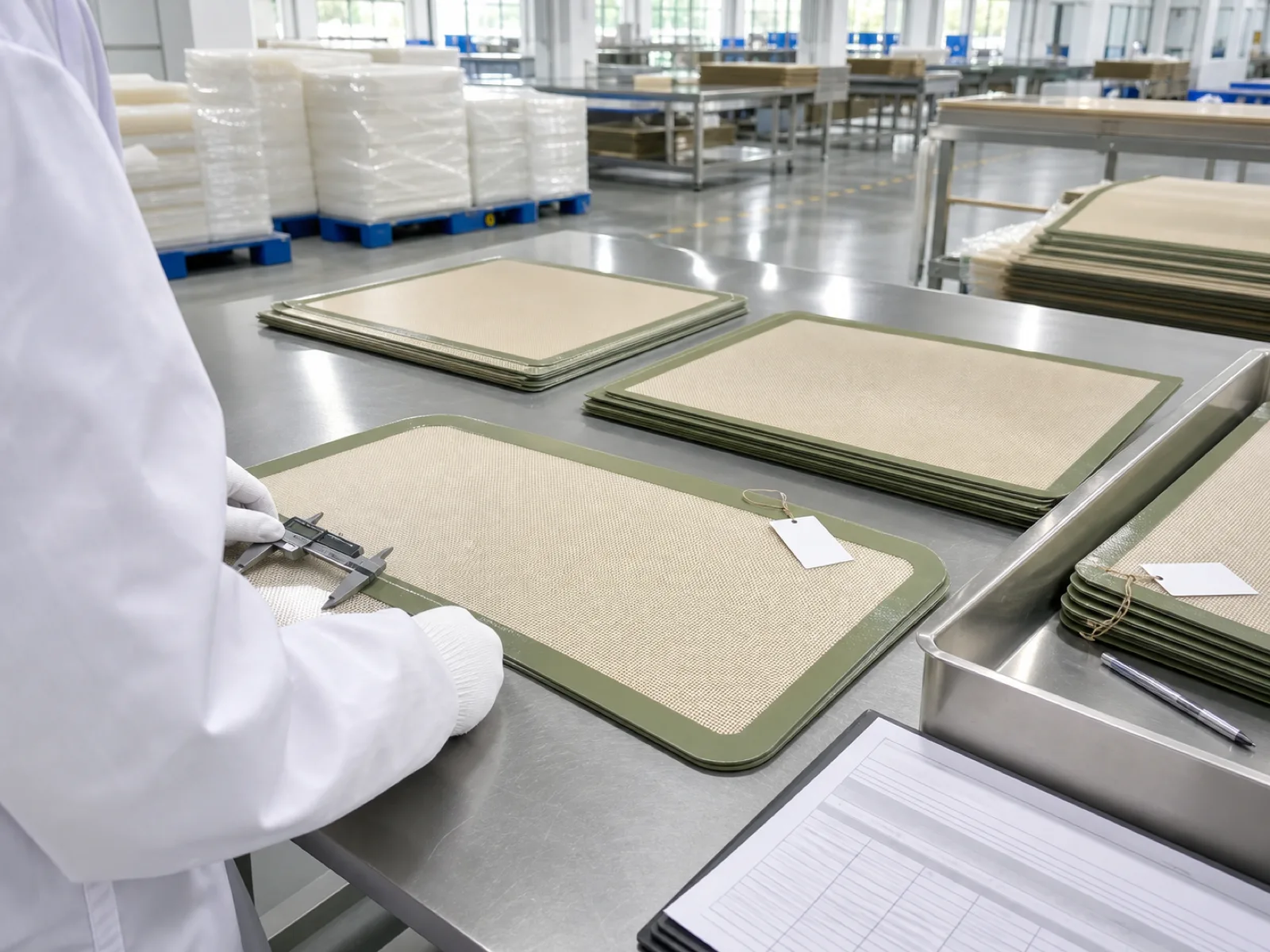
Program defaults on incoming RFQs:
- Default cure system — post-cured peroxide-cured HCR for Tier 2 US retail programs at $10-25 USD retail price point; platinum-cured HCR or LSR for EU premium, Whole Foods orbit, medical-adjacent, and PFAS-conscious US premium programs.
- Default hardness — Shore A 55 ± 5 per ASTM D22409, 0.7 mm thickness, fiberglass scrim reinforcement.
- Default compliance packet — FDA 21 CFR 177.2600 + LFGB §30/31 + PFAS non-detect + Sedex SMETA 4-Pillar + CPSIA + Prop 65, per batch, from an accredited third-party lab.
- Default logistics — Yantian Port origin, EXW / FOB / CIF quoted at RFQ, 8-12 sailings per week to US West Coast, weekly consolidation available.
Compliance documentation, cure verification, tooling economics, and audit-stack rigour are the four levers Wetop plays on every incoming brief. The sourcing checklist for a silicone factory is the buyer-side companion to this guide — the exact questions to ask any Chinese silicone-mat supplier before signing a mold or a PO.
Sourcing a silicone oven mat OEM program? Email inquiry@wetopsilicone.com with target SKU geometry, target retail tier and market, target MOQ, and required compliance stack — we return with a cure recommendation, unit-price brackets at 500 / 1,000 / 5,000 / 10,000, tooling cost and lead time, and a documentation packet outline. Manufacturing detail on the capabilities page; NDA available on request before spec exchange.
Ready to source? Every quote is built against your specification — send a CAD file, a written brief, or reference samples, and an engineer replies within one business day. Request a quote →
Footnotes
-
US Food and Drug Administration. 21 CFR 177.2600 — Rubber articles intended for repeated use. https://www.ecfr.gov/current/title-21/chapter-I/subchapter-B/part-177/subpart-C/section-177.2600 — the primary US regulation governing food-contact silicone for repeated-use articles. ↩ ↩2 ↩3
-
US Consumer Product Safety Commission. Consumer Product Safety Improvement Act (CPSIA). https://www.ecfr.gov/current/title-16 — US federal statute setting lead and phthalate limits on consumer products. ↩
-
International Organization for Standardization. ISO 9001:2015 — Quality Management Systems — Requirements. https://www.iso.org/standard/62085.html — the quality management standard Wetop is certified against since 2008. ↩
-
European Parliament and Council. Regulation (EC) No 1935/2004 — Materials and articles intended to come into contact with food. https://eur-lex.europa.eu/legal-content/EN/TXT/?uri=CELEX%3A02004R1935-20090807 — framework regulation for all EU food-contact materials. ↩ ↩2
-
German Federal Institute for Risk Assessment (BfR). Recommendation XV — Silicones. https://www.bfr.bund.de/en/bfr_recommendations_on_food_contact_materials-7498.html — technical standard behind LFGB §30/31 for food-contact silicone. ↩ ↩2 ↩3
-
European Chemicals Agency. PFAS Universal Restriction Proposal. https://eur-lex.europa.eu/legal-content/EN/TXT/?uri=CELEX%3A32006R1907 — the regulatory action driving PFAS-free spec adoption in EU premium retail. ↩ ↩2
-
United States Pharmacopeia. USP <88> — Biological Reactivity Tests, In Vivo. https://www.usp.org/harmonization-standards/pdg/excipients/plastic-materials — USP Class VI biological reactivity classification for medical-grade elastomers. ↩ ↩2
-
NSF International / American National Standards Institute. NSF/ANSI 51 — Food Equipment Materials. https://www.ecfr.gov/current/title-21/chapter-I/subchapter-B/part-177 — US commercial-kitchen food-equipment material standard. ↩
-
ASTM International. ASTM D2240-15 — Standard Test Method for Rubber Property—Durometer Hardness. https://www.astm.org/d2240-15r21.html — the measurement standard for Shore A hardness. ↩ ↩2 ↩3
-
International Organization for Standardization. ISO 2859-1:1999 — Sampling procedures for inspection by attributes. https://www.iso.org/standard/1141.html — defines the AQL sampling procedure Wetop uses on outgoing cosmetic inspection. ↩ ↩2
FAQ
-
How long does a first production run take from PO to shipping?
For a new mold: 7-15 days for T1 samples off a soft or shared cavity, 20-30 days for a production P20 mold, then 35-45 days for the first sea-freight-ready batch after PPAP-equivalent sign-off. For a repeat program on an existing mold, 25-30 days is standard, and 18-22 days is achievable on prioritized programs with committed press slots.
-
What does the retail audit stack look like for Home Depot, Wayfair, or Target silicone-mat SKUs?
Four document families: (1) per-batch FDA 21 CFR 177.2600 and LFGB §30/31 third-party test reports from an accredited lab; (2) PFAS non-detect analysis per batch given the ECHA restriction trajectory; (3) Sedex SMETA 4-Pillar social compliance audit (labor, health-safety, environment, business ethics); (4) California Prop 65 and CPSIA compliance letters. Higher-tier programs additionally require ISO 9001 certification of the manufacturing site.
-
What Shore A hardness and thickness should I spec for a silicone baking mat?
Standard oven mats run Shore A 50-60 and 0.6-1.0 mm thick. Under 40 Shore the mat tears easily during pan release; over 70 it loses conformability and cracks at fold points. Thickness under 0.5 mm has poor thermal buffering and warps in the oven; over 1.2 mm is over-engineered for the application and adds material cost without functional benefit. ASTM D2240 is the measurement standard; require it on the incoming quote, not vendor-defined internal scales.
-
Can you emboss our logo or run a custom color on a 500-piece MOQ?
Embossed logo — yes, at MOQ 500; the logo geometry is cut into the P20 mold cavity at tooling stage, so it adds $200-500 tooling cost but no unit-cost delta after that. Custom Pantone color — yes at MOQ 500 with a $300-800 masterbatch charge; below that the color-match run economics don't work. Screen-printed or laser-etched logos post-mold have different MOQ dynamics — 1,000+ for cost-effective screen print, 500 for laser.
-
What causes the 'first-heat odor' complaint on cheap silicone oven mats?
Under-post-cured peroxide-cure silicone. Peroxide-cure produces trace organic byproducts — acetophenone, α-methylstyrene, dicumyl fragments — that need 4-6 hours in a 180-200°C oven to volatilize out. Factories saving on oven time ship product with residual volatiles that off-gas at first oven use, producing a slight acidic smell and generating 3-8% retail return rates on premium SKUs. Post-cure is not optional; LFGB §30/31 organic volatile testing catches under-cured product at the batch level.
-
How do I audit that a Chinese silicone-mat supplier is a real factory versus a trading company?
Six checks. Ask for an ISO 9001 certificate in the factory's name (not a broker's); a video walkthrough of the compression molding presses and post-cure ovens; the master-batch lot certificate from the raw-silicone compound house; per-batch third-party lab reports (SGS / Intertek / TÜV / Bureau Veritas) for the last two production lots; the Sedex membership number; and the Yantian or Shekou shipping origin on prior BLs. A supplier who cannot produce all six on request should be assumed to be a trading company.
-
What fiberglass scrim gauge should we spec on a silicone baking mat, and when should we go scrim-free?
Standard retail silicone baking mats run a 0.15-0.22 mm fiberglass scrim laminated between two thin silicone skins, with the finished mat at 0.7-0.8 mm total thickness and Shore A 55 ± 5 per ASTM D2240[^astm-d2240]. The scrim does two jobs — it prevents the mat from stretching out of shape after 200+ oven cycles, and it stops the mat from warping off a flat pan at 230°C. Under-spec scrim (below 0.15 mm or open weave over 40×40 threads/inch) shows through the silicone after 30-50 washes as a visible grid pattern — one of the most common consumer-return drivers on cheap Home Depot / Wayfair caliber SKUs. Go scrim-free only on oven-liner and roll-up-mat subtypes where the geometry doesn't demand flatness discipline, or on premium platinum-cured LSR mats above 1.2 mm thickness where the wall itself carries the dimensional stability. For flat 40×30 cm baking mats at 0.6-1.0 mm the scrim is non-negotiable at retail tier. On the RFQ, require: scrim material (fiberglass vs PET — fiberglass is standard, PET only for niche cold-cure programs), gauge in mm, weave density, and a lamination-strength spec of ≥ 4 N/cm peel-test result. A supplier who cannot cite scrim gauge and peel-test data is running an unqualified compound stack — a real factory documents the scrim to the same discipline as the silicone masterbatch under ISO 9001[^iso-9001] traceability.
-
What Shore A durometer and rib pattern do silicone oven mats need for a Whole Foods or premium-tier US retail placement versus a Home Depot Tier 2 SKU?
The material spec is nearly identical — Shore A 50-60 per ASTM D2240[^astm-d2240], 0.7-0.9 mm thickness, platinum-cured HCR on the premium track, post-cured peroxide-cured HCR on the Tier 2 track. Where the two program tiers diverge is the finishing detail and the surface texture, and it's cheaper to spec correctly on tooling day than to re-cut a mold six months in. For Whole Foods / Erewhon / Williams Sonoma caliber: matte-satin surface finish (SPI D-3 texture on the cavity), micro-ribbed underside at 0.15 mm rib height on a 3 mm pitch for pan grip, laser-etched or debossed logo (not screen-printed — the printed edge gets fingernail-scored by returns processors and shows up as a QC fail), and Pantone match to ± 1.5 Delta-E. Compliance stack carries LFGB §30/31 organic volatile testing behind BfR Recommendation XV[^bfr-lfgb-xv], PFAS non-detect per ECHA trajectory[^echa-pfas-proposal], and Sedex SMETA 4-Pillar current. For Home Depot / Wayfair / Target Tier 2: gloss surface acceptable, plain underside, screen-printed logo fine at 1,000+ MOQ, Pantone tolerance ± 3 Delta-E. Compliance stack still requires FDA 21 CFR 177.2600[^fda-177-2600] baseline, CPSIA[^cpsia-silicone], Prop 65, but LFGB is optional and PFAS non-detect is written into fewer RFQs (though the trajectory is converging fast — 2024-2026 RFQs increasingly demand it at both tiers). Both tiers share the same underlying P20 mold if the cavity is cut with the premium finish; you can run the same tool for both markets and downgrade the finishing pass for Tier 2. The reverse — cutting a gloss-only cavity and trying to matte-finish later — doesn't work.
-
How do we run a PPAP-equivalent first-article package on a silicone oven mat program at Home Depot or Wayfair caliber without formal IATF 16949?
Consumer-housewares programs don't run formal PPAP under IATF 16949 (that's automotive), but Tier 2 retail buyers at Home Depot, Wayfair, Target, and Tesco increasingly demand a PPAP-equivalent first-article submission package before the PO goes live. Wetop's standard package covers eight elements: 1. Design record — final approved geometry drawing signed by both parties, including the ± 0.1 mm dimensional tolerance envelope on length / width / thickness and the ± 0.02 mm on embossed-logo depth. 2. Process flow diagram — mixing, pre-form, compression cycle time and temperature, post-cure duration and oven-set-point, trimming, cosmetic inspection, packaging. Documented to ISO 9001[^iso-9001]. 3. FMEA — process-failure-mode analysis specifically flagging cure-through (post-cure skipped), scrim-bond delamination, rim burr, and first-heat odor from residual acetophenone. 4. Control plan — the five QC gates (raw COA, in-process CPK ≥ 1.33 every 500 pieces, in-line 100% cosmetic, outgoing AQL 2.5 per ISO 2859-1[^iso-2859-1], per-batch third-party lab). 5. MSA / gauge R&R — durometer and thickness measurement repeatability across three operators. 6. Process capability study — CPK measurements on the T3 pilot run (20-50 pieces) proving the process holds tolerance. 7. Material spec — masterbatch lot certificate, FDA[^fda-177-2600] + LFGB[^bfr-lfgb-xv] + PFAS non-detect[^echa-pfas-proposal] third-party lab reports on the pilot batch. 8. Retention samples — five pilot pieces retained at Wetop plus five shipped to the buyer for reference-master retention. Turnaround is 5-7 days after T3 pilot pieces exit the press. The buyer signs off on all eight before the first-production PO releases. This is the discipline gap where roughly 70% of Chinese silicone-mat exporters fall out of the RFQ pipeline — they can produce samples but cannot produce the paperwork stack.
-
How does a silicone oven mat compare against a parchment-paper SKU or a PTFE-coated fiberglass mat in a private-label decision tree?
For a housewares brand deciding between silicone, parchment, and PTFE-coated fiberglass for a private-label bakeware-accessory line, the three materials sit at genuinely different price / performance / positioning points. Silicone oven mat (this guide's subject): unit cost $1.20-3.60 at 500-10,000 MOQ, retail $10-25, service temperature -40°C to 230°C, 2-3 year consumer life at 100+ bake cycles per year, FDA 21 CFR 177.2600[^fda-177-2600] baseline plus LFGB[^bfr-lfgb-xv] for premium tier, PFAS-free when platinum-cured, dishwasher safe. Positioning: reusable, premium, kitchen-tool-tier margin. The 'buy once, use forever' story a premium housewares brand wants. Parchment paper: unit cost $0.02-0.08 per sheet at scale, retail $6-12 per 50-sheet roll, single-use, no compliance stack beyond FDA food-contact paper coating rules. Positioning: consumable. Wrong category for a differentiated private-label play — you're competing against Reynolds and store brands on shelf. PTFE-coated fiberglass mat: unit cost $0.80-2.20 at MOQ, retail $8-18, service temperature to 260°C. The problem: PFAS. PTFE releases PFOA-related concerns under the ECHA universal restriction trajectory[^echa-pfas-proposal], and Whole Foods / Erewhon / EU premium retail have started writing 'no PTFE, no PFAS' into RFQs since 2023. A private-label brand launching in 2026 that specs PTFE is buying into a compliance headwind that will only intensify. Decision tree for a premium housewares brand: silicone. Full stop. For a value-tier commodity SKU where margin dominates: parchment single-use. PTFE-coated fiberglass is the compliance-orphan middle option that has no strategic home in a modern private-label roadmap. See the [FDA vs LFGB decoder](/guide/fda-vs-lfgb-silicone/) for the compliance-tier positioning behind this call.
References
Authoritative sources cited in this guide
- US Food and Drug Administration (Code of Federal Regulations). 21 CFR 177.2600 — Rubber articles intended for repeated use. https://www.ecfr.gov/current/title-21/chapter-I/subchapter-B/part-177/subpart-C/section-177.2600 — Primary US regulation governing food-contact silicone. The compliance baseline behind every Wetop OEM silicone oven mat program.
- German Federal Institute for Risk Assessment (BfR). BfR Recommendation XV — Silicones. https://www.bfr.bund.de/en/bfr_recommendations_on_food_contact_materials-7498.html — Technical standard behind LFGB §30/31 for food-contact silicone. Defines the organic volatile extraction test post-cure clears.
- International Organization for Standardization. ISO 9001:2015 — Quality Management Systems — Requirements. https://www.iso.org/standard/62085.html — Quality-management standard Wetop is certified against. Governs the batch traceability and post-cure records that support every RFQ.
- International Organization for Standardization. ISO 2859-1:1999 — Sampling procedures for inspection by attributes. https://www.iso.org/standard/1141.html — Defines the AQL sampling procedure Wetop uses on outgoing cosmetic inspection (typically AQL 2.5 for oven mats).
- ASTM International. ASTM D2240-15 — Standard Test Method for Rubber Property—Durometer Hardness. https://www.astm.org/d2240-15r21.html — Measurement standard behind every Shore A hardness spec on a Wetop oven-mat program.
- United States Pharmacopeia. USP <88> — Biological Reactivity Tests, In Vivo. https://www.usp.org/harmonization-standards/pdg/excipients/plastic-materials — USP Class VI biological reactivity classification, relevant when a silicone-mat program crosses into medical-adjacent or infant-feeding accessory territory.
- European Chemicals Agency (ECHA). PFAS Universal Restriction Proposal (2023). https://eur-lex.europa.eu/legal-content/EN/TXT/?uri=CELEX%3A32006R1907 — Regulatory action driving PFAS-free spec adoption in EU premium retail and, downstream, in US West Coast retail.
- European Parliament and Council. Regulation (EC) No 1935/2004 — Materials and articles intended to come into contact with food. https://eur-lex.europa.eu/legal-content/EN/TXT/?uri=CELEX%3A02004R1935-20090807 — Framework regulation for all EU food-contact materials. Sets the overall requirement behind LFGB and BfR technical standards.
- US Consumer Product Safety Commission. Consumer Product Safety Improvement Act (CPSIA). https://www.ecfr.gov/current/title-16 — US federal statute setting lead and phthalate limits on consumer products. Applies to any silicone kitchen SKU sold in US retail.
- NSF International / American National Standards Institute. NSF/ANSI 51 — Food Equipment Materials. https://www.ecfr.gov/current/title-21/chapter-I/subchapter-B/part-177 — US commercial-kitchen food-equipment material standard. Sometimes written into food-service OEM RFQs above the retail-tier baseline.
Start a custom program
Send a brief. Get an engineer’s reply in one business day.
Every Wetop program is tooled from a customer’s specification. Send a CAD file (STEP · IGES · DWG) or a written brief and we’ll reply with a mold cost estimate, price brackets at MOQ 500 / 1,000 / 5,000, and any engineering questions.