Buyer Guide · commercial intent
Silicone Pet Water Dispenser OEM Buyer Guide
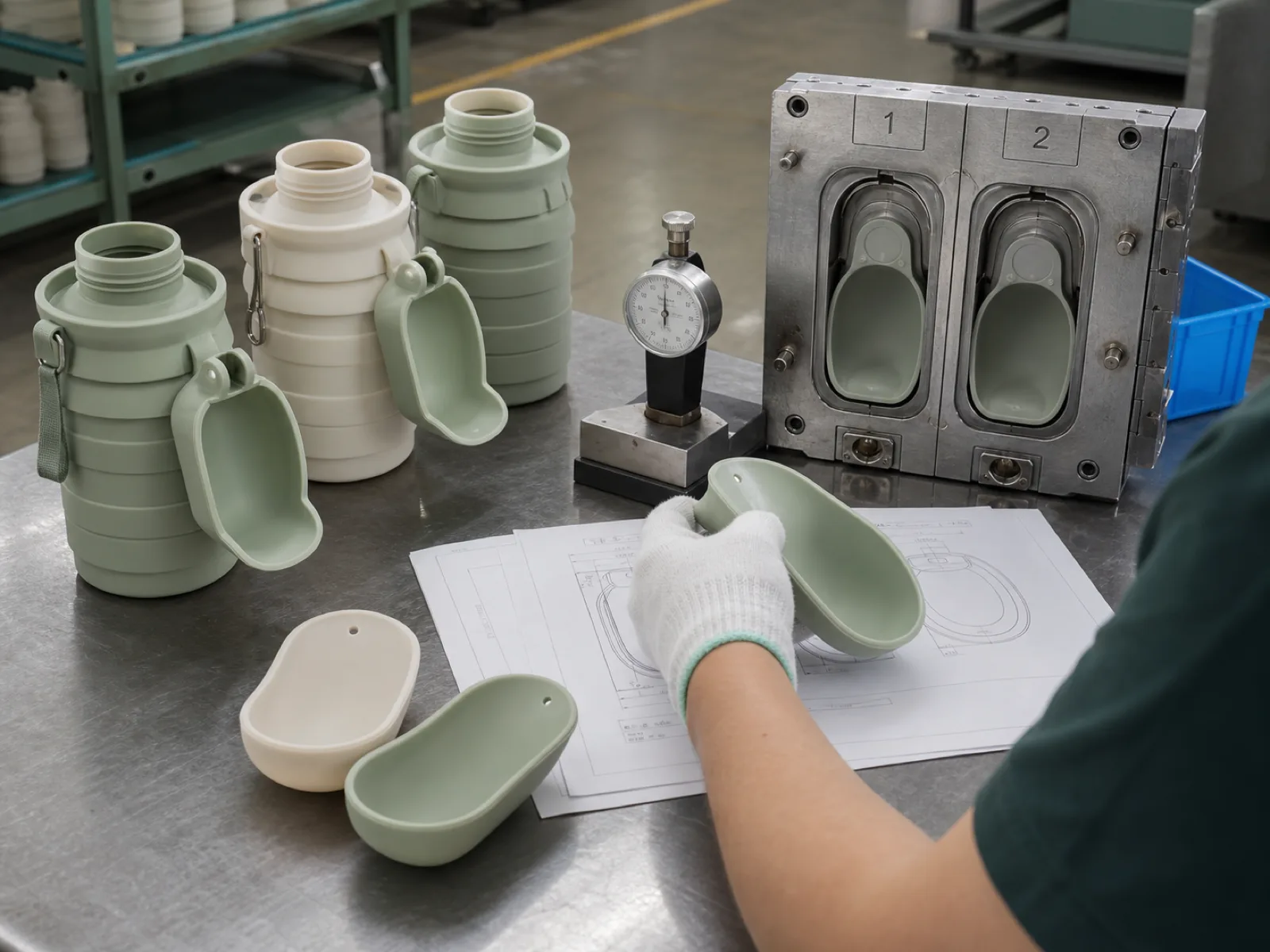 Buyer Guide
 A silicone pet water dispenser is a food-grade silicone device that stores and delivers drinking water to a dog or cat on the move, built in four main form factors — a bottle-adapter flip-leaf, a foldable travel bowl, a squeeze bottle, and the sealing components inside a gravity fountain. The specification decisions that separate a leak-tight, odor-free dispenser an animal will actually drink from — from a returns problem — are the cure system, the Shore A hardness of each component, the valve and gasket seal geometry, and the drop-and-squeeze test protocol, and every one of them is locked before the first sample is cut. This guide is the engineering-desk brief for pet-brand and housewares buyers running a silicone pet water dispenser program at 3,000 to 500,000 pcs, covering form factors, food-grade material spec, leak-proof engineering, capacity and bottle-neck fit, molding process, MOQ and tooling math, private-label branding, and the compliance packet that clears customs.
To a pet-brand buyer, a silicone water dispenser looks simple — a soft trough on a water bottle, a few dollars landed, fifteen on the shelf. Then the first container arrives with a valve that weeps when the bottle is packed sideways, a flip leaf too floppy to hold water, and a faint rubber smell that makes the reviewer’s dog walk away from it. None of those are bad luck. Each maps to a specific decision the factory made — or skipped — during cure-system selection, durometer targeting, and seal validation. This guide is written from the engineering desk at Wetop’s Dongguan floor for brand owners and private-label buyers who want the manufacturing math behind a dispenser that survives a backpack, a dishwasher, and a fussy animal.
What is a silicone pet water dispenser, and what are the main form factors?
A silicone pet water dispenser is a food-grade silicone device that holds and delivers drinking water to a pet, usually for travel or outdoor use. Four form factors dominate: a bottle-adapter flip-leaf that screws onto a drink bottle and flips out a drinking trough, a foldable travel bowl that collapses flat, a squeeze bottle with an attached cup, and the sealing components inside a gravity fountain. Each shares the same food-safe silicone but differs in wall thickness, Shore A, and seal geometry.
The category is one manufacturing logic wearing four bodies, and knowing which one you are quoting is the first fork in the RFQ. The bottle-adapter flip-leaf is the best-selling travel design: a rigid or semi-rigid cap screws onto a standard drink-bottle neck, and a silicone leaf flips out to form a shallow trough the animal laps from. Water the pet does not drink tips back into the bottle when the leaf folds up — the “no waste” selling point. The load-bearing engineering here is the leaf’s Shore A (stiff enough to hold an open trough, soft enough to squeeze) and the neck gasket that keeps it from weeping in a bag.
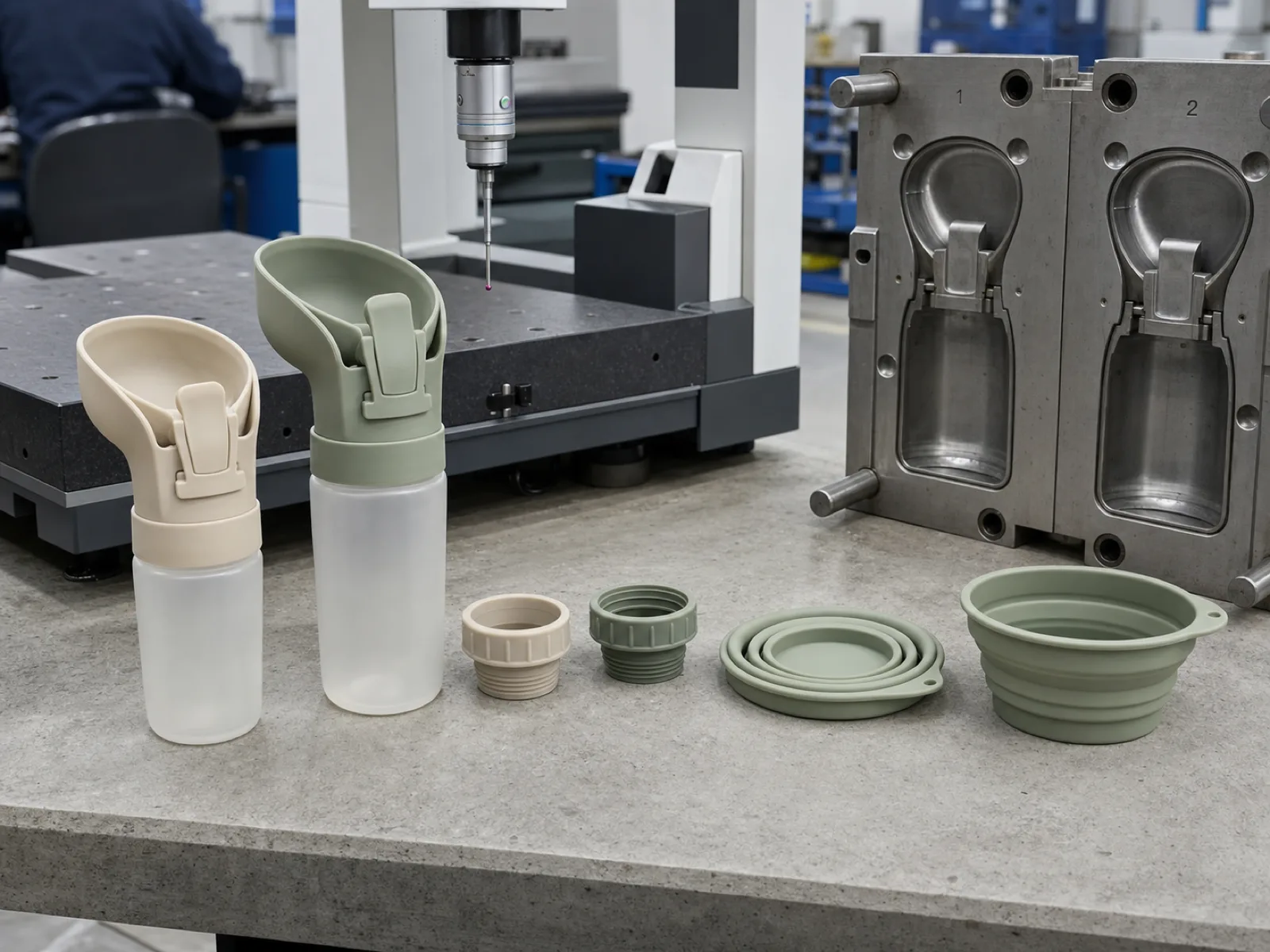
The foldable travel bowl collapses flat to a disc or folds into a pocketable puck and springs back to hold 350–1,000 ml. Its engineering problem is fold fatigue — the wall must fold flat thousands of times without cracking or taking a permanent set — which is a wall-thickness and durometer decision covered in depth in the collapsible silicone pet bowl manufacturing guide. The squeeze-bottle design pushes water on demand into an integrated silicone cup and lives on its one-way valve. The fourth family is the set of silicone sealing, gasket, and reservoir components inside a gravity or fountain dispenser — not a standalone product but the parts that make a plastic fountain leak-tight, and a common OEM sub-assembly order.
| Form factor | Primary selling point | Load-bearing engineering detail | Typical capacity |
|---|---|---|---|
| Bottle-adapter flip-leaf | No-waste travel hydration | Leaf Shore A + neck gasket seal | 350–580 ml |
| Foldable travel bowl | Packs flat, multi-pet | Fold-fatigue wall + spring-back | 350–1,000 ml |
| Squeeze bottle + cup | One-hand on-demand water | One-way dispensing valve | 350–750 ml |
| Gravity / fountain components | Continuous home supply | Reservoir gasket + tank seal | Sub-assembly |
Which food-grade material and cure system belong in a pet water dispenser?
A pet water dispenser must be molded from platinum-cured, food-grade silicone that clears FDA 21 CFR 177.2600 and LFGB. Platinum cure is a clean addition reaction with no odor-causing byproducts; peroxide cure leaves benzoic-acid residues that off-gas a rubber smell into standing water and make animals refuse to drink. Silicone contains no BPA, BPS, phthalates, or PVC by chemistry, so the decisive spec is the cure system, not a generic "food-grade" label.
There are two crossroads in the material decision, and both get skipped in low-cost quoting. The first is cure chemistry. Platinum (addition) cure crosslinks vinyl- and hydride-functional silicone with a platinum catalyst in a stoichiometrically clean reaction that generates no volatile byproducts, which is why platinum-cured silicone ships into infant-feeding and medical applications with minimal post-cure[^nih-silicone-review]. Peroxide cure uses a free-radical initiator whose reaction leaves benzoic acid and related volatiles that a proper 4-hour, 200 °C post-cure is meant to drive off — but a factory protecting throughput often shortens it, and residual volatiles stay in the part. On a product that sits full of standing water all day, those volatiles migrate into the water as a rubber odor, and a dog’s nose is a far more sensitive quality inspector than a human’s. The full breakdown is in the platinum-cured vs peroxide-cured silicone guide.
The second crossroad is proving the grade on the finished good. A listing that says “food-grade silicone” almost always means the raw compound carries a supplier certificate — not that the finished dispenser was lot-tested. Silicone is inherently free of BPA, BPS, phthalates, and PVC because none are part of its chemistry, so the honest safety story is the migration test on the actual part, plus platinum cure. The material-safety case a skeptical category buyer or a worried pet owner will demand is laid out in the is silicone safe for dogs materials guide.
| Attribute | Peroxide-cured silicone | Platinum-cured silicone |
|---|---|---|
| Odor / off-gas into standing water | High without full post-cure | Very low |
| Byproducts of cure reaction | Benzoic acid, volatiles | None |
| BPA / BPS / phthalate / PVC content | None (chemistry) | None (chemistry) |
| Repeated drinking-water clearance path | Difficult | Standard |
| Best fit for a pet water dispenser | Avoid | Default |
| Relative raw-material cost | Lowest | Mid |
For any pet water dispenser sold above an entry-level price, Wetop only quotes platinum-cured compound. The odor-into-water and refusal-to-drink failure modes that come with peroxide are exactly the ones that generate a one-star review with a photo of a dog turning its head away.
What Shore A hardness and temperature range should the silicone hit?
Match Shore A to the component: a flip-leaf trough wants Shore A 45–60 to hold an open shape while staying squeezable, a foldable bowl wall wants 40–55 to fold flat and spring back, and a valve or neck gasket wants a softer 30–45 to seat leak-tight. Platinum-cured silicone holds a service range of roughly −40 °C to 230 °C, so freezing water, a hot car, and a dishwasher cycle are all well inside its envelope.
“Soft,” “medium,” and “firm” are not a spec — they are how two people end up arguing over a rejected lot. Perceived firmness on a dispenser is driven by three variables: the durometer of the cured silicone (measured on the Shore A scale per ASTM D2240[^astm-standards]), the wall thickness, and the geometry (a curved wall resists deflection more than a flat one). This is why a dispenser spec must name a Shore A target and a tolerance for each functional component, not a single number for “the silicone.”
The durometer map Wetop uses to translate a dispenser design into a moldable spec:
| Component | Shore A target | Why this band | Verification at lot release |
|---|---|---|---|
| Flip-leaf drinking trough | 45–60 | Holds an open trough, still squeezes to tip water back | Durometer on the leaf field, ±5 |
| Foldable bowl wall | 40–55 | Folds flat without cracking, springs back stable | Durometer + fold-cycle sample |
| Valve / stopper / neck gasket | 30–45 | Compresses into a leak-tight seat under torque | Durometer + seal leak test |
| Rigid base / structural rim (if silicone) | 60–70 | Structural stability, footprint grip | Durometer on the rim |
Temperature range is the spec that lets a pet brand make outdoor and freeze-and-go claims with a straight face. Platinum-cured silicone stays flexible and dimensionally stable from about −40 °C to 230 °C in continuous service, which means a dispenser can be frozen with water inside for a hot-day hike, left in a car, and cleaned in a top-rack dishwasher without deforming or leaching — an envelope no polypropylene or PET pet bottle matches. If your team wants the full durometer scale mapped to tactile feel across product classes, the Shore A hardness silicone chart is the reference; the reasoning behind the temperature envelope is in the wider material literature and the FDA repeated-use rule. The mistake to avoid: approving a hand-feel prototype without recording each component’s Shore A, then having no objective way to hold the production lot to the same firmness and seal behavior.
How is a silicone pet water dispenser engineered to be leak-proof?
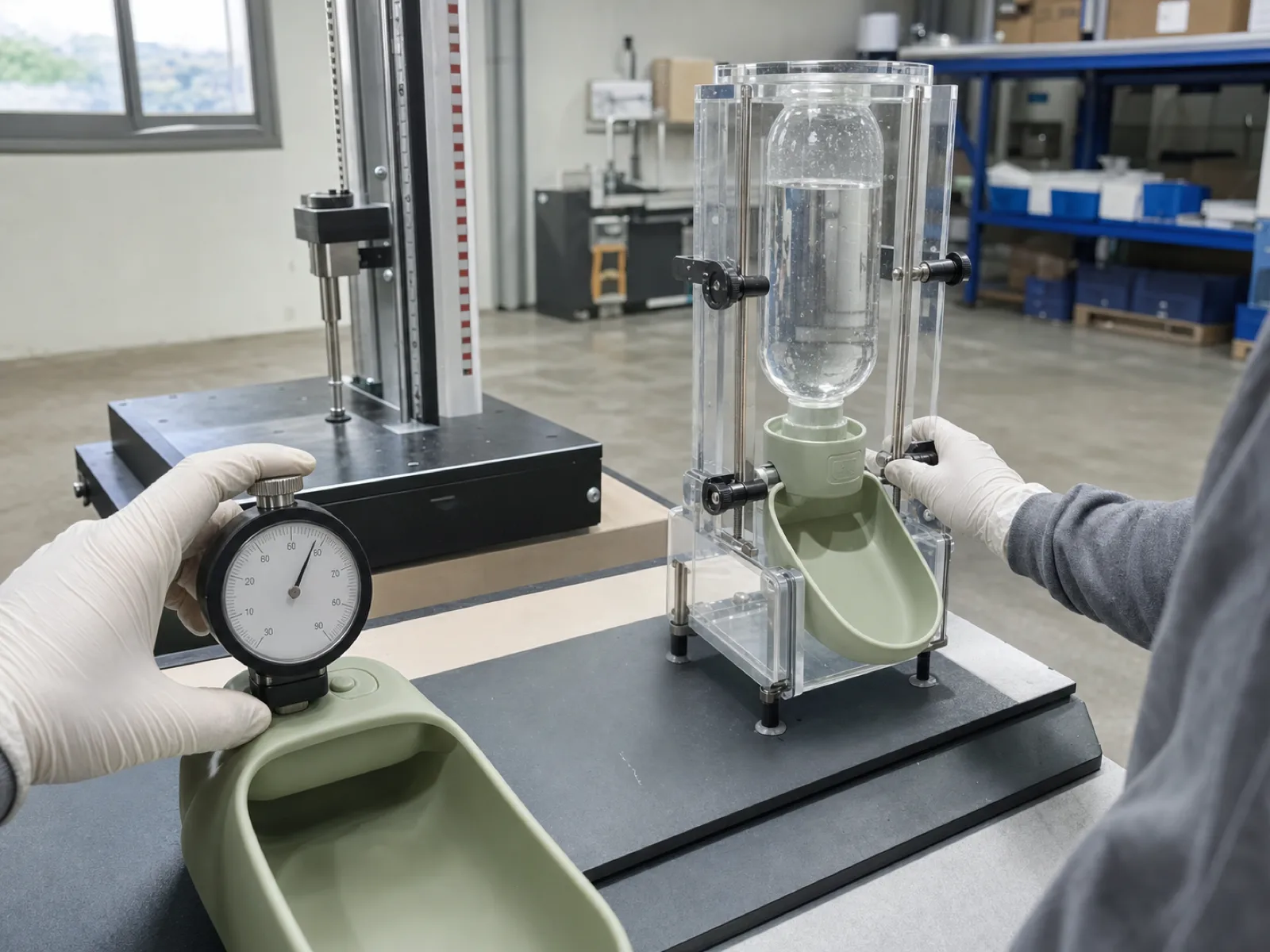
Leak-proofing is a geometry-and-test problem, not a coating or a marketing word. The seal is engineered at three interfaces: a compression gasket where the unit threads onto a bottle neck, a one-way flap or duckbill valve where water dispenses, and a stopper where the reservoir fills. The gasket is molded in softer Shore A 30–45 silicone so it deforms under thread torque, then it is proven on a filled 1.0–1.2 m drop test, a squeeze-and-invert cycle, and a static hold.
The word “leak-proof” appears on every competitor listing and is validated on almost none of them. On a silicone pet water dispenser there are three places water escapes, and each has a specific engineered defense. The thread/neck interface — where the dispenser screws onto a bottle or the cap onto the reservoir — is sealed by a molded compression gasket or an integral lip that deforms into the mating surface as the thread torques down; molding it in a softer Shore A 30–45 silicone is what lets it conform to an imperfect plastic thread and stay tight. The dispensing point — the flip leaf, spout, or squeeze outlet — often carries a one-way flap or duckbill valve so water goes out but does not slosh back and weep. The fill port is closed by a stopper or plug whose seal is a durometer-and-fit decision.
Seal geometry is necessary but not sufficient; the difference between a leak-proof claim you can defend and one you cannot is the test protocol run before the mold is approved:
| Test | What it proves | Pass criterion |
|---|---|---|
| Filled drop test (1.0–1.2 m onto hard floor) | Seal survives real-world drops in a pack | No seam weep, no valve blow-out, no crack |
| Squeeze-and-invert cycle (repeated) | Valve and gasket hold under pressure and orientation change | No leak through valve or thread after N cycles |
| Static full-hold (inverted, timed) | No slow weep at seams or gasket | Zero visible moisture at 24 h |
| Thread-torque seat check | Gasket seats leak-tight at spec torque | Sealed within torque window, not over-tightened |
A dispenser that passes all four earns the leak-proof line on the pack. One that only claims it in copy is a returns problem — and pet buyers return leaking water products at a punishing rate because the failure is visible, wet, and lands in a backpack. Wetop validates seal geometry on the physical T1 sample rather than on a drawing, which is why a dispenser program usually budgets one extra sample-correction round versus a flat part.
What capacity, dimensions, and bottle-neck adapters are standard?
Standard portable capacities run 350–580 ml, with 350 ml and 500 ml the most common retail sizes; foldable bowls and reservoirs range higher. For bottle-adapter models the critical dimension is the neck thread the unit fits — 28 mm PCO, 30 mm, and 38 mm are the common drink-bottle necks — and the SKU must state it, because an adapter sized to the wrong neck leaks or will not seat. A dual-fit or interchangeable-ring design widens compatibility at a modest tooling adder.
Capacity is a merchandising decision as much as an engineering one. A 350 ml unit is the pocket/small-dog size, a 500 ml unit is the everyday walk size, and 580 ml and up moves toward large dogs and multi-pet outings; foldable bowls and gravity reservoirs extend well past a liter. The physical trade-off is pack size versus refill frequency — a bigger reservoir means fewer refills on a hike but a bulkier product — and most retail lines carry two capacities to cover both shoppers.
For any bottle-adapter model the make-or-break dimension is the neck thread. A flip-leaf cap or squeeze adapter that fits a 28 mm PCO neck will not seat on a 38 mm sports-bottle neck, and a mismatch here is not a cosmetic flaw — it leaks or falls off. The common necks to design against:
| Bottle neck standard | Where it is found | Adapter design note |
|---|---|---|
| 28 mm PCO 1810 / 1881 | Most single-use PET water bottles | Highest-compatibility default for a universal adapter |
| 30 mm | Many reusable sport bottles | Common secondary fit |
| 38 mm | Wide-mouth sports and juice bottles | Needs its own thread; do not assume it |
| Proprietary / integrated bottle | Dispenser ships with its own bottle | Thread is yours — spec it and own the tooling |
Two OEM strategies solve the fit problem. Ship a dedicated bottle so the thread is proprietary and always fits — cleaner branding, higher unit cost. Or design a universal or dual-fit adapter, sometimes with a small range of interchangeable silicone rings, so one SKU works across the necks shoppers already own. The ring approach adds tooling but turns “does this fit my bottle?” from a return into a yes.
Compression molding or LSR injection — how is a dispenser actually made?
Silicone pet water dispensers are usually compression-molded from high-consistency rubber (HCR): a pigmented silicone slug is cured inside a heated, cavity-engraved mold under press tonnage in a few minutes, then deflashed and post-cured. LSR injection molding is reserved for very high volumes or fine valve geometry, because its higher tooling cost only pays back above roughly 200,000 pcs/year. The critical step for a drinking product is the 4-hour, 200 °C post-cure that clears residual volatiles.
The process choice is an economic decision disguised as a technical one. Compression molding places a pre-weighed slug of pigmented HCR into an open, heated cavity; the press closes under tonnage, the silicone flows to fill the trough, wall, or gasket geometry, and it cures in place. It is the right method for most dispenser components because the tooling is comparatively cheap, color changes are fast, and the flip-leaf and bowl geometries mold cleanly. The trade-off is a longer cycle and a manual deflash step, both absorbed easily at these volumes. The full process explainer is in the silicone molding process explained guide.
LSR injection molding pumps two-part liquid silicone into a closed, heated mold where it cures in 15–90 seconds, fully automated, holding tight tolerance. It shines on ultra-high volumes and on the fine, consistent geometry of a precision one-way valve or duckbill, where dimensional repeatability drives the leak-proof performance. But the tooling is multiples more expensive and color changes are slower, so for a typical dispenser program under roughly 200,000 pcs/year the automation savings never catch the tooling premium. Many programs land on a hybrid: compression-mold the trough and bowl, LSR-mold the valve.
| Factor | Compression molding (HCR) | LSR injection molding |
|---|---|---|
| Tooling cost (dispenser) | USD 3,000 – 8,000 | USD 15,000 – 45,000+ |
| Cycle time per part | 2 – 5 min | 15 – 90 s |
| Color changeover | Fast (slug swap) | Slower (purge cycle) |
| Best volume band | up to ~200,000 pcs/yr | 200,000 pcs/yr and up |
| Fine-valve dimensional repeatability | Good | Excellent |
| Right call for a dispenser | Default (trough, bowl) | Valve at very high volume |
After the part is demolded, the make-or-break step for a drinking product is the post-cure: a 4-hour bake at 200 °C that drives off residual volatiles. On a dispenser holding standing water, this is the difference between clean water and a rubber taste, so a factory that shortens it to protect throughput is disqualifying itself for a pet-hydration program.
What certifications and import documents does a dispenser program need?
A US/EU pet-hydration program needs FDA 21 CFR 177.2600 extractables clearance on the finished dispenser, LFGB §30/31 batch reports for the EU (BfR Recommendation XV as the basis), BPA/phthalate-free declarations, REACH SVHC screening on every pigment and additive, California Prop 65 screening for US retail, and an ISO 9001 supplier certificate. Screen the finished-good report, not just the raw-compound COA — customs and retailer audits reject the compound certificate in its place.
The documentation trap that catches first-time pet buyers is the finished-good versus compound distinction. A “FDA certified” claim on a listing almost always means the base silicone carries 177.2600[^fda-177-2600] clearance from its supplier, not that the finished dispenser was lot-tested by an accredited third-party lab. Because the dispenser holds drinking water, the migration test on the actual part is what a US Customs FDA review and a pet-retailer supplier audit will demand. The FDA’s food-contact framework is the authority context for why a repeated-use drinking article is graded this way[^fda-food-packaging]. The minimum documentation packet:
- Finished-good FDA 21 CFR 177.2600[^fda-177-2600] migration report from an accredited lab (Intertek, SGS, or Eurofins), per lot or per quarter
- LFGB §30/31 batch report for EU markets, with BfR Recommendation XV[^bfr-xv] as the technical basis
- BPA-free and phthalate-free declarations (silicone contains neither by chemistry; the declaration is what the retailer files)
- REACH SVHC screening[^echa-reach] on every pigment, masterbatch, and additive against the current candidate list
- California Prop 65[^oehha-prop65] statement covering the compound and colorants for US retail listings
- ISO 9001[^iso-9001] certificate — Wetop is certified since 2008
A note on claims to avoid: an “antibacterial” or “biofilm-proof” line built on a silver-ion additive turns the additive into a regulated biocide under US EPA and the EU Biocidal Products Regulation, which is a registration liability you inherit if you copy a competitor’s copy. The defensible, science-backed position is the inherent property — platinum-cured silicone is non-porous, so it gives biofilm far less to colonize than a textured plastic bottle, and it rinses and dries clean. The certification comparison that most affects a dispenser program’s paperwork is spelled out in the FDA vs LFGB silicone guide.
OEM vs ODM, MOQ tiers, tooling cost, and lead time
OEM means the factory builds to your finished design and dedicated tooling; ODM means you customize the factory's existing dispenser platform to skip new-mold cost and lead time. Wetop's MOQ starts at 500 pcs/color on existing tooling and 3,000 pcs on a new compression mold at USD 3,000–8,000 tooling cost. Samples land in 7–15 days on existing tools and 25–35 days on new tools; bulk runs 20–30 days after approval.
Most first-time pet buyers should start ODM — pick a proven flip-leaf, foldable-bowl, or squeeze platform, then customize color, capacity, adapter fit, and branding on top. It reaches market months faster and avoids sinking tooling money before the SKU proves itself. Once annual volume justifies the investment, move to a dedicated OEM mold for a distinctive dispenser you own outright. The valve-and-seal geometry is the reason a dispenser tool costs more than a flat part: it is a multi-surface sealing mold that must be validated on a filled leak test, not just dimensionally.
MOQ and tooling tier structure at Wetop (2026 pricing):
| Program tier | MOQ per color | Tooling cost | Unit price band (FOB) | Best for |
|---|---|---|---|---|
| Stock platform, Wetop packaging | 500 pcs | USD 0 | USD 1.10 – 3.20 | Sample orders, small brands |
| Stock platform, custom Pantone + logo deboss | 1,000 pcs | USD 150 – 350 (logo insert) | USD 1.00 – 2.90 | Private-label test runs |
| Custom flip-leaf / bowl, new compression mold | 3,000 pcs | USD 3,000 – 8,000 | USD 0.90 – 2.60 | Brands wanting a distinct dispenser |
| Full private-label — mold + color + clip + carton | 5,000 – 10,000 pcs | USD 4,500 – 11,000 all-in | USD 1.20 – 3.40 all-in | Pet-retail PL programs |
Sample timeline (existing tooling): color-matched pre-production sample in 7–10 days; retail-ready first-article with adapter and clip in 12–15 days. Sample timeline (new tooling): T1 sample off the new mold in 25–30 days; T2 seal-and-valve corrections in 5–7 days; production release after the filled leak test passes on T2. Bulk production: 20–30 days for a standard container order, driven by color-match sign-off, packaging artwork, and any secondary assembly such as a clip, carabiner, or dedicated bottle. If you are building the whole hydration line, the silicone slow feeder OEM guide covers the adjacent feeding-product tooling math so you can consolidate a program under one MOQ conversation.
To spec a clean RFQ, hand the factory: the form factor and capacity, the bottle-neck standard (or “ships with its own bottle”), the target Shore A per component, the Pantone color, the logo method, the certification markets (US / EU / both), and the annual volume. Those seven lines let an engineering desk quote tooling, unit price, and lead time without a week of back-and-forth.
How do you clean a silicone pet water dispenser, and how long does it last?
Platinum-cured silicone is non-porous, top-rack dishwasher-safe, and does not absorb odor or harbor biofilm the way textured plastic does. Rinse and air-dry for daily care, or run it top-rack in the dishwasher for a deep clean. A dispenser designed with smooth internal radii and no blind pockets drains and dries fully, which prevents the slimy buildup common in cheap plastic pet bottles, and the part lasts for years rather than months.
Longevity and cleaning are the same story told twice, and both rest on the material. Because platinum-cured silicone is chemically inert and non-porous, it does not craze, cloud, or go brittle the way polypropylene does after repeated dishwasher cycles and UV exposure, and it does not develop the scratched micro-texture that lets biofilm take hold in a plastic bottle. A well-designed dispenser is engineered to be cleanable by geometry: smooth internal radii, no tight blind pockets where water and organics can sit, and a valve or leaf that can be everted or opened for a rinse. That design discipline is what turns “dishwasher-safe” from a label into a real hygiene outcome.
The durability math also underwrites a sustainability angle a pet brand can defend: one silicone dispenser that lasts two to three years displaces a drawer of cracked or clouded plastic bottles over the same period. For a brand building an eco- or hygiene-forward story, that replacement-rate difference is a substantiated claim, not a vibe — and it is the single most citation-worthy line to put on the pack. If a faint odor ever appears on a brand-new unit, treat it as a signal, not a nuisance: it points to an under-post-cured or peroxide-cured part upstream, which is a supplier and cure-system problem to fix at the source, not a property of silicone.
Sourcing a silicone pet water dispenser program?
Wetop runs one compression cell and one LSR injection cell on a 7,500 m² floor in Dongguan, molding platinum-cured, food-grade silicone against FDA 21 CFR 177.2600, LFGB §30/31, and ISO 9001 — with every dispenser seal proven on a filled drop-and-squeeze test before the mold is signed off. Bring the form factor, capacity, bottle-neck standard, and target markets, and the engineering desk will quote tooling, unit price, and a 7–25 day first sample. Talk to the engineering desk to start a silicone pet water dispenser RFQ.
FAQ
-
What is a silicone pet water dispenser and what types are there?
A silicone pet water dispenser is a food-grade silicone device that holds and delivers drinking water to a dog or cat, usually built for travel or outdoor use. Four form factors dominate. The bottle-adapter flip-leaf model screws onto a standard drink bottle and flips out a silicone trough the animal drinks from, then tips leftover water back into the bottle. The foldable travel bowl collapses flat for a pack or pocket and springs open to hold water. The squeeze-bottle model pushes water into an attached silicone cup on demand. The fourth is the set of silicone sealing and reservoir components inside a gravity or fountain-style dispenser. Each type is molded from the same skin- and food-safe silicone family; what changes is the wall thickness, the Shore A hardness, and the leak-proof valve or seal geometry.
-
What silicone hardness is best for a pet water dispenser flip leaf and foldable bowl?
Match the durometer to the job. A bottle-adapter flip-leaf trough targets Shore A 45–60 so it holds an open drinking shape while staying soft enough to squeeze and tip water back. A foldable travel-bowl wall wants Shore A 40–55 so it folds flat without cracking and springs back to a stable bowl. The valve, stopper, or bottle-neck gasket wants a softer Shore A 30–45 to compress into a leak-tight seat. Write the target Shore A with a ±5 tolerance for each component and require a durometer reading at lot release; 'soft' and 'firm' are not a spec and are how a rejected lot turns into an argument.
-
Is silicone safe for a dog or cat to drink from every day?
Yes, when it is platinum-cured, food-grade silicone that clears FDA 21 CFR 177.2600 and LFGB. Platinum-cured silicone is chemically inert, non-porous, and does not leach BPA, BPS, phthalates, or PVC because it contains none by chemistry. The safety failure mode to design out is cure system: peroxide-cured silicone can retain benzoic-acid byproducts that off-gas a rubber odor into standing water, which makes animals refuse to drink and reads as a quality defect. Specify platinum cure and a finished-good migration report, not a raw-compound certificate, and the daily-drinking-water claim is defensible.
-
How is a silicone pet water dispenser made leak-proof?
Leak-proofing is a geometry-and-test problem, not a coating. The seal is engineered at the interface: a compression gasket where the dispenser threads onto a bottle neck, a molded one-way flap or duckbill valve where water is dispensed, and a stopper or plug where the reservoir is filled. The gasket is molded in a softer Shore A 30–45 silicone so it deforms into the mating surface under thread torque. It is then proven, not assumed: a filled unit takes a 1.0–1.2 m drop test onto hard floor, a repeated squeeze-and-invert cycle, and a static hold to confirm no weep at the seams. A dispenser that passes those three tests earns the leak-proof line on the pack; one that only claims it in copy is a returns problem waiting to happen.
-
What capacity and bottle-neck sizes are standard for a portable pet water dispenser?
Standard portable capacities run 350–580 ml, with 350 ml and 500 ml the most common retail sizes; larger foldable bowls and gravity reservoirs range higher. For bottle-adapter models the critical dimension is the neck thread it fits: 28 mm PCO, 30 mm, and 38 mm are the widely used drink-bottle necks, and the SKU must state which one because an adapter sized to the wrong neck leaks or will not seat at all. A dual-fit design or a small range of interchangeable adapter rings widens compatibility, at a modest tooling adder.
-
What is the MOQ and tooling cost for a custom silicone pet water dispenser?
Wetop's silicone pet water dispenser MOQ starts at 500 pcs per color on existing tooling. A custom flip-leaf shape, foldable-bowl profile, or a proprietary valve that needs a new compression mold starts at 3,000 pcs to amortize a USD 3,000–8,000 tooling cost, higher than a simple flat part because a dispenser is a multi-surface, sealing geometry. A full private-label program — custom mold, Pantone color, debossed logo, a printed clip or carabiner, and retail packaging — typically runs 5,000–10,000 pcs to hit pet-retail landed-cost targets.
-
How long does sampling and production take for a custom pet water dispenser?
On existing tooling, a color-matched pre-production sample takes 7–15 days. A new custom compression mold takes 25–35 days for a T1 sample, plus 5–7 days for corrections after your review, and a dispenser usually needs one extra correction round because the seal and valve are validated on the physical part, not on a drawing. Bulk production runs 20–30 days after sample approval for a standard container order, subject to color-match sign-off, packaging artwork, and any secondary assembly such as a clip, carabiner, or bottle.
-
Can the factory add our logo, Pantone color, and private-label packaging to the dispenser?
Yes. Wetop's color desk matches Pantone solid-coated within ΔE ≤ 1.5 on a D65 light box using platinum-cured masterbatch, so the trough, bowl, and adapter ring can all carry a brand color. Logos are debossed or embossed into the mold cavity at roughly USD 150–350 per insert with zero unit-cost adder and unlimited wash durability, which is the right method on a wet, dishwasher-cleaned product; a pad-printed or heat-transfer logo is available for multi-color artwork but wears faster in a dishwasher. Packaging spans polybag, kraft hang card, printed sleeve, and full-color retail box with a custom hangtag.
-
How do you clean a silicone pet water dispenser and does it hold odor?
Platinum-cured silicone is non-porous and top-rack dishwasher-safe, and it does not absorb odor or harbor biofilm the way a porous or textured plastic dispenser can. For daily care, rinse and air-dry; for a deeper clean, run it top-rack in the dishwasher or hand-wash with warm soapy water. A dispenser designed with smooth internal radii and no tight blind pockets drains and dries fully, which is what prevents the slimy biofilm that builds in cheap plastic pet bottles. If a faint odor ever appears on a new unit, it indicates an under-post-cured or peroxide-cured part, not a property of silicone itself.
References
Authoritative sources cited in this guide
- US Food and Drug Administration. 21 CFR 177.2600 — Rubber articles intended for repeated use. https://www.ecfr.gov/current/title-21/chapter-I/subchapter-B/part-177/subpart-C/section-177.2600 — The controlling US extractables limit for repeated-use silicone in food- and drinking-water-contact articles — total extractives in n-hexane ≤ 20 mg/in² — used here as the baseline migration standard for a pet water dispenser.
- International Organization for Standardization. ISO 9001:2015 — Quality Management Systems — Requirements. https://www.iso.org/standard/62085.html — The QMS Wetop is certified against — the documented quality system a pet-retail supplier audit and a leak-test lot-release protocol are built on top of.
- ASTM International. ASTM International — Standards & Publications. https://www.astm.org/products-services/standards-and-publications/standards.html — Source for ASTM D2240 durometer methodology used to bench-verify the Shore A hardness spec on the flip leaf, bowl wall, and valve gasket of a silicone pet water dispenser.
- German Federal Institute for Risk Assessment (BfR). BfR Recommendations on Food Contact Materials — Recommendation XV, Silicones. https://www.bfr.bund.de/en/bfr_recommendations_on_food_contact_materials-7498.html — The technical basis for LFGB §30/31 clearance on repeated-contact silicone — sets peroxide residual and volatile-matter limits relevant to the odor-into-water failure mode of a pet dispenser.
- European Chemicals Agency (ECHA) / EUR-Lex. REACH Regulation (EC) No 1907/2006 — Registration, Evaluation, Authorisation and Restriction of Chemicals. https://eur-lex.europa.eu/legal-content/EN/TXT/?uri=CELEX%3A32006R1907 — Screening framework for every masterbatch, pigment, and additive used in a silicone pet water dispenser sold into the EU — the SVHC candidate-list check an importer must file.
- California Office of Environmental Health Hazard Assessment (OEHHA). Proposition 65 — The Safe Drinking Water and Toxic Enforcement Act. https://oehha.ca.gov/proposition-65 — The California list a pet-product importer must screen a dispenser's compound and colorants against before a US retail listing, referenced here for the pigment and additive compliance step.
- US Food and Drug Administration. Food Ingredients & Packaging. https://www.fda.gov/food/food-ingredients-packaging — FDA's landing page for food-contact substance regulation — the authority context for why a repeated-use drinking-water article is graded under 21 CFR 177.2600.
- US National Library of Medicine (PubMed). Silicone in food-contact and biomedical applications — safety review. https://pubmed.ncbi.nlm.nih.gov/23256725/ — Peer-reviewed migration and biocompatibility data underpinning the FDA and LFGB clearance of platinum-cured silicone for repeated drinking-water contact.
Start a custom program
Send a brief. Get an engineer’s reply in one business day.
Every Wetop program is tooled from a customer’s specification. Send a CAD file (STEP · IGES · DWG) or a written brief and we’ll reply with a mold cost estimate, price brackets at MOQ 500 / 1,000 / 5,000, and any engineering questions.