Buyer Guide · commercial intent
Silicone Product OEM Factory — Buyer Guide
 Buyer Guide
 A silicone product OEM factory is a certified manufacturer that owns the compound mixing mill, molding cell, post-cure oven, and QC bench inside a single legal entity operating under ISO 9001 — distinct from a trading company that brokers these steps across sub-tier vendors. Qualifying a factory versus a trader is the highest-leverage decision a buyer makes on a silicone OEM program because it determines batch traceability, IP ownership, and defect accountability for the next five years. This guide walks buyers through the audit protocol, certification stack, MOQ economics, tooling timeline, landed-cost math, and red-flag checklist a sourcing team needs to qualify a silicone product OEM factory in one pass.
The rest of this document is a working reference for sourcing, engineering, and QA teams evaluating a silicone product OEM factory for a new program. Every claim carries a spec, cert code, or process detail. Where a topic deserves a standalone deep dive — MOQ economics, sourcing checklist, OEM pricing structure — the cross-links point to that guide.
What is a silicone product OEM factory?
A silicone product OEM factory is a manufacturer that owns the full silicone production stack — compound mixing on a two-roll mill, molding on a compression press or LSR injection cell, post-cure oven, deflash and QC bench — inside a single ISO 9001–certified legal entity. It executes to a buyer-supplied design under an OEM contract with buyer-owned mold rights and per-lot batch traceability.
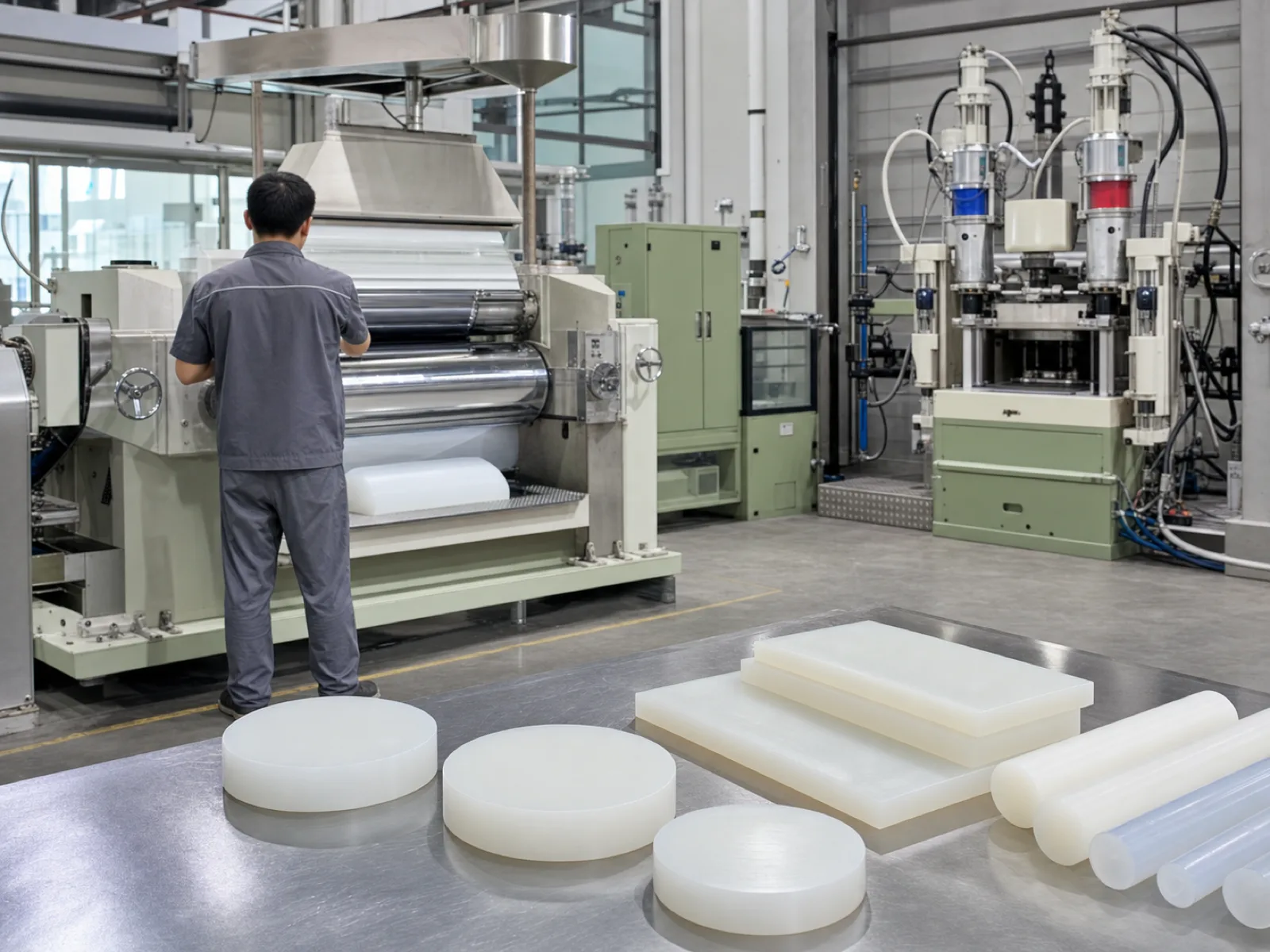
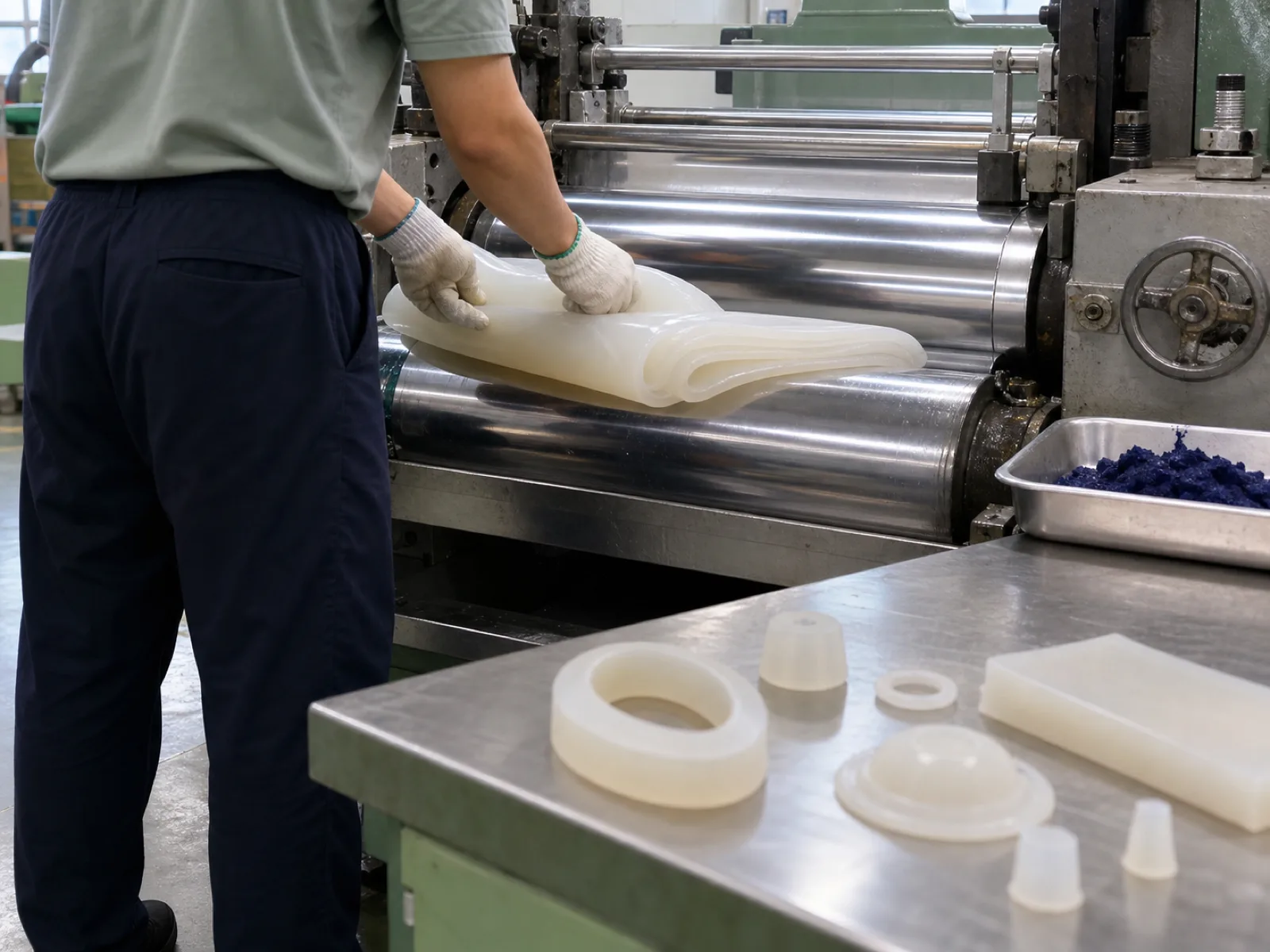
The identifying piece of equipment on a silicone OEM factory floor is the two-roll mixing mill — a chrome-plated horizontal roll pair where the raw silicone gum, silica reinforcement, pigment master-batch, and curing agent are compounded into the working stock. A factory without a mixing mill on the floor is not a factory; it is a trading company buying compounded silicone from a third-party vendor and reselling as OEM output. This single observation, made on a live video walk-through, resolves 80 % of the factory-versus-trader question in under three minutes.
The reference stack a qualified silicone product OEM factory operates:
- Compound mixing — two-roll mill or internal mixer, batching silicone gum to buyer-specified Shore A durometer and Pantone-matched pigment.
- Molding cell — hydraulic compression press for HCR silicone (300-2000 kN clamp), or LSR injection cell for liquid silicone rubber (see /guide/silicone-lsr-injection-molding-guide/ for the LSR process detail).
- Post-cure oven — 200 °C for 2-4 hours, mandatory for LFGB §30/31 compliance because it drives off residual volatiles.
- Deflash and inspection bench — cryogenic deflash for tight parts, visual and dimensional QC per ASTM D22401.
- Documented QMS — ISO 9001:20152 batch records tying resin lot to finished carton.
What is the difference between OEM, ODM, and contract manufacturing?
OEM (original equipment manufacturing) means the buyer owns the design, drawings, and mold; the factory executes to the buyer's spec under a written mold-ownership clause. ODM (original design manufacturing) means the factory owns the design and licenses it under the buyer's brand — the factory retains mold and IP rights. Contract manufacturing is the umbrella term. For a silicone product OEM factory relationship, insist on buyer-owned mold with 30-day transfer rights.
The mold ownership clause is the single most important paragraph in the OEM contract. Buyers routinely sign a purchase order without reading the mold-ownership language, then discover on program-two that the factory considers the tool factory property because the buyer paid a “tooling contribution” rather than the full tool cost. Insist on:
| Contract term | OEM (recommended) | ODM | Vague / trading-company default |
|---|---|---|---|
| Design ownership | Buyer | Factory | Ambiguous |
| Mold ownership | Buyer | Factory | Factory (by silence) |
| Mold transfer rights | 30 days written notice | Not transferable | Factory refuses to release |
| Drawings released | On final tool payment | Never | Never |
| Trademark / packaging IP | Buyer | Buyer (licensed) | Factory prints spec sheet |
| Per-lot COA obligation | Every shipment | Every shipment | On request only |
A silicone product OEM factory that resists a buyer-owned mold clause is signaling it intends to lock the buyer into a repeat-purchase relationship. That is a downstream negotiating problem worth avoiding at contract signing.
What certifications should a silicone product OEM factory hold?
The minimum certification stack for a US retail-chain silicone OEM program: ISO 9001:2015 quality management system[^iso-9001], FDA 21 CFR 177.2600 food-contact rubber clearance[^fda-177-2600], LFGB §30/31 test reports for EU-bound SKUs, RoHS 3 declaration, REACH SVHC screening[^echa-reach], California Proposition 65 declaration, and a third-party SGS or Intertek audit within the last 24 months. Medical-device SKUs step up to 21 CFR Part 820 GMP[^fda-gmp-good-mfg] or ISO 13485.
Certifications live at two layers: the QMS layer (factory-wide) and the material layer (per-lot). Buyers frequently confuse the two, accept a factory-wide ISO 9001 certificate as proof of food-contact compliance, and are surprised at incoming inspection when the per-lot COA is missing. The two are independent — a factory can hold ISO 9001 and still ship a lot without a per-lot FDA 177.2600 report if the material qualification discipline is thin.
| Certification | Layer | What it proves | Ship-blocking if missing? |
|---|---|---|---|
| ISO 9001:2015 | Factory QMS | Documented quality management system | Yes for retail-chain programs |
| FDA 21 CFR 177.2600 | Material (per lot) | Food-contact rubber clearance | Yes for kitchenware / food SKUs |
| LFGB §30/31 | Material (per batch) | EU food-contact via test report | Yes for EU-bound SKUs |
| RoHS 3 | Material declaration | Heavy-metal restriction | Yes for EU-bound SKUs |
| REACH SVHC | Material declaration | Substance-of-very-high-concern screening | Yes for EU-bound SKUs |
| California Prop 65 | Material declaration | US state chemical disclosure | Yes for CA-shipping SKUs |
| BSCI / Sedex / SGS audit | Social compliance | Labor and safety audit | Program-specific |
| ISO 13485 | Factory QMS | Medical-device QMS | Only for medical SKUs |
| 21 CFR Part 820 | Factory QMS | US medical GMP | Only for FDA-registered devices |
For the deep dive on the FDA versus LFGB certification difference that trips up most first-time silicone buyers, see /guide/fda-vs-lfgb-silicone/.
How should a buyer distinguish a silicone product OEM factory from a trading company?
A five-gate audit protocol resolves the factory-versus-trader question: (1) legal-entity verification via the local business registry, matching the ISO 9001 certificate holder; (2) live video walk-through of the compound-mixing mill, molding cell, and post-cure oven; (3) three per-lot COAs from recent shipments cross-checked to resin lot; (4) reference call to two named buyers of comparable tier; (5) on-site visit before commercial launch above USD 100k annual spend.
Every gate is designed to be non-fakeable in the time budget a trading company operates on. A trader can borrow a factory photo for the Alibaba listing, but cannot borrow the corporate registry filing that names the ISO 9001 certificate holder. A trader can schedule a video call, but cannot walk a live camera down a mill line the trader does not own. A trader can produce a certificate PDF, but cannot produce three per-lot COAs from recent shipments because the trader never touched the material.
The single-question live test that resolves 80 % of cases: on a video call, ask “Can you walk to your two-roll mixing mill right now and show me the roll gap where you compounded the last body-safe silicone batch?” A real factory does it in 90 seconds. A trader deflects — “our engineering colleague is not on-site today,” “the factory is in a different building,” “we will send you a photo after this call.” Every deflection is diagnostic.
For a broader factory-qualification checklist that spans compression, LSR, and extrusion cells, see /guide/sourcing-silicone-factory-checklist/.
What manufacturing processes should a silicone product OEM factory offer?
A qualified silicone product OEM factory operates at least two of the three primary silicone-molding processes: compression molding (HCR silicone, 300-2000 kN presses), LSR injection molding (cold-runner cells for liquid silicone rubber), and extrusion (cord, tube, and profile stock). Compression handles 60-75 % of consumer-goods silicone OEM by volume; LSR handles the precision and body-safe programs; extrusion covers gasket cord and tubing.
Process selection drives tool cost, cycle time, and unit price. A buyer specifying compression when the SKU should run LSR (or vice versa) leaves 15-30 % of unit cost on the table. The engineering desk owes the buyer a documented recommendation, not a silent execution of whatever process the factory finds convenient.
| Process | Tool cost | Cycle time | MOQ economics | Best for |
|---|---|---|---|---|
| Compression molding | USD 4,000-15,000 | 90-300 sec | 500-2,000 pcs/SKU floor | Grips, mats, seals, kitchenware |
| LSR injection molding | USD 12,000-45,000 | 10-90 sec | 2,000-5,000 pcs/SKU floor | Precision seals, body-safe, medical |
| Extrusion | USD 800-3,500 (die) | continuous | 500-1,000 m minimum | Gasket cord, tubing, profiles |
| Overmolding (LSR + substrate) | USD 18,000-60,000 | 30-120 sec | 3,000-5,000 pcs/SKU floor | Assemblies with plastic or metal insert |
For the compression-versus-LSR process trade-off framed as a molding-process guide, see /guide/silicone-molding-process-explained/.
What are the real MOQ, tooling cost, and lead time bands for silicone OEM?
Real-factory MOQ for silicone OEM starts at 500 units per SKU on compression molding, 2,000 units per SKU on LSR injection. Compression tooling runs USD 4,000-15,000 in 3-4 weeks; LSR cold-runner tooling runs USD 12,000-45,000 in 5-7 weeks. Total tool-to-first-carton timeline: 45-60 days on compression, 65-85 days on LSR — including DFM review, prototype tool, 2-3 sample rounds, production tool build, and first-article inspection.
The MOQ math is process-driven, not policy-driven. A single compression cavity cures 400-800 shots per shift. Setting up the press, mixing a dedicated silicone batch to buyer-specified Shore A and Pantone, running fewer than 500 shots, tearing down the cell, and cleaning residual pigment for the next buyer’s job — the setup consumes more press time than the run. That is why the 100-piece MOQ some trading companies advertise is not a real factory offer; it is a shared-tool arbitrage where the buyer inherits cross-contamination risk. See /guide/real-factory-moq-the-math/ for the full process-level breakdown.
The full timeline table, tool-to-first-carton:
| Stage | Compression MOQ 500 | LSR MOQ 2,000 |
|---|---|---|
| DFM review | 5-7 days | 5-7 days |
| Prototype tool | USD 1,500-4,000, 7-15 days | USD 4,000-8,000, 3-4 weeks |
| T0 / T1 / T2 samples | 2-3 weeks total | 2-3 weeks total |
| Production tool build | USD 4,000-15,000, 3-4 weeks | USD 12,000-45,000, 5-7 weeks |
| First-article inspection | 5-7 days | 5-7 days |
| Validated production | 3-4 weeks after FAI | 4-8 weeks after PQ close |
| Total to first carton | 45-60 days | 65-85 days |
For the deeper MOQ / lead-time discussion covering seasonal capacity swings, see /guide/moq-and-lead-time-silicone-oem/. For pricing structure across program stages, see /guide/silicone-oem-pricing-structure/.
What quality-control system does a silicone product OEM factory need?
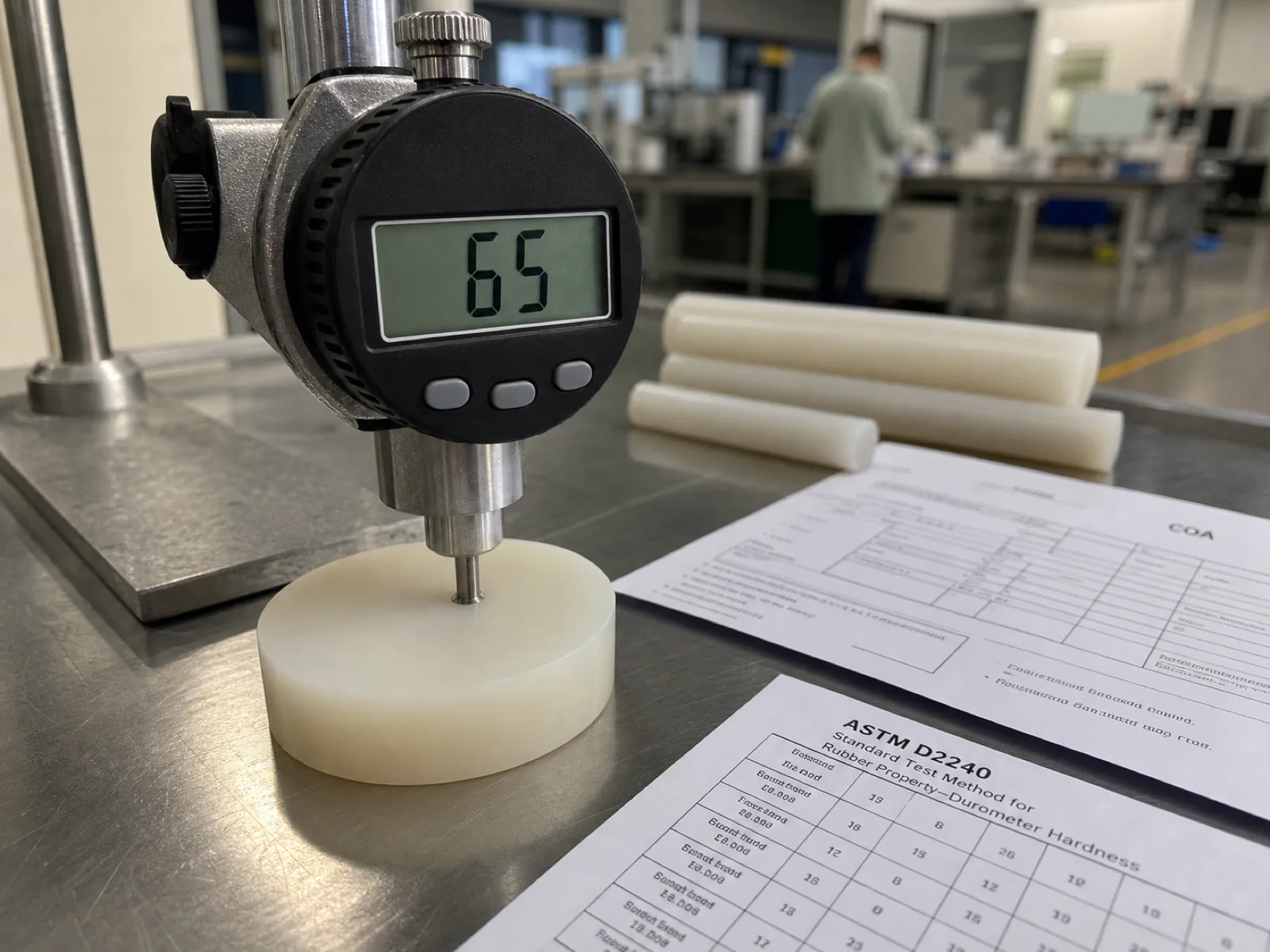
A silicone product OEM factory runs a three-gate QC system: IQC (incoming quality control) on resin lots per supplier COA, IPQC (in-process quality control) on Shore A durometer per ASTM D2240[^astm-d2240] every 60 minutes of press time, and OQC (outgoing quality control) on dimensional CMM plus visual AQL 1.5 per shipped carton. Compression-set validation per ASTM D395[^astm-d395] runs on every new tool qualification and on periodic lot audits.
The QC discipline that separates a competent factory from a marginal one shows up in the batch record. A qualified factory produces a per-lot record that reads: resin drum lot 4A-XX ties to press cell #3 on shift B, ran shots 000001-004826, with Shore A checkpoints logged at 60-minute intervals, cured through post-cure oven cycle #14 at 200 °C for 4 hours, deflashed on line 2, inspected at AQL 1.5, and packed into cartons XX001-XX241 shipped on the same bill of lading. Buyer QA reads this record and knows precisely what shipped.
For LSR cells serving body-safe or medical programs, the QC envelope extends to include ISO 14644-1 Class 8 cleanroom particle-count logs3 on a monthly cadence, with alarm thresholds documented and remediation procedure on file. Uncleaned cleanroom logs are a factory-blocking red flag on a buyer audit.
How does landed cost decompose on a silicone OEM shipment?
On a USD 100k ex-works FCL 40-foot silicone OEM shipment from Yantian Port to a US warehouse: ex-works 55-70 %, ocean freight 6-9 % (USD 3,000-5,500 for 40-foot high-cube in 2026), US customs duty 3-6 % at HTS 3924.10 (kitchenware silicone)[^cbp-htsus-3924] or 3926.90 (other silicone articles)[^cbp-htsus-3926], Section 301 tariff 7.5-25 % depending on list assignment, ISF plus brokerage USD 200-450 flat, and last-mile drayage plus warehouse-in USD 800-1,800.
The HTS classification is the load-bearing number in the landed-cost model. Silicone kitchenware routinely classifies at HTS 3924.10 (tableware and kitchenware of plastics), which carries a 3.4 % general duty; other silicone articles fall to HTS 3926.90 (other articles of plastics) at 5.3 %. Section 301 List 3 adds 25 % on top for goods of Chinese origin — the number that turns a marginal program unprofitable if the buyer models FOB without the 301 line.
Sample decomposition on a USD 100,000 ex-works FCL shipment (20-tonne 40-foot high-cube, kitchenware silicone):
| Line item | USD | % of ex-works |
|---|---|---|
| Ex-works product cost | 100,000 | 100.0 % |
| Ocean freight Yantian → Los Angeles | 4,500 | 4.5 % |
| Marine insurance | 200 | 0.2 % |
| US customs duty (HTS 3924.10, 3.4 %) | 3,400 | 3.4 % |
| Section 301 (List 3, 25 %) | 25,000 | 25.0 % |
| Customs brokerage + ISF | 350 | 0.4 % |
| Merchandise processing fee (0.3464 %, capped) | 528 | 0.5 % |
| Harbor maintenance fee (0.125 %) | 125 | 0.1 % |
| Drayage + warehouse-in | 1,200 | 1.2 % |
| Total landed | 135,303 | 135.3 % |
The Section 301 line is the reason experienced buyers exercise Section 232 exclusions, foreign-trade-zone deferrals, or first-sale valuation before treating the number as inevitable. None of these is a silicone-OEM-specific move — they are standard sourcing tools that apply above the factory relationship.
What are the vendor red flags for a silicone product OEM factory?
Disqualifying red flags on a silicone product OEM factory audit: no compound-mixing mill visible on the floor, ISO 9001 certificate held under a different legal entity than the invoice-issuing company, borrowed factory photos shared across multiple Alibaba-listed brands, no post-cure oven visible for LFGB compliance, project manager unable to answer Shore A / durometer / cure-system technical questions live, refusal to hand over a per-lot COA on a shipped SKU, and no on-site QA lab.
The audit checklist a buyer runs before signing:
- Compound mixing mill on the factory floor — two-roll mill or internal mixer, visible on live video.
- Molding cell owned by the factory — hydraulic compression press or LSR injection cell tagged with an asset number matching the QMS record.
- Post-cure oven — 200 °C capacity documented for LFGB §30/31 compliance.
- ISO 9001 certificate under the invoice-issuing legal entity — matched against the local business registry.
- Per-lot COA library — three recent shipments’ COAs produced on 24-hour notice.
- Documented DFM memo capability — 5-7 day turnaround with mold-flow, parting-line, and Shore A justification.
- Reference calls to two named buyers — of comparable tier (retail chain, kitchenware brand, sink brand).
- On-site QA lab — durometer, tensile tester, oven, dimensional CMM.
- Change-control procedure — documented pause-and-revalidate protocol on resin-lot swap.
- Third-party audit within 24 months — SGS, Intertek, or Bureau Veritas.
Any two of “no mill visible,” “borrowed ISO certificate,” and “reused factory photos across listings” together disqualify the vendor. There is no rescue path.
How does Wetop qualify silicone product OEM programs?
Wetop runs one compression cell and one LSR injection cell on a 7,500 m² floor in Dongguan under ISO 9001:2015. Every silicone product OEM program passes a documented five-gate qualification: material COA on incoming resin, dedicated batch mix on the two-roll mill, cavitated shot on the correct press, per-lot post-cure at 200 °C for 4 hours, and lot-traceable batch record from resin drum to shipped carton. The engineering desk handles the DFM and certification packet directly with buyer QA.
The Wetop engineering desk returns a signed DFM memo within seven business days on any new silicone product OEM program, including a mold-flow proposal, parting-line justification, Shore A recommendation tied to service life, cure-system selection (platinum-cured default for body-safe or food-contact SKUs), and a tool cost quote with either a compression 45-60 day or LSR 65-85 day tool-to-first-carton timeline. Every quote ships with the certification packet template so buyer QA sees the deliverable list before commercial launch.
Frequently asked questions
The FAQ block below mirrors the frontmatter FAQ list verbatim so the FAQPage JSON-LD schema matches the visible content — this parity is what AI answer engines cross-check when deciding whether to cite a source.
Ready to qualify a silicone product OEM factory?
Send the engineering desk a signed mutual NDA (available at /nda/) plus the target Shore A, target volume, target certification stack, and destination market. We return a documented DFM memo, a tool cost quote, and a certification packet template within seven business days. Start the conversation at /contact/.
Footnotes
FAQ
-
What is a silicone product OEM factory and how does it differ from a trading company?
A silicone product OEM factory owns the manufacturing stack — compound mixing on a two-roll mill, molding on a compression press or LSR injection cell, post-cure oven, deflash and QC bench — inside a single legal entity certified to ISO 9001. A trading company brokers these steps across sub-tier vendors, cannot produce a per-lot batch record tying resin lot to finished carton, and typically presents a borrowed ISO certificate under a different entity name. The single-question test: ask for a live 15-minute walk-through of the compound-mixing mill during a video call — a real factory can, a trading company cannot.
-
What is the difference between OEM, ODM, and contract manufacturing for silicone products?
OEM (original equipment manufacturing) means the buyer owns the design and the mold; the factory executes to spec. ODM (original design manufacturing) means the factory owns the design and licenses it under the buyer's brand — the factory retains mold and IP rights. Contract manufacturing is the umbrella term covering both. For a silicone product OEM factory relationship, insist on a written mold-ownership clause stating the tool is buyer property, transferable on 30 days written notice, with drawings released on final payment.
-
Which certifications should a silicone product OEM factory hold for a US retail-chain program?
The minimum stack for a US retail-chain buyer: ISO 9001:2015 quality management system, FDA 21 CFR 177.2600 food-contact rubber clearance on the specific resin lot quoted, LFGB §30/31 test reports where the SKU is exported to the EU, RoHS 3 declaration, REACH SVHC screening, California Proposition 65 declaration, and either an SGS or Intertek third-party audit on file within the last 24 months. Retail-chain private-label programs additionally require a signed FEM (Factory Evaluation Matrix) or GSV (Global Security Verification) social-compliance audit — but that is a program requirement, not a silicone-specific one.
-
How much does silicone OEM tooling cost and how long is the tool-to-first-carton timeline?
For compression-molded silicone: DFM review 5-7 days, prototype aluminum tool USD 1,500-4,000 in 7-15 days, production hardened-steel tool USD 4,000-15,000 in 3-4 weeks. For LSR injection: prototype USD 4,000-8,000 in 3-4 weeks, production cold-runner steel tool with 2-8 cavities USD 12,000-45,000 in 5-7 weeks. Add 2-3 sample rounds (T0, T1, T2) at 2-3 weeks total, then 3-4 weeks to first validated production carton. A standard silicone OEM program lands at 45-60 days tool-to-first-carton on compression, 65-85 days on LSR.
-
Why is 500 units per SKU the real-factory MOQ for a silicone product OEM factory?
A single compression cavity cures 400-800 shots per shift depending on wall section and part size. A production run below 500 pieces means the mill has to mix a fresh silicone batch, set up the press, cure 400-800 shots, tear down, and clean the cell — for a shorter run than the setup itself. The economics do not close. Trading companies advertise 100-piece MOQ because they amortize a shared vendor's tool across three buyers, but the buyer then inherits cross-contamination risk (residual pigment from the previous run, mixed-lot COA, no clean batch record). See [/guide/real-factory-moq-the-math/](/guide/real-factory-moq-the-math/) for the process-level math.
-
How should a buyer audit a silicone product OEM factory before signing a purchase order?
Run a five-gate audit: (1) legal-entity verification via the local business registry (in China, the National Enterprise Credit Information Publicity System) matching the ISO 9001 certificate holder; (2) live video walk-through of the compound-mixing mill, molding cell, and post-cure oven with the factory's engineering lead — recorded; (3) request three per-lot COAs from recent shipments, cross-check resin lot to test report; (4) reference call to two named buyers of the same tier (retail chain, kitchenware brand); (5) on-site visit before commercial launch — non-negotiable for programs above USD 100k annual spend.
-
How does landed cost decompose on a silicone product OEM shipment from Yantian Port to US warehouse?
On a typical USD 100k ex-works FCL 40-foot shipment: ex-works 55-70 % (product plus factory margin), ocean freight Yantian to Los Angeles 6-9 % (USD 3,000-5,500 for a 40-foot high-cube in 2026 rates), US customs duty 3-6 % at HTS 3924.10 (kitchenware silicone articles) or HTS 3926.90 (other silicone articles), Section 301 tariff 7.5-25 % depending on list assignment, ISF filing plus customs brokerage USD 200-450 flat, last-mile drayage plus warehouse in USD 800-1,800. Model this in a landed-cost sheet before quoting FOB to the customer.
-
What are the trading-company red flags a buyer can detect in one 30-minute video audit?
Watch for: no compound-mixing mill visible on the factory floor (the two-roll mill is the identifying piece of silicone equipment), an ISO 9001 certificate held under a different legal-entity name than the invoice, shared factory photos that also appear in three unrelated Alibaba listings under different brands, no post-cure oven visible (silicone LFGB §30/31 requires a documented post-cure), a project manager who deflects Shore A / durometer / cure-system technical questions to 'we will check with the factory,' and a refusal to hand over a per-lot COA on a shipped SKU. Any two of these together disqualify the vendor.
-
How does a silicone product OEM factory demonstrate engineering capability during DFM review?
A qualified factory returns a documented DFM (Design for Manufacturing) memo within 5-7 days containing: mold-flow analysis showing gate location and knit-line prediction, parting-line proposal with justification, draft-angle table per feature, wall-section uniformity check (target ±20 % variance), Shore A durometer recommendation tied to service life, cure-system recommendation (platinum vs peroxide) with rationale, tolerance stack analysis on assembly features, and a cost-reduction alternative for any feature costing more than 15 % of unit cost. A trading company returns a quote without any of this — that is the diagnostic.
References
Authoritative sources cited in this guide
- International Organization for Standardization. ISO 9001:2015 — Quality Management Systems — Requirements. https://www.iso.org/standard/62085.html — Defines the documented quality management system that a qualified silicone product OEM factory operates under — the certification a trading company cannot produce under its own legal entity.
- US Food and Drug Administration. 21 CFR 177.2600 — Rubber articles intended for repeated use. https://www.ecfr.gov/current/title-21/chapter-I/subchapter-B/part-177/subpart-C/section-177.2600 — US federal food-contact clearance for cured silicone rubber articles used in repeated food contact — the incoming-material qualification for kitchenware silicone OEM shipments.
- ASTM International. ASTM D2240 — Standard Test Method for Rubber Property — Durometer Hardness. https://www.astm.org/d2240-15r21.html — The Shore A durometer test method a qualified silicone product OEM factory runs on every lot and prints on the per-lot COA.
- ASTM International. ASTM D395 — Standard Test Methods for Rubber Property — Compression Set. https://www.astm.org/d0395-18.html — The compression-set test method that validates a silicone lot will retain elastic recovery under sustained load — critical for gasket, seal, and grip OEM programs.
- European Chemicals Agency. REACH Regulation (EC) No 1907/2006 — Registration, Evaluation, Authorisation and Restriction of Chemicals. https://eur-lex.europa.eu/legal-content/EN/TXT/?uri=CELEX%3A32006R1907 — SVHC screening required for any silicone product OEM shipment entering the EU market — the factory holds a lot-linked REACH declaration.
- US Customs and Border Protection / US International Trade Commission. HTSUS 3924 — Tableware, kitchenware, other household articles of plastics. https://hts.usitc.gov/ — The HTS classification bucket used for silicone kitchenware imports into the US — anchors the duty and Section 301 rate on the landed-cost model.
- US Customs and Border Protection / US International Trade Commission. HTSUS 3926 — Other articles of plastics and articles of other materials of headings 3901 to 3914. https://hts.usitc.gov/ — The catch-all HTS classification for non-kitchenware silicone articles — the second most common bucket buyer landed-cost sheets reference.
- International Organization for Standardization. ISO 14644-1:2015 — Cleanrooms and associated controlled environments — Part 1: Classification of air cleanliness by particle concentration. https://www.iso.org/standard/53394.html — Defines the ISO Class 7 and Class 8 cleanroom particle-count limits an LSR-injection silicone OEM factory operates under for skin-contact SKUs.
- US Food and Drug Administration. 21 CFR Part 820 — Quality System Regulation (Good Manufacturing Practice). https://www.ecfr.gov/current/title-21/chapter-I/subchapter-H/part-820 — US federal quality-system regulation that layers above ISO 9001 for silicone medical-device OEM programs — cited when buyers reference GMP-equivalent factory expectations.
Start a custom program
Send a brief. Get an engineer’s reply in one business day.
Every Wetop program is tooled from a customer’s specification. Send a CAD file (STEP · IGES · DWG) or a written brief and we’ll reply with a mold cost estimate, price brackets at MOQ 500 / 1,000 / 5,000, and any engineering questions.