Buyer Guide · commercial intent
Silicone Rubber Seal Manufacturer: OEM Buyer Guide
 Buyer Guide
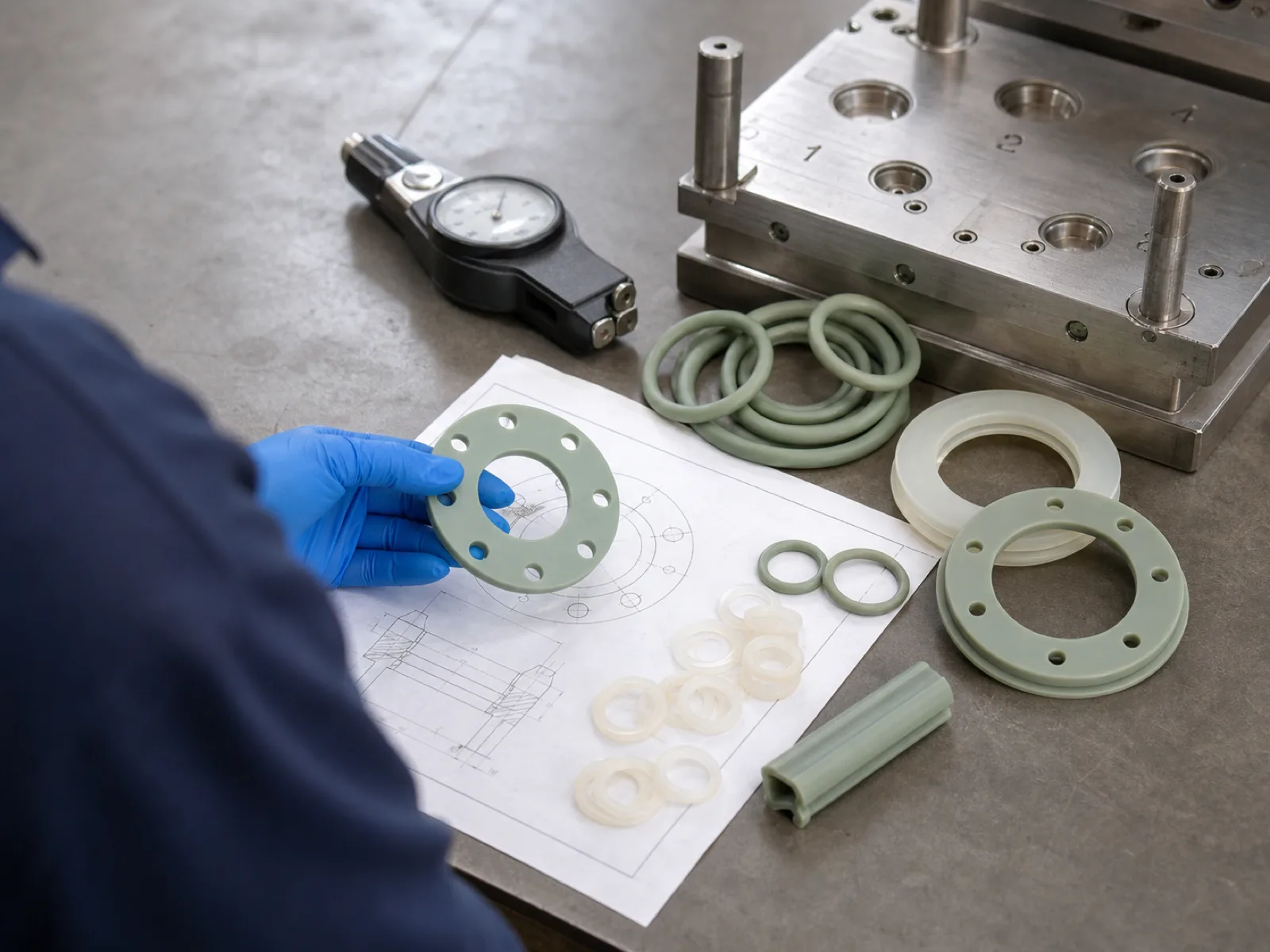
 A silicone rubber seal manufacturer molds, extrudes, and die-cuts sealing components — O-rings, flange and lid gaskets, bulb and channel profiles, and flat die-cut gaskets — from platinum- or peroxide-cured silicone. The specifications that decide whether a seal holds for years or leaks in a month are the cure system, the Shore A durometer, the compression set, the gland or groove design, and the media the seal contacts, and every one is locked before tooling is cut. This guide is the engineering-desk brief for OEM and industrial buyers sourcing custom silicone rubber seals at 500 to 500,000 pcs, covering seal types, material grades, cure systems, process selection, performance specs, gland design, certifications, elastomer comparison, and the MOQ, tooling, and lead-time math behind a production program.
To a design or sourcing engineer, a silicone seal looks like a commodity — a soft ring in a groove, pennies a piece, buy it anywhere. Then a food-equipment gasket takes a compression set and starts weeping after three months in a hot clamp, a medical-device O-ring fails an extractables panel because the supplier shortened the post-cure, or an extruded door seal cracks at the vulcanized corner. None of those are bad luck. Each maps to a specific decision a manufacturer made — or skipped — during cure-system selection, durometer targeting, process choice, and testing. This guide is written from the engineering desk at Wetop’s Dongguan floor for buyers who need the manufacturing logic behind a silicone rubber seal that survives its service temperature, its media, and its clamp load for the life of the product.
What is a silicone rubber seal, and what types do manufacturers make?
A silicone rubber seal is a sealing component molded, extruded, or die-cut from cured silicone that blocks fluid, gas, dust, or contamination across a joint. Manufacturers make four families: molded O-rings for bores, molded flange and lid gaskets, extruded bulb/P/D/U-channel profiles for edges and doors, and die-cut flat gaskets from calendered sheet. Each shares the same silicone chemistry but differs in geometry, process, and the sealing mechanism it relies on.
The category is one material shaped by three manufacturing methods, and knowing which family your part belongs to is the first fork in the RFQ. The molded O-ring is the workhorse static and dynamic seal: a round-cross-section ring compressed inside a groove (a gland) so it deforms and blocks flow. It is defined by two dimensions — inner diameter and cross-section — plus a durometer, and it is molded because a closed loop with a precise round section cannot be made any other way. Molded gaskets cover flange, lid, valve, and face seals with more complex two- or three-dimensional geometry — bolt-hole patterns, sealing beads, bosses — and are compression- or injection-molded from a cavity-engraved tool.
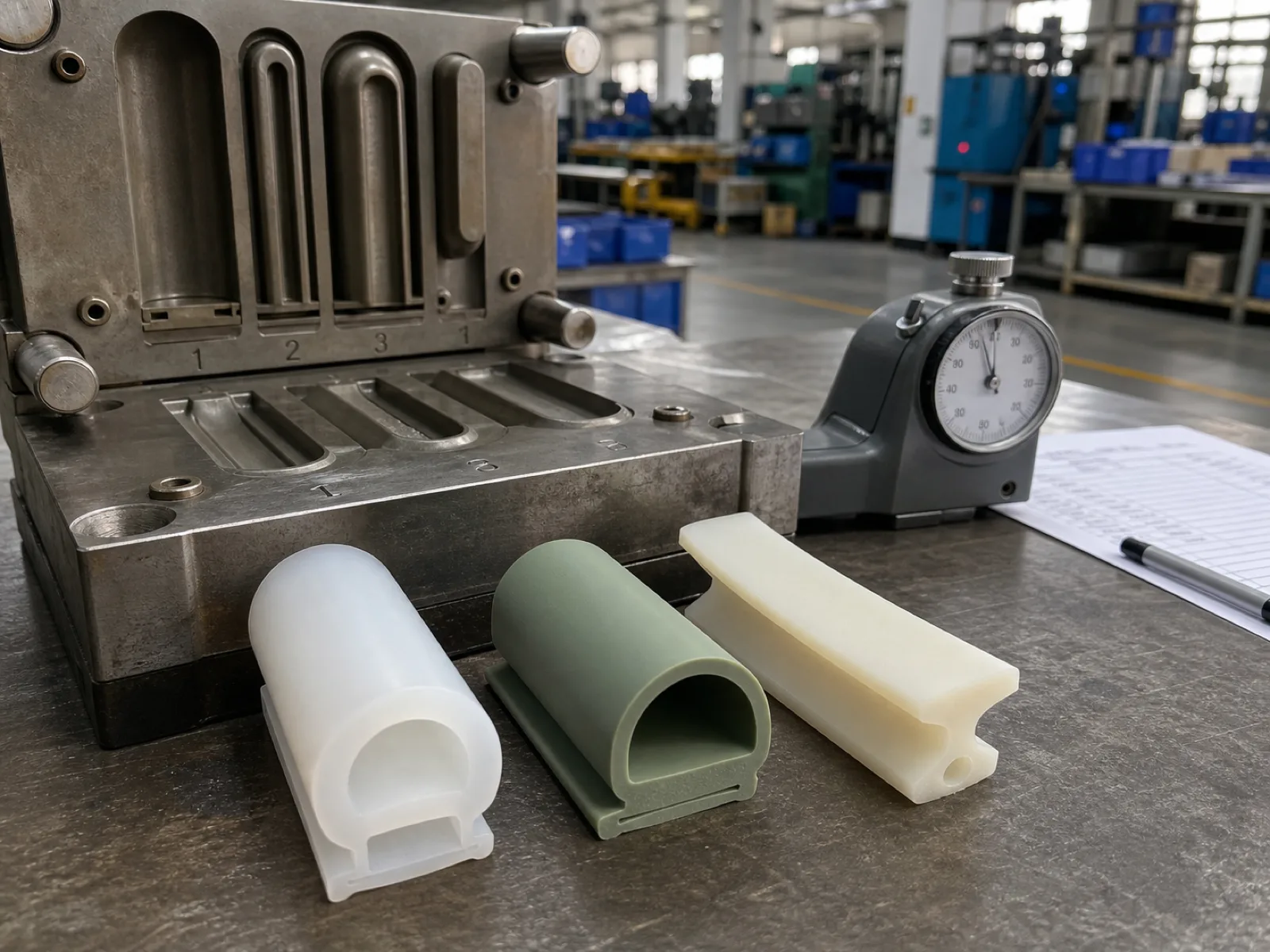
The extruded profile family handles constant cross-sections that run in length: bulb seals for doors and enclosures, P- and D-sections for cabinet edges, U-channel for panel trim, cord stock, and tubing. Silicone is pushed through a profile die, vulcanized in a hot-air or salt-bath line, then cut to length or joined into a closed loop by molded or vulcanized corners. The fourth family is the die-cut flat gasket: a two-dimensional shape punched from calendered silicone sheet with a steel-rule or matched-metal die, which skips mold tooling entirely and is the fastest route for a simple flat seal. A full-service manufacturer runs all three processes, so the part drives the method rather than the factory’s single machine dictating the design.
| Seal family | Typical form | Sealing mechanism | Best process |
|---|---|---|---|
| O-ring | Round-section closed loop | Groove compression in a bore/face | Compression / injection molding |
| Molded gasket | Flange, lid, valve, face seal | Bolt-load face compression | Compression / injection molding |
| Extruded profile | Bulb, P, D, U-channel, cord | Edge or door compression | Profile extrusion + cut/join |
| Die-cut flat gasket | 2D sheet shape | Flat face compression | Die-cutting calendered sheet |
What silicone grades do seal manufacturers offer?
Seal manufacturers offer a grade ladder tuned to the application: general-purpose silicone for industrial seals, food-grade for equipment contact, medical-grade for device components, fluorosilicone (FVMQ) for fuel and oil resistance, electrically conductive silicone for EMI-shielding gaskets, and flame-retardant grades for UL 94 rated enclosures. The base chemistry is the same silicone backbone; fillers, cure system, and additives define the grade and its clearances.
Choosing the grade is a compliance-and-environment decision, and quoting the cheapest general-purpose compound into a food or medical application is the most expensive mistake a program makes. General-purpose silicone (VMQ) is the default for industrial static seals — enclosure gaskets, HVAC seals, lighting seals — where there is no contact-safety or fuel-resistance requirement. Food-grade silicone is a controlled compound that clears FDA 21 CFR 177.2600[^fda-177-2600] and, for commercial equipment, NSF/ANSI 51[^nsf-51]; it is what belongs in a steam-table gasket, a coffee-machine seal, or a bottling-line O-ring. Medical-grade silicone is platinum-cured, lot-traceable compound validated to USP Class VI[^usp-class-vi] or ISO 10993[^iso-10993] biocompatibility for seals that go inside a device.
Beyond the contact-safety ladder sit the specialty grades. Fluorosilicone (FVMQ) adds fluorine to the backbone so the seal resists petroleum fuels, oils, and solvents that swell standard silicone — the grade for aerospace and automotive fuel-system seals that still need a wide temperature range. Electrically conductive silicone, filled with silver, silver-plated, or nickel-graphite particles, makes an EMI/RFI-shielding gasket that seals an enclosure and grounds it at the same time. Flame-retardant silicone meets UL 94 V-0 or V-1 for electrical and transit enclosures. Each grade is a different compound cost and a different lead time, so the RFQ must name the grade, not just “silicone.” For the safety-and-clearance case behind the food and medical grades, the FDA vs LFGB silicone guide and the USP Class VI biocompatibility guide carry the detail.
| Grade | Key property | Typical seal application | Headline clearance |
|---|---|---|---|
| General-purpose VMQ | Wide temp, low cost | Enclosure, HVAC, lighting gaskets | None required |
| Food-grade | Contact-safe, low extractables | Equipment, beverage, appliance seals | FDA 177.2600 · NSF 51 |
| Medical-grade | Biocompatible, traceable | Device O-rings, cushions, valve seals | USP Class VI · ISO 10993 |
| Fluorosilicone (FVMQ) | Fuel/oil resistant | Aerospace/automotive fuel seals | Fuel-immersion spec |
| Conductive | EMI/RFI shielding | Shielded enclosure gaskets | Shielding effectiveness |
| Flame-retardant | Self-extinguishing | Electrical/transit enclosures | UL 94 V-0 / V-1 |
Platinum-cured or peroxide-cured — which cure system for seals?
Specify platinum-cured (addition) silicone for any seal contacting food, water, pharmaceuticals, or the body, because the cure generates no volatile byproducts and clears USP Class VI and ISO 10993 on standard post-cure. Peroxide-cured silicone leaves benzoic-acid residues that cause odor, taste transfer, and extractables failures if the post-cure is shortened. Peroxide cure stays acceptable and lower-cost for industrial seals with no contact-safety requirement.
The cure system is the decision that quietly determines whether a seal passes its compliance panel, and it is the first corner a low-cost supplier cuts. Platinum (addition) cure crosslinks vinyl- and hydride-functional silicone with a platinum catalyst in a stoichiometrically clean reaction that produces no volatile byproducts, which is why platinum-cured silicone ships into medical-component and food applications with minimal post-cure. Peroxide (free-radical) cure uses an organic peroxide initiator whose reaction leaves benzoic acid and related volatiles behind; a proper 4-hour, 200 °C post-cure is designed to drive them off, but a factory protecting throughput often shortens it, and the residual volatiles stay in the seal.
For a static enclosure gasket or an HVAC seal, peroxide-cured silicone is perfectly adequate and cheaper — nothing about the application cares about a trace odor. For a food-equipment gasket, a beverage-line O-ring, or a medical-device seal, the residual volatiles are disqualifying: they off-gas, they transfer taste, and they can fail the n-hexane extractables limit under 177.2600 or the biological-reactivity screen under USP Class VI. The honest rule is to match the cure to the contact environment, and to demand a finished-good test rather than trust the raw-compound certificate. The full mechanism, cost, and post-cure breakdown is in the platinum-cured vs peroxide-cured silicone guide.
| Attribute | Peroxide-cured | Platinum-cured |
|---|---|---|
| Cure byproducts | Benzoic acid, volatiles | None |
| Post-cure sensitivity | High (odor if shortened) | Low |
| Food / medical clearance path | Difficult | Standard |
| Best fit | Industrial static seals | Contact-safe & device seals |
| Relative compound cost | Lower | Mid–higher |
Molding, extrusion, or die-cutting — which process for which seal?
Geometry and volume pick the process. Closed-loop and three-dimensional parts — O-rings, flange gaskets, molded lid seals — are compression- or injection-molded. Constant cross-sections in length — bulb, P, D, U-channel, cord — are extruded and cut or joined. Flat two-dimensional gaskets in low-to-moderate volume are die-cut from calendered sheet, skipping mold tooling. High-volume complex parts move to LSR injection for cycle-time economics.
Process selection is an economic decision disguised as a technical one, and a manufacturer that owns all three routes maps the part to the cheapest method that meets spec. Compression molding places a pre-weighed slug of high-consistency rubber (HCR) into a heated, cavity-engraved mold; the press closes under tonnage and the silicone cures to shape in a few minutes. It is the default for O-rings, gaskets, and molded profiles because tooling is comparatively cheap and color changes are fast. LSR injection molding pumps two-part liquid silicone into a closed heated mold where it cures in 15–90 seconds, fully automated to ±0.05 mm; it wins on very high volumes and fine, repeatable geometry — a precision valve seal or a thin-wall lip seal — but the tooling costs multiples more, so it pays back only above roughly 200,000 pcs/year.
Extrusion pushes uncured silicone through a profile die and vulcanizes it continuously; it is the only economical way to make long runs of constant cross-section — door bulb seals, window channels, cord stock — and the profile is then cut to length or its ends are joined into a closed loop by a molded corner or a vulcanized splice. Die-cutting punches a flat gasket from calendered silicone sheet with a steel-rule or matched-metal die; it skips mold tooling entirely, which makes it the fastest and cheapest route for a simple flat seal at low-to-moderate volume, though it is limited to two-dimensional shapes and a sheet-thickness tolerance. The decision framework a manufacturer applies:
| If the seal is… | …the process is | Why | Tooling cost band |
|---|---|---|---|
| A closed round loop (O-ring) | Compression / injection mold | Section and loop need a cavity | USD 300 – 3,000 |
| A 3D gasket (flange, lid, bead) | Compression / injection mold | Bosses and beads need a cavity | USD 1,500 – 8,000 |
| A constant cross-section in length | Profile extrusion | Continuous section, cut to length | USD 300 – 1,500 (die) |
| A flat 2D shape, low volume | Die-cutting sheet | No mold needed, fast turn | USD 150 – 600 (die) |
| A complex part, >200k/yr | LSR injection | Cycle-time economics | USD 15,000 – 45,000+ |
The build detail behind molded gasket tooling — cavitation, flash, parting-line placement, and post-cure — is covered in the silicone rubber gasket manufacturing guide.
What performance specs define a silicone rubber seal?
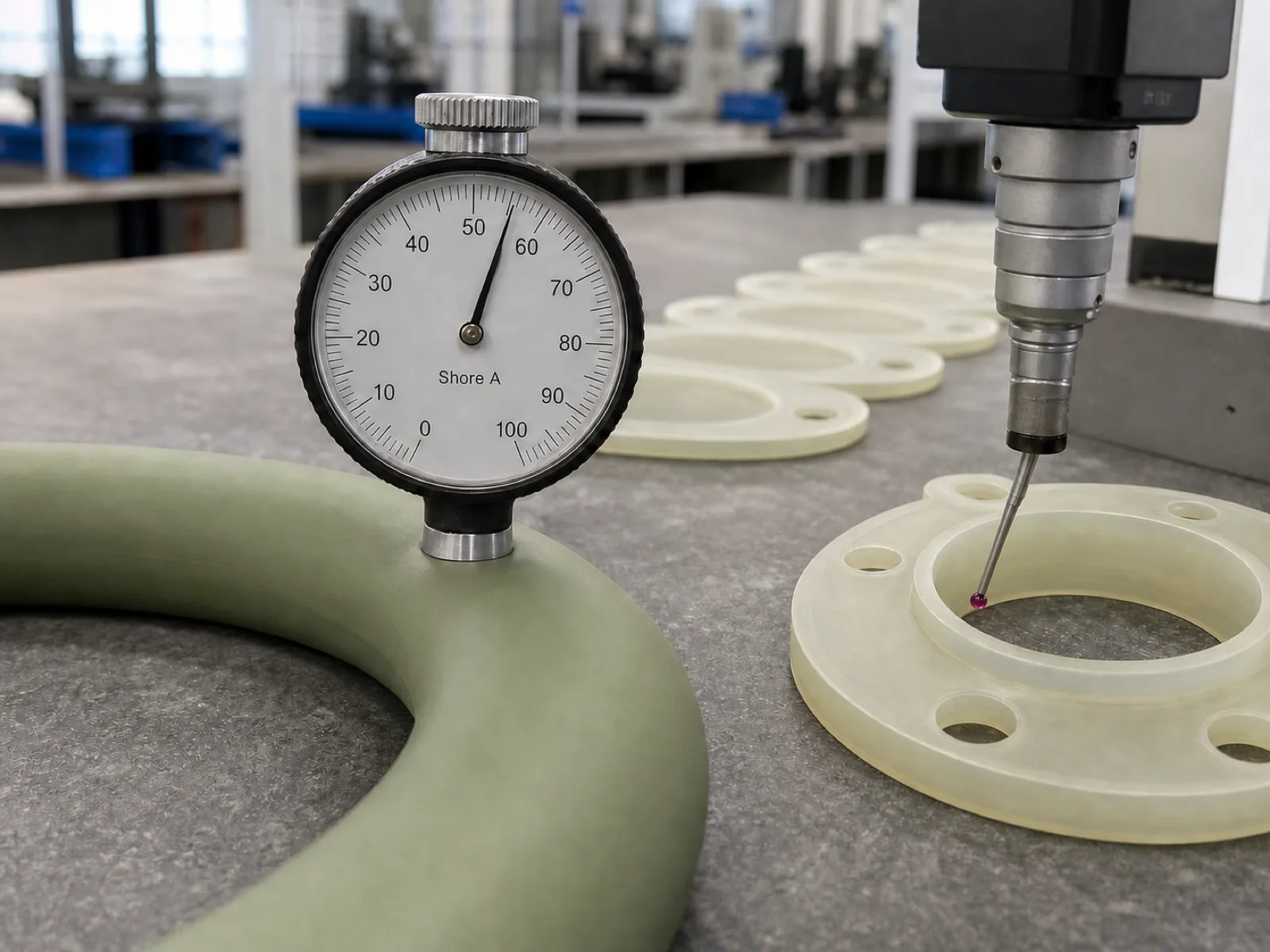
Four specs define a silicone seal: Shore A hardness (durometer, typically 20–80), service temperature range (roughly −60 °C to +230 °C continuous, +300 °C excursion), compression set (permanent deformation under load, tested per ASTM D395), and media compatibility. A complete seal spec names a Shore A target with tolerance, the temperature envelope, a maximum compression set percentage, and the fluid or gas the seal contacts.
A seal fails when one of these four is left unwritten, so a defensible spec names all four. Shore A durometer — measured per ASTM D2240[^astm-standards] — sets how the seal deforms: too soft and it extrudes into the gap under pressure, too hard and it will not conform to seal at low load. Service temperature is silicone’s headline advantage: platinum-cured compound stays flexible and dimensionally stable across roughly −60 °C to +230 °C, wider than most elastomers, with short excursions near +300 °C on high-temperature grades. Compression set, tested per ASTM D395 at 22 hours and 175 °C, is the long-term spec that decides whether a clamped gasket keeps sealing for years or takes a set and weeps — lower is better, and it is where good platinum-cured silicone earns its cost premium. Media compatibility is the limit to respect: silicone tolerates heat, ozone, UV, and water superbly but swells in petroleum fuels and oils.
The durometer map Wetop uses to translate a sealing job into a moldable spec:
| Seal duty | Shore A target | Why this band | Verification at lot release |
|---|---|---|---|
| Soft conforming gasket (low bolt load) | 30–50 | Deforms to seal an imperfect flange | Durometer ±5, leak test |
| Static face / O-ring seal | 40–60 | Resists gap extrusion, seats reliably | Durometer ±5, compression set |
| Dynamic / wear seal | 50–70 | Balances seal and abrasion resistance | Durometer + dimensional |
| Structural profile / grommet | 60–80 | Holds shape under load | Durometer on the section |
The temperature and durometer references buyers most often pull are the silicone temperature range guide and the Shore A hardness chart. The mistake to design out: approving a hand-feel prototype without recording Shore A and compression-set targets, then having no objective basis to hold the production lot to the same sealing behavior.
How do you engineer the gland and compression for a silicone seal?
A silicone seal only works if the gland — the groove or clamped gap it sits in — squeezes it the right amount. Static face seals target roughly 15–30% compression; dynamic seals target 10–20%; the groove must leave room for the seal to deform without over-filling. Gland design pairs the seal cross-section, groove volume, surface finish, and durometer, and it is the mechanical decision that separates a seal that holds from one that extrudes or leaks.
The seal is only half the design; the gland — the groove, bore, or clamped face that holds it — is the other half, and a correctly specified O-ring in a wrong groove leaks anyway. The governing number is compression ratio: the percentage the seal’s cross-section is squeezed when the joint closes. Too little compression and the seal never develops the contact stress to block flow; too much and it is over-stressed, takes a permanent set, or extrudes into the gap. A static face seal generally targets 15–30% compression, a dynamic seal 10–20% to limit friction and wear. The groove must also leave fill room — typically the groove volume is 15–25% larger than the seal volume — so the deformed seal has somewhere to go.
Three secondary factors decide whether the seal holds over its life. Surface finish on the mating faces matters because a soft silicone seal conforms to a lightly-finished surface but a hard one needs a finer finish to seal — a soft Shore A 30–50 gasket is the answer to a warped or rough flange. Tolerance stack across the groove depth, the seal cross-section, and the mating gap sets the actual compression the seal sees, so a seal spec that ignores the groove tolerance is only half a spec. Media compatibility closes the loop: the fluid, its temperature, and its pressure decide the grade — water, steam, and food favor silicone; fuel and oil push the design to fluorosilicone or FKM. A manufacturer that engineers the seal without asking about the gland and the media is quoting a part, not a solution.
Which certifications should a silicone rubber seal manufacturer hold?
The certification packet scales with the application: ISO 9001 for the quality system on every program, FDA 21 CFR 177.2600 and NSF/ANSI 51 for food-contact seals, USP Class VI or ISO 10993 for medical-device component seals, LFGB for the EU food market, REACH SVHC screening on pigments and fillers, and UL 94 for flame-rated electrical enclosures. Screen the finished-good report, not the raw-compound COA.
The documentation gap that catches first-time buyers is the finished-good versus compound distinction. A “FDA silicone” or “USP Class VI material” claim on a datasheet almost always means the base compound carries that clearance from its supplier — not that the finished seal was lot-tested by an accredited lab. For a seal that contacts food or a patient, the migration or biocompatibility test on the actual part is what a customs review and an OEM supplier audit demand. The certification an importer should require, by application:
- ISO 9001[^iso-9001] — the quality-management baseline on every program; Wetop is certified since 2008.
- FDA 21 CFR 177.2600[^fda-177-2600] finished-good extractables report for US food-contact seals, from an accredited lab.
- NSF/ANSI 51[^nsf-51] for silicone gaskets in commercial food equipment — the standard a foodservice OEM audit expects.
- USP Class VI[^usp-class-vi] or ISO 10993[^iso-10993] for a seal used as a medical-device component — the biological-reactivity or biocompatibility data that supports the device maker’s submission.
- LFGB batch report for the EU food market, plus REACH SVHC[^echa-reach] screening on every pigment, filler, and additive.
- UL 94 flammability rating (V-0 / V-1) for seals in electrical and transit enclosures.
A scope note that protects a program: a silicone seal manufacturer supplies components — the O-ring, gasket, tubing, or cushion that goes into a finished device — and provides the biocompatibility and traceability data that support the device. It does not clear the finished medical device itself; the 510(k) or CE mark belongs to the device maker. The regulatory context for why a repeated-use food-contact seal is graded under 177.2600 is on the FDA’s food-contact landing page[^fda-food-packaging]. To confirm a manufacturer can actually produce this packet rather than just name-drop the acronyms, walk the sourcing silicone factory checklist.
Silicone vs EPDM, FKM/Viton, and NBR — when is silicone the right seal?
Silicone wins on temperature range (−60 °C to +230 °C), food and medical clearances, and ozone/UV resistance, making it the default for high-heat, contact-safe, and outdoor seals. EPDM is cheaper for water, steam, and weather seals with no food requirement. FKM/Viton is the choice for aggressive chemicals and fuels at high heat. NBR is the low-cost pick for petroleum oil and fuel at moderate temperature. Match the elastomer to media first, temperature second.
Silicone is not the answer to every seal, and a manufacturer that recommends it into a fuel line is selling the wrong part. The elastomer decision is driven by media first, then temperature, then cost. Silicone (VMQ) owns the widest temperature window and the food/medical clearances, and it shrugs off ozone, UV, and weathering — which is why it belongs in oven and steam gaskets, cold-chain seals, medical-device components, and outdoor enclosure seals. Its weakness is petroleum: silicone swells in fuels, oils, and many solvents. EPDM is the cost-effective choice for water, steam, brake fluid, and weather seals where no food contact is required, but it also fails in petroleum media. FKM/Viton resists aggressive chemicals, fuels, and high heat, at a higher price, and is the aerospace and chemical-processing default. NBR (nitrile) is the inexpensive standard for petroleum oil and fuel at moderate temperature, but it has poor ozone and high-heat resistance.
| Elastomer | Temp range | Best media | Weakness | Relative cost |
|---|---|---|---|---|
| Silicone (VMQ) | −60 to +230 °C | Food, water, steam, air; medical | Fuels, oils, solvents | Mid |
| Fluorosilicone (FVMQ) | −55 to +200 °C | Fuel + wide temp | Higher cost | High |
| EPDM | −50 to +150 °C | Water, steam, weather | Petroleum media | Low |
| FKM / Viton | −20 to +200 °C | Chemicals, fuels, high heat | Cost, low-temp | High |
| NBR (nitrile) | −30 to +120 °C | Petroleum oil, fuel | Ozone, high heat | Low |
The practical rule an engineering desk applies: if the seal contacts food, water, steam, or the body, or if it lives above 150 °C or below −40 °C, silicone is the default; if it contacts fuel or oil, look to fluorosilicone, NBR, or FKM. When silicone is right but the seal also sees fuel, fluorosilicone bridges the gap. A manufacturer that carries the full silicone grade ladder can also tell you honestly when to walk away from silicone — which is the sign of an engineering supplier rather than a catalog vendor.
MOQ, tooling cost, and lead time for custom silicone seals
Wetop's silicone seal MOQ starts at 500 pcs/SKU on existing O-ring and gasket tooling. A new compression mold starts at 3,000 pcs to amortize a USD 300–8,000 tooling cost set by part size and cavitation; die-cut flat gaskets need only a USD 150–600 die at low volume; extruded profiles need a USD 300–1,500 die. First samples land in 7–25 days depending on whether tooling exists, with bulk production in 20–30 days after approval.
Most programs should start ODM where possible — a standard O-ring cross-section, a common bulb-seal profile, or a die-cut flat gasket off existing tooling reaches market fastest and avoids sinking mold money before the SKU is proven. Move to a dedicated OEM mold when the geometry is proprietary or the volume justifies owning the tool. The cost driver on a molded seal is cavitation: a small single-cavity O-ring die sits near the bottom of the tooling range, while a large multi-cavity flange-gasket mold sits near the top. Die-cutting and extrusion carry the lowest tooling because there is no cavity to sink.
MOQ and tooling tier structure at Wetop (2026 pricing):
| Program tier | MOQ per SKU | Tooling cost | Unit price band (FOB) | Best for |
|---|---|---|---|---|
| Stock O-ring / profile, existing tool | 500 pcs | USD 0 | USD 0.03 – 1.20 | Sample & small runs |
| Die-cut flat gasket, new die | 1,000 pcs | USD 150 – 600 | USD 0.05 – 1.50 | Simple flat seals |
| Extruded custom profile, new die | 1,000 pcs | USD 300 – 1,500 | USD 0.10 – 3.00 /m | Door, edge, channel seals |
| Custom molded gasket, new compression mold | 3,000 pcs | USD 1,500 – 8,000 | USD 0.08 – 2.60 | Proprietary molded seals |
| High-volume LSR seal, injection tool | 25,000 pcs | USD 15,000 – 45,000+ | USD 0.05 – 1.80 | >200k/yr precision seals |
Sample timeline: on existing tooling, a durometer-matched pre-production sample in 7–10 days; a first-article with certification documents in 12–15 days. On a new compression mold, a T1 sample in 20–30 days, T2 dimensional corrections in 5–7 days, and production release after CMM and durometer verification on T2. Bulk production runs 20–30 days after sample approval for a standard order, driven by grade compounding, color-match sign-off, and any secondary operation such as vulcanized corner joining on an extruded loop. The lead-time and MOQ logic across the whole silicone product line is broken down in the MOQ and lead time guide.
To spec a clean RFQ, hand the factory seven lines: the seal family (O-ring / molded gasket / extruded profile / die-cut), the critical dimensions and cross-section, the target Shore A per part with tolerance, the service temperature and the media contacted, the silicone grade and required certifications, the annual volume, and the color. Those seven lines let an engineering desk quote tooling, unit price, and lead time without a week of back-and-forth.
Sourcing a custom silicone rubber seal program?
Wetop runs compression, LSR injection, extrusion, and die-cutting on a 7,500 m² floor in Dongguan, molding platinum- and peroxide-cured silicone seals against FDA 21 CFR 177.2600, USP Class VI, NSF/ANSI 51, LFGB, and ISO 9001 — with every critical sealing dimension CMM-verified and every durometer confirmed at lot release. Bring the seal family, cross-section, service temperature, media, and target certifications, and the engineering desk will quote tooling, unit price, and a 7–25 day first sample. Talk to the engineering desk to start a silicone rubber seal RFQ.
FAQ
-
What does a silicone rubber seal manufacturer actually produce?
A silicone rubber seal manufacturer molds, extrudes, and die-cuts sealing components from platinum- or peroxide-cured silicone. The core output is four families: molded O-rings for dynamic and static bores; molded flange, lid, and face gaskets; continuous extruded profiles in bulb, P, D, and U-channel cross-sections cut to length or vulcanized into closed loops; and die-cut flat gaskets punched from calendered sheet. A full-service manufacturer also compounds pigmented and specialty grades, runs the mold or die tooling in-house, post-cures for extractables clearance, and issues the material and dimensional documentation an OEM audit requires. The differentiator between a manufacturer and a trader is owning the tooling and the cure-and-test process, not just the finished part.
-
What Shore A hardness should a custom silicone seal be?
Match the durometer to the sealing job. A static face or O-ring seal that must resist extrusion into a gap targets Shore A 40–60. A soft gasket that has to conform to a warped or lightly-finished flange and seal at low bolt load wants Shore A 30–50. A structural or load-bearing profile — a door bulb seal, a compression rail, a grommet — wants Shore A 60–80 to hold shape under load. Write the target with a ±5 tolerance and require a durometer reading per ASTM D2240 at lot release; 'soft' and 'firm' are not a spec, and they are how a rejected lot becomes an argument.
-
Which is better for a seal, platinum-cured or peroxide-cured silicone?
Platinum-cured (addition) silicone is the default for any seal contacting food, water, pharmaceuticals, or the body, because the cure reaction generates no volatile byproducts and clears USP Class VI and ISO 10993 with standard post-cure. Peroxide-cured silicone leaves benzoic-acid and related residues that a proper 4-hour, 200 °C post-cure is meant to drive off; when the post-cure is shortened, those volatiles cause odor, taste transfer, and extractables failures. Peroxide cure remains acceptable and lower-cost for industrial seals with no contact-safety requirement — HVAC gaskets, enclosure seals, general-purpose profiles — where extractables are irrelevant.
-
What is compression set and why does it matter for a silicone gasket?
Compression set measures how much of its original thickness a seal permanently loses after being held compressed at temperature — a low value means the gasket springs back and keeps sealing, a high value means it takes a set and eventually leaks. It is tested per ASTM D395, typically 22 hours at 175 °C for silicone, and reported as a percentage where lower is better. It is the single most important long-term spec for a static seal that stays clamped for years, and it is why silicone outperforms cheaper elastomers in a hot, always-compressed joint: high-quality platinum-cured silicone holds a low compression set across a wide temperature band.
-
Can a silicone seal manufacturer make medical-grade and food-grade seals?
Yes, and the distinction is documentation and cure system, not a different silicone. Food-grade silicone seals clear FDA 21 CFR 177.2600 and NSF/ANSI 51 for food-equipment contact; medical-component seals are molded from platinum-cured medical-grade compound and validated to USP Class VI biological reactivity or ISO 10993 biocompatibility. Note the scope carefully: a component manufacturer supplies the silicone seal, gasket, or tubing that goes into a finished device — it does not clear the finished medical device itself. The device maker holds the 510(k) or CE mark; the seal supplier provides the biocompatibility data and lot traceability that support it.
-
How do I choose between molding, extrusion, and die-cutting for my seal?
Geometry and volume decide it. A closed-loop or three-dimensional part — an O-ring, a flange gasket with bosses, a molded lid seal — is compression- or injection-molded because the shape cannot be produced any other way. A constant cross-section that runs in long lengths — a door bulb seal, a window channel, an edge trim — is extruded, then cut to length or joined into a loop. A flat two-dimensional gasket in low-to-moderate volume is die-cut from calendered sheet, which skips mold tooling entirely and is the fastest, cheapest route for a simple flat seal. Many programs combine methods: an extruded profile with molded corners, for example.
-
What temperature range can a silicone rubber seal handle?
Platinum-cured silicone holds a continuous service range of roughly −60 °C to +230 °C, with short excursions to about +300 °C depending on the formulation. That is a wider usable window than NBR, EPDM, or most standard elastomers, and it is silicone's headline advantage for oven door seals, steam and autoclave gaskets, engine-bay electronics seals, and cold-chain applications. The limit to respect is chemical, not thermal: silicone tolerates the heat but swells in petroleum fuels, oils, and some solvents, which is where fluorosilicone or FKM takes over. Always spec the temperature range alongside the media the seal contacts.
-
What is the MOQ and tooling cost for custom silicone rubber seals?
Wetop's MOQ starts at 500 pcs per SKU on existing O-ring and gasket tooling. A custom molded seal that needs a new compression mold starts at 3,000 pcs to amortize a USD 300–8,000 tooling cost, where the range is driven by part size and cavitation — a small single-cavity O-ring die sits near the bottom, a large multi-cavity flange-gasket mold near the top. Die-cut flat gaskets need only a steel-rule or matched-metal die at roughly USD 150–600 and can run at low volume. Extruded profiles need a profile die at USD 300–1,500. First samples land in 7–25 days depending on whether tooling exists.
References
Authoritative sources cited in this guide
- US Food and Drug Administration. 21 CFR 177.2600 — Rubber articles intended for repeated use. https://www.ecfr.gov/current/title-21/chapter-I/subchapter-B/part-177/subpart-C/section-177.2600 — The controlling US extractables limit for repeated-use rubber and silicone in food-contact articles — total extractives in n-hexane and water capped by weight — the baseline any food-grade silicone seal is graded against.
- International Organization for Standardization. ISO 9001:2015 — Quality Management Systems — Requirements. https://www.iso.org/standard/62085.html — The QMS a silicone seal manufacturer is certified against — the documented quality system that a supplier audit, lot traceability, and dimensional lot-release protocol are built on top of.
- ASTM International. ASTM International — Standards & Publications. https://www.astm.org/products-services/standards-and-publications/standards.html — Source for ASTM D2240 (durometer), D395 (compression set), and D1414 (O-ring test methods) that a seal program uses to bench-verify Shore A, compression set, and dimensional specs.
- United States Pharmacopeia. USP <88> Biological Reactivity Tests, In Vivo (Class I–VI). https://www.usp.org/ — Defines the Class VI biological reactivity classification a medical-component silicone seal is validated to — the systemic injection, intracutaneous, and implantation tests referenced for a device-contact gasket or O-ring.
- International Organization for Standardization. ISO 10993-1:2018 — Biological evaluation of medical devices — Part 1. https://www.iso.org/standard/68936.html — The risk-based biocompatibility framework for a silicone seal used as a medical-device component — the international counterpart to USP Class VI cited for a device-contact seal.
- NSF International. NSF/ANSI 51 — Food Equipment Materials. https://www.nsf.org/ — The material standard for silicone seals and gaskets used in commercial food-equipment contact — the certification a foodservice OEM audit expects on a door, lid, or steam-table gasket.
- European Chemicals Agency (ECHA) / EUR-Lex. REACH Regulation (EC) No 1907/2006 — Registration, Evaluation, Authorisation and Restriction of Chemicals. https://eur-lex.europa.eu/legal-content/EN/TXT/?uri=CELEX%3A32006R1907 — Screening framework for every pigment, filler, and additive in a silicone seal sold into the EU — the SVHC candidate-list check an importer files alongside LFGB clearance.
- US Food and Drug Administration. Food Ingredients & Packaging. https://www.fda.gov/food/food-ingredients-packaging — FDA's food-contact regulation landing page — the authority context for why a repeated-use silicone seal contacting food is graded under 21 CFR 177.2600.
Start a custom program
Send a brief. Get an engineer’s reply in one business day.
Every Wetop program is tooled from a customer’s specification. Send a CAD file (STEP · IGES · DWG) or a written brief and we’ll reply with a mold cost estimate, price brackets at MOQ 500 / 1,000 / 5,000, and any engineering questions.