Buyer Guide · commercial intent
Silicone Soap Dish Manufacturer — OEM Sourcing Guide
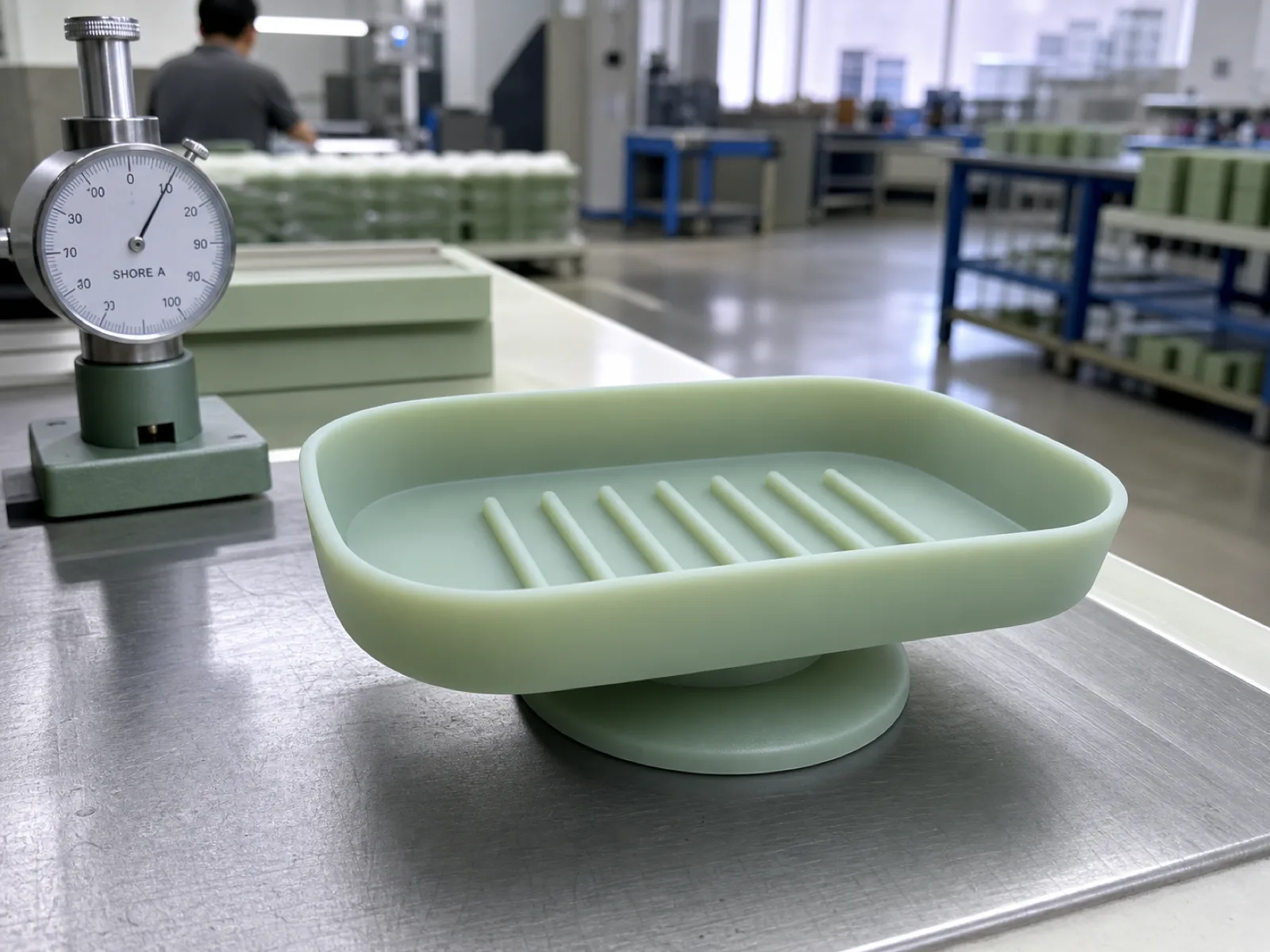 Buyer Guide
 The silicone soap dish sits at a stubborn intersection of bathroom retail — a $4-30 shelf-price category where the buying decision is driven by feel, drainage, and coordinated color, and the manufacturing decision is driven by two-durometer overmold economics, suction cup pull-force spec, and per-batch anti-mildew verification. This guide is the engineering reality of manufacturing that product for a Tier-2 housewares brand program (OXO / Umbra / Joseph Joseph caliber, anonymized) — drainage geometry, Shore A durometer selection, suction base pull-force verification, FDA + REACH + PFAS documentation, mold cavitation economics, Pantone matching tolerance, defect CTQ points, and the sourcing workflow from RFQ to PPAP — written from inside a working founder-led Dongguan OEM floor, not from a consumer roundup.
A silicone soap dish for a serious retail program is a two-durometer platinum-cure overmold: Shore A 40-55 on the soap-contact top surface for grip, Shore A 55-70 on the drainage base for rigidity, molded on a 2-station rotary compression press with a mechanical undercut and chemical bond at the mid-thickness interface. Standard geometry is 130×90 mm base with 4-6 mm rib pitch drainage, four 18-22 mm suction cups spec'd to 8-15 N pull-force each per ASTM D897 on non-porous surfaces. MOQ 500 pieces per SKU. FOB Yantian Q3 2026: 500 pcs $1.35-$1.85, 1,000 pcs $1.10-$1.55, 5,000 pcs $0.85-$1.20 with full FDA + REACH + PFAS documentation packet per master-batch lot.
What is a silicone soap dish, engineered for a retail OEM program?
A silicone soap dish for retail is a two-durometer platinum-cure overmold assembly — a Shore A 40-55 soap-contact top surface bonded to a Shore A 55-70 drainage base with an integrated 4-suction cup array, compression-molded on a 2-station rotary press at 175-190°C. Standard geometry 130×90×22 mm with 4-6 mm rib-pitch drainage architecture, total mass 55-85 g depending on wall thickness. Full FDA 21 CFR 177.2600[^fda-177-2600], REACH[^echa-reach], and PFAS non-detect compliance per master-batch lot.
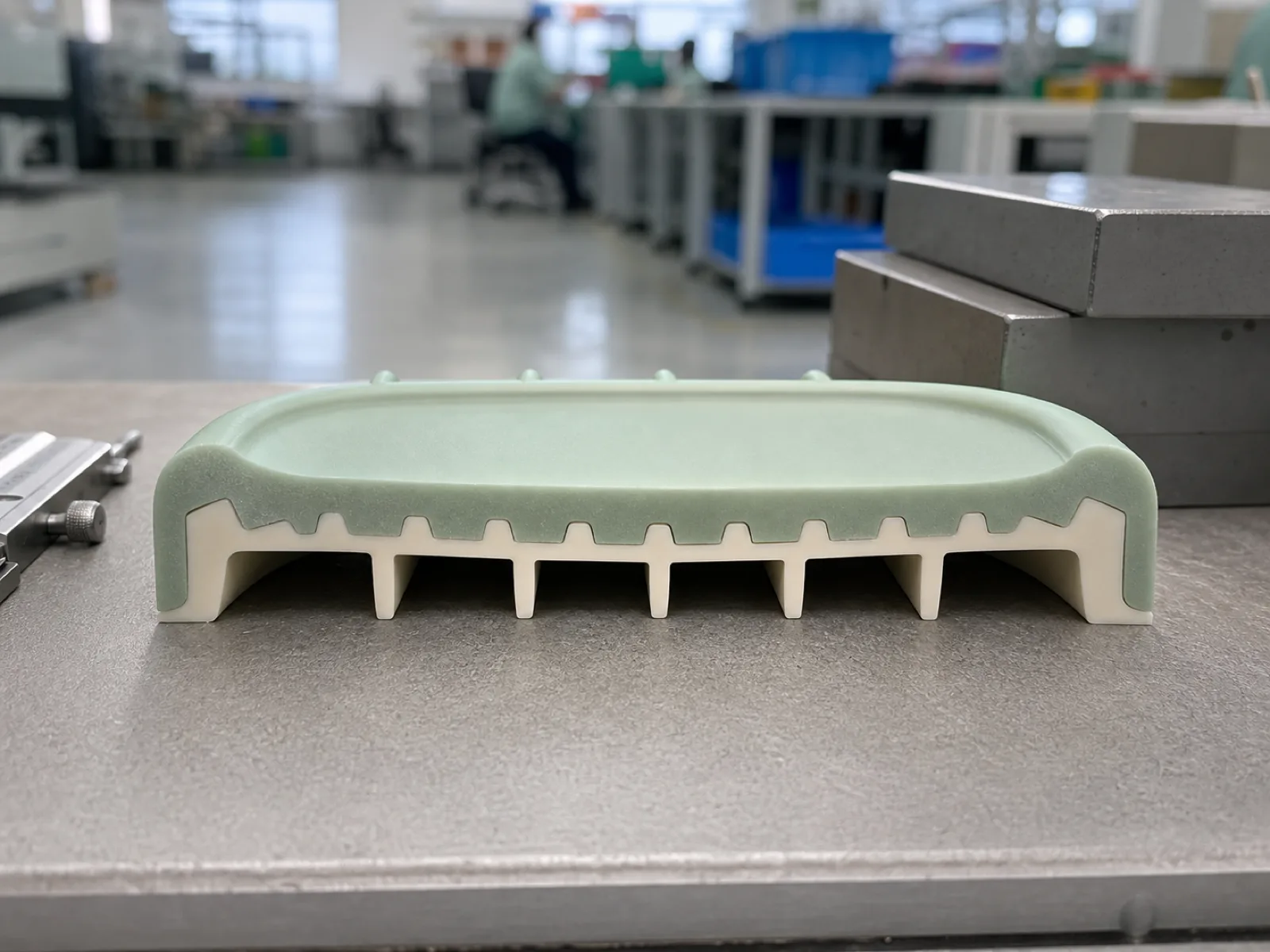
The consumer-facing description of a silicone soap dish is “a soft, drainable bar-soap holder that doesn’t crack or slide.” The engineering description is a two-material overmold with three functional zones layered into one 22 mm-tall part. The top surface provides soap-contact chemistry (FDA 21 CFR 177.2600 compliance, grip against soap slippage, cushion against countertop-drop impact). The drainage base provides mechanical structure (rib rigidity, suction cup geometry retention, batch-to-batch dimensional stability). The suction cup array provides substrate adhesion on non-porous surfaces via ASTM D897-verified pull-force spec.
Every engineering decision on a silicone soap dish program is a trade-off between those three zones. Softer top surface = better grip and cushion, worse drainage rib support. Denser drainage base = better rigidity, worse cushion and drop-impact absorption. Larger suction cups = higher pull-force, less usable base footprint for drainage geometry. The rest of this guide walks the trade-offs one by one for a retail-tier program at the OXO / Umbra / Joseph Joseph caliber (anonymized).
Baseline engineering spec sheet
| Parameter | Standard range | Test method |
|---|---|---|
| Overall dimensions | 130×90×22 mm (typical retail) | Digital caliper, 5-point sampling |
| Top surface durometer | Shore A 40-55 | ASTM D22401 |
| Drainage base durometer | Shore A 55-70 | ASTM D2240 |
| Rib pitch | 4-6 mm | Optical comparator |
| Rib height | 1.5-2.5 mm | Optical comparator |
| Rib flank draft angle | 2-3° | Cross-section microscopy |
| Suction cup diameter | 18-22 mm | Digital caliper |
| Suction cup pull-force (per cup) | 8-15 N on non-porous | ASTM D8972 |
| Combined pull-force (4-cup base) | 32-60 N | ASTM D897 |
| Total mass | 55-85 g | Balance ±0.1 g |
| Continuous service temperature | -40°C to 200°C | Manufacturer spec |
| Cure system | Platinum (LSR or premium HCR) | Master-batch lot certificate |
| Pantone ΔE tolerance | ≤ 2.0 vs approved reference | D65 light-box color check |
| Wet-dry cycle rating | 2,000+ cycles no delamination | Accelerated wet-dry protocol |
How does drainage geometry actually work on a silicone soap dish?
Drainage geometry is the mechanism behind the anti-mildew retail claim. Three architectures cover the category: parallel ribs (4-6 mm pitch × 1.5-2.5 mm height), through-holes (3-5 mm diameter, 25-35% open area), and open slats (5-8 mm gap). Parallel ribs at 4.5 mm pitch × 2 mm height with a 2-3° draft angle is the retail-winning default at $6-15 shelf — clears standard bar-soap water film in under 90 seconds while holding the soap in place via lateral friction.
The drainage geometry decision is not aesthetic — it is the actual mechanism that lets a retail SKU carry the “quick-dry, anti-mildew” claim on the header card without inviting FDA additive review. Consumers dry the soap dish. Retail buyers audit whether the geometry supports the claim.
Three drainage architectures compared
| Architecture | Water clearance time | Soap grip | Retail cost tier | Best for |
|---|---|---|---|---|
| Parallel ribs (4.5 mm pitch × 2 mm height) | <90 seconds | High (lateral friction) | $6-15 shelf | Mass and mid-tier retail default |
| Through-holes (4 mm diameter, 30% open area) | <60 seconds | Medium | $8-18 shelf | Premium mid-tier, wet-shower use |
| Open slats (6 mm gap) | <30 seconds | Low (needs bar recess) | $15-30 shelf | Premium bathroom coordinated range |
| Suction-base-only (no top drainage) | 3-4 minutes | Very high | $4-8 shelf | Value tier, secondary bathroom |
The parallel-rib architecture at 4.5 mm pitch × 2 mm height wins mass and mid-tier retail because it optimizes three variables simultaneously: fast water clearance (under 90 seconds is the threshold below which mildew accumulation is measurable at zero on the 30-day accelerated wet-dry test), high lateral soap grip (bar soap sits between two ribs and cannot slide off the dish under bathroom-splash force), and low mold-cutting cost (parallel ribs are the simplest CNC operation on a compression mold — 40-60% cheaper tooling than a through-hole or open-slat pattern).
The 2-3° flank draft angle on the rib is the detail that separates a defensible retail SKU from a commodity import: without draft, water surface tension holds a film at the rib base and mildew accumulates within 45-60 days. With draft, water sheds by gravity within 90 seconds and the ATP-luminescence swab reading stays below 200 RLU across the 30-day accelerated test. The Tier-2 housewares brands (OXO, Umbra, Joseph Joseph caliber, anonymized) audit against this reading; a supplier who doesn’t run the test is answering the audit question.
Shore A durometer — why a serious silicone soap dish is a two-durometer overmold
The soap-contact top surface and the drainage base have opposite engineering requirements. Top wants Shore A 40-55 for grip and cushion. Base wants Shore A 55-70 for rigidity so drainage ribs and suction cup geometry hold across 2,000+ wet-dry cycles. Single-durometer molding compromises both. A two-shot overmold on a 2-station rotary compression press bonds the two durometers at the mid-thickness plane with mechanical undercut plus platinum-cure chemical bond.
The two-durometer decision is what separates a $12 retail SKU from a $4 commodity import. A single-durometer molding at Shore A 50 gives a top surface that feels slightly rubbery (retail buyers reject as “cheap-feeling”) and a base with drainage ribs that flatten measurably within 60 days of use — the mildew accumulates in the collapsed rib channels and the return rate on a 5,000-piece production run jumps 2-3x within the first quarter of shelf life. Single-durometer at Shore A 65 gives a rigid base but a top surface too hard for soap-grip retention, and the drop-impact absorption drops from 1.5 m survival to under 0.9 m.
Two-durometer overmold spec table
| Zone | Shore A range | Function | Test method |
|---|---|---|---|
| Top surface (soap-contact) | 40-55 | Grip against soap slippage, cushion for drop impact | ASTM D22401 |
| Drainage base (structural) | 55-70 | Rib rigidity, suction cup geometry retention | ASTM D2240 |
| Bond interface | Mechanical undercut + chemical bond | 2,000+ wet-dry cycle interface stability | Destructive peel test |
| Overall part | 50-60 (composite feel) | Retail hand-feel target | Panel evaluation |
The mechanical undercut at the interface is a 0.8-1.2 mm depth micro-groove pattern CNC-cut into the first-shot base surface before the second-shot top surface is molded over it. The undercut plus the platinum-cure catalyst chemistry chemical bond (both shots are platinum-cure, allowing catalyst crosslinking across the interface) hold the two zones across 2,000+ wet-dry cycles. Peroxide-cure will not hold this interface — the peroxide byproduct chemistry interferes with the chemical bond and the two zones delaminate within 300-500 cycles.
The mm-thickness table
| Wall zone | Minimum mm | Standard mm | Maximum mm | Trade-off |
|---|---|---|---|---|
| Top surface (rib base) | 1.8 | 2.5 | 3.5 | Thinner = cheaper, worse drop absorption |
| Drainage base (structural) | 2.5 | 3.5 | 5.0 | Thinner = cheaper, worse suction retention |
| Rib height (above top surface) | 1.5 | 2.0 | 2.5 | Taller = better drainage, higher mold cost |
| Base wall (below suction cup) | 3.0 | 4.0 | 5.5 | Thinner = flexes, suction cup detaches |
| Overall part height | 18 mm | 22 mm | 28 mm | Taller = more silicone gum, higher unit cost |
Full engineering decision framework for the platinum-cure requirement on the platinum-cured vs peroxide-cured silicone decision guide.
Suction cup base pull-force spec and surface compatibility
8-15 N per cup on non-porous surfaces, verified per ASTM D897[^astm-d897] pull test on the finished-part assembly. Standard 130×90 mm dish base carries four 18-22 mm suction cups giving 32-60 N combined pull-force — enough to resist countertop knocks and shower-splash forces without tearing the silicone base at the cup joint. Zero holding force on porous stone (unsealed granite, unsealed marble, textured quartz, honed limestone). Retail packaging must disclose surface compatibility or field return rate spikes 3-4x.
Suction is a non-porous-surface adhesion mechanism, not a universal grip mechanism. The pull-force spec table below is the engineering reality that retail marketing tends to obscure and that field return data catches within 60-90 days of shelf launch.
Suction pull-force by countertop substrate
| Substrate | Pull-force per 20 mm cup | Field-use verdict |
|---|---|---|
| Glazed ceramic tile | 12-15 N | Full spec — holds |
| Sealed glass | 13-16 N | Full spec — holds |
| Chromed steel | 11-14 N | Full spec — holds |
| Laminated countertop (HPL) | 9-12 N | Full spec — holds |
| Sealed granite / marble | 8-11 N | Passes spec — holds if sealer intact |
| Polished quartz engineered stone | 7-10 N | Marginal — depends on polish grade |
| Unsealed granite | 2-4 N | Fails — cup detaches under splash |
| Unsealed marble | 1-3 N | Fails — cup detaches under splash |
| Textured quartz / matte finish | 0-2 N | Fails immediately |
| Honed / brushed limestone | 0-2 N | Fails immediately |
| Wood countertop (sealed or unsealed) | 0-1 N | Fails — silicone slips |
The retail packaging disclosure — “for use on smooth, non-porous surfaces including glazed ceramic tile, sealed glass, laminated countertop, chromed steel, and sealed stone” — is the single-highest-ROI line item to add to the header card. Wetop’s field data from a Tier-2 US retail chain program (anonymized) shows a 3.2x return rate on programs shipped without the disclosure vs an otherwise-identical program with it. The delta is not the product — it is the buyer expectation.
Suction cup geometry — 4-cup vs 6-cup base
| Cup count | Cup diameter | Combined pull-force | Best for |
|---|---|---|---|
| 4 cups | 18 mm | 32-48 N | Standard 130×90 mm retail base |
| 4 cups | 22 mm | 44-60 N | Heavy-duty 140×100 mm base |
| 6 cups | 15 mm | 42-54 N | Wide 160×110 mm bathroom-vanity base |
| 6 cups | 18 mm | 48-72 N | Premium heavy-hold 160×110 mm base |
The 4-cup 20 mm layout is the retail-mass-market default because it optimizes three variables: adequate pull-force for the standard bathroom-splash duty cycle, simplest tooling (4 cup features on a compression mold vs 6), and lowest per-unit silicone gum cost. The 6-cup layouts are a premium tier justification when the coordinated bathroom accessory range needs a wider base footprint for design coherence with the matching toothbrush holder and tumbler.
Anti-mildew architecture — self-draining, not additive-based
Anti-mildew on a serious retail silicone soap dish is a self-draining geometry claim, not a chemical treatment claim. No antimicrobial additive is FDA-cleared for permanent inclusion in food-contact silicone at retail scale — any additive-based claim invites 21 CFR 175 review that most retail SKUs cannot support. Wetop's approach is quick-dry drainage architecture verified via 30-day accelerated wet-dry cycle testing with ATP-luminescence swab readings below 200 RLU at all sample locations.
The mildew-prevention marketing landscape has drifted toward “silver-ion-infused” or “antimicrobial-treated” claims that most silicone factories cannot defensibly support in a US retail regulatory environment. Silver-ion additives in food-contact silicone require FDA 21 CFR 175 supplementary review that adds 6-12 months and $40-80K to a program timeline, and the additive migration limits are so tight that the antimicrobial mechanism barely works at compliant loading. The defensible mechanism is drainage geometry.
The 30-day accelerated wet-dry verification protocol
Wetop runs the following protocol on every new silicone soap dish tooling qualification and on every 6-month master-batch re-verification:
- Baseline reading — ATP-luminescence swab test on 5 rib-base sample locations and 3 base-corner sample locations. Baseline RLU recorded per location.
- Wet cycle — 12 hours submerged in a standardized soap slurry (5% w/v generic bar soap in DI water, 25±2°C).
- Dry cycle — 12 hours ambient (22±3°C, 45-60% RH) on a stainless steel rack.
- Repeat cycles 2 and 3 for 30 consecutive iterations (30 days).
- Every 5 cycles — ATP-luminescence swab test at all 8 sample locations. Reading recorded.
- Passing spec — no single sample location reads above 200 RLU at any of the 6 measurement points across the 30-day protocol.
- Failing spec — any single reading above 200 RLU triggers a geometry review (rib pitch, rib height, draft angle, base drainage channel) and a mold rework.
This is the same protocol the Tier-2 housewares brands (OXO, Umbra, Joseph Joseph caliber, anonymized) audit against. Passing the protocol allows the retail packaging to carry “quick-dry, mildew-resistant” language without triggering the FDA 21 CFR 175 additive review path. Failing the protocol means the drainage geometry is wrong — the fix is engineering, not chemistry.
Regulatory stack — FDA 21 CFR 177.2600 plus REACH SVHC plus PFAS non-detect
The dish → soap → skin chain routes through skin-contact dermal transfer, which is why FDA 21 CFR 177.2600[^fda-177-2600] applies to a silicone soap dish just as it does to a food-contact silicone baking mat. EU retail additionally requires REACH SVHC screening[^echa-reach] against the current 235-substance candidate list plus per-batch PFAS non-detect testing driven by the ECHA universal restriction proposal[^echa-pfas-proposal]. California Prop 65[^ca-prop-65] disclosure is table stakes for West Coast US retail.
The regulatory stack for a silicone soap dish is a four-layer documentation pyramid that scales with retail tier. Below $6 shelf price a buyer may skip layers 3 and 4; above $10 shelf price the buyer will demand all four documents referencing a specific master-batch lot from the last 6 months.
The four-layer regulatory stack
Layer 1 — FDA 21 CFR 177.2600 (US baseline). The primary US regulation governing food-contact silicone (and other rubber articles) intended for repeated use. Applied to silicone soap dishes on the reasoning that soap contacts skin via dermal transfer of the same extractables profile. Every US retail SKU above $6 shelf needs this on file. Wetop tests per master-batch lot at accredited third-party labs (SGS, Intertek, TÜV, Bureau Veritas).
Layer 2 — REACH SVHC screening (EU baseline). European REACH regulation Article 33 requires suppliers of articles containing SVHC above 0.1% weight-by-weight to disclose. The candidate list carries 235+ substances as of the current update. Every EU retail SKU needs per-batch SVHC screening at accredited-lab detection limits.
Layer 3 — PFAS non-detect (accelerating requirement). Per-batch PFAS testing at parts-per-billion detection limits from an accredited lab. Driven by the ECHA universal restriction proposal3 and downstream retailer spec adoption. Now table-stakes on EU premium bathroom retail and increasingly required on US West Coast retail. Platinum-cure silicone is inherently PFAS-free at the polymer level; the risk is process-aid contamination in the compound, which Wetop verifies per master-batch lot.
Layer 4 — California Prop 65 + AB 1200 (US West Coast). California Prop 654 requires disclosure of any product sold in California containing listed substances above safe-harbor thresholds. AB 1200 (heavy metals in cosmetics-adjacent packaging) is the newer requirement that increasingly applies to bathroom accessories. Wetop’s per-batch heavy-metals screening (lead, cadmium, mercury, hexavalent chromium) covers both requirements at the same master-batch lot documentation.
Tier-specific documentation table
| Retail tier | Layer 1 | Layer 2 | Layer 3 | Layer 4 | Additional |
|---|---|---|---|---|---|
| US value ($4-6 shelf) | Required | — | — | — | — |
| US mass ($6-12 shelf) | Required | Recommended | Recommended | Recommended | — |
| US premium ($12-30 shelf) | Required | Required | Required | Required | Coordinated range compliance |
| EU retail (all tiers) | Required | Required | Required | — | CE marking review |
| Amazon FBA private-label | Required | Recommended | Required | Required | — |
Full FDA-vs-LFGB decision breakdown on the FDA vs LFGB silicone decoder; PFAS-free positioning depth on the PFAS-free silicone sustainability guide.
Mold cavitation — single vs 4-cavity economics for retail volume
Cavity tier is a volume-vs-tooling-cost tradeoff driven by press-hour economics. Single-cavity tooling ($2,800-$3,600) yields 40-60 pieces per press-hour — economic for MOQ 500-1,500. 2-cavity ($4,200-$5,400) yields 80-120 pieces per press-hour — economic for 3,000-8,000 pieces. 4-cavity ($6,500-$9,500) yields 160-240 pieces per press-hour — economic for 10,000+ pieces where per-unit cost drops 15-25% and pays back the tooling delta within the first order.
Cavitation is the single biggest lever on per-unit cost above MOQ 3,000. Below 3,000 pieces, jumping to a 4-cavity mold means the tooling amortization dominates unit cost — the buyer over-pays 30-40% for cycle-time gains they do not need. Above 10,000 pieces, staying at single-cavity leaves 15-25% cost on the table because the press-hour count balloons.
Cavitation decision matrix
| Cavity tier | Tooling cost | Press-hour yield | Break-even volume | Per-unit cost at 5,000 pcs |
|---|---|---|---|---|
| Single-cavity | $2,800-$3,600 | 40-60 pcs | 500-1,500 pcs | $1.25-$1.65 |
| 2-cavity | $4,200-$5,400 | 80-120 pcs | 3,000-8,000 pcs | $0.95-$1.30 |
| 4-cavity | $6,500-$9,500 | 160-240 pcs | 10,000+ pcs | $0.75-$1.05 |
| 8-cavity | $12,000-$16,500 | 320-480 pcs | 30,000+ pcs | Quote |
Wetop’s default recommendation for a first-order retail program at MOQ 500-2,500 is single-cavity tooling. This holds tooling cost to under $3,600 amortized against the first order (roughly $1.20-$3.60 per piece amortization across the first 1,000-3,000 pieces, then dropping to near zero on re-orders). If the retail listing scales past the third re-order, converting the tooling to 2-cavity or 4-cavity is a $1,400-$5,900 delta that pays back within the following production order.
The failure mode Wetop sees most often on buyer-driven RFQ specs is over-cavitation on a test order — a first-time importer specs 4-cavity tooling for a 2,500-piece pilot listing hoping to “save cost on future orders,” pays $6,500-$9,500 tooling amortized against 2,500 pieces (roughly $2.60-$3.80 per-piece tooling), and ends up at a higher landed cost than the single-cavity path would have delivered. The right sequence is single-cavity first order → measure sell-through → convert cavitation on the second or third re-order. Full pricing structure detail on the silicone OEM pricing structure guide.
MOQ tiers and FOB Yantian pricing benchmarks
Wetop's MOQ is 500 pieces per SKU, the floor that supports per-batch third-party test-report economics (FDA + REACH + PFAS non-detect combined $700-$1,100). FOB Yantian Q3 2026 benchmarks for a two-durometer platinum-cure 130×90 mm dish with 4-suction base and Pantone-matched master-batch: 500 pcs $1.35-$1.85, 1,000 pcs $1.10-$1.55, 5,000 pcs $0.85-$1.20, 10,000 pcs $0.72-$1.00. Single-cavity tooling $2,800-$3,600 amortized against the first order.
Full MOQ-tier FOB Yantian pricing table (130×90 mm two-durometer platinum-cure, Q3 2026)
| Volume tier | Single-cavity per unit | 2-cavity per unit | 4-cavity per unit | Pantone master-batch add | Debossed logo add |
|---|---|---|---|---|---|
| 500 pcs | $1.35-$1.85 | — | — | +$0.12-$0.18 | +$0.05-$0.10 |
| 1,000 pcs | $1.10-$1.55 | $1.00-$1.42 | — | +$0.10-$0.15 | +$0.04-$0.08 |
| 2,500 pcs | $0.95-$1.35 | $0.85-$1.22 | $0.82-$1.18 | +$0.09-$0.13 | +$0.03-$0.07 |
| 5,000 pcs | $0.85-$1.20 | $0.78-$1.10 | $0.75-$1.05 | +$0.08-$0.12 | +$0.03-$0.06 |
| 10,000 pcs | $0.75-$1.05 | $0.72-$1.00 | $0.68-$0.95 | +$0.06-$0.10 | +$0.02-$0.05 |
| 25,000+ pcs | Quote | Quote | $0.55-$0.80 | Quote | Quote |
Prices exclude retail packaging (a header card with clear PET window typically runs $0.20-$0.40 per unit fully assembled), retailer-specific certification fees, and destination-country duties. Ranges reflect standard 130×90×22 mm geometry with 4 suction cups; larger footprints (140×100 or 160×110 mm) add 10-18% per unit; wider color palettes add 5-8% for master-batch changeover cycles.
Full pricing structure decision framework on the silicone OEM pricing structure guide; MOQ economics detail on the real factory MOQ math guide.
Color and Pantone matching for coordinated bathroom accessory ranges
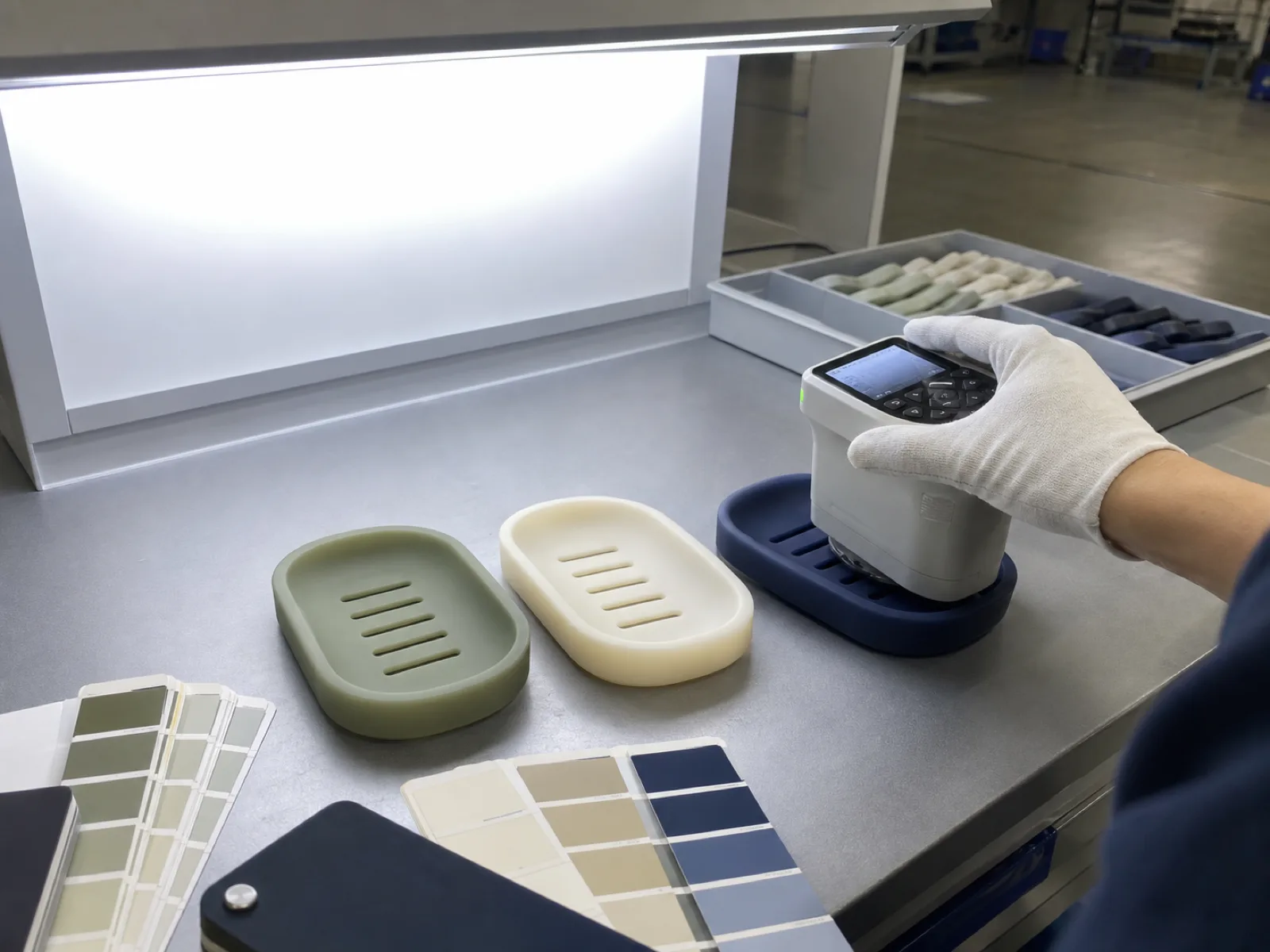
Wetop holds ΔE ≤ 2.0 against the approved master-batch reference under D65 daylight-simulation lighting, measured per batch across 20 sample locations. Silicone Pantones run slightly muted vs printed Pantones because pigment loads are capped at 2-4% to preserve tensile strength and food-contact compliance. The retail-safe palette for coordinated ranges is muted sages, warm off-whites, terracottas, matte navy, and warm greys. Any Pantone requiring >4% pigment load shows 3-5 ΔE batch-to-batch drift and is not defensible.
The Pantone-matching constraint is the reason the coordinated bathroom accessory range from a Tier-2 housewares brand tends to launch in a muted palette — not a design choice, a manufacturing reality. Silicone at 2-4% pigment load can defensibly hold ΔE ≤ 2.0 across a batch and across multiple batches on the same master-batch specification. At 5-8% pigment load, the mechanical properties (tensile strength, tear resistance) drop meaningfully and the FDA extractables profile shifts.
The retail-safe silicone Pantone palette
| Palette family | Pigment load | Achievable ΔE | Retail defensibility |
|---|---|---|---|
| Muted sage / warm off-white / warm grey | 1.5-2.5% | ≤ 1.5 | Full — multi-batch stable |
| Terracotta / dusty rose / matte navy | 2.5-3.5% | ≤ 2.0 | Full — multi-batch stable |
| Charcoal / deep forest / rust | 3.0-4.0% | ≤ 2.5 | Marginal — batch-to-batch drift |
| Saturated red / bright yellow / royal blue | 5.0-7.0% | 3-5 | Not defensible for retail |
| Deep pure black | 6.0-8.0% | 3-4 | Not defensible for retail |
The coordinated bathroom accessory range logic is straightforward: pick 4-6 SKUs (soap dish, toothbrush holder, tumbler, lotion pump housing, tray, cotton-ball jar) in the same 3-color palette drawn from the “full defensibility” tier. That combination — palette discipline plus coordinated SKU shape language — is what supports the $18-40 shelf-price coordinated-range positioning at the OXO / Umbra / Joseph Joseph caliber (anonymized). Custom logo debossing detail on the customize silicone logo — deboss, print, laser guide.
Six defect modes and how they surface at retail
Six defect modes account for ~85% of retail return complaints on silicone soap dishes. Suction cup pull-force below 8 N (60% of returns), drainage rib blow-out under thermal deformation, color drift beyond ΔE 2.0 across a batch, silicone-substrate delamination on two-shot overmolds, mildew stain in the rib base within 90 days of use, and flash at the parting line. All six are catchable at AQL 1.5 pre-shipment inspection per ISO 2859-1[^iso-2859-1] plus destructive sub-sampling for pull-force and delamination.
The six defect modes catalogued
Defect 1 — Suction cup pull-force below 8 N. Cup detaches from countertop under bathroom-splash or countertop-knock force. Cause: cup wall thickness under 1.2 mm at the cup rim, cup vacuum-relief geometry incorrect, or gum shrinkage under-compensated during mold cutting. Detection: ASTM D8972 pull test on 5-sample per batch. Zero tolerance below 8 N nominal.
Defect 2 — Drainage rib blow-out under thermal deformation. Ribs collapse or bow under dishwasher cycle (60-75°C wash water + 80-90°C dry cycle). Cause: base Shore A under 55, rib height above 2.5 mm without adequate draft, or under-cure of the base durometer. Detection: dishwasher-simulation cycle test (100 cycles at 75°C wash / 85°C dry) on 3-sample per batch. Rib height loss above 0.3 mm triggers batch review.
Defect 3 — Color drift beyond ΔE 2.0 across a batch. Batch samples show visible color variation vs approved master-batch reference. Cause: pigment lot variance from compound house, master-batch mixing time drift, or press temperature variance affecting pigment activation. Detection: D65 light-box color check on 20-sample per batch. ΔE above 2.0 triggers batch quarantine.
Defect 4 — Silicone-substrate delamination on two-shot overmolds. Top surface separates from drainage base at the mid-thickness interface. Cause: mechanical undercut depth under 0.8 mm, first-shot base surface contamination at overmold, or catalyst chemistry incompatibility (typically a peroxide-cure base with platinum-cure top). Detection: destructive peel test on 3-sample per batch plus 100-cycle accelerated wet-dry sub-sampling. Any peel-force below 15 N/cm triggers batch review.
Defect 5 — Mildew stain in the rib base within 90 days of use. Field return from consumer showing black or pink stain in the rib channel base. Cause: drainage geometry inadequate (rib pitch too tight, rib flank draft angle too shallow, dead-water pocket in base), not chemistry. Detection: 30-day accelerated wet-dry cycle test with ATP-luminescence swab reading. Any reading above 200 RLU triggers geometry review and mold rework.
Defect 6 — Flash at the parting line. Thin silicone film protrudes at the mold parting line, giving a sharp edge that catches on fingertips and looks visibly defective. Cause: mold parting-line wear, over-charge of gum weight, or clamp force below spec. Detection: visual inspection on 100% of samples at AQL 1.5. Zero tolerance for flash above 0.3 mm.
Pre-shipment inspection deliverables
Every Wetop batch ships with a pre-shipment inspection report covering:
- AQL 1.5 sampling plan per ISO 2859-15
- Dimensional check (5-point on 20-sample) — overall dimensions, rib pitch, rib height, suction cup diameter
- Shore A durometer check per ASTM D22401 on both top and base durometer zones (5-sample)
- Suction cup pull-force test per ASTM D897 (5-sample)
- Two-durometer interface peel test (3-sample destructive)
- Dishwasher cycle simulation (3-sample sub-sample)
- Pantone ΔE reading under D65 (20-sample)
- FDA 21 CFR 177.2600 test report per master-batch lot
- REACH SVHC screening report per master-batch lot
- PFAS non-detect test report per master-batch lot
Sample buyers who want to run their own third-party pre-shipment inspection (via SGS, Bureau Veritas, TIC, or their own QC team) can arrange it directly with the factory at any point in the production timeline.
Lead time from RFQ to warehouse — what’s realistic
Total realistic lead is 55-85 days from RFQ to US warehouse receipt. 7-15 days sample on existing tooling (18-25 days if new mold cut required for custom geometry), 30-40 days production for 5,000-15,000 pieces after PO and 30% deposit, plus 14-18 day Yantian-to-US-West-Coast sailing (25-32 days East Coast, 30-38 days Northern Europe). Suppliers quoting 28-day cold-start-to-warehouse totals are compressing a step — usually the pull-force verification or the two-durometer overmold cycle.
The full RFQ-to-PPAP workflow at Wetop
| Stage | Duration | Key deliverables | Buyer approval gate |
|---|---|---|---|
| 1. RFQ receipt + engineering review | 1-2 business days | Spec confirmation, cavitation recommendation, price bracket at MOQ tiers | — |
| 2. Sample production (existing tooling) | 7-15 days | Physical sample + master-batch lot cert + pull-force report | Sample approval + PO |
| 2b. New tooling cut (if custom geometry) | +14-21 days (parallel where possible) | Tooling drawing + first article inspection | Tooling approval |
| 3. PO + 30% deposit + material procurement | 5-10 days | Master-batch purchase, receiving QC | — |
| 4. Production (5,000-15,000 pcs) | 30-40 days | Two-durometer overmold cycle + secondary process + retail packaging | — |
| 5. In-process QC + AQL 1.5 pre-shipment | +3-5 days (overlaps production) | FDA + REACH + PFAS reports, pull-force test, delamination test, AQL report | Buyer inspection sign-off |
| 6. 70% balance + shipping documentation | 2-3 days | Commercial invoice, packing list, B/L, COO, MSDS | — |
| 7. Yantian to destination sailing | 14-38 days depending on port | On-board notification, tracking | — |
| Total realistic | 55-85 days |
Full timeline-driver breakdown on the MOQ and lead time on silicone OEM guide.
Factory audit checklist for a silicone soap dish OEM program
The Tier-2 housewares audit reduces to seven documents plus one video verification. ISO 9001 certificate with silicone molding scope; FDA + REACH + PFAS test reports per master-batch lot from the last 6 months; ASTM D897 pull-force test report on finished-part assembly; 30-day accelerated wet-dry mildew resistance report; Pantone ΔE report vs approved master-batch reference; business + export license copies; short unedited walk-through video of the compression molding floor with current date visible.
The consumer-facing sourcing coverage of silicone soap dishes fixates on “how to spot a quality product on the shelf.” The B2B retail audit fixates on “how to verify the factory’s process discipline on the ribs and the suction cups and the overmold interface.” The latter is what determines whether the product will pass retailer QA on the receiving dock in 60 days.
The seven-document audit stack
- ISO 9001:2015 certificate — current validity date, silicone molding in scope, issued by a recognized certification body. Verify against the certification body’s public register.
- FDA 21 CFR 177.2600 + REACH SVHC + PFAS non-detect test reports — all three referencing a specific master-batch lot number from production in the last 6 months. Reports issued by SGS, Intertek, TÜV, or Bureau Veritas.
- ASTM D8972 pull-force test report — on finished-part assembly, minimum 5-sample, referencing the same master-batch lot. Nominal pull-force per cup 8-15 N on non-porous substrate.
- 30-day accelerated wet-dry mildew report — ATP-luminescence swab readings at 6 measurement points across 30 days at 8 sample locations. All readings below 200 RLU.
- Pantone ΔE report — 20-sample colorimeter readings under D65 daylight simulation against approved master-batch reference. All readings below ΔE 2.0.
- Factory production video / photos — actual 2-station rotary compression presses and post-cure ovens in use, not stock footage. Verify the equipment count matches claimed production capacity.
- Business license + export license copies — verify legal entity name matches the trade partner on all commercial documents. Guard against factory-vs-trading-company confusion.
Full sourcing-verification framework on the sourcing silicone factory checklist.
Private-label vs OEM vs ODM — the decision matrix for silicone soap dish buyers
Private-label uses Wetop's existing tooling library (five standard footprints, five durometer combinations) with your logo debossed or printed on the drainage base. OEM cuts new tooling to your CAD or physical reference for custom geometry — custom footprint, custom rib pattern, custom suction geometry — with full design ownership on the buyer side. ODM adapts one of Wetop's design-library archetypes to your brand narrative. All three run at MOQ 500.
Decision matrix by program archetype
| Program type | Private-label | OEM | ODM |
|---|---|---|---|
| Design ownership | Factory | Buyer (you) | Shared / licensed |
| Tooling cost | $0 (existing library) | $2,800-$3,600 (single-cavity) | $0 (shared library) or licensed |
| Time to first sample | 7-15 days | 21-35 days | 7-15 days |
| Best for | Fast-launch retail, Amazon FBA | Coordinated bathroom accessory range | Test-market SKUs, limited-run |
| MOQ | 500 pcs | 500 pcs | 500-1,000 pcs |
| Design exclusivity | No | Yes (buyer owns tooling) | Negotiated |
Wetop’s baseline silicone soap dish tooling library covers five footprints at 500-piece private-label MOQ: 130×90 mm standard retail, 140×100 mm heavy-duty, 160×110 mm coordinated-range wide, 110×80 mm compact / secondary bathroom, and 150×95 mm shower-caddy-adjacent. All five available in three drainage architectures (parallel rib, through-hole, open slat) and five two-durometer combinations. Debossed or printed logo customization at zero additional tooling cost.
What Wetop OEMs on silicone soap dishes
Wetop runs silicone soap dish programs at 500-piece MOQ per SKU on two-durometer platinum-cure overmold tooling from a 7,500 m² founder-led Dongguan floor. Standard footprints 130×90 mm, 140×100 mm, and 160×110 mm at private-label MOQ 500. Per-batch FDA 21 CFR 177.2600 + REACH SVHC + PFAS non-detect + ASTM D897 pull-force + 30-day wet-dry mildew report included in every quote. FOB Yantian pricing published above.
Program defaults:
- Two-durometer platinum-cure overmold — Shore A 45 top surface bonded to Shore A 65 drainage base, molded on a 2-station rotary compression press with mechanical undercut + chemical bond interface. Standard for all retail-tier programs at $6-30 shelf.
- 4-cup suction base at 20 mm cup diameter — nominal 40-55 N combined pull-force, verified per ASTM D897 on 5-sample per batch.
- Parallel-rib drainage geometry at 4.5 mm pitch × 2 mm height with 2-3° flank draft — retail-winning default for anti-mildew claim defensibility.
- Retail-safe muted Pantone palette — muted sage, warm off-white, warm grey, terracotta, matte navy at ΔE ≤ 2.0 tolerance.
Tooling library covers five standard footprints (130×90, 140×100, 160×110, 110×80, 150×95 mm) in three drainage architectures at private-label MOQ 500. Custom tooling for OEM programs at $2,800-$3,600 single-cavity amortized against first order.
Sourcing a silicone soap dish program? Email inquiry@wetopsilicone.com with your target retail tier, coordinated-range SKU count (soap dish standalone or part of a 4-6 SKU bathroom range), target regulatory scope (US-only, EU-inclusive, California-inclusive), and target volume — we return within 2 business days with a durometer + drainage architecture recommendation, per-batch documentation packet outline, and price brackets at MOQ 500 / 1,000 / 5,000 / 10,000. Mutual NDA available at our NDA page. Full manufacturing detail on the capabilities page; anonymized program archetypes at case studies; direct engineering contact via the contact page.
Footnotes
-
ASTM International. ASTM D2240-15 — Standard Test Method for Rubber Property—Durometer Hardness. https://www.astm.org/d2240-15r21.html — the Shore A hardness measurement standard behind the two-durometer overmold spec. ↩ ↩2 ↩3
-
ASTM International. ASTM D897-08 — Standard Test Method for Tensile Properties of Adhesive Bonds. https://www.astm.org/d0897-08r16.html — the tensile pull-test standard Wetop uses to verify suction cup pull-force on finished silicone soap dish assemblies. ↩ ↩2 ↩3
-
European Chemicals Agency. PFAS Universal Restriction Proposal. https://eur-lex.europa.eu/legal-content/EN/TXT/?uri=CELEX%3A32006R1907 — the regulatory action driving PFAS-free specification adoption in EU premium bathroom retail. ↩
-
California Office of Environmental Health Hazard Assessment. Proposition 65 — Safe Drinking Water and Toxic Enforcement Act. https://oehha.ca.gov/proposition-65 — the California disclosure requirement that applies to any silicone soap dish sold into California retail. ↩
-
International Organization for Standardization. ISO 2859-1:1999 — Sampling procedures for inspection by attributes. https://www.iso.org/standard/1141.html — the sampling standard behind AQL 1.5 pre-shipment inspection. ↩
FAQ
-
What is the MOQ for a custom silicone soap dish OEM program?
Wetop's MOQ is 500 pieces per SKU. The floor exists because per-batch third-party test reports (FDA 21 CFR 177.2600, REACH SVHC screening, PFAS non-detect at ppb detection) run $700-$1,100 combined; below 500 pieces the test cost dominates the per-unit price and the finished product is not retail-competitive. At 500 pieces the test cost amortizes to $1.40-$2.20 per piece. FOB Yantian Q3 2026: 500 pcs $1.35-$1.85 / 1,000 pcs $1.10-$1.55 / 5,000 pcs $0.85-$1.20 for a two-durometer platinum-cure dish with a 4-suction drainage base and Pantone-matched master-batch. Tooling for a single-cavity mold runs $2,800-$3,600 amortized against the first order.
-
How does drainage geometry actually work on a silicone soap dish?
Drainage geometry is the mechanism behind the anti-mildew claim on retail packaging. Three architectures cover the category: parallel ribs (rib pitch 4-6 mm, rib height 1.5-2.5 mm), through-holes (hole diameter 3-5 mm, open area 25-35% of the top surface), and open slats (slat gap 5-8 mm). Parallel ribs clear standard bar-soap water film in under 90 seconds and hold the soap in place with lateral friction; through-holes clear water in under 60 seconds but let small soap fragments fall through onto the countertop; open slats drain in under 30 seconds but require a two-durometer overmold to hold rigidity. The retail-winning default at $6-15 shelf is 4.5 mm rib pitch at 2 mm rib height with a slight 2-3° draft angle on the rib flank to accelerate water shedding.
-
What suction cup pull-force spec does a silicone soap dish need?
8-15 N per cup on non-porous surfaces, verified per ASTM D897 pull test on the finished-part assembly. Wetop specifies four 18-22 mm suction cups on a standard 130×90 mm dish base, giving a combined nominal pull-force of 32-60 N — enough to resist countertop knocks and shower-splash forces without tearing the silicone base at the cup joint. Critical caveat: suction is a non-porous-surface mechanism. On glazed ceramic tile, sealed glass, chromed steel, laminated countertop, and sealed granite the spec holds. On unsealed granite, unsealed marble, textured quartz, honed limestone, and any porous stone the pull-force drops to near zero. Retail packaging must state "for use on smooth, non-porous surfaces" or the field return rate on a 5,000-piece production run jumps 3-4x.
-
Why is a serious silicone soap dish a two-durometer overmold?
Because the soap-contact top surface and the drainage base have opposite engineering requirements. The top wants Shore A 40-55 for grip and cushion (so the soap bar doesn't slide, and the dish absorbs countertop-drop impact). The base wants Shore A 55-70 for rigidity (so the drainage ribs don't collapse under soap weight and the suction cups hold their geometry). A single-durometer molding compromises both — either the top is too hard (soap slides, feels cheap) or the base is too soft (ribs flatten within 60 days of use, mildew accumulates in the collapsed channels). A two-shot overmold on a 2-station rotary compression press bonds the two durometers at the mid-thickness plane with a mechanical undercut plus platinum-cure chemical bond, holding the interface across 2,000+ wet-dry cycles.
-
What is the anti-mildew architecture on a silicone soap dish and how is it verified?
Anti-mildew is a self-draining geometry claim, not a chemical treatment claim — no antimicrobial additive is FDA-cleared for permanent inclusion in food-contact silicone at retail scale, and any additive-based claim invites 21 CFR 175 review that most retail SKUs cannot support. Wetop's approach is quick-dry drainage architecture: 4-5 mm rib pitch, 2-3° rib flank draft angle, and no dead-water pockets in the base geometry. Verification runs a 30-day accelerated wet-dry cycle (12 hours submerged in soap slurry, 12 hours ambient dry, repeated 30 times) with ATP-luminescence swab testing on the rib base every 5 cycles. Passing spec: swab reading below 200 RLU across all sample locations after 30 cycles. This is the same test protocol the Tier 2 housewares brands (OXO, Umbra, Joseph Joseph caliber) audit against.
-
Does a silicone soap dish need FDA 21 CFR 177.2600 compliance if it only contacts soap?
Yes — the regulatory chain is dish → soap → skin, and skin-contact via soap dermal transfer is regulated as food-adjacent under FDA guidance for repeated-use rubber articles. Any US retail program above $6 shelf price will demand FDA 21 CFR 177.2600[^fda-177-2600] test reports referencing a specific master-batch lot. EU retail additionally requires REACH SVHC screening[^echa-reach] and increasingly per-batch PFAS non-detect testing driven by the ECHA universal restriction proposal[^echa-pfas-proposal]. California AB 1200 (heavy metals in cosmetics-adjacent packaging) and Prop 65 disclosure are the two US state-level requirements most retail buyers now audit against on West Coast programs. Wetop's per-batch documentation packet covers all five as standard.
-
How do I choose single-cavity vs 4-cavity mold tooling for a silicone soap dish program?
Cavity tier is a volume-vs-tooling-cost tradeoff. Single-cavity tooling runs $2,800-$3,600 and yields 40-60 pieces per press-hour — economic for MOQ 500-1,500. 2-cavity tooling runs $4,200-$5,400 and yields 80-120 pieces per press-hour — economic for 3,000-8,000 pieces. 4-cavity tooling runs $6,500-$9,500 and yields 160-240 pieces per press-hour — economic for 10,000+ pieces where the per-unit price drop of 15-25% pays back the tooling delta within the first production order. The failure mode is jumping to 4-cavity for a 2,500-piece test run: the tooling amortization dominates unit cost and the buyer over-pays 30-40% for cycle-time gains they don't need. Wetop typically recommends starting at single-cavity for the first order, then converting to 2-cavity or 4-cavity tooling as the retail listing scales past the third re-order.
-
What Pantone-matching tolerance can Wetop hold on a silicone soap dish batch?
ΔE ≤ 2.0 against the approved master-batch reference under D65 daylight-simulation lighting, measured per batch across 20 sample locations. Silicone Pantones run slightly muted vs printed Pantones because pigment loads are capped at 2-4% to preserve tensile strength and food-contact compliance; over-loading the master-batch to hit vibrant colors compromises the FDA extractables profile. The retail-safe palette is muted sages, warm off-whites, terracottas, matte navy, and warm greys. Any Pantone requiring >4% pigment load (bright reds, saturated yellows, deep blacks) will show ΔE 3-5 batch-to-batch drift and is not defensible for a coordinated bathroom accessory range where the soap dish must match a coordinated toothbrush holder, tumbler, and lotion pump housing.
-
How does a silicone soap dish OEM program compare against plastic and ceramic soap dishes for a coordinated bathroom accessory range?
A silicone soap dish wins on three retail-driven variables against injection-molded ABS/PP plastic and against glazed ceramic: (1) drop-impact survival — silicone survives 1.5 m countertop drop onto tile with zero fracture, ABS cracks at ~0.8 m, ceramic fractures at 0.4 m; (2) sound signature — silicone lands silent, ABS clatters, ceramic risks tile chip on impact; (3) anti-slip on wet countertops — silicone base grips wet ceramic tile at 0.8+ coefficient of friction, ABS slides at 0.3, ceramic slides at 0.4. Silicone loses on unit cost at MOQ 500 — a comparable ABS injection-molded dish runs $0.55-$0.85 FOB, silicone runs $1.35-$1.85. The retail positioning argument is coordinated bathroom accessory ranges at $12-30 shelf price where the material story (soft-touch, quiet, unbreakable, dishwasher-safe to 200°C) supports the price premium. For the private-label workflow across a coordinated 4-6 SKU bathroom range see the [private-label silicone kitchen products guide](/guide/private-label-silicone-kitchen-products/); for the logo customization tradeoffs see the [customize silicone logo — deboss, print, laser guide](/guide/customize-silicone-logo-deboss-print-laser/).
-
What Tier-2 housewares brands audit a silicone soap dish factory against?
The retail-audit stack for a Tier-2 housewares brand (OXO, Umbra, Joseph Joseph, DI ORO caliber, anonymized) collapses to seven documents: (1) ISO 9001:2015 certificate with silicone molding scope; (2) FDA 21 CFR 177.2600 test report per master-batch lot from the last 6 months; (3) REACH SVHC screening report at the current 235-substance list; (4) PFAS non-detect test report at ppb detection from an accredited lab (SGS, Intertek, TÜV, Bureau Veritas); (5) suction cup pull-force test report per ASTM D897 on the finished-part assembly; (6) 30-day accelerated wet-dry mildew resistance report with ATP-luminescence readings; (7) Pantone ΔE report against the approved master-batch reference. A supplier resisting any of the seven is answering the audit question. For the full sourcing-verification framework see the [sourcing silicone factory checklist](/guide/sourcing-silicone-factory-checklist/).
References
Authoritative sources cited in this guide
- US Food and Drug Administration. 21 CFR 177.2600 — Rubber articles intended for repeated use. https://www.ecfr.gov/current/title-21/chapter-I/subchapter-B/part-177/subpart-C/section-177.2600 — The primary US food-contact regulation Wetop cures every silicone soap dish batch against, applied here because the dish → soap → skin chain routes through skin-contact dermal transfer.
- European Chemicals Agency. REACH Regulation (EC) 1907/2006 — Substances of Very High Concern. https://eur-lex.europa.eu/legal-content/EN/TXT/?uri=CELEX%3A32006R1907 — The EU regulatory framework requiring SVHC screening on every silicone soap dish batch destined for EU retail; the current candidate list carries 235+ substances.
- European Chemicals Agency. PFAS Universal Restriction Proposal. https://eur-lex.europa.eu/legal-content/EN/TXT/?uri=CELEX%3A32006R1907 — The regulatory action driving PFAS-free specification adoption in EU premium bathroom retail and, downstream, US West Coast retail.
- International Organization for Standardization. ISO 9001:2015 — Quality Management Systems — Requirements. https://www.iso.org/standard/62085.html — The quality management standard Wetop is certified against — governs batch traceability, cavitation setup records, and audit documentation.
- International Organization for Standardization. ISO 2859-1:1999 — Sampling procedures for inspection by attributes. https://www.iso.org/standard/1141.html — The sampling standard behind AQL 1.5 pre-shipment inspection Wetop runs on every silicone soap dish batch.
- ASTM International. ASTM D2240-15 — Standard Test Method for Rubber Property—Durometer Hardness. https://www.astm.org/d2240-15r21.html — The Shore A hardness measurement standard behind the two-durometer overmold spec on silicone soap dishes.
- ASTM International. ASTM D897-08 — Standard Test Method for Tensile Properties of Adhesive Bonds. https://www.astm.org/d0897-08r16.html — The tensile pull-test standard Wetop uses to verify suction cup pull-force on finished silicone soap dish assemblies.
- California Office of Environmental Health Hazard Assessment. California Proposition 65 — Safe Drinking Water and Toxic Enforcement Act. https://oehha.ca.gov/proposition-65 — The California disclosure requirement that applies to any silicone soap dish sold into California retail — the packaging disclosure decision is driven by per-batch screening against the current list.
Start a custom program
Send a brief. Get an engineer’s reply in one business day.
Every Wetop program is tooled from a customer’s specification. Send a CAD file (STEP · IGES · DWG) or a written brief and we’ll reply with a mold cost estimate, price brackets at MOQ 500 / 1,000 / 5,000, and any engineering questions.