Buyer Guide · commercial intent
Custom Silicone Stretch Lid Manufacturing: OEM Buyer Guide
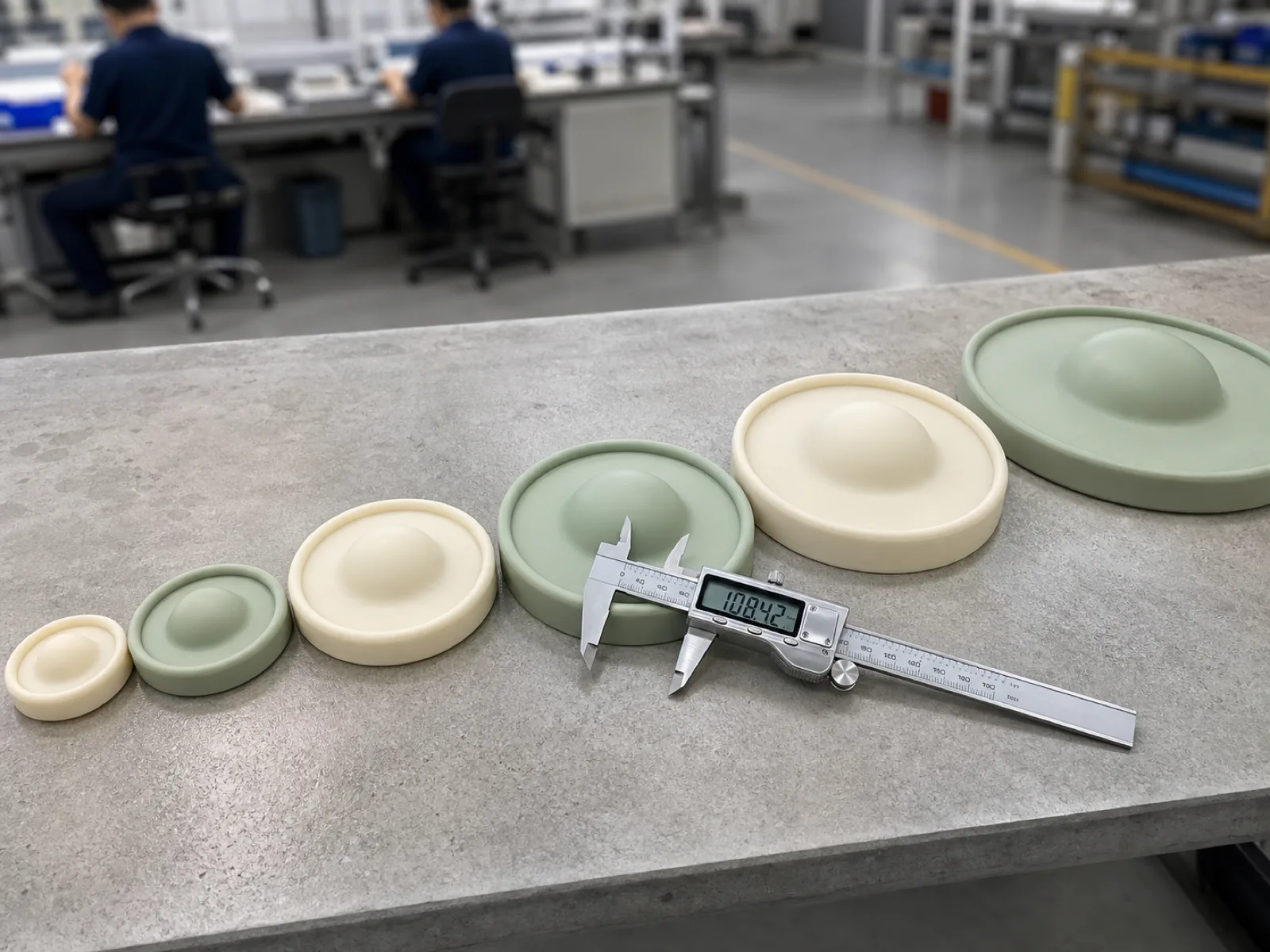 Buyer Guide
 Ordering custom silicone stretch lids is a decision about fit range, reuse economics, and documentation depth — not just a per-piece price. A single lid stretches 30-55% over a container rim, so a 6-piece graduated set covers most kitchen vessels from a can to a small skillet. Wetop manufactures custom and private-label stretch lid programs at a 500-set MOQ per SKU, with every batch carrying its own FDA 21 CFR 177.2600 and LFGB test reports and a landed cost that typically clears USD 1.55-3.20 per set to the US West Coast.
Most brand buyers meet the silicone stretch lid as a reusable-kitchen SKU that has to earn a shelf slot against cling film, beeswax wraps, and rigid snap lids. The manufacturing questions that decide whether that program succeeds are different from the ones a consumer roundup covers: how fit diameters overlap across a set, what stretch ratio the compound actually delivers, how reuse life is tested rather than claimed, and what a full container costs landed. This guide is written from Wetop’s Dongguan engineering desk for buyers running a custom stretch lid program at 500 to 200,000 sets, with the sizing math, custom-manufacturing scope, durability protocol, and FOB-to-landed economics laid out the way we hand them to a program manager on the first call.
What does custom silicone stretch lid manufacturing actually involve?
Ordering custom silicone stretch lids means committing to a per-SKU minimum — 500 sets at Wetop — in exchange for factory-direct pricing, per-batch food-contact test reports, and custom color, logo, and packaging. It is distinct from retail arbitrage: the buyer owns spec decisions on fit range, cure system, and documentation depth, which is where program margin and return rate are won or lost.
A custom stretch lid program is a spec commitment before it is a price. The buyer decides the piece count and diameter spread of the set, the cure system, the durometer, the color, the branding method, and the retail-readiness of the packaging. Each of those choices moves both the FOB number and the field return rate, and a supplier that quotes a single price without asking about them is quoting a different product than the one that will land.
The 500-set MOQ floor is a documentation-economics number, not an equipment limit. A custom program that ships into any serious retail channel needs its own per-batch FDA 21 CFR 177.26001 and LFGB2 test reports, tied to the specific master-batch lot the goods were molded from. That test packet runs USD 1,000-1,400 for a stretch lid family. Spread across 500 sets it amortizes to a workable per-set cost; spread across 100 sets it dominates the price and the product stops being competitive. The full MOQ logic sits in the real-factory MOQ math, and per-tier timing in the MOQ and lead time on silicone OEM guide.
The three purchasing models map cleanly to how much of the spec the buyer owns:
| Model | Tooling cost | Buyer owns | MOQ | Best for |
|---|---|---|---|---|
| Private label — Wetop cavity library | USD 0 | Color, logo, packaging | 500 sets | Category test, DTC / Amazon FBA, fast time-to-shelf |
| OEM — new mold to buyer drawing | USD 6,500-18,000 (amortized) | Geometry + tool | 500 sets | Differentiated fit range, supplier lock-in |
| ODM — Wetop engineers geometry | Engineering fee + tooling | Licensed / joint design | 500-3,000 sets | Buyers new to the silicone category |
How do silicone stretch lids compare to plastic wrap, beeswax wraps, and rigid lids?
Silicone stretch lids win on reuse life and thermal range, losing only on unit price and on sealing deeply irregular shapes. They survive 500+ dishwasher cycles and a -40 °C to 230 °C range, versus single-use cling film and 60-100-use beeswax wraps that can't take a dishwasher, microwave, or deep freeze. That cost-per-use gap is the resale story the category is built on.
The brand buyer isn’t merchandising a lid — they’re merchandising a replacement for four incumbent behaviors: cling film, foil, beeswax wraps, and mismatched rigid containers. Winning that shelf slot is an argument about cost-per-use and versatility, so the comparison has to be honest about where silicone loses as well as where it wins.
| Attribute | Silicone stretch lid | Plastic cling film | Beeswax wrap | Rigid snap lid |
|---|---|---|---|---|
| Reuses before failure | 500-1,000 | 1 (single-use) | 60-100 | 200-500 (if size matches) |
| Temperature range | -40 °C to 230 °C | ~ -18 °C to 70 °C | -10 °C to 30 °C | Varies (often not oven-safe) |
| Dishwasher safe | Yes | No | No | Usually |
| Microwave safe | Yes | Partly | No | Usually not |
| Fits many container sizes | Yes (stretch envelope) | Yes | Somewhat | No (one lid, one vessel) |
| Airtight / liquid seal | Good on round mouths | Good | Weak | Best |
| Cost per use (retail) | Lowest over life | Low upfront, high over time | Moderate | Low if reused |
| Resale margin (for the brand) | High | Commodity | Moderate | Moderate |
The engineering-honest verdict brand buyers should carry into a category review: silicone stretch lids own the reusable-and-heat-safe quadrant. Cling film wins only on lowest upfront price, beeswax wins only on the compostable-materials narrative, and rigid lids win only on a perfect liquid seal for a fixed container. A stretch lid line positioned as the “one drawer replaces the wrap, the foil, and the odd-lid pile” story is defensible on every spec except deep-irregular sealing.
What sizes do silicone stretch lids come in, and how do fit diameters work?
A silicone stretch lid stretches 30-55% beyond its molded diameter, so each lid seals a fit-diameter band rather than a single size. A nominal 4-inch lid covers roughly 3.2 to 5.6 inches. Graduated sets are built so those bands overlap — a 6-piece graduated set from 2.6 to 8.7 inches nominal covers cups through a small skillet with no gaps.
The single most-omitted number in the entire category is the fit diameter. Competitor listings publish a nominal molded diameter and an image, and leave the buyer to guess what it actually fits. That guess is where field returns come from. The real spec is a range, governed by the stretch ratio the compound and rim geometry deliver.
Stretch ratio is a function of elongation-at-break and rim-bead design. A Shore A 45-50 compound at 500-550% elongation stretches comfortably to 40-55% over nominal before rim tension becomes too high to seal reliably; a stiffer Shore A 55-60 compound stretches only 25-35%. The rolled rim bead sets how that tension distributes around the circumference. Below is the fit-diameter table Wetop publishes for a standard graduated set, so a buyer can map the set to their target container list before tooling.
| Lid position | Nominal molded dia. | Fit-diameter band | Typical containers sealed |
|---|---|---|---|
| 1 (mini) | 2.6 in (66 mm) | 2.2-3.6 in | Cans, small jars, cups, cut citrus |
| 2 | 3.75 in (95 mm) | 3.1-5.0 in | Mugs, pint glasses, small bowls |
| 3 | 4.5 in (114 mm) | 3.7-6.0 in | Cereal bowls, medium jars |
| 4 | 5.75 in (146 mm) | 4.7-7.6 in | Mixing bowls, storage tubs |
| 5 | 6.5 in (165 mm) | 5.3-8.6 in | Large bowls, pots, cut melon |
| 6 (large) | 8.7 in (220 mm) | 7.1-11.5 in | Skillets, large pots, casserole dishes |
The overlap is deliberate. Because band 3 (3.7-6.0 in) and band 4 (4.7-7.6 in) share a wide middle, a container at 5 inches has two lids that fit it — the set has no dead zones. When a buyer wants a 4-piece value set instead, the engineering task is to widen each lid’s target band (softer compound, higher elongation) so four lids still cover the range six normally would, which trades a little rim durability for coverage. Square and rectangular containers are specified against the diagonal, not the side, because the lid stretches over the corners first.
How does a silicone stretch lid actually grip and seal?
A silicone stretch lid seals by two mechanisms at once: circumferential stretch tension pulling a rolled rim bead down and inward against the container wall, and a partial vacuum trapped under the domed center when the lid is pressed on. Stretch tension does the mechanical holding; the trapped-air suction adds the airtight liquid seal on smooth round mouths.
Understanding the seal mechanism is what lets a buyer diagnose a leaking-lid complaint instead of just returning the batch. Two independent forces are at work. First, stretch tension: when the lid is pulled over a rim wider than its molded diameter, the elastomer wants to contract, and that contractile force clamps the rolled rim bead against the vessel wall. This is why durometer and elongation matter — too stiff and it can’t stretch enough to clamp, too soft and it clamps weakly and tears.
Second, the suction effect: pressing the domed center down before releasing evacuates a small volume of air, and atmospheric pressure then holds the lid seated. On a smooth glass or stainless mouth this produces the satisfying airtight seal buyers demo on the shelf; on a rough, chipped, or threaded rim the vacuum leaks and only the mechanical stretch clamp remains, which still holds the lid on but no longer seals liquid. The rim-bead cross-section — a 2.5-4.0 mm rolled bead rather than a flat edge — is what makes both mechanisms reliable, and it is a mold-design decision locked at the tooling stage, not something that can be fixed in QC.
The practical seal envelope: a well-specified Shore A 50 lid holds an inverted 30-second liquid seal on round mouths across its full fit band, holds mechanically (no liquid seal) on irregular mouths, and should never be marketed as spill-proof for transport — that is a rigid-lid claim, and setting the expectation correctly at the packaging stage cuts a predictable return category.
What’s the full custom-manufacturing scope on a stretch lid program?
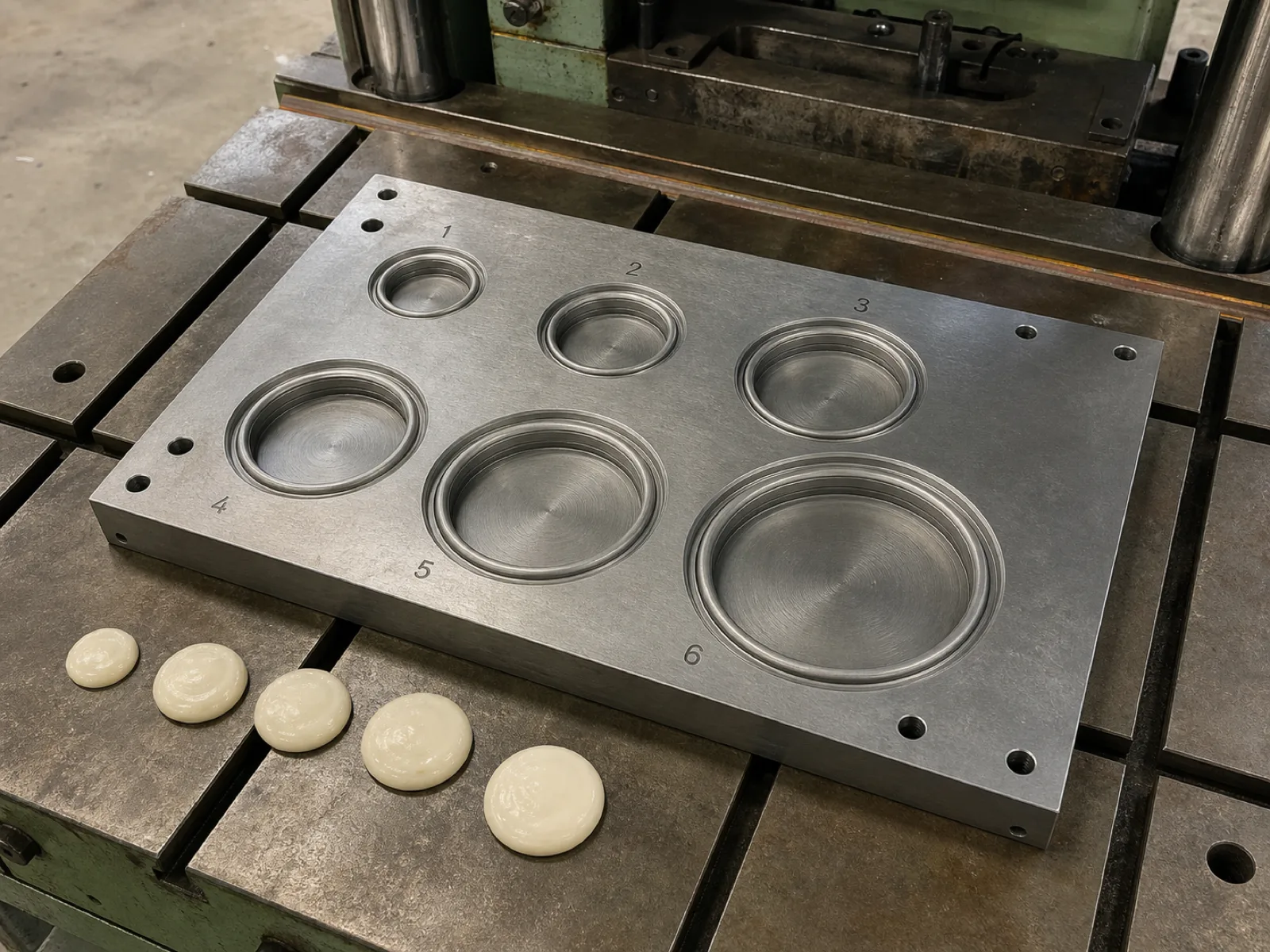
Custom manufacturing on a stretch lid program covers five layers: mold and cavity design, rim-bead and wall structure, Pantone-matched masterbatch color, branding method (deboss, emboss, pad print, or laser), and retail-ready packaging or private-label documentation. Private label uses Wetop's existing cavities at zero tooling cost; full OEM cuts a new multi-cavity mold to the buyer's drawing.
The customization decision tree is where a custom program becomes a brand rather than a commodity buy. Each layer carries its own economics and lead-time impact.
| Layer | Options | Cost impact | Notes |
|---|---|---|---|
| Mold / cavity | Existing library vs new multi-cavity tool | USD 0 vs 6,500-18,000 | New tool amortized against first order; buyer owns it |
| Structure | Rim-bead profile, wall 0.8-1.6 mm, pull-tab | Tooling-dependent | Rim bead sets seal reliability; locked at mold stage |
| Color | Pantone-matched inorganic masterbatch | +USD 0.09-0.22/set | ΔE ≤ 1.5 on D65 light box; muted tones hit easiest |
| Logo | Deboss / emboss / pad print / laser | USD 0-0.18/set | Deboss = zero unit adder, permanent |
| Packaging | Polybag / header card / kraft sleeve / FSC box | +USD 0.06-0.60/set | Retail-readiness tier drives this |
Color is the layer buyers most often underestimate. Silicone masterbatch uses inorganic pigments (iron oxide, titanium dioxide, chrome oxide) for heat stability, which narrows the achievable gamut versus injection-molded plastic. Sage, cream, terracotta, charcoal, and classic red hit ΔE ≤ 1.5 cleanly; saturated neons and deep purples are difficult in a heat-stable pigment and often can’t clear retail color tolerance. Branding method is a durability decision — a debossed logo is a physical feature of the mold cavity that outlives the product, while a pad print is the cheapest route to multi-color but wears within 40-60 dishwasher cycles. The method-by-method economics live in the silicone logo customization guide. Durometer selection against the Shore A hardness chart is the structural choice that ties color and rim geometry back to seal performance.
What temperature range, hardness, and wall thickness should a custom program lock?
Lock a stretch lid program at Shore A 45-55 durometer, 0.8-1.6 mm wall (1.0-1.2 mm retail default), elongation-at-break above 400%, and a verified -40 °C to 230 °C continuous range. Those four numbers, written into the PO as contract terms with their ASTM test methods, are what separate a lid that seals and lasts from a commodity import that tears or off-gasses.
A custom spec is only as good as the numbers written into the purchase order. Four parameters carry the product, and each has a test method a buyer can demand a report against.
| Parameter | Program spec | Test method | Why it matters |
|---|---|---|---|
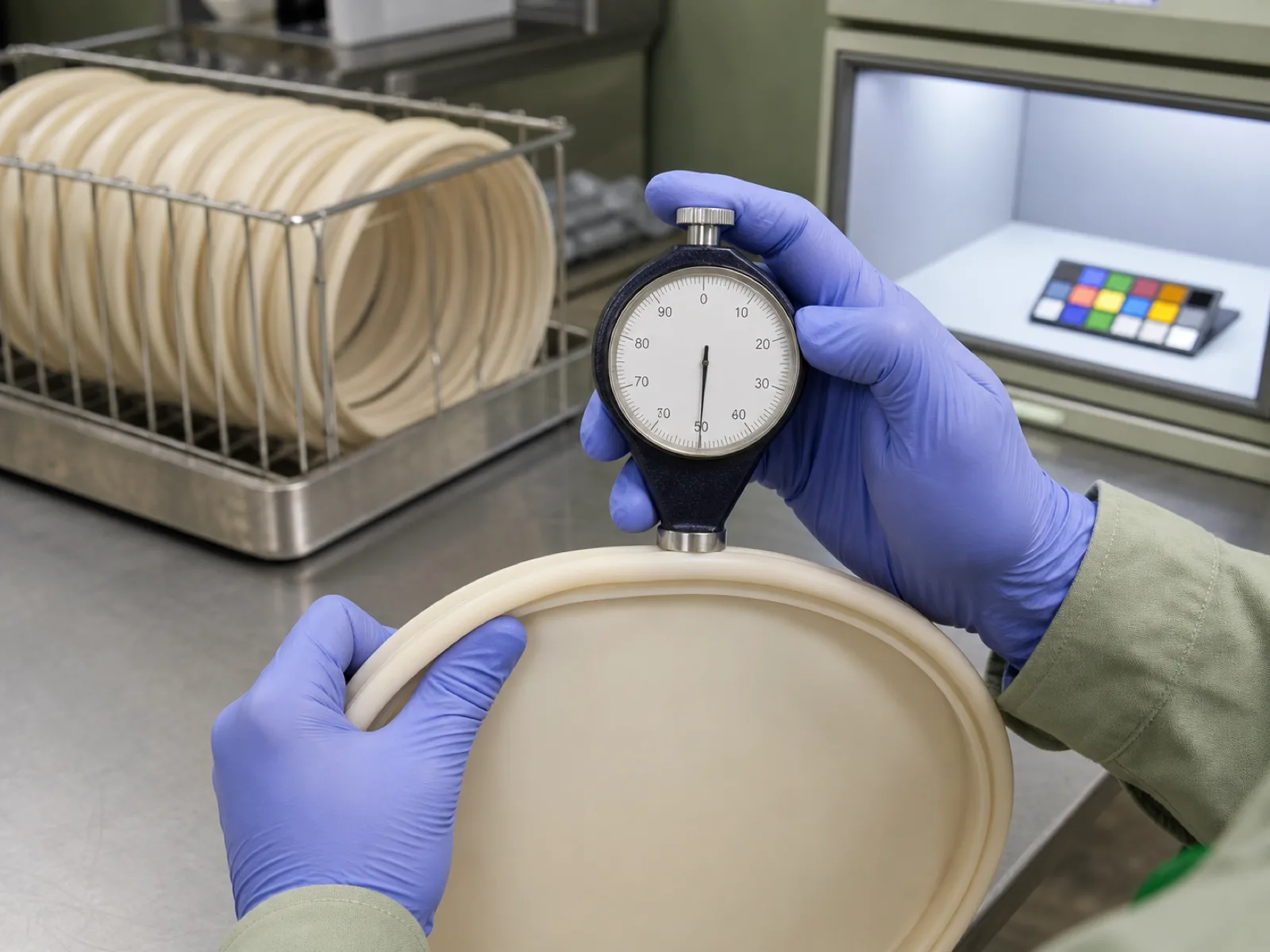
| Shore A hardness | 45-55 (default 50) | ASTM D22403 | Too high won’t seal; too low tears at rim |
| Wall thickness | 0.8-1.6 mm (1.0-1.2 default) | Digital caliper, 5-point | Thin walls fatigue; thick walls stretch poorly |
| Elongation at break | ≥ 400% (typical 450-550%) | ASTM D412 | Sets the stretch envelope and permanent-set resistance |
| Continuous temperature | -40 °C to 230 °C | Thermal cycling + LFGB extractables | Covers freezer, microwave, dishwasher, oven |
The temperature envelope is where the cheapest imports quietly fail. The silicone polymer itself holds the -40 °C to 230 °C range without trouble; what fails is an under-cured lid whose residual volatiles off-gas an odor on the first microwave heat. That is a post-cure problem — a 4-6 hour oven cycle at 180-200 °C that commodity factories skip to save energy — not a material limitation. A buyer verifying a custom program should ask for the post-cure log tied to the master-batch lot, not accept the “-40 to 230” claim on the packaging at face value. The cure-system trade-off behind that step is detailed in the platinum-cured vs peroxide-cured silicone guide.
How durable are silicone stretch lids, and how is lifespan actually tested?
Reuse life on a correctly cured stretch lid is 500-1,000 stretch-and-wash cycles, verified by test methods rather than marketing: 500-cycle dishwasher aging measured against a ΔE ≤ 2 color-shift limit, -40 °C freezer thermal shock, elongation retention above 400%, and compression set under 25% at ASTM D395. Rim-bead fatigue, not tearing, is the true end-of-life signal on a good lid.
“Reusable” and “lasts for years” are claims a brand buyer should never accept without a test protocol behind them, because the failure economics land on the buyer’s return desk, not the factory’s. Durability on a stretch lid is a bundle of measurable properties, each with an accepted method:
- Dishwasher aging — 500 automated cycles at 71 °C peak, pH 10.5 detergent, then color measurement against the approved sample. Acceptance: ΔE ≤ 2 (no visible yellowing or greying) and no loss of rim snap-back.
- Thermal shock — cycling between -40 °C freezer and 230 °C oven, checking for crack initiation at the rim and any permanent doming loss.
- Elongation retention — ASTM D412 elongation-at-break re-measured after aging; a lid that drops below 400% has lost its stretch envelope and will no longer seal its full fit band.
- Compression set — ASTM D395, 22 hours at 175 °C, acceptance ≤ 25%; a lid that takes a permanent set stops snapping back to its molded diameter.
- Rim tear resistance — ASTM D624, target ≥ 22 kN/m; the property that determines whether the lid survives repeated over-stretch or splits at the bead.
The end-of-life mode on a well-made lid is graceful: the rim bead slowly loses snap-back over hundreds of cycles until the seal weakens, giving the user years of service. The end-of-life mode on an under-cured commodity lid is abrupt — a rim tear inside the first 30-80 stretches. That gap between 30 cycles and 500+ cycles is entirely a cure-and-post-cure story, which is why durability due-diligence on a custom program is really cure-verification due-diligence.
What certifications and food-contact clauses apply to a stretch lid program?
A custom stretch lid program needs FDA 21 CFR 177.2600[^fda-177-2600] for US food contact, LFGB §30/31 per BfR Recommendation XV[^bfr-lfgb-xv] for the EU, EU Regulation 1935/2004[^ec-1935-2004] framework compliance, ISO 9001:2015[^iso-9001] quality-system certification, and increasingly a per-batch PFAS non-detect report. Each must reference a specific recent master-batch lot, not the compound supplier's blanket certificate.
The certification trap for first-time buyers is accepting a compound-level certificate in place of a finished-good, lot-specific test report. An “FDA certified” claim on a marketplace listing usually means the raw silicone had 177.2600 clearance from its supplier — it does not mean the finished lid was lot-tested by an accredited third party, and US Customs FDA import review does not accept the substitution. The documents a serious program carries, tied to the lot the goods shipped from: FDA 21 CFR 177.2600 extractables, LFGB §30/31 organic-volatile results, an EU 1935/2004 Declaration of Compliance for EU shipments, a REACH SVHC screen4 on the masterbatch, and the ISO 9001 certificate covering silicone-molding scope. Buyers running into both US and EU should read the FDA vs LFGB silicone decoder to see where the two frameworks diverge on extractables limits and per-batch reporting — the divergence changes which lab report the auditor will demand.
What does a container of custom silicone stretch lids cost landed?
FOB Yantian runs USD 1.20-2.90 per graduated set by volume and cure system. A 40HQ container holds 55,000-90,000 sets; landed to US West Coast, add ocean freight (USD 2,800-4,200 per container in 2026), 3.4% duty under HTS 3924.10.4000[^hts-3924], plus brokerage and drayage. Landed cost typically clears USD 1.55-3.20 per set — far below the per-piece pricing that misleads first-time buyers.
The landed-cost math is the most under-explained number in stretch lid procurement, and it is where marketplace single-piece pricing quietly misleads. A listing quoting USD 2.50 for one set is structured to reprice at container quantity, and a buyer who models the program on the sample price is off by a wide margin. The honest math runs FOB plus a stack of freight and customs line items. Below is Wetop’s landed-cost table for a representative retail spec — a 6-piece graduated set, Shore A 50, platinum-cured, Pantone-matched, debossed logo, kraft-sleeve packaging.
| Line item | Cost per set | Cost per 40HQ (70,000 sets) |
|---|---|---|
| FOB Yantian (spec above) | USD 1.95 | USD 136,500 |
| Ocean freight, Yantian → LA/LB | USD 0.050 | USD 3,500 |
| Duty (HTS 3924.10.4000, 3.4%) | USD 0.066 | USD 4,641 |
| Customs brokerage + ISF | USD 0.006 | USD 400 |
| Drayage (port → CA warehouse) | USD 0.017 | USD 1,200 |
| Destination delivery (avg) | USD 0.014 | USD 1,000 |
| Landed, LA/LB warehouse | USD 2.10 | USD 147,241 |
At a 3× retail markup, a set landed near USD 2.10 supports a USD 6.99-8.99 shelf price with room for retailer margin. The variable that swings the container count is piece density: a 4-piece value set packs far more units into a 40HQ than a 12-piece premium set, so freight-per-set drops on smaller sets and rises on larger ones. Wetop runs a cubic-optimization pass on every mixed-SKU program before booking. Volume moves FOB predictably — 500 sets sit at the top of the range, 10,000+ sets at the bottom — and the full tiered pricing structure is in the silicone OEM pricing structure guide.
What quality control and defect criteria protect the buyer?
The buyer is protected by an AQL acceptance gate written into the PO: ISO 2859-1[^iso-2859-1] sampling at AQL 1.0-2.5 by retail tier, with explicit reject criteria on rim tear, permanent set, seal failure, first-heat odor, rim flash, and dishwasher discoloration. The gate belongs in the contract — a supplier who won't name an AQL level is not offering an acceptance standard.
Quality control on a custom stretch lid program is a contract term, not a courtesy. The buyer sets an AQL acceptance level per ISO 2859-15 — AQL 1.0 for premium/warehouse-club tiers, 1.5 for mid-market retail, 2.5 for value and marketplace programs — and the pre-shipment inspection either passes or holds the lot against it. The reject criteria that gate belongs to are specific and testable:
| Defect | Reject criterion | Root cause | Detection |
|---|---|---|---|
| Rim tear on first stretch | Any tear signal = reject | Under-cure or Shore A too high | Stretch test, 5 samples/batch |
| Permanent set | Elongation < 400% or set > 25% | Wrong compound / cure | ASTM D412 / D395 destructive |
| Seal failure on round mouth | Fails inverted 30 s liquid hold | Shore A too high or rim geometry | Seal test, 5 archetype containers |
| First-heat odor | Any detectable off-note | Skipped or short post-cure | LFGB §30/31 + organoleptic panel |
| Rim flash | Visible burr on sealing rim | Mold wear / cavity imbalance | Visual/tactile at AQL sampling |
| Dishwasher discoloration | ΔE > 2 after 50 cycles | Inferior masterbatch pigment | Aging protocol vs approved sample |
Every Wetop production batch ships with a pre-shipment inspection report covering the AQL sampling result, dimensional checks on fit diameter and wall thickness, Shore A durometer readings per ASTM D22403, a stretch-and-seal test across container archetypes, the FDA and LFGB reports for the lot, and the post-cure oven log. Buyers who want independent verification can commission their own SGS or Bureau Veritas pre-shipment inspection against the same criteria — the acceptance standard is the buyer’s to set, and a factory confident in its process welcomes it.
Ready to run a custom silicone stretch lid program?
Wetop is a founder-led, ISO 9001 silicone factory in Dongguan running platinum-cured LSR injection and post-cured peroxide compression cells dedicated to food-contact kitchenware. We manufacture custom and private-label silicone stretch lid programs for US and EU housewares brands, retail chains, and DTC sellers at 500-set to 200,000-set annual scale, with per-batch FDA 21 CFR 177.2600 and LFGB documentation included in every quote.
Send your target set format (piece count and fit range), retail tier, cure preference or a request for our recommendation, branding spec, and annual volume, and talk to the engineering desk. We return a fit-diameter sizing proposal, tooling and MOQ estimate, and an FOB-to-landed price band inside two business days.
Footnotes
-
US Food and Drug Administration. 21 CFR 177.2600 — Rubber articles intended for repeated use. https://www.ecfr.gov/current/title-21/chapter-I/subchapter-B/part-177/subpart-C/section-177.2600 — the controlling US food-contact regulation Wetop tests every stretch lid batch against. ↩
-
German Federal Institute for Risk Assessment (BfR). Recommendation XV — Silicones. https://www.bfr.bund.de/en/bfr_recommendations_on_food_contact_materials-7498.html — the technical basis for LFGB §30/31 organic-volatile testing on food-contact silicone. ↩
-
ASTM International. ASTM D2240-15 — Standard Test Method for Rubber Property—Durometer Hardness. https://www.astm.org/d2240-15r21.html — the Shore A hardness measurement standard. ↩ ↩2
-
European Chemicals Agency. REACH Regulation (EC) No 1907/2006 — SVHC Candidate List. https://eur-lex.europa.eu/legal-content/EN/TXT/?uri=CELEX%3A32006R1907 — the SVHC screening list masterbatch for EU-bound stretch lids is checked against. ↩
-
International Organization for Standardization. ISO 2859-1:1999 — Sampling procedures for inspection by attributes. https://www.iso.org/standard/1141.html — the AQL sampling standard behind Wetop’s pre-shipment acceptance gate. ↩
FAQ
-
What's the minimum order quantity for custom silicone stretch lids?
Wetop's MOQ is 500 sets per SKU on existing tooling. That floor is set by test economics, not press capacity: a per-batch FDA 21 CFR 177.2600 plus LFGB report packet costs roughly USD 1,000-1,400 and only amortizes to a retail-competitive per-set number at 500 sets or above. Sub-500 orders reprice the test cost onto too few units.
-
Are silicone stretch lids better than plastic wrap or beeswax wraps for resale?
For a reuse-positioned SKU, yes. A silicone stretch lid survives 500+ dishwasher cycles; cling film is single-use and beeswax wraps degrade in 60-100 uses and can't go in a dishwasher, microwave, or freezer below -10 °C. Silicone carries a higher shelf price and a cost-per-use story that merchandises the reusability claim brand buyers build the category on.
-
What sizes should a custom silicone stretch lid set include?
The standard set format is a 6-piece graduated set spanning roughly 2.6-inch to 8.7-inch nominal diameters, because each lid's 30-55% stretch envelope overlaps the next size up. That set covers cups, cans, mugs, jars, bowls, and a small skillet. A 4-piece value set (2.6-6.5 inch) and a 12-piece premium set (2-10 inch) bracket it above and below.
-
How many times can a silicone stretch lid be reused before it wears out?
A correctly cured platinum or post-cured peroxide stretch lid holds seal for 500-1,000 stretch-and-wash cycles — three to five years of normal home use. Wear surfaces first as rim-bead fatigue (loss of snap-back) rather than tearing. Under-cured commodity lids fail far earlier, tearing at the rim inside 30-80 cycles, which is why cure verification is the durability lever.
-
Can I get my logo and custom colors on custom silicone stretch lids?
Yes. Color is a Pantone-matched inorganic masterbatch held to ΔE ≤ 1.5 on a D65 light box; muted earth tones, sage, cream, and classic colors hit tolerance cleanly while neon shades are harder in heat-stable pigment. Logos are debossed into the mold cavity (zero unit adder, permanent), pad-printed (multi-color, wears in 40-60 cycles), or laser-marked (permanent, monochrome).
-
Do silicone stretch lids seal on square and irregular containers?
They seal on round and mildly out-of-round mouths reliably. Square and rectangular containers work when the lid diameter is specified against the container's diagonal, not its side length, and the compound runs a softer Shore A 45-50 with 500%+ elongation for corner conformability. Deeply irregular or heavily rimmed vessels are the edge case where a molded flat lid outperforms a stretch lid.
-
How much does a container of silicone stretch lids cost landed?
A 40HQ holds 55,000-90,000 graduated sets depending on piece count and inner-carton density. FOB Yantian runs USD 1.20-2.90 per set by volume and cure; add ocean freight (USD 2,800-4,200 per container in 2026), 3.4% duty under HTS 3924.10.4000, plus brokerage and drayage. Landed cost to US West Coast typically clears USD 1.55-3.20 per set.
-
Are silicone stretch lids dishwasher, freezer, and microwave safe?
Platinum-cured and properly post-cured silicone stretch lids hold a -40 °C to 230 °C continuous range, clearing top-rack dishwasher (71 °C), freezer, and microwave use. The limiting factor on cheap lids is not the silicone but skipped post-cure, which leaves volatiles that off-gas an odor on first microwave heat. Verify the post-cure log, not the packaging claim.
-
What's the difference between stock private-label and fully custom stretch lid tooling?
Private-label uses Wetop's existing cavity library — you add a masterbatch color, a debossed logo, and packaging at zero tooling cost, MOQ 500 sets. Fully custom OEM cuts a new multi-cavity mold to your diameters, rim-bead profile, and wall spec at USD 6,500-18,000 amortized against the first order, and you own the tool. Custom is worth it when container-fit differentiation drives the shelf story.
References
Authoritative sources cited in this guide
- US Food and Drug Administration. 21 CFR 177.2600 — Rubber articles intended for repeated use. https://www.ecfr.gov/current/title-21/chapter-I/subchapter-B/part-177/subpart-C/section-177.2600 — The controlling US food-contact regulation Wetop tests every stretch lid batch against, per master-batch lot.
- German Federal Institute for Risk Assessment (BfR). BfR Recommendation XV — Silicones. https://www.bfr.bund.de/en/bfr_recommendations_on_food_contact_materials-7498.html — The technical basis for LFGB §30/31 organic-volatile testing — the reason mandatory post-cure exists on stretch lids.
- International Organization for Standardization. ISO 9001:2015 — Quality Management Systems — Requirements. https://www.iso.org/standard/62085.html — The quality management system Wetop is certified against — governs batch traceability and documentation retained for customer audits.
- International Organization for Standardization. ISO 2859-1:1999 — Sampling procedures for inspection by attributes. https://www.iso.org/standard/1141.html — The AQL sampling standard behind Wetop's pre-shipment inspection acceptance gate on stretch lid batches.
- ASTM International. ASTM D2240-15 — Standard Test Method for Rubber Property—Durometer Hardness. https://www.astm.org/d2240-15r21.html — The Shore A hardness measurement standard behind every stretch lid durometer spec Wetop quotes.
- European Parliament and Council. Regulation (EC) No 1935/2004 — Materials intended to come into contact with food. https://eur-lex.europa.eu/legal-content/EN/TXT/?uri=CELEX%3A02004R1935-20090807 — The overarching EU framework regulation for food-contact materials — LFGB compliance sits inside it.
- European Chemicals Agency (ECHA). REACH Regulation (EC) No 1907/2006 — SVHC Candidate List. https://eur-lex.europa.eu/legal-content/EN/TXT/?uri=CELEX%3A32006R1907 — The SVHC screening list any masterbatch used in EU-bound stretch lids is checked against.
- US International Trade Commission. Harmonized Tariff Schedule (HTS) 3924.10 — Tableware and kitchenware, of plastics. https://hts.usitc.gov/ — The correct HTS classification for silicone stretch lids imported into the US — 3.4% general-column duty.
Start a custom program
Send a brief. Get an engineer’s reply in one business day.
Every Wetop program is tooled from a customer’s specification. Send a CAD file (STEP · IGES · DWG) or a written brief and we’ll reply with a mold cost estimate, price brackets at MOQ 500 / 1,000 / 5,000, and any engineering questions.