Buyer Guide · commercial intent
Silicone Watch Band Manufacturer — OEM Guide
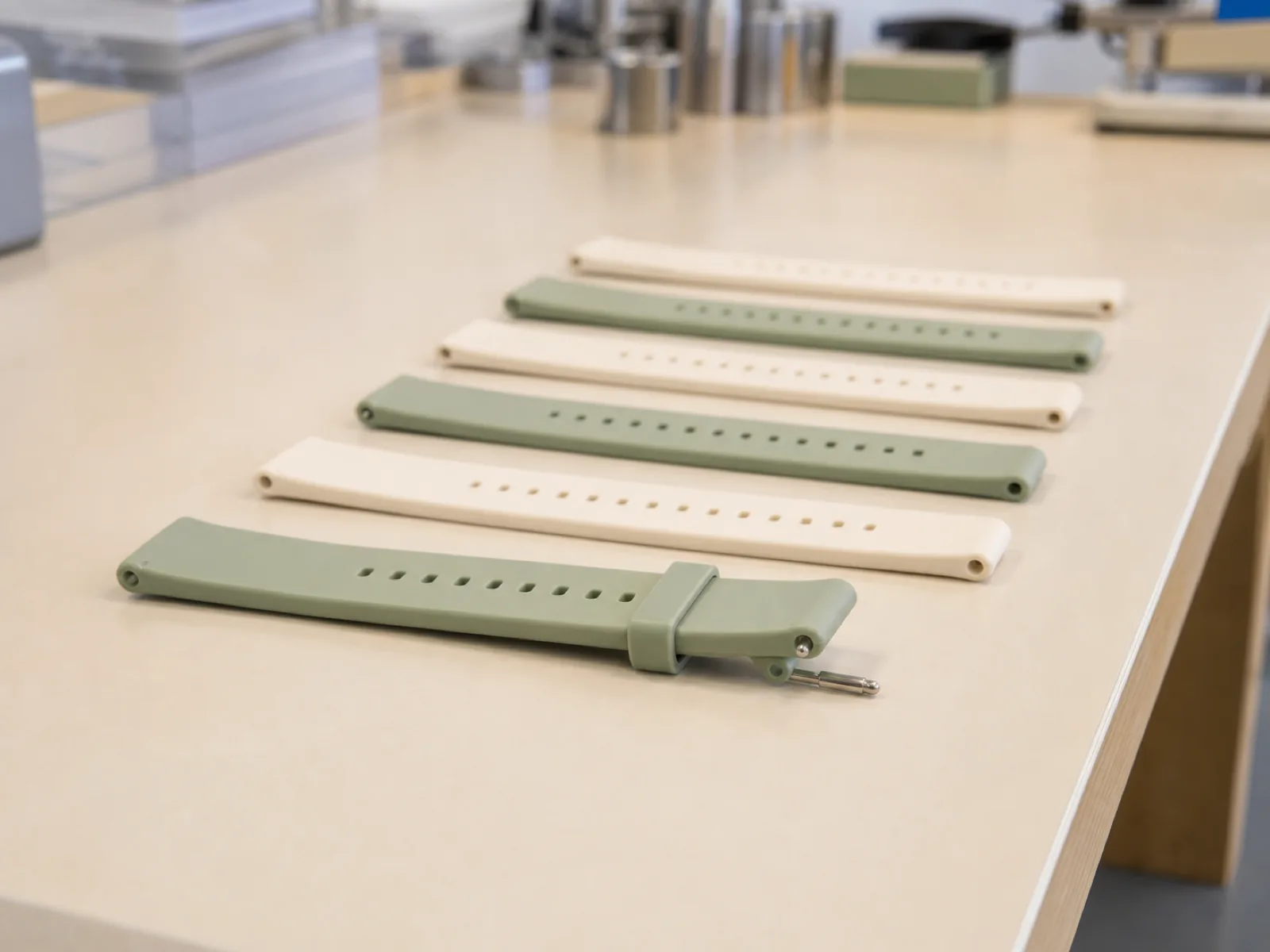 Buyer Guide
 A silicone watch band manufacturer worth qualifying for OEM production must run both LSR injection and HCR compression cells, hold ISO 10993-10 skin-sensitization data on top of FDA 21 CFR 177.2600, and quote a Shore A 40-50 daily-wear formulation as the default. Program economics turn on mold amortization, not headline unit price — a $4,500 LSR tool at 500 units loads $9/unit of tooling; at 8,000 units it loads $0.56/unit. Every wearable-grade strap needs post-cure at 200 °C for 4 hours to volatilize residual siloxanes below the threshold that triggers skin reactions in the 4-hour Buehler test.
Silicone watch bands look simple — one continuous strap, two lug holes, a keeper loop. The engineering underneath is not. A wearable in 24/7 skin contact carries harder biocompatibility documentation than a food-contact utensil. A 22 mm lug width has to hold ±0.10 mm across 50,000 shots or the strap won’t seat on a stainless quick-release pin. And the choice between LSR injection and HCR compression molding, made once at tooling kickoff, sets the unit-cost floor for the life of the program. This guide breaks down what a competent silicone watch band manufacturer must show you before you cut a PO — process, materials, compliance, mold economics, and the QC checklist that separates a wrist-comfortable strap from a $2 Alibaba lookalike.
What defines a qualified silicone watch band manufacturer?
A qualified silicone watch band manufacturer runs both LSR injection and HCR compression molding cells, holds ISO 9001 quality-system certification[^iso-9001], carries ISO 10993-10 skin-sensitization test data[^iso-10993-10] on top of FDA 21 CFR 177.2600 food-contact clearance[^fda-177-2600], and can quote tooling amortization transparently against your target volume.
Three factory capabilities separate an OEM watch band supplier from a general silicone shop:
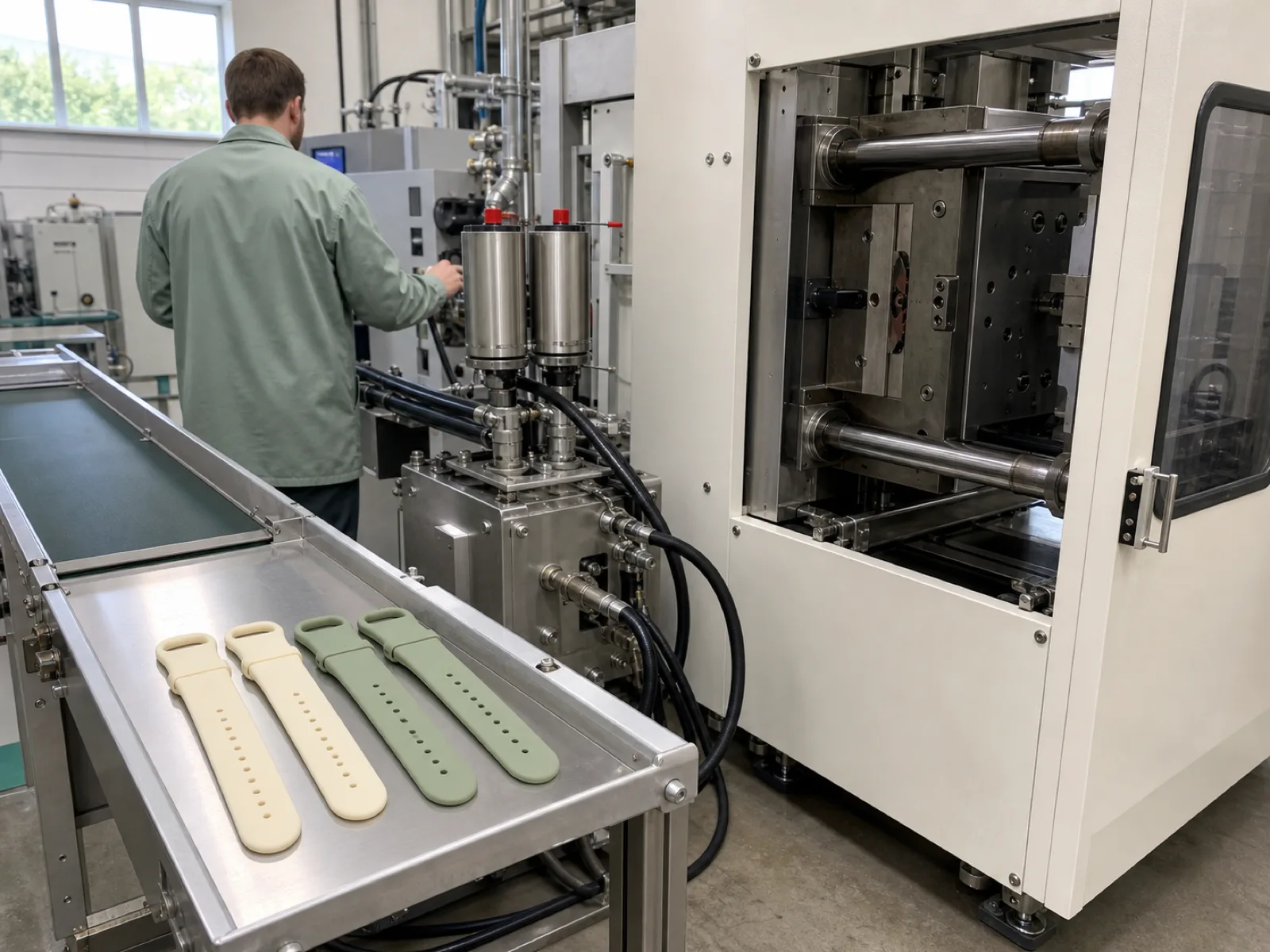
- Dual-process capability. LSR injection dominates the smartwatch aftermarket because cycle times land at 45-90 seconds per strap and tolerance holds at ±0.05 mm. HCR compression is still the right choice for thick sport straps and low-volume colorways where a $1,800-$3,500 tool beats an $8,000+ LSR tool. A shop that only owns one process will push every program into its process — you need both cells on the floor to pick per-project.
- Wearable-grade compliance packet. Food-contact clearance alone is not sufficient documentation for a wristworn product. Buyers at brands running smartwatch straps or fitness bands need ISO 10993-5 (in-vitro cytotoxicity)1 and ISO 10993-10 (skin sensitization) chapter-and-verse reports, plus batch-level LFGB §30/31 supplements2 for EU distribution.
- Overmolding proficiency. A watch band with a stainless 316L quick-release pin, a PC lug adapter, or a nylon-glass reinforced buckle is not one process — it’s an insert-load-and-shoot cycle with fixture engineering, interference-fit math, and post-cure adhesion validation per ASTM D4293.
Wetop tools both an LSR injection cell and an HCR compression cell in Dongguan (7,500 m², 60 staff). We publish the ISO 10993-10 packet at first-article — not “on request” — and we don’t accept a program that hasn’t been sized against real mold amortization.
LSR injection versus HCR compression — which molding process fits your watch band?
LSR injection is the correct process above roughly 8,000 units per SKU — 45-90 second cycles, ±0.05 mm tolerance, fully automated pin overmolding. HCR compression is correct below 8,000 units or for thick sport straps where a $1,800-$3,500 tool beats LSR's $4,500-$12,000. The break-even is program volume, not marketing preference.
The choice is a function of program volume, geometry complexity, and how many colorways you’re running. Here’s the engineering side-by-side:
| Attribute | LSR Injection Molding | HCR Compression Molding |
|---|---|---|
| Cycle time | 45-90 seconds | 240-360 seconds |
| Tolerance (lug width) | ±0.05 mm | ±0.15 mm |
| Tool cost (single cavity) | $4,500-$12,000 | $1,800-$3,500 |
| Tool life | 500,000+ shots | 150,000-300,000 shots |
| Overmolding stainless pins | Native — insert-load-and-shoot | Possible but manual, 20-30% higher scrap |
| Break-even vs HCR | ~8,000 units per SKU | Under 8,000 units |
| Thin-section limit | 0.4 mm reliably | 0.8 mm reliably |
| Best fit | Smartwatch straps, quick-release systems | Sport straps, chunky lug geometry, low-volume colorways |
For a smartwatch aftermarket program targeting 20,000-50,000 units per colorway with stainless quick-release adapters, LSR is the only sensible answer — the cycle-time savings pay back the tool inside the first 8,000 units and every unit after that runs at $1.20-$2.80 conversion cost. For a traditional 20-22 mm buckle strap in six colorways at 1,500 units each, HCR compression is the right call — you spend $10,800-$21,000 on tools instead of $54,000+ on LSR tools, and the 4-6 minute cycle is fine because the volume isn’t there to burn through capacity. If you’re weighing the deeper trade-offs, our LSR injection molding guide walks through cure kinetics and cavity design in more depth.
What Shore A hardness makes a silicone watch band comfortable for daily wear?
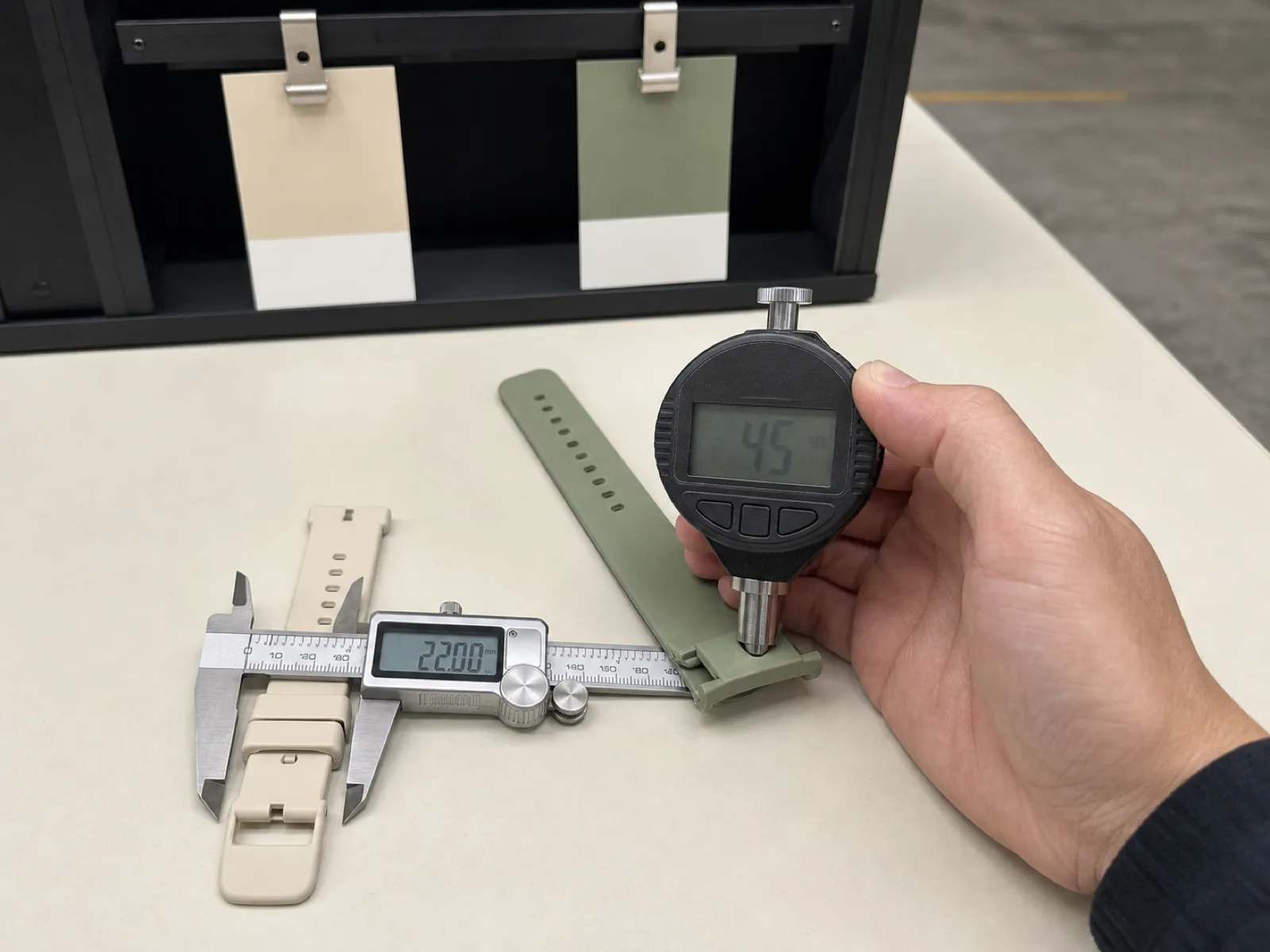
Shore A 40-50 is the daily-wear sweet spot for silicone watch bands. Below Shore A 30 the strap feels sticky against skin and traps lint; above Shore A 60 it presses uncomfortably into the wrist bone during 4-hour wear tests. Sport straps trend Shore A 45-55 for tear resistance at the quick-release cutout.
Shore A durometer per ASTM D22404 is the single most-consequential material spec on a wearable strap — it drives comfort, tear resistance, and the strap’s ability to hold Pantone color under stretch. The map below is what Wetop’s engineering desk quotes as default when a buyer says “make it feel good”:
| Shore A range | Feel on wrist | Tear resistance | Best fit | Typical use |
|---|---|---|---|---|
| 20-30 | Very soft, sticky, lint-magnet | Poor — tears at lug hole | Novelty / decorative | Medical monitoring bands |
| 30-40 | Soft, pillowy, some drag | Marginal | Kids’ fitness bands | Youth smartwatch straps |
| 40-50 | Silky, comfortable, low drag | Good | Daily-wear smartwatch | Apple Watch / Galaxy aftermarket |
| 50-60 | Firm, rebound, drier feel | Very good | Sport / fitness | Running-focused straps |
| 60-70 | Stiff, pressure-marks after 4 hr | Excellent | Industrial / rugged | Diver / tactical straps |
Tensile and tear-strength targets go alongside Shore A in the material data sheet. For a Shore A 45 platinum-cured LSR strap, Wetop specs tensile at ≥ 7 MPa per ASTM D4125, tear strength at ≥ 25 kN/m per ASTM D6246, and elongation-at-break ≥ 400 %. If a competing supplier can’t hand you the D412 / D624 report at first-article, they’re either not testing or hiding numbers you won’t like. Our platinum-cured vs peroxide-cured comparison covers why peroxide-cured HCR is a hard “no” for skin-contact wearables regardless of durometer.
What compliance packet does a wearable silicone watch band require?
Wearable silicone watch bands require ISO 10993-10 skin sensitization[^iso-10993-10], ISO 10993-5 cytotoxicity[^iso-10993-5], FDA 21 CFR 177.2600 food-contact clearance[^fda-177-2600], and LFGB §30/31 for EU distribution[^lfgb-30-31]. Food-grade certification alone does not qualify a product for 24/7 skin contact — buyers who accept a food-grade-only packet inherit the sensitization risk.
The compliance stack for a wearable is stricter than for a kitchen utensil because the exposure route is different: continuous skin contact, 20-24 hours per day, on skin that may be sweaty, sunscreened, or freshly showered. That’s a chronic dermal exposure profile, and the ISO 10993 series is what medical-device regulators use to assess it.
What Wetop’s default compliance packet includes for a watch band OEM program:
- ISO 10993-5 — In-vitro cytotoxicity. MTT or Neutral Red Uptake assay on the cured silicone extract. Pass = cell viability ≥ 70 % vs control.
- ISO 10993-10 — Skin sensitization (Buehler or LLNA). Guinea-pig or murine assay for delayed-type hypersensitivity. Pass = no sensitization reaction.
- FDA 21 CFR 177.2600. Confirms the silicone base + curing package are cleared for repeated food contact — which is the analog test for material purity even when the product is worn, not eaten.
- LFGB §30/31. German BfR-standard extraction test for EU distribution. Batch-level report, not one-time.
- Post-cure verification. 4-hour, 200 °C oven cycle drives residual siloxanes (D4 / D5 / D6) below skin-reaction thresholds. Skipping post-cure is the single most-common root cause of “my strap gave me a rash” returns.
Buyers running smartwatch-strap programs at scale (Kraus / Ruvati / OXO / Joseph Joseph / DI ORO tier of housewares brand rigor applied to wearables) increasingly ask for a compound-level Prop 65 declaration and REACH SVHC screening on top of the ISO 10993 stack. That adds 5-10 business days to the pre-production checklist but is now baseline for US retail-chain distribution.
How is a silicone watch band OEM program priced — the mold amortization math
Silicone watch band unit cost is the sum of material cost, cycle-time labor, and mold amortization over program volume. Tooling is the swing variable: a $4,500 LSR tool loads $9/unit at MOQ 500 and $0.56/unit at 8,000 units. Compression tools amortize faster but per-unit labor is higher — the crossover is the honest number to model.
Nobody in this category publishes the math transparently. Here it is:
LSR injection example — 22 mm smartwatch strap, Shore A 45, one colorway:
| Line item | Per unit at 500 | Per unit at 3,000 | Per unit at 10,000 |
|---|---|---|---|
| Base silicone material (24 g × $4/kg) | $0.10 | $0.10 | $0.10 |
| Pigment masterbatch (2 % load) | $0.08 | $0.08 | $0.08 |
| Cycle labor + overhead (60 s cycle, 4-up cavity) | $0.42 | $0.42 | $0.42 |
| Post-cure + QC | $0.28 | $0.28 | $0.28 |
| Mold amortization ($4,500 tool) | $9.00 | $1.50 | $0.45 |
| Packaging + polybag | $0.15 | $0.15 | $0.15 |
| Landed FOB Yantian ex-tooling | $10.03 | $2.53 | $1.48 |
HCR compression example — same strap, Shore A 50:
| Line item | Per unit at 500 | Per unit at 3,000 | Per unit at 10,000 |
|---|---|---|---|
| Base silicone material | $0.11 | $0.11 | $0.11 |
| Pigment | $0.09 | $0.09 | $0.09 |
| Cycle labor + overhead (300 s cycle, 8-up cavity) | $0.85 | $0.85 | $0.85 |
| Post-cure + QC | $0.32 | $0.32 | $0.32 |
| Mold amortization ($2,500 tool) | $5.00 | $0.83 | $0.25 |
| Packaging | $0.15 | $0.15 | $0.15 |
| Landed FOB Yantian ex-tooling | $6.52 | $2.35 | $1.77 |
The break-even between the two processes sits around 8,000 units per SKU. Below that HCR wins; above that LSR wins and keeps winning as volume compounds. Buyers usually walk in assuming LSR is the “premium” option — the honest answer is that it’s the correct option for the right volume band, not a quality signal. For the broader tooling and MOQ math across silicone categories, see our MOQ and lead time deep dive.
What customization options are standard on OEM silicone watch bands?
Standard customization scope covers Pantone TCX masterbatch color match, laser-engraved or debossed logos, IML in-mold labeling, matte or gloss surface finish, and overmolded stainless 316L quick-release pins. Wetop pushes buyers toward masterbatch and debossing for durability — laser marks fade under 400 hours of sweat exposure.
The customization matrix that ships on a real watch band program:
- Color match. Masterbatch pigment at 1.5-3.0 % holds Pantone TCX at ΔE ≤ 1.5 across a 5,000-unit batch. Liquid pigment dosing costs less on colorway changeovers but holds ΔE ≤ 2.5 only. UV-stable pigments (cadmium-free, chrome-free) cost 15-25 % more but resist chalking past 500 hours of QUV weathering.
- Logo application. Debossed logos (molded into the strap) survive the strap’s life — the mold cavity has the logo cut into it. Laser-engraved logos are faster to change between SKUs but fade to unreadable in 400-800 hours of sweat + sunscreen exposure. IML in-mold labeling applies a printed film into the mold pre-shot and is the best fit for full-color brand marks that need to survive the wearable’s lifetime.
- Surface finish. SPI-A2 mold polish gives a smooth satin finish; SPI-B1 gives a matte feel that hides fingerprints; textured (VDI-24 to VDI-30) gives grip on sport straps. Wetop can match a competitor’s texture from a physical sample without measuring — we mold-etch reference chips on file.
- Overmolded hardware. Stainless 316L quick-release pins, PC or nylon-glass reinforced lug adapters, aluminum buckle inserts — all standard on the LSR cell. Interference fit is 0.15-0.20 mm; pin Ra 0.8-1.6; pull-out target 40 N per ASTM D429 principles.
For the deeper logo-application decision matrix (deboss vs laser vs pad print vs IML), see our silicone logo customization guide.
How long does a silicone watch band OEM program take from PO to production?
A Wetop silicone watch band OEM program runs 45-70 calendar days from PO to shipping-ready first production run — 15-25 days tooling, 7-10 days sampling and buyer approval, 10-15 days first-article inspection with compliance packet compilation, then 5-10 days pre-shipment validation. Rush timing collapses to 35 days with tooling overtime.
The gate-by-gate timeline:
| Phase | Days | What happens | Buyer action |
|---|---|---|---|
| Tool design + cutting | 15-25 | 2D + 3D mold design → CNC roughing → EDM finishing → SPI polishing → first shot | Approve mold design drawings before cut |
| Sampling round 1 | 4-6 | 20-50 shots off first-shot tool → Shore A, dimension, color, lug fit | Approve or send back with revisions |
| Sampling round 2 (typical) | 3-5 | Corrections on color/finish/hardware fit | Sign off on golden sample |
| First-article inspection | 10-15 | Dimensional CTQ verification → tensile/tear per ASTM D412/D624 → ISO 10993 packet | Review FAIR report + compliance docs |
| Production ramp | 5-10 | Full-run production → AQL 1.5 sampling → pre-shipment QC → carton assembly | Confirm ship-ready + book freight |
The two failure modes that stretch this timeline: buyers who send verbal colorway feedback instead of a Pantone TCX code (adds 5-7 days per iteration), and buyers who wait for first-article to specify ISO 10993 testing (adds 15-20 days if the compound wasn’t pre-qualified). Wetop’s engineering desk asks both questions on the intake call to prevent both.
What defect modes should buyers watch for on silicone watch band production?
Four defect modes drive most silicone watch band returns: flash at the parting line above 0.15 mm, pin-hole tear during quick-release insertion, color streaking from pigment under-dispersion, and lug-width creep beyond ±0.10 mm nominal. AQL 1.5 sampling at first-article catches all four; the fixes are tool polish, premix time, and cavity pressure balance.
A defect gallery no competitor publishes because it looks off-brand — but it’s the specificity that separates real engineering from marketing:
- Flash at parting line. Root cause: cavity pressure too high or mold clamp force insufficient. Fix: rebalance shot volume and increase clamp tonnage. Visible acceptance limit: 0.15 mm at any point along the parting line.
- Pin-hole tear on quick-release insertion. Root cause: Shore A too low for the geometry, or the pin cavity has a sharp radius. Fix: raise durometer to Shore A 45 minimum, add 0.5 mm fillet radius to pin cavity. Acceptance: zero tears in 100 insertion cycles at 40 N.
- Color streaking. Root cause: pigment masterbatch premix time under 20 minutes, or pigment loading exceeds 3.5 %. Fix: extend premix, reduce loading, verify pigment carrier compatibility with base LSR. Acceptance: ΔE ≤ 1.5 across 5,000 units.
- Lug-width creep. Root cause: mold thermal expansion drift, or shot-to-shot cavity pressure variance. Fix: install cavity thermocouple + pressure sensor loop. Acceptance: ±0.10 mm nominal on 22 mm lug across 8-hour production run.
- UV chalking. Root cause: non-UV-stable pigment or under-cured base compound. Fix: switch to UV-stable pigment, verify post-cure at 200 °C × 4 hr. Acceptance: no visible chalking after 500 hr QUV.
Buyers who ask “show me your rejected samples from the last program” get better factories than buyers who ask “show me your best product.” Wetop keeps a rejected-sample archive on the QC bench and walks it through first-article reviews.
Talk to the Wetop engineering desk
If you’re scoping a silicone watch band OEM program — smartwatch aftermarket, traditional 20-22 mm buckle, sport quick-release, or a hybrid design with overmolded hardware — Wetop’s engineering desk will size the mold, quote the tool amortization honestly against your target volume, and hand back an ISO 10993-10 compliance path before you cut a PO. We tool both LSR injection and HCR compression cells side-by-side in Dongguan so we recommend the process that fits your program, not the process we happen to own.
Talk to the engineering desk →
References
Footnotes
-
ISO 10993-5:2009 — Biological evaluation of medical devices — Part 5: Tests for in vitro cytotoxicity. International Organization for Standardization. https://www.iso.org/standard/36406.html ↩
-
LFGB §30/31 — Food and Feed Code, materials in contact with food. German Federal Ministry of Justice. https://www.gesetze-im-internet.de/lfgb/ ↩
-
ASTM D429-14 — Standard Test Methods for Rubber Property — Adhesion to Rigid Substrates. ASTM International. https://www.astm.org/d0429-14.html ↩
-
ASTM D2240-15 — Standard Test Method for Rubber Property — Durometer Hardness. ASTM International. https://www.astm.org/d2240-15r21.html ↩
-
ASTM D412-16 — Standard Test Methods for Vulcanized Rubber and Thermoplastic Elastomers — Tension. ASTM International. https://www.astm.org/d0412-16.html ↩
-
ASTM D624-00 — Standard Test Method for Tear Strength of Conventional Vulcanized Rubber and Thermoplastic Elastomers. ASTM International. https://www.astm.org/d0624-00r20.html ↩
FAQ
-
What Shore A hardness is best for a silicone watch band?
Shore A 40-50 is the wrist-comfort sweet spot for daily-wear silicone watch bands. Below Shore A 30 the strap feels sticky against skin and picks up lint; above Shore A 60 it presses into the wrist bone under 4-hour wear tests. Sport-focused straps trend Shore A 45-55 for tear resistance during quick-release cycles.
-
Should a silicone watch band manufacturer use LSR injection or HCR compression molding?
LSR injection wins above ~8,000 units per SKU — 45-90 second cycles, fully automated, ±0.05 mm tolerance on lug widths. HCR compression wins for low-volume colorways or thick-section sport straps where the $1,800-$3,500 tool cost beats LSR's $4,500-$12,000. Wetop tools both cells side-by-side so we pick the process per program, not per catalog.
-
Do silicone watch bands need ISO 10993 biocompatibility testing?
Yes for any strap in continuous skin contact more than 24 hours per day. FDA 21 CFR 177.2600 covers food-contact silicone but does not certify sensitization or cytotoxicity for wearables. ISO 10993-5 (cytotoxicity) and ISO 10993-10 (sensitization/irritation) are the two chapters brand buyers reference for smartwatch and fitness-band programs.
-
What is the MOQ for OEM silicone watch bands at Wetop?
Wetop's baseline MOQ is 500 units per SKU-color combination, with the mold amortization landing at $5-$9/unit at that quantity for an entry HCR tool. LSR programs typically require 3,000-5,000 units per SKU to make the cycle-time savings pay back the higher tooling investment.
-
How is a stainless quick-release pin overmolded into a silicone watch band?
The 316L stainless pin loads into a fixture on the mold, then LSR shoots around it with a 0.15-0.20 mm interference fit against a Ra 0.8-1.6 pin surface. Post-cure at 200 °C for 4 hours locks the bond. Wetop validates pull-out on 40 N axial load per ASTM D429 principles before PPAP release.
-
How do you color-match a silicone watch band to a Pantone TCX code?
Masterbatch pigment dosing at 1.5-3.0 % holds ΔE ≤ 1.5 across a 5,000-unit batch under D65 light-box inspection. Liquid pigment dosing is faster to change between SKUs but holds ΔE ≤ 2.5. UV-stable pigments cost 15-25 % more but resist chalking past 500 hours of QUV exposure.
-
What is the realistic service life of a silicone watch band?
18-36 months of 24/7 wear before UV chalking, sweat-oil swelling, or lug-hole tear triggers replacement. Sport-worn straps in high-UV, high-chlorine environments trend to the 18-month end; office-wear straps hold to 36 months. Warranties should be scoped to 12-18 months to sit inside that curve.
-
How long does a silicone watch band OEM program take from prototype to production?
45-70 days at Wetop: 15-25 days for tool cutting and first-shot, 7-10 days for sample rounds and Shore A/color/lug-fit approval, 10-15 days for first-article dimensional inspection and ISO 10993 packet compilation, then 5-10 days to production-ready shipping. Rush programs collapse to 35 days with tooling overtime.
-
What defects should buyers watch for in silicone watch band QC?
Flash at the parting line (>0.15 mm), pin-hole tear during quick-release insertion, color streaking from pigment dispersion, and lug-width creep beyond ±0.10 mm nominal. Wetop's AQL 1.5 sampling catches these at first-article; the fix is tool polish (SPI-A2), pigment premix time (20 min), and mold-cavity pressure balance.
References
Authoritative sources cited in this guide
- International Organization for Standardization. ISO 9001:2015 — Quality Management Systems — Requirements. https://www.iso.org/standard/62085.html
- International Organization for Standardization. ISO 10993-10:2021 — Biological evaluation of medical devices — Part 10: Tests for skin sensitization. https://www.iso.org/standard/75279.html
- International Organization for Standardization. ISO 10993-5:2009 — Biological evaluation of medical devices — Part 5: Tests for in vitro cytotoxicity. https://www.iso.org/standard/36406.html
- US Food and Drug Administration. 21 CFR 177.2600 — Rubber articles intended for repeated use. https://www.ecfr.gov/current/title-21/chapter-I/subchapter-B/part-177/subpart-C/section-177.2600
- ASTM International. ASTM D412-16 — Standard Test Methods for Vulcanized Rubber and Thermoplastic Elastomers — Tension. https://www.astm.org/d0412-16.html
- ASTM International. ASTM D624-00 — Standard Test Method for Tear Strength of Conventional Vulcanized Rubber and Thermoplastic Elastomers. https://www.astm.org/d0624-00r20.html
- ASTM International. ASTM D2240-15 — Standard Test Method for Rubber Property — Durometer Hardness. https://www.astm.org/d2240-15r21.html
- ASTM International. ASTM D429-14 — Standard Test Methods for Rubber Property — Adhesion to Rigid Substrates. https://www.astm.org/d0429-14.html
- German Federal Ministry of Justice. LFGB §30/31 — Food and Feed Code, materials in contact with food. https://www.gesetze-im-internet.de/lfgb/
Start a custom program
Send a brief. Get an engineer’s reply in one business day.
Every Wetop program is tooled from a customer’s specification. Send a CAD file (STEP · IGES · DWG) or a written brief and we’ll reply with a mold cost estimate, price brackets at MOQ 500 / 1,000 / 5,000, and any engineering questions.