Buyer Guide · commercial intent
Silicone Food Storage Bag OEM Guide — Cure, Compliance, MOQ
What changed: First publication under v2 advanced-GEO standard — benchmarked against top-ranking consumer-roundup pages and rewritten from inside the factory floor with FDA/LFGB clause citations, MOQ-tier FOB pricing, cure-system decision matrix, closure engineering breakdown, and retail audit checklist that consumer coverage does not touch.
 Buyer Guide
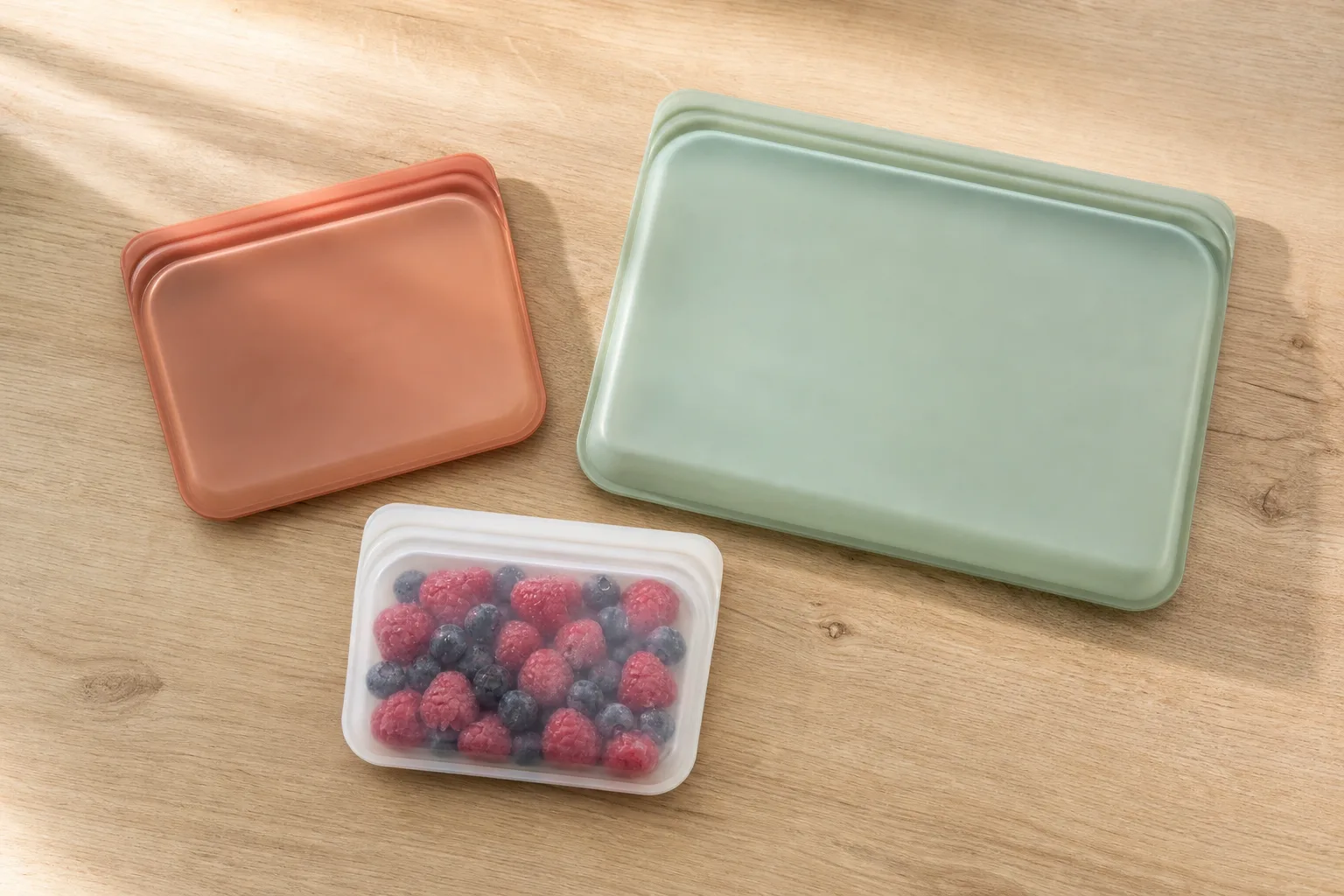
 The silicone food storage bag is the highest-scrutiny food-contact SKU in the reusable-kitchen category — repeated flex cycles at the closure, direct food contact across a service-temperature range from freezer to boiling, and a regulatory stack (FDA + LFGB + Prop 65 + PFAS) that no consumer roundup surfaces to buyers. Every serious retail program above $12 shelf-price now audits the same seven documents pre-PO. This guide is the engineering reality of manufacturing that product — cure chemistry, closure engineering, MOQ-tier FOB pricing, defect CTQ points, and the sourcing workflow from RFQ to PPAP — written from inside a working Dongguan OEM factory floor for procurement teams at housewares, sink, pet, medical, and baby brands.
A silicone food storage bag is a one-piece platinum-cured LSR (or post-cured peroxide HCR) shell 0.7-1.4 mm thick, Shore A 45-60, molded on 4-8 cavity injection tools with an integrated slider zipper, press-seal channel, or vacuum-port closure. Post-cured 4-6 hours at 180-200°C to clear LFGB §30/§31 organic volatile testing per BfR Recommendation XV. For B2B OEM programs, MOQ 500 pieces per SKU delivers per-batch FDA 21 CFR 177.2600 + LFGB + Prop 65 + PFAS test reports. FOB Yantian for a 500 ml platinum-cure slider-closure bag with 1-color debossed logo runs $3.20-$4.10 at 500 pcs, dropping to $1.75-$2.20 at 10,000 pcs. Total realistic lead from RFQ to US warehouse: 75-110 days including 14-18 day Yantian sailing.
What is a silicone food storage bag, engineered for OEM production?
A silicone food storage bag is a one-piece molded PDMS shell at Shore A 45-60 durometer per ASTM D2240[^astm-d2240], wall thickness 0.7-1.4 mm, cured on a 4-8 cavity injection or compression tool at 160-200°C. Continuous service temperature -40°C to 230°C. The closure system — integrated slider zipper, press-seal channel, or vacuum port — is either co-molded (platinum LSR two-shot) or bonded in a secondary process (peroxide HCR with silicone primer). Closure engineering, not shell chemistry, drives 60% of tooling cost and 100% of retail-tier positioning.
Consumer-facing coverage of silicone food storage bags describes them as “reusable, dishwasher-safe, freezer-to-oven”. The engineering description is a three-part system layered into one 1 mm shell. The shell provides food-contact chemistry (FDA 21 CFR 177.26001 compliance, thermal envelope, structural integrity under vacuum). The closure provides the sealing function under repeated flex cycles across 2-5 year service life. The bonding chemistry between shell and closure (or the two-shot LSR interface, on platinum tooling) provides delamination resistance across 2,000+ open-close cycles.
Every meaningful engineering decision on a bag program is a trade-off between those three subsystems. Thicker shell wall = better structural integrity under vacuum, higher per-unit cost. Softer shell durometer = better fold flexibility, worse dimensional stability during freezer cycling. Slider closure = higher retail-tier positioning, higher tooling cost. The rest of this guide walks the trade-offs one by one.
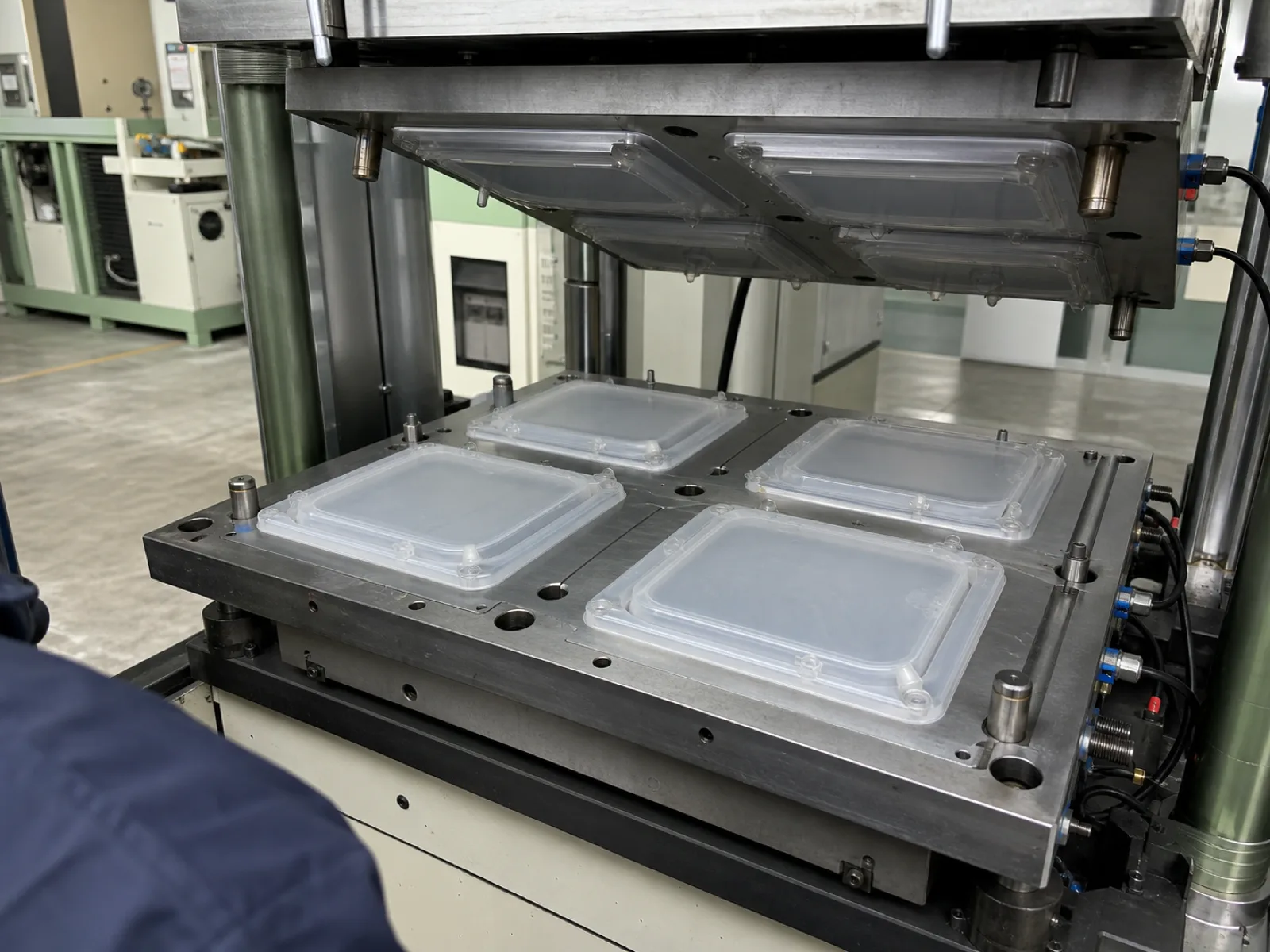
Baseline engineering spec sheet
| Parameter | Standard range | Test method |
|---|---|---|
| Shell wall thickness | 0.7-1.4 mm (typical retail: 0.9-1.2 mm) | Ultrasonic gauge, 8-point sampling |
| Shell Shore A hardness | 45-60 (retail); 55-65 (heavy-duty commercial) | ASTM D22402 |
| Valve Shore A hardness (vacuum-port SKUs) | 35-45 (softer than shell for seal engagement) | ASTM D22402 |
| Tensile strength | ≥ 6.5 MPa | ASTM D412 |
| Elongation at break | ≥ 350% | ASTM D412 |
| Tear resistance | ≥ 22 kN/m | ASTM D624 |
| Continuous service temperature | -40°C to 230°C | LFGB thermal cycling per BfR XV3 |
| Freezer service | -40°C for ≥ 90 days without embrittlement | Internal + LFGB extractables |
| Slider bead height tolerance | ±0.05 mm | Optical comparator, 5-point |
| Press-seal channel interference | 0.15-0.25 mm crush | Feeler-gauge sampling |
| Cure system | Platinum LSR or peroxide HCR | Master-batch lot certificate |
| Cure temperature at press | 160-200°C | Press PLC log |
| Post-cure cycle | 4-6 h @ 180-200°C | Batch oven log |
| Closure cycle-life target | ≥ 2,000 open-close cycles, zero seal degradation | Automated cycle-tester fixture |
What certifications does a silicone food storage bag need for retail?
The mandatory stack for serious retail bag programs is FDA 21 CFR 177.2600[^fda-177-2600] (US food contact), LFGB §30/§31 organic volatile testing per BfR Recommendation XV[^bfr-lfgb-xv] (EU food contact), EU Regulation 1935/2004[^ec-1935-2004] framework declaration (EU market entry), California Prop 65 Chapter 6 heavy-metals declaration (US market entry), and per-batch PFAS non-detect testing at ppb detection limits driven by the ECHA restriction proposal[^echa-pfas-proposal]. All five referenced to a specific master-batch lot from the last 6 months.
The bag category raises the certification bar above baking mats because the product sees direct liquid food contact — including acidic, alcoholic, and fatty foods — across a wider temperature range and a longer service life. Retail auditors treat the documentation stack as a gate, not a preference.
The five-layer certification stack
Layer 1 — FDA 21 CFR 177.2600 (US baseline). The primary US food-contact regulation for rubber articles intended for repeated use. Tests aqueous, 8% ethanol, and n-heptane extractables against defined limits. Every US retail SKU needs this on file, tested per master-batch lot at accredited third-party labs (SGS, Intertek, TÜV, Bureau Veritas).
Layer 2 — LFGB §30/§31 (EU / premium US). German Food and Feed Code sections 30 and 31, technically grounded in BfR Recommendation XV3 and framed by EU Regulation 1935/20044. Tests organic volatile extractables under stricter protocols than FDA — the reason mandatory 4-6 hour post-cure exists on every bag batch. Any EU program and any US premium retail demands this alongside FDA.
Layer 3 — EU Regulation 1935/2004 framework declaration. The overarching EU framework regulation4 for food-contact materials — a signed declaration of conformity referencing the framework plus underlying LFGB test data. Required for any EU market entry independent of the LFGB report itself.
Layer 4 — California Prop 65 Chapter 6 heavy-metals declaration. California Proposition 65 lists heavy metals (lead, cadmium, mercury, arsenic) with parts-per-million action levels. Any US retail SKU sold in California — which effectively means any US retail SKU — needs a heavy-metals test report and a Prop 65 conformity declaration. Third-party lab tests at ppm detection limits per master-batch lot.
Layer 5 — PFAS non-detect (accelerating requirement). Per-batch PFAS testing at ppb detection limits from an accredited lab. Not a formal certification — a test report on the finished-part material. Driven by the ECHA universal restriction proposal5 and downstream retailer spec adoption. Now table-stakes on any EU premium program and increasingly required on US West Coast retail.
Tier-specific additional documents
| Retail tier | Layer 1 FDA | Layer 2 LFGB | Layer 3 EU 1935 | Layer 4 Prop 65 | Layer 5 PFAS | Additional |
|---|---|---|---|---|---|---|
| US mass retail ($8-14 shelf) | Required | Recommended | — | Required | Recommended | — |
| US premium retail ($14-30 shelf) | Required | Required | — | Required | Required | — |
| EU retail (all tiers) | Required | Required | Required | — | Required | REACH declaration |
| Commercial-kitchen adjacent | Required | Required | — | Required | Required | NSF/ANSI 516 |
| Infant / baby-food tier | Required | Required | Required | Required | Required | CPSIA7 |
| Medical / clinical-adjacent | Required | Required | Required | Required | Required | USP <88> extract testing |
Full breakdown of the FDA vs LFGB decision framework on our FDA vs LFGB silicone decoder.
Platinum-cured or peroxide-cured silicone — which cure system for bags?
Platinum-cure LSR by default for any retail bag program at $12+ shelf, and mandatory on EU premium, PFAS-free positioning, and infant-tier programs. Peroxide-cure HCR with mandatory 4-6 hour post-cure at 180-200°C is viable for US mass retail at $8-14 shelf. Bags amplify the decision because the closure bead sees 2,000+ repeated flex cycles across service life — under-post-cured peroxide-cure at the bead generates first-heat odor and, in edge cases, LFGB §30/§31 failure that under-post-cured drying mats never trigger.
Both cure systems use the same PDMS polymer. The catalyst that triggers crosslinking is where they diverge — platinum for platinum-cure, organic peroxide for peroxide-cure — and that catalyst choice cascades into byproduct chemistry, first-heat odor risk, per-unit cost, and closure-tooling geometry.
For bag programs specifically, cure choice has two extra layers that don’t apply to flat sheet products. First, the closure geometry: platinum LSR supports two-shot co-molded slider zippers where the rail and shell cure together in one press cycle. Peroxide HCR requires a secondary bonding step — the closure profile is molded separately, then bonded to the shell with a silicone primer under a second press cycle. This adds tooling cost, cycle time, and a delamination-mode defect that platinum LSR does not have. Second, the closure bead sees repeated mechanical flex at temperatures from -40°C freezer to 230°C oven — any residual peroxide decomposition byproduct at the bead concentrates in the highest-stress zone and out-gasses first.
Cost delta at bag MOQ tiers
| Cure system | 500 pcs (500 ml slider) | 1,000 pcs | 5,000 pcs | 10,000 pcs |
|---|---|---|---|---|
| Peroxide-cured HCR (post-cured, PFAS-free process aid verified) | $2.80-$3.60 | $2.30-$2.90 | $1.75-$2.25 | $1.55-$1.95 |
| Platinum-cured LSR (co-molded closure) | $3.20-$4.10 | $2.60-$3.30 | $2.00-$2.55 | $1.75-$2.20 |
| Delta | +12-15% | +12-14% | +12-15% | +12-15% |
Numbers are FOB Yantian, Q3 2026 benchmarks, 500 ml capacity with integrated slider closure and 1-color debossed logo, PDMS at Shore A 50-58, 0.9-1.2 mm wall thickness. Custom Pantone-matched master-batch adds $0.10-$0.18 per unit. Frosted or textured shell finish adds $0.06-$0.12. Retail-ready color header card packaging adds $0.22-$0.45 per unit fully assembled.
Full engineering decision framework for the cure question on our platinum-vs-peroxide-cured silicone decision guide.
Closure engineering — slider, press-seal, or vacuum port
Three engineered closure systems drive 60% of bag program tooling cost and 100% of retail-tier positioning. Integrated slider zipper: co-molded silicone rail with tongue-and-groove profile, captive slider, tooling $12,000-$18,000. Press-seal channel: interference-fit crush at 0.15-0.25 mm, tooling $8,500-$12,000. Vacuum port with one-way check valve: softer Shore A 35-45 valve, tooling $10,000-$14,000 plus valve tooling. All three cleared at ≥ 2,000 open-close cycles pre-ship.
The closure is the single component that determines retail positioning, tooling cost, and defect exposure. Buyers evaluating a bag program should specify the closure geometry before the shell capacity.
Integrated slider zipper
Tongue-and-groove profile co-molded into the top rail of the bag shell, closed by a captive plastic or silicone slider that pulls the two rails together as it travels. Highest perceived retail value; matches the visual language of consumer plastic zip-top bags. Tooling requires a 4-cavity two-shot LSR mold with a rail insert — $12,000-$18,000 amortized against first order volume. CTQ: bead height ±0.05 mm; slider engagement force 3-8 N throughout travel; zero air leak at 10 kPa pressure differential for 60 seconds.
Press-seal channel
Interference-fit crush channel with 0.15-0.25 mm crush, closed by finger pressure running the length of the seal. Lower perceived retail value; matches the visual language of vacuum-sealed pouches. Tooling on a single-shot compression or injection tool — $8,500-$12,000. CTQ: channel width tolerance ±0.03 mm; opening force 4-9 N; zero air leak at 5 kPa for 60 seconds.
Vacuum port with silent one-way check valve
Integrated silicone check valve (Shore A 35-45, softer than shell) at the top or side of the bag, allowing air evacuation with a hand pump or vacuum sealer. Premium tier — sous vide, meal prep, dry goods storage positioning. Tooling for the shell $10,000-$14,000 plus a separate 8-cavity valve tool at $6,000-$9,000. CTQ: valve seat concentricity ±0.02 mm; opening pressure 2-4 kPa; sealing pressure ≥ 20 kPa without leak.
Closure comparison matrix
| Closure system | Tooling cost | Retail tier | Cycle life | Per-unit add cost |
|---|---|---|---|---|
| Press-seal channel | $8,500-$12,000 | Mass ($8-14) | ≥ 2,000 cycles | Baseline |
| Integrated slider zipper | $12,000-$18,000 | Premium ($14-25) | ≥ 3,000 cycles | +$0.35-$0.60 |
| Vacuum port + check valve | $16,000-$23,000 combined | Premium ($20-40) | ≥ 5,000 cycles | +$0.55-$0.95 |
MOQ tiers and FOB Yantian pricing benchmarks
Wetop's MOQ is 500 pieces per SKU — the floor at which per-batch third-party test report economics (FDA + LFGB + Prop 65 + PFAS at ~$1,100-$1,500 combined) amortize acceptably. FOB Yantian Q3 2026 benchmarks for a 500 ml platinum-cure LSR bag with integrated slider and 1-color debossed logo: 500 pcs $3.20-$4.10, 1,000 pcs $2.60-$3.30, 5,000 pcs $2.00-$2.55, 10,000 pcs $1.75-$2.20, 20,000+ $1.50-$1.90. Tooling for a new slider geometry $12,000-$18,000 amortized against first-order volume.
Bag pricing runs 60-80% above baking mat pricing at equivalent MOQ tiers because injection cycle time is longer, closure QC is more labor-intensive, and closure cycle-life testing adds an inspection cost per batch. The MOQ math also holds harder — below 500 pieces per SKU the per-batch test cost dominates the finished per-unit price to the point where the product isn’t retail-competitive at any margin.
Full MOQ-tier FOB Yantian pricing (500 ml integrated slider, Q3 2026)
| Volume tier | Peroxide HCR (post-cured) | Platinum LSR (co-molded) | Vacuum-port valve add | Frosted shell add | Pantone master-batch add |
|---|---|---|---|---|---|
| 500 pcs | $2.80-$3.60 | $3.20-$4.10 | +$0.85-$1.10 | +$0.10-$0.15 | +$0.15-$0.20 |
| 1,000 pcs | $2.30-$2.90 | $2.60-$3.30 | +$0.75-$0.95 | +$0.08-$0.12 | +$0.12-$0.17 |
| 2,500 pcs | $2.00-$2.50 | $2.25-$2.80 | +$0.65-$0.85 | +$0.07-$0.11 | +$0.11-$0.15 |
| 5,000 pcs | $1.75-$2.25 | $2.00-$2.55 | +$0.55-$0.75 | +$0.06-$0.10 | +$0.10-$0.14 |
| 10,000 pcs | $1.55-$1.95 | $1.75-$2.20 | +$0.45-$0.65 | +$0.05-$0.09 | +$0.08-$0.12 |
| 20,000+ pcs | $1.35-$1.70 | $1.50-$1.90 | Quote | Quote | Quote |
Prices exclude retail packaging (a color header card with backing runs $0.22-$0.45 per unit fully assembled), certification fees for a specific retailer scope, and destination-country duties.
Tooling investment for custom closures and capacities
- Small capacity (250-350 ml) with press-seal channel: $7,500-$10,000
- Standard capacity (500 ml) with press-seal channel: $8,500-$12,000
- Standard capacity (500 ml) with integrated slider zipper: $12,000-$18,000
- Standard capacity (500 ml) with vacuum port: $16,000-$23,000 (shell + valve tooling combined)
- Large capacity (1000-1500 ml) with slider: $14,000-$22,000
- Extra-large / stand-up gusseted: $18,000-$28,000
Tooling is a one-time cost that Wetop typically amortizes against the first production order rather than billing as a separate line — the amortization is baked into a slightly higher per-unit price on the first 5,000-10,000 pieces, then unit price drops on re-orders. Full pricing structure detail on the silicone OEM pricing structure guide and the MOQ economics logic on the real factory MOQ math guide.
Lead time from RFQ to warehouse — what’s realistic
Total realistic lead is 75-110 days from RFQ to US warehouse receipt. 10-18 days for sample on existing tooling (4-6 weeks if new closure tooling required), 40-55 days for production of 5,000-20,000 pieces after PO and 30% deposit, plus 14-18 day Yantian-to-US-West-Coast sailing (25-32 days East Coast, 30-38 days Northern Europe). Suppliers quoting 40-day cold-start-to-warehouse totals for a bag SKU are compressing tooling validation, post-cure, or closure cycle-life testing — often all three.
Lead-time compression on bag programs is a stronger red flag than on flat-sheet products because the closure system requires distinct validation steps that can’t be truncated without shipping downstream defects. The four places suppliers cut corners:
- Skip closure cycle-life testing. ≥ 2,000 open-close cycles on an automated fixture takes 8-16 hours per lot. Skipping saves the fixture time and creates the field-failure defect complaint.
- Skip or shorten post-cure. 4-6 hours of oven time at 180-200°C per batch is the LFGB §30/§31 compliance step. Skipping saves 20-30% oven energy and ships product that fails EU premium retail audit — plus generates first-heat odor at the closure bead.
- Skip incoming raw material QC. Master-batch lot verification catches ~1-2% of upstream compound-house defects. Skipping creates traceability gaps.
- Skip pre-shipment AQL inspection. ISO 2859-18 AQL 1.5 sampling on a 5,000-piece bag batch takes ~6-10 hours by a qualified inspector.
The full RFQ-to-PPAP workflow at Wetop
| Stage | Duration | Key deliverables | Buyer approval gate |
|---|---|---|---|
| 1. RFQ receipt & engineering review | 2-3 business days | Closure recommendation, cure recommendation, spec confirmation, price bracket | — |
| 2. Sample production (existing tooling) | 10-18 days | Physical sample + master-batch lot cert + Shore A + closure cycle test | Sample approval + PO |
| 2b. New tooling cut (if custom closure or capacity) | +28-45 days (parallel where possible) | Tooling drawing + T1 first-article inspection + closure cycle-life report | Tooling approval |
| 3. PO + 30% deposit + material procurement | 5-10 days | Master-batch purchase, receiving QC | — |
| 4. Production (5,000-20,000 pcs) | 40-55 days | Injection or compression molding + post-cure + closure assembly + retail packaging | — |
| 5. In-process QC + AQL 1.5 pre-shipment | +4-7 days (overlaps production) | FDA + LFGB + Prop 65 reports, PFAS non-detect, closure cycle-life, AQL inspection | Buyer inspection sign-off |
| 6. 70% balance + shipping documentation | 2-3 days | Commercial invoice, packing list, B/L, COO, MSDS, EU 1935/2004 declaration | — |
| 7. Yantian to destination sailing | 14-38 days depending on port | On-board notification, tracking | — |
| Total realistic | 75-110 days |
Full breakdown of the timeline drivers on the MOQ and lead time on silicone OEM guide.
Factory audit checklist — what retail buyers actually verify
The retail-audit checklist for bag programs reduces to seven documents plus one video verification. ISO 9001 certificate with silicone-molding scope; FDA + LFGB test reports per master-batch lot from the last 6 months; California Prop 65 Chapter 6 heavy-metals declaration; PFAS non-detect per batch; post-cure oven log for that same batch; closure cycle-life report; business + export license copies. Plus a 2-3 minute unedited walk-through video of injection cells, post-cure ovens, and closure QC stations. Resistance to sending any of these is the audit answer.
Consumer coverage of silicone bags obsesses over “how the closure feels in hand”. B2B retail audit obsesses over “how the factory documents that the closure will still feel that way at cycle 2,000”. The latter determines whether the product will pass retailer QA on the receiving dock in 90 days.
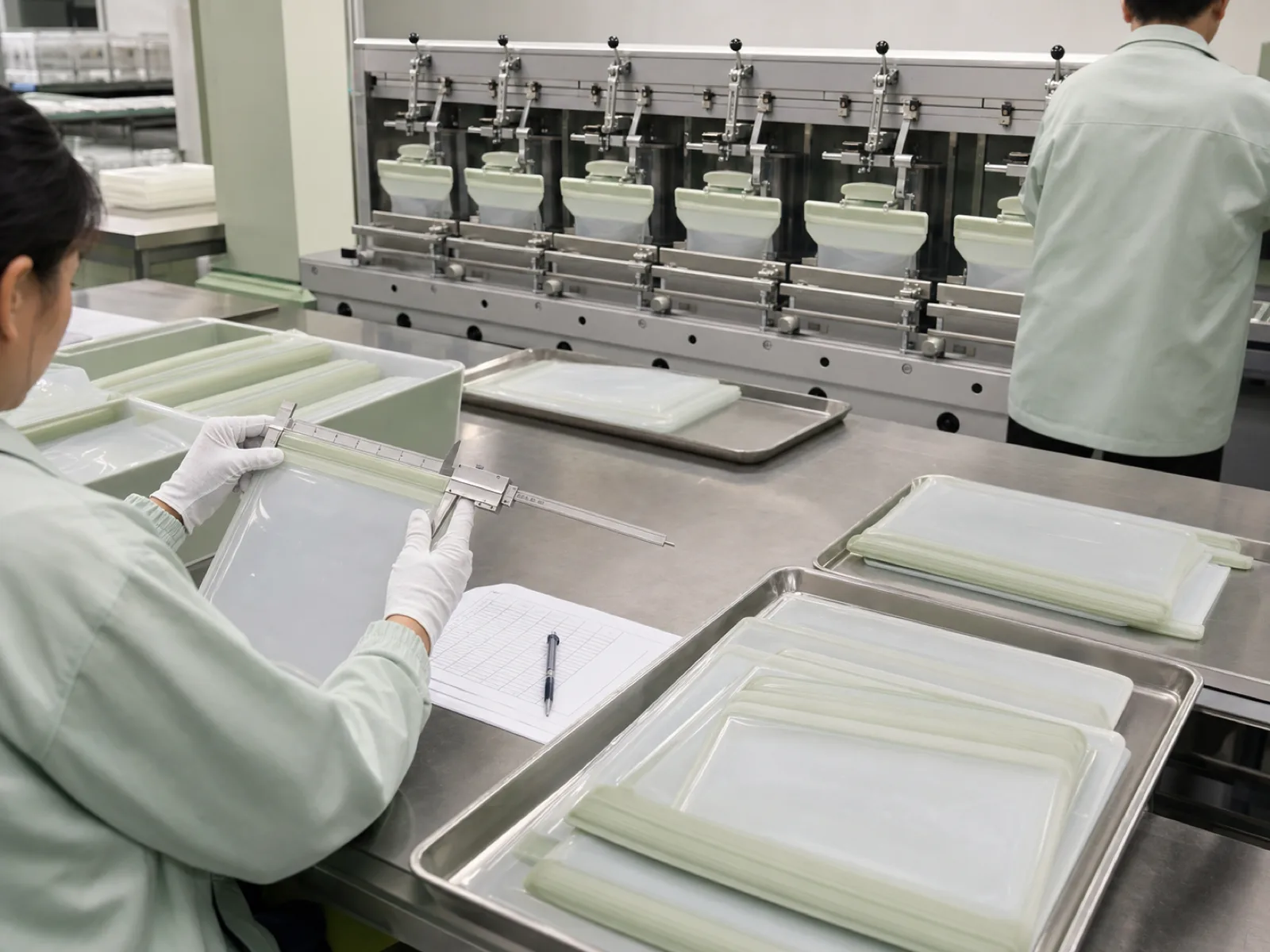
The seven-document audit stack
- ISO 9001:2015 certificate — current validity date, silicone injection and compression molding in scope, issued by a recognized certification body (SGS, TÜV, Bureau Veritas, DNV, DEKRA). Verify against the certification body’s public register.
- FDA 21 CFR 177.2600 + LFGB §30/§31 test reports — referencing a specific master-batch lot number from production in the last 6 months. Reports issued by SGS, Intertek, TÜV, or Bureau Veritas. Quantitative extractables values, not just pass/fail.
- California Prop 65 Chapter 6 heavy-metals declaration — lead, cadmium, mercury, arsenic tested at ppm detection limits per master-batch lot.
- PFAS non-detect test report — per-batch analysis at ppb detection limits from an accredited lab. Accelerating requirement given the ECHA restriction proposal5.
- Post-cure cycle log — batch temperature-time record from the oven PLC or manual logbook, referencing the same master-batch lot. 180-200°C for 4-6 hours per batch, retained for 36 months minimum per ISO 9001.
- Closure cycle-life report — automated open-close fixture results at ≥ 2,000 cycles with no seal degradation, referenced to the master-batch lot.
- Business license + export license copies — verify legal entity name matches the trade partner on commercial documents.
The single video verification worth 10 documents
Request a 2-3 minute unedited walk-through video of the injection and compression molding floor with the current date shown (holding a printed daily newspaper or shift log). A working silicone bag OEM factory has:
- 6-16 active injection or compression molding cells (depending on scale)
- Two-shot LSR tooling visibly rigged for platinum-cure programs
- Post-cure ovens with batches inside (not empty)
- Raw material staging with visible master-batch lot labels
- Automated closure cycle-life test fixtures in the QC bay
- Secondary process area with printing, deburring, and packaging in progress
Full sourcing-verification framework on the sourcing silicone factory checklist.
Private-label vs OEM vs ODM — the decision matrix for buyers
The three sourcing models differ by documentation depth and design ownership, not by manufacturing quality. Private-label: our existing tooling library (500 ml, 1000 ml, 1500 ml capacities with slider or press-seal closure), your logo — no tooling investment. OEM: your CAD or reference bag, we cut new tooling ($8,500-$23,000), you own the design. ODM: we develop the SKU from a brief, you license the resulting design. All three at MOQ 500. Choose by whether retail differentiation needs to be design-level or brand-only.
The private-label / OEM / ODM distinction on bag programs is heavier than on flat-sheet products because the closure geometry is the single largest driver of retail differentiation — and closure tooling is where the OEM cost lives.
Decision matrix by program archetype
| Program type | Private-label | OEM | ODM |
|---|---|---|---|
| Design ownership | Factory | Buyer (you) | Shared / licensed |
| Tooling cost | $0 (existing library) | $8,500-$23,000 | $0 (shared library) or licensed |
| Time to first sample | 10-18 days | 45-70 days (tooling cut + T1 validation) | 10-18 days |
| Best for | Fast-launch retail SKUs, private-label brands | Differentiated retail line, exclusive closure geometry | New brands, category test, limited-run |
| MOQ | 500 pcs | 500 pcs | 500-1,000 pcs |
| Design exclusivity | No | Yes (buyer owns tooling) | Negotiated |
| Retail differentiation ceiling | Logo + color + packaging | Full design + closure + capacity + template | Full design + brand narrative |
Wetop’s baseline bag tooling library covers: 250 ml (small snack), 500 ml (sandwich standard), 1000 ml (quart), 1500 ml (half-gallon), 2000 ml (gallon) — each available in press-seal channel or integrated slider closure at 500-piece MOQ under private-label with debossed or printed logo customization.
Full workflow detail on customize silicone logo — deboss, print, or laser and the private-label silicone kitchen products guide.
CTQ inspection points — the seven defect modes on silicone bags
Seven defect modes account for ~90% of retail return complaints on silicone food storage bags. Slider bead height variance beyond ±0.05 mm; press-seal channel interference outside 0.15-0.25 mm; wall thickness variance beyond ±0.08 mm; under-cure at the closure bead; vacuum-port valve durometer wrong (should be Shore A 35-45); delamination of secondary-bonded closure on peroxide-cure product; debossed logo pigment migration during post-cure. All catchable at AQL 1.5 sampling per ISO 2859-1[^iso-2859-1] pre-shipment.
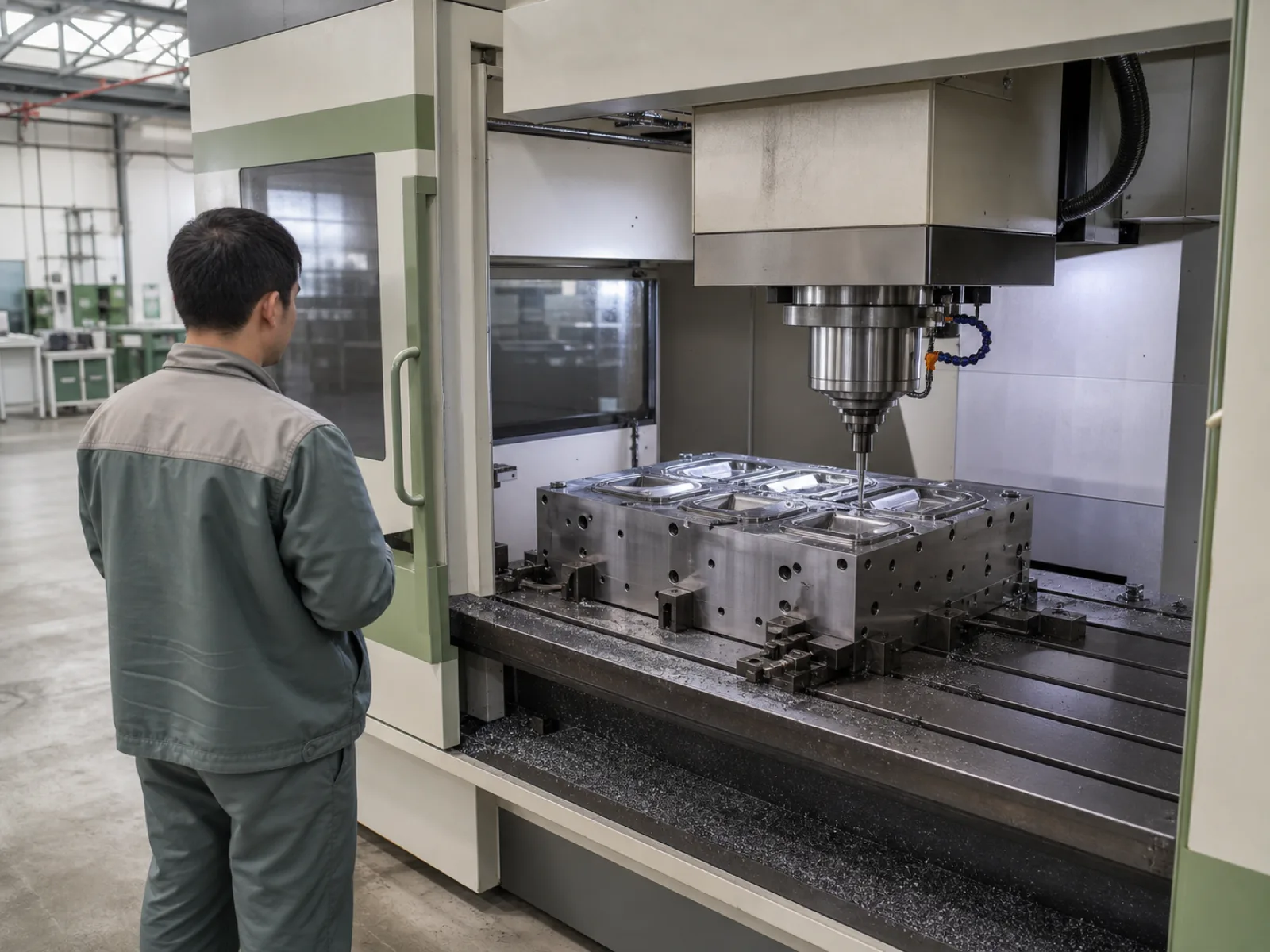
The seven defect modes catalogued
Defect 1 — Slider bead height variance beyond ±0.05 mm. Inconsistent slider engagement force, uneven seal, air leak at low pressure differential. Cause: mold cavity wear, unequal LSR shot volume across cavities, or slider tolerance stack-up. Detection: optical comparator 5-point sampling per lot; slider engagement force measurement 3-8 N throughout travel.
Defect 2 — Press-seal channel interference outside 0.15-0.25 mm crush. Below 0.15 mm: won’t stay closed. Above 0.25 mm: won’t open without deformation. Cause: mold surface wear, gum viscosity drift, or press temperature drift. Detection: feeler-gauge sampling, opening-force measurement 4-9 N.
Defect 3 — Wall thickness variance beyond ±0.08 mm. Collapse under vacuum evacuation, split at fold lines during freezer service, uneven service life. Cause: mold flow imbalance across cavities, gum weight variance, or press stroke drift. Detection: ultrasonic thickness gauge 8-point sampling per bag.
Defect 4 — Under-cure at the closure bead. First-heat odor at the sealing surface, LFGB §30/§31 failure on the closure profile even when the shell passes. Cause: cycle time too short at the bead where thermal mass is highest, or missing post-cure. Detection: LFGB §30/§31 organic volatile testing3 on isolated bead samples plus organoleptic panel testing.
Defect 5 — Vacuum-port valve durometer wrong. Valve too hard (>Shore A 45) won’t open at 2-4 kPa; valve too soft (<Shore A 35) won’t seal at 20 kPa. Cause: wrong master-batch to valve tooling, or cross-contamination during two-shot LSR. Detection: ASTM D22402 durometer check on every valve batch.
Defect 6 — Delamination of secondary-bonded closure on peroxide-cure HCR. Closure profile separates from shell under repeated flex. Cause: bonding primer contamination, under-cure at bond interface, or thermal shock. Detection: destructive peel test (target ≥ 3 N/mm) plus 20-cycle thermal shock at -40°C to 100°C.
Defect 7 — Debossed logo pigment migration during post-cure. Logo appears yellowed, grey, or mottled instead of clean color. Cause: pigment migration at 180-200°C post-cure, incompatible pigment chemistry, or contaminated master-batch. Detection: D65 daylight-simulation light-box color check per ISO 2859-1; ΔE ≤ 2 against approved sample.
Pre-shipment inspection deliverables
Every Wetop bag batch ships with a pre-shipment inspection report covering:
- AQL 1.5 sampling plan per ISO 2859-18
- Wall thickness ultrasonic gauge (8-point per sample)
- Shore A durometer check per ASTM D22402 on shell and (where applicable) valve
- Closure cycle-life test result (≥ 2,000 cycles, zero degradation)
- Air-tightness test (10 kPa differential, 60 seconds, zero leak)
- FDA + LFGB test report referencing the master-batch lot
- California Prop 65 heavy-metals declaration referencing the same lot
- PFAS non-detect test report referencing the same lot
- Post-cure oven log for the batch
Sample buyers running their own third-party pre-shipment inspection (SGS, Bureau Veritas, TIC, or in-house QC) can arrange it directly with the factory at any point in the production timeline.
What Wetop OEMs on silicone food storage bags
Wetop runs silicone food storage bag programs at 500-piece MOQ per SKU on both cure systems from a 7,500 m² founder-led Dongguan floor. Platinum-cure LSR for EU premium, PFAS-free positioning, infant-tier programs, and any retail program at $12+ shelf. Post-cured peroxide-cure HCR for US mass-tier retail accessory programs at $8-14 shelf. Per-batch FDA 21 CFR 177.2600 + LFGB §30/§31 + Prop 65 heavy-metals + PFAS non-detect test reports plus closure cycle-life documentation included in every quote.
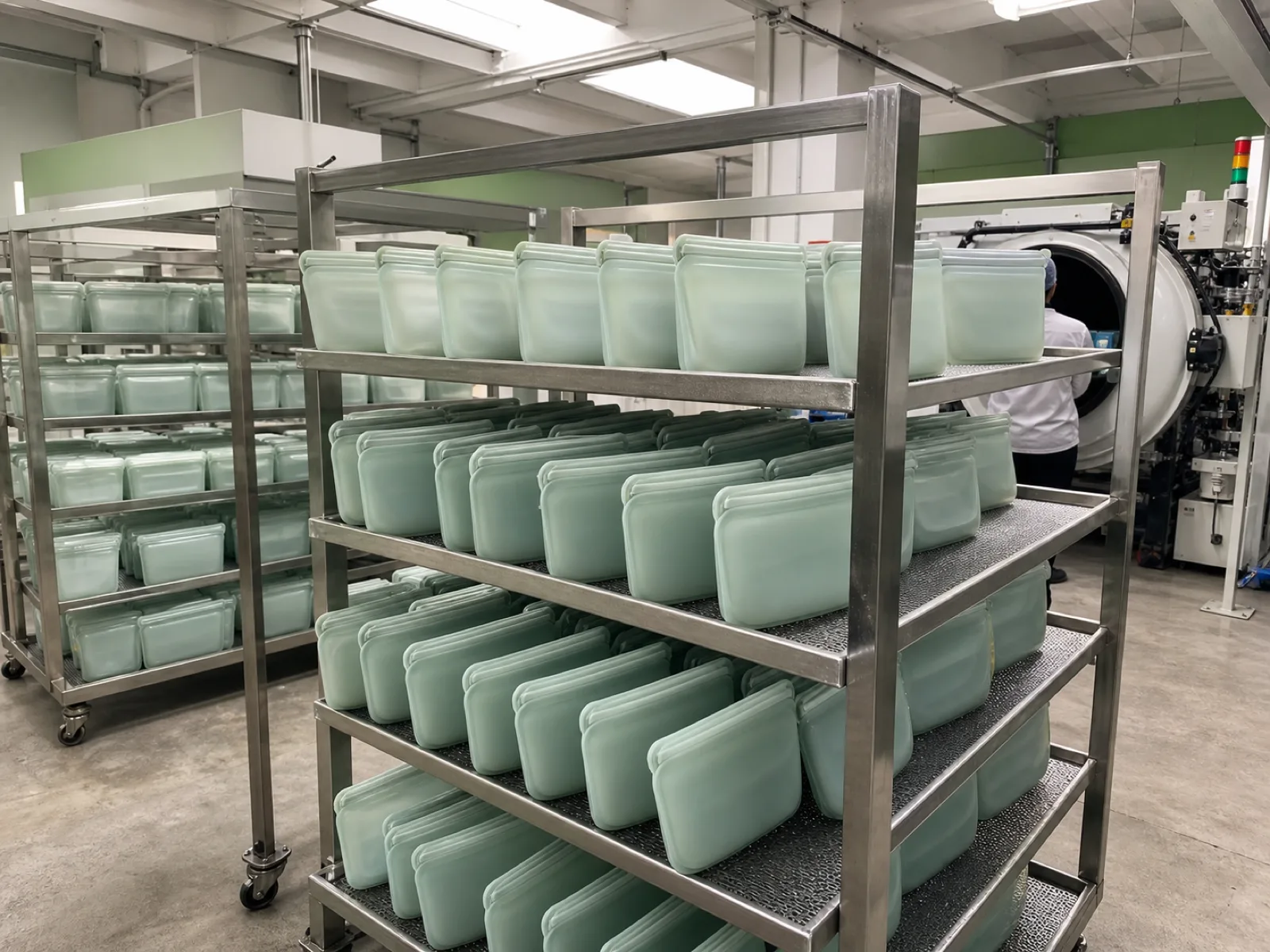
Program defaults:
- Platinum-cure LSR (two-shot co-molded closure) — for EU premium retail, PFAS-free marketing, infant-tier programs, sous vide / meal-prep positioning, and any multi-year brand program where regulatory-drift insurance matters.
- Post-cured peroxide-cure HCR (secondary-bonded closure) — for US mass and mid-tier retail programs at $8-14 shelf, with PFAS-free process aids verified per batch, mandatory 4-6 hour post-cure at 180-200°C on every lot, and destructive peel testing on the closure bond per batch.
Tooling library covers 250 ml, 500 ml, 1000 ml, 1500 ml, 2000 ml capacities in press-seal channel or integrated slider closure at private-label MOQ 500. Custom tooling for OEM programs $8,500-$23,000 amortized against first order depending on closure geometry.
Sourcing a silicone food storage bag program? Email inquiry@wetopsilicone.com with your target retail tier, target regulatory scope (US-only, EU-inclusive, medical-adjacent, infant-tier), preferred closure system (or ask for recommendation), preferred cure system, and target volume — we return within 2 business days with a closure and cure recommendation, per-batch documentation packet outline, and price brackets at MOQ 500 / 1,000 / 5,000 / 10,000. Mutual NDA available at our NDA page. Full manufacturing detail on the capabilities page; anonymized program archetypes at case studies; direct engineering contact via the contact page.
Footnotes
-
US Food and Drug Administration. 21 CFR 177.2600 — Rubber articles intended for repeated use. https://www.ecfr.gov/current/title-21/chapter-I/subchapter-B/part-177/subpart-C/section-177.2600 — the primary US food-contact regulation Wetop tests every silicone bag master-batch lot against. ↩
-
ASTM International. ASTM D2240-15 — Standard Test Method for Rubber Property—Durometer Hardness. https://www.astm.org/d2240-15r21.html — the Shore A hardness measurement standard for shell and valve silicone. ↩ ↩2 ↩3 ↩4
-
German Federal Institute for Risk Assessment (BfR). Recommendation XV — Silicones. https://www.bfr.bund.de/en/bfr_recommendations_on_food_contact_materials-7498.html — the technical standard behind LFGB §30/§31 organic volatile testing for food-contact silicone. ↩ ↩2 ↩3
-
European Parliament and Council. Regulation (EC) No 1935/2004 — Materials intended to come into contact with food. https://eur-lex.europa.eu/legal-content/EN/TXT/?uri=CELEX%3A02004R1935-20090807 — the EU framework regulation for food-contact materials. ↩ ↩2
-
European Chemicals Agency. PFAS Universal Restriction Proposal. https://eur-lex.europa.eu/legal-content/EN/TXT/?uri=CELEX%3A32006R1907 — the regulatory action driving PFAS-free per-batch testing as table stakes on EU premium and US West Coast retail bag programs. ↩ ↩2
-
NSF International / ANSI. NSF/ANSI 51 — Food Equipment Materials. https://www.ecfr.gov/current/title-21/chapter-I/subchapter-B/part-177 — occasionally required for silicone food storage bags sold into commercial-kitchen adjacent channels. ↩
-
US Consumer Product Safety Commission. CPSIA — Consumer Product Safety Improvement Act. https://www.ecfr.gov/current/title-16 — the US consumer product safety framework any infant-tier or children’s silicone bag program must certify against. ↩
-
International Organization for Standardization. ISO 2859-1:1999 — Sampling procedures for inspection by attributes. https://www.iso.org/standard/1141.html — the sampling standard behind AQL 1.5 pre-shipment inspection on every bag batch. ↩ ↩2
FAQ
-
What is a silicone food storage bag actually made of, at the material level?
A silicone food storage bag is a one-piece molded shell of polydimethylsiloxane (PDMS) silicone at Shore A 45-60 durometer, 0.7-1.4 mm wall thickness, cured under injection or compression at 160-200°C and post-cured 4-6 hours at 180-200°C. The closure — integrated slider zipper, press-seal channel, or vacuum port — is either co-molded in the same shot (platinum LSR two-shot tooling) or bonded in a secondary process (peroxide HCR with silicone adhesive primer). Continuous service temperature -40°C to 230°C. Cure system (platinum vs peroxide) drives odor profile, extractables, and regulatory tier — not mechanical function.
-
What is the MOQ for custom silicone food storage bags and what does it cost?
Wetop's MOQ is 500 pieces per SKU. FOB Yantian benchmarks Q3 2026 for a 500 ml platinum-cure LSR bag with integrated slider and 1-color debossed logo: 500 pcs $3.20-$4.10 / 1,000 pcs $2.60-$3.30 / 5,000 pcs $2.00-$2.55 / 10,000 pcs $1.75-$2.20. Peroxide-cure HCR with disciplined post-cure runs 12-20% below platinum. Tooling for a new closure geometry runs $8,500-$18,000 for a 4-8 cavity LSR tool. Custom Pantone-matched master-batch adds $0.10-$0.18 per unit. Retail-ready color header card packaging adds $0.22-$0.45 per unit fully assembled.
-
What closure options exist — slider zipper, press-seal, or vacuum port?
Three engineered closure systems with distinct cost, tooling, and use-case profiles. (1) Integrated slider zipper: co-molded silicone rail with a mating tongue-and-groove profile, driven by a captive plastic or silicone slider. Tooling $12,000-$18,000 for a 4-cavity LSR mold. Retail-ready. (2) Press-seal channel: interference-fit channel with 0.15-0.25 mm crush, closes by finger pressure along the length. Tooling $8,500-$12,000. Simpler, cheaper, lower perceived retail value. (3) Vacuum port with silent one-way valve: integrated silicone check-valve (softer Shore A 35-45) allowing air evacuation with a hand pump or vacuum sealer. Tooling $10,000-$14,000 plus valve tooling. Premium tier. Wetop OEMs all three at MOQ 500.
-
How long is the lead time from PO to warehouse for a silicone bag program?
10-18 day sample on existing tooling (4-6 weeks if new closure tooling required for a slider geometry). 40-55 day production for 5,000-20,000 pieces after PO and 30% deposit — longer than baking mats because the injection cycle plus post-cure plus closure QC takes more oven and inspector time per unit. Add 14-18 day Yantian-to-US-West-Coast sailing, 25-32 days East Coast, 30-38 days Northern Europe. Total realistic buyer-side lead: 75-110 days from RFQ to warehouse receipt. Suppliers quoting 40-day totals from cold start are running unqualified tooling, skipping post-cure, or skipping closure cycle-life testing — treat as a red flag.
-
How do I audit a silicone food storage bag factory without visiting in person?
Seven documents plus one video verification cover 95% of what an on-site audit would confirm. (1) ISO 9001:2015 certificate — silicone molding in scope, current validity. (2) FDA 21 CFR 177.2600 test report per master-batch lot from the last 6 months. (3) LFGB §30/§31 report per BfR Recommendation XV, same lot reference. (4) California Prop 65 Chapter 6 heavy-metals declaration. (5) PFAS non-detect at accredited-lab ppb limits. (6) Post-cure oven log — 4-6 hours at 180-200°C, batch-referenced. (7) Business + export license copies. Plus a 2-3 minute unedited walk-through video of injection cells, post-cure ovens, and closure QC stations with the current date shown. Resistance to sending any of these is the audit answer.
-
What are the common defect modes on silicone food storage bags?
Seven defect modes account for ~90% of retail return complaints. (1) Slider zipper bead height variance beyond ±0.05 mm — inconsistent seal engagement. (2) Press-seal channel interference fit outside 0.15-0.25 mm — either won't stay closed or won't open cleanly. (3) Wall thickness variance beyond ±0.08 mm — collapse under vacuum or split at fold lines. (4) Under-cure at the closure bead — first-heat odor, LFGB §30/§31 failure. (5) Vacuum-port valve durometer wrong (should be Shore A 35-45, softer than shell) — leaks or won't release. (6) Delamination of secondary-bonded closure on peroxide-cure HCR product. (7) Debossed logo pigment migration during post-cure. All catchable at AQL 1.5 sampling per ISO 2859-1 pre-shipment.
-
What is the difference between private-label, OEM, and ODM for silicone bags?
Private-label: you buy from Wetop's existing tooling library (500 ml, 1000 ml, 1500 ml standard capacities with slider or press-seal closure) and we deboss or print your logo. No tooling investment, 10-18 day sample, 500-piece MOQ. OEM: you supply CAD or a physical reference bag, we cut new tooling to your spec — custom capacity, custom closure geometry, custom gusset. Full design ownership. Tooling $8,500-$18,000 amortized. 45-70 day tooling lead. ODM: we develop the SKU from your brief (target tier, feature set, price target) and you license the resulting design. All three at MOQ 500. Choose by whether retail differentiation needs to be design-level or brand-only.
-
How do I spec the slider bead geometry so the bag doesn't leak at cycle 500 the way store-brand bags do?
The slider bead is where 60% of retail-return complaints on premium silicone bags originate, and the spec sheet has to nail three interlocking dimensions. First, bead height tolerance ±0.05 mm — measured on an optical comparator at 5 points along the rail per ISO 2859-1[^iso-2859-1] AQL 1.5 sampling. Second, tongue-and-groove interference at 0.10-0.15 mm crush across the mating profile — tighter and the slider stalls, looser and the seal breaks at 10 kPa differential. Third, slider engagement force curve 3-8 N throughout travel with no dead spots. The upstream driver is co-mold discipline on the two-shot LSR tool. Cavities must be balanced to ±0.03 mm bead-height variance cavity-to-cavity, which requires in-house mold-making rather than a sub-contracted tool house — cavity wear on the rail profile is where cheap tooling shows up first, usually at cycle 500-800 when the slider starts skipping engagement teeth. Spec the cycle-life requirement on the RFQ: ≥ 2,000 open-close cycles on an automated fixture, zero seal degradation, air-tight at 10 kPa for 60 s post-cycling. Ask for the automated fixture log referenced to the master-batch lot per ISO 9001[^iso-9001] batch traceability. Suppliers that can't produce a fixture log are running consumer-tier programs where the closure quietly fails after 300-500 cycles — the exact failure mode that shows up in one-star reviews on the store-brand equivalent. That failure signature is why Tier 2 retail QA now asks for the fixture log before approving PPAP.[^iso-2859-1][^iso-9001]
-
How do premium silicone bag brands (OXO / Stasher / W&P caliber) differ from generic silicone zip bags at the closure engineering level?
At the shell level they're similar — Shore A 48-55 PDMS, 0.9-1.1 mm wall thickness, platinum-cure LSR. The step-change happens at three closure sub-features that consumer coverage never surfaces. First, the slider rail on premium-tier caliber bags is co-molded in a two-shot LSR tool where the rail insert cures simultaneously with the shell — not bonded in a secondary step. This eliminates the delamination defect mode that shows up on generic peroxide-cure HCR bags at cycle 800-1,200. Two-shot tooling runs $12,000-$18,000 for a 4-cavity mold, versus $6,000-$9,000 for single-shot HCR with secondary bond — the 2× tooling premium is why generic-tier programs skip it. Second, valve durometer on vacuum-port SKUs is spec'd at Shore A 35-45 (softer than the Shore A 48-55 shell) so the check-valve engages at 2-4 kPa opening pressure and seals at ≥ 20 kPa. Generic bags use a single master-batch across shell and valve, which is why the generic version either leaks or won't release. Third, per-batch closure cycle-life testing at ≥ 2,000 cycles is contractual on premium-tier programs — factory ships the fixture log with every lot referenced to the master-batch. Generic programs run cycle-life once at PPAP and never again, which is how the closure quietly degrades over the production run. At Wetop we quote all three sub-features at MOQ 500 for private-label brands targeting the premium-housewares-caliber tier — the FOB Yantian premium runs 12-15% over generic HCR, benchmarked against the pricing tables in the guide body.[^iso-2859-1]
-
What do Home Depot, Wayfair, and Tesco silicone-bag-SKU audits actually inspect on the receiving dock?
Tier 2 retail chains at Home Depot / Wayfair / Tesco / Carrefour caliber run a documented receiving-dock hold protocol on silicone food-contact SKUs — the receiving QA team pulls three cartons at random from the pallet and validates seven inputs before releasing the load. Missing any one is an automatic 5-14 day hold pending supplier response. First, FDA 21 CFR 177.2600[^fda-177-2600] test report referencing a specific master-batch lot dated within the last 6 months — not a 3-year-old report. Second, LFGB §30/§31 organic volatile test per BfR Recommendation XV[^bfr-lfgb-xv] on the same lot. Third, California Prop 65 Chapter 6 heavy-metals declaration at ppm limits. Fourth, PFAS non-detect at ppb from an accredited lab, driven by the ECHA restriction proposal[^echa-pfas-proposal]. Fifth, the post-cure oven log — 4-6 hours at 180-200°C — referenced to the same lot number, retained 36 months per ISO 9001[^iso-9001]. Sixth, closure cycle-life fixture report at ≥ 2,000 cycles with zero seal degradation. Seventh, AQL 1.5 pre-shipment inspection report per ISO 2859-1[^iso-2859-1] on that shipment. Physically they pull three bags per carton and check slider bead height (±0.05 mm), wall thickness (±0.08 mm across 8 points), and run an air-tightness test at 10 kPa for 60 seconds. First-heat organoleptic — put the bag in an oven at 100°C for 15 minutes and smell it. Any residual peroxide odor triggers a full-lot hold pending third-party LFGB retest. The hold cost falls on the supplier: retest fees plus 5-14 days of tied-up receiving-dock capacity. Which is why any factory quoting bag programs without offering the seven-document packet upfront is running a program that will eventually get held.
References
Authoritative sources cited in this guide
- US Food and Drug Administration. 21 CFR 177.2600 — Rubber articles intended for repeated use. https://www.ecfr.gov/current/title-21/chapter-I/subchapter-B/part-177/subpart-C/section-177.2600 — The primary US food-contact regulation Wetop tests every silicone bag master-batch lot against.
- German Federal Institute for Risk Assessment. BfR Recommendation XV — Silicones. https://www.bfr.bund.de/en/bfr_recommendations_on_food_contact_materials-7498.html — The technical standard behind LFGB §30/§31 organic volatile testing — the reason mandatory 4-6 hour post-cure exists on silicone food bags.
- European Parliament and Council. Regulation (EC) No 1935/2004 — Materials intended to come into contact with food. https://eur-lex.europa.eu/legal-content/EN/TXT/?uri=CELEX%3A02004R1935-20090807 — The overarching EU framework regulation — every EU retail bag program requires a declaration of conformity referencing this framework.
- International Organization for Standardization. ISO 9001:2015 — Quality Management Systems — Requirements. https://www.iso.org/standard/62085.html — The quality management standard Wetop is certified against — governs batch traceability, post-cure records, and closure cycle-life documentation.
- International Organization for Standardization. ISO 2859-1:1999 — Sampling procedures for inspection by attributes. https://www.iso.org/standard/1141.html — The sampling standard behind AQL 1.5 pre-shipment inspection on every Wetop silicone bag batch.
- ASTM International. ASTM D2240-15 — Standard Test Method for Rubber Property—Durometer Hardness. https://www.astm.org/d2240-15r21.html — The measurement standard behind every Shore A hardness spec on shell and valve silicone.
- European Chemicals Agency. PFAS Universal Restriction Proposal. https://eur-lex.europa.eu/legal-content/EN/TXT/?uri=CELEX%3A32006R1907 — The regulatory action driving per-batch PFAS non-detect testing as table stakes on EU premium and US West Coast retail bag programs.
- US Consumer Product Safety Commission. CPSIA — Consumer Product Safety Improvement Act. https://www.ecfr.gov/current/title-16 — The US consumer product safety framework any infant-tier or children's silicone bag program must certify against.
- NSF International / ANSI. NSF/ANSI 51 — Food Equipment Materials. https://www.ecfr.gov/current/title-21/chapter-I/subchapter-B/part-177 — Occasionally required for silicone food storage bags sold into commercial-kitchen adjacent channels.
Start a custom program
Send a brief. Get an engineer’s reply in one business day.
Every Wetop program is tooled from a customer’s specification. Send a CAD file (STEP · IGES · DWG) or a written brief and we’ll reply with a mold cost estimate, price brackets at MOQ 500 / 1,000 / 5,000, and any engineering questions.