Buyer Guide · commercial intent
Silicone Ice Cube Tray OEM Sourcing Guide — Compliance
What changed: First-pub v2 advanced-GEO release — written against a competitor benchmark of 2,800-word consumer roundups with zero Tier-1 references, this guide covers the full B2B compliance stack, cure-chemistry decision framework, Shore A × cube geometry map, and MOQ 500 / 1k / 5k / 10k unit-cost tiers FOB Yantian.
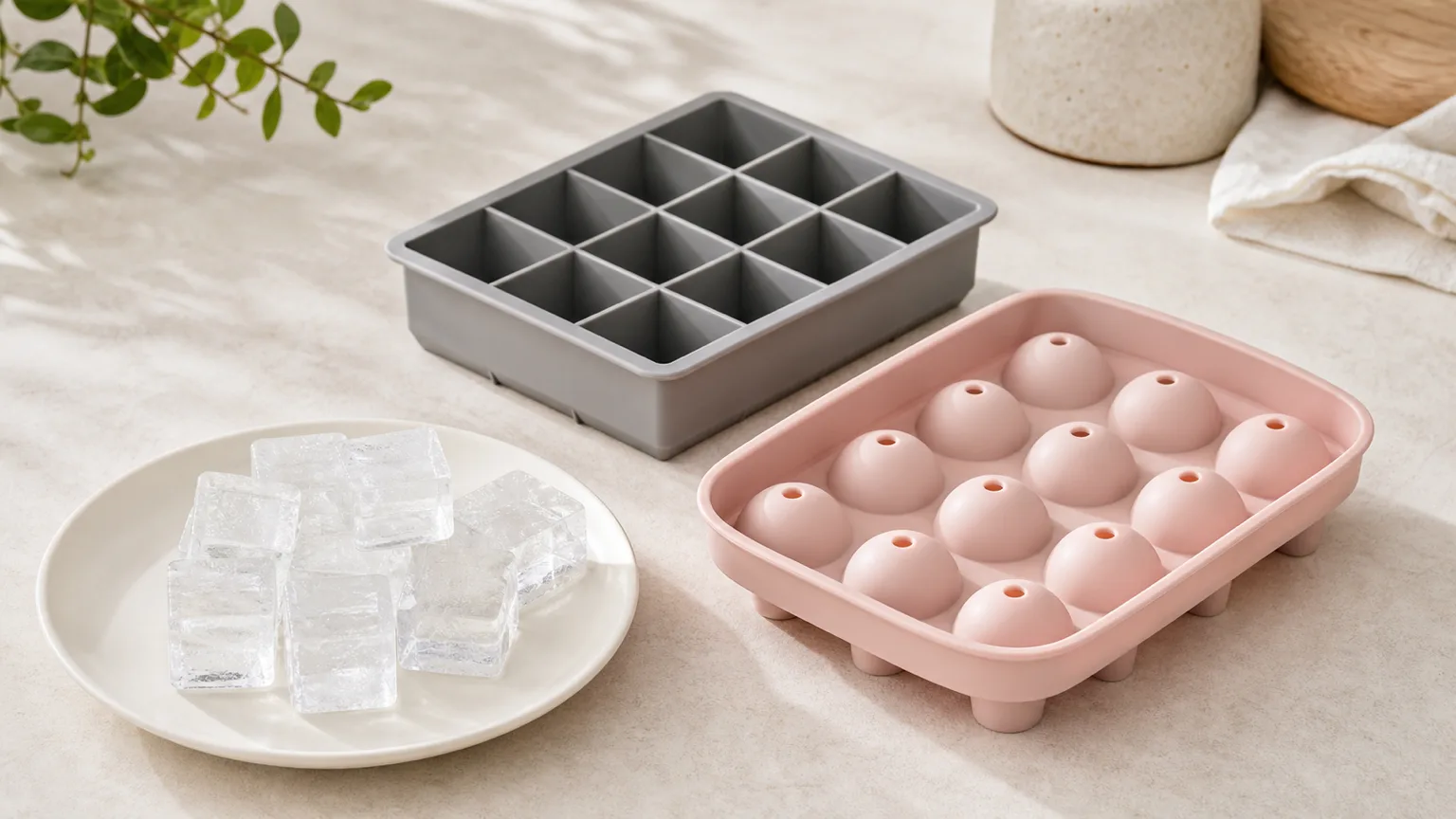 Buyer Guide
 Silicone ice cube trays look like a commodity from the retail shelf side. From the OEM sourcing side they are one of the more instructive B2B silicone programs to spec correctly — the combination of direct-with-food contact, freeze-thaw cycling, retail-chain compliance audits, and custom cavity geometry surfaces every serious question a procurement manager should ask a factory. This guide is the sourcing playbook for procurement teams at housewares brands, baby brands, pet brands, cocktail-bar programs, and medical-adjacent buyers — the full compliance stack, cure-system decision framework, Shore A × cube geometry map, MOQ and unit-cost math, and the audit tests that separate a real Dongguan factory from an intermediary reselling under a factory-sounding domain.
Custom silicone ice cube trays for retail-tier and OEM programs require full compliance across FDA 21 CFR 177.2600, LFGB §30/31 organic volatile testing, ISO 9001 batch traceability, and per-batch PFAS non-detect reporting — plus USP Class VI documentation on baby-brand and medical-adjacent programs. Wetop's minimum order quantity is 500 units per SKU on a shared open mold and 3,000 units on custom cavity tooling that amortizes to $0.08-0.35 per unit across a 30,000-piece program horizon. FOB Yantian unit cost on a platinum-cure 15-cavity 1.25-inch cube tray runs $2.85 at MOQ 500 down to $1.45 at MOQ 10,000, with peroxide-cure and disciplined post-cure 15-22% below at every tier.
What compliance stack does a retail-tier silicone ice cube tray actually need?
Full compliance for a retail-tier silicone ice cube tray program is a four-part stack: FDA 21 CFR 177.2600 for US shelf, LFGB §30/31 (per BfR Recommendation XV) for EU shelf, ISO 9001 on the manufacturer for batch traceability, and per-batch PFAS non-detect analysis for premium retail. Baby-brand and medical-adjacent programs add USP Class VI and ISO 10993-1 biocompatibility. Anything less either fails audit at the retail chain gate or introduces a documentation gap that turns into a chargeback three months into the program.
Consumer roundups skip this section because they are optimizing for click-through on affiliate links. Procurement managers do not have that luxury. The compliance stack is what determines whether the ice cube tray SKU gets accepted at buyer sign-off, whether the retail chain audit passes, and whether the PFAS-free marketing claim on the retail box survives an ECHA-driven challenge from an EU retailer1.
The reference regulations, mapped to the buying regions:
| Region | Baseline regulation | Testing standard | Documentation Wetop supplies per batch |
|---|---|---|---|
| United States | FDA 21 CFR 177.26002 | Extractables (chloroform + n-hexane, 6 h at reflux) | Third-party report from SGS / Intertek / TÜV / Bureau Veritas, referencing master-batch lot |
| European Union | LFGB §30/31 (BfR Recommendation XV3) + EC 1935/20044 | Total organic volatile ≤ 0.5%; Peroxides ≤ 2 mg/kg | Per-batch LFGB report + declaration of compliance (DoC) under EC 1935/2004 |
| US Children’s product | CPSIA5 | Total lead ≤ 100 ppm; third-party testing under CPSIA §102 | CPSIA test report from a CPSC-accredited lab |
| Baby / Medical-adjacent | USP Class VI6 + ISO 10993-17 | Biological reactivity in vivo; biocompatibility decision matrix | USP <88> extract testing on finished part; ISO 10993 assessment package |
| PFAS-free positioning | ECHA restriction proposal trajectory1 | PFAS non-detect at parts-per-billion (targeted PFAS panel + total organic fluorine) | Per-batch PFAS non-detect report from accredited lab |
| Manufacturer traceability | ISO 90018 + ISO 2859-1 AQL9 | Documented cure logs, post-cure oven records, AQL sampling per batch | ISO 9001 certificate + AQL inspection record per batch |
The gap between “our silicone is food-safe” (the intermediary answer) and this stack (the real-factory answer) is where retail-chain audits succeed or fail. Wetop bundles the FDA + LFGB + PFAS + AQL package into the standard quote. USP <88> and ISO 10993 are priced separately on baby-brand and medical-adjacent programs because the extract testing runs against the finished cured part, not the raw gum.
Platinum-cure or peroxide-cure — which cure system for a silicone ice cube tray program?
Peroxide-cure with disciplined 4-6 hour post-cure at 180-200°C is the correct default for mid-tier housewares retail ($8-20 shelf price). Platinum-cure is the right default for baby brands, medical-adjacent programs, EU premium retail, and any SKU whose marketing claims include PFAS-free positioning. The unit-cost premium is 15-25%; the paperwork burden platinum-cure removes on premium tiers usually pays it back.
Both cure systems use the same silicone polymer backbone — polydimethylsiloxane. The catalyst is the whole difference. Platinum-cure uses a platinum complex (Karstedt’s catalyst) driving a hydrosilylation reaction with no byproducts. Peroxide-cure uses organic peroxide (typically dicumyl peroxide) that decomposes during cure and leaves trace organic volatiles behind — which is why LFGB §30/31 mandates the 4-6 hour post-cure oven cycle.
Key spec deltas for cube-tray programs:
- Organoleptic profile (first-heat odor). Peroxide-cure without disciplined post-cure produces a mild acidic odor on first freeze/thaw that generates 3-8% return rates on premium retail SKUs. Platinum-cure has no first-heat odor by chemistry. On a mid-tier program where the retail box gets rinsed by the consumer before use, either works.
- PFAS process aids. Historically peroxide-cure formulations sometimes used PFAS process aids for mold release. Reputable compound houses have offered PFAS-free peroxide formulations since ~2020. Platinum-cure does not use PFAS process aids by chemistry. If the retail chain requires a PFAS-free spec, platinum-cure removes the per-batch aid-verification burden.
- Cost delta. Platinum catalyst is ~5x more expensive than organic peroxide by weight; the cure cycle at press is slightly longer; the qualified supplier base is narrower. Net per-unit premium is 15-25% at MOQ 500-10,000.
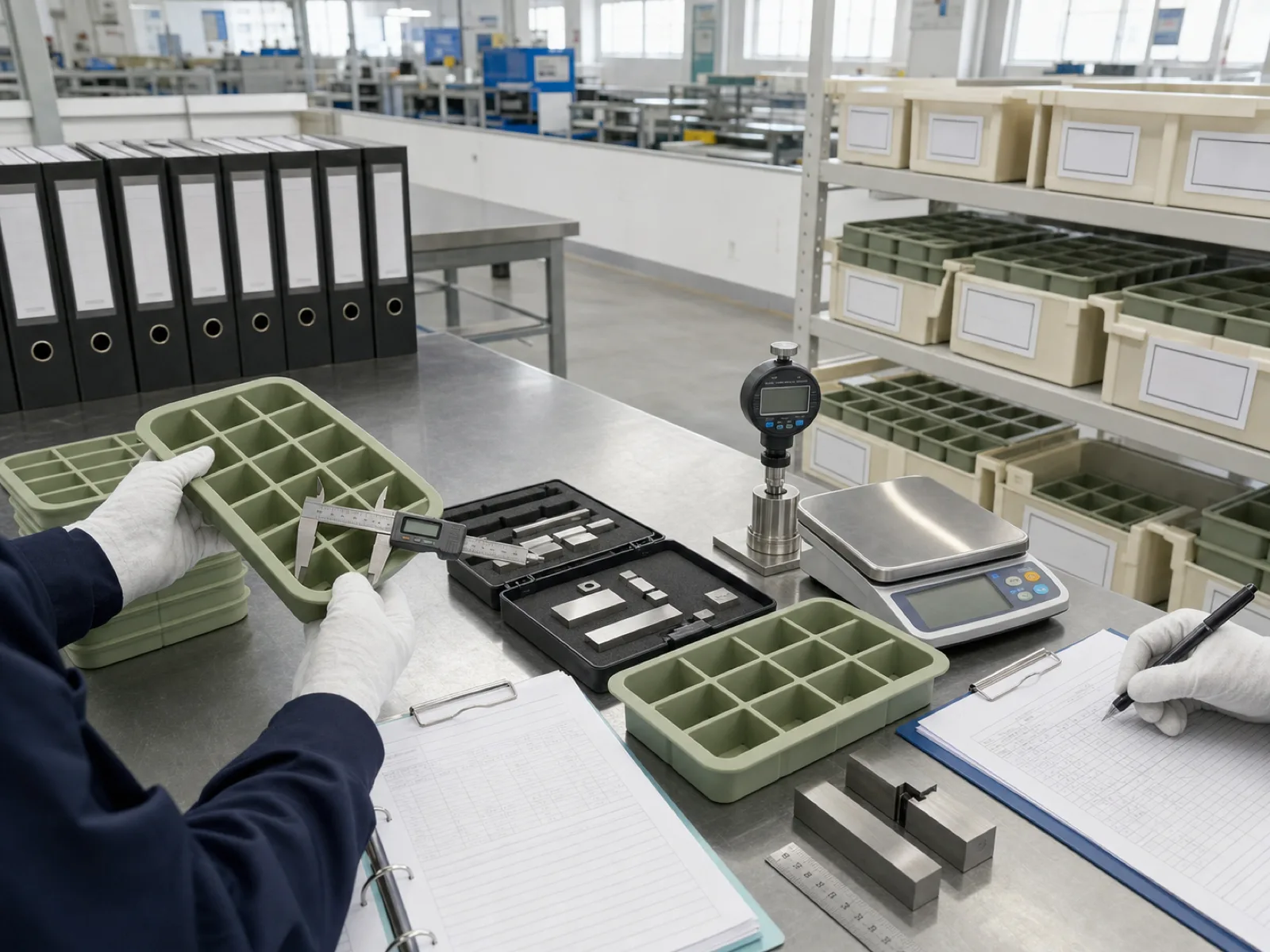
- Cure logs. Real factories retain per-batch cure temperature × time logs referencing the master-batch lot number for 36 months minimum per ISO 9001 documented process control8. If your supplier cannot produce the previous production batch’s cure log within one business day, treat that as an audit red flag.
The full decision framework — including EU regulatory scope, USP Class VI documentation depth, and program-horizon economics — is in the platinum vs peroxide cured silicone decision guide. The short version: score the RFQ across retail tier, regulatory scope, PFAS positioning, and unit-cost sensitivity. Two or more pointing premium → default platinum. Three or more pointing cost-led → default peroxide with mandatory post-cure and PFAS-free process aid verification.
What Shore A hardness does a silicone ice cube tray need?
Shore A hardness is geometry-driven, not preference-driven. Standard 1-inch and 1.25-inch cube trays with straight-wall pull-out geometry spec Shore A 50. Large-format 2-inch to 2.5-inch cocktail spheres and king cubes spec Shore A 40-45 to release cleanly without wall deformation. Thin-webbed trays (crushed ice, small stackable, textured surface) spec Shore A 60-70 for wall stability. Measurement standard is ASTM D2240 on a Type A durometer[^astm-d2240] — never vendor-defined internal scales.
The mistake procurement teams new to silicone make on Shore A is treating it like a single spec (“food-grade Shore A 50”). It is a mechanical property that has to be matched to the cube cavity geometry, the release angle, the wall thickness ratio, and the intended freeze/thaw duty cycle. The wrong Shore A on the wrong geometry produces trays that tear on cube release (too soft), cubes that crack the tray on removal (too hard), or trays that ship with hairline stress fractures out of the first freeze cycle (wrong crosslink density from an under-cured batch).
The Shore A × geometry map that Wetop’s engineering team defaults to on cube-tray programs:
| Cube geometry | Cavity depth | Wall thickness | Shore A | Rationale |
|---|---|---|---|---|
| Standard 1-inch cube (12-15 cavities) | 25 mm | 2.5-3.0 mm | 50 | Mass-retail default. Balances release ease with stack durability across the retail supply chain. |
| Standard 1.25-inch cube (12-15 cavities) | 32 mm | 2.5-3.0 mm | 50 | The most common retail SKU. Shore A 50 handles the release without stress on the cavity walls. |
| Large 2-inch cube (6-9 cavities) | 51 mm | 3.0-4.0 mm | 45 | Deep cavity walls need lower durometer to invert without tearing at the corners. |
| King 2.5-inch cube / sphere (4-6 cavities) | 64 mm | 4.0-5.0 mm | 40 | Cocktail-bar geometry. Lowest durometer that still holds shape on release; higher durometers crack the cube on removal. |
| Crushed ice / small stackable (24+ cavities) | 15 mm | 1.5-2.0 mm | 65 | Thin walls need higher durometer for stack-in-freezer stability without collapse. |
| Textured / faceted design cube | 25-32 mm | 2.5-3.0 mm | 55 | Slightly higher durometer holds the texture detail on release without deformation. |
| Silicone-with-lid combo tray (spill-free) | 32 mm | 3.0-3.5 mm body + soft lid | 50 body + 30-40 lid | Two-durometer program — rigid body for cube support, soft lid for pull-off seal. |
The ASTM D2240 measurement is done with a Type A durometer on a 6mm cross-section sample at 23°C. Any supplier who quotes Shore A without specifying the measurement standard is either inexperienced or dodging — the range between “Shore A 50 per D2240” and “Shore A 50 per internal method” can be 5-8 points, which is the difference between a cube that releases cleanly and one that tears the cavity.
What is the tooling and mold amortization economics for custom cube shapes?
Custom cavity tooling for a branded cube shape runs $2,500-8,500 depending on cavity count and complexity — a P20-steel 15-cavity 1.25-inch mold is $3,200-4,800; a 6-cavity 2-inch king-cube mold is $4,500-6,500; a 4-cavity faceted design mold is $6,500-8,500. Amortized across a 30,000-piece program horizon that adds $0.08-0.28 per unit. Wetop's model refunds 50-100% of the tooling cost against the first 20,000 units of production once the program clears sign-off, which converts the mold to a "loaner-with-buyback" arrangement that most procurement teams find easier to defend internally than a capital line item.
The economics are straightforward once you separate the shared-mold path from the custom-tooling path. On the shared-mold path (standard 1-inch, 1.25-inch, or 2-inch cube geometry, generic tray footprint, brand added by deboss or pad print) there is no tooling cost — MOQ 500 covers the material, cure, post-cure, packaging, and per-batch test reports. On the custom-tooling path the tooling is a one-time capital cost that amortizes across the program horizon.
Amortization math for a custom 15-cavity 1.25-inch tray with a branded cube shape (P20-steel mold, $4,200 tooling):
| Program horizon | Tooling amortized per unit | Total unit cost (platinum-cure FOB Yantian) |
|---|---|---|
| 3,000 units (MOQ) | $1.40 | $3.65 |
| 5,000 units | $0.84 | $2.79 |
| 10,000 units | $0.42 | $1.97 |
| 20,000 units | $0.21 | $1.66 |
| 30,000 units | $0.14 | $1.59 |
| 50,000 units | $0.084 | $1.53 |
The 20,000-piece breakpoint is where custom tooling stops being a burden on the P&L. Below it, the shared-mold path plus a distinctive deboss usually pencils out better than paying for the cavity. Above it, custom tooling recovers cleanly and unlocks the differentiation that lets the brand defend a higher shelf price. See the silicone OEM pricing structure decoder for the full material + labor + overhead + tooling breakdown.
What are the MOQ pricing tiers at 500 / 1,000 / 5,000 / 10,000 units FOB Yantian?
On a standard 15-cavity 1.25-inch cube tray in platinum-cure with a debossed brand mark and per-batch FDA + LFGB test reports, FOB Yantian unit cost runs $2.85 at MOQ 500, $2.35 at MOQ 1,000, $1.75 at MOQ 5,000, and $1.45 at MOQ 10,000. Peroxide-cure with disciplined 4-6 hour post-cure runs 15-22% below at every tier: $2.30 / $1.90 / $1.40 / $1.15 respectively. Large-format 2-inch spheres or king-cubes add $0.85-1.60 per unit for material weight and cure-cycle time.
The pricing bracket table for the three most common cube-tray geometries at Wetop, FOB Yantian, in USD, standard packaging (retail box + insert card + barcode + care instructions):
| SKU | Cure | MOQ 500 | MOQ 1,000 | MOQ 5,000 | MOQ 10,000 |
|---|---|---|---|---|---|
| 15-cavity 1.25-inch cube tray | Platinum | $2.85 | $2.35 | $1.75 | $1.45 |
| 15-cavity 1.25-inch cube tray | Peroxide + post-cure | $2.30 | $1.90 | $1.40 | $1.15 |
| 6-cavity 2-inch large cube tray | Platinum | $3.90 | $3.25 | $2.45 | $2.05 |
| 6-cavity 2-inch large cube tray | Peroxide + post-cure | $3.15 | $2.65 | $2.00 | $1.65 |
| 4-cavity 2.5-inch king cube / sphere | Platinum | $4.65 | $3.85 | $2.95 | $2.45 |
| 4-cavity 2.5-inch king cube / sphere | Peroxide + post-cure | $3.75 | $3.15 | $2.40 | $1.95 |
| 24-cavity crushed ice tray | Platinum | $2.65 | $2.20 | $1.65 | $1.35 |
| 24-cavity crushed ice tray | Peroxide + post-cure | $2.15 | $1.80 | $1.35 | $1.10 |
All FOB Yantian; DDP US West Coast add roughly $0.35-0.55 per unit sea freight amortized across a 20-foot container of ~40,000 trays; DDP EU add roughly $0.45-0.75 depending on port. Per-batch PFAS non-detect testing adds $180-320 per batch (not per unit — the lab fee is fixed per production batch and amortizes to fractions of a cent per piece at MOQ 1,000+). USP <88> extract testing on baby-brand programs adds $850-1,400 per batch.
What is the lead time — from PO to freight-ready?
Shared-mold sampling runs 7-15 days from PO signature; custom-tooling sampling runs 25-40 days; mass production runs 30-45 days at MOQ 500-10,000; sea freight from Yantian adds 18-22 days to US West Coast, 30-35 days to US East Coast, and 28-35 days to major EU ports. Total PO-to-shelf on a shared-mold program is 55-75 days; on a custom-tooling program 90-115 days. Every stage is documented per ISO 9001 batch record.
Stage-by-stage breakdown for a typical MOQ 3,000 custom-cube-shape program (platinum-cure, 15-cavity 1.25-inch tray, private-label packaging, DDP US West Coast):
| Stage | Duration | What happens |
|---|---|---|
| PO signature + material prep | Days 1-5 | Compound house releases raw gum against master-batch lot; PFAS-free process aid confirmed; cure system spec locked. |
| Custom mold fabrication | Days 5-30 | P20-steel CNC mold with the branded cube cavity; polish; trial cure; dimensional inspection to ±0.1mm on cavity. |
| First-article sampling | Days 30-35 | Sample cure batch; QC dimensional and cosmetic inspection; sampling ship to buyer via DHL. |
| Buyer sample sign-off | Days 35-45 | Buyer receives, tests freeze cycle, signs off. Wetop holds mold and material batch. |
| Mass production | Days 45-80 | Cure runs at press; 4-6 hour post-cure per batch; QC AQL 2.5 sampling per ISO 2859-19; per-batch FDA + LFGB + PFAS testing lab lead time overlaps. |
| Final QC + packaging | Days 80-85 | AQL inspection sign-off; retail box + insert card + barcode packaging; container load plan. |
| Sea freight FOB Yantian → US West Coast | Days 85-105 | 18-22 days transit; ~2 days port handling. |
| Total PO-to-shelf | 100-110 days | Custom-tooling program; shared-mold path shaves 25-30 days. |
Every stage has a documented handoff — cure log, post-cure oven record, AQL inspection report, freight bill of lading — cross-referenced to the master-batch lot number that ends up printed on the retail carton. This is the ISO 9001 batch traceability chain that lets a Home Depot / Wayfair / Tesco chargeback dispute resolve in one email exchange instead of a three-month back-and-forth.
How do I audit a real factory vs a trading company on Alibaba-type platforms?
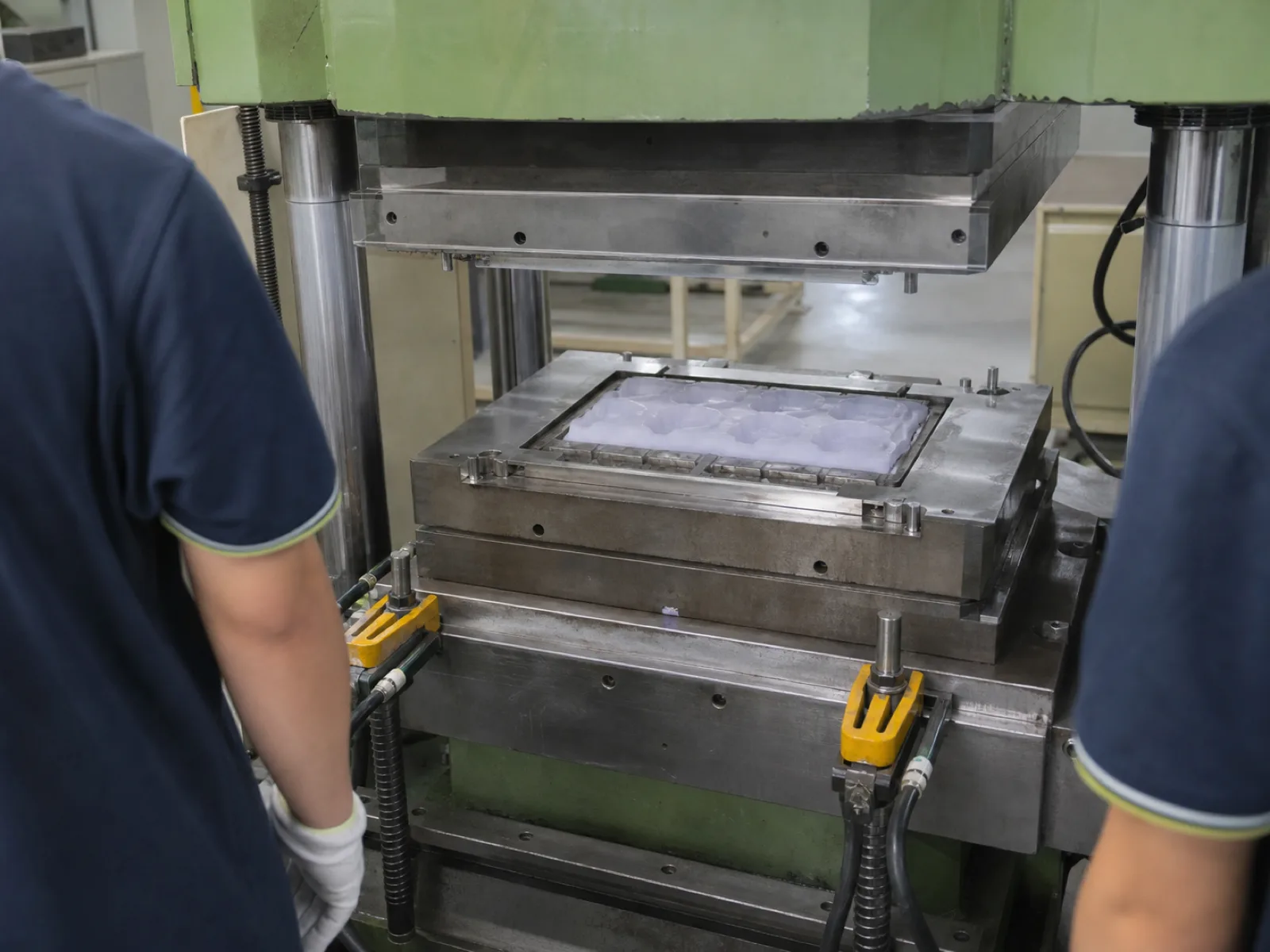
Four audit tests separate a real factory from a trading company reselling under a factory-sounding domain. (1) Request a live 20-minute factory-floor video call and ask for the master-batch lot number of the raw silicone gum being cured that day — a real factory produces it in under a minute. (2) Request the previous 30 days of post-cure oven temperature logs — real factories retain these per ISO 9001, intermediaries do not have the record. (3) Request per-batch third-party test reports from SGS / Intertek / TÜV referencing the master-batch lot number — real factories retain 36 months minimum. (4) Ask specifically which cure system (platinum or peroxide) they run on your program — real factories answer specifically, intermediaries pivot to "food-grade silicone".
The four tests are not adversarial. They are the same documentation a Home Depot or Tesco QA audit will ask for six months into the program. Testing them upfront on the RFQ conversation surfaces the intermediary versus real-factory distinction cleanly, without either party losing face:
- Live factory-floor video call. A real factory schedules a 20-minute walk-through with the engineering lead within one to three business days. During the walk, ask to see the raw silicone gum currently being cured and request the master-batch lot number on-camera. An intermediary reselling under a factory-sounding domain schedules the call three to five business days out (they need to arrange access to their subcontractor’s floor), often cannot show the raw material lot, or the “factory” is a warehouse with staged product for photography.
- Post-cure oven records. ISO 9001 documented process control8 requires temperature-time logs retained for the duration specified in the manufacturer’s Quality Management System — typically 36 months. Real factories email a redacted copy of the previous 30 days of oven logs (referencing lot numbers, not customer names) within one to two business days. Intermediaries either send a generic screenshot from the compound house’s website or send a hand-typed table with no lot references.
- Per-batch third-party test reports. Real factories retain a shelf of SGS / Intertek / TÜV / Bureau Veritas reports cross-referenced to the master-batch lot number. Ask for one from the last six months on a comparable silicone kitchenware program (not a live customer’s specifically). The report should show total volatile extractables in mg/dm², peroxide residuals in mg/kg, and lot traceability. Intermediaries send a generic “material declaration” PDF that references the raw gum, not the finished part.
- Cure system specificity. Ask which cure system the factory runs on your program. Real factories answer “platinum-cure LSR” or “peroxide-cure HCR with 6-hour post-cure at 190°C” and can walk through the cost delta and documentation delta between the two on a call. Intermediaries answer “food-grade silicone” and pivot when pressed.
Any factory that passes the four tests is worth pricing against. Any factory that fails one of them should be treated as at-risk on the full program. See the sourcing silicone factory checklist for the complete 24-point RFQ questionnaire Wetop’s engineering team recommends procurement managers use on incoming silicone OEM conversations.
Which retail chains and brand tiers does a silicone ice cube tray need to clear?
Retail-tier readiness for silicone ice cube trays clusters into three lanes: Tier 2 US mass housewares (Home Depot, Wayfair, Bed Bath & Beyond caliber) needs FDA 21 CFR 177.2600 + CPSIA + ISO 9001; EU housewares chains (Tesco, Carrefour, EU retailers) need LFGB §30/31 + EC 1935/2004 declarations of compliance; and premium / baby / medical-adjacent tiers add USP Class VI, ISO 10993, and per-batch PFAS non-detect on top. Wetop programs the compliance packet upfront based on which lane the SKU is targeting.
Retail-chain compliance is where a silicone ice cube tray program either scales cleanly or gets stuck at buyer sign-off. The three-lane map:
- Tier 2 US mass housewares. Home Depot / Wayfair / Bed Bath & Beyond caliber. Retail price $8-20. Compliance baseline: FDA 21 CFR 177.2600 per-batch third-party report, CPSIA §102 if the SKU is marketed as a children’s product, ISO 9001 batch traceability on the manufacturer. Cure system default: peroxide with disciplined 4-6 hour post-cure. Wetop has running program experience with Tier 2 US housewares retail-chain audits at this depth.
- EU housewares chains. Tesco / Carrefour / EU retailer caliber. Retail price €10-25. Compliance baseline: LFGB §30/31 per-batch report, EC 1935/2004 declaration of compliance4, REACH SVHC screening, ISO 9001 traceability. Cure system default: platinum-cure or post-cured peroxide with PFAS non-detect verification (EU premium chains increasingly require PFAS-free per the ECHA restriction trajectory1).
- Baby / Medical-adjacent / EU premium. Baby-brand caliber, natural-food retail, medical-adjacent accessory brands. Retail price $18-40. Compliance baseline: platinum-cure default, USP Class VI6 documentation, ISO 10993-1 biocompatibility assessment7 where applicable, per-batch PFAS non-detect at parts-per-billion, full ingredient disclosure on retail box.
A single silicone ice cube tray SKU can move between lanes with a change in cure system and documentation depth. The engineering pattern is stable; the compliance packet changes. That is the OEM leverage that lets one Dongguan factory run programs across all three lanes on the same shop floor without swapping tooling.
What vertical use cases does a custom silicone ice cube tray program serve?
Six B2B verticals drive the meaningful volume in custom silicone ice cube trays: housewares brands (standard 1-1.25-inch cube retail SKUs), baby brands (small-cube breast-milk and puree freezing trays with USP Class VI), pet brands (silicone treat-freezing molds with FDA + CPSIA compliance), cocktail-bar programs (2-2.5-inch king cubes and spheres for premium bar accounts), medical-adjacent programs (dosing trays, lab-use freezing, cryotherapy accessory), and hotel / hospitality private-label programs. Wetop runs custom cavity tooling for programs in each vertical with the compliance packet tuned to the target retail lane.
The six vertical archetypes, mapped to the cure default and documentation depth:
- Housewares brands. Standard 1-inch and 1.25-inch cube tray retail SKUs at MOQ 3,000-10,000. Cure default: peroxide with 4-6 hour post-cure. Compliance packet: FDA + LFGB + ISO 9001. Retail lane: Tier 2 US and EU housewares chains. Program duration: 2-4 years typical.
- Baby brands. Small-cube (0.5-1 inch) trays for breast-milk, purees, and homemade baby food freezing. MOQ 3,000-8,000. Cure default: platinum-cure LSR. Compliance packet: FDA + LFGB + USP Class VI + ISO 10993-1 + per-batch PFAS non-detect + CPSIA. Retail lane: baby-brand DTC, natural-food retail, premium baby-boutique chains.
- Pet brands. Silicone treat-freezing molds for peanut butter, broth, and probiotic treats. MOQ 3,000-10,000. Cure default: platinum-cure for premium pet brands; post-cured peroxide for mid-tier. Compliance packet: FDA + LFGB (pet food contact draws from human food contact standards). Retail lane: Chewy / Petco caliber and pet-brand DTC.
- Cocktail-bar programs. 2-inch cube and 2-2.5-inch sphere trays for craft cocktail bars, hotel bar accounts, and spirits-brand promotional programs. MOQ 500-3,000 (lower MOQ because unit price is higher and program is often event-tied). Cure default: platinum-cure. Compliance packet: FDA + LFGB + brand-specific artwork on deboss / pad-print.
- Medical-adjacent programs. Dosing trays for compounding pharmacies, lab-use freezing trays for pharmaceutical research, cryotherapy accessory silicone. MOQ 500-3,000. Cure default: platinum-cure LSR (USP Class VI baseline). Compliance packet: USP <88> + ISO 10993-1 + per-batch material traceability + finished-part extractables testing.
- Hotel / hospitality private-label. Custom-branded silicone ice cube trays for hotel bar programs, cruise-line beverage service, and airline first-class amenity kits. MOQ 500-5,000. Cure default: platinum-cure with branded cube geometry. Compliance packet: FDA + LFGB + brand debossing.
What Wetop OEMs on silicone ice cube tray programs
Wetop runs both platinum-cure LSR and post-cured peroxide-cure HCR on the same ISO 9001 certified Dongguan floor. Standard cube geometries (1-inch, 1.25-inch, 2-inch, 2.5-inch king, sphere, crushed-ice, textured) available on shared open molds at MOQ 500; custom cavity tooling for branded cube shapes at MOQ 3,000 with 50-100% tooling refund against the first 20,000 units. Per-batch FDA + LFGB + PFAS non-detect + ISO 2859-1 AQL documentation included in every quote; USP Class VI and ISO 10993 add-on packages for baby-brand and medical-adjacent programs.
Wetop’s Dongguan floor runs 60 staff across a 7,500 m² footprint — compounding, compression molding, LSR injection molding, secondary-process post-cure oven, QC, and finishing under one roof. The engineering lead William Zhuo owns cure-system selection, cavity design, and post-cure discipline personally on every program that clears sign-off. Program defaults on silicone ice cube trays:
- Platinum-cure LSR for baby-brand, medical-adjacent, EU premium retail, hotel / hospitality private-label, and PFAS-free positioning programs.
- Post-cured peroxide-cure HCR for Tier 2 US housewares retail, EU mid-tier housewares chains, pet-brand mid-tier, and cost-led OEM programs.
MOQ 500 per SKU on shared cube geometries — see MOQ and lead time on custom silicone OEM for the full schedule breakdown, and the real-factory MOQ math for why MOQ 500 is the honest floor rather than the MOQ 100 that intermediaries advertise. Per-batch FDA and LFGB documentation; logo debossing, pad printing, and laser etching all in-house at customize silicone logo — deboss, print, laser. Full private-label packaging on the private-label silicone kitchen products workflow.
Sourcing a custom silicone ice cube tray program? Email inquiry@wetopsilicone.com with your target retail tier, cube geometry, target MOQ, and compliance scope — we return with a cure recommendation, per-batch documentation packet, tooling amortization schedule, and price brackets at MOQ 500 / 1,000 / 5,000 / 10,000 FOB Yantian within two business days. Under NDA on request. Full manufacturing detail on our capabilities page; anonymized program archetypes on case studies.
Ready to source? Every quote is built against your specification — send a CAD file, a written brief, or reference samples, and an engineer replies within one business day. Request a quote →
Footnotes
-
European Chemicals Agency. PFAS Universal Restriction Proposal. https://eur-lex.europa.eu/legal-content/EN/TXT/?uri=CELEX%3A32006R1907 — the regulatory action driving PFAS-free spec adoption in EU premium retail and downstream in US West Coast retail. ↩ ↩2 ↩3
-
US Food and Drug Administration. 21 CFR 177.2600 — Rubber articles intended for repeated use. https://www.ecfr.gov/current/title-21/chapter-I/subchapter-B/part-177/subpart-C/section-177.2600 — the primary US food-contact regulation Wetop cures every silicone ice cube tray program against per production batch. ↩
-
German Federal Institute for Risk Assessment (BfR). Recommendation XV — Silicones. https://www.bfr.bund.de/en/bfr_recommendations_on_food_contact_materials-7498.html — the technical standard behind LFGB §30/31 for food-contact silicone, defining the organic volatile extraction test mandatory post-cure clears. ↩
-
European Parliament and Council. Regulation (EC) No 1935/2004 — Framework Regulation on Food Contact Materials. https://eur-lex.europa.eu/legal-content/EN/TXT/?uri=CELEX%3A02004R1935-20090807 — the EU umbrella regulation under which LFGB silicone testing sits. ↩ ↩2
-
US Consumer Product Safety Commission. Consumer Product Safety Improvement Act (CPSIA). https://www.ecfr.gov/current/title-16 — the US regulation covering children’s-product silicone ice cube trays; total lead limits and third-party testing burden for baby-brand SKUs. ↩
-
United States Pharmacopeia. USP <88> — Biological Reactivity Tests, In Vivo. https://www.usp.org/harmonization-standards/pdg/excipients/plastic-materials — USP Class VI biological reactivity classification; baseline documentation for baby-brand and medical-adjacent silicone ice cube tray programs. ↩ ↩2
-
International Organization for Standardization. ISO 10993-1:2018 — Biological evaluation of medical devices — Part 1. https://www.iso.org/standard/68936.html — the international biocompatibility standard applied on medical-adjacent silicone ice tray programs. ↩ ↩2
-
International Organization for Standardization. ISO 9001:2015 — Quality Management Systems — Requirements. https://www.iso.org/standard/62085.html — the quality management standard Wetop is certified against; governs batch traceability, cure logs, and post-cure oven records for every ice cube tray production run. ↩ ↩2 ↩3
-
International Organization for Standardization. ISO 2859-1:1999 — Sampling procedures for inspection by attributes. https://www.iso.org/standard/1141.html — the AQL sampling standard Wetop QC applies to every mass-production batch. ↩ ↩2
FAQ
-
What is the real MOQ for a custom silicone ice cube tray at OEM tier?
MOQ 500 units per SKU on a shared open mold (standard 1-inch, 1.25-inch, or 2-inch cube geometry) is the floor at Wetop — enough for procurement teams testing a new SKU without committing to tooling. Custom cavity geometry (branded cube shape, embossed brand mark, non-standard sphere, cocktail-bar 2.5-inch king cube) triggers dedicated tooling and lifts effective MOQ to 3,000-5,000 units to amortize the mold. Suppliers advertising MOQ 100 or MOQ 300 on custom shapes are usually running unlicensed cavity substitutions or absorbing the mold cost into inflated per-unit pricing — either way, the math falls apart under retail-tier audit. See [the real-factory MOQ math](/guide/real-factory-moq-the-math/) for the full breakdown.
-
How much does a custom silicone ice cube tray cost at OEM tier FOB Yantian?
On a standard 15-cavity 1.25-inch cube tray in platinum-cure with a debossed brand mark, FOB Yantian pricing runs $2.85 at MOQ 500, $2.35 at MOQ 1,000, $1.75 at MOQ 5,000, and $1.45 at MOQ 10,000. Peroxide-cure with mandatory 4-6 hour post-cure runs 15-22% below at every tier ($2.30 / $1.90 / $1.40 / $1.15 respectively). A 2-inch premium sphere or king-cube tray adds $0.85-1.60 per unit for the material weight and cure-cycle time. All prices include per-batch FDA 21 CFR 177.2600[^fda-177-2600] and LFGB §30/31[^bfr-lfgb-xv] third-party test reports.
-
Which compliance certificates does a retail-tier silicone ice cube tray need?
For US retail (Home Depot / Wayfair / BBB caliber): FDA 21 CFR 177.2600, CPSIA where applicable[^cpsia-silicone], and ISO 9001 traceability on the manufacturer. For EU retail (Tesco / Carrefour / EU housewares chains): LFGB §30/31 organic volatile testing (grounded in BfR Recommendation XV[^bfr-lfgb-xv]) and Framework Regulation (EC) No 1935/2004[^ec-1935-2004] declarations of compliance. For baby / medical-adjacent tiers: USP Class VI[^usp-class-vi] and ISO 10993-1[^iso-10993] biocompatibility assessment. Wetop bundles the FDA + LFGB per-batch reports into the standard quote; USP and ISO 10993 documentation are add-on packages for medical-adjacent programs.
-
Platinum-cure or peroxide-cure for a silicone ice cube tray program?
Peroxide-cure with disciplined 4-6 hour post-cure at 180-200°C is genuinely fine for mid-tier retail ($8-20 shelf) housewares programs — the material clears FDA and LFGB when the factory runs the post-cure cycle correctly. Platinum-cure is the right default for baby / infant feeding, medical-adjacent, EU premium retail, and PFAS-free positioning tiers. The 15-25% unit premium recovers when the retail tier's audit or PFAS-free marketing claim would otherwise require verification paperwork on peroxide-cure. Full framework in the [platinum vs peroxide cure decision guide](/guide/platinum-cured-vs-peroxide-cured-silicone/).
-
How long does sampling and mass production take for silicone ice cube trays?
Shared-mold sampling (existing 1-inch, 1.25-inch, or 2-inch cube tray geometry) runs 7-15 days from PO signature — 5-7 days for material prep and cure, 2-8 days for logo debossing, QC inspection, and DHL sampling shipment. Custom-tooling sampling (dedicated cavity for a branded cube shape) runs 25-40 days including CNC mold fabrication, trial cure, and dimensional verification. Mass production runs 30-45 days for MOQ 500-10,000 on either the shared or custom mold path once the sample is signed off. Sea freight FOB Yantian to US West Coast adds 18-22 days; East Coast via Panama adds 30-35 days. Full breakdown at [MOQ & lead time on custom silicone OEM](/guide/moq-and-lead-time-silicone-oem/).
-
How do I tell a real silicone factory from an Alibaba trading company?
Four audit tests, in order. (1) Ask for a live 20-minute factory-floor video call and request the master-batch lot number from the raw silicone gum being cured that day — a real factory can produce it in under a minute, a trading company will need to call back. (2) Ask for the post-cure oven temperature log for the previous 30 days — real factories log this per ISO 9001 requirements[^iso-9001], intermediaries don't have the record. (3) Request per-batch third-party test reports from SGS / Intertek / TÜV / Bureau Veritas referencing the master-batch lot number — real factories retain 36 months of these, intermediaries send generic material declarations. (4) Ask which cure system (platinum or peroxide) they run on your program — real factories answer specifically; intermediaries say 'food-grade silicone' and pivot. See [the sourcing silicone factory checklist](/guide/sourcing-silicone-factory-checklist/) for the full audit protocol.
-
What Shore A hardness should I spec for my silicone ice cube tray?
Geometry-driven. Standard 1-inch to 1.25-inch cube trays with a straight-wall pull-out geometry spec Shore A 50 — the standard mass-retail default. Large-format 2-inch to 2.5-inch cocktail spheres and king cubes spec Shore A 40-45 to allow the cube to release without deformation of the tall cavity walls. Thin-webbed trays (crushed ice, small stackable, textured surface) spec Shore A 60-70 for wall stability and stack durability. Measurement standard is ASTM D2240[^astm-d2240]; require the supplier to state the measurement method (D2240 durometer on a Type A gauge) rather than vendor-defined internal scales.
-
Can Wetop private-label and custom-brand our silicone ice cube tray?
Yes — logo debossing is included in the base quote at MOQ 500+, and full private-label packaging (retail box, insert card, barcode, batch code, care instructions in EN/DE/FR/ES/JP) is a standard add-on. Debossed brand marks (0.5-0.8mm depth), pad-printed brand marks (2-color max), and laser-etched serial codes are all in-house processes at Wetop's Dongguan floor. Full detail at [customize silicone logo — deboss, print, laser](/guide/customize-silicone-logo-deboss-print-laser/) and [private-label silicone kitchen products](/guide/private-label-silicone-kitchen-products/).
References
Authoritative sources cited in this guide
- US Food and Drug Administration (Code of Federal Regulations). 21 CFR 177.2600 — Rubber articles intended for repeated use. https://www.ecfr.gov/current/title-21/chapter-I/subchapter-B/part-177/subpart-C/section-177.2600 — The primary US food-contact regulation Wetop cures every silicone ice cube tray program against per production batch.
- German Federal Institute for Risk Assessment (BfR). BfR Recommendation XV — Silicones. https://www.bfr.bund.de/en/bfr_recommendations_on_food_contact_materials-7498.html — The technical standard behind LFGB §30/31 for food-contact silicone. Defines the organic volatile extraction test mandatory post-cure clears — the hidden variable most consumer roundups miss.
- International Organization for Standardization. ISO 9001:2015 — Quality Management Systems — Requirements. https://www.iso.org/standard/62085.html — The quality management standard Wetop is certified against. Governs batch traceability, cure logs, and post-cure oven records referenced throughout this guide.
- International Organization for Standardization. ISO 2859-1:1999 — Sampling procedures for inspection by attributes. https://www.iso.org/standard/1141.html — The AQL sampling standard Wetop QC applies to every mass-production batch of silicone ice cube trays.
- ASTM International. ASTM D2240-15 — Standard Test Method for Rubber Property—Durometer Hardness. https://www.astm.org/d2240-15r21.html — The Shore A hardness measurement standard behind every durometer spec Wetop quotes on cube-tray programs.
- United States Pharmacopeia. USP <88> — Biological Reactivity Tests, In Vivo. https://www.usp.org/harmonization-standards/pdg/excipients/plastic-materials — USP Class VI biological reactivity classification — the baseline documentation Wetop delivers on baby-brand and medical-adjacent silicone ice cube tray programs.
- European Chemicals Agency (ECHA). PFAS Universal Restriction Proposal (2023). https://eur-lex.europa.eu/legal-content/EN/TXT/?uri=CELEX%3A32006R1907 — The regulatory action driving PFAS-free spec adoption in EU premium retail and downstream in US West Coast retail — why Wetop supplies per-batch PFAS non-detect reports.
- European Parliament and Council. Regulation (EC) No 1935/2004 — Framework Regulation on Food Contact Materials. https://eur-lex.europa.eu/legal-content/EN/TXT/?uri=CELEX%3A02004R1935-20090807 — EU framework regulation on food-contact materials — the umbrella under which LFGB testing sits for silicone ice cube trays sold into EU housewares chains.
- US Consumer Product Safety Commission. Consumer Product Safety Improvement Act (CPSIA). https://www.ecfr.gov/current/title-16 — The US regulation covering children's-product silicone ice cube trays — total lead limits and third-party testing burden for baby-brand SKUs.
- International Organization for Standardization. ISO 10993-1:2018 — Biological evaluation of medical devices — Part 1. https://www.iso.org/standard/68936.html — The international biocompatibility standard applied when a silicone ice tray program crosses the medical-adjacent threshold (dosing trays, lab-use ice, cryotherapy accessory).
Start a custom program
Send a brief. Get an engineer’s reply in one business day.
Every Wetop program is tooled from a customer’s specification. Send a CAD file (STEP · IGES · DWG) or a written brief and we’ll reply with a mold cost estimate, price brackets at MOQ 500 / 1,000 / 5,000, and any engineering questions.