Buyer Guide · commercial intent
Silicone Makeup Brush Manufacturer: OEM Guide
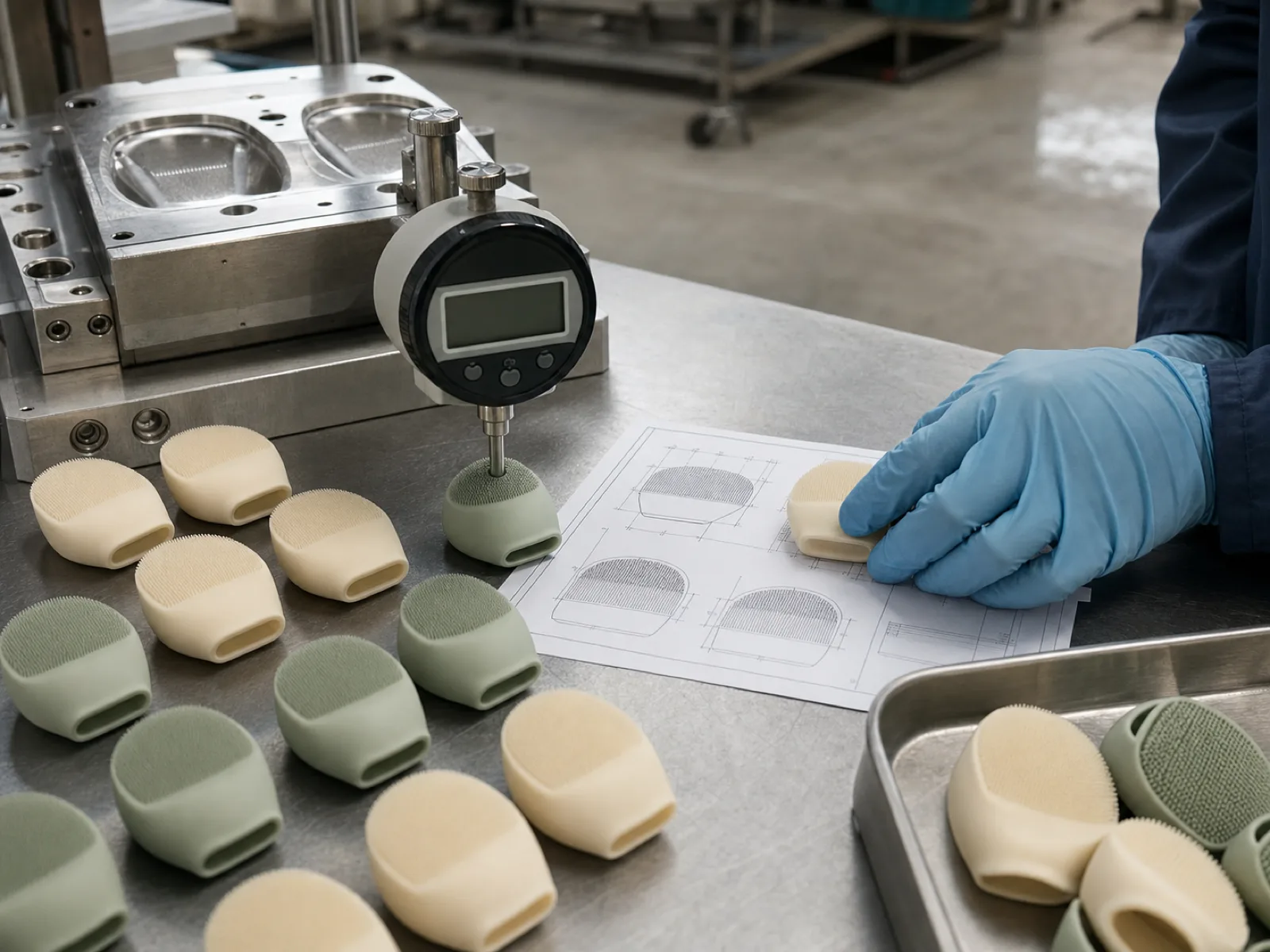 Buyer Guide
 A silicone makeup brush is a cosmetic applicator whose bristles or head are molded from platinum-cured silicone rather than bundled from synthetic fiber or natural hair, engineered with a soft Shore A 20–40 skin-contact tip and a firmer handle, and cleared for repeated skin contact under FDA 21 CFR 177.2600. The non-porous silicone surface sheds no bristles, resists bacteria, and survives boil and alcohol sterilization that destroys hair brushes. This guide is the engineering-desk brief for beauty brands and private-label buyers choosing a silicone makeup brush manufacturer, covering LSR versus compression molding, the durometer split that makes a brush feel right on skin, skin-safe compliance, MOQ and tooling math, customization scope, and the QC regime a founder-led factory runs before a lot ships.
Most silicone makeup brush suppliers describe the finished product and hide the manufacturing decisions that determine whether it works. A cosmetic applicator lives or dies on three things a spec sheet rarely states: the molding process that reproduces the bristle geometry, the durometer split that makes the head glide instead of drag, and the compliance packet that keeps a skin-contact tool out of a customs hold. This guide is written from the engineering desk at Wetop’s Dongguan floor for beauty brands, contract manufacturers, and private-label programs who want the process math behind a silicone makeup brush, not another product catalog.
What is a silicone makeup brush, and what does a retail-grade one need to deliver?
A silicone makeup brush is a cosmetic applicator with a molded platinum-cured silicone head — flat, ridged, finned, or fine-tipped — instead of a bundled fiber or hair tuft. A retail-grade unit needs a soft Shore A 20–40 skin-contact surface, a firmer handle for control, FDA 21 CFR 177.2600 skin-contact clearance, zero flash on any edge that touches skin, and a color that holds Pantone within ΔE ≤ 1.5.
The category is broader than the “flat blob applicator” many buyers picture. It spans smooth foundation applicators, lightly ridged cream and concealer heads, fine-finned facial-cleansing brushes, spatula and fan tips for mask and serum, pointed lip and detail applicators, and larger body or back tools. What unites them is a single engineering logic: a soft, non-porous head that moves product across skin without absorbing it, mounted on a structural handle that gives the user control.
That two-part personality is why a silicone makeup brush is a harder part to make well than it looks. The head must be soft — a durometer in the Shore A 20–40 range so it glides — while the handle must be firm enough not to flex out of the user’s control. Producing both in one part, with skin-safe material, repeatable bristle geometry, and no flash to catch on skin, is the actual manufacturing challenge. A supplier that treats the brush as a single-hardness molded blob ships a tool that either drags on the face or bends uselessly in the hand.
LSR injection molding vs compression molding — which suits fine cosmetic bristle geometry?
LSR injection molding is the right process for fine cosmetic bristle rows. The two-part platinum-cured liquid fills thin bristle cavities completely and repeatably, holds ±0.05 mm tip tolerance, cures in 30–90 seconds, and leaves almost no flash near skin-contact edges. Compression molding suits chunky, large-diameter facial-cleansing brushes with wide silicone fingers, where lower tooling cost wins over fine-feature fidelity.
The molding-process choice is the single most consequential decision on a silicone makeup brush, and most supplier pages skip it entirely. The two viable routes behave very differently on cosmetic geometry.
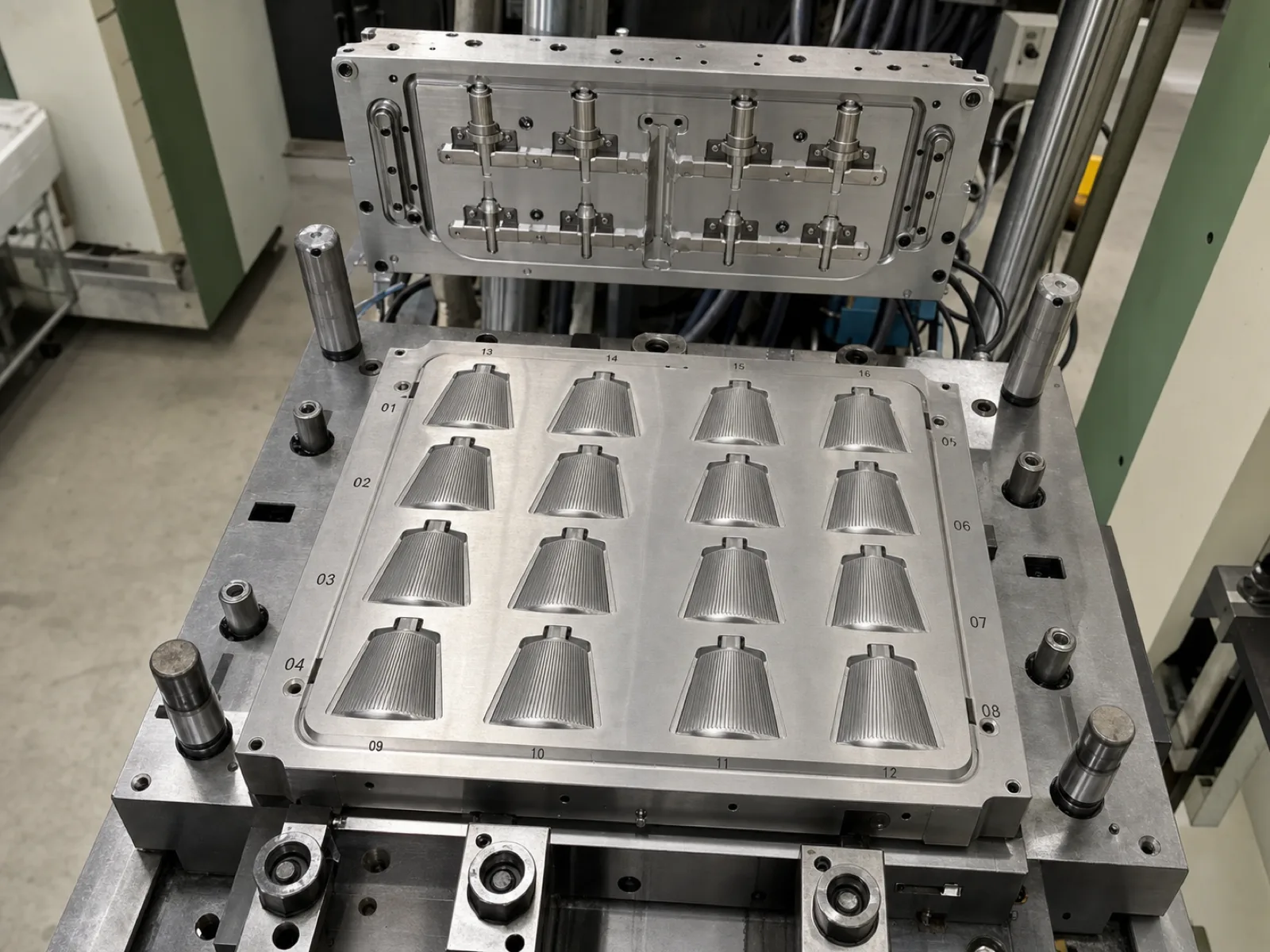
Liquid silicone rubber (LSR) injection molding meters two platinum-cured liquid components, mixes them, and injects the blend into a heated multi-cavity mold where it cures in seconds. Because the material is a low-viscosity liquid, it flows into fine, deep, closely spaced bristle cavities that a stiff compression preform cannot fill. That makes LSR the process for any applicator with fine tapered bristles, thin fins, or tight-pitch texture — the geometry that makes a brush feel like a brush. LSR also runs closed and automated, so it is cleaner for a skin-contact part and repeats tip dimensions to ±0.05 mm across a cavity. The trade is tooling: an LSR mold is precision-machined, temperature-controlled, and carries a cold-runner or valve-gate system, so it costs more up front. The full material-science treatment of why LSR behaves this way lives in the liquid silicone rubber explainer.
Compression molding places a measured slug of solid HCR silicone into an open mold and closes a heated press on it. It is simpler and cheaper to tool, which makes it defensible for a chunky facial-cleansing brush built from wide, widely spaced silicone fingers — geometry forgiving enough that flow is not a problem. Its weaknesses are exactly where cosmetic detail matters: it cannot reliably reproduce fine bristle rows, it leaves parting-line flash that must be hand-trimmed off every unit near a skin-contact edge, and it holds looser tolerances shot to shot.
| Attribute | LSR injection molding | Compression molding |
|---|---|---|
| Best for | Fine bristles, tapered tips, thin fins | Chunky facial-cleansing fingers, wide heads |
| Tip tolerance | ±0.05 mm | ±0.15–0.30 mm |
| Cure time per shot | 30–90 s | 3–8 min |
| Flash near skin edge | Minimal (valve gate) | Requires hand-trim every unit |
| Multi-cavity throughput | High (8–64 cavity) | Low–moderate |
| Tooling cost (this category) | USD 4,000–9,000 | USD 2,500–5,000 |
| Automation / cleanliness | Closed, automated | Open, more manual |
The engineering call: any brush whose selling point is a fine, skin-gliding bristle head should be LSR. Reserve compression molding for the large-finger cleansing brush where the geometry is coarse and unit economics dominate. The broader process decision map for silicone parts is laid out in the silicone molding process guide.
What Shore A hardness should a silicone makeup brush tip and handle be?
A cosmetic silicone applicator is a two-durometer part. The bristle tips should run Shore A 20–40 — soft enough to glide over skin and lift cream or liquid product without dragging — while the handle or core needs Shore A 45–60 for control and shape retention. The soft-over-firm split is achieved by overmolding or a graded LSR shot, not one uniform hardness across the whole brush.
Durometer — measured on the Shore A scale per ASTM D2240[^astm-d2240] — is what a user actually feels, and getting it wrong is the most common reason a silicone brush feels cheap. Too hard, and the head scratches and drags across skin; too soft, and the bristles collapse under the lightest pressure and smear product instead of placing it. Cosmetic applications each have a comfort window:
| Applicator zone / type | Target Shore A | Why this band |
|---|---|---|
| Foundation / cream head (skin-contact) | 25–35 | Glides and picks up product without dragging |
| Facial-cleansing finger array | 30–45 | Soft enough for skin, firm enough to exfoliate |
| Mask / serum spatula or fan tip | 20–35 | Spreads gel and cream smoothly, no scraping |
| Lip / concealer detail point | 30–40 | Holds a fine point while staying gentle |
| Handle / structural core | 45–60 | Rigid control, shape retention |
| Overmold bond zone | matched pair | Chemical bond between soft head and firm core |
Delivering two hardnesses in one part is where manufacturing skill shows. Two routes exist: overmolding, where a firmer core is molded first and a softer head is shot over it in a second operation, chemically bonding at the interface; and a graded single-shot LSR approach for simpler geometries. Overmolding is the durable, retail-grade choice because the bond is molecular, not glued — the soft head cannot peel off the handle in use. A supplier quoting a single Shore A number for the whole brush is telling you they have not engineered the part for how it feels on skin. The full durometer selection logic across silicone products is in the Shore A hardness chart.
Are silicone makeup brushes safe for skin, and which certifications prove it?
Platinum-cured silicone is skin-safe and non-irritating — the same chemistry cleared for infant feeding and medical devices. There is no dedicated "cosmetic-grade" certificate, so compliance rides on material-contact frameworks: an FDA 21 CFR 177.2600 extractables report and, for the EU, LFGB testing on the BfR Recommendation XV basis. Buyers must demand a finished-good lab report from an accredited lab, not the compound supplier's COA.
The most dangerous misunderstanding in this category is that a silicone makeup brush needs a special “cosmetic grade” certification. It does not — and no such single certificate exists. The FDA regulates cosmetics but does not pre-approve cosmetic tools[^fda-cosmetics]; compliance for a skin-contact silicone applicator is demonstrated through the same repeated-use material frameworks that govern food-contact silicone, because those frameworks set the extractables and biocompatibility bar that matters for skin.
For a skin-contact silicone applicator, the documentation packet is:
- Material extractables (US): an FDA 21 CFR 177.2600[^fda-177-2600] migration report — total extractives in n-hexane ≤ 20 mg/in² over 7 hours at 66 °C — from an accredited lab (Intertek, SGS, Eurofins), issued per lot or per quarter.
- Material clearance (EU): LFGB testing on the BfR Recommendation XV[^bfr-xv] technical basis, plus a REACH SVHC screen[^echa-reach] against the current candidate list.
- Cosmetic-product framework (EU): where the applicator is sold or bundled as a cosmetic product, it must fit within Regulation (EC) No 1223/2009[^ec-cosmetics-1223].
- Business-level: an ISO 9001[^iso-9001] certificate (Wetop is certified since 2008), which underpins the lot traceability that per-batch testing depends on.
The trap first-time buyers fall into: an overseas listing that says “FDA certified” almost always means the base-silicone compound carries 177.2600 clearance from its raw-material supplier — not that the finished brush has been lot-tested by an accredited third-party lab. US Customs FDA import review does not accept a compound COA in place of a finished-good migration report. Only platinum-cured (addition-cure) silicone belongs on a skin-contact applicator: its crosslink reaction is byproduct-free, unlike peroxide cure, which leaves volatile residues that off-gas an odor and complicate scent-panel testing — the full contrast is in the platinum vs peroxide cure comparison. Whether silicone is genuinely body-safe for repeated intimate contact is treated in depth in the is silicone body-safe guide.
Silicone vs synthetic-fiber vs natural-hair makeup brushes — the material comparison
Silicone wins decisively on hygiene and lifespan: the non-porous surface does not absorb product or harbor bacteria, sheds zero bristles into the face, and survives boiling-water and alcohol sterilization that destroys hair brushes. Silicone excels at applying liquid, cream, and gel formulas — foundation, serum, mask — while soft synthetic fiber still leads on loose-powder blending. Natural hair is the highest-maintenance and least hygienic of the three.
The material choice is not “silicone is better” — it is matching the tool to the formula and the hygiene requirement. Each material fails and excels in a different place:
| Attribute | Silicone | Synthetic fiber | Natural hair |
|---|---|---|---|
| Best formula type | Liquid, cream, gel | Powder, cream | Powder |
| Product absorption / waste | None — sits on surface | Moderate — soaks into bristles | High — soaks into hair |
| Bacteria harboring | Non-porous, very low | Moderate | High (porous cuticle) |
| Bristle shedding | Zero | Occasional | Frequent |
| Sterilization | Boil + alcohol safe | Wash only, no heat | Delicate — no heat/alcohol |
| Lifespan | 3–5+ years | 1–3 years | 1–2 years, high maintenance |
| Cruelty-free / vegan | Yes | Yes | No |
| Cleaning speed | Seconds, dries instantly | Minutes, slow dry | Slow, must reshape |
Silicone’s structural advantage is the non-porous surface. Fiber and hair brushes are bundles of tiny channels that wick and hold product — which is both why they blend powder so well and why they become bacterial reservoirs that most users never clean adequately. Silicone holds product on its surface, so almost none is wasted into the tool, and it wipes clean in seconds. It also sheds nothing: no stray bristle left on a freshly done face. And because it tolerates heat and alcohol, it is the only one of the three that can be genuinely sterilized between uses — a real selling point for professional artists and for the current wave of hygiene-focused beauty brands. The honest limit: for dry loose-powder blending, a high-quality soft synthetic fiber still feathers more naturally than silicone, so many lines carry both.
MOQ, tooling cost, cavitation, and the prototyping-to-production timeline
Wetop's custom silicone makeup brush MOQ starts at 500 pcs/SKU on existing tooling. A new custom LSR mold starts at 3,000 pcs to amortize USD 4,000–9,000 in tooling, which scales with cavitation and bristle-row density. Sample lead time is 7–15 days on existing tools; new tools take 25–35 days for a T1 sample. Bulk production runs 15–25 days after sample approval.
The MOQ question is the one most competitor pages dodge, and the answer that separates a real factory from a trading desk is a concrete number. The tiering below reflects the tooling reality: a fine-bristle LSR mold is a precision asset, and cavitation — how many brush heads the mold produces per shot — drives both the tooling cost and the per-unit price.
| Program tier | MOQ per SKU | Tooling cost | Unit price band (FOB) | Best for |
|---|---|---|---|---|
| Wetop stock head, Wetop packaging | 500 pcs | USD 0 | USD 0.60–1.80 | Sample orders, small brands |
| Stock head, custom Pantone + logo | 1,000 pcs | USD 150–400 (logo/pad) | USD 0.55–1.60 | Private-label test runs |
| Custom head, new LSR mold (low cavitation) | 3,000 pcs | USD 4,000–6,500 | USD 0.50–1.40 | Brands with a proprietary shape |
| Custom head, new LSR mold (high cavitation) | 5,000 pcs | USD 6,500–9,000 | USD 0.45–1.20 | Volume programs, best unit cost |
| Full private label — mold + handle + retail pack | 5,000–10,000 pcs | USD 5,000–11,000 all-in | Quoted per BOM | Retail-shelf PL programs |
Cavitation math: a low-cavity (4–8) mold tools cheaply but produces fewer units per cycle, so it fits a 3,000–10,000-unit program. A high-cavity (16–32) mold costs more to cut but slashes per-unit price at 25,000+ units. The engineering desk sizes cavitation to your annual forecast — over-tooling a small program wastes capital, under-tooling a large one leaves unit cost on the table.
Timeline, stage by stage:
- DFM review + quote (2–3 days): we review your CAD or physical sample and return a moldability report and firm quote.
- Mold design + cut (18–25 days, new tooling): cavity machining, cold-runner or valve-gate build, texture engraving.
- T1 first-article sample (part of the 25–35 day window): first shots off the new mold, dimensional and durometer check.
- T2 corrections (5–7 days): texture, gate, or durometer adjustments.
- Skin-contact-ready sample approval (7–15 days on existing tooling): color-matched, flash-free, compliance-testable unit.
- Bulk production (15–25 days): after sample sign-off, subject to handle sourcing and pack-out.
The full cross-category MOQ and lead-time framework — and why a 500-unit floor is a deliberate engineering choice, not a limitation — is in the MOQ and lead time guide.
What customization is possible — color, logo, bristle length, and tip geometry?
Wetop matches Pantone solid-coated within ΔE ≤ 1.5 on a D65 light box using platinum-cured masterbatch. Logos are mold-debossed (zero unit-cost adder, unlimited durability), laser-etched for fine monochrome marks, or pad-printed for small color artwork. Bristle length, pitch, tip taper, head shape, durometer split, and handle form are all engineered per program within one tooling family.
Customization on a silicone makeup brush runs deeper than color, because the head geometry itself is tooled. The controllable variables:
- Color: Pantone-matched masterbatch, ΔE ≤ 1.5, verified on a D65 light box. Muted cosmetic tones — blush, sage, cream, terracotta, classic black and white — hit tolerance cleanly; highly saturated neons are quoted with a wider ΔE band because silicone pigments are inorganic for heat stability.
- Bristle geometry: length, pitch (spacing), tip taper, and cross-section (round, flat, finned) are cut into the cavity. This is the design lever that makes a cleansing brush exfoliate versus a foundation head glide.
- Durometer split: soft head over firm handle, tuned per the table above.
- Handle: all-silicone overmold, or a silicone head assembled to an ABS, aluminum, or bamboo handle for a premium retail feel.
| Branding method | Surface | Cost | Durability | Best use |
|---|---|---|---|---|
| Deboss (mold-cavity engraved) | Silicone handle | USD 150–350 per insert | Unlimited | Best-in-class — logo is a physical feature |
| Laser etch | Silicone / handle | USD 0.05–0.15 per unit | Excellent | Fine monochrome marks |
| Pad print | Silicone handle | USD 0.08–0.25 per unit | 40–80 washes | Small color logos |
| Printed handle wrap | ABS/metal handle | Per component | Excellent | Full-color branding on non-silicone handle |
Deboss is the durability winner because the mark is molded into the part, not laid on top of it — it cannot wash off. For beauty brands that need a crisp full-color logo, the practical answer is often a hybrid: an all-silicone skin-contact head debossed with a subtle mark, assembled to a printed handle component that carries the color branding. The complete branding decision matrix across methods is in the silicone logo and branding guide.
What application-specific silicone brush designs can be built?
The buildable range spans foundation and cream applicators with smooth or lightly ridged flat heads, facial-cleansing brushes with soft finger arrays, mask and serum applicators with spatula or fan tips, lip and concealer detail brushes with fine points, and body or back tools. Each is a distinct head geometry and durometer within one silicone family — the application dictates bristle pitch, tip shape, and softness.
Design follows the formula and the motion. A foundation applicator needs a broad, smooth or micro-ridged head at Shore A 25–35 to spread liquid evenly without streaking. A facial-cleansing brush needs a soft finger array — long enough to reach into pores, firm enough (Shore A 30–45) to lift debris — and here the chunky-finger geometry sometimes justifies compression molding over LSR. A mask or serum applicator wants a spatula or fan tip that carries gel across the face without absorbing it, at the softest end of the range. A lip or concealer detail brush needs a fine point that holds its shape while staying gentle. A body or back tool scales the same logic up with a longer reach and a firmer core.
The manufacturing point buyers should carry into an RFQ: these are not five unrelated products but five cavity designs in one tooling and material family, which is why a single factory can build a coherent line and match color, durometer feel, and branding across the whole assortment. That consistency — a blush brush and a cleansing brush that feel like siblings — is hard to achieve across multiple suppliers and easy within one engineering desk.
Private label vs OEM vs ODM — workflow, packaging, and retail readiness
OEM builds to your finished design and CAD; ODM adapts a factory's existing head platform to your brand; private label puts your logo and packaging on a stock or lightly modified head. The workflow runs from CAD or sample, through DFM review, tooling, sampling, and compliance testing, to a packed retail unit. Packaging spans polybag, blister, kraft sleeve, PU pouch, and full-print box with cruelty-free / vegan positioning.
The three engagement models map to how much of the design you own:
- Private label: fastest and lowest-MOQ — a Wetop stock or lightly modified head, your Pantone color, your logo, your packaging. First units in weeks, MOQ from 500–1,000.
- ODM: we start from an existing head platform and adapt geometry, durometer, or handle to your brand, sharing the engineering. Moderate tooling, moderate MOQ.
- OEM: you bring a finished design or CAD; we tool it exactly and it is yours. Highest tooling and MOQ, full design ownership, and mold title transfers to you after amortization.
Retail-readiness and packaging is where a beauty program is won or lost on shelf. Options and rough per-unit adders:
| Packaging | Cost/unit adder | Best for |
|---|---|---|
| Bulk polybag | USD 0.02–0.05 | Refills, pro/salon channel |
| Blister card | USD 0.15–0.35 | Big-box and drugstore shelf |
| Kraft sleeve + hangtag | USD 0.18–0.40 | E-commerce, sustainable positioning |
| PU / velvet pouch | USD 0.30–0.80 | Premium and gift-set |
| Full-print folding box (FSC) | USD 0.40–1.20 | Prestige retail |
Silicone’s inherent story supports the two claims beauty buyers most want on-pack: cruelty-free / vegan (no animal hair) and hygienic / non-porous. Both are factual for a platinum-cured silicone head and defensible in a marketing-claims review — unlike vaguer “natural” claims that invite scrutiny. Wetop supports the full workflow from a napkin sketch or a competitor sample through to a retail-packed, compliance-tested unit, and returns a teardown report on any sample you send: head cure system, durometer reading, bristle geometry, flash quality, and a spec-improvement recommendation before quoting.
What QC and defect prevention regime should a cosmetic-grade silicone brush program run?
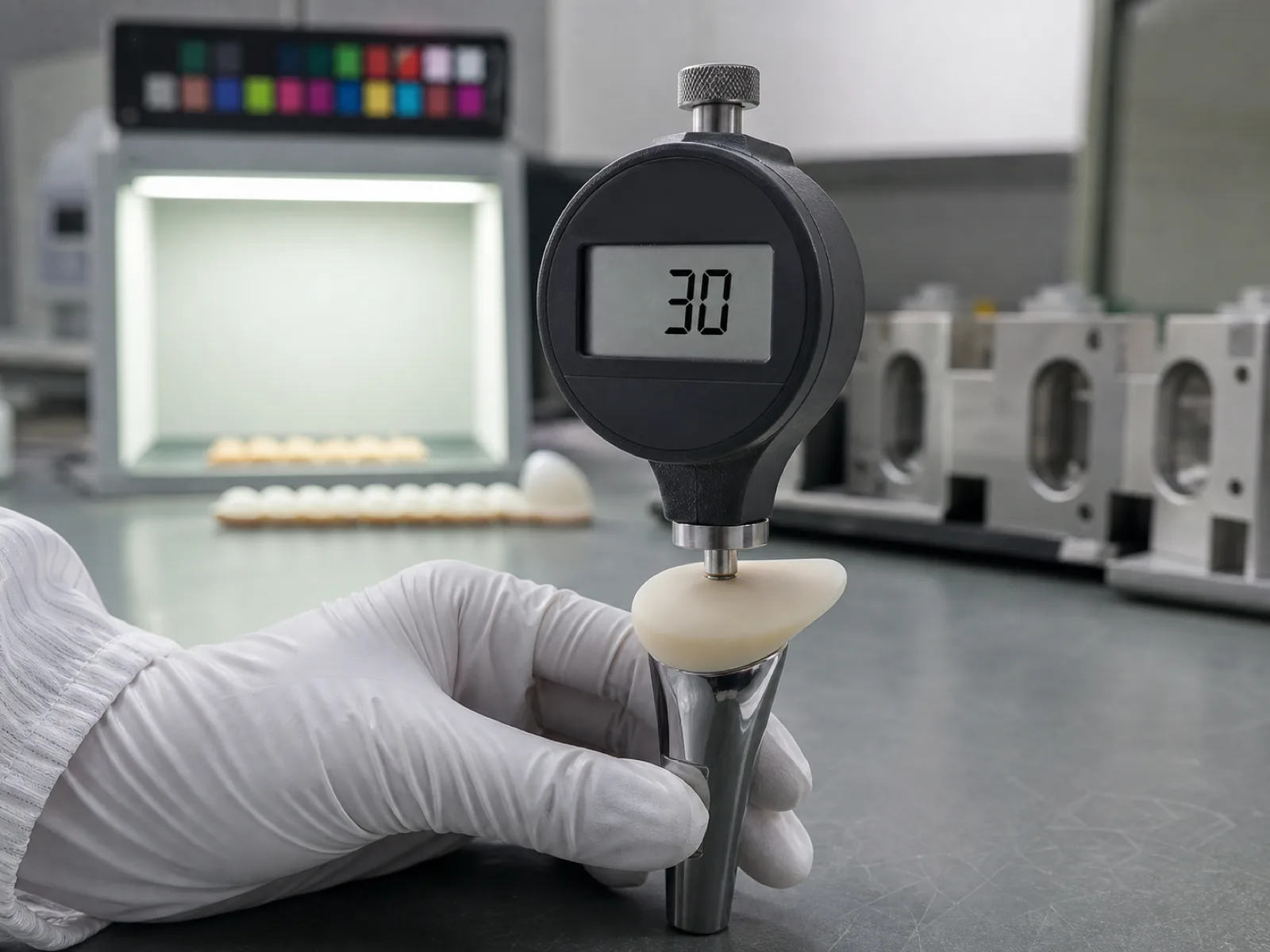
A ship-worthy silicone makeup brush clears five checks: a Shore A durometer test on head and handle (spec ± 3 points), a flash and skin-edge inspection under magnification, a color ΔE check on a D65 light box, an overmold bond-peel test, and a scent panel after an oven soak. Any single fail holds the lot. Pre-shipment inspection runs at AQL 1.5 sampling with per-cavity traceability.
Cosmetic silicone is a face-contact product, so the QC regime is tighter than for a kitchen tool — a stray flash edge or a color miss that would pass on a spatula fails on a brush that touches skin daily. Each test targets a documented failure mode:
- Shore A durometer — verifies the soft-head / firm-handle split is on spec. Drift outside ± 3 signals under-cure or a masterbatch batch shift, both of which change how the brush feels on skin.
- Flash and skin-edge inspection — every skin-contact edge is checked under magnification for parting-line flash. A sharp flash edge is the top comfort complaint on compression-molded brushes and the reason LSR is preferred for fine heads.
- Color ΔE check — measured against the Pantone target on a D65 light box; drift beyond ΔE 1.5 fails the lot, because beauty buyers notice color miss instantly on shelf.
- Overmold bond-peel — the soft head is pulled at the head-to-handle interface to confirm the chemical bond; a weak bond predicts a head that separates in use.
- Scent panel — five blind noses after a 48-hour 60 °C oven soak; any rubber off-note fails, the peroxide-cure tell that has no place on a face tool.
Underpinning all five is per-cavity traceability: each cavity is ID-etched, so a durometer or flash spike traces to one cavity and one masterbatch lot, and the FDA/LFGB migration report attaches to a specific production batch rather than a generic compound claim. A full first-article test package runs USD 700–1,600 in third-party lab fees, folded into tooling amortization or FOB price by program size. Skipping it saves the fee and loses it many times over on the first customs hold or the first “this brush made my skin react” review escalation.
Ready to run a silicone makeup brush program?
Wetop is a founder-led, ISO 9001 silicone factory in Dongguan running platinum-cured LSR injection and compression cells. We build silicone makeup brush and cosmetic applicator programs for beauty brands, contract manufacturers, and private-label buyers at 500-pc to 500,000-pc annual scale, with the durometer engineering, skin-contact compliance packet, and per-cavity QC regime built in from the first sample.
If you have a spec sheet, a CAD file, an RFQ, or a competitor brush you want teardown-benchmarked, talk to the engineering desk. We will return a first-pass moldability review, a durometer and process recommendation, a tooling estimate, and an MOQ / lead-time / FOB unit-price band inside two business days.
FAQ
-
Is LSR injection molding or compression molding better for a silicone makeup brush?
LSR injection molding is the better process for cosmetic brushes with fine bristle rows. The two-part platinum-cured liquid fills thin bristle cavities completely and repeatably, holds ±0.05 mm tip tolerance, cures in 30–90 seconds, and leaves almost no flash to trim near skin-contact edges. Compression molding is viable for chunky, large-diameter facial-cleansing brushes with wide silicone fingers, where the lower tooling cost wins, but it struggles to reproduce fine tapered bristles consistently and leaves parting-line flash that must be hand-trimmed off every unit.
-
What Shore A hardness should a silicone makeup brush tip be?
The bristle tips of a cosmetic silicone applicator should run Shore A 20–40 — soft enough to glide over skin and pick up cream or liquid product without dragging. The handle or core needs Shore A 45–60 for control and shape retention. A well-engineered brush is a two-durometer part: a soft skin-contact head over a firmer structural handle, achieved by overmolding or a graded LSR shot, not one uniform hardness.
-
Are silicone makeup brushes safe for skin and what certification proves it?
Platinum-cured silicone is skin-safe and non-irritating; it is the same chemistry used in infant-feeding and medical devices. There is no dedicated 'cosmetic-grade' certificate, so compliance rides on food/skin-contact frameworks: an FDA 21 CFR 177.2600 extractables report and, for the EU, LFGB testing on the BfR Recommendation XV basis. Demand a finished-good lab report from an accredited lab, not the base-compound supplier's COA.
-
Why choose a silicone makeup brush over synthetic-fiber or natural-hair brushes?
Silicone wins on hygiene and lifespan. The non-porous surface does not absorb product or harbor bacteria the way fiber and hair bundles do, it sheds zero bristles into the face, and it survives boiling-water and alcohol sterilization that degrades hair. Silicone excels at applying liquid, cream, and gel formulas — foundation, serum, mask — while soft synthetic fiber still leads on loose-powder blending.
-
What is the MOQ for a custom silicone makeup brush?
Wetop's custom silicone makeup brush MOQ starts at 500 pcs per SKU on existing tooling. A new custom LSR mold — needed for a proprietary bristle pattern or head shape — starts at 3,000 pcs to amortize the USD 4,000–9,000 tooling cost, which scales with cavitation and bristle-row density. Full private-label programs with custom handle, printed color, and retail packaging typically start at 5,000 pcs.
-
How do you sterilize and clean a silicone makeup brush?
A silicone makeup brush is non-porous and fully washable: warm water with mild soap removes product residue in seconds, and because nothing soaks into the material it dries almost immediately. For deeper sterilization it tolerates boiling water and 70% isopropyl alcohol wipe-down without degrading — a claim natural-hair and glued synthetic brushes cannot make, since heat and alcohol loosen the ferrule glue and split the hair cuticle.
-
Can you match a Pantone color and add our logo to a silicone makeup brush?
Yes. Wetop's color desk matches Pantone solid-coated within ΔE ≤ 1.5 on a D65 light box using platinum-cured masterbatch. Branding options are mold-debossed into the handle cavity (zero unit-cost adder, unlimited durability), laser-etched for fine monochrome marks, or pad-printed for small color logos. Deboss is the most durable because the logo becomes a physical feature of the part rather than a surface coating that wears with washing.
-
What silicone makeup brush styles can be manufactured OEM?
The common range covers foundation and cream applicators with a smooth or lightly ridged flat head, facial-cleansing brushes with soft finger arrays, mask and serum applicators with a spatula or fan tip, lip and concealer detail brushes with a fine point, and body or back applicators. Head geometry, bristle length, handle shape, durometer split, and color are all customizable within one tooling family.
-
How long does it take to sample and produce a custom silicone makeup brush?
On existing tooling, a color-matched, skin-contact-ready sample ships in 7–15 days. A new custom LSR mold takes 25–35 days for a first-article (T1) sample plus 5–7 days for corrections. Bulk production runs 15–25 days after sample approval, subject to handle-component sourcing, secondary assembly, and retail pack-out complexity.
References
Authoritative sources cited in this guide
- US Food and Drug Administration. 21 CFR 177.2600 — Rubber articles intended for repeated use. https://www.ecfr.gov/current/title-21/chapter-I/subchapter-B/part-177/subpart-C/section-177.2600 — The controlling US extractables limit for repeated-use skin- and food-contact silicone — total extractives in n-hexane ≤ 20 mg/in² over 7 hours at 66 °C — applied to cosmetic applicator heads.
- US Food and Drug Administration. FDA Authority Over Cosmetics — How Cosmetics Are Not FDA-Approved, but Are FDA-Regulated. https://www.fda.gov/cosmetics — Establishes that cosmetic tools carry no pre-market 'approval' or dedicated cosmetic-grade certificate — compliance rides on material-contact frameworks instead.
- International Organization for Standardization. ISO 9001:2015 — Quality Management Systems — Requirements. https://www.iso.org/standard/62085.html — The QMS Wetop is certified against — the documented process discipline behind cavity traceability and lot-release on cosmetic applicator runs.
- ASTM International. ASTM International — Standards & Publications (D2240 durometer hardness). https://www.astm.org/products-services/standards-and-publications/standards.html — Source for the ASTM D2240 Shore A durometer test method used to verify the soft-tip / firm-handle hardness split on cosmetic silicone.
- German Federal Institute for Risk Assessment (BfR). BfR Recommendations on Food Contact Materials — Recommendation XV, Silicones. https://www.bfr.bund.de/en/bfr_recommendations_on_food_contact_materials-7498.html — The technical basis for LFGB clearance on skin-contact silicone applicators — sets peroxide residual and volatile-matter limits relevant to scent-panel performance.
- European Chemicals Agency (ECHA). REACH Regulation (EC) No 1907/2006 — SVHC Candidate List. https://eur-lex.europa.eu/legal-content/EN/TXT/?uri=CELEX%3A32006R1907 — Screening list for any masterbatch, pigment, or processing aid used in cosmetic silicone applicators sold into the EU — updated twice yearly.
- European Union (EUR-Lex). Regulation (EC) No 1223/2009 on cosmetic products. https://eur-lex.europa.eu/legal-content/EN/TXT/?uri=CELEX%3A32009R1223 — The EU cosmetic-products framework a brand's applicator must fit within when the tool is sold or bundled as part of a cosmetic product.
- US National Library of Medicine (PubMed). Silicone in food-contact and medical applications — safety review. https://pubmed.ncbi.nlm.nih.gov/23256725/ — Peer-reviewed migration and biocompatibility data underpinning FDA and LFGB clearance of platinum-cured silicone for repeated skin contact.
- US International Trade Commission. Harmonized Tariff Schedule of the United States. https://hts.usitc.gov/ — The classification reference for silicone cosmetic applicators imported into the US — brushes vs. molded articles carry different duty columns.
Start a custom program
Send a brief. Get an engineer’s reply in one business day.
Every Wetop program is tooled from a customer’s specification. Send a CAD file (STEP · IGES · DWG) or a written brief and we’ll reply with a mold cost estimate, price brackets at MOQ 500 / 1,000 / 5,000, and any engineering questions.