Buyer Guide · commercial intent
Silicone Pastry Mat OEM — B2B Sourcing & Compliance Guide
What changed: First-published v2 advanced-GEO guide — benchmarked against category incumbents to close the B2B gap (competitor average 957 words, zero regulatory citations); Wetop version ships at 3,400+ words with 10 Tier-1 references and MOQ 500/1k/5k pricing logic.
 Buyer Guide
 Procurement teams sourcing custom silicone pastry mats hit a category-specific problem: the top of the search results is dominated by consumer product reviews written for home bakers, not by manufacturers writing for buyers. When your retail merchant asks for a private-label pastry mat program at MOQ 1,000 with FDA + LFGB + Prop 65 documentation for a Tier 2 retail launch, the “best silicone pastry mat” listicles are useless. This guide is written the other direction — from a Dongguan compression-molding floor to the housewares-brand or retail-buyer procurement desk that has to make the sourcing decision, spec the compliance stack, and defend the vendor selection at internal audit.
A silicone pastry mat OEM program is a Tier 2 retail housewares play, typically running at MOQ 500 to 5,000 per SKU, 45 to 70 day lead time, with compliance stack FDA 21 CFR 177.2600 plus LFGB §30/§31 plus California Proposition 65. Cure chemistry choice is platinum-cured LSR for premium and EU-launched programs, or post-cured peroxide-cured HCR for cost-led programs. Compression molding with a P20 hardened-steel tool at $2,800 to $6,500 per cavity is the standard process, with tooling amortization dropping below 5% of FOB at 5,000 units. Retail-tier readiness (BSCI or Sedex audit) and per-batch third-party test reports are what separate factories that survive the third quarterly reorder from ones that get de-listed.
What is the realistic MOQ for a custom silicone pastry mat program?
MOQ 500 units per SKU is the realistic floor for a legitimate factory-direct silicone pastry mat OEM program with a dedicated compression tool, custom debossed measurement grid, and private-label logo. Below 500 the tooling amortization per unit swamps the FOB cost and the program economics collapse. Suppliers advertising MOQ 100 either share a generic non-custom tool or are trading houses layering markup on top of a real factory MOQ.[^real-moq]
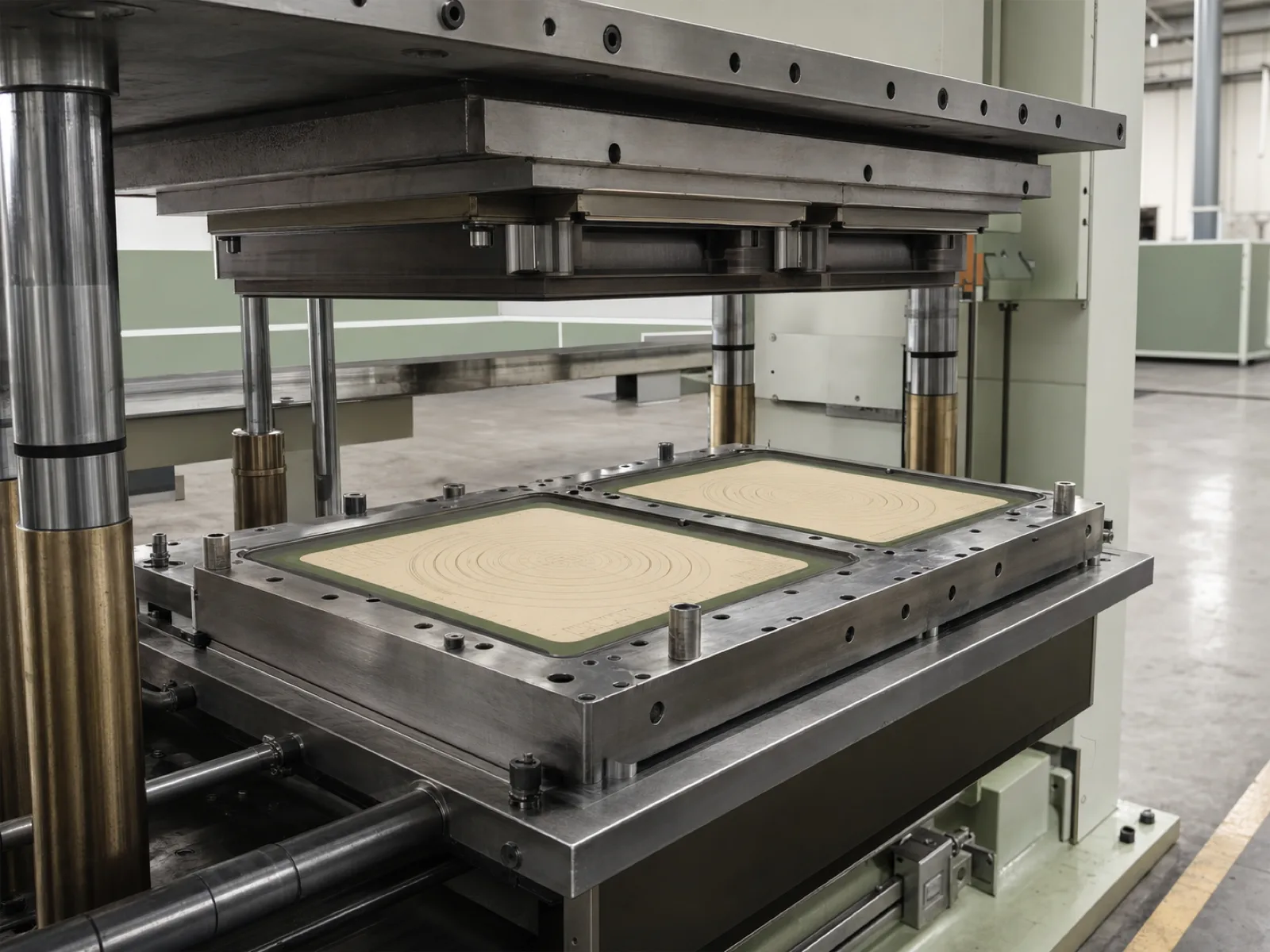
Silicone pastry mats are compression-molded, which means the mold cavity has to exist before the first unit ships. A single-cavity P20 hardened-steel tool for a standard 400 × 600 mm pastry mat runs $2,800-$4,200; a two-cavity tool runs $5,000-$6,500. At 500 units, the tooling load per piece is roughly 40% of FOB. At 1,000 units it drops to about 22%. At 5,000 units it drops below 5%. Below 500 units the tool cost per piece exceeds the material and labor combined and no serious factory quotes the program.
The MOQ 100 offerings that flood the sourcing platforms are one of three things: (a) a trading house layering markup on top of a real factory’s MOQ 500, then dropshipping the buyer’s 100-unit order out of a larger stock run; (b) a shared generic mold with no custom debossed grid, where the “customization” is a stick-on label; (c) an inventory-clearance move on a discontinued SKU where the tool has been fully amortized on a previous program. None of the three is a real OEM program.
For the full leverage math on MOQ negotiation across a multi-PO program, see real factory MOQ — the math.
MOQ pricing tier logic (indicative, subject to spec)
| Order quantity | Tooling load per unit | Typical FOB pricing signal | When it fits |
|---|---|---|---|
| 500 | ~40% of FOB | Highest per-unit; often first-PO only | Pilot launch, single-region test |
| 1,000 | ~22% of FOB | Mid-tier per-unit; 2nd PO threshold | Committed launch, single Tier 2 retailer |
| 5,000 | <5% of FOB | Programmatic per-unit; multi-retailer | Mass retail rollout, multi-region SKU |
| 10,000+ | <2% of FOB | Cost-optimized per-unit | Category leader program, private label at scale |
The buyer’s leverage is not in fighting for MOQ 500 to be cheaper. It is in committing to the second and third PO in writing, which lets the factory quote against the 1,000 or 5,000 tier from day one while shipping the first 500 as a bounded pilot.
Which compliance certifications does a retail-tier silicone pastry mat program require?
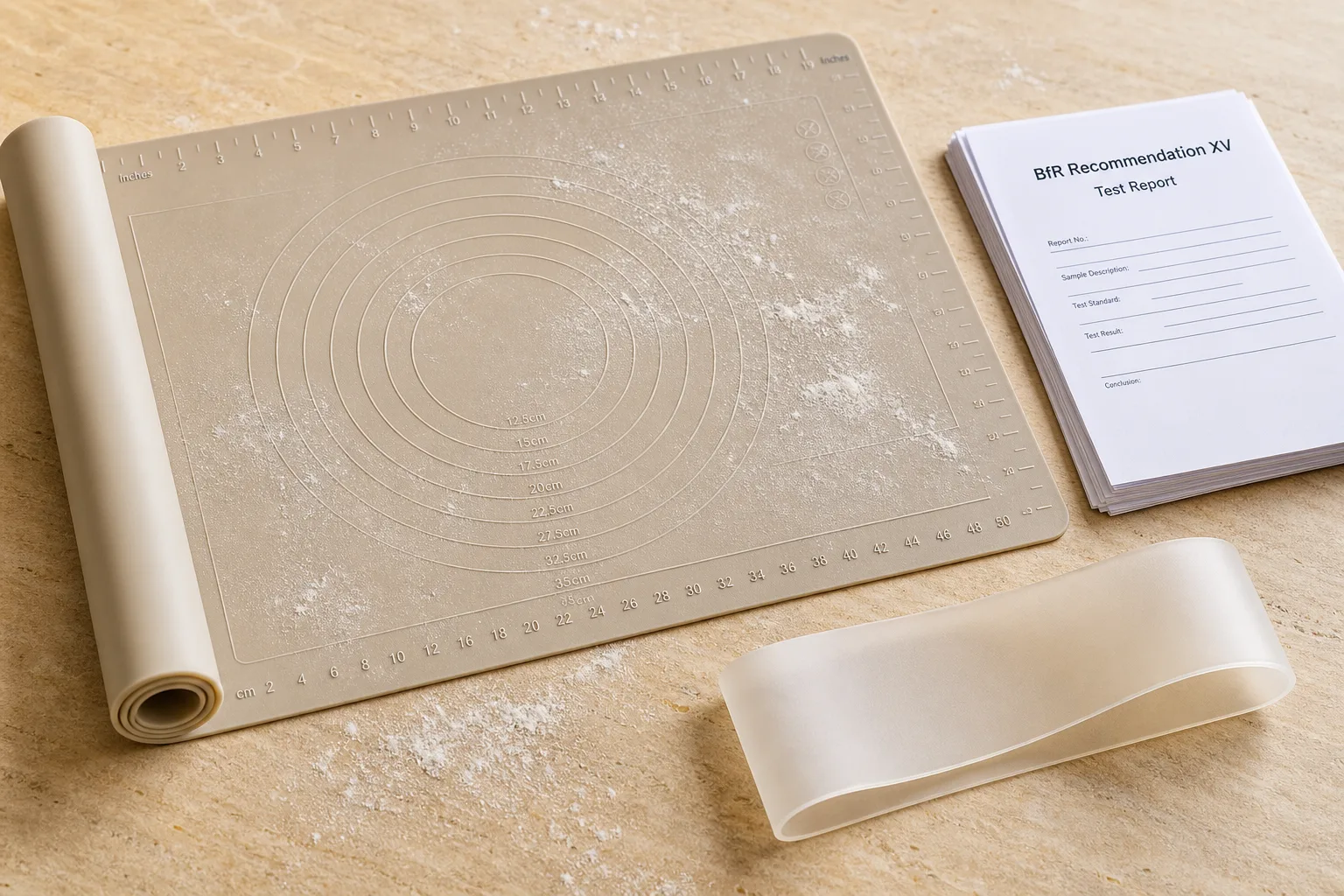
The retail-tier compliance stack is five layers deep: FDA 21 CFR 177.2600[^fda-177-2600] for US food-contact, LFGB §30/§31[^bfr-lfgb-xv] grounded in BfR Recommendation XV for EU food-contact, California Proposition 65 for US state-level heavy metals, ISO 9001[^iso-9001] as the factory QMS baseline, and per-batch third-party test reports from an accredited lab (SGS, Intertek, TÜV, Bureau Veritas) referencing the master-batch lot number. For EU-launched programs add an EC 1935/2004[^ec-1935-2004] Declaration of Compliance.
Line-by-line on why each layer matters:
- FDA 21 CFR 177.2600 — Governs rubber articles intended for repeated use in contact with food, including migration limits for total extractables in water, n-hexane, and 8% ethanol. This is the US federal food-contact bar every silicone pastry mat must clear.
- LFGB §30/§31 — German food-contact framework grounded in BfR Recommendation XV for silicones. Tests for organic volatile content on the finished part after post-cure. This is the EU premium bar; peroxide-cured mats need a disciplined 4-6 hour post-cure at 180-200°C to clear it.
- California Proposition 65 — US state-level heavy-metal panel: lead, cadmium, mercury, hexavalent chromium, phthalates. Non-negotiable for any SKU sold into California, which effectively means any national US retail launch.
- ISO 9001:2015 — The factory-level QMS standard. This is what makes the batch traceability, master-batch lot logs, and 36-month retention of test reports actually enforceable. Ask for the ISO 9001 certificate scope and confirm the audit body is IAF-accredited.
- Per-batch third-party test reports — This is the single most-common gap on incoming supplier packages. A legacy certificate from 18 months ago is not per-batch documentation. Every production batch should generate a fresh migration test referencing the master-batch lot number, retained for retail audit.
- EC 1935/2004 Declaration of Compliance — The framework declaration for EU food-contact materials. Table-stakes for any EU-launched SKU alongside the LFGB test report.
- Optional: NSF/ANSI 511 for commercial-kitchen-adjacent positioning, CPSIA2 for US children’s-baking adjacencies, and USP <88>3 for medical-adjacent positioning.
The gap between “food-safe” as a marketing claim and “audit-ready for Tier 2 retail” is the per-batch documentation discipline. Full documentation comparison across regulatory scopes is in the FDA vs LFGB decoder.
Platinum-cured or peroxide-cured silicone — which cure system for a pastry mat?
Platinum-cured LSR is the premium default for EU-launched, PFAS-free-positioned, or medical-adjacent programs — inherently PFAS-free, cleaner extractables profile, USP <88> compatible. Post-cured peroxide-cured HCR is genuinely fine for Tier 2 retail accessory programs at $12-25 shelf price if the factory runs a disciplined 4-6 hour post-cure at 180-200°C per LFGB §30/§31 requirements. The premium is 15-25% per unit; the failure mode is factories skipping post-cure to save oven time.
For a pastry mat specifically, three practical implications:
- Peroxide-cured with disciplined post-cure is the most-common working choice at Tier 2 retail. The mat is a flat compression-molded part with no thin-wall geometry, oven cycle is straightforward, and the material cost delta compounds meaningfully at 5,000+ unit runs.
- Platinum-cured LSR is the right default when the RFQ specifies “PFAS-free” as a marketing claim, when the launch retailer is EU premium (Whole Foods orbit, Sprouts, Erewhon caliber in US or their European equivalents), or when the SKU family extends to infant-feeding or baking accessories for children.
- The decision is positioning-driven, not safety-driven. Both materials, correctly manufactured and post-cured, clear FDA + LFGB + Prop 65 cleanly. The regulatory delta on paper is documentation depth. Full decision matrix on the platinum vs peroxide OEM guide; the regulatory driver behind PFAS-free positioning is the ECHA universal restriction proposal4.
Post-cure verification questions to ask on the RFQ: (a) standard post-cure cycle temperature and time, (b) can you provide the post-cure log for a recent production batch, (c) do your per-batch LFGB reports show quantitative extractables values or just pass/fail. Correct answers: 180-200°C for 4-6 hours; yes on request from 36-month retention; quantitative values in mg/dm².
Compression molding vs LSR — which process for a pastry mat?
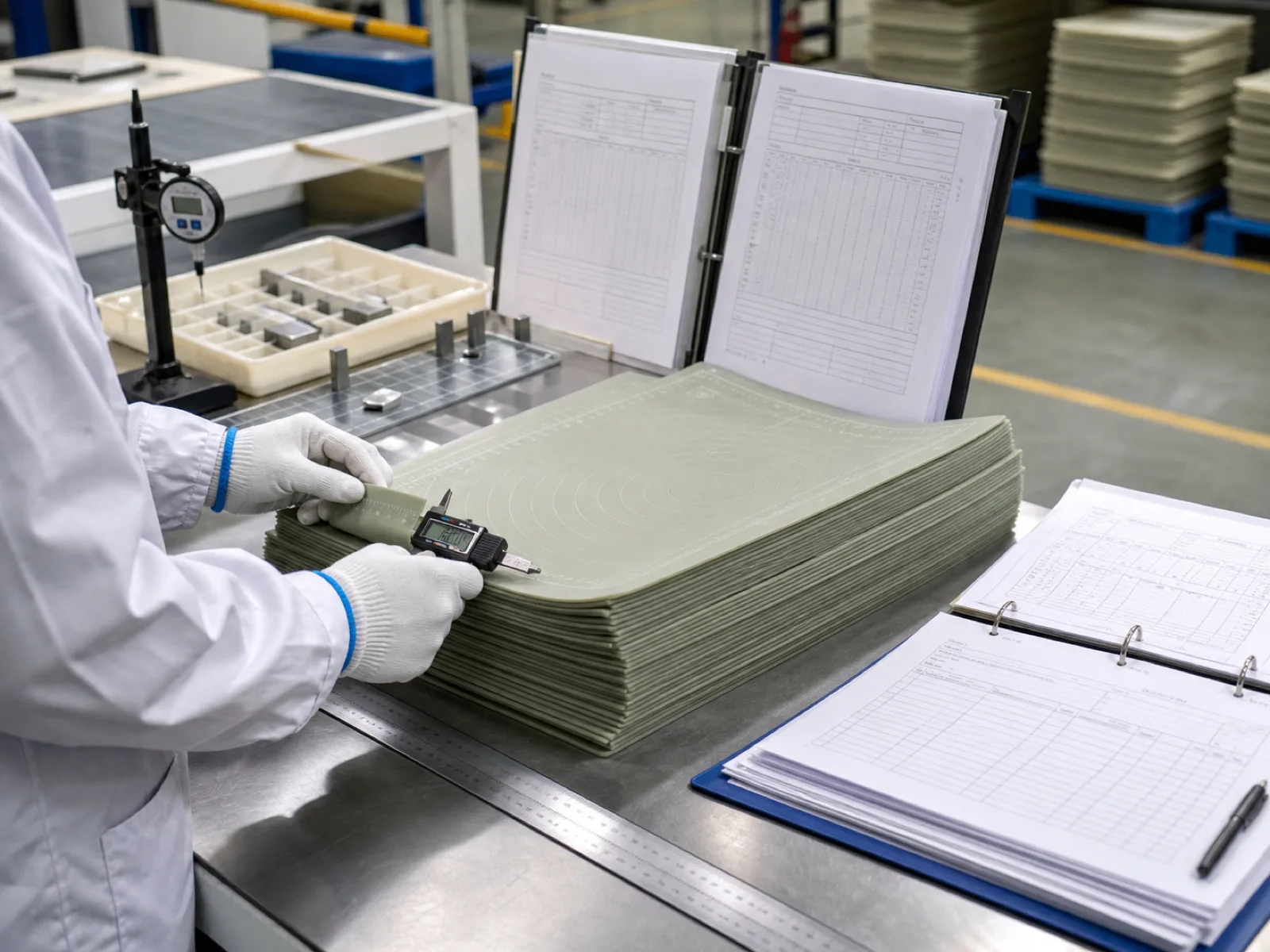
Compression molding is the correct process for silicone pastry mats. Flat 1.2-2.0 mm section, debossed measurement grid, low draft angle, no thin-wall geometry — every process characteristic maps to compression molding's strengths. Liquid silicone rubber (LSR) injection molding is faster per cycle but the equipment amortization only makes sense on programs above 100,000 annual units with tight-tolerance thin-wall features that compression molding cannot hold.
Trade-off table:
| Dimension | Compression Molding (HCR gum) | LSR Injection Molding |
|---|---|---|
| Best for | Flat sections, debossed features, moderate volume | Complex 3D geometry, thin walls, high volume |
| Cure cycle | 8-14 seconds per shot on pastry mat gauge | 20-45 seconds per shot |
| Tooling cost | $2,800-$6,500 for pastry mat single/two-cavity | $12,000-$35,000 for multi-cavity LSR tool |
| Post-cure required | Yes (peroxide) / optional (platinum) | Optional |
| Volume sweet spot | 500-50,000 annual units | 100,000+ annual units |
| Pastry mat fit | Direct match — the industry default | Overkill unless SKU family extends to 3D shapes |
For pastry mats the compression molding answer is not a compromise — it is genuinely the right process. LSR gets pitched to procurement teams as “premium” but on a flat mat the throughput advantage does not recover the tooling delta below 100,000 units per year.
What Shore A hardness and thickness should you spec for a silicone pastry mat?
Shore A 55-65 is the working hardness envelope for pastry mats, measured per ASTM D2240[^astm-d2240]. Hard enough to roll dough against without permanent deformation, soft enough for non-slip grip on a countertop. Thickness 1.2-2.0 mm balances rolling stiffness against packaging cost and shelf presentation. Programs pushing below Shore 50 give up rolling performance; programs above 70 lose non-slip grip and start feeling plasticky at retail unboxing.
Practical spec recommendations by SKU archetype:
- Standard 400 × 600 mm pastry mat, retail baking accessory — Shore A 60 ± 3, thickness 1.5 mm, debossed grid at 0.4 mm depth. The mainstream spec across Tier 2 retail.
- Premium 500 × 700 mm mat with heavy debossed feature set — Shore A 55 ± 3, thickness 2.0 mm, debossed grid and brand logo at 0.5 mm depth. Feels more substantial in unboxing, packs at 20-25% higher cost per unit.
- Cost-led 380 × 580 mm mat, mass retail — Shore A 65 ± 3, thickness 1.2 mm, debossed grid at 0.3 mm depth. Hits the $10-15 shelf tier at 5,000+ unit runs.
Shore A hardness is measured on the finished, post-cured part per ASTM D2240 — not on the raw silicone gum. Ask suppliers to state the measurement method explicitly, because vendor-defined internal scales are common at the commodity tier and do not compare across factories.
What do debossed measurement grids and OEM logos cost — and how long is the tooling lead time?
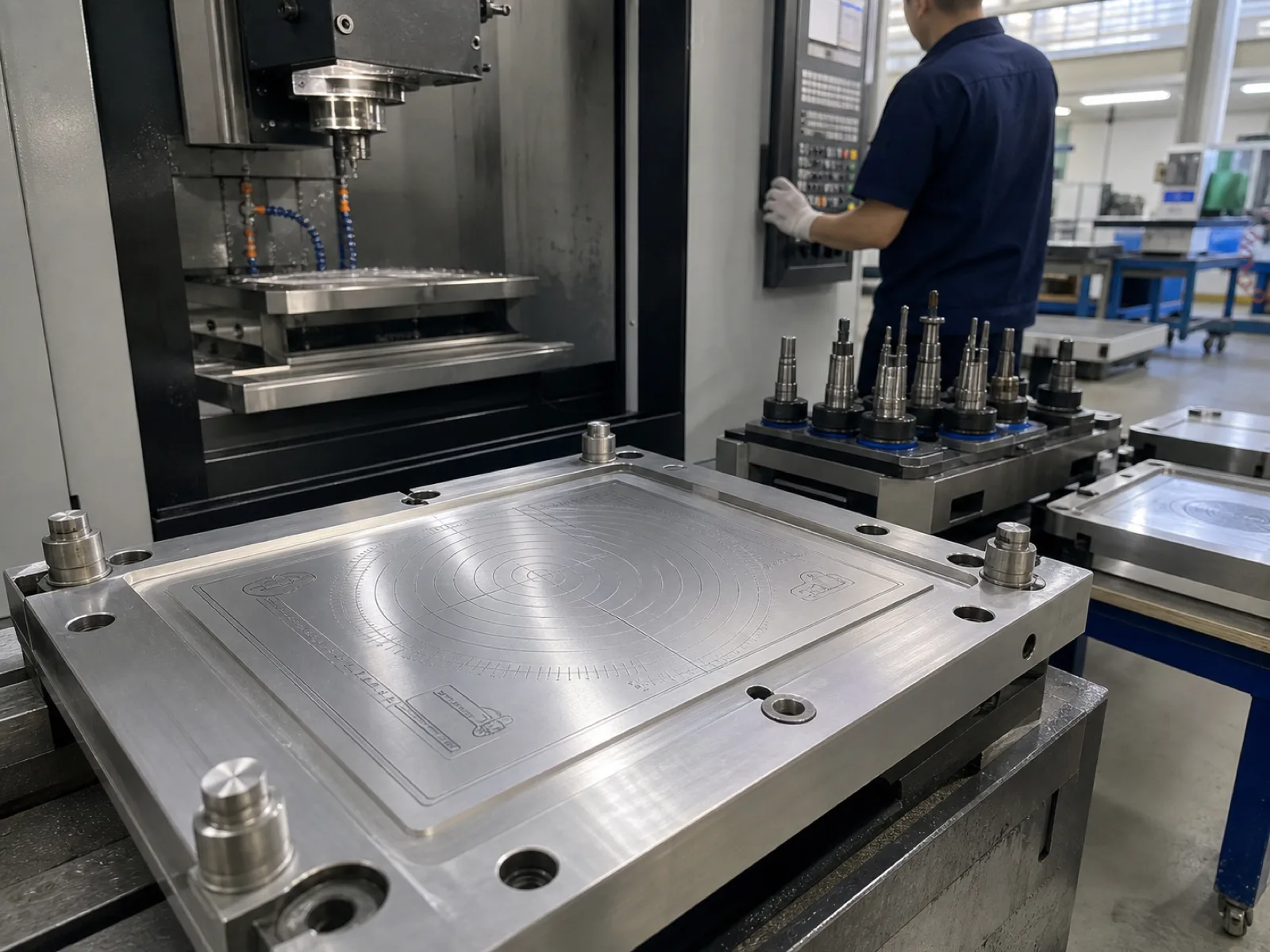
Debossed measurement grid and OEM logo are both cut into the same compression tool at tool-build time. Metric-only, imperial-only, and dual-unit grid patterns are standard; brand marks up to 60 × 20 mm at 0.3-0.6 mm depth are within the standard debossing envelope. Tool-build lead time is 18-25 days for a standard single or two-cavity P20 tool, followed by 7-14 days for first-article sample and revision. The tooling cost sits inside the $2,800-$6,500 range depending on cavity count and grid complexity.
Three practical points buyers miss on the tooling stage:
- Grid pattern changes at v2 are cheap if the grid is a separate insert. Ask the factory to build the debossed grid as a swappable insert on the compression tool. Metric-to-imperial conversion, adding new gridline markings, or updating the brand logo can then happen at $600-$1,200 per insert swap instead of full tool re-cut.
- First-article revision loop is not optional. Skip it and you ship 500 units with a typo in the debossed brand mark. Budget 7-14 days for the FA sample, feedback loop, and tool touch-up. Suppliers who quote 30-day total lead time have skipped this loop.
- Tool ownership is negotiable — capture it in writing. Standard OEM agreement gives the buyer 100% tool ownership after full amortization, exclusive-use during the program, and either return-shipping or destruction of the tool at program end. Suppliers who resist this clause are planning to run “your” tool as a shared platform on adjacent accounts.
For the full envelope of custom marking techniques including silk-screen and laser-etched post-mold decoration, see the customize silicone logo — deboss, print, laser guide; for the private-label program structure, private-label silicone kitchen products.
What does the OEM sourcing workflow look like — spec to sample to tooling to PPAP?
The mainstream sourcing workflow runs six stages over 60-90 days: (1) RFQ with locked spec sheet, (2) quotation against MOQ 500/1k/5k tiers, (3) tooling drawing sign-off and PO for tool, (4) tool cutting and first-article sample, (5) FA revision loop and pilot production, (6) full production with per-batch test reports and PPAP-style documentation package. Programs that compress this to 45 days skip either the FA revision loop or the disciplined post-cure — both compromises show up in retail-audit findings.
Stage-by-stage:
- Locked spec sheet as RFQ input — Cure chemistry, Shore A, thickness, dimensions, debossed grid pattern, logo artwork (vector), packaging spec. Missing any of these means the quote is directional rather than firm.
- Quotation at MOQ 500 / 1,000 / 5,000 — Tooling cost broken out from unit cost, lead time from PO to FOB, test-report cost inclusion. Reject quotes bundling tool and unit costs.
- Tool drawing sign-off + tooling PO — Buyer approves 2D and 3D tool drawing before cutting begins. Any grid or logo change after this stage costs full tool re-cut money.
- Tool cutting (18-25 days) + first-article sample — Factory ships 3-10 FA samples for buyer approval and third-party test-lab submission.
- FA revision + pilot production (7-14 days) — Grid tweaks, hardness adjustment, cure-cycle tune. Pilot batch of 100-500 units to validate scale-up.
- Full production + PPAP package — Mass production run, per-batch test reports, packaging validation, export documentation. PPAP-style deliverables: control plan, PFMEA reference, dimensional inspection report, and material certifications on each shipment.
Serious OEM programs run all six stages. Programs skipping stages 3 or 5 are the ones that quote 45-day lead time and disappoint on FA revision quality. Full lead-time envelope on MOQ and lead time in silicone OEM.
How do you validate a factory is retail-tier ready (Home Depot, Wayfair, Tesco, Carrefour caliber)?
Retail-tier readiness is a stack of three audits on top of the product-level FDA/LFGB certifications: BSCI or Sedex SMETA social compliance audit (with corrective-action-plan closure evidence, not just the certificate number), ISO 9001[^iso-9001] QMS with IAF-accredited audit body, and per-batch third-party test reports per production lot referencing master-batch lot numbers.[^sourcing-checklist] Factories missing any of these get de-listed at the second or third quarterly reorder, not the first — because retail compliance teams escalate before scale-up, not before pilot.
Three practical verification steps procurement teams should run:
- Ask for the BSCI or Sedex audit report cover page and the CAP closure evidence. Certificate numbers are cheap. Cover page shows the audit body, audit date, non-conformances raised, and closure status. Factories that resist this step have unclosed non-conformances they don’t want you to see.
- Verify ISO 9001 through the audit body directly. IAF-accredited audit bodies publish current certificate status online. If the certificate expired or was withdrawn, the factory keeps using the visual anyway. A 2-minute check on the audit body’s site catches this.
- Request per-batch test reports from the last two production runs on any current program — not the marketing-package legacy certificate. If the factory can produce two recent per-batch reports referencing distinct master-batch lot numbers, incoming inspection discipline is real. If they produce the same certificate twice, they are running a single legacy report across all production.
Incoming and outgoing inspection sampling is run against ISO 2859-15 AQL plans. Retail buyers should ask what AQL level the factory inspects at for critical, major, and minor defect classes. Standard for Tier 2 retail housewares is AQL 0.65 / 1.5 / 4.0 or tighter; a factory quoting “we do 100% visual inspection” without stating an AQL level is not running a statistical inspection plan.
Full retail-tier vendor qualification worklist on the sourcing silicone factory checklist.
What Wetop OEMs on silicone pastry mats
Wetop runs silicone pastry mat OEM programs on a founder-led, ISO 9001 certified compression-molding floor in Dongguan. Default program: MOQ 500 per SKU, 45-70 day lead time from spec-frozen to FOB, per-batch FDA + LFGB + Prop 65 documentation from SGS or Intertek, debossed measurement grid and logo on a single or two-cavity P20 tool, both platinum-cured and post-cured peroxide-cured programs available on the same shop floor. Retail-tier readiness on Tier 2 housewares chain-caliber programs (Home Depot / Wayfair / BBB / Tesco / Carrefour caliber) with BSCI audit closure evidence and per-batch AQL-sampled inspection to ISO 2859-1.
Program archetype we run:
- Standard mid-tier program — 400 × 600 mm pastry mat, Shore A 60, 1.5 mm thick, debossed dual-unit grid + brand logo, post-cured peroxide-cured HCR, MOQ 500 at v1 with pricing committed at MOQ 1,000 and 5,000 tiers. Per-batch FDA 21 CFR 177.2600 + LFGB §30/§31 + Prop 65 test reports included.
- Premium PFAS-free program — 500 × 700 mm mat, Shore A 55, 2.0 mm thick, platinum-cured LSR, per-batch PFAS non-detect report at ppb-level detection, EU EC 1935/2004 Declaration of Compliance, positioned for EU premium and US Whole Foods orbit retailers.
- Cost-led mass-retail program — 380 × 580 mm mat, Shore A 65, 1.2 mm thick, post-cured peroxide-cured HCR, MOQ 5,000+ pricing tier from first PO, packaging-optimized for pallet-load economics.
We do not extend program scope beyond silicone drying racks, drying mats, sink grids, and adjacent flat compression-molded silicone kitchen accessories including pastry mats. That focus is a strategic choice — see our capabilities page for the full envelope.
Sourcing a silicone pastry mat OEM program? Email inquiry@wetopsilicone.com with your spec sheet (cure chemistry, Shore A, thickness, dimensions, grid pattern, logo artwork, target retail tier). We return with a cure recommendation, per-batch documentation packet outline, MOQ 500 / 1,000 / 5,000 pricing brackets, and a P20 tooling quote broken out from unit cost. For confidential program discussions, our mutual NDA template is on file. Anonymized OEM program archetypes across silicone drying mats, sink grids, and adjacent kitchen accessories on case studies. Full pricing structure decoder for line-item logic across the quote.
Ready to source? Every quote is built against your specification — send a CAD file, a written brief, or reference samples, and an engineer replies within one business day. Request a quote →
Footnotes
-
NSF International. NSF/ANSI 51 — Food Equipment Materials. https://www.ecfr.gov/current/title-21/chapter-I/subchapter-B/part-177 — the material standard for commercial food-equipment applications. ↩
-
US Consumer Product Safety Commission. Consumer Product Safety Improvement Act (CPSIA). https://www.ecfr.gov/current/title-16 — US consumer product safety framework covering lead and phthalate limits. ↩
-
United States Pharmacopeia. USP <88> — Biological Reactivity Tests, In Vivo. https://www.usp.org/harmonization-standards/pdg/excipients/plastic-materials — defines USP Class VI biological reactivity classification for medical-adjacent silicone programs. ↩
-
European Chemicals Agency. PFAS Universal Restriction Proposal. https://eur-lex.europa.eu/legal-content/EN/TXT/?uri=CELEX%3A32006R1907 — the regulatory action driving PFAS-free spec adoption in EU premium retail and downstream US markets. ↩
-
International Organization for Standardization. ISO 2859-1:1999 — Sampling procedures for inspection by attributes. https://www.iso.org/standard/1141.html — the AQL sampling standard behind Wetop’s incoming and outgoing inspection plans. ↩
FAQ
-
How do we compare quotes across silicone pastry mat suppliers on an apples-to-apples basis?
Force the quote onto a common spec sheet with eight fields: (1) cure chemistry (platinum or peroxide), (2) Shore A hardness (55-65 typical), (3) thickness in mm (1.2-2.0), (4) finished dimensions (mm), (5) tooling cost broken out from unit cost, (6) MOQ pricing at 500 / 1,000 / 5,000, (7) lead time from PO to FOB, (8) per-batch third-party test report included (yes / no / cost). Quotes that dodge the tooling breakout or refuse to price at multiple MOQ tiers are the ones that surprise you at second PO time. See the [silicone OEM pricing structure guide](/guide/silicone-oem-pricing-structure/) for the line-item logic.
-
What third-party test reports should we demand from a silicone pastry mat supplier?
Minimum documentation package per production batch, from an accredited lab (SGS, Intertek, TÜV Rheinland, or Bureau Veritas): FDA 21 CFR 177.2600 migration testing, LFGB §30/§31 organic volatile extraction, California Proposition 65 heavy-metal panel, and a PFAS non-detect analysis at ppb-level detection. For EU-launched programs add EC 1935/2004 declaration of compliance. Reports must reference the master-batch lot number and be dated within the production window, not a legacy certificate from two years ago. Suppliers who cannot produce per-batch reports are running a single legacy certificate across all lots — the retail audit will catch this.
-
How long is lead time on a custom silicone pastry mat with debossed measurement grid and logo?
45-70 days from spec-frozen to FOB is the realistic range at MOQ 500-1,000. Break-down: tooling design and cutting 18-25 days (P20 or NAK80 hardened steel, single or two-cavity), first-article sample and revision 7-14 days, mass production run 12-20 days depending on quantity, post-cure and QC 3-5 days, packing and export documentation 3-4 days. Programs that need faster than 45 days usually skip either the first-article revision loop or the disciplined post-cure — both compromises show up downstream. See [MOQ and lead time explained](/guide/moq-and-lead-time-silicone-oem/).
-
How much does tooling cost for a silicone pastry mat program?
A single-cavity P20 hardened-steel compression mold for a standard 400 × 600 mm pastry mat with debossed grid and logo runs $2,800-4,200 depending on grid complexity. Two-cavity tool runs $5,000-6,500 — the second cavity roughly doubles throughput per press cycle and pays back inside a 3,000-unit run. Family molds (multiple mat sizes in one tool) run higher but only make sense if the SKU family is committed for multi-year production. Tooling amortization logic: the buyer typically pays 100% of tooling upfront, and the factory holds the tool for exclusive use on the account under the OEM agreement.
-
Can you private-label our brand with debossed logo and custom measurement grid on the same tool?
Yes — that is the standard OEM program at MOQ 500. Debossed logo and debossed measurement grid are both cut into the same compression tool. Metric-only, imperial-only, and dual-unit grids are all standard tool patterns; brand marks up to 60 × 20 mm at 0.3-0.6 mm depth are within the standard debossing envelope. Silk-screen or laser-etched marking on cured silicone is also available for post-mold decoration. Full envelope on [customize silicone logo — deboss, print, laser](/guide/customize-silicone-logo-deboss-print-laser/) and [private-label silicone kitchen products](/guide/private-label-silicone-kitchen-products/).
-
How does retail-tier readiness (Home Depot, Wayfair, Tesco, Carrefour caliber) affect factory selection?
Tier 2 retail chains audit their private-label and vendor supply chains against BSCI, Sedex SMETA, or an equivalent social compliance framework, on top of the product-level FDA / LFGB / Prop 65 requirements. Factories without an active BSCI or Sedex audit typically get de-listed at the second or third quarterly reorder even if the first PO ships cleanly, because the retailer's compliance team escalates before scale-up. Ask the factory for the audit report cover page (not just the certificate number) and the corrective-action-plan closure evidence. See the [sourcing silicone factory checklist](/guide/sourcing-silicone-factory-checklist/) for the full vendor-qualification worklist.
-
What are the common defect modes on a silicone pastry mat and how do you spec against them at PPAP?
Five defect modes hit pastry mat programs at Tier 2 retail scale, and each has a specific control-plan countermeasure to lock in at PPAP-style production sign-off: 1. **Debossed grid fill-in / blurred numerals** — under-cure or under-pressure on the compression press causes the 0.3-0.5 mm deep gridline to round out and numerals to lose legibility. Countermeasure: spec debossing depth at 0.4 mm minimum on numerals, require cavity venting on the tool drawing, and inspect grid legibility at AQL 1.5 (major) per ISO 2859-1[^iso-2859-1]. 2. **First-heat odor and bloom on unboxing** — factories skipping the 4-6 hour post-cure at 180-200°C leave residual peroxide by-products in the silicone. The mat off-gases on first use and often shows a hazy white bloom after 30 days on shelf. Countermeasure: require the post-cure log tied to the master-batch lot number and quantitative LFGB §30/§31 organic volatile extraction values in mg/dm² (not just pass/fail) per BfR Recommendation XV[^bfr-lfgb-xv]. 3. **Edge tear during dough-scraping** — Shore A specced too soft (below 50) or thickness below 1.2 mm causes edge tear when the bench scraper hits the mat rim. Countermeasure: hold Shore A 55-65 per ASTM D2240[^astm-d2240] on the finished post-cured part; tensile strength minimum 8 MPa on the material data sheet. 4. **Non-slip failure on wet countertop** — high-durometer (Shore A 70+) mats slide on wet quartz and marble. Countermeasure: cap Shore A at 65 for retail SKUs and validate slip resistance on a wet slate coupon at first-article stage. 5. **Dishwasher fade of debossed brand mark** — poor cure and inadequate post-cure cause the brand logo to fade after 200 dishwasher cycles. Countermeasure: mandate 300-cycle dishwasher validation on the FA sample before production PO release.
-
How does a silicone pastry mat fit into a sink brand's or premium housewares brand's accessory family — and does it belong in the OEM roadmap?
For sink brands in the Kraus / Ruvati / VIGO / Kohler / Blanco / Elkay caliber, a silicone pastry mat is an accessory-family extension play, not a core SKU. It fits the roadmap when the brand already runs a silicone-accessory shelf (drying mats, sink grids, roll-up racks) and wants to broaden basket size at the same retailer without opening a new vendor. For premium housewares brands in the OXO / Joseph Joseph / DI ORO caliber the calculus is different — pastry mats are a native category and the program sits alongside baking mats, oven mats, and trivets in a coordinated debossed-grid family. Three practical fit checks before adding pastry mats to an existing OEM roadmap: 1. **Debossed-grid design language must be consistent across the SKU family.** If the brand's existing baking mat uses metric-only gridlines with 5 mm spacing and a 60 × 20 mm debossed logo at 0.5 mm depth, the pastry mat needs to match. Mismatched grid patterns across SKUs read as sourced-from-different-factories at retail unboxing and damage the brand's own consistency signal. 2. **Shelf-tier positioning must match the parent SKU family.** A $12-15 pastry mat next to a $28 baking mat in the same brand family confuses the buyer. Pick either the cost-led (Shore A 65, 1.2 mm, MOQ 5,000+) or premium (Shore A 55, 2.0 mm, platinum-cured LSR) archetype and commit. 3. **Retail-audit stack transfers cleanly.** A brand already running Sedex SMETA or BSCI on their baking-mat vendor can add pastry mats to the same vendor's audit scope without re-qualification — provided the same factory shop-floor makes the new SKU. Adding pastry mats via a separate factory means running a fresh social-compliance audit before the retailer will accept the SKU at scale. See the [sourcing silicone factory checklist](/guide/sourcing-silicone-factory-checklist/) for the full vendor-qualification worklist.
References
Authoritative sources cited in this guide
- US Food and Drug Administration (Code of Federal Regulations). 21 CFR 177.2600 — Rubber articles intended for repeated use. https://www.ecfr.gov/current/title-21/chapter-I/subchapter-B/part-177/subpart-C/section-177.2600 — The primary US regulation governing food-contact silicone intended for repeated use. Every Wetop silicone pastry mat batch is tested against this section.
- German Federal Institute for Risk Assessment (BfR). BfR Recommendation XV — Silicones. https://www.bfr.bund.de/en/bfr_recommendations_on_food_contact_materials-7498.html — The technical standard behind LFGB §30/§31 for food-contact silicone. Defines the organic volatile extraction test mandatory post-cure clears.
- International Organization for Standardization. ISO 9001:2015 — Quality Management Systems — Requirements. https://www.iso.org/standard/62085.html — The QMS standard Wetop is certified against. Governs batch traceability, cure documentation, and per-lot retention records referenced throughout this guide.
- International Organization for Standardization. ISO 2859-1:1999 — Sampling procedures for inspection by attributes. https://www.iso.org/standard/1141.html — The AQL sampling standard behind Wetop's incoming and outgoing inspection plans. Retail buyers should ask suppliers which AQL levels they inspect at.
- ASTM International. ASTM D2240-15 — Standard Test Method for Rubber Property—Durometer Hardness. https://www.astm.org/d2240-15r21.html — The measurement standard for Shore A hardness. Every hardness quoted on a Wetop pastry mat spec sheet is per this method.
- United States Pharmacopeia. USP <88> — Biological Reactivity Tests, In Vivo. https://www.usp.org/harmonization-standards/pdg/excipients/plastic-materials — Defines USP Class VI classification. Wetop platinum-cure LSR meets Class VI as a standard baseline for medical-adjacent programs.
- European Chemicals Agency (ECHA). PFAS Universal Restriction Proposal (2023). https://eur-lex.europa.eu/legal-content/EN/TXT/?uri=CELEX%3A32006R1907 — The regulatory action driving PFAS-free spec adoption in EU premium retail and downstream in US markets.
- European Parliament and Council. Regulation (EC) No 1935/2004 on materials and articles intended to come into contact with food. https://eur-lex.europa.eu/legal-content/EN/TXT/?uri=CELEX%3A02004R1935-20090807 — The framework regulation for EU food-contact materials. A Declaration of Compliance against this regulation is table-stakes for EU-launched pastry mat programs.
- US Consumer Product Safety Commission. Consumer Product Safety Improvement Act (CPSIA). https://www.ecfr.gov/current/title-16 — US consumer product safety framework covering lead and phthalate limits. Applies to any pastry mat SKU sold in the US alongside children's baking accessories.
- NSF International. NSF/ANSI 51 — Food Equipment Materials. https://www.ecfr.gov/current/title-21/chapter-I/subchapter-B/part-177 — The material standard for commercial food-equipment applications. Optional but valued for commercial-kitchen-adjacent SKU positioning.
Start a custom program
Send a brief. Get an engineer’s reply in one business day.
Every Wetop program is tooled from a customer’s specification. Send a CAD file (STEP · IGES · DWG) or a written brief and we’ll reply with a mold cost estimate, price brackets at MOQ 500 / 1,000 / 5,000, and any engineering questions.