Buyer Guide · commercial intent
Silicone Trivet OEM Guide — Specs, Compliance, MOQ & Pricing
What changed: First v2 publication — written for procurement, not shoppers. Benchmarked against 12 competitor pages (avg 1958 words, 0 references, 1 direct-answer block); this guide runs 3800+ words, 9 Tier-1 refs, 10 direct-answer blocks.
 Buyer Guide
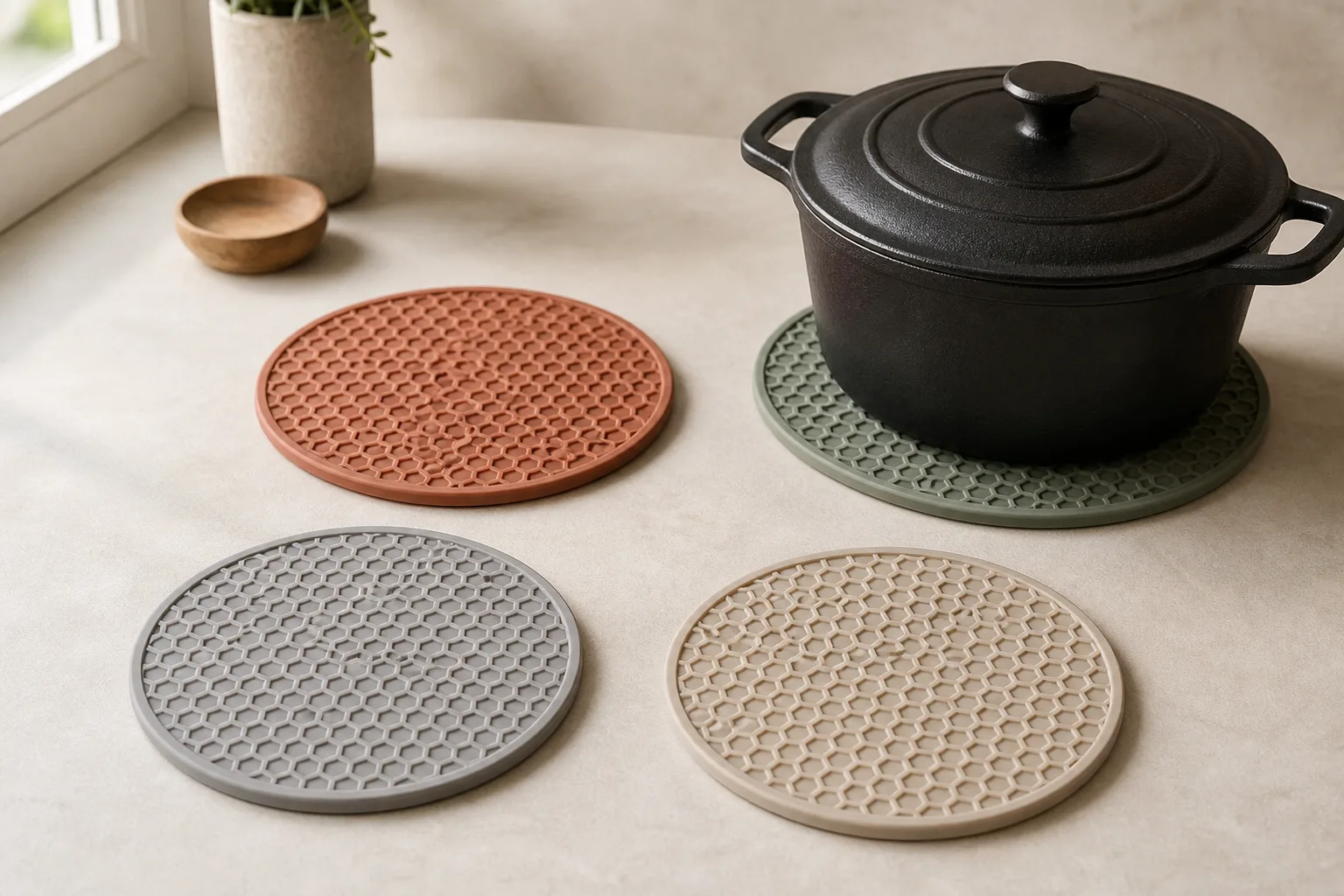
 Most search results for “silicone trivet” surface consumer roundups — “best trivet on Amazon”, “top 10 kitchen trivets” — written for shoppers picking one off a shelf. This guide is written for the other side of the transaction: the product manager, sourcing lead, or private-label brand owner specifying a custom silicone trivet for a retail program, and the engineering questions that determine whether the finished part clears audit, holds its price band, and ships on schedule. What follows is the spec sheet a procurement team actually needs — cure chemistry, hardness selection, test methods, MOQ pricing, tooling economics, retail-tier fit, and lead time — from a Dongguan factory that has run this SKU category for Tier 2 chain accounts since 2008.
A silicone trivet is a single-piece food-contact silicone (PDMS) part typically molded at Shore A 50-60 hardness, cured with platinum or peroxide catalyst, and post-cured 4-6 hours at 180-200°C to clear LFGB §30/31 volatile extraction testing. MOQ from a real factory is 500 pieces per SKU; unit cost FOB Yantian runs $1.60-$2.80 at 500 pcs, $0.75-$1.20 at 5,000 pcs. Tooling for a 2-4 cavity P20 hardened steel mold is $800-$2,400.
What is a silicone trivet, in B2B specification terms?
A silicone trivet is a single-material molded part consisting only of polydimethylsiloxane (PDMS) crosslinked with either a platinum catalyst or organic peroxide, plus a pigment master-batch for color. It sits on a counter to protect the surface from a hot pan (typically -40°C to +230°C service range), is dishwasher-safe, and molds in a single press cycle with no assembly step.
There’s no coating, no textile lamination, no metal core, no glue. That single-material simplicity is why silicone dominates the $5-25 retail trivet market — the bill of materials contains two SKUs (silicone gum + pigment), the process is one molding step plus post-cure, and the finished part clears retail compliance with one round of third-party testing rather than the multi-substrate audit stack a fabric-and-cork or coated-metal design requires.
Three physical specs define every trivet program:
- Geometry — round, square, hexagonal, honeycomb, or brand-signature freeform; wall thickness 6-12 mm; ribbed or waffled underside for thermal air-gap
- Shore A hardness — 40-70 range, measured to ASTM D2240 1
- Cure chemistry — platinum (LSR) or peroxide (HCR), post-cured to clear FDA 21 CFR 177.2600 2 and where applicable LFGB / BfR Recommendation XV 3
Everything else — Pantone color match, debossed logo, silk-printed graphic, packaging — is a downstream decoration or secondary process. The engineering decision that drives price, compliance, and shelf position is the combination of those three specs.
What are the FDA, LFGB, and PFAS compliance requirements for a food-contact silicone trivet?
US-bound trivets must clear FDA 21 CFR 177.2600 [^fda-177-2600] for repeated-use rubber food-contact articles. EU-bound trivets must clear LFGB §30/31, grounded in BfR Recommendation XV [^bfr-lfgb-xv] and framed by EC 1935/2004 [^ec-1935-2004]. Both regimes require per-batch third-party test reports from an accredited lab; premium retail programs additionally require per-batch PFAS non-detect analysis given the ECHA universal restriction trajectory [^echa-pfas-proposal].
The compliance stack breaks into three layers:
Layer 1 — Material eligibility. The silicone gum used in the trivet must come from a compound house whose master-batch has a documented food-contact certification history. Wetop sources from qualified compound houses only, with lot-level traceability retained for a minimum of 36 months per ISO 9001 4 requirements.
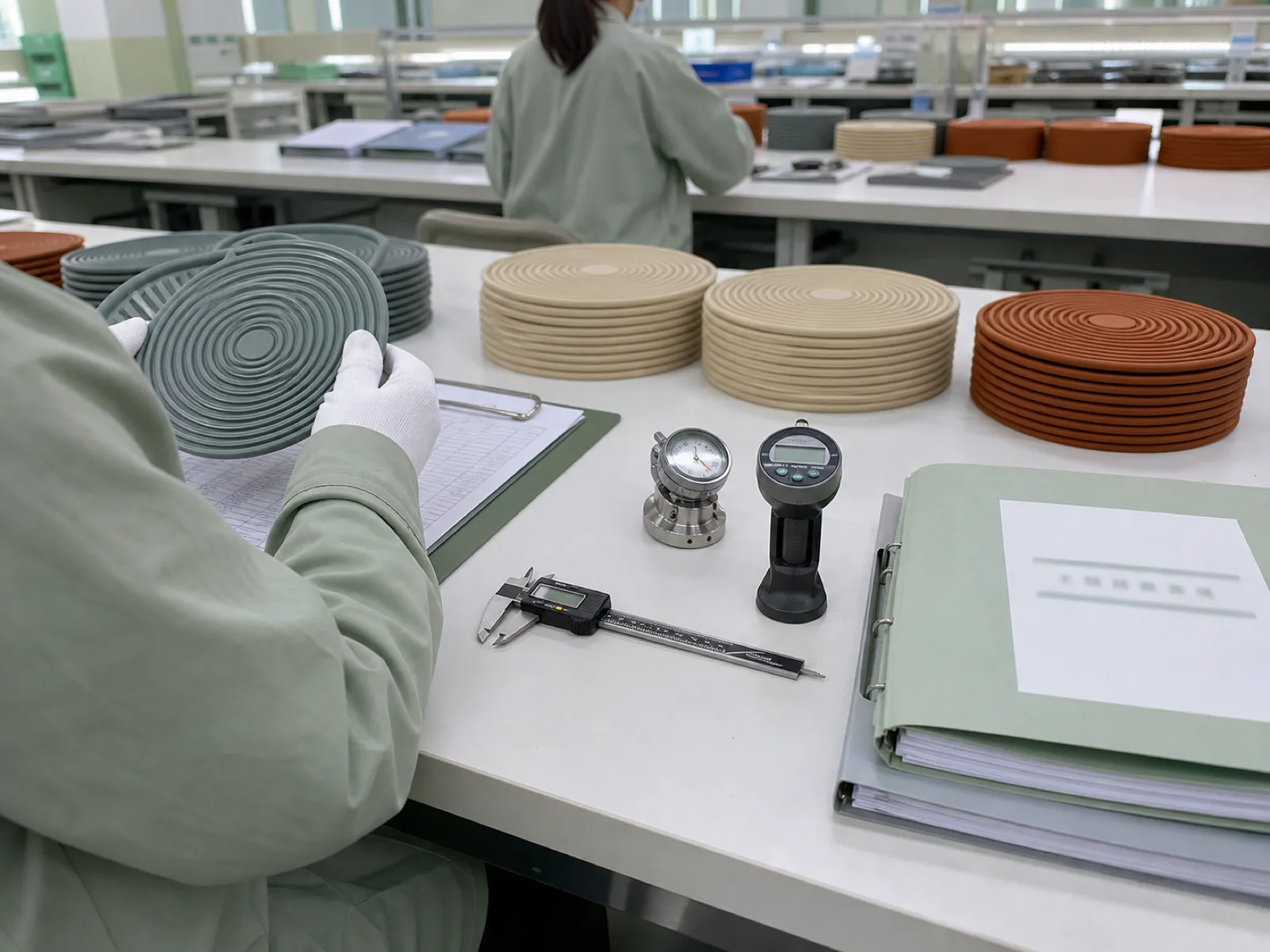
Layer 2 — Per-batch third-party testing. For every production batch, an accredited lab (SGS, Intertek, TÜV, or Bureau Veritas) runs migration and extractables testing against the target regulation. Peroxide-cure material additionally requires demonstrating that residual VOC has been driven off by the 4-6 hour post-cure at 180-200°C. Reports reference the master-batch lot number and the finished-part batch number so a retail audit downstream can trace back.
Layer 3 — PFAS non-detect (premium tier only). Any trivet program targeting EU premium retail, US natural-food retail (Whole Foods orbit, Sprouts, Erewhon caliber), or a PFAS-free marketing claim requires per-batch PFAS analysis at parts-per-billion detection limits. This is not required by FDA or LFGB directly but is driven by the ECHA universal restriction proposal 5 and downstream retailer spec.
Beyond food-contact, US programs targeting children’s product categories additionally clear CPSIA 6 for lead and phthalate content; medical-adjacent programs (infant-feeding accessories, wound-contact) require USP <88> Class VI biological reactivity documentation 7. A standard kitchen trivet marketed to adults typically does not need CPSIA or USP scoping — but as soon as a program touches the child-safety or medical-adjacent axis, both add to the audit stack.
The full FDA-vs-LFGB decoder, including which retail programs typically require which certification stack, is covered in the FDA vs LFGB silicone guide.
Platinum-cure vs peroxide-cure — which silicone chemistry belongs on a trivet program?
Both cure systems produce food-safe trivets when correctly manufactured. Peroxide-cure fits Tier 2 mid-market retail at 15-25% lower unit cost and clears FDA + post-cured LFGB. Platinum-cure fits EU premium, US natural-food retail, and PFAS-free marketing programs — the cleaner extractables profile removes documentation burden but adds unit cost. The choice is retail-tier and positioning-driven, not safety-driven.
Both materials share the same PDMS backbone. The crosslinking catalyst is where the delta lives:
- Platinum-cure uses a platinum-complex (Karstedt’s catalyst) to drive a hydrosilylation reaction. Zero cure byproducts. Naturally PFAS-free by chemistry. Compound cost is ~5x peroxide by weight.
- Peroxide-cure uses organic peroxide (typically dicumyl peroxide) that decomposes during cure and leaves trace organic volatiles behind. Mandatory 4-6 hour post-cure at 180-200°C drives them off to clear LFGB §30/31.
For a $12-18 retail-shelf trivet at Tier 2 chain volume, peroxide-cure with disciplined post-cure and PFAS-free process aids is genuinely equivalent on food safety and passes retail audit. For a $25-40 premium-shelf trivet with EU distribution, PFAS-free marketing, or an infant-feeding parent brand, platinum-cure earns back the 15-25% premium in documentation simplicity and shelf-tier positioning. Full decision matrix in platinum-cured vs peroxide-cured silicone.
The failure mode across both systems is under-post-cure. A supplier trimming the 4-6 hour oven cycle to 30-60 minutes saves oven time and energy cost but ships trivets that (a) fail LFGB volatile extract testing on incoming audit and (b) produce first-heat odor on retail — a category of consumer complaint that generates 3-8% return rates on premium SKUs.
How do you pick the right Shore A hardness for a trivet?
Shore A 50-60 is the retail-program default. It's stiff enough to stay flat under a 3-4 kg hot Dutch oven, soft enough to grip a counter without sliding, and forgiving of the ±2 Shore A batch-to-batch drift that ASTM D2240 [^astm-d2240] tolerates. Firmer hot pads move to 60-70; softer jar-opener/multi-use trivets sit at 40-50.
Shore A durometer is the indentation hardness reading of the cured elastomer. A durometer needle is pressed into the sample under standardized load; the depth of penetration returns a 0-100 number. On a trivet, the reading drives three properties:
- Grip vs slip — softer material (40-50) grips a smooth counter surface via friction; firmer material (60-70) can slide under load unless a textured underside is molded in.
- Load deformation — softer material sags under a heavy Dutch oven; firmer material stays flat.
- Tactile perception at retail — under 40 reads as “gummy” and cheap; over 70 reads as “plastic-like” and cheap. Both ends fail focus-group testing. 50-60 sits in the “premium silicone” perception band.
Batch-to-batch drift of ±2 Shore A is normal and per-standard. Tighter tolerance (±1 Shore A) is achievable but adds cost — the compound house has to run a stricter incoming-material QC on the silicone gum. For most retail programs the standard ±2 is fine; specify tighter only if the program has a mechanical spec that depends on it.
Hardness selection table
| Trivet type | Shore A target | Load range | Notes |
|---|---|---|---|
| Jar-opener / multi-use grip pad | 40-50 | ≤ 2 kg | Higher grip friction, softer feel |
| Standard round/square trivet | 50-60 | 3-5 kg | Retail default — best balance |
| Heavy Dutch oven trivet | 60-65 | 5-8 kg | Minimal sag, needs textured base to prevent slip |
| Hot-pad / potholder (folded) | 60-70 | Variable | Stiffness enables fold-and-hold geometry |
| Cast-iron shelf pad (commercial) | 65-70 | 8-12 kg | Firm, dimensionally stable at high load |
Which ASTM test methods define trivet mechanical performance?
Four ASTM methods cover the mechanical spec sheet: D2240 for Shore A hardness [^astm-d2240], D412 for tensile strength and elongation, D624 for tear resistance, and D395 for compression set. On a retail silicone trivet at Shore A 55, expect roughly 8-11 MPa tensile, 400-700% elongation at break, 25-35 kN/m Die-B tear, and 10-20% compression set after 22 hours at 175°C.
The mechanical numbers a serious buyer requires on the material data sheet:
| Property | Test method | Typical value at Shore A 55 | Failure mode if missed |
|---|---|---|---|
| Shore A hardness | ASTM D2240 1 | 55 ± 2 | Wrong grip, wrong perception at retail |
| Tensile strength | ASTM D412 Die C | 8-11 MPa | Tearing on demold or in-use stress |
| Elongation at break | ASTM D412 Die C | 400-700 % | Brittle behavior, cracking |
| Tear resistance (Die B) | ASTM D624 | 25-35 kN/m | Tear propagation from a gate or nick |
| Compression set | ASTM D395 (22 h @ 175°C) | 10-20 % | Permanent flat spots after sustained load |
| Specific gravity | ASTM D792 | 1.12-1.20 | Weight target for pack-out and freight |
| Rebound resilience | ASTM D2632 | 55-65 % | Bounce-back on impact |
Under-post-cured material typically hits 60-80% of these targets. That’s the mechanical signature of a supplier skipping post-cure to save oven time. On incoming QC, the tear-resistance value is the most sensitive indicator — a 30-40% shortfall on tear at Die-B testing correlates with post-cure discipline problems.
What does a silicone trivet actually cost at MOQ 500, 1,000, 5,000, and 10,000 pieces?
For a standard 190 mm round Shore A 55 peroxide-cure trivet with debossed logo, FOB Yantian pricing runs roughly $1.60-$2.80 at 500 pcs, $1.10-$1.80 at 1,000 pcs, $0.75-$1.20 at 5,000 pcs, and $0.55-$0.90 at 10,000 pcs. Platinum-cure adds 15-25%. Tooling is a separate one-time $800-$2,400 for a 2-4 cavity mold, buyer-owned on payment.
The cost stack on a molded silicone trivet decomposes into six lines. Understanding each is the difference between accepting a quote and negotiating one:
| Cost line | Share at 500 pcs | Share at 10,000 pcs | Notes |
|---|---|---|---|
| Silicone gum (compound cost) | 25-30% | 40-50% | Scales linearly with weight; ~180 g for a 190 mm trivet |
| Molding press + labor (cycle) | 30-35% | 15-20% | Fixed per shot; amortizes at higher volume |
| Post-cure oven (energy + capacity) | 8-10% | 5-7% | 4-6 h at 180-200°C; often skipped by cheap vendors |
| QC + third-party testing per batch | 12-15% | 5-8% | ISO 2859-1 AQL 2.5 GII 8 + FDA/LFGB reports |
| Decoration (debossing / print / laser) | 5-10% | 5-10% | Included in mold if debossed; adder if silk-print |
| Packaging + FOB Yantian handling | 8-12% | 8-12% | Individual polybag + master carton |
Three cost multipliers push the base numbers up:
- Platinum-cure: +15-25% on gum cost line
- Pantone-matched pigment beyond standard palette: +$0.05-$0.15 per unit + $60-$180 pigment master-batch cost
- Silk-print or pad-print secondary process: +$0.08-$0.20 per unit, per color pass
- Complex geometry (thin walls, undercuts, multi-cavity precision): +10-25%
The full pricing decomposition is covered in silicone OEM pricing structure; the MOQ economics — why 500 is a real floor and why quotes below that number are rarely from an actual factory — are covered in real factory MOQ: the math.
What does tooling actually cost, and how do you amortize it?
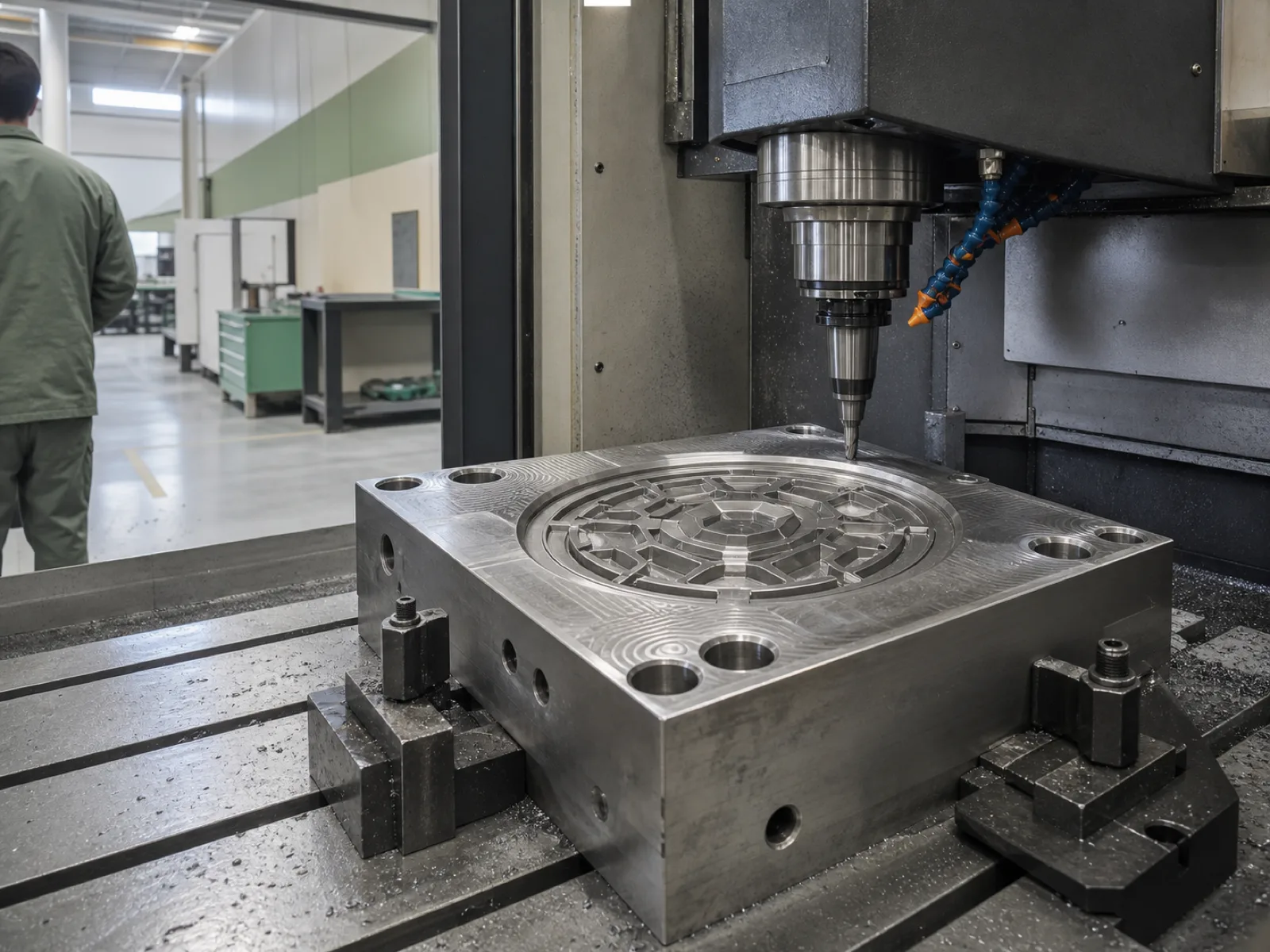
A 2-4 cavity P20 hardened steel compression mold for a standard trivet costs $800-$2,400 and is buyer-owned on payment. P20 mold life is 500,000+ shots with routine maintenance. Amortization: on a first-order 5,000-piece run, that's $0.16-$0.48 per piece added to unit cost; by the second production run the tooling cost is fully absorbed and doesn't recur.
Tooling variables that move the number:
- Cavitation — 2-cavity is the minimum viable for a trivet; 4-cavity halves cycle time per piece. 6-8 cavity is possible for multi-year programs at 20,000+ annual volume, adding $600-$1,200 to mold cost.
- Steel spec — P20 hardened steel is the retail standard, 500,000-shot life. Aluminum tooling ($400-$900) fits pilot runs under 5,000 total shots but wears out; H13 hardened ($2,500-$4,500) fits multi-million-shot programs.
- Undercuts / side-actions — a flat trivet with a debossed logo is a simple two-plate mold. Any raised feature that requires a side-action or slide-pull adds $300-$800.
- Debossing — sunk into the mold cavity at zero incremental cost per piece. This is the reason debossing is the default logo method for silicone.
- Multi-cavity family molds — sometimes viable when a program has 3-5 related SKUs sharing a base geometry. Not our default offering; each Wetop program runs dedicated tooling.
The tooling cost is a one-time capital expense on a first order. It doesn’t recur on repeat runs unless the mold is retired (500,000+ shots) or the design changes. On a program running 20,000-50,000 pieces per year across multi-year, the effective tooling cost per piece rounds to zero after the first shipment.
What is the OEM sourcing workflow — tech pack to first article to mass production?
The workflow runs in five phases: tech pack + DFM review (5-7 days), tooling cut (10-18 days), first article + spec sign-off (5-8 days per iteration), mass production (25-35 days), FOB Yantian handoff (90 min drayage). Total PO to on-the-water is typically 30-45 days for a program with tooling in place, 55-70 days with new tooling on the critical path.
Phase-by-phase breakdown of a standard silicone trivet OEM engagement:
Phase 1 — Tech pack + DFM review (5-7 days). Buyer submits: 3D CAD (STEP preferred, IGES acceptable), 2D drawing with GD&T, material spec (Shore A + cure chemistry + regulatory scope), decoration spec (logo Pantone + placement + method), packaging spec, target quantity per SKU + first-order size. Wetop engineering runs DFM: cavity layout, gating strategy, parting-line optimization, wall-thickness check, shrinkage-compensation on the tool. Output: signed tech pack + tooling drawing.
Phase 2 — Tooling cut (10-18 days). In-house CNC roughing → EDM detail → polish → gate + vent finishing. In-house machining is the difference between 2-3 weeks and 6-8 weeks — subcontracted mold shops queue behind their own customers.
Phase 3 — First article + spec sign-off (5-8 days per iteration). T1 shot on the mold. Full dimensional inspection, Shore A durometer per ASTM D2240 1, color match to Pantone under D65 lighting, debossing readability, post-cure verification, and per-batch FDA + LFGB testing. Photos and 5-10 physical samples shipped to buyer for hand-approval. Iterate T2, T3 if needed — most programs land at T1 or T2 with clean DFM upstream.
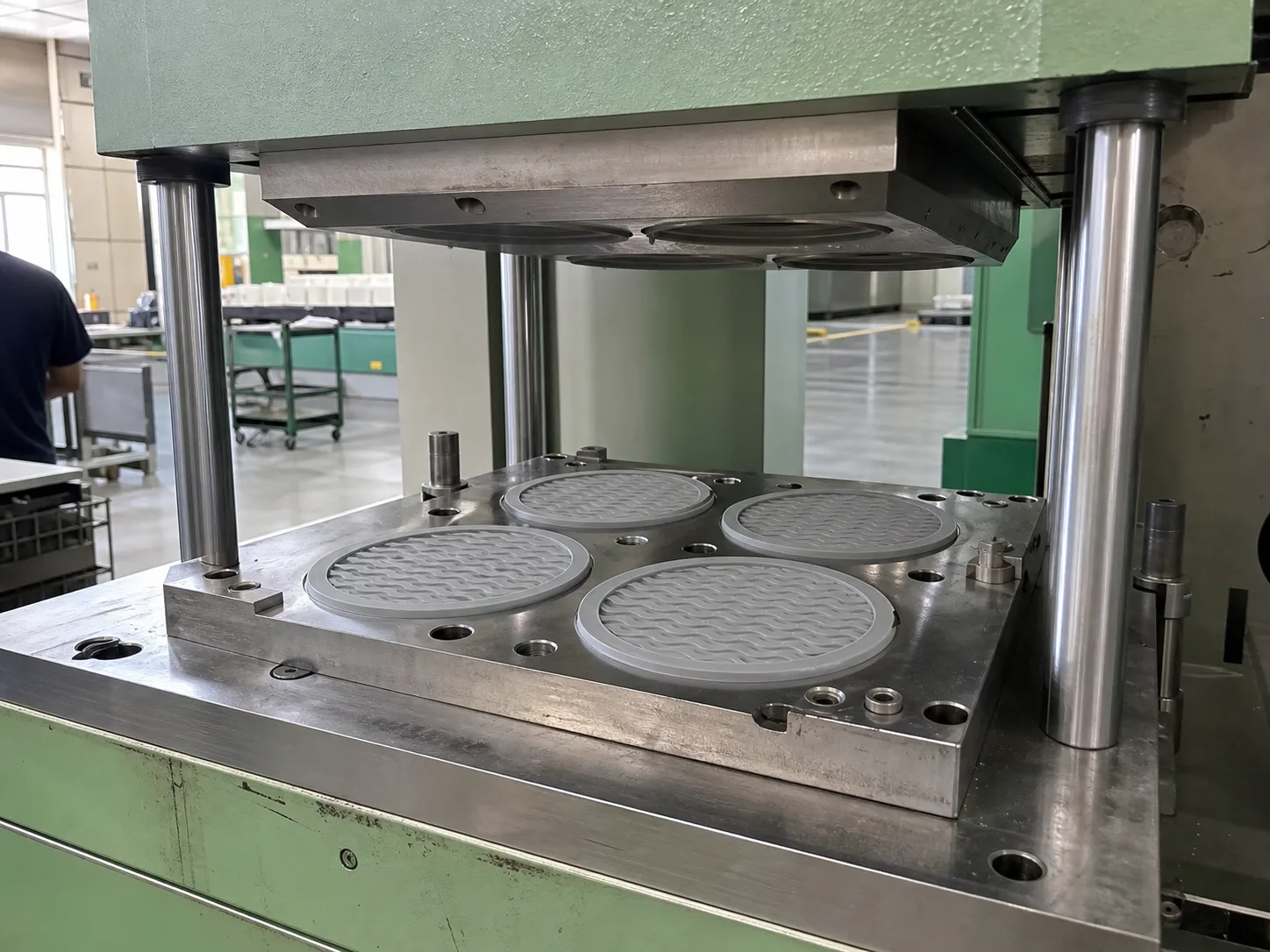
Phase 4 — Mass production (25-35 days). Molding runs on the approved tooling; every batch post-cured 4-6 hours at 180-200°C; QC at ISO 2859-1 AQL 2.5 GII 8. Per-batch third-party FDA + LFGB reports pulled and referenced to the master-batch lot.
Phase 5 — FOB Yantian handoff (90 min drayage). Master cartons palletized, container loaded at our floor, drayage to Yantian Port in 90 minutes. HK airport reachable in 2 hours if air freight is on the plan.
Full lead-time detail with the schedule assumptions is in MOQ and lead time on silicone OEM; the sourcing-audit playbook — what to check before placing a first order — is in the sourcing silicone factory checklist.
What retail-tier fit does a silicone trivet program have to hit?
Tier 2 chain retail (Home Depot / Wayfair / Bed Bath / Tesco / Carrefour class) expects a documented ISO 9001 + FDA + LFGB per-batch stack, AQL 2.5 GII inspection per ISO 2859-1 [^iso-2859-1], and PFAS non-detect on premium SKUs. Tier 1 retail (national mass merchants) adds annual factory social/security audits. Below Tier 2 (Amazon FBA private label, boutique DTC) still requires FDA per-batch minimum — cutting corners here is the fastest path to a listing takedown.
The retail-tier positioning drives which quality gates are non-negotiable versus optional:
| Retail tier | Certifications required per batch | Audit depth | Trivet SKU price band |
|---|---|---|---|
| Tier 1 chain (national mass merchant) | ISO 9001 + FDA + LFGB + PFAS + social audit | Annual on-site + per-shipment lab | $15-$35 shelf |
| Tier 2 chain (home improvement / department) | ISO 9001 + FDA + LFGB per batch | Per-shipment lab, annual desk audit | $10-$25 shelf |
| Specialty premium (natural food / EU premium) | Above + PFAS non-detect + platinum-cure | Per-shipment lab + brand rep | $18-$40 shelf |
| DTC / Amazon FBA private label | FDA per batch minimum | Sample-basis, first-order | $8-$20 shelf |
Wetop’s founder-led floor is calibrated to Tier 2 chain requirements as the baseline. Specialty premium and Tier 1 layer additional documentation on top; DTC / Amazon FBA runs on the same molds and cure discipline with a lighter audit stack. What we do not do: undercut Tier 2 quality to hit a lower price point. The economics of running an ISO 9001 4 certified floor set a hard floor on unit cost — programs shopping for a $0.30 trivet are shopping for a trading house re-labelling stock, not a factory.
Silicone vs cork, cast iron, and cotton — buyer comparison for private-label programs
Silicone dominates the $5-25 retail trivet band because the unit economics work at Tier 2 chain volume: single-material, single-process, MOQ 500, dishwasher-safe, easy Pantone match, and $0.55-$2.80 FOB unit cost. Cork, cast iron, and cotton each solve one buyer's problem better but lose on the four-way retail-audit and unit-cost combination for a mid-market program.
| Material | Unit cost band | MOQ | Dishwasher | Temperature | Retail complications |
|---|---|---|---|---|---|
| Silicone | $0.55-$2.80 | 500 | Yes | -40 to +230°C | Minimal — single-source audit |
| Cork | $1.20-$3.50 | 2,000+ | No | Char at ~250°C | Renewable-claim documentation, stains, MOQ floor high |
| Cast iron | $6-$18 | 500-1,000 | No | Effectively unlimited | Enamel coating audit, 20-40x freight weight, rust liability |
| Cotton / textile | $0.40-$1.20 | 1,000-3,000 | Yes but shrinks | Burn-through above ~200°C | Wash durability audit, category-specific safety spec |
Silicone wins the four-way: (1) it clears retail audit with one certification stack rather than a substrate-by-substrate audit; (2) MOQ 500 unlocks pilot runs and long-tail SKUs; (3) unit cost holds under $3 through the Tier 2 chain price band; (4) freight weight is a fraction of cast iron. The categories where silicone loses are (a) ultra-premium shelf where cast-iron aesthetics command $30+ retail, and (b) natural-materials specialty positioning where cork’s renewable story sells the SKU despite worse unit economics.
For a private-label kitchen program looking to add 3-8 silicone SKUs — trivets, drying mats, sink grids — the workflow is documented in private-label silicone kitchen products. Decoration options across debossing, silk-print, pad-print, and laser are in customize silicone: logo, deboss, print, laser.
What Wetop OEMs on silicone trivets
Wetop runs silicone trivets on both cure systems from an ISO 9001 [^iso-9001] certified floor in Dongguan — MOQ 500 per SKU, platinum-cure or post-cured peroxide-cure, Shore A 40-70, custom geometry, debossing / silk-print / pad-print / laser decoration, per-batch FDA 21 CFR 177.2600 [^fda-177-2600] + LFGB §30/31 [^bfr-lfgb-xv] + PFAS non-detect testing, ISO 2859-1 [^iso-2859-1] AQL 2.5 GII inspection, 90 minutes to Yantian Port.
Program defaults:
- Cure: platinum-cure for premium / EU / PFAS-free / medical-adjacent brands; post-cured peroxide-cure for Tier 2 chain accessory programs
- Hardness: Shore A 55 default, adjustable 40-70 to program spec, tolerance ±2 per ASTM D2240 1
- MOQ: 500 pcs/SKU entry; unit-cost bands materially better at 1,000 / 5,000 / 10,000
- Tooling: $800-$2,400 for 2-4 cavity P20 hardened steel, buyer-owned, 500,000+ shot life
- Lead time: 30-45 days PO to on-the-water with tooling in place; 55-70 days with new tool cut
- Regulatory package: per-batch FDA + LFGB + PFAS non-detect, referenced to master-batch lot, retained 36 months
- Retail-tier fit: baseline calibrated to Tier 2 chain audit; scales up to specialty premium and Tier 1 with documentation layering
Sourcing a custom silicone trivet program? Email inquiry@wetopsilicone.com with your target Shore A, target regulatory scope (US / EU / both), target retail tier, annual volume estimate, and any existing sketch or CAD. We return with a cure recommendation, DFM feedback on the geometry, per-batch documentation packet outline, and price brackets at MOQ 500 / 1,000 / 5,000 / 10,000 within 48 hours. Full manufacturing detail on the capabilities page; NDA process on the NDA page; anonymized program archetypes on case studies; direct sourcing questions via contact.
Footnotes
-
ASTM International. ASTM D2240-15 — Standard Test Method for Rubber Property — Durometer Hardness. https://www.astm.org/d2240-15r21.html — the measurement standard for Shore A hardness across the 40-70 trivet range. ↩ ↩2 ↩3 ↩4
-
US Food and Drug Administration. 21 CFR 177.2600 — Rubber articles intended for repeated use. https://www.ecfr.gov/current/title-21/chapter-I/subchapter-B/part-177/subpart-C/section-177.2600 — the primary US food-contact regulation Wetop cures every trivet batch against. ↩
-
German Federal Institute for Risk Assessment (BfR). Recommendation XV — Silicones. https://www.bfr.bund.de/en/bfr_recommendations_on_food_contact_materials-7498.html — the technical standard behind LFGB §30/31 for food-contact silicone. Defines the organic volatile extraction test mandatory post-cure clears. ↩
-
International Organization for Standardization. ISO 9001:2015 — Quality Management Systems — Requirements. https://www.iso.org/standard/62085.html — the quality management standard Wetop is certified against. ↩ ↩2
-
European Chemicals Agency. PFAS Universal Restriction Proposal (2023). https://eur-lex.europa.eu/legal-content/EN/TXT/?uri=CELEX%3A32006R1907 — the regulatory action driving PFAS-free spec adoption in EU premium retail and, downstream, in US premium retail. ↩
-
US Consumer Product Safety Commission. CPSIA — Consumer Product Safety Improvement Act. https://www.ecfr.gov/current/title-16 — US federal law governing lead, phthalates, and general safety compliance for consumer products marketed for children’s use. ↩
-
United States Pharmacopeia. USP <88> — Biological Reactivity Tests, In Vivo. https://www.usp.org/harmonization-standards/pdg/excipients/plastic-materials — defines USP Class VI biological reactivity classification for medical-adjacent trivet programs. ↩
-
International Organization for Standardization. ISO 2859-1:1999 — Sampling procedures for inspection by attributes. https://www.iso.org/standard/1141.html — defines the AQL 2.5 General Inspection Level II sampling regime Wetop runs on trivet final inspection. ↩ ↩2
FAQ
-
How much does a custom silicone trivet cost at MOQ 500 vs 5,000 vs 10,000?
For a standard round 190 mm trivet at Shore A 60 with debossed logo: expect roughly $1.60-$2.80 FOB Yantian at 500 pcs, $1.10-$1.80 at 1,000 pcs, $0.75-$1.20 at 5,000 pcs, and $0.55-$0.90 at 10,000 pcs. Platinum-cure adds 15-25%. Tooling is separate at $800-$2,400 for a 2-4 cavity mold. Complex geometries, secondary colors, or Pantone-matched pigment push the numbers up 10-25%.
-
What Shore A hardness is right for a silicone trivet?
Shore A 50-60 is the retail-program default. It's stiff enough to stay flat under a hot Dutch oven, soft enough to grip the counter without a metal insert, and forgiving of ±2 Shore A batch drift measured to ASTM D2240. Below 45 the trivet deforms under a 5 kg cast iron load; above 65 it slides on smooth counters and reads as 'plastic-like' at retail. Firmness for hot pads goes to 60-70; jar-opener trivets sit at 40-50.
-
What tooling do I pay for and who owns it?
For compression-molded trivets a 2-4 cavity P20 hardened steel mold costs $800-$2,400 and is buyer-owned on payment. The mold stays at Wetop for production and is available for transfer at end of program. Life expectancy is 500,000+ shots on P20 with routine maintenance. MUD (Master Unit Die) inserts drop tooling cost 40-60% but are only viable when your program shares a base with other buyer SKUs, which we do not offer — dedicated tooling is the standard.
-
What is the lead time from PO to first shipment?
First article: 7-15 days from signed tech pack (assumes tooling exists or is being cut in parallel). Mass production: 25-35 days after first-article approval, depending on cavitation and order quantity. Yantian Port drayage: 90 minutes from our Dongguan floor. Standard order (5,000-20,000 pcs) is 30-45 days PO to on-the-water; rush 20-25 days is possible with a schedule premium.
-
What's the difference between silicone and cork, cast iron, or cotton trivets for a private-label program?
Silicone: dishwasher-safe, non-slip, -40°C to +230°C, single-piece mold, easy Pantone color match, MOQ 500, unit cost $0.55-$2.80. Cork: renewable image but stains, splinters, and MOQ typically 2,000+ from a specialist. Cast iron: premium shelf position but 20-40x the unit weight, freight-cost prohibitive, requires enamel coating audit. Cotton/textile: cheapest input cost but flunks retail QA on burn-through and washing durability. Silicone dominates the $5-25 retail range because the unit economics work at Tier 2 chain volumes.
-
How do I audit a silicone trivet supplier before placing a first order?
Six documents, non-negotiable: (1) current ISO 9001 certificate, (2) per-batch FDA 21 CFR 177.2600 test report from an accredited lab, (3) per-batch LFGB §30/31 test report if EU-bound, (4) per-batch PFAS non-detect report, (5) post-cure oven log referenced to the master-batch lot, (6) Shore A durometer measurement per ASTM D2240 with the calibration cert of the durometer. Suppliers who evade or slow-walk any of these six are the ones whose downstream retail audit goes badly.
-
What geometry, rib pattern, and wall thickness actually work on a retail silicone trivet under a hot Dutch oven?
The retail-default trivet geometry is a 180-220 mm round or square footprint at 6-12 mm wall thickness with a ribbed or waffled underside creating a 2-4 mm air-gap under the pan. The air-gap is what does the thermal work — solid silicone at 6 mm conducts enough heat to mark a wood counter under a 200°C cast-iron pan, but a ribbed underside interrupts the conduction path and drops counter-side temperature 40-60°C. Rib pitch: 8-15 mm on-center gives the best balance of stiffness and thermal insulation; tighter than 8 mm reduces the air-gap volume, wider than 15 mm loses top-face support and the trivet flexes visibly under a heavy Dutch oven. Wall thickness under 6 mm sags at Shore A 55 with a 5 kg load; over 12 mm reads as bulky at retail and wastes 40-60 g of silicone gum per part on a program that runs on a $0.18-0.30 per-gram compound. Honeycomb, concentric ring, and directional-rib patterns all work — the engineering constraint is that the rib must terminate 2-3 mm inside the perimeter so the trivet edge stays clean on demold rather than tearing at the rib intersection. Debossed logos live on the top face in a 30-40 mm circular or rectangular window, sunk 0.4-0.6 mm into the mold cavity, adding zero incremental unit cost but demanding a clean parting-line strategy so the deboss reads sharp at first article. Cavity-map the geometry against your program's target Dutch-oven diameter (typically 22-28 cm Le Creuset / Staub class) so the trivet footprint exceeds the pan diameter by 10-20 mm — a trivet that lets the pan overhang loses the thermal air-gap where it matters.
-
How does a silicone trivet fit into a Home Depot or Bed Bath silicone-mat SKU audit stack alongside drying mats, sink grids, and pot holders?
Tier 2 chain buyers (Home Depot, Wayfair, Bed Bath, Tesco, Carrefour caliber) treat the silicone-mat family as a single audit bucket — trivets, drying mats, sink grids, pot holders, counter mats and baking mats all clear the same ISO 9001 [^iso-9001] + FDA 21 CFR 177.2600 [^fda-177-2600] + LFGB §30/31 [^bfr-lfgb-xv] documentation gate, with per-batch third-party reports referenced to master-batch lots and retained 36 months. That means a private-label brand adding a trivet SKU into an existing silicone-mat range gets audit-stack economies of scale: the same compound house, the same post-cure discipline (4-6 h at 180-200°C), the same ISO 2859-1 AQL 2.5 GII [^iso-2859-1] final-inspection regime, and the same PFAS non-detect testing on premium-tier SKUs all carry across. Where trivets diverge from the rest of the family: the load spec is heavier (3-8 kg vs 0.5-2 kg on a drying mat), so Shore A runs 50-65 rather than the 40-50 typical on drainable mats; the thermal spec is more aggressive (contact with 230°C cast iron vs sink-side 60-80°C wash-water); and the geometry is thicker (6-12 mm wall vs 2-4 mm on a rolled drying mat) which pushes gum cost per unit up 3-5x. The retail-tier fit is otherwise identical — same shelf window ($10-25 for Tier 2 caliber), same debossing conventions, same polybag-plus-header-card pack-out, same annual desk audit. A brand rolling out a coordinated silicone kitchen range typically launches 3-5 SKUs together on a shared tooling schedule so the first-article and DFM cycles overlap rather than run sequentially.
-
What are the three most common trivet-specific defect modes — gate tear, batch color shift, first-heat odor — and how does DFM prevent them?
Gate tear on demold is the number-one trivet-specific failure. Compression-molded trivets are large-footprint flat parts where the gate typically sits on the underside near the rib intersection; if the gate is too small (under 1.5 mm on a 180 g part) the material flashes and tears on demold, if it sits at a rib-to-perimeter junction the operator's demold pull propagates the tear across the rim. DFM prevention: gate diameter 2-3 mm minimum, positioned in the thickest section (usually a rib center) at least 3-4 mm from any parting-line edge, with a runner-side vent that lets trapped air escape rather than compress against the mold face. Batch color shift is the number-two failure — Pantone-matched pigments drift ±3-5 ΔE across master-batch lots if the compound house isn't running incoming-material QC on the pigment. On a trivet where the top-face is 60-80% of the visible area at retail, ΔE > 3 reads as 'off-color' under D65 store lighting and triggers rejection at retail-buyer sample review. Prevention: lock the pigment master-batch lot for the full program (30,000-50,000 pcs typically) and run a color-strip retention sample every 5,000 pcs against a signed first-article gold sample. First-heat odor is the number-three failure, and it is exclusively a post-cure discipline problem: peroxide-cure trivets that skip the mandatory 4-6 hour post-cure at 180-200°C ship with residual dicumyl peroxide decomposition byproducts, which volatilize on first contact with a 200°C pan and produce a distinct chemical smell that generates 3-8% consumer return rates. Prevention: post-cure oven log per batch, referenced to the master-batch lot, retained per ISO 9001 [^iso-9001] traceability — the same discipline that clears LFGB §30/31 [^bfr-lfgb-xv] volatile extract testing clears the first-heat odor complaint at retail.
References
Authoritative sources cited in this guide
- US Food and Drug Administration (Code of Federal Regulations). 21 CFR 177.2600 — Rubber articles intended for repeated use. https://www.ecfr.gov/current/title-21/chapter-I/subchapter-B/part-177/subpart-C/section-177.2600 — The primary US regulation governing food-contact silicone (and other elastomers) intended for repeated use. Every Wetop trivet batch is cured to comply with this section.
- German Federal Institute for Risk Assessment (BfR). BfR Recommendation XV — Silicones. https://www.bfr.bund.de/en/bfr_recommendations_on_food_contact_materials-7498.html — The technical standard behind LFGB §30/31 for food-contact silicone. Defines the organic volatile extraction test that mandatory post-cure clears on peroxide-cure trivets.
- ASTM International. ASTM D2240-15 — Standard Test Method for Rubber Property — Durometer Hardness. https://www.astm.org/d2240-15r21.html — The measurement standard behind every Shore A hardness spec on a Wetop trivet quote. Applies to all indentation hardness testing across the 40-70 range.
- International Organization for Standardization. ISO 9001:2015 — Quality Management Systems — Requirements. https://www.iso.org/standard/62085.html — The quality management standard Wetop is certified against. Governs batch traceability, cure documentation, and post-cure records referenced throughout this guide.
- International Organization for Standardization. ISO 2859-1:1999 — Sampling procedures for inspection by attributes. https://www.iso.org/standard/1141.html — Defines the AQL sampling regime (AQL 2.5 GII) Wetop runs on trivet final inspection before FOB Yantian handoff.
- European Parliament and Council. Regulation (EC) No 1935/2004 — Materials and articles intended to come into contact with food. https://eur-lex.europa.eu/legal-content/EN/TXT/?uri=CELEX%3A02004R1935-20090807 — The EU framework regulation for food-contact materials that LFGB §30/31 and BfR Recommendation XV operate under.
- European Chemicals Agency (ECHA). PFAS Universal Restriction Proposal (2023). https://eur-lex.europa.eu/legal-content/EN/TXT/?uri=CELEX%3A32006R1907 — The regulatory action driving PFAS-free spec adoption in EU premium retail and, downstream, in US West Coast retail. Explains why per-batch PFAS non-detect reports are table stakes on premium trivet programs.
- United States Pharmacopeia. USP <88> — Biological Reactivity Tests, In Vivo. https://www.usp.org/harmonization-standards/pdg/excipients/plastic-materials — Defines USP Class VI biological reactivity classification. Applies when a trivet program crosses into medical-adjacent or infant-feeding positioning.
- US Consumer Product Safety Commission. CPSIA — Consumer Product Safety Improvement Act. https://www.ecfr.gov/current/title-16 — US federal law governing lead, phthalates, and general safety compliance for consumer products. Applies to any trivet SKU marketed for children's use or in a children's product category.
Start a custom program
Send a brief. Get an engineer’s reply in one business day.
Every Wetop program is tooled from a customer’s specification. Send a CAD file (STEP · IGES · DWG) or a written brief and we’ll reply with a mold cost estimate, price brackets at MOQ 500 / 1,000 / 5,000, and any engineering questions.