Buyer Guide · commercial intent
Medical Grade Silicone Rubber Supplier — OEM Buyer's Guide
 Buyer Guide
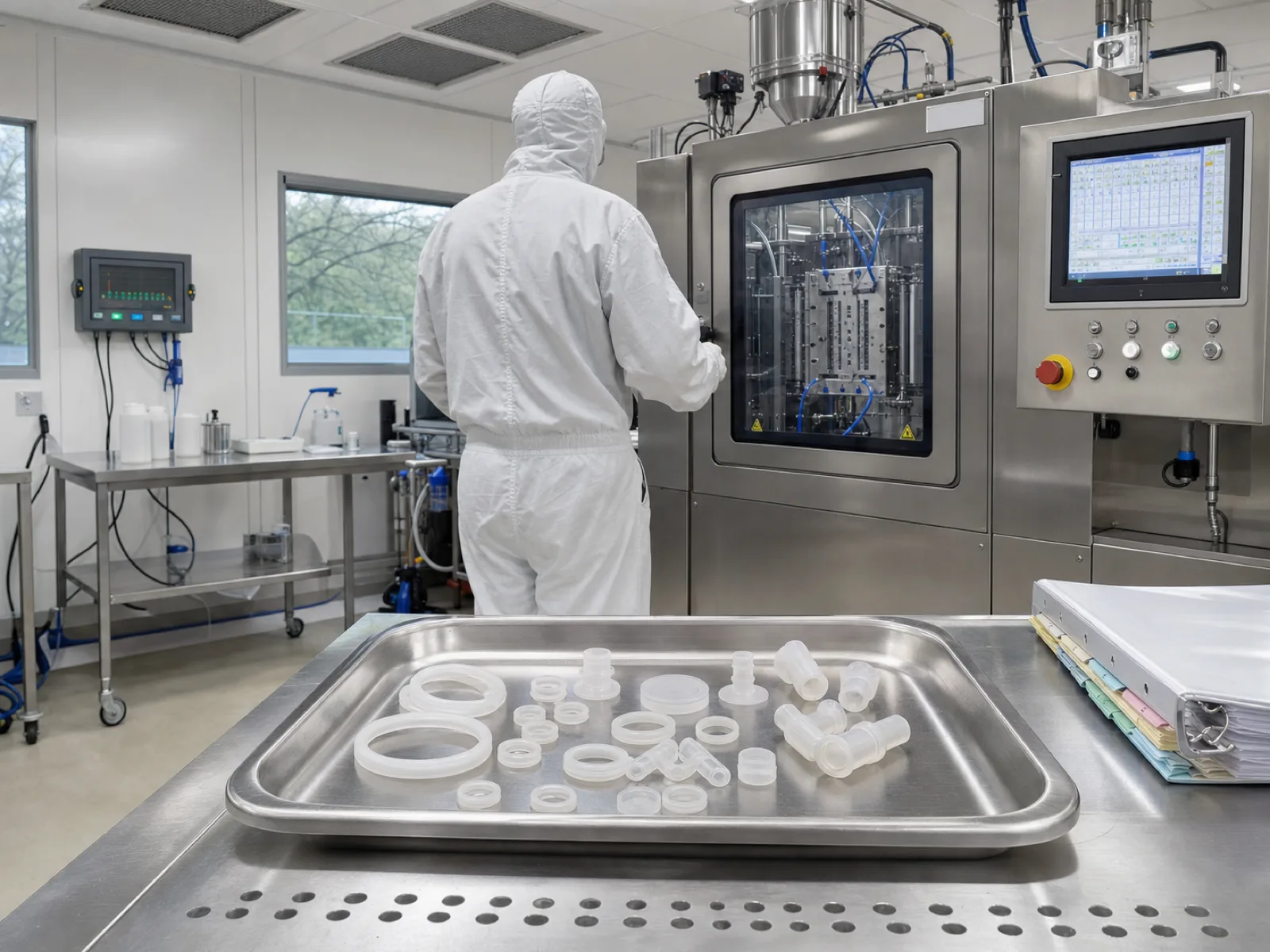
 The phrase “medical grade silicone rubber supplier” has become the most-abused claim on English-language sourcing platforms. Roughly nine out of ten factories advertising the phrase are food-grade shops with a compression press, an ISO 9001 certificate, and marketing copy borrowed from a competitor. This guide is the engineering and compliance framework Wetop uses internally to audit medical silicone programs — and the same framework device-brand sourcing teams should apply before signing a PO with any silicone factory that claims medical-grade capability.
A qualified medical grade silicone rubber supplier holds three concurrent credentials: ISO 13485:2016 quality management, raw-material qualification to USP Class VI via USP <88>, and ISO 10993-5/-10 biocompatibility test reports run on finished-part material from an accredited laboratory. Cleanroom manufacturing to ISO 14644-1 Class 7 or Class 8, platinum-cured LSR chemistry, and documented sterilization compatibility complete the audit-proof supplier profile. A factory missing any one of these credentials is a food-grade shop borrowing medical-grade vocabulary — not a compliant partner for a device program.
What defines a real medical grade silicone rubber supplier?
Three concurrent credentials define the category. A genuine medical grade silicone rubber supplier holds ISO 13485:2016[^iso-13485] certification for the quality system, sources raw resin qualified to USP Class VI per USP <88>[^usp-class-vi], and delivers ISO 10993-5 and -10 test reports on finished-part material from an accredited lab. Any supplier missing one of the three is a food-grade shop with an ISO 9001 certificate, and their claim will not survive a device-brand quality audit.
The confusion is deliberate. Many silicone factories that supply kitchenware, drying racks, and consumer accessories have added “medical-grade” language to their sourcing-platform listings because it commands higher pricing and lower churn. The vocabulary is free; the manufacturing infrastructure is not.
The three-credential test:
| Credential | Standard | What it proves | Who issues it |
|---|---|---|---|
| Quality management | ISO 13485:20161 | Change control, design history, traceability, process validation appropriate for medical-device components | TÜV, BSI, DNV, SGS, DEKRA (verify on certifier registry) |
| Raw material | USP Class VI via USP <88>2 | The silicone compound has passed three in-vivo biological reactivity tests at 121°C, 70°C, and 50°C extraction | Compound house (Dow, Wacker, Momentive, Elkem, Shin-Etsu) |
| Finished part | ISO 10993-53 + -104 | The molded finished part — including pigments and process additives — is non-cytotoxic and non-irritating | Accredited third-party lab (SGS, Intertek, TÜV, Bureau Veritas) |
Notice that ISO 9001 is not on the list. ISO 9001 is a general quality management standard; ISO 13485 is the medical-device-specific quality standard with more prescriptive requirements around design history, corrective and preventive action (CAPA), and supplier control. FDA regulatory reviewers and EU MDR notified bodies treat ISO 9001-only silicone suppliers as unqualified for medical device components. When your device manufacturer performs a supplier audit under their own ISO 13485 obligations, an ISO 9001 silicone factory will be flagged as a supplier control gap.
For a fuller comparison of the raw-material qualification framework, see the food-grade vs medical-grade silicone guide — the regulatory delta explained end-to-end.
Which certifications and standards apply to medical silicone?
The medical silicone certification stack has four tiers. Baseline — ISO 13485:2016 (quality) and USP Class VI (raw material). Biocompatibility — the applicable ISO 10993 sub-parts (typically -5, -10, -11) run on finished-part material. Manufacturing environment — ISO 14644-1 Class 7 or Class 8 cleanroom classification[^iso-14644-1]. Sterilization — ISO 11137-1[^iso-11137-1] for radiation, ISO 11135 for EtO, ISO 17665 for steam. FDA's biocompatibility guidance[^fda-guidance-biocompatibility] maps the ISO 10993 outputs to US regulatory acceptance.
Each certification answers a different auditor question:
ISO 13485:2016 answers “Does the supplier’s quality system meet medical-device requirements?” It governs document control, design and development, purchasing controls, production validation, and post-market surveillance. Certification is issued by a notified body after a two-stage audit and requires annual surveillance audits and a three-year recertification cycle. When you request the certificate, verify the scope statement — many silicone factories carry ISO 13485 with a scope limited to a single product category. If your part isn’t covered by the scope, the certificate is decorative.
USP <88> Class VI answers “Is the raw silicone compound biologically inert at the extraction limits USP tested?” The test involves preparing extracts of the material at 50°C, 70°C, and 121°C in physiological solutions, then injecting the extracts systemically and intracutaneously into test animals and implanting samples for observation. Passing all three tests at all three temperatures yields Class VI — the strictest tier. The certificate lives at the compound house, not at the molding factory; a genuine medical silicone supplier presents the compound-house CoA with lot number tracing back to your production run.
ISO 10993 series answers “Is the finished part — with your pigments, process aids, and molding conditions — biocompatible for its specific contact category and duration?” ISO 10993-1:2018 clause 55 is the decision framework; the sub-parts (-5, -6, -10, -11, -17, -23) are the individual test protocols. A device brand’s regulatory affairs team specifies which sub-parts apply based on the finished device’s intended use; the supplier’s job is to demonstrate compliance on finished-part material extracts.
ISO 14644-1 cleanroom classification answers “Is the manufacturing environment particulate-controlled?” ISO Class 7 allows 352,000 particles per cubic meter at 0.5 µm; Class 8 allows 3.52 million. Class 7 is the working baseline for medical LSR injection; Class 8 is acceptable for external-contact parts with lower risk profiles. Verify the last quarter of continuous particulate monitoring logs during your supplier audit — a compliant cleanroom keeps them, an aspirational one shows you a photo of a ceiling filter.
Sterilization standards — ISO 11137-1 (radiation), ISO 11135 (EtO), ISO 17665 (steam) — govern the validation of the sterilization process itself, typically the responsibility of the device manufacturer or a contract sterilizer. A qualified silicone supplier does not sterilize your parts, but they do characterize the material’s response to your specific sterilization mode and cycle.
LSR vs HCR vs RTV vs FSR — which medical silicone chemistry?
Liquid silicone rubber (LSR) is the near-default for medical-grade production. Platinum-cured LSR delivers ±0.05 mm dimensional precision, low residual volatiles, and clean cytotoxicity out of the mold. High-consistency rubber (HCR) fits larger geometries and lower cavitation counts. Room-temperature vulcanizing (RTV) silicone serves prototyping and low-volume specialty parts. Fluorosilicone (FSR) is specified only when solvent, fuel, or aggressive-chemical resistance is required — most medical parts do not need it.
The chemistry choice is driven by geometry, tolerance, cavitation economics, and application-specific chemical resistance requirements.
Liquid Silicone Rubber (LSR) is a two-part platinum addition-cure silicone system. Part A contains the base polymer plus platinum catalyst; Part B contains the base polymer plus a hydride cross-linker. The two parts are metered 1:1 through a static mixer, injected into a heated tool at 150-220°C, and cross-linked in cycle times of 15-45 seconds depending on wall thickness. LSR dominates medical because:
- Precision. ±0.05 mm dimensional tolerance is routinely achievable on tools with proper cold-runner design.
- Clean chemistry. Platinum cure produces no by-products; extractables profiles are cleaner than any other silicone cure system.
- Automation. Cold-runner tools with valve gating allow lights-out production at high cavitation counts.
- Overmolding. LSR bonds directly to compatible thermoplastics and metal inserts, enabling multi-material medical assemblies (thermoplastic hubs with silicone seals, metal inserts with silicone overmold).
Qualified medical LSR grades in current use: Dow Silastic Q7-4780 series, Wacker SilBione LSR 4300/4700 series, Momentive Silopren LSR 2000/4000 series, Elkem Silbione Biomedical, Shin-Etsu KE-2000 series. Each series references specific USP Class VI dossiers.
High-Consistency Rubber (HCR) is a gum-form silicone compression-molded or transfer-molded. HCR is used for catheter shafts (longer flow paths that LSR cannot fill economically), larger seals, and parts where tooling amortization at moderate volumes favors compression over injection. Cure systems for medical HCR are typically platinum-based; peroxide-cured HCR requires aggressive post-cure to volatilize DCBA by-products and is falling out of medical use.
Room-Temperature Vulcanizing (RTV) silicone is a one-part or two-part condensation-cure system that cures at ambient temperature. RTV serves prototyping, low-volume specialty parts, and hand-poured molds. Medical RTV grades exist (typically the two-part platinum RTV subset) but the volume of medical parts produced this way is small compared to LSR.
Fluorosilicone Rubber (FSR) is silicone with fluorine-substituted side chains, delivering resistance to hydrocarbons, fuels, and aggressive solvents that swell standard silicone. Cost is 4-6× standard LSR. FSR is specified for medical applications involving contact with lipid-based drug formulations, hydrocarbon lubricants, or laboratory instrument fluid paths — not for general body-contact use.
| Chemistry | Cure system | Typical medical use | Tolerance | Relative cost |
|---|---|---|---|---|
| LSR (Liquid Silicone Rubber) | Platinum addition | Catheter tips, seals, tubing connectors, respiratory manifolds, wearable device gaskets | ±0.05 mm | 1.0× baseline |
| HCR (High-Consistency Rubber) | Platinum or peroxide | Catheter shafts, large seals, gaskets, extruded tubing | ±0.10-0.20 mm | 0.7-0.9× LSR |
| RTV Silicone | Condensation or Pt | Prototypes, custom fixtures, hand-poured molds | ±0.20-0.50 mm | Highly variable |
| FSR (Fluorosilicone) | Platinum addition | Fuel-resistant seals, drug-contact wetted paths, lab instrument o-rings | ±0.05 mm | 4-6× LSR |
For a full breakdown of the cure chemistry choice, see platinum-cured vs peroxide-cured silicone.
What ISO 10993 test panel does my medical silicone part need?
Panel selection is contact-category and duration driven per ISO 10993-1:2018 clause 5. For most non-implantable devices — external tubing, wearable seals, mask components — the audit floor is ISO 10993-5 cytotoxicity plus -10 irritation and sensitization. Mucosal or long-term contact adds -11 systemic toxicity. Implantable or long-term (>30 days) contact expands the panel to -6 local effects after implantation, -11 subchronic, -3 genotoxicity, and -17 chemical characterization. The tests must run on finished-part material extracts, not raw-resin only.
The ISO 10993-1 matrix is structured by two axes:
Contact category (Y-axis):
- Surface-contacting — skin, mucosal membrane, breached surface
- External communicating — blood path (indirect), tissue/bone/dentin, circulating blood
- Implant — tissue/bone, blood contact
Contact duration (X-axis):
- Limited — up to 24 hours
- Prolonged — 24 hours to 30 days
- Long-term — >30 days
The intersection cells define the applicable ISO 10993 sub-parts. Below is the practical panel for the medical silicone applications most silicone factories encounter:
| Application example | Contact category | Duration | Standard ISO 10993 panel |
|---|---|---|---|
| Respiratory mask silicone cushion | Skin, mucosal | Limited | -5 cytotoxicity, -10 irritation/sensitization |
| Wearable device silicone housing | Skin | Prolonged | -5, -10 |
| Catheter tubing (short-stay urinary) | External communicating (mucosa) | Prolonged | -5, -10, -11 systemic toxicity |
| Silicone seal in drug delivery pump | External communicating (drug path) | Long-term | -5, -10, -11, -17 chemical characterization, -18 chemical analysis |
| Implantable silicone port component | Implant, tissue | Long-term | -5, -6 implantation, -10, -11 subchronic, -3 genotoxicity, -17, -18 |
The critical distinction is that ISO 10993 tests run on finished-part material extracts — not on raw-resin CoA. Pigments, mold-release agents, secondary bonding adhesives, and molding conditions (temperature, cycle time, post-cure profile) all affect the extractables profile of the finished part. A supplier who hands you only the raw-resin USP Class VI certificate has not demonstrated finished-part biocompatibility; the ISO 10993 test on your specific molded part is the audit-proof document.
Wetop’s default compliance stack for medical-grade LSR programs runs -5, -10, and -11 on production-representative finished parts through SGS or Intertek, with reports lot-linked to the raw-material CoA and the tool trial run. For applications with implantable or long-term contact, the panel expands under the device manufacturer’s regulatory affairs guidance.
Sterilization compatibility — autoclave, gamma, EtO, e-beam
Platinum-cured silicone is compatible with all four major sterilization modes, but property retention differs. Steam autoclave (121-134°C) is the friendliest cycle — silicone retains >95% tensile and elongation over 100+ cycles. Gamma irradiation (25-40 kGy per ISO 11137-1) increases cross-link density, raising Shore A 2-5 points and dropping elongation 10-15%. Ethylene oxide requires post-sterilization aeration to purge residual gas. E-beam behaves like gamma with less thermal exposure. A qualified supplier documents post-sterilization property retention on your specific compound and cycle.
Sterilization is where “medical-grade silicone” separates from truly qualified silicone. A supplier who cannot provide a post-sterilization property retention study for your compound and your sterilization cycle has not validated the material — they have sold you a datasheet.
Steam autoclave (moist heat). The gentlest sterilization mode for silicone. Standard cycles: 121°C for 15-30 minutes, or 134°C for 3-18 minutes, at 15 psi. Platinum-cured LSR typically retains >95% of tensile strength and elongation over 100+ cycles. HCR retains similar performance. Note: repeated autoclave cycles cause gradual mass loss (0.1-0.3% per cycle) from residual volatiles evaporation — desirable for reducing extractables but relevant to precision dimensional parts.
Gamma irradiation. Ionizing radiation from Cobalt-60 source at 25-40 kGy per ISO 11137-16. Causes chain cross-linking in silicone, raising cross-link density. Practical property shifts:
- Shore A hardness: +2 to +5 points
- Tensile strength: -5% to -10%
- Elongation at break: -10% to -20%
- Tear strength: -5% to -15%
These shifts are predictable but must be characterized on your compound at your intended dose. Colored silicone parts may exhibit slight color shift under gamma; if aesthetic color match matters, run a dose validation.
Ethylene oxide (EtO). Chemical sterilization at 30-65°C with EtO gas. Fully compatible with platinum-cured silicone from a property standpoint. The critical validation step is post-sterilization aeration to purge residual EtO and its by-products (ethylene chlorohydrin, ethylene glycol) below ISO 10993-7 limits — silicone’s gas absorption profile requires aeration times of 12-72 hours depending on wall thickness. Suppliers must characterize the residuals profile for parts thicker than 2 mm.
Electron beam (e-beam). Similar chemistry to gamma but delivered at higher dose rate with less thermal exposure. Property shifts track gamma with slightly less magnitude. E-beam is faster and suitable for lower-volume runs where gamma capacity is unavailable.
| Sterilization mode | Standard cycle | Silicone property retention | Notes |
|---|---|---|---|
| Steam autoclave | 121°C / 15-30 min or 134°C / 3-18 min | >95% tensile, >95% elongation over 100 cycles | Gentlest mode; some mass loss over repeated cycles |
| Gamma irradiation | 25-40 kGy | Shore A +2-5, elongation -10-20% | ISO 11137-1 dose validation required |
| Ethylene oxide (EtO) | 30-65°C, EtO gas + humidity | Full property retention | Post-sterilization aeration mandatory for residual purge |
| Electron beam | 25-50 kGy | Similar to gamma, slightly less magnitude | Faster than gamma at moderate volumes |
The supplier’s deliverable is a post-sterilization property study — tensile, elongation, Shore A, and where applicable compression set — run on your specific compound after your specific sterilization cycle. Generic datasheet claims are not validation.
Medical device applications served by silicone
Silicone serves five major medical device application clusters. Catheters and tubing (drainage, feeding, urinary, IV extension). Seals, gaskets, and o-rings (device housings, drug delivery pumps, respiratory circuits). Respiratory components (mask cushions, breathing circuit connectors, CPAP interfaces). Wearable and external device components (biosensor pads, glucose monitor housings, hearing aid ear tips). Specialty and implantable components (long-term ports, drug-eluting seals, prosthetic liners) — the highest-risk tier with the most demanding qualification pathway.
Wetop’s medical-grade program primarily serves the first four clusters — non-implantable finished-part silicone components where the device manufacturer holds the 510(k) or MDR file and Wetop supplies the qualified silicone component with full material and process documentation. Implantable silicone is a specialized subcategory typically served by dedicated implant-grade suppliers with additional regulatory infrastructure.
Catheter tubing and connectors. Extruded silicone tubing in inner diameters from 0.5 mm (fine catheters) to 15 mm (drainage tubing), typically HCR-based for the tubing itself with LSR-molded connectors, tips, and hubs overmolded onto thermoplastic. Wall thickness tolerance ±0.05 mm, durometer 40-70 Shore A depending on application. Biocompatibility panel: ISO 10993-5, -10, -11.
Seals, gaskets, and o-rings. LSR-molded seals for device housings, drug-delivery cartridge seals, respiratory circuit connectors. Precision ±0.05 mm on sealing surfaces, durometer 50-70 Shore A. Compression set at 22 hours / 175°C typically <20% for qualified medical LSR. See the silicone o-ring specifying guide for dimensional and material selection detail.
Respiratory components. Mask cushions, breathing circuit connectors, CPAP interface pads. LSR-molded with soft durometer (20-40 Shore A) for skin comfort, biocompatibility panel ISO 10993-5 and -10 (limited-duration skin contact). Cleanroom Class 7 or 8 acceptable depending on device classification.
Wearable and external device components. Biosensor adhesive pads with silicone contact layers, glucose monitor housings with silicone gasketing, hearing aid ear tips (though most in-ear silicone is a separate specialty), smartwatch strap sealing gaskets. Biocompatibility panel ISO 10993-5, -10 with sensitization emphasis for prolonged skin contact.
Specialty and implantable components. Not Wetop’s core focus. Implantable silicone requires implant-grade raw material (e.g., Dow Silastic Q7-4735/4750 series, NuSil MED series), dedicated ISO Class 7 or better cleanroom infrastructure, extended ISO 10993 panels (including -6 implantation and -11 chronic), and typically ISO 13485 with implantable-scope certification.
Supplier audit checklist — the eight-document packet
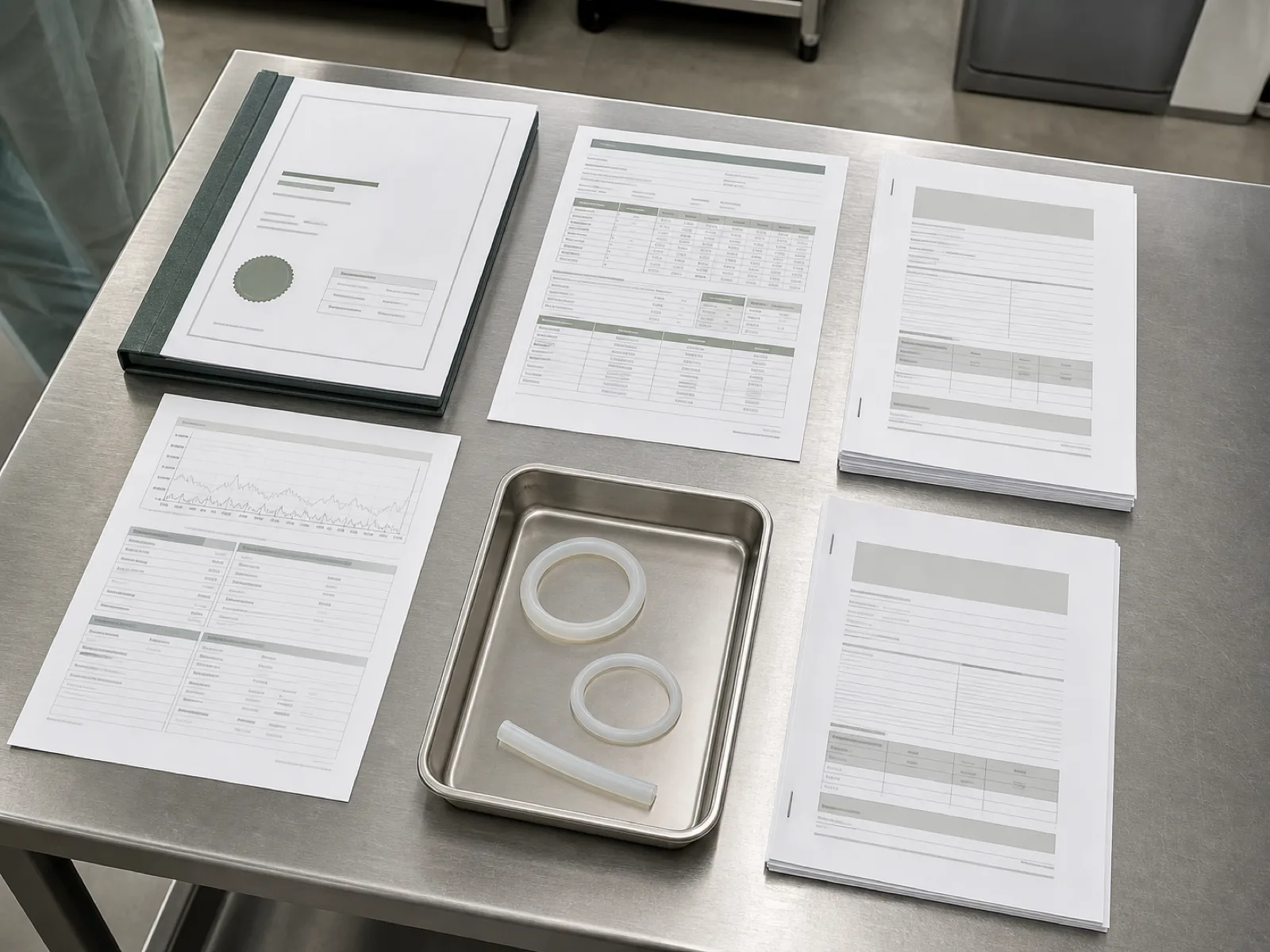
An audit-proof medical silicone supplier delivers eight documents on request. ISO 13485 certificate with scope statement. Raw-material CoA referencing USP Class VI with lot traceability. ISO 10993 finished-part test reports (-5, -10, minimum) from an accredited lab. Platinum-cure attestation on master-batch certificate. Colorant and additive Class VI dossier for each pigment. Cleanroom particulate monitoring log (last quarter). IQ/OQ/PQ tooling and process validation record. Sterilization compatibility study on your specific compound and cycle. Missing any single document is a disqualification, not a negotiation point.
The following checklist is what Wetop presents unprompted to medical device brand customers during the RFQ stage — and what any competent medical silicone supplier should be able to produce within one business day of a written request:
1. ISO 13485:2016 certificate. Scanned, current-dated, with certification body registration number verifiable on the certifier’s public register (TÜV, BSI, DNV, SGS, DEKRA). Read the scope statement — verify your product category is inside the certified scope.
2. Raw-material Certificate of Analysis. From the compound house (Dow, Wacker, Momentive, Elkem, Shin-Etsu). References the specific product code (e.g., Silastic Q7-4780), USP Class VI compliance per USP <88>, lot number, and manufacturing date. Lot number must trace to your production run.
3. ISO 10993 finished-part test reports. Minimum: -5 cytotoxicity, -10 irritation and sensitization. Additional sub-parts (-11, -6, -17) as required by your contact category. Reports must be from an accredited third-party lab (SGS, Intertek, TÜV, Bureau Veritas, Nelson Labs), lot-linked to production material.
4. Platinum-cure attestation. Written statement on the master-batch lot certificate confirming platinum addition cure system — not vague “medical-grade cure” language. Peroxide-cured material is disqualifying for most medical applications.
5. Colorant and additive Class VI dossier. Every pigment, mold-release agent, and secondary additive in the compound must carry its own USP Class VI documentation. This is the single most common failure — brands specify medical-grade base LSR but accept food-grade pigment, voiding the Class VI claim on the finished part.
6. Cleanroom particulate monitoring log. Last quarter of continuous or scheduled particulate monitoring records from the molding cell, demonstrating ISO 14644-1 Class 7 or Class 8 compliance. Photo of a filter is not a log.
7. IQ/OQ/PQ validation record. Tooling installation qualification, operational qualification, and performance qualification records per ISO 13485 process validation requirements. Documents the tool’s ability to produce parts meeting spec repeatably.
8. Sterilization compatibility study. Post-sterilization tensile, elongation, Shore A retention on your specific compound after your specific sterilization cycle — autoclave, gamma at dose, EtO with aeration validation, or e-beam at dose. Generic datasheet is not a study.
If a prospective supplier stalls on any single one of these eight documents, treat it as a hard disqualification. Genuine medical silicone suppliers keep these documents current because their existing customers audit them regularly. See the full sourcing factory checklist for adjacent verification steps.
MOQ, lead time, tooling, and pricing economics
Realistic medical silicone OEM economics at 500-5,000 units per SKU. Raw LSR resin $30-80/kg (Dow, Wacker, Momentive qualified lots). IQ/OQ/PQ tooling and process validation $8,000-25,000 one-time per SKU. Sample and first-article $800-2,500 per material configuration. Lead time 8-14 weeks first article (3-5 weeks tool build, 2-3 weeks validation, 3-6 weeks ISO 10993 testing), dropping to 4-6 weeks per repeat order. Cleanroom overhead adds 15-25% to processing versus food-grade production.
Medical silicone economics diverge from food-grade silicone at every line item. The following is Wetop’s transparent cost structure for medical-grade LSR programs, representative of the qualified-supplier market range:
Raw material. Qualified medical LSR runs $30-80 per kilogram at compound-house list pricing, versus $8-15 per kilogram for food-grade HCR. The delta reflects tighter extractables specs (<0.5% total volatiles for medical vs 2-3% for food-grade), lot-level CoA overhead, and full raw-material traceability. Specialty grades (implantable, low-consistency LSR for micro-cavitation) run higher.
Tooling and process validation. IQ/OQ/PQ tooling validation adds one-time $8,000-25,000 per SKU on top of the base tool cost, depending on cavitation count, cold-runner complexity, and validation lot size. This is separate from ISO 10993 test cost and separate from ongoing production tooling maintenance.
First-article and sample cost. Medical-grade first-article typically runs $800-2,500 per material configuration. This covers raw-material qualification for your lot, tool trial run, initial biocompatibility screening (cytotoxicity as a go/no-go), and dimensional inspection to specification. For programs requiring ISO 10993-5, -10, and -11 on production material, add $6,000-12,000 for the accredited lab panel.
Lead time. First-article delivery 8-14 weeks: 3-5 weeks tool build with IQ/OQ, 2-3 weeks validation runs and PQ, 3-6 weeks ISO 10993 lab turnaround. Repeat production orders after validation: 4-6 weeks including cleanroom scheduling and CoA generation.
Processing overhead. Cleanroom manufacturing (gowning, particulate monitoring, batch segregation, cleaned tooling, dedicated material handling) adds 15-25% to processing overhead compared to food-grade production. This is baked into the piece price.
MOQ. Wetop runs medical-grade programs at MOQ 500 per SKU — the same floor as food-grade programs. Some medical silicone suppliers demand higher MOQ (5,000-10,000) to amortize validation and cleanroom setup; ours is calibrated for early-stage and mid-volume device brands. See the MOQ and lead time guide for the underlying math and the real factory MOQ math for how validation cost amortizes across program volume.
Custom molding capabilities for medical silicone
Medical silicone custom molding spans four processes. LSR injection molding for precision parts (±0.05 mm), overmolded onto plastics and metal inserts. HCR compression and transfer molding for larger geometries. Silicone extrusion for tubing and profiles. Dip coating for balloon and thin-wall components. Wetop operates LSR injection cells with cold-runner tooling and platinum-cure LSR in an ISO 14644-1 Class 7/8 cleanroom environment; extrusion and dip coating are supplied via qualified partner factories under our ISO 13485 supplier-quality agreement.
Process selection is driven by geometry, wall thickness, cavitation economics, and tolerance.
LSR injection molding. Two-part platinum-cured silicone injected through a cold-runner tool into a heated cavity. Wall thickness range 0.3-8 mm typical; cycle times 15-45 seconds. Cavitation 2-32 typical for medical parts; higher for high-volume programs. Delivers ±0.05 mm dimensional tolerance and clean flash-free parts with proper tool design. The default process for seals, connectors, catheter tips, mask cushions, and wearable device gaskets.
LSR overmolding. Two-shot LSR-onto-thermoplastic (typically PBT, PA, or PC-based engineering plastics) or LSR-onto-metal-insert. Requires primer or a self-bonding LSR grade for reliable adhesion. Delivers multi-material medical assemblies in a single cycle — thermoplastic hub with silicone seal, metal shaft with silicone tip.
HCR compression and transfer molding. Gum-form silicone pressed into a heated tool. Cycle times 90-300 seconds. Cavitation counts lower than LSR (typically 2-16). Fits larger geometries, catheter shafts, and larger seals where LSR flow paths become uneconomical.
Silicone extrusion. Continuous tubing and profile production. Diameters 0.5-15 mm typical for medical tubing. Wall thickness ±0.05 mm on qualified lines. Post-cure typically required for medical extrusion to volatilize residual peroxide by-products (though platinum-cured extrusion HCR is increasingly available).
Dip coating and specialty processes. Balloon catheter components, thin-wall silicone films, latex-substitute product categories. Specialty capability outside Wetop’s in-house scope but available through qualified partner factories.
For LSR process detail, see the LSR injection molding guide and the liquid silicone rubber OEM manufacturer guide.
How to verify a Chinese medical silicone supplier
Five verification steps most sourcing teams skip. Verify ISO 13485 on the certifying body's public register. Request the raw-resin PO to Dow, Wacker, or Momentive with product code. Request three recent ISO 10993 finished-part test reports from named accredited labs. Video-call factory walk-through of the cleanroom, gowning area, and live particulate monitor. Ask for two device-brand customer references in your product category. Suppliers who resist any of these steps are not qualified — they are marketing.
Chinese silicone manufacturing spans the full spectrum from world-class validated medical suppliers to consumer-goods factories with borrowed vocabulary. The verification steps below separate the two:
Step 1 — ISO 13485 certificate validation. Request the current certificate with registration number. Cross-check on the certifying body’s public register: TÜV (tuv.com), BSI (bsigroup.com), DNV (dnv.com), SGS (sgs.com), DEKRA (dekra.com). If the certificate is issued by a lesser-known body, treat it with additional scrutiny — the medical-device certification market has a long tail of aspirational certifiers. Verify the scope statement covers your product category.
Step 2 — Raw resin purchase order. A genuine medical-grade LSR PO to Dow, Wacker, Momentive, Elkem, or Shin-Etsu references a specific product code — Silastic Q7-4780, SilBione LSR 4370, Silopren LSR 2670, Silbione Biomedical MED-2445, or KE-2059. Vague language (“medical-grade silicone from a reputable source”, “USP Class VI raw material”) is the tell. Legitimate suppliers show you the PO; aspirational ones show you a marketing datasheet.
Step 3 — Recent ISO 10993 finished-part test reports. Request the last three ISO 10993-5 and -10 (or applicable sub-parts) test reports on production parts, from named accredited labs (SGS, Intertek, TÜV, Bureau Veritas, Nelson Labs). Verify the reports reference finished-part material, not raw-resin extracts. Factories that have never run a validated medical-grade program cannot produce these reports because they don’t exist.
Step 4 — Live cleanroom walk-through. Video-call factory tour of the cleanroom gowning area, injection molding cell, and particulate monitor readout. Ask to see the last month of particulate monitoring records. A compliant cleanroom shows continuous or scheduled monitoring data; an aspirational one shows you a room with plastic curtains and a HEPA filter photo.
Step 5 — Customer references. Two device-brand customer references in your product category, contactable by email or phone. Confirm the reference is a genuine device brand, not a distributor or a trading company. A qualified supplier maintains reference relationships; an aspirational one deflects.
Suppliers who stall or resist any of these five steps are self-selecting out of medical-grade eligibility. The verification is not adversarial — it is the standard supplier qualification any device manufacturer’s own ISO 13485 quality system will demand under supplier control requirements.
Wetop’s medical-grade silicone capability profile
Wetop operates its medical-grade silicone production alongside its consumer product manufacturing under a scoped ISO 13485 supplier-quality framework, with the following capability profile:
- Certifications. ISO 9001:2015 (full scope) and ISO 13485:2016 (medical-scope for LSR injection molding and secondary operations). USP Class VI raw resin from Dow Silastic, Wacker SilBione, and Momentive Silopren grades. Finished-part ISO 10993-5 and -10 test reports on request; -11 available on program-specific basis.
- Cleanroom. ISO 14644-1 Class 7/8 injection molding cell with continuous particulate monitoring, dedicated gowning, batch segregation, and change-controlled tooling.
- Chemistry. Platinum-cured LSR primary process; HCR compression for larger geometries; extrusion and dip coating supplied via qualified partner factories under our supplier-quality agreement.
- Applications. Non-implantable finished-part silicone for respiratory components, wearable device housings, catheter connectors and tips, seals and o-rings, drug-delivery cartridge components. Implantable and long-term implantable components are outside our in-house scope and handled by specialist implant-grade suppliers we can refer to.
- MOQ and lead time. MOQ 500 per SKU. First-article 8-14 weeks including tooling validation and biocompatibility testing. Production reorders 4-6 weeks.
- Documentation. Full eight-document supplier packet — ISO 13485 certificate, raw-material CoA, ISO 10993 test reports, platinum-cure attestation, pigment Class VI dossier, cleanroom particulate log, IQ/OQ/PQ validation record, sterilization compatibility study — delivered per SKU per production lot.
- Location. Dongguan, China. 90 minutes to Yantian Port; 2 hours to Hong Kong airport.
For device brands scoping a medical silicone OEM program, send the RFQ with contact category, contact duration, sterilization mode, target durometer, target dimensional tolerance, and program volume estimate. Wetop’s engineering team returns a compound recommendation, tooling estimate, ISO 10993 panel scope, and lead-time schedule within three business days.
Bring the RFQ to a founder-led engineering supplier
Every medical silicone program Wetop takes on runs through the same eight-document supplier packet, the same ISO 13485-scoped process controls, and the same Class 7/8 cleanroom cells. The founder-led engineering team owns the material selection, tooling design, and validation schedule from RFQ to production release — no sales handoff, no black-box quoting. If you’re qualifying a medical grade silicone rubber supplier for a device program, start the conversation with our engineering team — send the contact category, duration, sterilization method, and target volume, and we’ll return the compound, tooling, and validation-schedule proposal.
Footnotes
-
ISO 13485:2016 — Medical devices — Quality management systems — Requirements for regulatory purposes. International Organization for Standardization. https://www.iso.org/standard/59752.html ↩
-
USP <88> — Biological Reactivity Tests, In Vivo. United States Pharmacopeia. https://www.usp.org/harmonization-standards/pdg/excipients/plastic-materials ↩
-
ISO 10993-5:2009 — Biological evaluation of medical devices — Part 5: Tests for in vitro cytotoxicity. International Organization for Standardization. https://www.iso.org/standard/36406.html ↩
-
ISO 10993-10:2021 — Biological evaluation of medical devices — Part 10: Tests for skin sensitization. International Organization for Standardization. https://www.iso.org/standard/75279.html ↩
-
ISO 10993-1:2018 — Biological evaluation of medical devices — Part 1. International Organization for Standardization. https://www.iso.org/standard/68936.html ↩
-
ISO 11137-1:2006 — Sterilization of health care products — Radiation — Part 1. International Organization for Standardization. https://www.iso.org/standard/33952.html ↩
FAQ
-
What certifications must a medical grade silicone rubber supplier hold?
Three concurrent credentials define a genuine medical-grade silicone supplier. First, ISO 13485:2016[^iso-13485] — the medical-device quality management standard governing change control, design history, and process validation. Second, raw-material qualification to USP Class VI via USP <88>[^usp-class-vi] — a compound-house certificate, not a factory claim. Third, ISO 10993[^iso-10993-1] biocompatibility test reports on finished-part material from an accredited lab (SGS, Intertek, TÜV, Bureau Veritas). A supplier missing any one of the three is a food-grade shop borrowing medical-grade vocabulary. ISO 9001 alone is insufficient; ISO 13485 is the correct floor for medical-device silicone.
-
What cleanroom class is required for medical grade silicone manufacturing?
For most medical LSR injection molding, the working baseline is ISO 14644-1 Class 7[^iso-14644-1] — 352,000 particles per cubic meter at 0.5 µm and 3,520 particles per cubic meter at 5 µm, with 30-60 air changes per hour. Class 8 (3.52 million particles/m³ at 0.5 µm) is acceptable for lower-risk external-contact parts like drainage tubing or external device housings. Implantable and long-term mucosal-contact components typically demand Class 7 across molding and post-cure secondary operations. Ask the supplier for the last quarter of particulate monitoring logs and the gowning SOP; a real cleanroom keeps records, an aspirational one shows you a room with plastic curtains.
-
Should I specify LSR, HCR, RTV, or FSR for a medical device silicone part?
Liquid silicone rubber (LSR) is the near-default for medical-grade injection molding — it delivers ±0.05 mm dimensional precision, low residual volatiles, and platinum cure without peroxide by-products. Grades like Dow Silastic Q7-4780, Wacker SilBione LSR 4370, and Momentive Silopren LSR 2670 dominate the market. High-consistency rubber (HCR) fits larger geometries with lower cavitation — catheter shafts, larger seals. Room-temperature vulcanizing (RTV) silicone is used for prototyping and low-volume specialty parts. Fluorosilicone rubber (FSR) is specified only when solvent or fuel resistance is required — most medical parts do not need it, and FSR compounds are 4-6× the cost of standard LSR. See the [LSR explainer](/guide/what-is-liquid-silicone-rubber-lsr-explained/) for cure chemistry detail.
-
What ISO 10993 tests do medical silicone parts actually need?
The panel is driven by contact category and duration per ISO 10993-1:2018 clause 5[^iso-10993-1]. For most non-implantable devices — external tubing, wearable seals, mask components, respiratory manifolds — the standard floor is ISO 10993-5 cytotoxicity[^iso-10993-5] plus -10 irritation and skin sensitization[^iso-10993-10]. Mucosal contact exceeding 24 hours adds -11 systemic toxicity[^iso-10993-11] and often -23 mucosal irritation. Implantable or long-term (>30 days) contact expands the panel to -6 local effects after implantation, -11 subchronic and chronic, -3 genotoxicity, and -17 chemical characterization. A qualified supplier runs these tests on finished-part material extracts — not just on the raw resin CoA.
-
Is platinum-cured or peroxide-cured silicone required for medical parts?
Platinum-cured silicone is the near-universal requirement for medical-grade production. Peroxide-cured silicone leaves residual 2,4-dichlorobenzoic acid (DCBA) by-products that are cytotoxic and require aggressive post-cure to volatilize — even then, they typically fail USP Class VI on freshly-molded parts. Platinum addition-cure produces no by-products, delivers cleaner extractables profiles, and passes ISO 10993-5 cytotoxicity out of the mold. The only medical use cases where peroxide-cured silicone still appears are large external components where post-cure is fully validated and the contact is transient. For catheters, seals, mucosal-contact parts, or anything with USP Class VI on the spec, insist on platinum cure in writing. See the [platinum vs peroxide comparison](/guide/platinum-cured-vs-peroxide-cured-silicone/) for the full chemistry.
-
Which sterilization methods are compatible with medical grade silicone?
Platinum-cured silicone is compatible with all four major medical sterilization modes — but property retention differs. Steam autoclave (121°C for 15 min or 134°C for 3 min) is the friendliest cycle; silicone retains >95% of tensile and elongation over 100+ cycles. Gamma irradiation at 25-40 kGy causes slight cross-link density increase — Shore A hardness rises 2-5 points, elongation drops 10-15%; still acceptable for most seal and tubing applications. Ethylene oxide (EtO) is fully compatible but requires post-sterilization aeration to purge residual gas below ISO 10993-7 limits. Electron-beam sterilization (25-50 kGy) behaves similarly to gamma with less thermal exposure. A qualified supplier runs your specific compound through your specific sterilization cycle and delivers a post-sterilization property retention report — not a generic datasheet.
-
What is the MOQ, lead time, and tooling cost for medical grade silicone OEM?
Realistic medical-grade silicone OEM economics at MOQ 500 to 5,000 units per SKU: raw LSR resin costs $30-80 per kilogram (Dow, Wacker, Momentive qualified lots) versus $8-15 per kilogram for food-grade HCR. IQ/OQ/PQ tooling and process validation adds one-time $8,000-25,000 per SKU depending on cavity count and cold-runner complexity. Sample and first-article cost typically runs $800-2,500 per material configuration to cover raw-material qualification, tool trial, and initial biocompatibility screening. Lead time for first-article delivery is 8-14 weeks — 3-5 weeks for tool build, 2-3 weeks for validation runs, 3-6 weeks for ISO 10993 testing. Production lead time drops to 4-6 weeks per repeat order once validation is complete. See the [MOQ and lead time guide](/guide/moq-and-lead-time-silicone-oem/) for the underlying math.
-
How do I verify a Chinese medical silicone supplier is legitimate?
Five verification steps most sourcing teams skip. First, ask for the ISO 13485:2016 certificate scan with the certification body's registration number — validate it directly on the certifying body's website (TÜV, BSI, DNV, SGS, DEKRA registers are public). Second, ask for the raw-resin purchase order — a genuine medical-grade LSR PO to Dow, Wacker, or Momentive references a specific product code (Silastic Q7-4780, SilBione LSR 4370, Silopren LSR 2670). Vague 'medical-grade from a reputable source' is a red flag. Third, request the last three ISO 10993 test reports on finished-part material — not just raw-resin CoA — from named accredited labs. Fourth, video-call factory walk-through of the cleanroom gowning area and the particulate monitor readout in real time. Fifth, ask for two customer references in your target device category. Details in the [sourcing factory checklist](/guide/sourcing-silicone-factory-checklist/).
-
Is ISO 13485 certification always required for a medical silicone supplier?
For any silicone component that will be integrated into a finished medical device sold under FDA 510(k), EU MDR, or comparable regulatory frameworks, the device manufacturer's own quality system will require ISO 13485-compliant suppliers — either fully certified or operating under a formal supplier-quality agreement that mirrors ISO 13485 change control and traceability requirements. For medical-adjacent products (wearables not classified as devices, industrial hygiene equipment, veterinary devices), ISO 9001 with USP Class VI raw material and ISO 10993 finished-part testing may be sufficient. When in doubt, default to ISO 13485 — it is the audit-proof answer and reduces regulatory friction downstream.
References
Authoritative sources cited in this guide
- International Organization for Standardization. ISO 13485:2016 — Medical devices — Quality management systems — Requirements for regulatory purposes. https://www.iso.org/standard/59752.html — The quality management standard governing medical-device manufacturing. Sets the change-control, design history, traceability, and process-validation requirements that separate medical silicone suppliers from food-grade shops.
- United States Pharmacopeia. USP <88> — Biological Reactivity Tests, In Vivo. https://www.usp.org/harmonization-standards/pdg/excipients/plastic-materials — Defines the six-classification biological reactivity system (Class I through VI). Class VI is the strictest and the standard baseline for raw silicone resin qualified for medical-grade OEM.
- International Organization for Standardization. ISO 10993-1:2018 — Biological evaluation of medical devices — Part 1: Evaluation and testing within a risk management process. https://www.iso.org/standard/68936.html — The umbrella biocompatibility standard. Clause 5 defines the contact category and duration decision matrix that determines which ISO 10993 sub-parts apply to a given silicone medical device component.
- International Organization for Standardization. ISO 10993-5:2009 — Biological evaluation of medical devices — Part 5: Tests for in vitro cytotoxicity. https://www.iso.org/standard/36406.html — The cytotoxicity test standard applied to finished-part silicone material extracts. First-line panel for virtually every medical-grade silicone program.
- International Organization for Standardization. ISO 10993-10:2021 — Biological evaluation of medical devices — Part 10: Tests for skin sensitization. https://www.iso.org/standard/75279.html — The irritation and skin/mucosal sensitization standard. Required alongside ISO 10993-5 for skin-contact and mucosal-contact medical silicone parts.
- International Organization for Standardization. ISO 10993-11:2017 — Biological evaluation of medical devices — Part 11: Tests for systemic toxicity. https://www.iso.org/standard/68426.html — The systemic toxicity panel triggered by mucosal contact exceeding 24 hours or by implantable and long-term contact medical silicone components.
- International Organization for Standardization. ISO 14644-1:2015 — Cleanrooms and associated controlled environments — Part 1: Classification of air cleanliness by particle concentration. https://www.iso.org/standard/53394.html — Defines the ISO Class 7 and Class 8 cleanroom particulate specifications that govern medical-grade silicone injection molding cells.
- US Food and Drug Administration. Use of International Standard ISO 10993-1 — FDA Guidance for Industry (2020). https://www.fda.gov/regulatory-information/search-fda-guidance-documents/use-international-standard-iso-10993-1-biological-evaluation-medical-devices-part-1-evaluation-and — FDA's official position on how ISO 10993 evaluations map to US regulatory acceptance for medical device biocompatibility submissions.
- International Organization for Standardization. ISO 11137-1:2006 — Sterilization of health care products — Radiation — Part 1: Requirements for development, validation and routine control. https://www.iso.org/standard/33952.html — The radiation sterilization validation standard applicable to gamma and electron-beam sterilization of medical silicone components. Governs the 25-40 kGy dose determination process.
- ASTM International. ASTM F2038 — Standard Guide for Silicone Elastomers, Gels, and Foams Used in Medical Applications Part I — Formulations and Uncured Materials. https://www.astm.org/f2038-18.html — The ASTM material guide for silicone elastomers used in medical applications. Referenced by regulatory reviewers as a supplementary material characterization standard alongside USP <88> and ISO 10993.
Start a custom program
Send a brief. Get an engineer’s reply in one business day.
Every Wetop program is tooled from a customer’s specification. Send a CAD file (STEP · IGES · DWG) or a written brief and we’ll reply with a mold cost estimate, price brackets at MOQ 500 / 1,000 / 5,000, and any engineering questions.