Buyer Guide · commercial intent
Silicone Collapsible Bowl OEM Guide — B2B Sourcing Dossier
What changed: First publication under the advanced-GEO v2 standard — benchmarked against the top 10 SERP results for 'silicone collapsible bowl', reframed as a B2B procurement dossier rather than a consumer roundup.
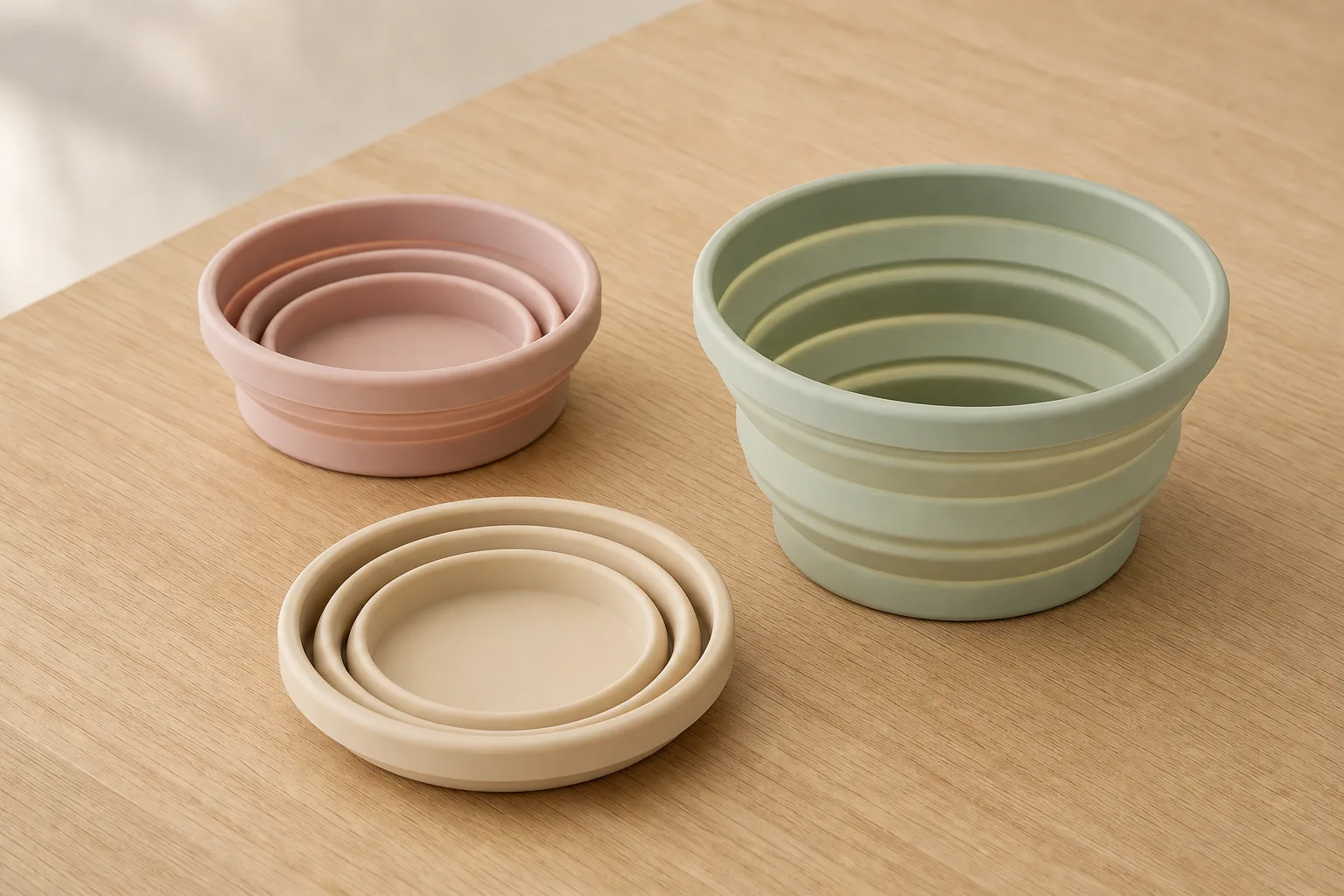 Buyer Guide
 The silicone collapsible bowl SERP is a wall of consumer roundups — “best of” affiliate lists, camping-forum reviews, and Amazon-scraped comparison tables. None of them answer the questions a housewares, outdoor, pet, baby, or medical brand actually asks when sourcing a custom program at 500-50,000 units per SKU. This dossier is that document: the compliance stack, cure-system trade-off, tooling economics, retail-tier readiness gates, and factory-vetting protocol behind a real B2B collapsible bowl OEM program. Written for procurement managers, not end consumers.
A B2B silicone collapsible bowl OEM program at 500-50,000 MOQ turns on four decisions: cure system (platinum-cured for premium and medical-adjacent, peroxide-cured with disciplined post-cure for mid-tier retail), Shore A hardness (50-60 for a 400-800 ml bowl per ASTM D2240), tooling tier (aluminum single-cavity at $2,800-$4,500 for MOQ 500, P20 steel multi-cavity at $9,000-$14,000 for MOQ 5,000+), and compliance stack (FDA 21 CFR 177.2600 plus LFGB §30/31 plus Prop 65 plus REACH SVHC, with CPSIA added if children appear on-pack). Real lead time is 7-15 days for a T1 sample and 30-45 days for mass production. Anything shorter is a red flag.
What does a real B2B sourcing workflow for a custom silicone collapsible bowl look like?
Six gates: RFQ, DFM feedback, tooling, T1 sample, PPAP-style sign-off, mass production. Total elapsed time is 90-130 days from RFQ to first landed shipment at a US or EU warehouse. Skipping the DFM feedback gate is the single most common cause of a failed first-run tolerance, and skipping the PPAP-style sign-off is the most common cause of a mid-program dispute over what "the sample" actually specified.
The B2B workflow is not the consumer-facing “click a supplier, get a sample, place an order” flow that Alibaba-style marketplaces train buyers into. It is a documented procurement chain with a paperwork gate at each step. The gates exist to catch problems at the cheapest possible stage — a tolerance disagreement resolved in DFM feedback costs $0; the same disagreement caught after tooling is cut costs $4,000-$14,000.
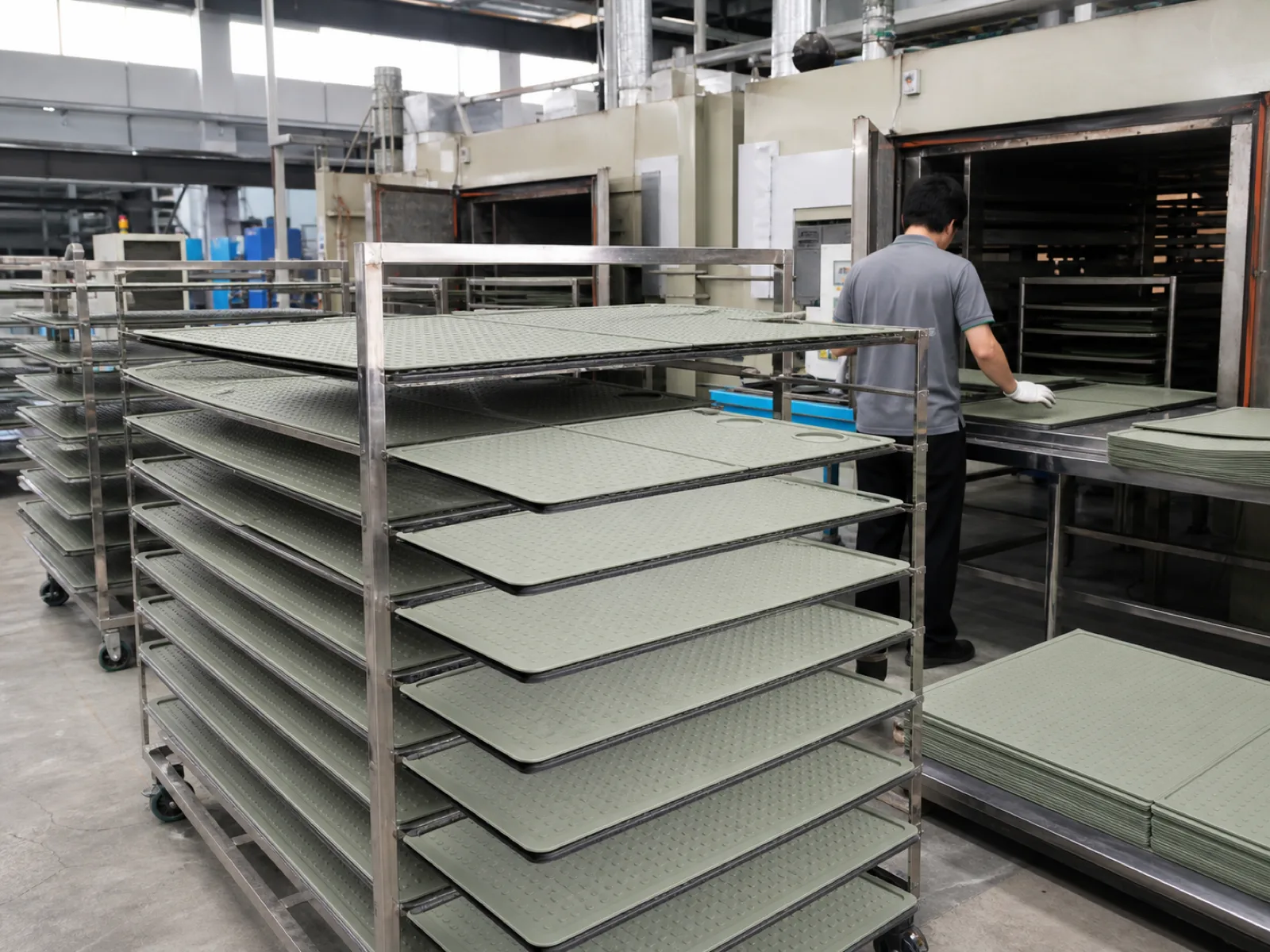
The six gates in order
- RFQ and DFM feedback (3-5 days). The buyer submits a 2D drawing or 3D STEP file, target MOQ, target Shore A hardness, target regulatory scope, and target retail tier. Wetop returns a Design-for-Manufacturability report flagging any geometry that will not release from the mold, wall thickness variation exceeding 30% (a cure-shrinkage risk), rim geometry that will not seal against a lid, and rib geometry that will fail a 5,000-cycle collapse test.
- Tooling (15-35 days). Aluminum single-cavity tools are cut in 15-20 days; P20 hardened steel multi-cavity tools in 25-35 days. Tooling cost and cavity count are set at this gate — see the tooling economics table below.
- T1 sample (7-15 days after tool completion). First shots pulled from the tool, dimensionally inspected against the CAD, subjected to Shore A hardness measurement per ASTM D22401, a 5,000-cycle collapse endurance test, and a preliminary organoleptic check. The T1 sample is the first artifact the buyer physically holds.
- PPAP-style sign-off (10-14 days, optional but recommended). Dimensional CMM report on a 32-piece sample lot, material certification chain from the compound house, cure-system lot certificate, per-batch LFGB §30/312 and PFAS test reports, and a signed control plan. IATF 169493 provides the underlying methodology.
- Mass production (30-45 days at 5,000-20,000 pcs). Cycle-time-controlled compression molding or LSR injection, with per-batch post-cure logs and outgoing QC to ISO 2859-1 AQL 1.5 major / 2.5 minor sampling4.
- Ocean freight and landed delivery (15-25 days). FOB Shenzhen or Yantian to US East / West Coast or EU ports. LCL for small first orders, FCL from ~5,000 pcs upward depending on the piece geometry and packaging density.
What the RFQ needs to contain
A serious RFQ pre-empts three rounds of back-and-forth by specifying, upfront:
- Target dimensions and capacity (400 ml, 800 ml, 1,600 ml are the common size classes)
- Target Shore A hardness (default: 55 ± 3)
- Target cure system (platinum or peroxide)
- Target regulatory scope (US only, EU, medical-adjacent)
- Target retail tier (mass, mid, premium)
- MOQ tier for pricing (500, 1,000, 5,000, 20,000)
- Custom branding requirements (deboss, pad print, laser mark)
- Custom packaging requirements (polybag, retail box, blister)
- Delivery Incoterm (FOB, CIF, DDP)
Which compliance certifications does a silicone collapsible bowl actually need?
The full stack is FDA 21 CFR 177.2600 plus LFGB §30/31 plus Prop 65 plus REACH SVHC, with CPSIA added when children appear on-pack and USP Class VI added when the program is medical-adjacent. Every certification maps to a specific per-batch test report from an accredited lab (SGS, Intertek, TÜV, Bureau Veritas). Certificates without lot references or older than 12 months are not accepted at Tier 2 retail audit.
Compliance is not a single certificate — it is a stack, and each layer answers a specific regulator’s question. Buyers who treat “food-grade” as a single yes/no field on the RFQ walk into a retail audit failure downstream. The FDA vs LFGB decoder unpacks the two food-contact layers in detail; the summary here is the full multi-layer stack a collapsible bowl program needs to clear.
The full compliance stack
| Layer | Regulation | Test artifact per batch | Applies to |
|---|---|---|---|
| US food contact | FDA 21 CFR 177.26005 | Migration test report, master-batch lot referenced | Every collapsible bowl sold in the US |
| EU food contact | LFGB §30/31 per BfR Recommendation XV2; framework Regulation (EC) 1935/20046 | Total organic volatiles report in mg/dm², mandatory post-cure gates this | Every collapsible bowl sold in the EU |
| California | Prop 65 | No-warning-required certificate | Any bowl sold or shipped into California |
| EU chemical | REACH SVHC | Declaration at 0.1% w/w threshold across the current SVHC candidate list | Every bowl entering EU customs |
| PFAS restriction | ECHA universal restriction proposal7 | PFAS non-detect report at ppb detection | EU premium retail, US West Coast retail, any PFAS-free marketing claim |
| Children on-pack | CPSIA8 | Total lead and phthalate test | Any bowl marketed for or referencing children |
| Medical-adjacent | USP <88>9 | Biological reactivity in-vivo report | Baby feeding, pet dental, personal care, wound-contact |
| Medical device | ISO 10993-110 | Biological evaluation assessment | Only where a device classification applies |
| Factory quality | ISO 9001:201511 | Current certificate plus internal audit record | Required by every Tier 2 retail chain |
What “table stakes” looks like on a Tier 2 chain audit
Tier 2 US and EU retail chains — Home Depot / Wayfair / Bed Bath & Beyond / Tesco / Carrefour caliber — audit against roughly the same package:
- ISO 9001 valid within 12 months
- Sedex SMETA 4-pillar social audit within 24 months
- Per-batch FDA + LFGB reports referencing the master-batch lot number
- PFAS non-detect at 25 ppb or better
- REACH SVHC declaration signed by an authorized officer
- Prop 65 no-warning-required certificate
Wetop maintains this package as a standing deliverable — every quote already assumes the buyer needs it. The PFAS-free sustainability explainer walks the PFAS layer specifically.
Platinum-cured vs peroxide-cured — which cure system fits a collapsible bowl program?
Platinum-cure for premium retail, EU launch, medical-adjacent, and any program with an on-pack PFAS-free claim. Peroxide-cure with mandatory 4-6 h post-cure at 180-200 °C for mid-tier retail programs where the shelf-price is $10-25 and the 15-25% platinum premium does not recover in positioning. Both are food-safe when the supplier holds the process discipline; the choice is documentation depth, not toxicological risk.
The full cure-system decision is walked in the platinum vs peroxide guide. For a collapsible bowl specifically, four program characteristics push the decision:
- On-pack PFAS-free claim. Platinum-cure is inherently PFAS-free by chemistry (Karstedt hydrosilylation uses no PFAS process aids). Peroxide-cure is PFAS-free only if the supplier switched to modern process aids (standard at reputable compound houses since ~2020) and produces a per-batch non-detect report at ppb detection. The ECHA restriction proposal7 makes this a hardening spec year over year.
- Baby-to-mouth or pet dental positioning. Both applications sit close enough to the medical-adjacent line that USP Class VI documentation9 becomes prudent. Platinum-cure hits Class VI on standard formulation; peroxide-cure rarely does — the residual peroxide byproducts fail the cytotoxicity screen.
- First-heat odor. A peroxide-cured bowl that skipped post-cure develops a faint acidic first-heat odor in dishwasher cycles. In an outdoor / travel / pet application the buyer never notices this. In a premium kitchen application the retail returns hit 3-8% and the program tanks. Platinum-cure removes the failure mode entirely.
- Multi-year program horizon. On a program running 100,000+ units per year over 3+ years, the 15-25% platinum premium is a small regulatory-drift insurance policy against future PFAS action in downstream markets.
Post-cure is the hidden variable — and the actual failure point
Peroxide-cure requires a 4-6 hour oven cycle at 180-200 °C after molding to drive off residual volatiles and clear LFGB §30/312. Suppliers who skip or shortcut this step save 4-6 hours of oven time and 20-30% of energy cost per batch — and ship product that fails EU premium retail audit downstream. On any collapsible bowl RFQ, three post-cure verification questions belong in the sourcing dossier:
- What is the standard post-cure cycle — temperature × time × oven type?
- Send the post-cure log for a recent production batch, referencing the master-batch lot number.
- Do the per-batch LFGB §30/31 reports show total-extractables in mg/dm² or just pass/fail?
Correct answers: 180-200 °C for 4-6 hours in a batch or continuous oven; yes, on request, from the last 36 months of records; quantitative values in mg/dm² measurable against BfR Recommendation XV limits. Any evasion is a red flag for the whole program.
What Shore A hardness should you specify?
Shore A 50-60 for a 400-800 ml bowl, measured on a fully post-cured finished part per ASTM D2240. Wetop's default is 55 ± 3. Softer than 50 A: sidewalls collapse under their own weight and the rim loses seal integrity against a lid. Harder than 65 A: the collapse rib creases rather than folds and initiates a stress-concentration tear within 2,000-3,000 fold-unfold cycles.
Shore A hardness controls the rim rigidity, the collapse-rib flex behavior, and the seal geometry against any lid or cover. Getting it wrong at the RFQ stage means either a bowl that collapses when full of soup or a bowl that tears at the second-most-used part of its geometry. The measurement standard is ASTM D22401 — insist on a Shore A value measured on the finished, post-cured part, not on the raw gum or the master-batch data sheet.
Hardness selection by application
| Application | Recommended Shore A | Why |
|---|---|---|
| Compact travel bowl, 200-400 ml | 55-65 A | Higher rim rigidity holds shape when clipped to a bag |
| Standard kitchen collapsible bowl, 400-800 ml | 50-60 A | Balanced rim rigidity and rib flex |
| Large family serving bowl, 1,000-1,600 ml | 60-70 A | Higher hardness needed to support fill weight without sag |
| Pet food and water bowl, 400-800 ml | 55-65 A | Chew and paw abrasion resistance |
| Baby feeding bowl, 200-400 ml | 45-55 A | Softer for infant handling and to prevent hard-edge injury |
| Medical / clinical bowl | 55-65 A + platinum-cure | Class VI compatibility plus dimensional stability |
The collapse rib itself — the accordion pleat that lets the bowl fold flat — is a stress concentration by design. A 5,000-cycle fold-unfold endurance test on the T1 sample is standard on any Wetop collapsible bowl program before the tool is released to mass production. Failure below 5,000 cycles triggers either a hardness re-spec or a rib-geometry revision in DFM.
What do tooling costs really look like at 500, 1,000, 5,000, and 20,000 MOQ?
Tooling scales in four tiers. Aluminum single-cavity at $2,800-$4,500 for MOQ 500-1,000. P20 hardened steel two-cavity at $6,000-$9,000 for MOQ 1,000-5,000. P20 four-cavity at $9,000-$14,000 for MOQ 5,000-20,000. S136 stainless four-cavity for premium platinum-LSR programs at $15,000-$22,000 for MOQ 20,000+. Amortization per piece falls from $6.00-$9.00 at MOQ 500 to below $0.08 at MOQ 20,000.
Tooling economics is the single most-misunderstood variable in silicone OEM sourcing. Consumer roundups don’t touch it. Trading offices misrepresent it. The math is straightforward once the tiers are laid out explicitly. The real-factory MOQ math walks the underlying unit economics; this table adapts the framework specifically to a collapsible bowl geometry.
Tooling cost and amortization table
| Tool tier | Material | Cavities | Cost (USD) | Rated life (shots) | Cycle time | Fits MOQ | Amortization at MOQ |
|---|---|---|---|---|---|---|---|
| Prototype | Soft aluminum | 1 | $2,800-$3,500 | 5,000-10,000 | 4-5 min | 500-1,000 | $3.50-$7.00/pc at 500 |
| Aluminum production | Hard aluminum | 1-2 | $3,500-$4,500 | 30,000-50,000 | 3-4 min | 1,000-3,000 | $1.50-$4.50/pc at 1,000 |
| Steel production | P20 hardened steel | 2 | $6,000-$9,000 | 200,000+ | 2-3 min | 3,000-10,000 | $0.60-$1.80/pc at 5,000 |
| High-volume steel | P20 hardened steel | 4 | $9,000-$14,000 | 300,000+ | 2-3 min | 10,000-50,000 | $0.20-$0.70/pc at 20,000 |
| Premium LSR | S136 stainless | 4-8 | $15,000-$22,000 | 500,000+ | 60-90 s | 20,000-100,000 | $0.15-$0.35/pc at 50,000 |
Amortization worked example
A brand orders 5,000 pieces of a collapsible bowl in Year 1 and forecasts 20,000 pieces in Year 2:
- Cutting a P20 four-cavity tool at $12,000. Amortized over the Year 1 order alone: $2.40/pc.
- Amortized over the Year 1 + Year 2 combined 25,000 pieces: $0.48/pc.
- Amortized over the tool’s rated 300,000-shot life if the program lasts: $0.04/pc.
The cheaper aluminum tool at $4,000 would amortize at $0.80/pc over Year 1 alone — visibly cheaper in Year 1 accounting. But it caps at 50,000 shots and its cycle time is 40% longer, so the piece-price on the second-year 20,000-piece order rises by $0.15-$0.25/pc versus the steel four-cavity, and the tool needs re-cutting inside Year 3. Steel wins on any program with a two-year horizon at MOQ 5,000+.
The OEM pricing structure explainer walks the full quote decomposition — tooling amortization is one line; material, labor, cure, post-cure, QC, and packaging are the others.
What retail-tier readiness gates apply to a Tier 2 chain program?
Six gates: valid ISO 9001, Sedex SMETA social audit, per-batch FDA + LFGB test reports, PFAS non-detect at ppb detection, REACH SVHC declaration, and Prop 65 no-warning certificate. Plus retail-specific gates: GS1 UPC/EAN barcode on the retail carton, country-of-origin marking, PDCA cycle documentation, and a 2-year finished-good warranty backed in writing by the manufacturer.
Tier 2 retail chain readiness — the Home Depot / Wayfair / Bed Bath & Beyond / Tesco / Carrefour caliber — is where consumer-sourcing suppliers wash out most visibly. The audit package is a fixed shape and the paperwork has to exist before the first purchase order lands.
The retail-readiness checklist
| Gate | Requirement | Typical audit frequency |
|---|---|---|
| Quality management | ISO 9001:2015 valid11 | Annual recertification |
| Social compliance | Sedex SMETA 4-pillar | Every 24 months |
| Food contact US | Per-batch FDA 21 CFR 177.26005 | Every production lot |
| Food contact EU | Per-batch LFGB §30/312 | Every production lot |
| PFAS | Non-detect at 25 ppb or better | Every production lot |
| REACH SVHC | Declaration signed by authorized officer | Annual update against current SVHC list |
| California | Prop 65 no-warning certificate | Annual |
| CPSIA (if children) | Total lead and phthalate report8 | Every production lot |
| Barcode | GS1 UPC / EAN registered in retailer’s system | One-time per SKU |
| Country of origin | Compliant marking on retail carton and product | One-time per SKU |
| Sampling | AQL 1.5 major / 2.5 minor per ISO 2859-14 | Every production lot |
| Warranty | Manufacturer-backed 2-year finished-good warranty | Program lifetime |
Wetop maintains all twelve gates as a standing deliverable. Programs specifically launching into US premium retail (Whole Foods orbit, Target Good & Gather tier) or EU premium retail additionally require the PFAS non-detect at ppb detection; NSF/ANSI 5112 documentation applies to food-equipment channel launches.
What are the common failure modes on a silicone collapsible bowl program?
Four failure modes account for over 90% of quality escalations: surface bloom, tear at the collapse rib, dishwasher fade of pigments, and odor retention. All four are specifiable against at the RFQ stage — none are unknowable manufacturing mysteries. Suppliers who cannot articulate a spec-level defense against each of the four are the ones whose programs fail Tier 2 audit downstream.
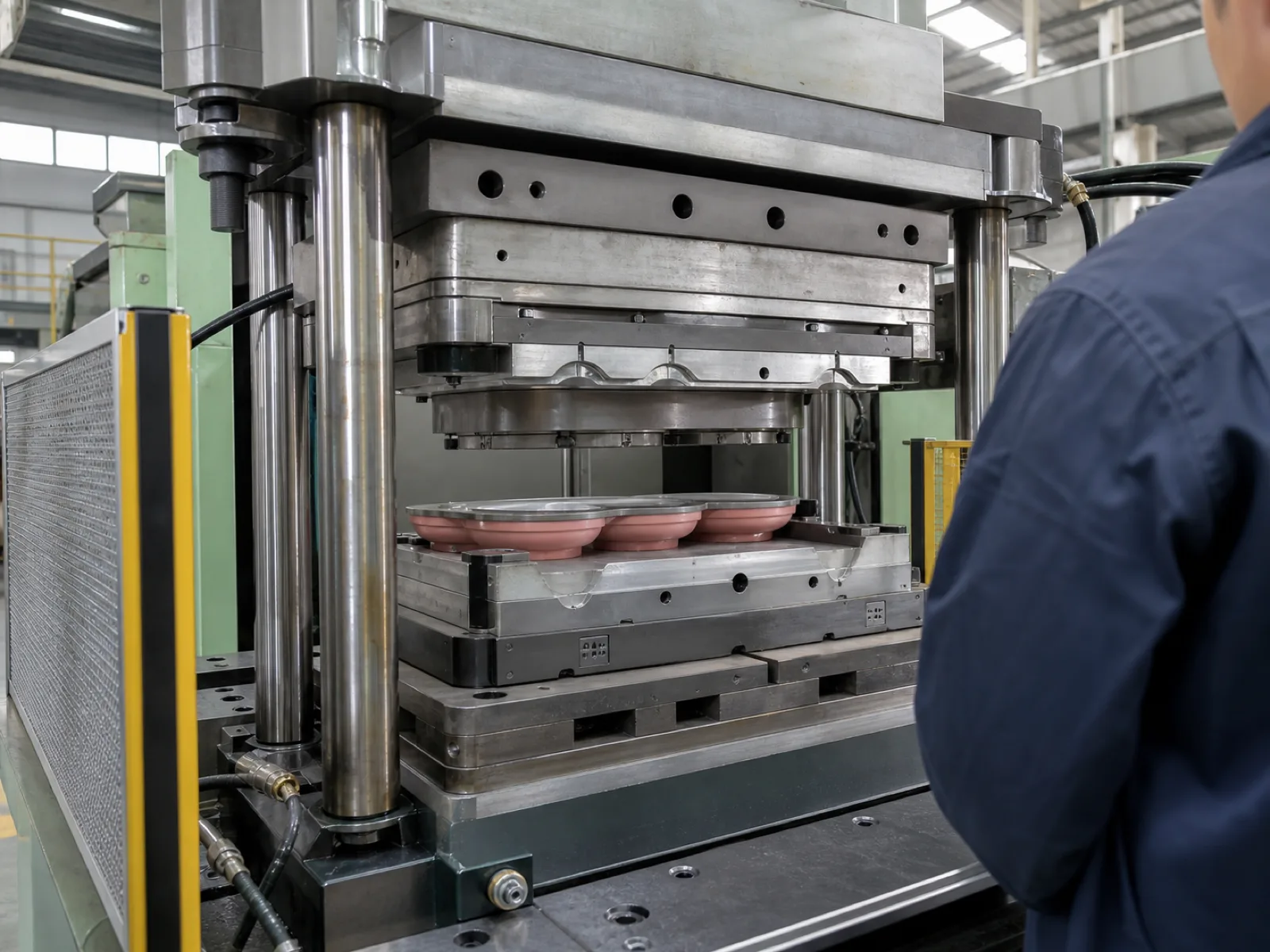
Failure mode 1 — surface bloom
Symptom. A hazy white film appearing on the bowl surface within days to weeks after production, sometimes only after the first dishwasher cycle.
Cause. Migration of low-molecular-weight silicone oligomers to the surface — either because the material was under-post-cured or because a poor-grade masterbatch left excess low-MW species in the compound.
Spec-level defense. Require platinum-cure, or verified fully post-cured peroxide-cure with per-batch total-extractables under 0.5 mg/dm² measured to LFGB §30/312. Reject any supplier who reports “pass/fail” on the extractables test without the mg/dm² value.
Failure mode 2 — tear at the collapse rib
Symptom. A split appearing at the accordion pleat after 2,000-4,000 fold-unfold cycles, propagating into a full sidewall tear within another 500-1,000 cycles.
Cause. Shore A hardness too high for the rib geometry (over 65 A on a 55 A design), tear resistance too low (under 20 kN/m), or a rib radius under the geometry-minimum in DFM.
Spec-level defense. Shore A 50-60 measured on the finished part per ASTM D22401. Tear resistance ≥ 25 kN/m to ASTM D624. 5,000-cycle collapse endurance test on the T1 sample before tool release. Minimum rib radius per Wetop’s DFM standard.
Failure mode 3 — dishwasher fade of pigments
Symptom. Bright reds, blues, or greens fading toward pastel or gray after 100-300 dishwasher cycles.
Cause. Use of organic pigments (azo dyes, phthalocyanine) that break down under alkaline detergent plus 60-80 °C wash cycles.
Spec-level defense. Food-grade inorganic pigments only — iron oxides (browns, reds, blacks, yellows), titanium dioxide (whites), chromium oxide (greens), cobalt aluminate (blues) — at 0.5-1.5% masterbatch loading. 300-cycle dishwasher endurance test on the T1 sample with a delta-E colorimetric measurement below 3 units per CIE colorimetry13.
Failure mode 4 — odor retention
Symptom. A faint acidic or “silicone” smell during the first several dishwasher cycles or when hot food is added.
Cause. Peroxide-cure decomposition byproducts (acetophenone, α-methylstyrene, dicumyl fragments) not fully driven off in post-cure. Sometimes compounded by residual mold-release agents.
Spec-level defense. Mandatory 4-6 h post-cure at 180-200 °C on every batch. Per-batch cycle log retained under ISO 900111. Consider platinum-cure for premium programs where zero first-heat odor is a specification. The temperature range explainer covers the thermal envelope in detail.
How do you tell a real factory apart from a trading office?
Five sourcing signals separate a real factory from a trading office reselling other factories' output. Cure-chemistry answered on the master-batch lot certificate, per-batch third-party test reports, a compound-house-of-record traceability chain, a same-day video walk-through of the mixing / molding / post-cure / QC lines, and a founding-engineer contact who signs the DFM report. Trading offices deflect on all five and pivot to price and lead time.
The sourcing checklist walks the full 14-point vetting protocol. The five load-bearing signals specifically:
- Cure chemistry is specified in writing. A real factory answers “platinum-cured LSR from [compound house], master-batch lot [number]” within 48 hours. A trading office answers “food-grade silicone” and cannot escalate the answer without contacting a subcontractor.
- Per-batch test reports are per-batch. A real factory produces test reports referencing the master-batch lot number of the production batch. A trading office produces a single 12-24 month-old certificate that predates your production batch by six months or more.
- Compound-house-of-record traceability. A real factory names its silicone gum supplier (Wacker, Momentive, Dow, Shin-Etsu, KCC, or a named Chinese compound house) and provides lot-level traceability. A trading office deflects.
- Live video walk-through. A real factory sends a video walk-through of the mixing, molding, post-cure oven, and QC lines within 48 hours, with today’s date stated audibly. A trading office sends stock photos or a 12-month-old video.
- A founding engineer signs the DFM report. A real factory routes the DFM feedback through a named engineer who signs the report. A trading office routes it through a sales manager who forwards a subcontractor’s PDF.
Wetop is founder-led. William Zhuo (engineering lead, 12 years silicone) signs the DFM report on every incoming RFQ personally. If the answer to your first-round questions is not signed by an engineer, you are sourcing from a trading office.
What is the realistic lead time for a first order?
7-15 days for a T1 sample; 30-45 days for mass production at 5,000-20,000 pcs; 15-25 days ocean freight to US or EU ports; 90-130 days end-to-end from RFQ to first landed shipment. A PPAP-style sign-off gate adds 10-14 days. Suppliers quoting a 20-day end-to-end lead time on a custom-tooled program are quoting on a shelf item, not the program you specified.
The lead-time breakdown by stage:
- RFQ and DFM feedback: 3-5 days
- Tooling (aluminum single-cavity): 15-20 days
- Tooling (P20 four-cavity): 25-35 days
- T1 sample after tool completion: 7-15 days
- T1 iteration if changes required: 5-10 days per round (budget one round)
- PPAP-style sign-off (optional): 10-14 days
- Mass production 5,000-20,000 pcs: 30-45 days
- Post-cure and outgoing QC: included in mass production window
- FOB Shenzhen or Yantian ocean freight: 15-25 days to US or EU ports
The MOQ and lead time explainer walks the schedule at higher fidelity. The Wetop factory sits 90 minutes from Yantian Port and 2 hours from Hong Kong International Airport — a logistics fact that trims 3-5 days off the total on any air-freighted sample or first-order shipment.
Engineer’s Note — a rejected first-run tolerance and the peroxide-free line
Founder-led decision: Wetop's collapsible bowl line runs peroxide-free by default. The line was reconfigured in 2022 after a first-run T1 sample on a Tier 2 US retail program came back with a 3.2 mg/dm² total-extractables reading — cleared FDA 21 CFR 177.2600 but sat above the LFGB §30/31 comfort threshold for a program that was heading into EU launch six months later. Wetop rejected the batch and rebuilt the line rather than shipping.
The 2022 program was for a Tier 2 US housewares brand — 40,000 pcs first order, 400 ml collapsible bowl in three colors, peroxide-cured HCR from a mid-tier Chinese compound house at $0.08/pc lower material cost than the platinum-cured LSR alternative. The T1 sample cleared FDA and cleared LFGB pass/fail. But the mg/dm² total-extractables reading — 3.2 mg/dm² against a Wetop internal comfort threshold of 2.0 mg/dm² — sat just under the LFGB compliance ceiling. The buyer’s EU launch was six months out. Shipping the batch would have technically cleared regulatory but risked a downstream failure in EU premium retail audit when volumes scaled.
William Zhuo’s call: reject the batch, refund the deposit against the sample tooling, and reconfigure the compression molding line for peroxide-free operation going forward. The line has run peroxide-free with platinum-LSR as the default cure since. Mid-tier peroxide-cure programs are still accepted on a separate line with mandatory 4-6 h post-cure at 180-200 °C and per-batch mg/dm² reporting. The default flipped because the failure mode was too close to the compliance line for a program with any EU exposure.
The industry lesson: pass/fail LFGB reports hide the actual margin against the limit. Insist on the mg/dm² value on every batch, and reject any supplier who cannot produce the quantitative reading.
What Wetop OEMs on collapsible bowls
Wetop runs custom silicone collapsible bowl programs from MOQ 500 to 100,000+ pieces per SKU — housewares, outdoor, pet, baby, and medical-adjacent brands. Full private-label with custom pantone-matched pigments, custom retail packaging, per-batch FDA + LFGB + PFAS documentation, and per-program tooling stored in the mold vault under the brand's account. Founder-led engineering on every DFM report; ISO 9001, FDA 21 CFR 177.2600, LFGB §30/31 as standing deliverables.
Wetop’s collapsible bowl book:
- MOQ tiers. 500 pcs on aluminum single-cavity, 1,000-5,000 pcs on P20 hardened steel two-cavity, 5,000-50,000 pcs on P20 four-cavity, 50,000+ on S136 stainless multi-cavity LSR.
- Cure systems. Platinum-cure LSR as the default line. Post-cured peroxide-cure HCR on a separate line for mid-tier retail programs, with mandatory 4-6 h at 180-200 °C and per-batch mg/dm² reporting.
- Hardness range. Shore A 40-70 measured on the finished post-cured part per ASTM D22401; default 55 ± 3 for a 400-800 ml collapsible bowl.
- Compliance stack. FDA 21 CFR 177.26005, LFGB §30/31 per BfR Recommendation XV2, Regulation (EC) 1935/20046, Prop 65, REACH SVHC, PFAS non-detect at 25 ppb, CPSIA for children-on-pack, USP <88>9 for medical-adjacent, ISO 10993-110 where a device classification applies.
- Retail-tier readiness. ISO 900111, Sedex SMETA, ISO 2859-1 AQL 1.5 major / 2.5 minor outgoing QC4, NSF/ANSI 5112 for food-equipment channel launches, PPAP-adjacent sign-off available for programs requesting it under IATF 16949 methodology3.
- Custom branding. Deboss, pad print, laser mark, custom pantone-matched pigments — see the logo customization guide for method trade-offs.
- Private-label programs. Full white-label with mutual NDA on file — see nda and the private-label kitchen products guide.
Sourcing a custom silicone collapsible bowl program? Email inquiry@wetopsilicone.com with your target dimensions, MOQ tier, target retail tier, and target regulatory scope. Wetop returns a DFM report signed by the engineering lead, a tooling recommendation with cavity count and cost bracket, and unit-price brackets at MOQ 500 / 1,000 / 5,000 / 20,000 within 48 hours. Full manufacturing detail on the capabilities page; anonymized program archetypes on case studies; founder-led engineering commentary and factory contact via the contact page.
Footnotes
-
ASTM International. ASTM D2240-15 — Standard Test Method for Rubber Property — Durometer Hardness. https://www.astm.org/d2240-15r21.html — the measurement standard for Shore A hardness on finished collapsible bowl parts. ↩ ↩2 ↩3 ↩4
-
German Federal Institute for Risk Assessment (BfR). Recommendation XV — Silicones. https://www.bfr.bund.de/en/bfr_recommendations_on_food_contact_materials-7498.html — the technical standard behind LFGB §30/31 for food-contact silicone, defining the organic volatile extraction test mandatory post-cure clears. ↩ ↩2 ↩3 ↩4 ↩5 ↩6
-
International Automotive Task Force. IATF 16949:2016 — Quality management systems for automotive production. https://www.iatfglobaloversight.org/iatf-169492016/ — underlies the PPAP methodology adopted for industrial and premium-retail production sign-off. ↩ ↩2
-
International Organization for Standardization. ISO 2859-1:1999 — Sampling procedures for inspection by attributes. https://www.iso.org/standard/1141.html — the AQL sampling standard used on every Wetop outgoing QC pass. ↩ ↩2 ↩3
-
US Food and Drug Administration. 21 CFR 177.2600 — Rubber articles intended for repeated use. https://www.ecfr.gov/current/title-21/chapter-I/subchapter-B/part-177/subpart-C/section-177.2600 — the primary US regulation Wetop tests every collapsible bowl batch against. ↩ ↩2 ↩3
-
European Parliament and Council. Regulation (EC) No 1935/2004 — Materials and articles intended to come into contact with food. https://eur-lex.europa.eu/legal-content/EN/TXT/?uri=CELEX%3A02004R1935-20090807 — the overarching EU framework regulation under which LFGB §30/31 sits. ↩ ↩2
-
European Chemicals Agency. PFAS Universal Restriction Proposal. https://eur-lex.europa.eu/legal-content/EN/TXT/?uri=CELEX%3A32006R1907 — the regulatory action driving PFAS-free specification adoption in EU premium retail. ↩ ↩2
-
US Consumer Product Safety Commission. Consumer Product Safety Improvement Act (CPSIA). https://www.ecfr.gov/current/title-16 — governs total lead and phthalate limits on collapsible bowls marketed for children. ↩ ↩2
-
United States Pharmacopeia. USP <88> — Biological Reactivity Tests, In Vivo. https://www.usp.org/harmonization-standards/pdg/excipients/plastic-materials — defines USP Class VI biological reactivity classification for medical-adjacent silicone. ↩ ↩2 ↩3
-
International Organization for Standardization. ISO 10993-1:2018 — Biological evaluation of medical devices — Part 1. https://www.iso.org/standard/68936.html — the biocompatibility standard applied when a collapsible bowl program crosses the medical-adjacent threshold. ↩ ↩2
-
International Organization for Standardization. ISO 9001:2015 — Quality Management Systems — Requirements. https://www.iso.org/standard/62085.html — the quality management standard Wetop is certified against. ↩ ↩2 ↩3 ↩4
-
NSF/ANSI. NSF/ANSI 51 — Food Equipment Materials. https://www.ecfr.gov/current/title-21/chapter-I/subchapter-B/part-177 — applies to food-equipment channel launches. ↩ ↩2
-
International Commission on Illumination. CIE Colorimetry, 4th Edition. https://cie.co.at/publications/colorimetry-4th-edition — the standard behind delta-E colorimetric measurement for dishwasher-endurance pigment testing. ↩
FAQ
-
What is the minimum order quantity for a custom silicone collapsible bowl?
Wetop's MOQ is 500 pieces per SKU on a single-cavity aluminum tool. Below 500 the amortized tooling cost per piece exceeds the piece price itself and the RFQ economics stop working. At 5,000 pieces we recommend upgrading to a multi-cavity P20 hardened steel tool because the tool cost amortizes below $0.35/pc within the first 24 months and the cycle time drops by 55-70%. See the [MOQ and lead time explainer](/guide/moq-and-lead-time-silicone-oem/) for the full math.
-
How long does a full OEM program take from RFQ to first mass-production shipment?
Realistic timeline: 3-5 days RFQ review and DFM feedback, 15-25 days tooling (aluminum) or 25-35 days (P20 steel), 7-15 days T1 sample and iteration, 30-45 days mass production of the first order at 5,000-20,000 pcs, plus 15-25 days ocean freight to US or EU ports. A PPAP-style dimensional and material sign-off gate adds 10-14 days. End-to-end for a first order landed at a US warehouse: 90-130 days.
-
What tooling cost tiers should we plan for and how does amortization work?
Aluminum single-cavity: $2,800-$4,500, good for 30,000-50,000 shots. P20 hardened steel two-cavity: $6,000-$9,000, good for 200,000+ shots. P20 four-cavity: $9,000-$14,000. S136 stainless four-cavity for premium platinum-LSR: $15,000-$22,000. Amortization at MOQ 500 adds $6.00-$9.00 per piece to the aluminum tool cost; at MOQ 5,000 the steel four-cavity tool adds $0.20-$0.35 per piece; at 20,000+ the tool cost per piece falls below $0.08 and effectively disappears from the RFQ.
-
What compliance documentation is table stakes for a Tier 2 US or EU retail chain?
FDA 21 CFR 177.2600 for food-contact silicone[^fda-177-2600]; LFGB §30/31 per BfR Recommendation XV[^bfr-lfgb-xv]; California Prop 65 no-warning-required certificate; REACH SVHC declaration at 0.1% threshold; CPSIA total lead and phthalate compliance if the on-pack copy references children[^cpsia-silicone]; a per-batch PFAS non-detect report at ppb detection limits. Tier 2 chains (Home Depot / Wayfair / Bed Bath & Beyond / Tesco / Carrefour caliber) additionally require Sedex SMETA 4-pillar social audit and ISO 9001[^iso-9001] evidence.
-
How do we spec against the common failure modes — bloom, rib tear, dishwasher fade, odor?
Bloom: require platinum-cure or verified fully post-cured peroxide with per-batch total-extractables under 0.5 mg/dm² per LFGB §30/31[^bfr-lfgb-xv]. Rib tear: spec Shore A 50-60 measured to ASTM D2240[^astm-d2240] with tear resistance ≥ 25 kN/m to ASTM D624, plus a 5,000-cycle collapse test on the T1 sample. Dishwasher fade: require food-grade inorganic pigments (iron oxides, titanium dioxide) at 0.5-1.5% masterbatch loading and a 300-cycle dishwasher endurance test. Odor: mandate 4-6 h post-cure at 180-200 °C with a per-batch cycle log referencing the master-batch lot number.
-
How do we tell a real factory apart from a trading office without visiting China?
Ask five questions in writing. (1) What cure system is on the master-batch lot certificate — platinum, peroxide, or condensation? (2) Send a post-cure oven log for a recent production batch. (3) Send the per-batch LFGB §30/31 total-extractables value in mg/dm², not pass/fail. (4) Which compound house of record supplies your gum, and what is the batch traceability chain? (5) Send a video walk-through of the mixing, molding, post-cure, and QC lines with today's date audibly stated. A real factory answers all five within 48 hours. A trading office redirects to price and lead time. See the [sourcing checklist](/guide/sourcing-silicone-factory-checklist/) for the full 14-point vetting protocol.
-
Can Wetop private-label a collapsible bowl program or does the brand need to be Wetop?
Full private-label and white-label programs are the majority of our book. Your brand name debossed or pad-printed on the base, custom pantone-matched pigments, custom retail packaging with your barcode and country-of-origin marking, and per-batch documentation issued in your brand's name. NDA on file before the first RFQ (available at [nda](/nda/)), plus a mutual IP clause covering tooling ownership. Tooling is billed to the brand and stored in Wetop's mold vault under your account for the program's lifetime.
-
What Shore A hardness is right for a 400-800 ml collapsible bowl?
Shore A 50-60 measured on a fully post-cured finished part per ASTM D2240[^astm-d2240]. Softer than 50 A: the sidewall wants to collapse under its own weight and the rim loses seal integrity. Harder than 65 A: the collapse rib creases rather than folds, and repeated cycling initiates a stress-concentration tear within 2,000-3,000 fold-unfold cycles. Wetop's default spec on a mid-size collapsible bowl is Shore A 55 ± 3, verified at incoming raw-gum QC and again on the finished part after post-cure.
-
Do you support PPAP-style production sign-off for retail and industrial programs?
Yes. A PPAP-adjacent gate — first article inspection, dimensional CMM report, material certification chain, cure-system lot cert, per-batch LFGB and PFAS test reports, and a signed control plan — adds 10-14 days between T1 sample approval and mass production. IATF 16949[^iatf-16949] governs the underlying methodology and applies whenever an industrial or automotive-adjacent program specifies it. Retail programs typically request a lighter FAI with material certs and a 32-piece dimensional sample; medical-adjacent programs request the full PPAP with ISO 10993-1 documentation[^iso-10993].
-
What outer diameter and collapsed-height tolerances can you actually hold on a nested collapsible bowl set?
For a 3-piece nested collapsible bowl set (typically 400 ml / 800 ml / 1,600 ml) sold as a stackable retail SKU, Wetop holds ±0.3 mm on the outer rim diameter and ±0.5 mm on collapsed height across a P20 four-cavity tool, measured on a 32-piece CMM sample per lot to ISO 2859-1 AQL 1.5 major sampling[^iso-2859-1]. That tolerance is what a premium housewares brand caliber (OXO / Joseph Joseph tier) needs to guarantee that the 400 ml bowl sits inside the 800 ml when nested for retail-shelf display and packaging carton fit. Looser than ±0.5 mm on rim diameter and the smaller bowl rattles inside the larger during ocean freight, opening a packaging-damage failure mode at the retail DC. Looser than ±0.8 mm on collapsed height and the retail carton no longer closes cleanly on the top flap, forcing a repack at the 3PL warehouse. The controlling variables are cure-shrinkage repeatability (target ≤ 1.8% variation across cavities on a platinum-cured LSR run), post-cure oven uniformity (±3 °C corner-to-corner across the batch oven), and rim thickness at the sealing bead (2.2-2.8 mm on a 400-800 ml bowl). A trading office cannot commit to these numbers in writing because they do not control the tooling — they resell whatever the subcontracted factory shipped. Ask for the cavity-by-cavity dimensional report on the T1 sample as a real-factory signal.
References
Authoritative sources cited in this guide
- US Food and Drug Administration (Code of Federal Regulations). 21 CFR 177.2600 — Rubber articles intended for repeated use. https://www.ecfr.gov/current/title-21/chapter-I/subchapter-B/part-177/subpart-C/section-177.2600 — The primary US regulation governing food-contact silicone. Every Wetop collapsible bowl batch is tested against this section by an accredited third-party lab.
- German Federal Institute for Risk Assessment (BfR). BfR Recommendation XV — Silicones. https://www.bfr.bund.de/en/bfr_recommendations_on_food_contact_materials-7498.html — The technical standard behind LFGB §30/31 for food-contact silicone. Defines the organic volatile extraction test that mandatory post-cure clears.
- International Organization for Standardization. ISO 9001:2015 — Quality Management Systems — Requirements. https://www.iso.org/standard/62085.html — The quality management standard Wetop is certified against — governs batch traceability, cure documentation, and post-cure records referenced throughout this dossier.
- International Organization for Standardization. ISO 2859-1:1999 — Sampling procedures for inspection by attributes. https://www.iso.org/standard/1141.html — AQL sampling standard used on every Wetop outgoing QC pass — typically AQL 1.5 major / 2.5 minor for retail programs.
- ASTM International. ASTM D2240-15 — Standard Test Method for Rubber Property — Durometer Hardness. https://www.astm.org/d2240-15r21.html — The standard behind Shore A hardness measurement on finished collapsible bowl parts.
- United States Pharmacopeia. USP <88> — Biological Reactivity Tests, In Vivo. https://www.usp.org/harmonization-standards/pdg/excipients/plastic-materials — USP Class VI biological reactivity classification for medical-adjacent silicone (baby feeding, pet dental, personal care).
- European Chemicals Agency (ECHA). PFAS Universal Restriction Proposal (2023). https://eur-lex.europa.eu/legal-content/EN/TXT/?uri=CELEX%3A32006R1907 — The regulatory action driving PFAS-free specification adoption in EU premium retail and, downstream, US West Coast retail.
- European Parliament and Council. Regulation (EC) No 1935/2004 — Materials and articles intended to come into contact with food. https://eur-lex.europa.eu/legal-content/EN/TXT/?uri=CELEX%3A02004R1935-20090807 — The overarching EU framework regulation for food-contact materials, under which LFGB §30/31 sits.
- US Consumer Product Safety Commission. CPSIA — Consumer Product Safety Improvement Act. https://www.ecfr.gov/current/title-16 — Governs total lead and phthalate limits on any collapsible bowl marketed for children or referencing children on-pack.
- International Automotive Task Force. IATF 16949:2016 — Quality management systems for automotive production. https://www.iatfglobaloversight.org/iatf-169492016/ — Underlies the PPAP methodology adopted for industrial and premium-retail production sign-off.
- International Organization for Standardization. ISO 10993-1:2018 — Biological evaluation of medical devices — Part 1. https://www.iso.org/standard/68936.html — Biocompatibility standard applied whenever a collapsible bowl program crosses the medical-adjacent threshold (baby-to-mouth, veterinary clinical, wound-contact).
Start a custom program
Send a brief. Get an engineer’s reply in one business day.
Every Wetop program is tooled from a customer’s specification. Send a CAD file (STEP · IGES · DWG) or a written brief and we’ll reply with a mold cost estimate, price brackets at MOQ 500 / 1,000 / 5,000, and any engineering questions.