Buyer Guide · commercial intent
Silicone Ice Tray OEM Guide — Cure, Compliance, Tooling, MOQ
What changed: First publication under v2 advanced-GEO standard — benchmarked against consumer-roundup SERP incumbents and rewritten from the factory floor with FDA/LFGB clause citations, platinum-cure VOC bake-out spec, MOQ 500 pricing structure, and the Tier 2 retail chain audit checklist that no consumer-facing page on this SERP covers.
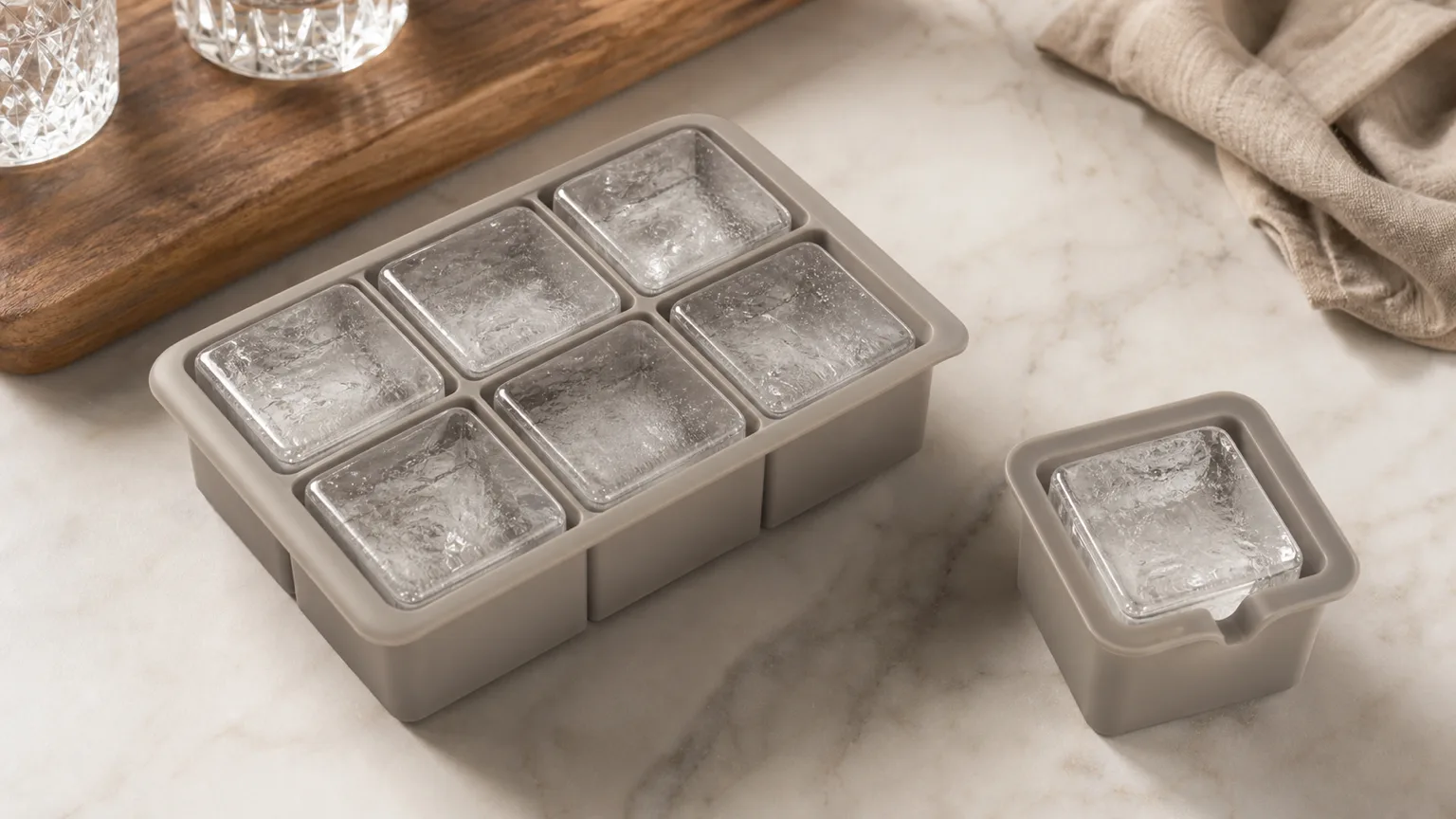 Buyer Guide
 The silicone ice tray SERP is 100% consumer roundup — affiliate lists, cocktail-blog recommendations, whiskey-cube reviews. None of it is useful to a procurement team sourcing a private-label or OEM ice tray program for Tier 2 retail placement. This guide is the engineering reality of manufacturing the product: cure chemistry, cavity tooling, MOQ-tier FOB pricing, Shore A selection tied to cube release, and the six-document audit stack a Home Depot / Wayfair / Bed Bath / Tesco / Carrefour buyer will actually run against a supplier. Written from inside a working founder-led OEM factory floor in Dongguan, not from a consumer surface.
A silicone ice tray is a single-material PDMS molded part at Shore A 40-70 durometer, produced by compression molding or liquid silicone injection, cured under mandatory 4-6 hour post-cure at 180-200°C to clear LFGB §30/31 organic volatile testing per BfR Recommendation XV. For B2B OEM programs, MOQ 500 pieces per SKU delivers per-batch FDA 21 CFR 177.2600 + LFGB + PFAS non-detect test reports. FOB Yantian for a standard 14-cavity 33 mm-cube platinum-cure tray with debossed logo runs $2.20-$2.85 at 500 pieces, dropping to $1.30-$1.75 at 5,000 pieces. Total realistic lead from RFQ to US warehouse: 60-90 days including 14-18 day Yantian sailing.
What is a silicone ice tray, engineered for OEM production?
A silicone ice tray is a single-material molded part in polydimethylsiloxane (PDMS) silicone at Shore A 40-70 durometer per ASTM D2240[^astm-d2240], produced either by compression molding of HCR silicone gum or by liquid silicone injection molding (LSR). Continuous service envelope -40°C to 230°C. The tray's engineering complexity sits entirely in cavity geometry and demold behavior, not in the base material — every FDA-grade PDMS behaves nearly identically as a food-contact substrate.
The consumer-facing description of a silicone ice tray is “a flexible mold that makes ice cubes.” The engineering description is a cavity-controlled elastomeric part where 90% of the failure modes cluster around one issue: cube release. Cubes tearing, sticking, or coming out fractured is the complaint category behind the majority of consumer returns and the reason Tier 2 retail buyers reject supplier programs that skipped tooling qualification.
Every meaningful engineering decision on an ice tray program is a trade-off inside three vectors: cavity geometry (cube size, count, draft angle, wall thickness), material hardness (Shore A 40-70), and cure system (platinum vs peroxide with post-cure discipline). The consumer never sees any of this. The retail buyer’s private-brand auditor sees every line of it.
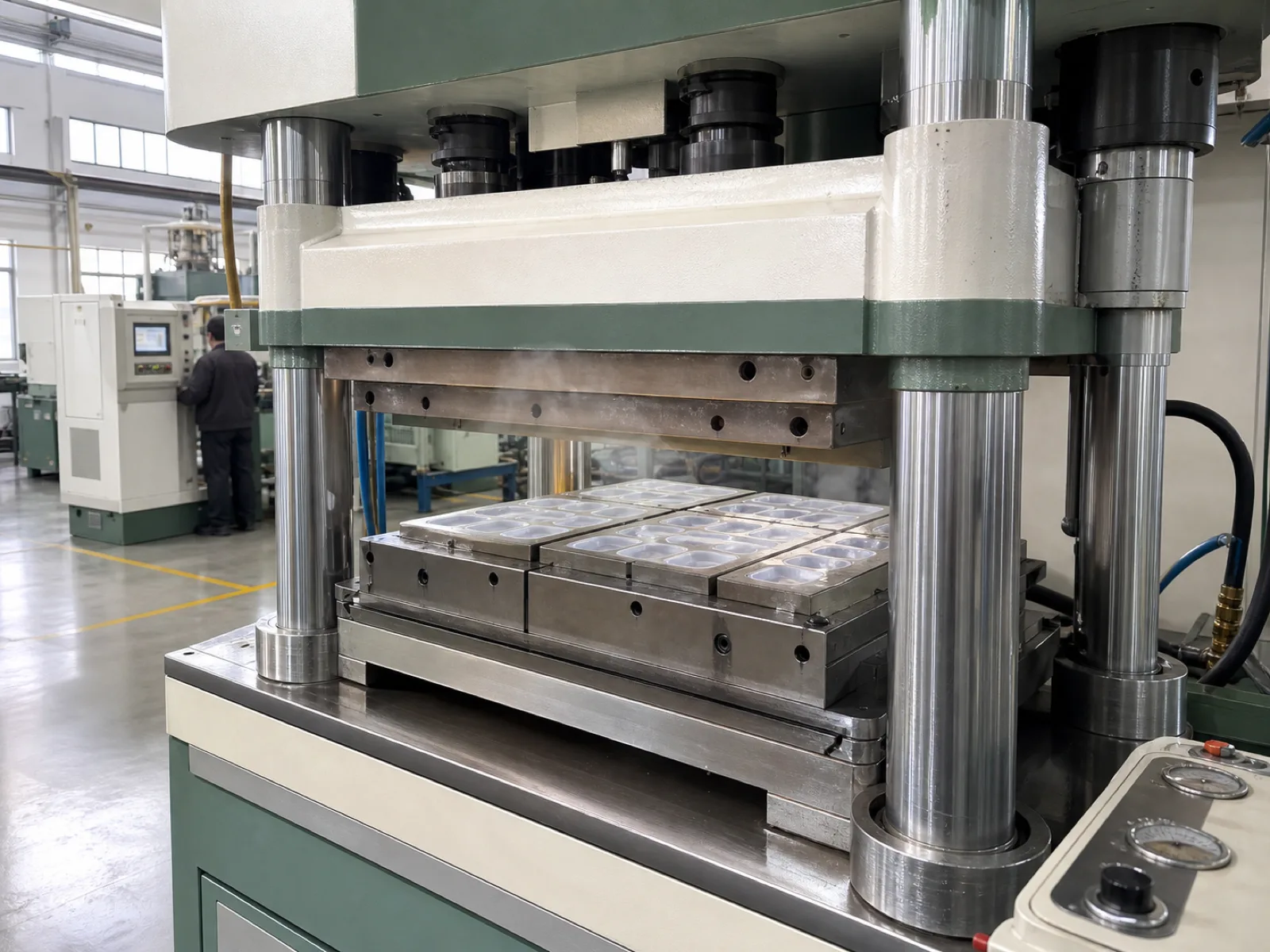
Baseline engineering spec sheet
| Parameter | Standard range | Test method |
|---|---|---|
| Shore A hardness | 40-70 (retail default 45-55) | ASTM D22401 |
| Wall thickness (cavity wall) | 1.8-3.5 mm | Digital caliper cross-section |
| Base thickness (tray floor) | 3.0-6.0 mm | Digital caliper |
| Cavity draft angle | 1.5-2.5° | Tooling drawing verification |
| Cube dimensional tolerance | ±0.5 mm on 33 mm cube | 5-point sampling per cavity |
| Tensile strength | ≥ 6.0 MPa | ASTM D412 |
| Elongation at break | ≥ 300% | ASTM D412 |
| Tear resistance | ≥ 20 kN/m | ASTM D624 |
| Compression set (22 h @ 175°C) | ≤ 25% | ASTM D395 |
| Continuous service temperature | -40°C to 230°C | Material spec + LFGB thermal cycling |
| Cure system | Platinum (LSR / HCR-Pt) or peroxide (HCR) | Master-batch lot certificate |
| Cure temperature at press | 160-200°C | Press log |
| Post-cure (VOC bake-out) | 4-6 h @ 180-200°C | Batch oven log |
The compression-set spec matters on ice tray programs specifically because cavities under repeated fill-freeze-flex-release cycles deform. A tray with compression set >30% after 22 hours at 175°C will start to lose cavity geometry after 12-18 months of consumer use, causing cubes to come out increasingly irregular — a slow-motion quality complaint that Tier 2 retailers with 2-year return policies feel directly.
What certifications does a silicone ice tray need for retail?
The mandatory stack for retail programs is FDA 21 CFR 177.2600[^fda-177-2600] (US food contact), LFGB §30/31 organic volatile testing per BfR Recommendation XV[^bfr-lfgb-xv] (EU food contact), California Prop 65 heavy-metals declaration, EU 1935/2004 framework[^ec-1935-2004] declaration for EU shipments, ISO 9001:2015[^iso-9001] (factory quality system), and per-batch PFAS non-detect testing. Home Depot, Wayfair, Bed Bath, Tesco, and Carrefour tier procurement teams audit against all six documents per master-batch lot.
The certification stack is documentation-depth, not binary pass/fail. Every level of retail positioning raises the bar on which reports the buyer’s auditor expects to see on file, referencing which lot, issued by which accredited lab.
The six-layer certification stack
Layer 1 — FDA 21 CFR 177.2600 (US baseline). The primary US regulation governing food-contact silicone (and other rubber articles) intended for repeated use. Tests aqueous, 8% ethanol, and n-heptane extractables against defined limits. Every US retail SKU needs this on file. Wetop tests per master-batch lot at accredited third-party labs (SGS, Intertek, TÜV, Bureau Veritas).
Layer 2 — LFGB §30/31 (EU / premium US). German Food and Feed Code sections 30 and 31, grounded in BfR Recommendation XV2 and framed by EU Regulation 1935/20043. Tests organic volatile extractables under stricter protocols than FDA — the reason mandatory 4-6 hour post-cure bake-out exists. Any EU retail program and any US premium retail demand this alongside FDA.
Layer 3 — California Prop 65 heavy-metals. Not silicone-specific but mandatory for CA retail: declaration and periodic testing that heavy-metal migration is below the Safe Harbor levels. Testing per 21 CFR 175.300 extractables methodology on the finished part. Wetop bundles this into the standard test packet.
Layer 4 — ISO 9001:2015 (quality system). The internationally recognized quality management system standard — certifies the factory’s documented process discipline. Auditors verify certificate validity, scope (silicone molding must be in-scope), and current calendar date. Wetop’s scope covers compression molding, LSR injection, secondary process, and QC.
Layer 5 — PFAS non-detect (accelerating requirement). Per-batch PFAS testing at parts-per-billion detection limits from an accredited lab. Not a formal certification — a test report on the finished-part material. Driven by the ECHA universal restriction proposal4 and downstream retailer spec adoption. Now table-stakes on any EU premium program and increasingly required on US Tier 2 retail placement.
Layer 6 — CPSIA (children’s tier only). The Consumer Product Safety Improvement Act5 framework — required for any silicone ice tray program marketed for baby-food freezing, infant purée cubes, or children’s beverage cubes. Adds phthalates and lead testing per 16 CFR 1303.
Tier-specific document expectations
| Retail tier | FDA | LFGB | Prop 65 | ISO 9001 | PFAS | CPSIA | NSF 516 |
|---|---|---|---|---|---|---|---|
| US mass retail ($6-12 shelf) | Required | Recommended | Required | Required | Recommended | — | — |
| US premium retail ($12-25 shelf) | Required | Required | Required | Required | Required | — | — |
| EU retail (all tiers) | Required | Required | — | Required | Required | — | — |
| Infant / baby-food cube tier | Required | Required | Required | Required | Required | Required | — |
| Commercial bar / food-service | Required | Required | Required | Required | Required | — | Required |
| Amazon FBA private-label | Required | Recommended | Required | Required | Recommended | Conditional | — |
Full FDA-vs-LFGB decision breakdown on our FDA vs LFGB silicone decoder.
Platinum-addition vs peroxide cure — the ice tray decision
Platinum-addition cure (LSR or platinum HCR) is the default for EU premium, PFAS-free positioning, infant / baby-food cube tier, and any program at $12+ shelf price. Peroxide-cure HCR with disciplined 4-6 hour VOC bake-out post-cure at 180-200°C is functionally equivalent for US mid-tier retail at $6-12 shelf price. Ice tray programs amplify the cure choice because product sits in direct freezer / drink contact, and under-post-cured peroxide-cure will transfer trace odor to the first several batches of ice.
Both cure systems polymerize the same PDMS backbone; the catalyst is where they diverge. Platinum-cure uses a platinum-complex catalyst that crosslinks the polymer via hydrosilylation with no organic byproducts. Peroxide-cure uses an organic peroxide (typically dicumyl peroxide or 2,4-dichlorobenzoyl peroxide) that leaves acetophenone or chlorobenzene fragments as post-reaction residuals — these are what the LFGB §30/31 test measures and what the mandatory post-cure oven cycle drives out of the finished part.
For ice tray programs, the residual VOC issue matters in a specific way: consumers routinely comment on “silicone taste” or “plastic smell” on the first several ice batches from a new tray. That complaint category is not the silicone itself — cured PDMS is odor-neutral — it is under-post-cured peroxide-cure product where residual peroxide fragments migrate into the ice during the first freeze-thaw cycles. Platinum-cure eliminates the mechanism; well-post-cured peroxide-cure neutralizes it. Commodity factories that skip post-cure ship the complaint.
Cure system cost delta at ice tray MOQ tiers
| Cure system | 500 pcs (14-cavity 33 mm) | 1,000 pcs | 5,000 pcs | 10,000 pcs |
|---|---|---|---|---|
| Peroxide-cure HCR (post-cured, PFAS-free verified) | $1.85-$2.35 | $1.50-$1.95 | $1.10-$1.45 | $0.90-$1.20 |
| Platinum-cure LSR / HCR-Pt | $2.20-$2.85 | $1.75-$2.30 | $1.30-$1.75 | $1.10-$1.45 |
| Delta | +15-25% | +15-22% | +15-22% | +15-20% |
Numbers are FOB Yantian, Q3 2026 benchmarks, 14-cavity 33 mm-cube tray with 1-color debossed logo, PDMS at Shore A 45-55, standard wall thickness 2.5 mm. Custom Pantone-matched master-batch adds $0.10-$0.18 per unit. Silicone lid add-on runs $0.35-$0.55 per unit at 5,000 pcs tier.
Full cure decision framework on the platinum-cured vs peroxide-cured silicone guide. The temperature envelope both cures clear on the silicone temperature range explainer.
Why the VOC bake-out post-cure is non-negotiable
A properly documented post-cure runs 4-6 hours at 180-200°C in a forced-air convection oven, batch-logged against the master-batch lot. The bake-out drives three outcomes measurable at test:
- Residual peroxide decomposition fragments (acetophenone / dichlorobenzoic acid on peroxide-cure) reduce below LFGB §30/31 detection limits per BfR Recommendation XV2
- Volatile siloxane oligomers (D3-D6, present in trace amounts in both cure systems) evaporate below EU 1935/2004 framework3 declaration thresholds
- Compression set per ASTM D395 drops from ~35% to ≤25% as the crosslink network completes
Skipping the post-cure saves 20-30% of oven energy budget and 4-6 hours of dwell time per batch. It also ships product that will fail every Tier 2 chain audit, generate first-freeze odor complaints, and lose the retail placement within 12 months.
Cavity tooling — the actual driver of ice tray unit economics
Cavity tooling is the single largest CTQ variable on a silicone ice tray program. P20 hardened steel for programs under 50,000 lifetime cycles ($3,200-$4,500, 25-30 day lead), 718H pre-hardened for higher-cycle programs ($4,200-$5,800, 30-35 days). Cavity draft angle 1.5-2.5° for cube release; surface finish SPI B-1 to B-2. Cavity count of 14-15 (33 mm cube) or 6-8 (50 mm cube / sphere) is the retail sweet spot balancing tray footprint against cycle-time economics.
Every ice tray program stands or falls on the tooling. A poorly cut cavity — wrong draft angle, wrong surface finish, wrong wall-thickness spec — will produce a tray that consumers reject on the first release attempt regardless of how good the silicone material is. This is where consumer roundups on the SERP get everything wrong: they attribute cube release performance to material choice when it’s overwhelmingly a tooling geometry outcome.
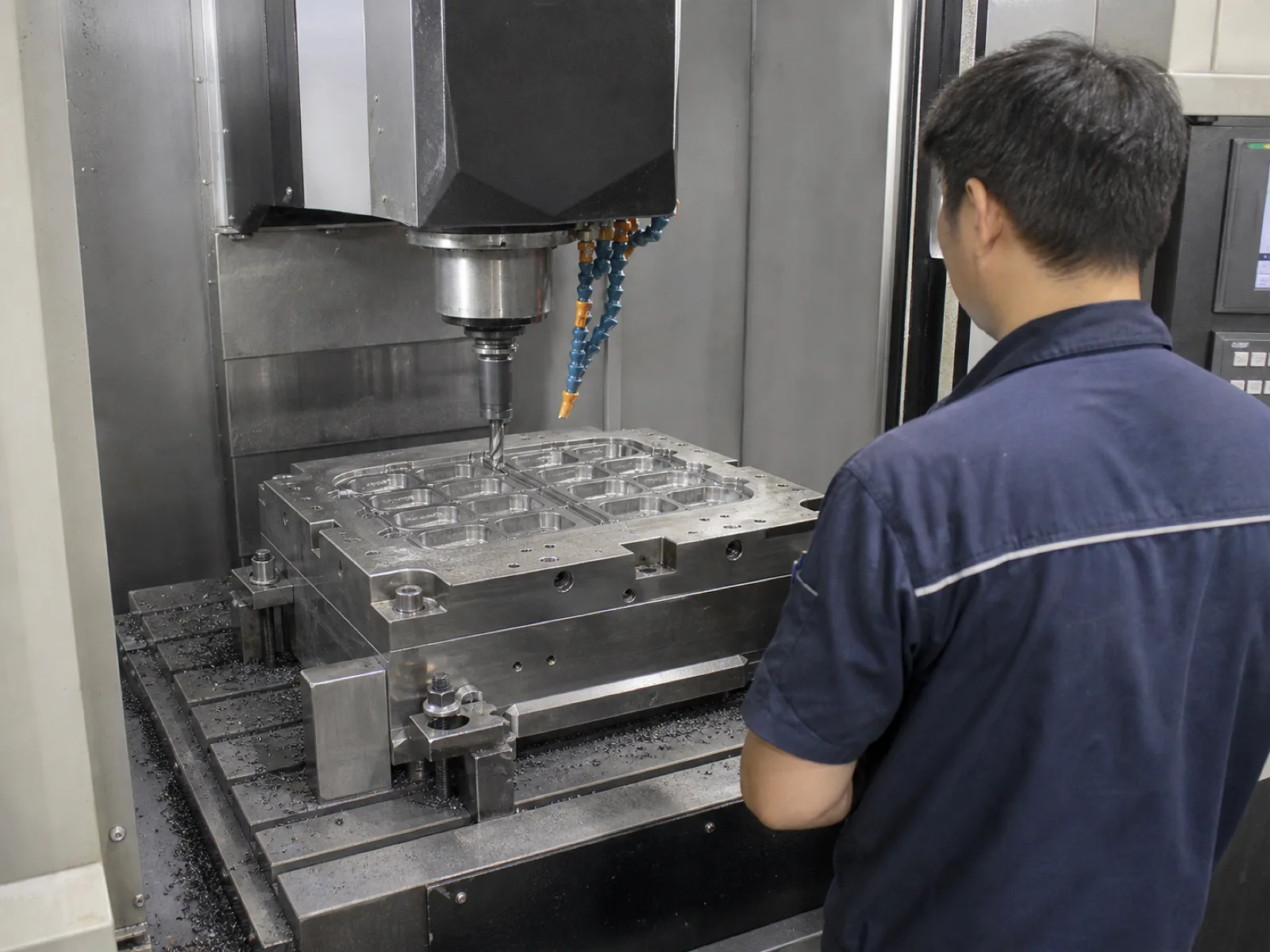
Steel grade selection matrix
| Program lifetime | Steel grade | Tooling cost (14-cavity) | Lead time | Best for |
|---|---|---|---|---|
| ≤ 25,000 lifetime cycles | P20 hardened | $3,200-$4,000 | 25-28 days | Seasonal / promotional / test-in-market SKUs |
| 25,000-50,000 cycles | P20 hardened | $3,600-$4,500 | 28-30 days | Standard retail line, 12-18 month refresh cycle |
| 50,000-150,000 cycles | 718H pre-hardened | $4,200-$5,200 | 30-33 days | Multi-year retail program, high-volume repeat order |
| 150,000+ cycles | S136 corrosion-resistant | $5,000-$5,800 | 33-35 days | High-humidity or long-service commercial-tier programs |
Novelty cavity geometries (sphere, diamond, holiday shapes, character molds) add 5-10 days and $1,500-$3,000 to the tooling for the additional CNC hours, undercut features, and — on sphere or complex geometries — hot-runner or side-action requirements.
Cavity geometry decision drivers
Four variables drive cavity geometry choice on a retail ice tray program:
- Cube size — 33 mm standard for whiskey-glass / cocktail service (retail default), 50-60 mm large-format for premium cocktail and specialty positioning, 25 mm mini for smoothie and juice service, custom sphere / diamond / novelty for seasonal SKUs.
- Cavity count — driven by target tray footprint (fitting standard home freezer drawer at 250-320 mm long) and the cavity size chosen. 14-15 cavities is the 33 mm sweet spot; 6-8 for 50 mm.
- Draft angle — 1.5-2.5° per cavity wall for clean release without stretching the material. Cavities with <1° draft require aggressive flex on demold and tear at cube corners over cycle life.
- Wall thickness — 1.8-2.5 mm between adjacent cavities (retail), 2.5-3.5 mm for commercial-bar service. Under 1.8 mm the wall flexes during pouring and cubes fill unevenly; over 3.5 mm the tray becomes overweight and expensive per unit.
Full tooling-cost logic in the silicone OEM pricing structure guide. The MOQ math is on the real factory MOQ math guide.
Shore A hardness selection tied to demold ease and cube release
Shore A 40-50 for maximum cube release ease on standard 33 mm cube geometry, Shore A 55-65 for large-format cubes and spheres where wall stiffness matters during pouring, Shore A 65-70 for commercial-bar programs requiring stacking durability. Hardness is coupled to cavity count and cube geometry — a Shore A 40 tray with 60 cavities will flex enough during pouring to spill water between cavities, so hardness selection is a systems decision not a material spec chosen in isolation.
Shore A durometer per ASTM D22401 measures the material’s resistance to indentation — functionally, how easily the cavity walls flex when the user twists the tray to release cubes. Softer material (Shore A 40) flexes easily, releases cubes cleanly with minimal user effort, but sacrifices stiffness. Harder material (Shore A 70) holds shape rigidly but requires more force to demold and can crack cubes at release if the draft angle isn’t matched.
Hardness selection by program archetype
| Program archetype | Shore A | Cavity count | Cube geometry | Rationale |
|---|---|---|---|---|
| Standard retail cube tray | 45-55 | 12-15 | 33 mm cube | Best release ease at retail cube size |
| Large-format whiskey / sphere | 55-65 | 4-8 | 50-60 mm cube or sphere | Wall stiffness for pouring; flex still enough for release |
| Baby-food / infant purée cube | 40-50 | 8-12 | 25-35 mm cube with rounded floor | Softer for easy purée release without cavity distortion |
| Novelty / character mold | 45-55 | 8-24 | Complex geometry | Balances demold relief with detail retention |
| Commercial bar / food-service | 60-70 | 4-8 | 50-65 mm | Stacking durability, rack service |
The relationship between hardness, cavity count, and geometry is captured in a simple heuristic Wetop uses at RFQ: for every 10 additional cavities beyond the retail default of 15, add 5 Shore A points to preserve tray-level stiffness. A 30-cavity mini-cube tray at Shore A 40 will flex during pouring; at Shore A 50 it won’t.
MOQ tiers and FOB Yantian pricing structure
Wetop's MOQ is 500 pieces per SKU — the minimum that supports per-batch third-party FDA + LFGB + PFAS test report economics. FOB Yantian Q3 2026 benchmarks for a standard 14-cavity 33 mm-cube platinum-cure ice tray with 1-color debossed logo: 500 pcs $2.20-$2.85, 1,000 pcs $1.75-$2.30, 5,000 pcs $1.30-$1.75, 10,000 pcs $1.10-$1.45, 20,000+ pcs quoted per program. Tooling amortizes into per-unit price on first order.
The 500-piece MOQ is not arbitrary. Below 500 pieces per SKU, the per-batch third-party test report cost — FDA + LFGB + PFAS + Prop 65 heavy-metals at approximately $900-$1,400 combined per lot — dominates per-unit price and blocks retail competitiveness. Above 500 pieces the test cost amortizes to $1.80-$2.80 per piece and drops fast: at 5,000 pieces it’s down to $0.18-$0.28 per piece; at 10,000 pieces $0.09-$0.14.
Full MOQ-tier FOB Yantian pricing (14-cavity 33 mm cube standard tray, Q3 2026)
| Volume tier | Peroxide-cure post-cured | Platinum-cure LSR/HCR-Pt | Silicone lid add | Pantone master-batch add |
|---|---|---|---|---|
| 500 pcs | $1.85-$2.35 | $2.20-$2.85 | +$0.55-$0.75 | +$0.15-$0.22 |
| 1,000 pcs | $1.50-$1.95 | $1.75-$2.30 | +$0.45-$0.65 | +$0.12-$0.18 |
| 2,500 pcs | $1.25-$1.65 | $1.50-$2.00 | +$0.40-$0.58 | +$0.10-$0.16 |
| 5,000 pcs | $1.10-$1.45 | $1.30-$1.75 | +$0.35-$0.55 | +$0.10-$0.15 |
| 10,000 pcs | $0.90-$1.20 | $1.10-$1.45 | +$0.30-$0.48 | +$0.08-$0.12 |
| 20,000+ pcs | $0.75-$1.05 | $0.90-$1.25 | Quote | Quote |
Prices exclude retail packaging (typical color header card with backing runs $0.20-$0.40 per unit fully assembled), retailer-specific certification fees, and destination duties.
Tooling investment for custom cavity geometries
| Cavity geometry | Steel grade | Cost | Lead time |
|---|---|---|---|
| Standard 12-16 cavity 33 mm cube | P20 hardened | $3,200-$4,200 | 25-28 days |
| Large-format 6-8 cavity 50-60 mm cube or sphere | P20 hardened | $3,800-$4,800 | 28-30 days |
| High-cavity 24-36 mini cube | 718H pre-hardened | $4,400-$5,400 | 30-33 days |
| Novelty character / holiday geometry | P20 hardened + side-action | $4,500-$6,500 | 30-35 days |
| Sphere or diamond with hot-runner | 718H + hot-runner | $5,200-$7,500 | 33-38 days |
Tooling amortization runs against first order volume — a 10,000-piece first order with $4,000 tooling amortizes to $0.40/unit rather than showing as a separate line item on the invoice, then unit price drops on re-orders when tooling is paid off.
Lead time from RFQ to warehouse — the compressed-quote red flags
Total realistic lead is 60-90 days from RFQ to US warehouse receipt. 7-15 day sample on existing tooling (25-35 days if new cavity mold cut), 35-45 day production for 5,000-20,000 pieces after PO and 30% deposit, plus 14-18 day Yantian-to-US-West-Coast sailing (25-32 days East Coast, 30-38 days Northern Europe). Suppliers quoting 30-day cold-start-to-warehouse totals are compressing the post-cure step, tooling qualification, or pre-shipment inspection — sometimes all three.
The four steps commodity factories cut
- Skip or shorten post-cure. 4-6 hours at 180-200°C is the LFGB §30/31 compliance driver. Skipping saves 20-30% oven energy and 4-6 hours dwell time — and produces first-freeze odor complaints downstream.
- Skip cavity dimensional CPK verification on tooling qualification. Every cavity in a 14-cavity tool should be individually measured for cube dimensional tolerance ±0.5 mm before production sign-off. Skipping saves 2-3 hours of inspection and creates cavity-to-cavity variation that shows up as inconsistent cube sizes at retail.
- Skip incoming raw material QC. Master-batch lot verification at receipt catches ~1-2% of upstream compound-house defects. Skipping saves 4-6 hours per shipment and creates traceability gaps that destroy the audit trail.
- Skip pre-shipment AQL inspection. ISO 2859-17 AQL 1.5 sampling on a 5,000-piece batch takes 4-8 hours by a qualified inspector. Skipping saves the inspection cost and pushes defect discovery to the retailer’s receiving dock.
The full RFQ-to-PPAP workflow at Wetop
| Stage | Duration | Key deliverables | Approval gate |
|---|---|---|---|
| 1. RFQ receipt & engineering review | 1-2 business days | Spec confirmation, cure recommendation, MOQ-tier pricing | — |
| 2. Sample on existing tooling | 7-15 days | Physical sample + master-batch cert + Shore A test | Sample approval + PO |
| 2b. New tooling cut (parallel where possible) | 25-35 days | Tooling drawing + first-article inspection with cavity CPK | Tooling approval |
| 3. PO + 30% deposit + material procurement | 5-10 days | Master-batch procurement, receiving QC | — |
| 4. Production (5,000-20,000 pcs) | 35-45 days | Compression / LSR molding + post-cure + secondary process + packaging | — |
| 5. In-process QC + AQL 1.5 pre-shipment | 3-5 days (overlaps production) | FDA + LFGB + PFAS reports, AQL inspection report | Buyer sign-off |
| 6. 70% balance + shipping docs | 2-3 days | Commercial invoice, packing list, B/L, COO, MSDS | — |
| 7. Yantian to destination sailing | 14-38 days | On-board notification, tracking | — |
| Total realistic | 60-90 days |
The full breakdown of timeline drivers on the MOQ and lead time on silicone OEM guide.
Tier 2 retail chain audit — the six-document packet
The Home Depot / Wayfair / Bed Bath / Tesco / Carrefour tier procurement audit reduces to a six-document packet — ISO 9001:2015 certificate with current validity and silicone-molding scope, FDA + LFGB test reports referencing the master-batch lot from the last 6 months, per-batch PFAS non-detect, post-cure log for that same batch, cavity dimensional CPK ≥ 1.33 from tooling qualification, and business + export license copies — plus one 2-3 minute unedited factory floor video with the current day's date visible. A supplier resisting any of these is answering the audit question.
Tier 2 retail chain buyers do not have the resources to run on-site factory visits on every SKU they onboard. What they do have is a documented procurement audit template that reduces on-site verification to document review plus a video check. The playbook is remarkably consistent across chains and worth understanding because it is what determines whether your OEM factory qualifies for placement or gets rejected on paperwork.
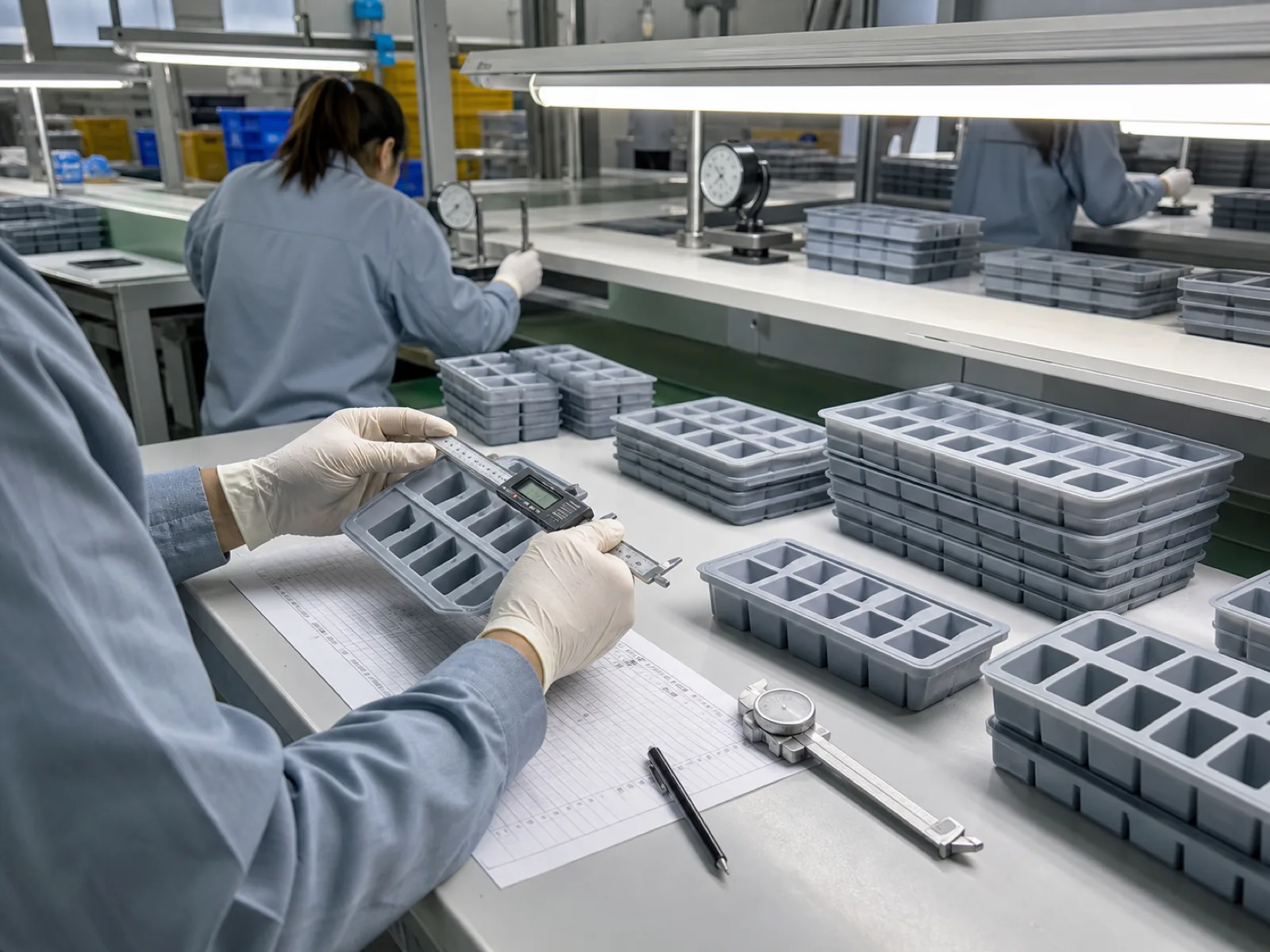
The six-document audit stack — what each verifies
- ISO 9001:2015 certificate — current validity date, silicone molding in scope, issued by a recognized certification body (SGS, TÜV, Bureau Veritas, DNV, DEKRA). Verify against the certification body’s public register. Reveals whether the factory operates a documented QMS at all.
- FDA 21 CFR 177.2600 + LFGB §30/31 test reports — referencing a specific master-batch lot from production in the last 6 months. Reports issued by SGS, Intertek, TÜV, or Bureau Veritas. Quantitative extractables values, not just pass/fail summary. Reveals whether the factory tests per lot or just once at supplier qualification.
- PFAS non-detect test report — per-batch analysis at ppb detection limits from an accredited lab. Accelerating requirement given ECHA restriction proposal4 downstream.
- Post-cure oven log — batch temperature-time record from the oven’s PLC or manual logbook, referencing the same master-batch lot. 180-200°C for 4-6 hours documented per batch, retained for 36 months per ISO 9001. Reveals whether post-cure is actually happening.
- Cavity dimensional CPK report — from tooling qualification, showing every cavity in the mold hits ±0.5 mm dimensional tolerance with process capability CPK ≥ 1.33. Reveals whether tooling qualification was done or skipped.
- Business + export license copies — verify legal entity name matches the trade partner on all commercial documents. Guards against factory-vs-trading-company confusion. Consumer roundups never mention this; it’s the top reason Tier 2 buyers reject Alibaba-sourced suppliers.
The unedited factory floor video — the single check worth 10 documents
Request a 2-3 minute unedited walk-through video of the compression molding and post-cure floor with the current date visible (holding a printed daily newspaper or the day’s shift log). A working silicone OEM factory has:
- 4-12 active compression molding presses (depending on scale), not idle
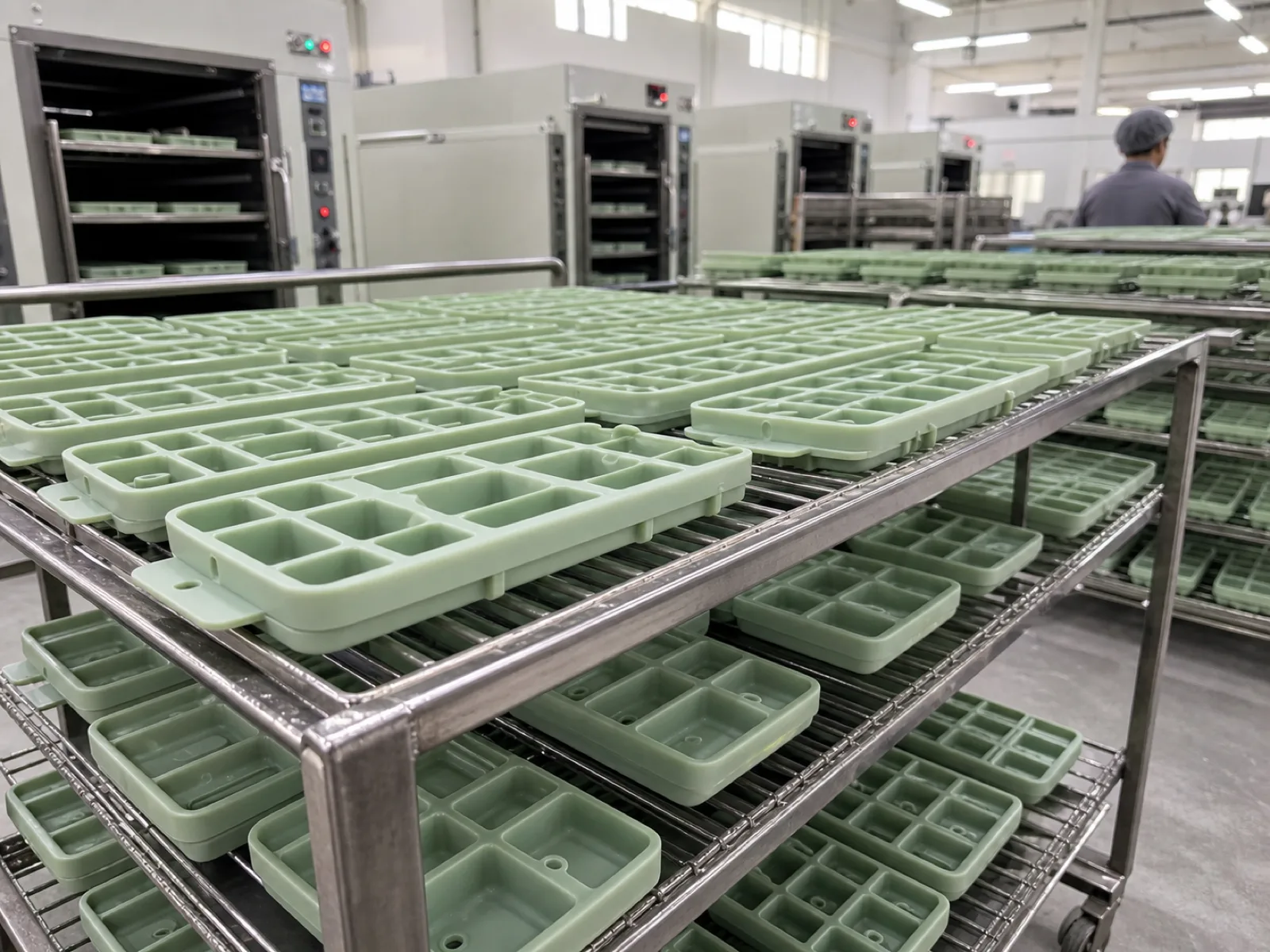
- Visible post-cure ovens with batches inside, not empty
- Raw material staging with visible master-batch lot labels
- A secondary process area with printing / deburring / packaging in progress
- A QC bench with active inspection in progress
- Not just a lobby, showroom, or empty warehouse
Full sourcing-verification framework on the sourcing silicone factory checklist.
What Wetop OEMs on silicone ice trays
Wetop runs silicone ice tray programs at 500-piece MOQ per SKU from a 7,500 m² founder-led Dongguan floor. Platinum-cure LSR and platinum HCR for EU premium, PFAS-free positioning, and infant / baby-food cube tier. Post-cured peroxide-cure HCR for US Tier 2 retail programs at $6-15 shelf price. Per-batch FDA 21 CFR 177.2600 + LFGB §30/31 + PFAS non-detect + Prop 65 heavy-metals reports included in every quote. In-house tooling in P20 and 718H at 25-35 day lead. FOB Yantian pricing published above.
Program defaults
- Platinum-cure LSR / platinum HCR — for EU premium retail, PFAS-free marketing positioning, infant / baby-food cube tier, and multi-year retail programs where regulatory-drift insurance matters.
- Post-cured peroxide-cure HCR — for US Tier 2 retail programs at $6-15 shelf price with PFAS-free process aids verified per batch and mandatory 4-6 hour post-cure at 180-200°C on every lot.
- In-house cavity tooling — P20 hardened for programs under 50,000 cycles ($3,200-$4,500), 718H pre-hardened above ($4,200-$5,800), 25-35 day lead from CAD sign-off with cavity CPK ≥ 1.33 verification before production sign-off.
- Standard tooling library at private-label MOQ 500 — 14-cavity 33 mm cube, 6-cavity 50 mm cube, 4-cavity 60 mm sphere, 8-cavity 25 mm mini-cube. Custom tooling for OEM programs.
Sourcing a silicone ice tray program? Email inquiry@wetopsilicone.com with target retail tier, target regulatory scope (US-only, EU-inclusive, infant-tier), preferred cure system (or ask for recommendation), cavity geometry and count, and target volume. We return within 2 business days with a cure recommendation, cavity tooling proposal, per-batch documentation packet outline, and price brackets at MOQ 500 / 1,000 / 5,000 / 10,000. Mutual NDA at our NDA page. Full manufacturing detail on the capabilities page; anonymized program archetypes at case studies; direct engineering contact via the contact page. See also our related silicone ice cube tray OEM guide and silicone snack cup baby OEM guide for infant-tier program adjacencies.
Footnotes
-
ASTM International. ASTM D2240-15 — Standard Test Method for Rubber Property—Durometer Hardness. https://www.astm.org/d2240-15r21.html — the Shore A hardness measurement standard. ↩ ↩2
-
German Federal Institute for Risk Assessment (BfR). Recommendation XV — Silicones. https://www.bfr.bund.de/en/bfr_recommendations_on_food_contact_materials-7498.html — the technical standard behind LFGB §30/31 organic volatile testing for food-contact silicone. ↩ ↩2
-
European Parliament and Council. Regulation (EC) No 1935/2004 — Materials intended to come into contact with food. https://eur-lex.europa.eu/legal-content/EN/TXT/?uri=CELEX%3A02004R1935-20090807 — the EU framework regulation for food-contact materials. ↩ ↩2
-
European Chemicals Agency. PFAS Universal Restriction Proposal. https://eur-lex.europa.eu/legal-content/EN/TXT/?uri=CELEX%3A32006R1907 — the regulatory action driving PFAS-free specification adoption in EU premium and downstream US retail. ↩ ↩2
-
US Consumer Product Safety Commission. CPSIA — Consumer Product Safety Improvement Act. https://www.ecfr.gov/current/title-16 — the US consumer product safety framework for children’s-tier and infant-food silicone ice tray programs. ↩
-
NSF International / ANSI. NSF/ANSI 51 — Food Equipment Materials. https://www.ecfr.gov/current/title-21/chapter-I/subchapter-B/part-177 — required for silicone ice trays sold into commercial-bar and food-service equipment channels. ↩
-
International Organization for Standardization. ISO 2859-1:1999 — Sampling procedures for inspection by attributes. https://www.iso.org/standard/1141.html — the sampling standard behind AQL 1.5 pre-shipment inspection. ↩
FAQ
-
What is a food-grade silicone ice tray actually made of?
A silicone ice tray is a single-material molded part in polydimethylsiloxane (PDMS) silicone at Shore A 40-70 durometer, produced by compression molding (HCR peroxide-cure or HCR platinum-cure) or by liquid silicone injection molding (LSR, always platinum-cure). Continuous service envelope -40°C to 230°C per material spec. The regulatory-defining characteristic is not the material — every serious factory runs FDA-grade PDMS — but the cure system and the post-cure discipline that clears organic volatile residuals from LFGB §30/31 testing.
-
Platinum-addition or peroxide cure for a silicone ice tray?
Platinum-addition (LSR or platinum HCR) for EU premium retail, PFAS-free positioning, infant / baby-food tier, and any program where the tray sees direct mouth contact from bite-sized frozen portions. Peroxide-cure HCR with disciplined 4-6 hour post-cure at 180-200°C is functionally acceptable for US mid-tier retail at $6-15 shelf price. Platinum runs 15-25% higher per unit but eliminates first-freeze odor risk, clears LFGB §30/31 more reliably batch-to-batch, and drops the PFAS process-aid verification burden — peroxide-cure programs must confirm the peroxide chemistry is not a fluorinated formulation.
-
What is the MOQ and what does a silicone ice tray cost at OEM volumes?
Wetop's MOQ is 500 pieces per SKU. FOB Yantian Q3 2026 benchmarks for a standard 14-cavity 33 mm-cube platinum-cure ice tray with debossed logo: 500 pcs $2.20-$2.85 / 1,000 pcs $1.75-$2.30 / 5,000 pcs $1.30-$1.75 / 10,000 pcs $1.10-$1.45 / 20,000+ pcs quote basis. Peroxide-cure with disciplined post-cure runs 15-25% below platinum. Tooling for a new cavity geometry runs $3,200-$5,800 amortized against first-order volume — usually rolled into per-unit price over the first 5,000-10,000 pieces rather than billed separately.
-
What Shore A hardness should a silicone ice tray specify?
Shore A 40-50 for maximum cube release ease (retail default on standard 33 mm cubes), Shore A 55-65 for large-format cubes / spheres where wall stiffness matters for cavity retention during pouring, Shore A 65-70 for commercial-bar programs where the tray needs to hold shape under repeated stacking. Softer durometer eases demold but reduces the tray's overall stiffness — a Shore A 40 tray with a 60-cavity geometry will flex enough during pouring to spill, so the hardness selection is coupled to cavity count and cube size, not chosen in isolation.
-
How long does new cavity tooling take to cut and what does it cost?
P20 hardened steel tooling for programs under 50,000 lifetime cycles: 25-30 days from CAD sign-off, cost $3,200-$4,500 depending on cavity count and geometry complexity. 718H pre-hardened tooling for programs above 50,000 cycles: 30-35 days, $4,200-$5,800. Sphere or large-format novelty cavities add 5-10 days for the extra CNC hours and, if hot-runner or side-action is needed, another $1,500-$3,000. Tooling amortization runs against first order volume, so a 10,000-piece first order with $4,000 tooling adds $0.40/unit rather than showing as a separate line item.
-
How do I audit an ice tray factory for Tier 2 retail placement without visiting?
The Home Depot / Wayfair / Bed Bath / Tesco / Carrefour tier audit reduces to six documents plus one video check. (1) ISO 9001:2015 certificate current, silicone molding in scope. (2) FDA 21 CFR 177.2600 + LFGB §30/31 reports referencing a master-batch lot from the last 6 months, issued by SGS / Intertek / TÜV / Bureau Veritas. (3) Post-cure oven log for the same batch — 180-200°C for 4-6 hours documented. (4) PFAS non-detect at ppb detection limits. (5) California Prop 65 heavy-metals declaration per 21 CFR 175.300 heavy-metals extractables limits. (6) Business + export license copies confirming factory-not-trader status. Plus a 2-3 minute unedited factory walk-through video with the current day's newspaper or shift log visible. A supplier resisting any of these is answering the audit question.
-
What cavity count and geometry work best for retail vs commercial ice tray programs?
Retail default: 14-15 cavity standard cube tray (33 mm cubes) or 6-8 cavity large-format (50 mm cubes / spheres) — sized to fit a standard home freezer drawer and to hit the $6-15 shelf price with reasonable margin. Commercial bar tier: 4-6 cavity large-format sphere or diamond (60-65 mm) at higher Shore A and thicker walls for volume-service durability. Novelty retail (holiday, character shapes) runs 8-24 cavities depending on cube geometry with matched draft angles — novelty geometries with tight relief require Shore A 45-55 to demold cleanly without tearing.
-
What causes the 'first-freeze plastic taste' complaint on silicone ice trays and how do I spec against it?
The first-freeze taste complaint is the single most common consumer return reason on silicone ice tray SKUs — and it is almost never the silicone. It is under-post-cured peroxide-cure product where residual dicumyl peroxide decomposition fragments (acetophenone, dichlorobenzoic acid) migrate into the water during the first two or three freeze-thaw cycles. Cured PDMS itself is odor-neutral at Shore A 40-70. The fix on the RFQ is two clauses. Clause one: mandatory 4-6 hour post-cure at 180-200°C in a forced-air convection oven, batch-logged against the master-batch lot, with the log retained 36 months per ISO 9001[^iso-9001] documented process control. Clause two: LFGB §30/31 organic volatile testing per BfR Recommendation XV[^bfr-lfgb-xv] on a lot from the last 6 months, quantitative extractables values reported, not pass/fail summary. If the buyer wants zero risk on a premium tier ($12+ shelf) or infant-food cube tier, spec platinum-addition cure (LSR or platinum HCR) instead — hydrosilylation crosslinking has no organic byproducts to bake out and eliminates the mechanism entirely. Wetop's field experience across peroxide-cure Tier 2 programs: a well-post-cured lot at 4 hours 190°C runs 0.1-0.3% first-freeze complaint rate; skipping post-cure to save the oven cycle runs 8-15% and typically loses the retail placement within 12 months. On Home Depot and Wayfair tier programs the compressed-quote factory that skipped post-cure to hit price is where those complaints originate.
-
How do I spec against cube-tearing and cavity distortion after 12-18 months of consumer use?
Two independent failure modes with two independent specs. Cube-tearing at release is a draft-angle and Shore A problem: cavity walls with less than 1° draft force the user to over-flex the tray on demold, tearing cube corners at the cavity mouth over cycle life. Spec 1.5-2.5° draft on the tooling drawing, verified at first-article inspection. Match Shore A to cavity count — Shore A 45-55 for the 14-cavity 33 mm retail default, adding 5 Shore A points per 10 additional cavities so a 24-cavity mini-cube runs Shore A 55-60 to preserve tray-level stiffness during pouring. Cavity distortion after 12-18 months is a compression-set problem. PDMS compression set per ASTM D395 (22 hours at 175°C) should be specified ≤ 25% on the RFQ; under-post-cured product ships at 30-40% and cavities start losing geometry after the first few hundred freeze-flex-release cycles, producing progressively more irregular cubes that trigger consumer returns on Tier 2 chains with 2-year return policies. The mandatory 4-6 hour post-cure at 180-200°C completes the crosslink network and drops compression set from ~35% into the ≤ 25% range as a side effect of clearing LFGB §30/31 residuals. Third guard: cavity dimensional CPK ≥ 1.33 verified at tooling qualification across all 14 cavities to ±0.5 mm on the 33 mm cube — otherwise cube-to-cube size variation compounds the perceived-quality issue at retail shelf.
References
Authoritative sources cited in this guide
- US Food and Drug Administration. 21 CFR 177.2600 — Rubber articles intended for repeated use. https://www.ecfr.gov/current/title-21/chapter-I/subchapter-B/part-177/subpart-C/section-177.2600 — The primary US food-contact regulation Wetop cures every silicone ice tray batch against, testing per master-batch lot.
- German Federal Institute for Risk Assessment. BfR Recommendation XV — Silicones. https://www.bfr.bund.de/en/bfr_recommendations_on_food_contact_materials-7498.html — The technical standard behind LFGB §30 and §31 organic volatile testing for food-contact silicone — the reason mandatory VOC bake-out post-cure exists.
- International Organization for Standardization. ISO 9001:2015 — Quality Management Systems — Requirements. https://www.iso.org/standard/62085.html — The quality management system Wetop is certified against — governs batch traceability, post-cure records, and audit documentation trail.
- International Organization for Standardization. ISO 2859-1:1999 — Sampling procedures for inspection by attributes. https://www.iso.org/standard/1141.html — The sampling standard behind AQL 1.5 pre-shipment inspection Wetop runs on every silicone ice tray batch.
- ASTM International. ASTM D2240-15 — Standard Test Method for Rubber Property—Durometer Hardness. https://www.astm.org/d2240-15r21.html — The measurement standard behind every Shore A hardness spec Wetop quotes on ice tray programs.
- European Parliament and Council. Regulation (EC) No 1935/2004 — Materials intended to come into contact with food. https://eur-lex.europa.eu/legal-content/EN/TXT/?uri=CELEX%3A02004R1935-20090807 — The overarching EU framework regulation for food-contact materials — LFGB compliance sits inside this framework.
- European Chemicals Agency. PFAS Universal Restriction Proposal. https://eur-lex.europa.eu/legal-content/EN/TXT/?uri=CELEX%3A32006R1907 — The regulatory action accelerating PFAS-free specification adoption in EU premium retail and downstream US retail — per-batch PFAS non-detect now table-stakes for Tier 2 chains.
- US Consumer Product Safety Commission. CPSIA — Consumer Product Safety Improvement Act. https://www.ecfr.gov/current/title-16 — The US consumer product safety framework any children's-tier or infant-food silicone ice tray program (frozen purée cubes, baby-food storage) must certify against.
- NSF International / ANSI. NSF/ANSI 51 — Food Equipment Materials. https://www.ecfr.gov/current/title-21/chapter-I/subchapter-B/part-177 — Required for silicone ice trays sold into commercial-bar and food-service equipment channels.
Start a custom program
Send a brief. Get an engineer’s reply in one business day.
Every Wetop program is tooled from a customer’s specification. Send a CAD file (STEP · IGES · DWG) or a written brief and we’ll reply with a mold cost estimate, price brackets at MOQ 500 / 1,000 / 5,000, and any engineering questions.