Buyer Guide · commercial intent
Silicone Lip Mask Manufacturer OEM Guide
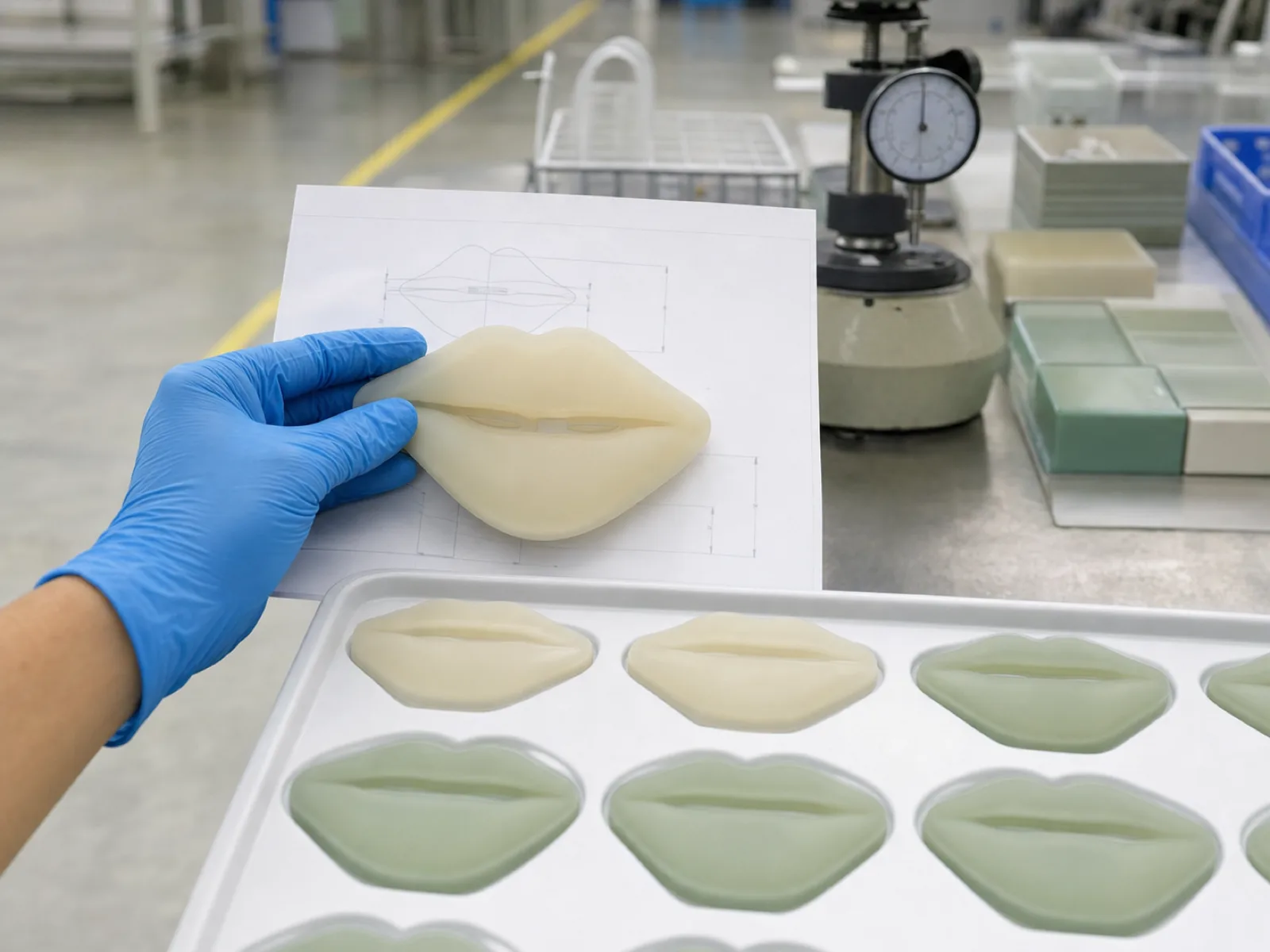 Buyer Guide
 A reusable silicone lip mask is a molded platinum-cured liquid silicone rubber (LSR) patch that a beauty brand pairs with a hydrating serum: the customer applies serum, presses the soft patch over the lips to seal moisture against the vermilion, then rinses and reuses the patch across hundreds of cycles. It is a distinct product from the single-use gel sheet or cream lip mask that shares the name — the molded patch needs a silicone manufacturer and a mold, not a cosmetic filler. This guide is the engineering-desk brief for beauty brands running a silicone lip mask program at 500 to 100,000 pcs, covering material selection, the real Shore A and temperature spec, FDA and LFGB compliance, the LSR molding workflow, MOQ tiers, and landed-cost math.
The silicone lip mask reads like a simple molded part from a brand founder’s seat — until the first sample comes back with a rubber odor the peroxide cure left behind, a Shore A so firm the patch will not conform to the lip line, or a customs hold because the skin-contact test report was never run. None of those are bad luck. They map directly to a handful of decisions the factory made — or skipped — during material selection, cure-system choice, mold design, and compliance planning. This guide is written from the engineering desk at Wetop’s Dongguan floor for beauty and personal-care brands who want the actual manufacturing math behind a silicone lip mask manufacturer relationship, not marketing copy.
What is a reusable silicone lip mask, and how does it differ from a gel or cream lip mask?
A reusable silicone lip mask is a molded platinum-cured LSR patch a brand pairs with a serum: the user applies serum, presses the patch over the lips to seal in hydration, then rinses and reuses it. A gel or cream lip mask is a single-use hydrogel sheet or leave-on balm. The molded patch needs a silicone factory and a mold; the gel needs a cosmetic contract filler.
The single most expensive mistake a first-time buyer makes in this category is not a spec error — it is sourcing the wrong supplier because the search term “silicone lip mask” points at two unrelated products. The reusable silicone patch is a durable good: a soft, lip-shaped piece of molded silicone that performs a mechanical job — sealing a serum’s moisture and active ingredients against the lips under a light occlusive layer while the customer wears it for 10 to 20 minutes. The gel or cream lip mask is a consumable: a single-use hydrogel patch soaked in serum, or a thick overnight balm, that is used once and discarded.
If your brand is building the reusable-patch product, you need a silicone manufacturer, an LSR injection mold, and a compliance packet on the silicone. If you are building the gel or balm, you need a cosmetic contract manufacturer with a filling line and an INCI formulation — a completely different vendor. Many programs pair the two: a branded reusable silicone patch sold as a set with a tube or sachet of serum. In that case, the silicone factory molds and brands the patch, and a cosmetic filler supplies the serum, with the two components co-packed into one retail set.
The application the reusable patch is engineered around is a hydration-seal function — the soft silicone forms a light occlusive barrier that slows transepidermal water loss from the lip serum, so actives sit on the lip longer instead of evaporating. A secondary marketing angle is the anti-wrinkle lip-line claim, where a contoured patch is pressed over the perioral area; that is a cosmetic-benefit claim the brand owns and substantiates, not a claim the silicone itself makes. From the factory’s side, both use cases resolve to the same engineering problem: a soft, skin-safe, contour-conforming molded patch that survives repeated washing.
What silicone material belongs in a lip-contact mask — food-grade vs medical-grade platinum-cured LSR?
A lip mask should be molded from platinum-cured liquid silicone rubber (LSR). The platinum addition-cure system leaves no volatile byproducts, so the patch does not off-gas a rubber odor, and standard grades clear FDA 21 CFR 177.2600 food-contact extractables. For a product held against thin lip skin, a medical-grade LSR that also clears USP Class VI biocompatibility is the defensible upgrade over a plain food-grade compound.
The material decision has two axes: cure system and grade. On cure system, there is no real debate for a lip-contact product. Peroxide-cured silicone (HCR) uses a free-radical initiator whose crosslink reaction generates volatile byproducts — benzoic acid, acetophenone — that off-gas a “rubber” or “tire” odor unless a long post-cure drives them off. Platinum-cured silicone uses a catalyst addition reaction between vinyl and hydride groups that is stoichiometrically clean: no byproducts, no odor, and biocompatibility clearance with minimal post-cure[^nih-silicone-review]. For anything a customer presses against their lips — permeable, sensitive skin near the mouth — Wetop molds only platinum-cured LSR and will not quote peroxide. The full chemistry breakdown lives in the platinum-cured vs peroxide-cured silicone guide if you need to defend the choice to a formulation team.
On grade, the practical choice is between food-grade LSR and medical-grade LSR:
| Grade | Clears | Extractables | Typical cost premium | Best for |
|---|---|---|---|---|
| Food-grade platinum LSR | FDA 21 CFR 177.2600, LFGB / BfR XV | Low | Baseline | Mass-market lip patches, budget retail |
| Medical-grade platinum LSR | Above + USP Class VI, ISO 10993-10 | Very low | +10–20% raw material | Premium and “clinical” positioned brands |
| Peroxide-cured HCR | Fails odor / migration for lip use | Higher, off-gasses | −12–18% | Not recommended for lip contact |
For a mass-market lip patch, food-grade platinum LSR is genuinely sufficient — it is the same clearance level used on infant-feeding silicone. For a brand positioning on “dermatologist-tested” or “clinical” language, the medical-grade upgrade that also carries USP Class VI[^usp-class-vi] and an ISO 10993-10 skin-sensitization file[^iso-10993] is worth the 10–20% material premium, because the marketing claim and the material file then line up. Buyers weighing whether silicone is the right skin-contact material at all should read the is silicone body-safe guide for the migration and biocompatibility evidence base.
What are the real technical specs of a silicone lip mask — hardness, thickness, temperature, and service life?
A lip mask patch runs Shore A 20–40 for a soft lip-conforming seal, a 1.2–2.5 mm wall depending on flat-film versus contoured-cup geometry, a −40 °C to 220 °C service range that covers every real use and cleaning condition, and a 1–2 year reusable service life across 200-plus wash cycles. Softer than Shore A 20 tears at the thin edge; harder than 40 breaks the moisture seal.
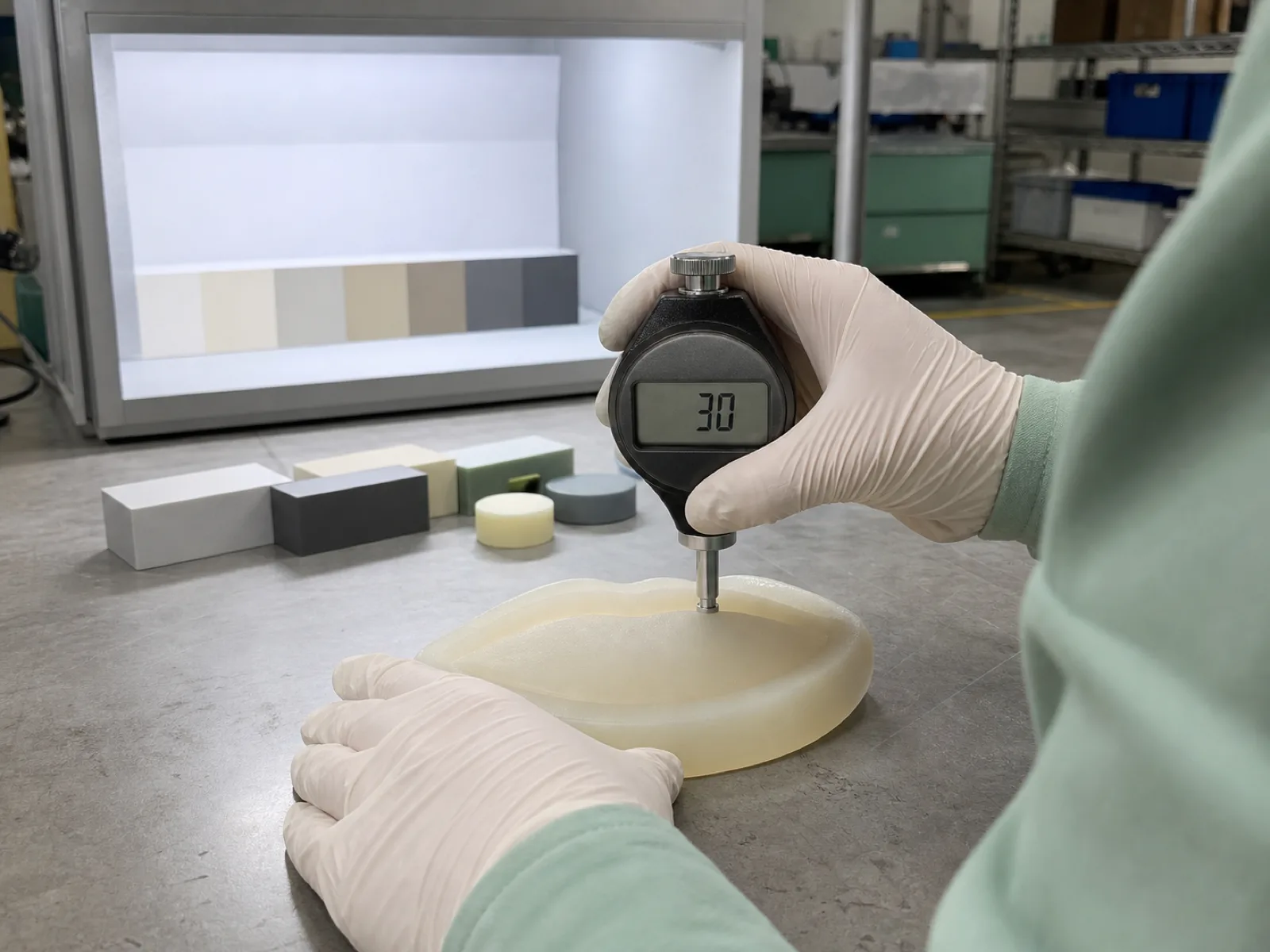
The spec that separates a lip patch that customers love from one that gets returned is hardness. A lip mask has to drape over the lip contour and hold a light seal without pinching or feeling like a rigid cup. That puts the working range at Shore A 20–40 — softer than a silicone spatula (Shore A 50–70) and closer to a soft medical seal. Wetop’s default lip-patch spec is Shore A 30 ± 3, which conforms to the lip line, holds tack for the moisture seal, and resists edge-nicking over reuse. The durometer band is a lot-release gate, not a nominal target: drift outside ± 3 signals a cure or compound-batch problem before it becomes a field return. The broader hardness map is in the Shore A hardness silicone chart if you are comparing across a product line.
The working spec table Wetop holds for a reusable lip patch:
| Parameter | Spec range | Wetop default | Why it matters |
|---|---|---|---|
| Hardness (Shore A) | 20 – 40 | 30 ± 3 | Conforms to lip contour, holds seal, resists edge tear |
| Wall thickness | 1.2 – 2.5 mm | 1.8 mm | Thin enough to drape, thick enough to survive reuse |
| Service temperature | −40 °C to 220 °C | — | Covers dishwasher / boiling-water sanitizing and cold storage |
| Color tolerance (ΔE) | ≤ 1.5 (D65) | ≤ 1.5 | Pantone match holds across production lots |
| Dimensional tolerance | ±0.05 mm (LSR) | ±0.05 mm | Consistent opening and seal geometry |
| Reusable service life | 1 – 2 years | 200+ cycles | Wash-and-reuse durability without loss of tack |
The temperature range is often over-specified by buyers who confuse it with a performance claim. A lip patch never sees oven heat; the −40 °C to 220 °C range matters only because it means the customer can sanitize the patch in boiling water or a dishwasher without deforming it, and it survives cold shipping and storage. The material comfortably exceeds every real thermal condition the product meets — the temperature spec is a durability guarantee, not a feature. The silicone temperature range guide covers why LSR tops out where it does if a customer asks.
What certifications does a silicone lip mask OEM program need for the US and EU?
A US silicone lip mask program needs an FDA 21 CFR 177.2600 migration report on the silicone, a California Prop 65 statement, and — because it contacts skin near the mouth — a skin-irritation and sensitization report on the finished patch. EU programs add LFGB clearance on the BfR XV basis, a REACH SVHC declaration, and cosmetic regulation (EC) 1223/2009 alignment when a serum ships with the patch.
The compliance trap on a lip mask is that it sits between two regulatory frameworks. The silicone patch is a material-contact article, so its baseline documentation looks like any food- or skin-contact silicone: an FDA 21 CFR 177.2600[^fda-177-2600] extractables report from an accredited lab (Intertek, SGS, or Eurofins), and — because it touches sensitive lip skin — a skin-irritation and sensitization test per ISO 10993-10[^iso-10993]. The serum, if one ships in the set, is a cosmetic governed by FDA’s cosmetic framework under MoCRA[^fda-cosmetics] in the US and cosmetic regulation (EC) 1223/2009[^ec-1223-2009] in the EU. Brands that assume one certificate covers the whole set get held when the two components carry different paths.
For a US-only patch program, the minimum documentation packet is:
- Silicone patch: 21 CFR 177.2600 migration test report from an accredited lab, issued per lot or per quarter
- Skin contact: ISO 10993-10 skin irritation and sensitization report on the finished patch
- State-level: California Prop 65 statement covering the silicone and any masterbatch pigment
- Business-level: ISO 9001[^iso-9001] certificate (Wetop is certified since 2008)
- Serum, if co-packed: cosmetic-side compliance handled by the fill vendor under MoCRA
For EU programs, add LFGB clearance on the silicone with BfR Recommendation XV[^bfr-xv] as the technical basis, a REACH SVHC declaration[^echa-reach] against the current candidate list, and — for the serum — cosmetic regulation (EC) 1223/2009 alignment with a CPNP notification. The most common hold Wetop sees on lip-mask imports is a missing skin-contact report: a supplier ships the food-contact migration report and assumes it covers lip use, but a skin-sensitization file is a separate test on the finished patch. The framework differences between US and EU food-contact clearance are broken down in the FDA vs LFGB silicone guide.
Reusable silicone lip patch vs single-use gel or cream lip mask — the efficacy and lifecycle comparison
A reusable silicone lip patch is a durable good used with a refillable serum, so its per-use cost falls toward the serum cost alone over hundreds of cycles, and it generates almost no packaging waste. A single-use gel or cream lip mask has a low unit cost but a high lifetime cost and continuous packaging waste. The silicone patch wins on lifecycle economics and sustainability positioning; the gel wins on cold-sensation novelty and zero learning curve.
This comparison is the disambiguation buyers most need, because the two products compete for the same shelf space and the same “lip hydration” search intent. The decision is not which is objectively better — it is which failure mode and which brand story a buyer is building around.
| Attribute | Reusable silicone patch + serum | Single-use hydrogel sheet | Overnight cream / balm |
|---|---|---|---|
| Cost per use (after purchase) | Serum cost only (~USD 0.05–0.20) | Full unit each use (USD 0.40–1.50) | Balm dose (USD 0.05–0.30) |
| Packaging waste | Near zero (patch reused) | High (one wrapper + patch per use) | Low (one tube) |
| Occlusive seal strength | Strong — silicone occludes | Moderate — gel dries out | Low — no occlusion |
| Reuse / durability | 200+ cycles, 1–2 years | Single use | N/A |
| Cold-sensation novelty | Optional (chill the patch) | Strong (cooling gel) | None |
| Sustainability story | Strong — refillable, low waste | Weak — disposable | Moderate |
| Retail price point | USD 12 – 30 (patch + serum set) | USD 2 – 6 per sheet | USD 8 – 25 |
The strategic case for the silicone patch is lifecycle cost and sustainability. A customer buys the patch once and refills serum, so the brand can build a recurring serum-refill revenue stream while telling a low-waste story that the disposable sheet cannot. The trade the buyer accepts is a higher first-purchase price and a small learning curve — the customer has to wash and store the patch. For a brand targeting the refill-and-sustainability segment, the reusable silicone patch is the stronger platform; for an impulse-buy or travel-sachet play, the disposable gel is the faster sell. A brand can, of course, run both.
What are the MOQ tiers and tooling cost for a custom silicone lip mask?
Wetop's silicone lip mask MOQ starts at 500 pcs per color on existing tooling with a custom logo, and 3,000 pcs on a new custom LSR mold. A custom multi-cavity injection tool runs roughly USD 2,500–5,500 depending on cavity count and patch geometry. Full private-label sets bundling patch, serum, and retail packaging typically start at 3,000–10,000 sets to hit cosmetic landed-cost targets.
The MOQ tier is governed by whether the order needs a new mold. On existing lip-patch tooling, Wetop molds a 500-pc minimum per color with a custom debossed or laser-marked logo — the entry point for a brand validating the market. A patch shape, opening geometry, or size that is not in the existing tooling family needs a new LSR injection mold, which pushes the minimum to 3,000 pcs to amortize the tool across the run.
| Program tier | MOQ per color | Tooling cost | Unit price band (FOB) | Best for |
|---|---|---|---|---|
| Stock patch shape, custom color + logo | 500 pcs | USD 0 | USD 0.55 – 1.10 | Market validation, small brands |
| Stock patch, custom Pantone + laser logo | 1,000 pcs | USD 0 – 250 (logo insert) | USD 0.50 – 1.00 | Private-label test runs |
| Custom patch shape, new LSR mold | 3,000 pcs | USD 2,500 – 5,500 | USD 0.35 – 0.85 | Brands with a distinct patch design |
| Full private-label set — patch + serum + retail box | 3,000 – 10,000 sets | USD 3,000 – 7,000 all-in | USD 1.80 – 4.50 all-in set | Retail-ready cosmetic programs |
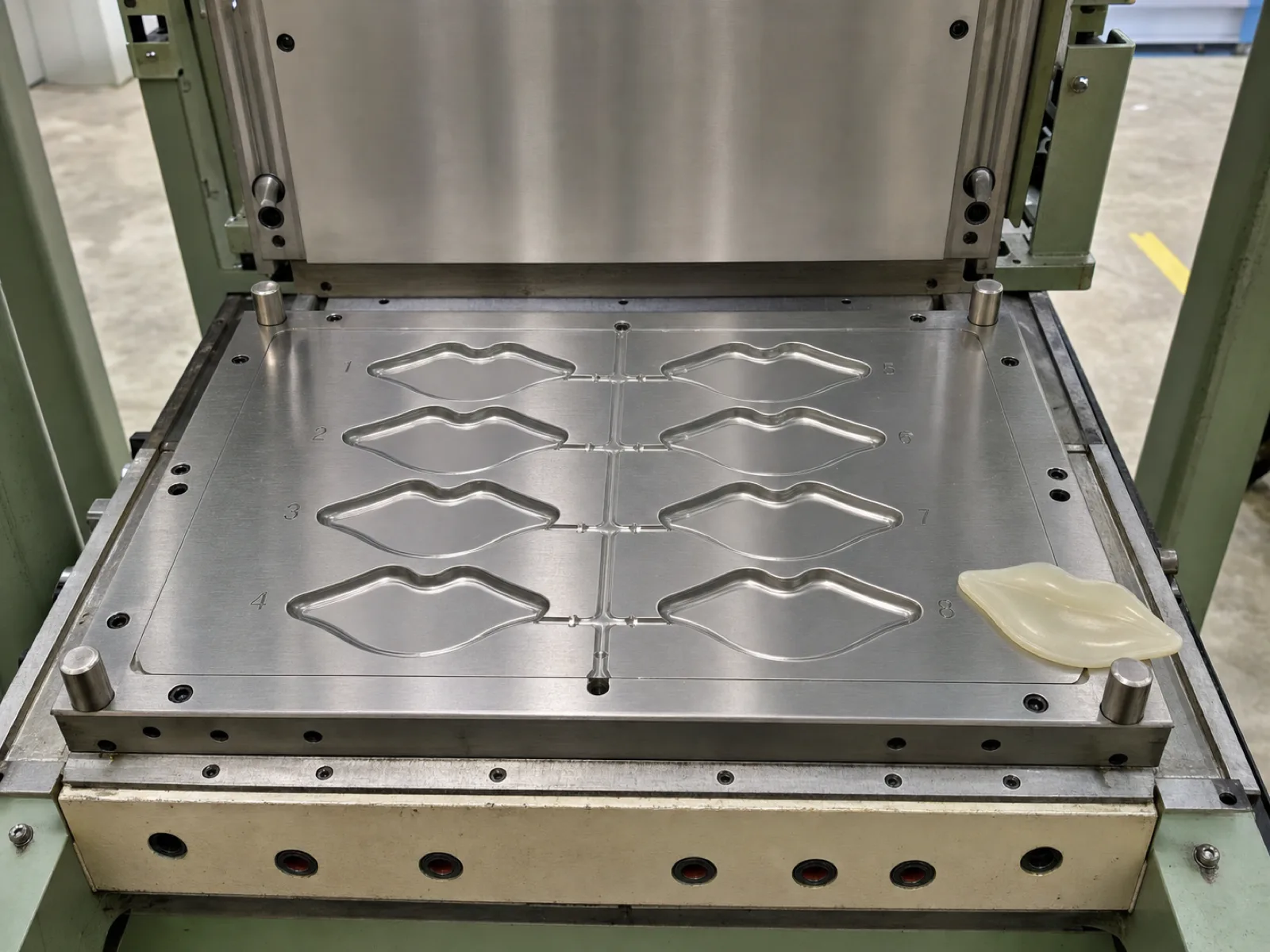
The tooling economics favor committing to a cavity count that matches the volume forecast. A single-cavity prototype mold is cheap but slow; a 4- to 8-cavity production mold costs more up front but drops the per-unit price meaningfully at volume because each injection shot produces more patches. Wetop sizes the cavity count to the annual forecast so the tooling amortization lands inside the FOB unit price rather than as a surprise adder. The mold is the buyer’s asset upon full payment of the tooling cost — Wetop transfers title after the first production run ships and does not hold molds as end-of-program leverage. The broader MOQ-and-tooling math across the catalog is in the MOQ and lead time silicone OEM guide.
How does the custom molding workflow work — LSR injection, Pantone color, logo, and opening geometry?
A silicone lip mask is molded by LSR injection: two-part platinum-cured silicone is metered, injected into a heated multi-cavity mold, and cured in 30–90 seconds per shot at ±0.05 mm tolerance. Color is matched with a Pantone masterbatch to ΔE ≤ 1.5, logos are debossed into the cavity or laser-marked on the cured patch, and the opening geometry is cut into the mold to the brand's lip-fit drawing.
LSR injection is the right process for a lip patch because the part is thin, soft, and made at cosmetic volumes. Two-part platinum-cured LSR is pumped from drums, metered by a static mixer, and shot into a heated tool where it cures in under 90 seconds. The process automates cleanly, holds tight tolerance, and produces no flash-heavy waste — which is why it beats compression molding for a thin sealing film. Compression molding is reserved for very low pilot runs or unusually thick contoured patches where an injection tool is not yet justified. The full process comparison is in the silicone molding process guide.
The three customization axes a brand controls:
- Pantone color: Wetop’s color desk matches Pantone solid-coated within ΔE ≤ 1.5 on a D65 light box using platinum-cured masterbatch. Translucent, pastel, blush, and skin-neutral tones — the palette lip masks usually live in — hit tolerance cleanly; deep saturated or neon colors are quoted with wider ΔE bands because inorganic heat-stable pigments limit the gamut.
- Logo and marking: debossing is engraved into the mold cavity at zero unit-cost adder and outlasts every other method across wash cycles; laser marking on the cured patch handles fine artwork and serialized codes; silkscreen with a skin-safe ink covers multi-color logos but wears faster than debossing. The full method trade-off is in the customize silicone logo guide.
- Opening and contour geometry: the patch shape — flat sealing film, contoured cup, or perioral-coverage patch — and any central opening are cut into the mold cavity to the brand’s lip-fit drawing. Getting the contour right is what makes the seal hold, so Wetop iterates the geometry on the T1 sample against a fit test before releasing the production tool.
OEM vs ODM, sampling lead time, and sample cost for a silicone lip mask
OEM means you bring the patch design and Wetop cuts a mold to your drawing; ODM means you customize color, logo, and packaging on Wetop's existing lip-patch tooling. Samples ship in 7–25 days: 7–15 days for a color-and-logo variant on existing tooling, and 20–25 days for a T1 sample off a new custom LSR mold, plus 5–7 days for corrections before production release.
The OEM-vs-ODM choice sets the timeline and the cost. ODM starts from Wetop’s existing lip-patch tooling family: the brand picks a proven patch shape and customizes color, logo, and packaging. No mold is cut, so the sample is fast (7–15 days) and the entry MOQ is low (500 pcs) — the right path for a first-time beauty brand validating the market. OEM means the brand brings its own patch design, opening geometry, and Shore A target, and Wetop builds a dedicated mold to the drawing. The sample takes longer (20–25 days for a T1 off the new tool) and the MOQ rises to 3,000 pcs, but the brand owns a distinct product and the mold.
The sampling sequence Wetop runs:
| Stage | Existing tooling (ODM) | New mold (OEM) |
|---|---|---|
| Color match + logo proof | 3 – 5 days | included in T1 |
| First-article / T1 sample | 7 – 15 days | 20 – 25 days |
| Correction round (T2) | 3 – 5 days | 5 – 7 days |
| Production release after approval | — | after T2 sign-off |
| Bulk production | 15 – 25 days | 20 – 30 days |
Sample cost on existing tooling is nominal — often waived against a confirmed order. A new-mold T1 sample carries the tooling deposit, credited into the production tooling cost once the order confirms. The engineering-desk suggestion for a first RFQ: send Wetop a reference patch of the seal and softness you want to match, and the response is a teardown noting cure system, Shore A reading, wall section, and a spec-improvement recommendation before quoting.
What QC and testing regime should a silicone lip mask program run?
A ship-worthy silicone lip mask clears five checks: a Shore A durometer test (spec ± 3), a dimensional and opening-geometry check against the drawing, a color ΔE check on a D65 light box, an edge-tear and reuse-cycle test on the thin sealing lip, and a skin-contact migration and sensitization report on the finished patch. Any single fail holds the lot; third-party pre-shipment inspection runs at AQL 1.5 sampling.
The QC regime targets the specific failure modes a lip patch actually hits in the field. Each bench test maps to a documented failure:
- Shore A durometer — verifies cure completeness and compound-batch consistency. A reading outside spec ± 3 predicts either a patch too firm to seal or too soft to survive reuse.
- Dimensional + opening geometry — the patch is measured against the drawing at ±0.05 mm; a drifted opening breaks the lip-fit and the seal.
- Color ΔE — every lot is checked against the Pantone target on a D65 light box; drift beyond ΔE 1.5 fails the lot, because a color shift between production runs is the most visible defect to a cosmetic buyer.
- Edge-tear + reuse cycle — the thin sealing lip is cycled through repeated flexing and washing to confirm it resists the edge-nicking that ends a patch’s service life.
- Skin-contact migration + sensitization — a finished-patch migration and ISO 10993-10 sensitization report[^iso-10993] confirms the patch is safe against lip skin across its life; this is the report customs most often demands.
A full first-article test package runs USD 800–1,600 in third-party lab fees, absorbed by Wetop into tooling amortization or the FOB unit price depending on program size. Skipping it saves the money and loses it many times over on the first customs hold or the first “the patch made my lips sting” complaint escalation. Every batch is released against an AQL 1.5 sampling plan under the ISO 9001[^iso-9001] QMS Wetop is certified against.
Packaging, private-label branding, and landed cost for a silicone lip mask set
A silicone lip mask ships in a reusable case, a printed carton, or as a full set co-packed with a serum. FOB unit price for a color-matched, logo'd LSR patch runs USD 0.35–1.10; the patch is small and light, so freight adds only cents. The larger cost driver in a full set is usually the filled serum and the retail carton, not the silicone patch itself.
Packaging on a reusable lip mask does more work than on a disposable, because the customer keeps the patch — so a hygienic storage case is part of the product, not an afterthought. The common architecture is a hard-shell case or tin that protects the patch between uses, wrapped in a printed retail carton, optionally co-packed with a serum tube or sachet as a set.
| Component | Cost band (per unit / set) | Notes |
|---|---|---|
| Silicone patch (FOB, color + logo) | USD 0.35 – 1.10 | Size and Shore A dependent |
| Reusable storage case / tin | USD 0.20 – 0.80 | Hygienic storage, part of the product |
| Printed retail carton | USD 0.25 – 0.90 | FSC board for premium positioning |
| Co-packed serum (from fill vendor) | USD 0.60 – 2.50 | Cosmetic-side cost, not silicone |
| Co-pack / assembly labor | USD 0.10 – 0.30 | Set assembly |
Because the silicone patch is small and light, ocean freight adds only a few cents per piece — a mid-spec patch lands to a Los Angeles warehouse around USD 0.55–1.35 before serum and packaging. The cost story in a full lip-mask set inverts what buyers expect: the silicone patch is often the cheapest line, while the filled serum and the retail carton dominate landed cost. Wetop molds and brands the patch, supplies the storage case, and co-packs the set when a brand’s fill vendor ships the serum in — delivering a retail-ready set rather than a loose part. Because the patch is a durable good the customer refills, the brand can price the launch set at a premium and build a recurring serum-refill revenue stream underneath it.
Ready to run a silicone lip mask program?
Wetop is a founder-led, ISO 9001 silicone factory in Dongguan running platinum-cured LSR injection cells for skin- and food-contact products. We manufacture reusable silicone lip mask programs for US and EU beauty and personal-care brands at 500-pc to 100,000-pc scale, with the material selection, compliance packet, color-matched branding, and QC regime built in — and we co-pack the finished set when a serum ships alongside the patch.
If you have a patch design, an RFQ, or a reference sample you want teardown-benchmarked for seal and softness, talk to the engineering desk. We will return a first-pass spec review, a tooling estimate, and an MOQ / lead-time / FOB unit-price band inside two business days.
FAQ
-
Do I need a separate serum supplier if I sell a reusable silicone lip mask?
Usually yes, if you sell the patch as a hydration set. Wetop molds, colors, and brands the silicone patch and supplies its storage case, but the serum inside the set is a cosmetic formulation that comes from a contract fill vendor with an INCI recipe and a filling line. The two components are co-packed into one retail set — Wetop can handle that co-pack when your fill vendor ships the serum in. A brand can also sell the reusable patch on its own and let the customer supply their own lip serum, which removes the cosmetic-side compliance entirely from the silicone order.
-
Does a silicone lip mask have a rubber smell?
A platinum-cured LSR patch does not. The rubber or 'tire' odor buyers worry about comes from peroxide-cured silicone, whose crosslink reaction leaves benzoic-acid and vinyl byproducts that off-gas over the first weeks of use. Platinum addition-cure is stoichiometrically clean and leaves no odor, which is exactly why Wetop molds every lip-contact patch in platinum LSR. If a sample from any supplier smells like rubber, it was molded in a peroxide compound or was under-post-cured — either way it is the wrong material for a product held against the mouth.
-
Can I order a small trial run of silicone lip masks before committing to a full mold?
Yes. On Wetop's existing lip-patch tooling you can order 500 pcs per color with your logo, which lets a brand validate the market without paying for a custom mold. You only reach the 3,000-pc minimum and the USD 2,500–5,500 tooling cost when you want a patch shape or opening geometry that is not already in the tooling family. Most first-time beauty brands run a 500–1,000 pc trial on a stock shape, then move to a custom mold once the SKU proves out at retail.
-
Why does a silicone lip mask need to be so soft?
Because a firm patch will not seal. The lip surface is curved and mobile, so the patch has to drape over the contour and hold a light occlusive seal without pinching — that is why the working hardness sits at Shore A 20–40, softer than a kitchen tool and closer to a soft medical seal. A patch harder than Shore A 40 bridges over the lip line and lets the serum evaporate at the edges; a patch softer than Shore A 20 tears at the thin sealing lip after repeated washing. Wetop's default is Shore A 30 ± 3 as the balance point.
-
Does a reusable silicone lip mask actually hydrate lips better than a balm alone?
The patch does not hydrate on its own — it is a delivery mechanism. Its job is occlusion: pressing a soft, moisture-proof silicone layer over serum-coated lips slows the water and actives from evaporating, so they sit on the lip surface longer than an unoccluded balm that air-dries. A brand substantiates the hydration or plumping claim on the serum and the wear protocol, not on the silicone. What the patch reliably delivers over a bare balm is the sealed 10-to-20-minute treatment window that the reusable-mask ritual is built around.
-
How long does a reusable silicone lip mask last before it needs replacing?
A platinum-cured LSR lip patch holds its seal and surface for roughly 1–2 years of regular use — 200 or more wash-and-reuse cycles — when the customer rinses it after each use and stores it dry in its case. The failure mode is not material breakdown but edge nicking and loss of tack at the thin sealing lip; a correctly specified Shore A 25–35 patch with a rolled edge resists both. Care guidance on the pack protects both the customer experience and the brand's review score.
-
Is a reusable silicone lip mask safe to use on the lips every day?
Yes, when it is molded from platinum-cured LSR and cleared for skin contact. The material is the same chemistry used in infant-feeding and medical-seal products, it is non-porous so it does not harbor bacteria between uses, and a finished-patch skin-irritation and sensitization report confirms daily lip contact is safe. The practical daily-use rule is hygiene, not material: the customer should rinse the patch after each use and store it dry, which both protects the skin and extends the patch's service life.
-
Can a silicone lip mask be sanitized in boiling water or a dishwasher?
Yes. The −40 °C to 220 °C service range of platinum-cured LSR is well above boiling-water and dishwasher temperatures, so the patch can be sanitized either way without deforming or losing its seal. This is one reason silicone beats a disposable gel sheet for a reuse-focused brand — the patch can be truly cleaned between uses rather than discarded. Wetop prints the sanitizing guidance on the care insert so customers get the hygiene benefit without guessing at safe temperatures.
-
How do I brand a silicone lip mask so the logo survives repeated washing?
Deboss it. A logo engraved into the mold cavity becomes a physical feature of the patch itself, so it never wears off no matter how many wash-and-reuse cycles the patch sees, and it adds nothing to the unit cost. Laser marking is the next-best option for fine artwork or serialized codes. Silkscreen printing with a skin-safe ink handles multi-color logos but wears faster under repeated washing, so it is best reserved for the storage case or carton rather than the patch that gets cleaned after every use.
References
Authoritative sources cited in this guide
- US Food and Drug Administration. 21 CFR 177.2600 — Rubber articles intended for repeated use. https://www.ecfr.gov/current/title-21/chapter-I/subchapter-B/part-177/subpart-C/section-177.2600 — The controlling US extractables limit for repeated-use silicone in contact with food and, by extension, the mucosal lip surface — total extractives in n-hexane ≤ 20 mg/in² over 7 hours at 66 °C.
- US Food and Drug Administration. FDA — Cosmetics Overview & Regulation (MoCRA). https://www.fda.gov/cosmetics — The regulatory framework covering lip-care cosmetic products and skin-contact devices sold in the US, including the Modernization of Cosmetics Regulation Act requirements a serum-plus-patch set must meet.
- United States Pharmacopeia. USP <88> Biological Reactivity Tests, In Vivo (Class VI). https://www.usp.org/harmonization-standards/pf/biological-reactivity-tests — The biocompatibility protocol platinum-cured silicone is graded against for skin- and mucosa-contact applications like a lip patch.
- International Organization for Standardization. ISO 10993-10 — Biological evaluation of medical devices: skin sensitization. https://www.iso.org/standard/75279.html — The skin irritation and sensitization test framework used to clear a finished lip-contact silicone patch for repeated skin exposure.
- International Organization for Standardization. ISO 9001:2015 — Quality Management Systems — Requirements. https://www.iso.org/standard/62085.html — The QMS Wetop is certified against — the documented process discipline behind per-lot color, durometer, and dimensional control on a lip patch.
- German Federal Institute for Risk Assessment (BfR). BfR Recommendations on Food Contact Materials — Recommendation XV, Silicones. https://www.bfr.bund.de/en/bfr_recommendations_on_food_contact_materials-7498.html — The technical basis for LFGB clearance on the silicone patch — sets peroxide-residual and volatile-matter limits that platinum cure clears with margin.
- European Chemicals Agency (ECHA). REACH Regulation (EC) No 1907/2006 — SVHC Candidate List. https://eur-lex.europa.eu/legal-content/EN/TXT/?uri=CELEX%3A32006R1907 — Screening list for any masterbatch pigment or processing aid in a lip patch sold into the EU — updated twice yearly.
- European Commission / EUR-Lex. Regulation (EC) No 1223/2009 on Cosmetic Products. https://eur-lex.europa.eu/legal-content/EN/TXT/?uri=CELEX%3A32009R1223 — The EU cosmetic regulation governing any serum that ships alongside the lip patch in a private-label set sold into Europe.
- US National Library of Medicine (PubMed). Silicone in food-contact and medical applications — safety review. https://pubmed.ncbi.nlm.nih.gov/23256725/ — Peer-reviewed migration and biocompatibility data underpinning FDA and USP clearance of platinum-cured silicone for skin- and mucosa-contact products.
Start a custom program
Send a brief. Get an engineer’s reply in one business day.
Every Wetop program is tooled from a customer’s specification. Send a CAD file (STEP · IGES · DWG) or a written brief and we’ll reply with a mold cost estimate, price brackets at MOQ 500 / 1,000 / 5,000, and any engineering questions.