Buyer Guide · commercial intent
Silicone Tubing Manufacturer — OEM Buyer's Guide
 Buyer Guide
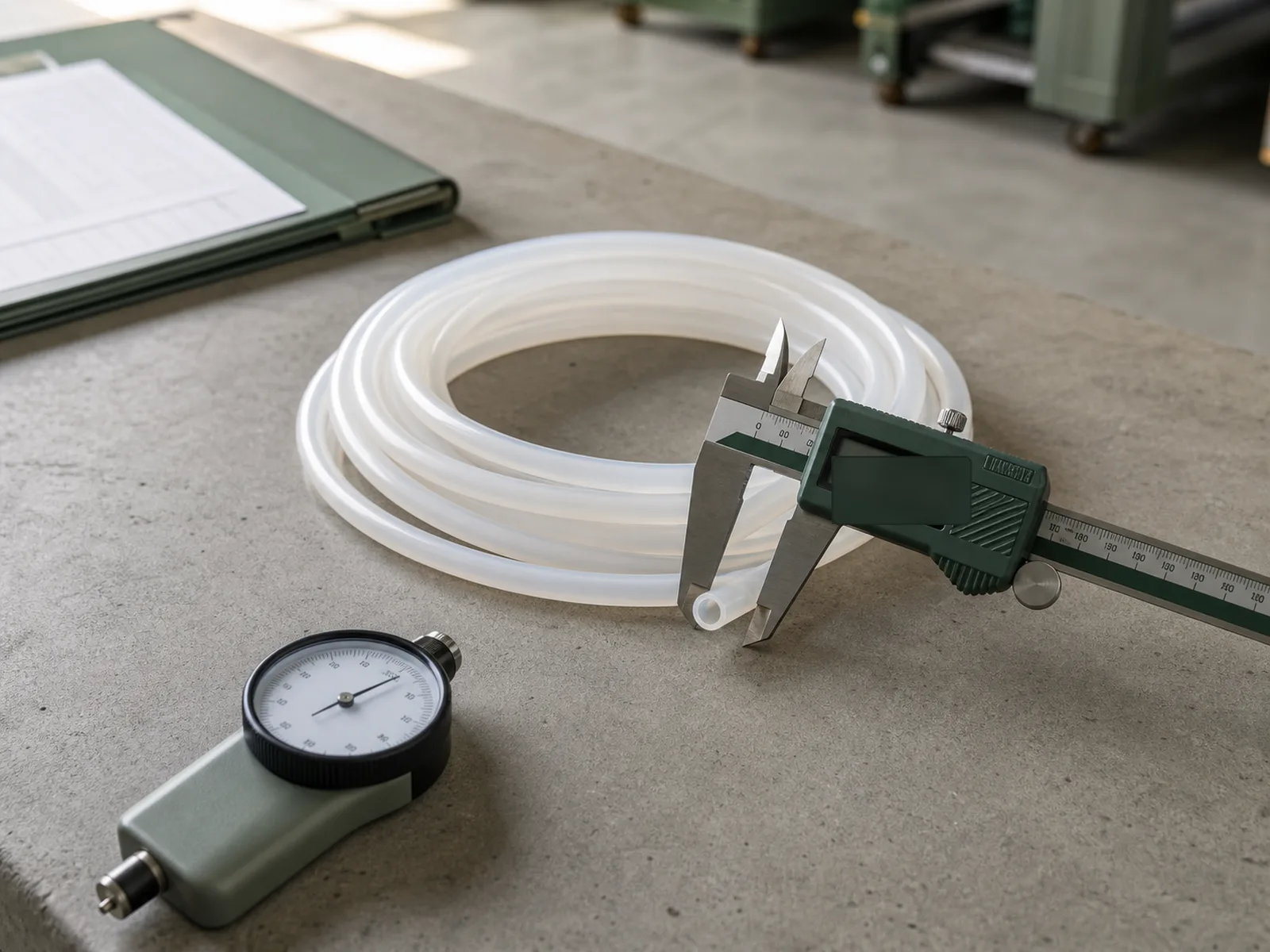
 A qualified silicone tubing manufacturer runs platinum-cured extrusion in a segregated cell, holds ±0.15 mm ID/OD tolerance, and ships per-lot Certificates of Analysis referencing ASTM D2240 durometer and ASTM D412 tensile data. Standard OEM MOQ is 500 meters per SKU for unreinforced tubing and 1,000 meters for braided construction, with 15-20 day lead times on existing tooling. Compliance stacks in three tiers: industrial (ISO 9001 + CoA), food-contact (FDA 21 CFR 177.2600 + LFGB §30/31), and medical-pharma (USP Class VI + ISO 10993-5/-10).
Buyers usually arrive at “silicone tubing manufacturer” search after a trading company has failed them once — the last lot came in loose on ID, the cure system was ambiguous, or the CoA turned out to be a template with unchanged numbers across four shipments. This guide is written for OEM engineers and sourcing managers who need to specify, quote, and qualify a silicone tubing supplier for programs that will run for years, not one PO. It covers the three compliance stacks, the drawing spec that a real factory can quote from, the cure-system decision, MOQ and tooling economics, and the QC packet that separates a real extrusion factory from a rebadged trader.
What separates a real silicone tubing manufacturer from a trader?
A real silicone tubing manufacturer owns the extrusion line, controls compound mixing on-site, and can produce a segregated platinum-cured cell on a live video walk within 24 hours. Traders send generic mill certificates, cannot show a die changeover, and typically source from three or four small extruders — so lot-to-lot variation compounds across shipments and no single supplier is accountable when the QC packet fails.
Four fingerprints separate factories from traders on the sourcing call. First, quote turnaround: a factory returns a technical quote in 48-72 hours with die availability, spool size options, and a specific tooling number; a trader takes 5-10 days and quotes only a per-meter price. Second, sample lead time: a factory ships die-cut samples off existing tooling in 3-5 days; a trader takes 15-20 days because they are ordering samples from an unnamed extruder. Third, drawing pushback: a factory engineer will call out unrealistic tolerances or an unspecified cure system before quoting; a trader accepts every spec silently. Fourth, the QC packet: a factory sends per-lot CoA with unique lot numbers, dates, and operator IDs; a trader sends a PDF template with the same numbers as the previous shipment.
What compliance stack do I need for OEM silicone tubing?
Silicone tubing compliance breaks into three stacks by application. Industrial and automotive tubing needs ISO 9001 plus a compound CoA and RoHS/REACH declarations. Food and beverage tubing adds FDA 21 CFR 177.2600 and LFGB §30/31, plus California AB 1200 PFAS-free for US retail. Medical and pharmaceutical tubing adds USP Class VI, ISO 10993-5 cytotoxicity, ISO 10993-10 sensitization, and typically ISO 13485 factory certification.
The three stacks are cumulative — a medical-grade line meets everything below it — but you should only qualify to the stack you actually need. USP Class VI adds $1.20-1.80 per meter and 6-8 weeks of first-article testing that a food-only or industrial line does not require. Compliance drift in the wrong direction (buying medical-grade tubing for a beverage dispenser) is expensive but safe; drift in the other direction (buying food-grade for a pharma fluid path) is a regulatory finding waiting to happen. The stack you specify should be the stack your customer signs off on, not the stack that sounds most impressive on the datasheet.
| Compliance stack | Applies to | Typical cost premium vs industrial |
|---|---|---|
| Industrial (ISO 9001 + CoA) | Automotive vents, drain, industrial fluid transfer | Baseline |
| Food-contact (adds FDA 177.2600 + LFGB §30/31 + AB 1200) | Beverage, dairy, coffee equipment, appliance water paths | +8-15 % |
| Medical-pharma (adds USP Class VI + ISO 10993-5/-10 + ISO 13485 factory) | Pharma fluid path, peristaltic dosing, Class II/III medical | +30-45 % |
Platinum-cured vs peroxide-cured — which cure system for tubing?
Platinum-cured silicone tubing is the default for food, beverage, medical, and pharmaceutical OEM. It leaves no peroxide by-product, has lower extractables and taste transfer, and holds 200-300 SIP cycles at 121 °C. Peroxide-cured silicone tubing costs 20-30 % less per meter and remains valid for non-critical industrial drain, vent, and low-temperature transfer where post-cure has been documented; without a 4-hour post-cure, peroxide-cured tubing usually fails 21 CFR 177.2600 extractable limits.
The cure decision is not a purity ranking — it is an application fit. Peroxide-cured tubing exists because dicumyl-peroxide crosslinking is faster and cheaper on the extrusion line, and for a low-temperature industrial vent line the taste and extractables profile does not matter. What matters is that the cure system is documented on the drawing and does not silently change lot-to-lot. Our platinum vs peroxide silicone deep-dive covers the chemistry in full.
How do I specify durometer, ID, OD, and wall thickness?
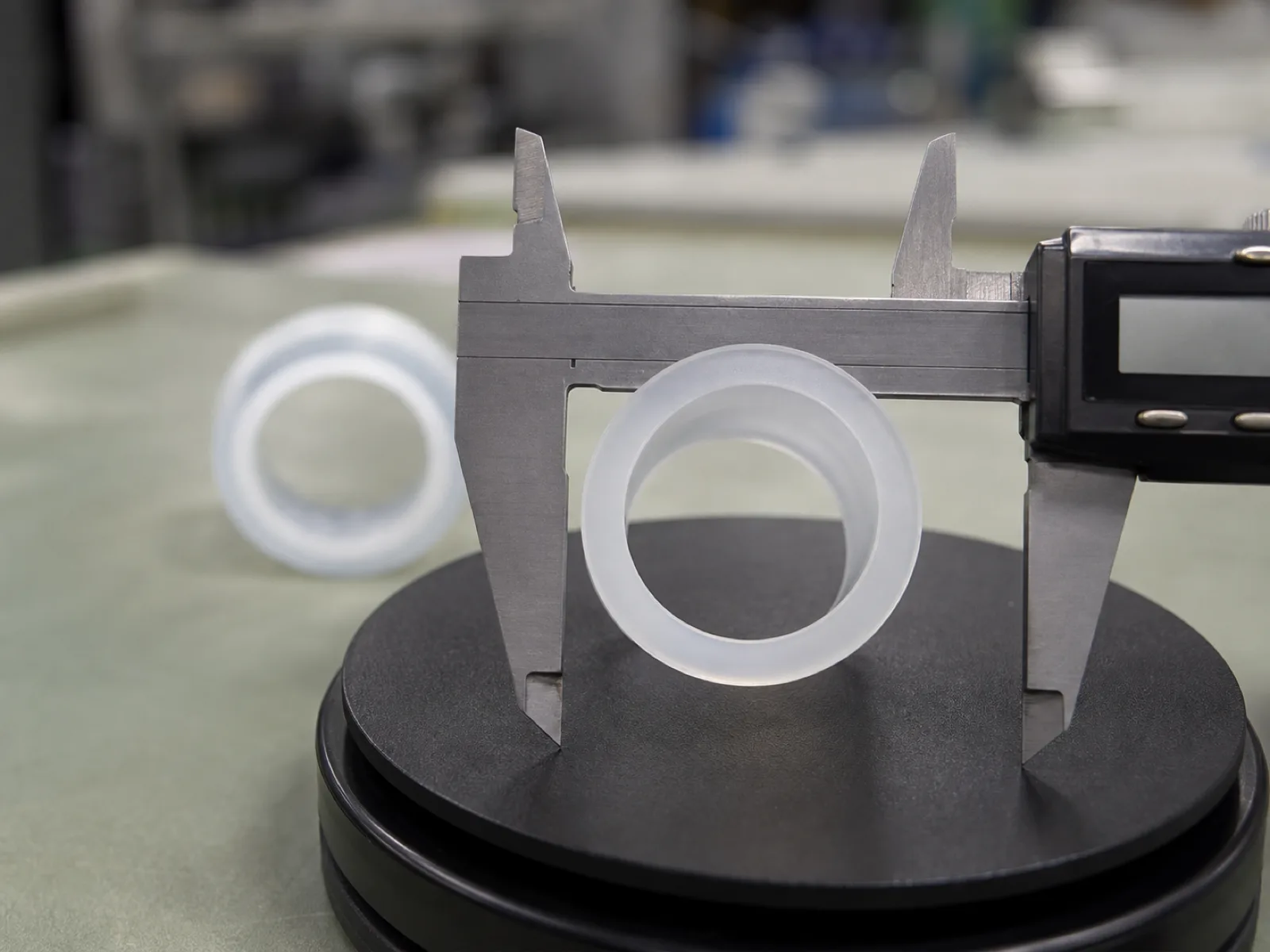
Every OEM silicone tubing drawing must carry six specs: nominal ID, nominal OD, wall thickness (or specify "as calculated"), durometer per ASTM D2240 (Shore A 40-80 range), cure system (platinum or peroxide), and compliance stack (177.2600 / LFGB / Class VI). Tolerances default to ±0.15 mm on ID and OD under 12 mm OD, ±0.25 mm above, and ±10 % on wall thickness. Anything missing gets filled in by the factory — usually not in your favor.
Durometer selection follows application, not preference. Peristaltic pump tubing lives in the 55-65 Shore A window because softer tubing walls creep and harder tubing walls resist pump-head occlusion. Beverage dispensing and general fluid transfer usually run 60-70 Shore A. Medical fluid path is typically 50 or 60 Shore A. High-vibration automotive routing runs 70-80 Shore A. The Shore A hardness chart covers cross-referencing to feel and application.
| Application | Recommended Shore A | Typical ID range | Wall thickness range |
|---|---|---|---|
| Peristaltic pump / dosing | 55-65 | 1.6 - 12.7 mm | 1.6 - 4.0 mm |
| Beverage / dairy transfer | 60-70 | 6.4 - 25.4 mm | 2.4 - 4.8 mm |
| Coffee equipment / hot-fill | 65-75 (braided) | 4.8 - 12.7 mm | 3.2 - 6.4 mm |
| Medical fluid path (Class VI) | 50-60 | 1.6 - 9.5 mm | 1.0 - 3.2 mm |
| Automotive vent / low-pressure | 70-80 | 6.4 - 19.0 mm | 2.4 - 4.8 mm |
When do I need reinforced silicone tubing?
Unreinforced silicone tubing handles low-pressure fluid transfer up to about 25 psi at room temperature, dropping to 8-10 psi at 180 °C. Above 30 psi at temperature, hot-fill CIP lines, or SIP cycles above 15 psi, polyester-braid reinforcement is required and roughly triples burst pressure. Wire-helix reinforcement is used only where full-vacuum resistance or crush resistance matters — beverage suction, dental evacuation, dedicated medical suction.
Reinforcement adds 40-60 % to per-meter cost and moves the MOQ from 500 meters to 1,000 meters because braid setup on the extrusion cell has its own changeover time. It also constrains the durometer window — braided tubing rarely runs below 55 Shore A because the softer inner wall extrudes unevenly under braid tension. If a program calls for both low-durometer peristaltic runs and high-pressure hot-fill runs, they are two separate SKUs on two separate extrusion cells.
What are OEM MOQ, tooling, and lead time?
Standard OEM MOQ at Wetop is 500 meters per SKU for unreinforced tubing, 1,000 meters for braided or wire-reinforced, and 1,000 meters for custom Pantone color runs. Die tooling runs $600-1,200 per set for standard round tubing and $1,400-1,800 for reinforced or precision-tolerance dies, amortized across the first two POs. Lead time is 15-20 days ex-works on existing tooling and 25-34 days on new tooling; sample-to-PO cycle for a first-time program is 30-45 days.
The MOQ math is compound-driven, not part-driven. Split-durometer or split-color runs on the same die combine toward the 500-meter compound minimum, so a program running 200 meters at 60 Shore A and 300 meters at 70 Shore A hits the floor on a single production day. What does not combine is cure system — platinum and peroxide runs cannot share a cell because of cross-contamination risk. See our real factory MOQ math guide for how these floors are calculated and why they exist.
What temperature and pressure ranges does silicone tubing hold?
Platinum-cured silicone tubing holds a continuous working range of -60 °C to +230 °C with short-term spikes to +260 °C. Pressure ratings are inversely tied to temperature: unreinforced tubing handles ~25 psi at 25 °C, ~15 psi at 100 °C, and 8-10 psi at 180 °C. Polyester-braid reinforcement roughly triples burst pressure at each temperature point; wire-helix reinforcement adds full-vacuum resistance without significantly raising positive-pressure burst.
Silicone’s temperature resilience is its structural advantage over EPDM, Viton, and thermoplastic elastomers — but it does not translate directly to pressure. As temperature rises, the polymer network softens and the effective wall stiffness drops, so pressure ratings must be de-rated by 40-60 % between 25 °C and 180 °C. For hot-fill or CIP loops, spec the pressure rating at the operating temperature, not at ambient. See our silicone temperature range explainer for the full stress-temperature curve.
What QC packet should ship with every lot?
Every OEM silicone tubing shipment should carry a five-document QC packet: (1) Certificate of Conformance referencing PO and drawing revision; (2) per-lot Certificate of Analysis with actual durometer per ASTM D2240, tensile and elongation per ASTM D412, and lot-specific ID/OD/wall dimensional readings; (3) compound-level FDA 21 CFR 177.2600 report dated within 12 months; (4) LFGB §30/31 report for EU shipments; (5) USP Class VI restatement for pharmaceutical programs. Dimensional CPK ≥ 1.33 on ID, OD, and wall.
The QC packet is where the trader-vs-factory distinction becomes irreversible. A real factory generates the CoA at end-of-run from actual sample measurement — you can see the operator ID, the date-time, and the metrology equipment ID. A trader generates the CoA in a spreadsheet and populates it with the same nominal values every shipment. The tell is trivial: request lot data for the previous three shipments and cross-check the numbers. If they are identical to the third decimal place, the CoA is fabricated.
How does extrusion compare to molding for tubing programs?
Extrusion is the correct process for tubing sold by the meter or coil — straight, continuous cross-section, produced at 5-30 meters per minute per line. Molding (compression, transfer, or LSR injection) is the correct process for shaped fluid-path components — elbows, tees, manifolds, over-molded connectors. Mixed programs run extruded tubing plus separately molded connectors, assembled downstream with silicone adhesive or over-molded silicone-on-silicone.
A silicone tubing manufacturer that also runs LSR injection or compression molding is not a red flag — it means the factory can quote the connector components on the same drawing. What matters is that extrusion and molding are separate cells with separate compound-handling protocols. For the molding side of a mixed program, see our silicone molding process guide and LSR OEM manufacturer overview.
How do I qualify a China-based silicone tubing manufacturer remotely?
Run a four-step remote qualification without visiting the factory: (1) request the ISO 9001 certificate and cross-check the accreditation body against IAF MLA; (2) get a live video walk of the extrusion cell showing die changeover and inline gauging; (3) order paid samples on your drawing and measure ID/OD/wall on your own metrology equipment — do not accept factory-measured data on the first article; (4) send samples for third-party FDA 21 CFR 177.2600 or USP Class VI testing at SGS or Intertek before releasing tooling PO.
The four steps take 30-45 days and eliminate ~90 % of the fake-factory risk. Step 3 is the one buyers most often skip and most often regret. A factory sending its own dimensional data on the first article is not lying — it is measuring what came off the die on the day the operator wanted the numbers to look good. Your metrology is the only data that matters, because your metrology is what your customer will use when the tubing arrives. For China-specific logistics — Yantian port cut-off, Shenzhen airport routing, sample-to-PO timeline — see our sourcing checklist.
Wetop as your silicone tubing manufacturer
Wetop runs a segregated platinum-cured extrusion cell with inline laser-micrometer gauging on ID and OD, holds ISO 9001:2015 factory certification, and ships per-lot Certificates of Analysis referencing ASTM D2240 durometer and ASTM D412 tensile data. Our extrusion team runs food-contact, industrial, and medical-grade programs on separate compound batches with segregated tooling. We are a founder-led independent factory in Dongguan — 90 minutes to Yantian Port and two hours to Hong Kong airport — with a 60-person team on 7,500 m², and we quote in 48-72 hours with a specific die number, spool size, and tooling amortization schedule.
If you are moving off a trading company and want a real silicone tubing manufacturer to quote your drawing, send us the spec and we will return a technical quote within three business days, including compound compliance documentation, tooling cost, and a first-article timeline. Include your ID/OD/wall spec, durometer target, cure system preference, compliance stack, and annual volume estimate.
References
The specifications, tolerances, and compliance references in this guide are drawn from the following primary standards and regulatory sources. All URLs are the publisher’s canonical location; specifications and clause numbers cited above match the current published revision.
FAQ
-
What should I look for in a silicone tubing manufacturer for OEM programs?
Ask for four things before quoting: (1) segregated platinum-cured extrusion cell — not shared with peroxide or non-food compounds; (2) ISO 9001 certificate plus ISO 13485 if the tubing is medical; (3) sample QC packet with per-lot CoA showing durometer, tensile, elongation, and ID/OD readings; (4) a compound-level FDA 21 CFR 177.2600 or USP Class VI report dated within 12 months. A silicone tubing manufacturer that cannot produce all four in 48 hours is a trading company, not a factory.
-
Is platinum-cured or peroxide-cured silicone tubing better for OEM use?
Platinum-cured silicone tubing is better for any application involving direct food or fluid contact, high-purity transfer, medical device use, or repeated steam-in-place cycles. It leaves no peroxide by-product, has lower extractables, and holds 200-300 SIP cycles at 121 °C. Peroxide-cured silicone tubing costs 20-30 % less per meter and is acceptable for non-critical drain, vent, and low-temperature industrial lines. Never use peroxide-cured tubing for beverage, dairy, or pharma without a documented 4-hour post-cure.
-
What durometer range do silicone tubing manufacturers offer?
Standard OEM silicone tubing runs Shore A 40-80 per ASTM D2240. Below 40 Shore A the tubing is too soft to hold ID under vacuum; above 80 Shore A it stops behaving like elastomer and pump heads cannot occlude the bore. Peristaltic pump tubing sits at 55-65 Shore A. Beverage dispensing and general fluid transfer usually specify 60-70 Shore A. Medical fluid path is typically 50 or 60 Shore A. Split-durometer runs on the same die combine toward the compound MOQ, not per-durometer MOQ.
-
What ID/OD tolerances can a silicone tubing manufacturer hold on extrusion?
Industrial baseline extrusion holds ±0.15 mm on ID and OD for tubing under 12 mm OD, and ±0.25 mm above 12 mm OD. Wall thickness tolerance is typically ±10 % of the nominal wall. Precision beverage and analytical lines can hold ±0.05 mm with inline laser-micrometer gauging, but require a dedicated die, a 500-meter minimum per run, and add 15-20 % to per-meter price. Anything looser than ±0.30 mm on a small-OD tube signals an unqualified factory.
-
Do I need USP Class VI silicone tubing for my application?
USP Class VI biocompatibility is required for direct pharmaceutical fluid path, injectable and infusion contact, and most Class II/III medical devices. It runs six-way animal testing per USP <88> plus ISO 10993-5 cytotoxicity and ISO 10993-10 sensitization. If your tubing only contacts food, beverage, or non-implanted industrial fluid, FDA 21 CFR 177.2600 and LFGB §30/31 are sufficient — VI adds $1.20-1.80 per meter with no additional food-safety benefit. See our [FDA vs LFGB silicone guide](/guide/fda-vs-lfgb-silicone/) for the food-contact stack.
-
What is the MOQ and lead time for custom OEM silicone tubing?
Wetop's standard OEM MOQ is 500 meters per SKU on a single ID/OD/durometer combination in translucent or a stock color. Braided or wire-reinforced tubing carries a 1,000-meter floor. Custom Pantone color runs also start at 1,000 meters because color master-batch has its own minimum. Lead time is 15-20 days ex-works on existing tooling and 25-34 days on new die + spool tooling. Sample-to-PO cycle for a first-time program runs 30-45 days including compound qualification.
-
When do I need reinforced (braided or wire-helix) silicone tubing?
Polyester-braid reinforcement is required for any pressurized transfer above 30 psi at temperature, hot-fill CIP lines, or SIP loops running above 15 psi. Braid roughly triples burst pressure with a 40-60 % cost premium. Wire-helix reinforcement is used only where full-vacuum resistance or crush resistance is needed — beverage suction lines, dental evacuation, some medical suction. Unreinforced silicone tubing handles low-pressure fluid transfer up to about 25 psi at ambient and 8-10 psi at 180 °C.
-
How does extrusion compare to molding for custom silicone tubing?
Extrusion is a continuous process producing straight tubing at 5-30 meters per minute per line — the correct route for tubing sold by the meter or coil. Molding (compression, transfer, or LSR injection) is a discrete process producing shaped fluid-path components — elbows, tees, manifolds, over-molded connector assemblies. If your part has any bend, feature, or connector geometry that cannot be cut and assembled downstream, it needs a mold — see our [LSR injection molding guide](/guide/silicone-lsr-injection-molding-guide/). Mixed programs run tubing extrusion plus separate molded connectors.
-
What certifications should ship with every lot of OEM silicone tubing?
Every OEM shipment should include: (1) Certificate of Conformance referencing PO and drawing revision; (2) Certificate of Analysis with lot-specific durometer per ASTM D2240, tensile and elongation per ASTM D412, and ID/OD/wall dimensional readings; (3) compound-level FDA 21 CFR 177.2600 report (annual, not per-lot); (4) LFGB §30/31 for EU shipments; (5) USP Class VI restatement for pharma programs. REACH SVHC and California AB 1200 PFAS-free declarations ship as PDF on request.
-
How do I qualify a Chinese silicone tubing manufacturer without visiting the factory?
Run a four-step remote qualification: (1) request the ISO 9001 certificate and cross-check the accreditation body against IAF MLA; (2) get a live video walk of the extrusion cell showing die changeover and inline gauging; (3) order paid samples on your drawing and measure ID/OD/wall on your metrology equipment — do not accept factory-measured data on the first article; (4) send the samples for third-party FDA 177.2600 or USP Class VI testing at SGS or Intertek. If all four pass, the factory is real. See our [sourcing silicone factory checklist](/guide/sourcing-silicone-factory-checklist/) for the full audit protocol.
References
Authoritative sources cited in this guide
- US Food and Drug Administration. 21 CFR 177.2600 — Rubber articles intended for repeated use. https://www.ecfr.gov/current/title-21/chapter-I/subchapter-B/part-177/subpart-C/section-177.2600
- United States Pharmacopeia. USP <88> Biological Reactivity Tests, In Vivo — Plastic Class Designations. https://www.usp.org/harmonization-standards/pdg/excipients/plastic-materials
- International Organization for Standardization. ISO 10993-5:2009 — Biological evaluation of medical devices — Tests for in vitro cytotoxicity. https://www.iso.org/standard/36406.html
- International Organization for Standardization. ISO 10993-10:2010 — Tests for irritation and skin sensitization. https://www.iso.org/standard/40884.html
- ASTM International. ASTM D2240 — Standard Test Method for Rubber Property — Durometer Hardness. https://www.astm.org/d2240-15r21.html
- ASTM International. ASTM D412 — Standard Test Methods for Vulcanized Rubber and Thermoplastic Elastomers — Tension. https://www.astm.org/d0412-16r21.html
- ASTM International. ASTM D2000 — Standard Classification System for Rubber Products in Automotive Applications. https://www.astm.org/d2000-18.html
- International Organization for Standardization. ISO 13485:2016 — Medical devices — Quality management systems. https://www.iso.org/standard/59752.html
- International Organization for Standardization. ISO 9001:2015 — Quality Management Systems — Requirements. https://www.iso.org/standard/62085.html
- European Chemicals Agency (ECHA). REACH Candidate List of substances of very high concern (SVHC). https://eur-lex.europa.eu/legal-content/EN/TXT/?uri=CELEX%3A32006R1907
Start a custom program
Send a brief. Get an engineer’s reply in one business day.
Every Wetop program is tooled from a customer’s specification. Send a CAD file (STEP · IGES · DWG) or a written brief and we’ll reply with a mold cost estimate, price brackets at MOQ 500 / 1,000 / 5,000, and any engineering questions.