Top-3 US premium baking brand caliber · Multi-Category · Coordinated silicone pastry mat retail family with PMS-matched measurement print across 4 sizes
Premium Baking Brand Pastry Mat OEM — 4-SKU Retail Program
Why this program is worth writing up
This is the OEM case where every buyer-side decision — cure system, compliance depth, MOQ tiering, print discipline — was made against a clause number rather than a marketing adjective. The 3-year record (zero recalls, zero bloom, ±0.42 ΔE mean color hold) is what a Tier-2 retail chain actually audits when a procurement lead argues for a supplier switch to their category director.
The brand isn’t named here — the program is under an anonymization agreement standard for retail-chain private-label work. What matters for other housewares-brand and retail procurement readers is the shape of the decisions, not the logo.
Cure system: why platinum-cured LSR was non-negotiable
Platinum-cured LSR (liquid silicone rubber) uses a platinum-catalyst addition-cure system that produces no by-products, holds ±0.05 mm dimensional tolerance, and clears FDA 21 CFR 177.2600 without the peroxide-decomposition residues that cause bloom. Peroxide-cured HCR is cheaper but leaves 2,4-dichlorobenzoic acid or benzoic acid residues that migrate to the surface over 6-12 months of shelf life — the exact defect that killed the previous supplier.
The previous supplier’s product had shipped clean at day zero and developed hazy white surface deposits inside a year on retail shelves. Root-cause on returned units traced back to a peroxide cure system with insufficient secondary post-bake — a 4-6 hour oven cycle at 200 °C would have volatilized the residues, but the previous factory skipped it to save energy and throughput. The engineering brief for this program locked platinum-cure into the RFQ so no compound-substitution game could re-open that failure mode. Details on the choice framework are in the platinum-cured vs peroxide-cured guide.
Compliance stack: clause-level certificates, not letter-of-guarantee
The program's compliance stack is FDA 21 CFR 177.2600 (rubber articles intended for repeated use, subclauses (c)(4)(i) total extractives + (c)(4)(ii) chloroform-soluble extractives), LFGB §30 and §31 (general safety + specific food-contact requirements), ISO 9001:2015 documented QMS, and California Proposition 65 attestations. Third-party verification comes through Intertek on first-article and annual audit.
The buyer-side difference: a letter of guarantee from a factory says “we comply.” A clause-level certificate says “this batch was tested against 21 CFR 177.2600(c)(4)(i), total extractives measured at 0.18 mg/in² (limit 20 mg/in²), on 2026-03-14, by [lab], report number XYZ.” Every retail-chain compliance department that has been through a recall knows which document holds up in a regulator letter.
For the deeper contrast between the two regulatory frameworks, see FDA vs LFGB silicone.
Material spec matrix: locked before tooling
The material spec matrix locked before tooling: Shore A 55 ± 3 (ASTM D2240), thickness 0.75 mm ± 0.05 mm across the sheet, tensile strength ≥ 8.0 MPa, tear strength (Die B) ≥ 25 kN/m, elongation at break ≥ 400 %, service temperature -40 °C to 230 °C continuous. Standard housewares-tier competitor spec runs Shore A 40-70, thickness 0.6-1.2 mm — the tighter window here was set to keep the mats flat in retail-shelf display and rigid enough for baker press-down without deformation.
The retail chain’s product-testing lab runs a plate-thermal-shock cycle (-30 °C freezer to 230 °C oven, 20 cycles) as an internal gate for any silicone bakeware. Anything that warps out of flatness > 2 mm across the 585 mm long dimension fails. Our first-article submissions ran that same protocol in-house before shipment; deviation logged at 0.6 mm max on the half-sheet SKU. Silicone’s -40 to 230 °C range survives this envelope with margin.
MOQ pricing tiers and tooling amortization
Pricing tiered at 500 / 1,000 / 5,000 / 10,000 units per SKU with tooling amortization amortized over the first 10,000 units at $0.35-0.55 per unit depending on SKU complexity (the French-baguette 3-trough tool amortized higher than the flat half-sheet). Unit price stepped down ~18 % from tier 1 to tier 4 — driven by cycle-time efficiency at run length, not by cutting compound cost.
The initial pilot ran at 500 units × 4 SKUs = 2,000 units total across the family so the brand’s product team could seed retail-chain buyer meetings with real inventory. Year-two POs stepped up to 12,000 units per SKU, which is where the compound-cost efficiency (larger drum orders, less color-changeover downtime) shows up in the unit price. The real-factory MOQ math explains why 500 units is a sane pilot floor for a platinum-cure LSR program and not the 5,000 units a compound house might quote.
For the broader tiered OEM pricing structure, see the linked guide. Overall MOQ and lead time framework applied identically here: 7-15 day sampling, 30-45 day production.
Retail-tier positioning: what a Tier-2 chain actually demands
Tier-2 retail chains (regional grocery, mass-craft, premium housewares — the tier a rung below mass-merchant Tier-1) demand three things Tier-1 does not always require: (1) private-label packaging finished at factory, not decanted into brand carton at a US 3PL, (2) per-batch third-party test reports with the PO, not annual sampling, (3) a named factory engineering contact for retail-buyer conference calls. Tier-1 mass merchants trade some of that for pure unit-price aggression.
The Tier-2 buyer’s audit posture is closer to a specialty retail chain than to a discount format: they’ll walk the factory floor once at RFP stage, request an ISO 9001 gap-analysis document, and require a written response to any consumer service escalation within 5 business days. The factory sourcing checklist is the framework we hand our buyer contacts to run their own audit.
Private-label finishing: PMS matching, packaging, measurement print
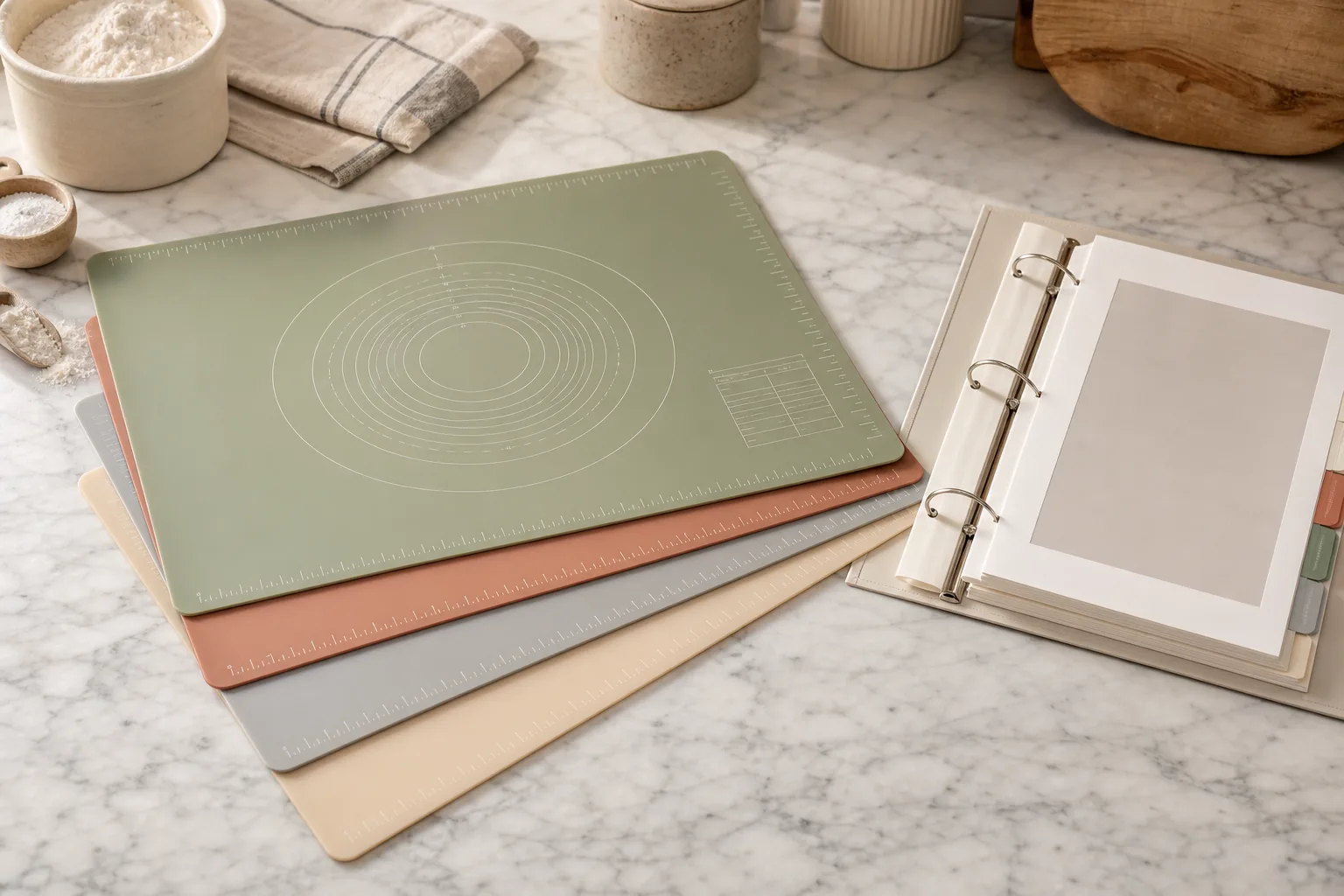
Private-label finishing was PMS 4625C measurement grid pad-printed on one long edge (cm scale) and one short edge (inch scale) with 4 concentric ring templates (baguette proofing / macaron piping guides). Print ink was a two-part platinum-cure silicone ink matched to the brand PMS via CIE Lab (ΔE00 formula) spectrophotometer on every mixed batch, cured at 200 °C for 4 hours in secondary post-bake to anchor against dishwasher cycling.
Print durability was the buyer-side unlock: previous supplier had used a solvent-based ink that peeled inside 30 dishwasher cycles. Ours held past 500 cycles in in-house testing and past 250 cycles in the customer’s third-party lab. The silicone print / laser / deboss methodology comparison covers when to use each — for measurement grids that must survive oven + dishwasher, pad-print with post-bake beats laser and deboss on cost and legibility.
Packaging shipped fully retail-ready: PET-lined kraft sleeve, UPC + FSC-certified paperboard, poly-bagged 24-per-master. The private-label kitchen products guide covers the finish-at-factory versus finish-in-market tradeoff.
Sample and pre-production timeline
First-article sample ran 12 days from PO to shipment: 4 days tooling-shop cavity finish + measurement-grid laser etch, 3 days first-shot + dimensional verification, 3 days pad-print and post-bake, 2 days internal lab (dimension, tensile, tear, thermal shock) before UPS priority. Production ran 35-42 days from PO for repeat SKUs after tooling was amortized.
The tightest window in the schedule was the color-match on the first-article — CIE Lab readings pass or fail on the third submission historically, so we build 2 iterations into the sample timeline before promising a hard date. On this program the pad-print ink matched at ΔE 0.31 on the first submission because we’d pre-mixed against the brand’s TPX Pantone reference before the customer’s designer flew in for the color-approval meeting.
Third-party testing routes
Third-party testing routes buyers should require for a US-shelf silicone bakeware program: Intertek or SGS on first-article (full 21 CFR 177.2600 clause + LFGB §30/§31 + Prop 65 panel), annual audit thereafter, plus per-batch factory COA. TÜV Rheinland is common for EU-market programs targeting BfR Recommendation XV. USP <88> Class VI is optional but recommended if the brand narrative uses "medical-grade" language.
The retail chain in this program specified Intertek because they already had a global master service agreement in place — this cuts turnaround from 3-4 weeks (open enrollment) to 8-10 business days on repeat submissions. Any of Intertek / SGS / TÜV / Bureau Veritas produces a report the retailer’s compliance team will accept; the choice comes down to which lab has the fastest turnaround at the region where the goods ship to. The PFAS-free sustainability piece covers the additional test we run in-house before third-party submission.
Common OEM defect modes — and how a real factory prevents them
The three defect modes that kill silicone pastry-mat OEM programs are (1) surface bloom from peroxide-cure residues, prevented by specifying platinum-cure and a mandatory 200 °C / 4 hr post-bake, (2) tear propagation at the edge, prevented by tooling gate placement 3 mm inside the trim line and Die B tear-strength ≥ 25 kN/m, and (3) non-slip failure from over-polished cavity, prevented by SPI B-2 texture on the underside cavity face to hold micro-suction against countertop.
The previous supplier’s failure was defect (1) — the reason the program landed at Wetop in the first place. Defect (2) shows up when a factory over-optimizes for cycle time and moves the mold gate too close to the trim; when the trim knife breaks the surface at the gate mark, a tear line propagates across the sheet under first hand-pull. Defect (3) is the counterintuitive one: buyers assume a smoother silicone underside grips better, but micro-texture is what creates the vacuum. This is the same principle behind why silicone drying racks outperform silicone-coated stainless in kitchen use.
What ships with every PO
Every PO ships with a per-batch COA bundle: platinum-cure attestation, 21 CFR 177.2600 clause statement with measured extractables values, LFGB §30 and §31 test results, Prop 65 attestation, ΔE color-match report for the pad-print, ISO 2859-1 Level II sampling record at AQL 1.5 cosmetic / AQL 0.65 critical, and lot traceability back to the master-batch compound drum. Documentation retained 36 months per ISO 9001:2015.
The buyer-side compliance workflow depends on this bundle arriving as one PDF referenced to the PO number, not five emails from three departments. This is the ISO 9001 process discipline that costs a factory more in documentation labor than in test fees — and is the thing a broker-model supplier cannot fake.
Program continuity: what year 2 and year 3 look like
Year 2 added a fifth SKU (a rectangular fondant mat, 480 × 320 mm, with debossed brand mark rather than pad-print) using the same platinum-cure compound and mold-shop process. Year 3 extended the retail lock to a 5-year window and added a color variant (soft-cream Pantone 7527C) with identical print spec. Program cadence stabilized at four production runs per year, ~11,000 units per SKU per run.
The buyer-side pattern here is worth naming: the program didn’t grow because we cut price — it grew because the compliance and print-durability record removed friction from the retailer’s category director’s approval cycle. Once the retailer’s product-testing lab stopped flagging silicone bakeware from this brand as a re-test target, the brand’s product team could pitch adjacent SKUs into the same range without restarting the qualification gate.
What the sourcing decision looked like from the buyer side
The buyer-side sourcing decision came down to three things: cure system on paper, factory-audit walkthrough in person, and per-batch documentation cadence. Unit price landed within 6 % of two other quotes on the RFP; the customer chose the factory whose compliance bundle was already structured for retail-chain audit. Unit price was not the deciding variable in year 1 — it became a re-negotiation lever in years 2 and 3 as volume tiered up.
For procurement leads evaluating a similar switch, the factory sourcing checklist covers the walkthrough questions we recommend. NDA templates, capacity data, and a direct engineering contact are available via the capabilities page or on request via contact. Standard NDA at NDA. Other retail-family programs at case studies.
Frequently asked
Q: Why did the previous supplier’s product bloom on shelf? A: Peroxide-cured HCR silicone leaves organic-acid residues (typically 2,4-dichlorobenzoic acid) from the curing agent. A properly-run peroxide process includes a 4-6 hour post-bake at 200 °C to volatilize the residues. Skip the post-bake to save energy and throughput, and the residues migrate to the surface over 6-12 months of ambient storage. Platinum-cure has no such by-product.
Q: Is 500 units per SKU a realistic MOQ for a platinum-cure LSR program? A: Yes for a real factory running its own LSR presses. It is not realistic for a broker-model supplier who buys press time by the hour — their unit economics require 5,000+ units per SKU. The difference is where the fixed cost of the color-match, cure-cycle set-up, and QC batch sits.
Q: How is the ±0.5 ΔE color tolerance measured? A: CIE Lab spectrophotometer readings against a physical TPX Pantone reference chip, ΔE00 formula, five points per batch (four corners + center of the printed edge). Reading logged on the batch COA. Standard housewares-tier tolerance is ±1-2 ΔE; ±0.5 requires master-batch discipline and pad-print ink pre-mixed against the reference, not tuned in-line.
Q: What third-party lab does the retail chain in this case require? A: Intertek, because the retailer holds a global MSA. SGS or TÜV Rheinland would be equally acceptable for the technical scope — the choice is a commercial one about turnaround time and existing account structure.
Q: How does tooling amortization work at 500-unit pilot? A: Tooling cost is quoted as a one-time NRE (non-recurring engineering) charge or amortized over the first 10,000 units at ~$0.35-0.55 per unit. Buyers typically prefer the amortized model for cash-flow reasons on a pilot; retailers running a 3+ year lock often prefer the NRE model to keep unit price clean for their internal margin math.
Q: What certification does the pad-print silicone ink need? A: The ink itself must clear 21 CFR 177.2600 as a food-contact substance — the same rule as the base silicone. LFGB §30/§31 for EU market. Some retailers additionally require a heavy-metal panel (lead, cadmium, mercury, hexavalent chromium) below CPSIA thresholds, even though pastry mats are not children’s products.
Q: How long does first-article approval typically take? A: 12 days from PO to sample shipment on our program cadence, then 5-15 business days at the third-party lab (Intertek quotes 8-10 on the MSA fast track). Total approve-to-produce window is 25-40 days from PO to production start, depending on whether the mold has already been amortized on a prior program.
Q: Can we deboss instead of pad-print the measurement grid? A: Yes — deboss is molded into the cavity and lasts the life of the mat, but it reduces contrast legibility on the food-contact face. For measurement grids that must be readable at a glance under kitchen lighting, pad-print with post-bake anchoring is the housewares-industry default. Deboss is stronger for brand-mark corner marks that just need to be identifiable.
Sourcing a similar program?
Get a CAD review and quote in one business day.
MOQ 500 per SKU. Samples in 7-25 days. We can share a more detailed reference (under NDA) for an adjacent program. Email inquiry@wetopsilicone.com or use the form.