Buyer Guide · commercial intent
Silicone Face Cleansing Brush Manufacturer Guide
 Buyer Guide
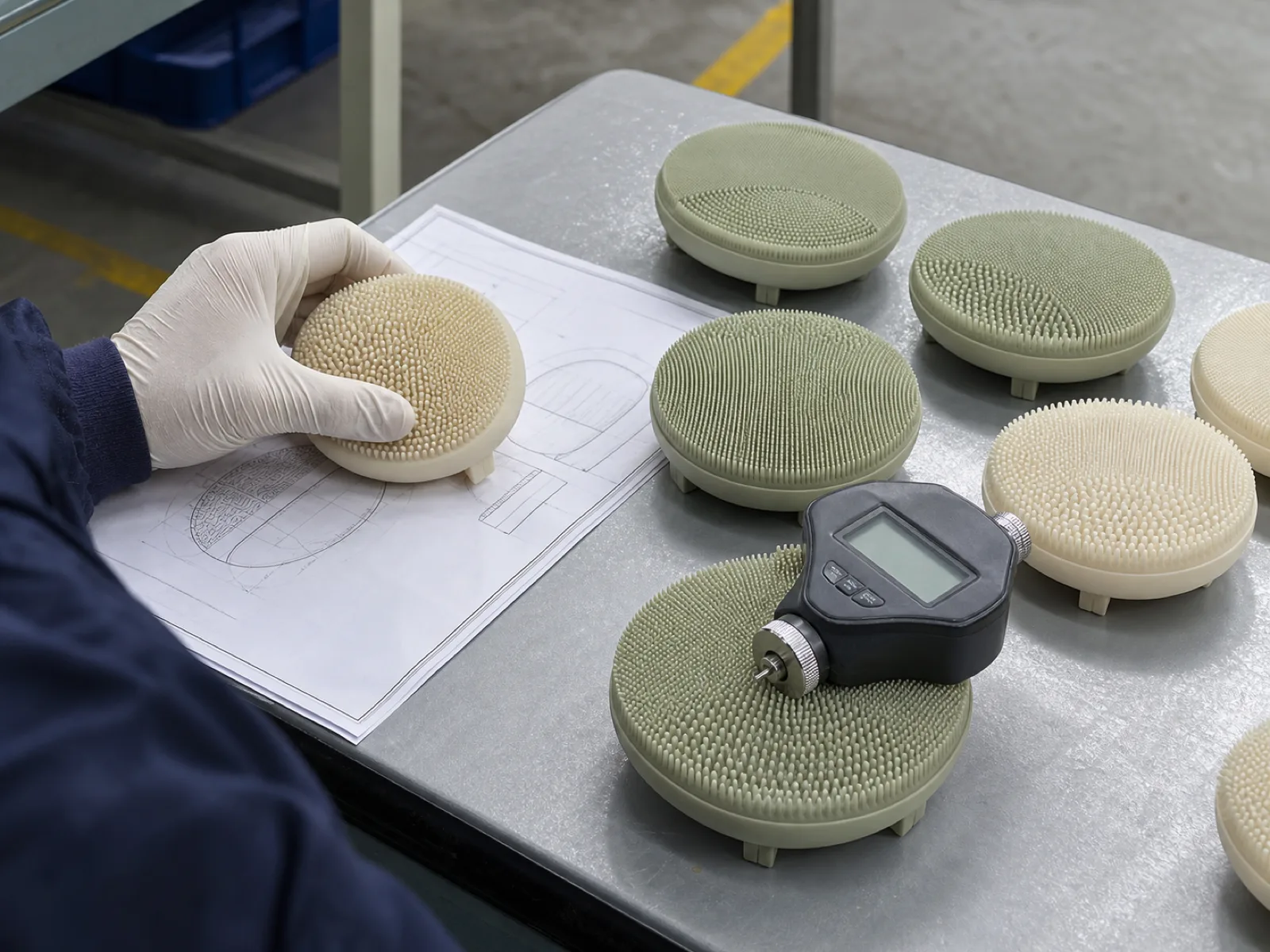
 A silicone face cleansing brush is a facial-care tool whose cleansing surface is a molded array of platinum-cured silicone fingers rather than a tuft of nylon bristles, built either as a simple manual head or as a sealed sonic device with a vibration motor and a waterproof housing. It is engineered with soft Shore A 20–35 touch points for delicate skin and firmer 35–50 nubs for the oily T-zone, cleared for repeated skin contact under FDA 21 CFR 177.2600, and — when sonic — validated to an IPX7 waterproof rating for shower use. This guide is the engineering-desk brief for skincare brands and private-label buyers choosing a silicone face cleansing brush manufacturer, covering sonic versus manual builds, the overmold that makes a sealed head watertight, the durometer map that matches finger softness to facial skin sensitivity, skin-safe compliance, MOQ and tooling math, and how to tell a real factory from a trading desk.
Most silicone face cleansing brush suppliers sell the finished object and hide the four decisions that determine whether it works: manual versus sonic, the process that seals a wet-environment device, the durometer map across the face, and the compliance packet that keeps a skin-contact tool through customs. A cleansing head is deceptively hard — it lives in the shower, touches sensitive skin daily, and often wraps a lithium battery. This guide is written from the engineering desk at Wetop’s Dongguan floor for skincare brands, contract manufacturers, and private-label programs who want the process math behind a silicone face cleansing brush, not another product listing.
What is a silicone face cleansing brush, and what must a retail-grade one deliver?
A silicone face cleansing brush is a facial tool with a molded array of soft platinum-cured silicone fingers instead of nylon bristles, sold as a manual head or a sonic (vibrating) device. A retail-grade unit needs a multi-durometer finger map (soft Shore A 20–35 for cheeks, firmer 35–50 for the T-zone), FDA 21 CFR 177.2600 skin clearance, a non-porous flash-free surface, and — if sonic — an IPX7 waterproof seal.
The category splits cleanly into two builds that share a face but differ completely underneath. A manual brush is a molded silicone head, often on a short handle or as a palm-sized pebble, used with cleanser and rinsed clean — no electronics, nothing to fail, and the simplest part to tool. A sonic brush wraps a vibration motor, a rechargeable battery, and a control PCB inside a waterproof housing, with the silicone cleansing face overmolded onto that housing. Same product family on the shelf; two entirely different manufacturing projects.
What unites both is the cleansing mechanism: soft silicone fingers that flex against the skin to lift cleanser, sebum, and dead cells out of pores without the scratch of stiff bristles. That flexing-finger action is why the durometer map matters more here than on almost any other cosmetic silicone tool — the fingers must be gentle enough for a reactive cheek and firm enough to actually clean an oily nose, in the same head. A supplier that molds one uniform hardness across the whole face is shipping a tool that either drags on delicate skin or slides uselessly over the T-zone.
Sonic (electric) vs manual silicone face cleansing brush — which should you build?
A manual silicone cleansing brush is the faster, lower-cost, lower-risk build: a molded head with no electronics, low MOQ, and no battery or waterproof-electronics certification. A sonic brush commands a higher retail price and adds perceived efficacy, but the vibration motor, battery, PCB, and IPX-rated waterproof housing turn it into a sealed-electronics program where roughly 80% of the added cost and lead time is the seal and electronics, not the silicone.
The manual-versus-sonic decision reshapes the entire program — MOQ, tooling, certification, and risk — so it belongs at the front of an RFQ, not the end. The two builds diverge sharply on everything except the silicone face.
Manual brushes are the volume workhorse of the category: a molded silicone head, sometimes with a magnetic or thread-mount handle, priced to move at drugstore and e-commerce shelves. There is no motor to fail, no battery to certify, no seal to leak. Because the whole part is silicone, it is dishwasher- and boil-safe, and the only certification burden is the skin-contact material packet. This is the right build for a brand testing the category, a value-tier SKU, or a gift-with-purchase.
Sonic brushes add a small eccentric or linear vibration motor that oscillates the silicone face thousands of times a minute, plus a rechargeable lithium cell, a PCB with speed modes, and — critically — a fully sealed, waterproof housing. The value proposition is a higher price point and a stronger efficacy story, but the engineering burden multiplies: the silicone must be overmolded onto the motor housing to form a watertight barrier, the battery compartment must be sealed and the charging made contactless, and the finished device must pass IPX water-ingress and lithium-battery transport testing. The silicone molding is the easy part of a sonic program; the seal and the electronics are where projects slip.
| Attribute | Manual silicone brush | Sonic silicone brush |
|---|---|---|
| Electronics | None | Motor + battery + PCB |
| Waterproofing | Inherent (solid silicone) | Engineered IPX seal + inductive charge |
| Certification burden | Skin-contact material only | Material + battery (UN 38.3) + IPX |
| Typical retail price | Low–mid | Mid–premium |
| Practical MOQ | 500–1,000 pcs | 3,000–5,000 pcs |
| Added lead time | None | +10–20 days (seal + electronics) |
| Failure risk in field | Very low | Seal leak, battery, motor |
The engineering call: build manual first to prove the head geometry and skin feel, then graduate the winning head onto a sonic base once volume justifies the electronics investment. A head tooled for manual use can often be re-mounted onto a sonic housing without re-cutting the finger cavities, which de-risks the jump.
LSR overmolding vs compression molding — which process suits a waterproof face brush?
LSR overmolding is the correct process for a sonic cleansing head because the low-viscosity liquid silicone is injected directly onto the motor housing, forming a molecular watertight bond in one automated shot — no glued seam to leak. Compression molding suits a standalone manual head with chunky fingers where tooling cost dominates, but it cannot reliably overmold onto a housing or hold a waterproof seal.
The molding-process choice is decided by whether the brush is sealed and by how fine the finger array is. The two routes behave very differently on both counts.
Liquid silicone rubber (LSR) injection and overmolding meters two platinum-cured liquid components, mixes them, and injects the blend into a heated mold — or directly over an insert such as a motor housing — where it cures in seconds. Because it is a low-viscosity liquid, LSR fills fine, dense, closely pitched finger cavities completely and repeatably, and it bonds chemically to a prepared housing to form a seamless waterproof skin. That makes LSR the only defensible process for a sonic brush: the waterproof barrier becomes part of the molded silicone rather than a glue line that fatigues and leaks after a few hundred shower cycles. The full material-science treatment of why LSR behaves this way lives in the liquid silicone rubber explainer.
Compression molding places a measured slug of solid HCR silicone into an open mold and closes a heated press on it. It tools cheaply, which makes it defensible for a standalone manual head with wide, coarse fingers — geometry forgiving enough that flow is not an issue and no housing seal is required. Its weaknesses are exactly where a face brush is demanding: it cannot overmold reliably onto a motor housing, it leaves parting-line flash that must be hand-trimmed off every skin-contact finger, and it holds looser tolerances shot to shot.
| Attribute | LSR injection / overmold | Compression molding |
|---|---|---|
| Overmold onto housing | Yes — molecular, watertight | No — not reliable |
| Best for | Sonic heads, fine dense fingers | Standalone manual, coarse fingers |
| Finger tolerance | ±0.05 mm | ±0.15–0.30 mm |
| Cure time per shot | 30–90 s | 3–8 min |
| Flash near skin edge | Minimal (valve gate) | Hand-trim every unit |
| Tooling cost (this category) | USD 5,000–11,000 | USD 2,500–5,500 |
| Waterproof-seal capability | Native | None |
The engineering call: any sonic or waterproof brush is LSR, full stop, because the seal depends on it. Reserve compression molding for a low-cost standalone manual head where fingers are coarse and unit economics dominate. The broader process decision map for silicone parts is laid out in the silicone molding process guide.
What Shore A hardness should silicone cleansing fingers be for each skin zone?
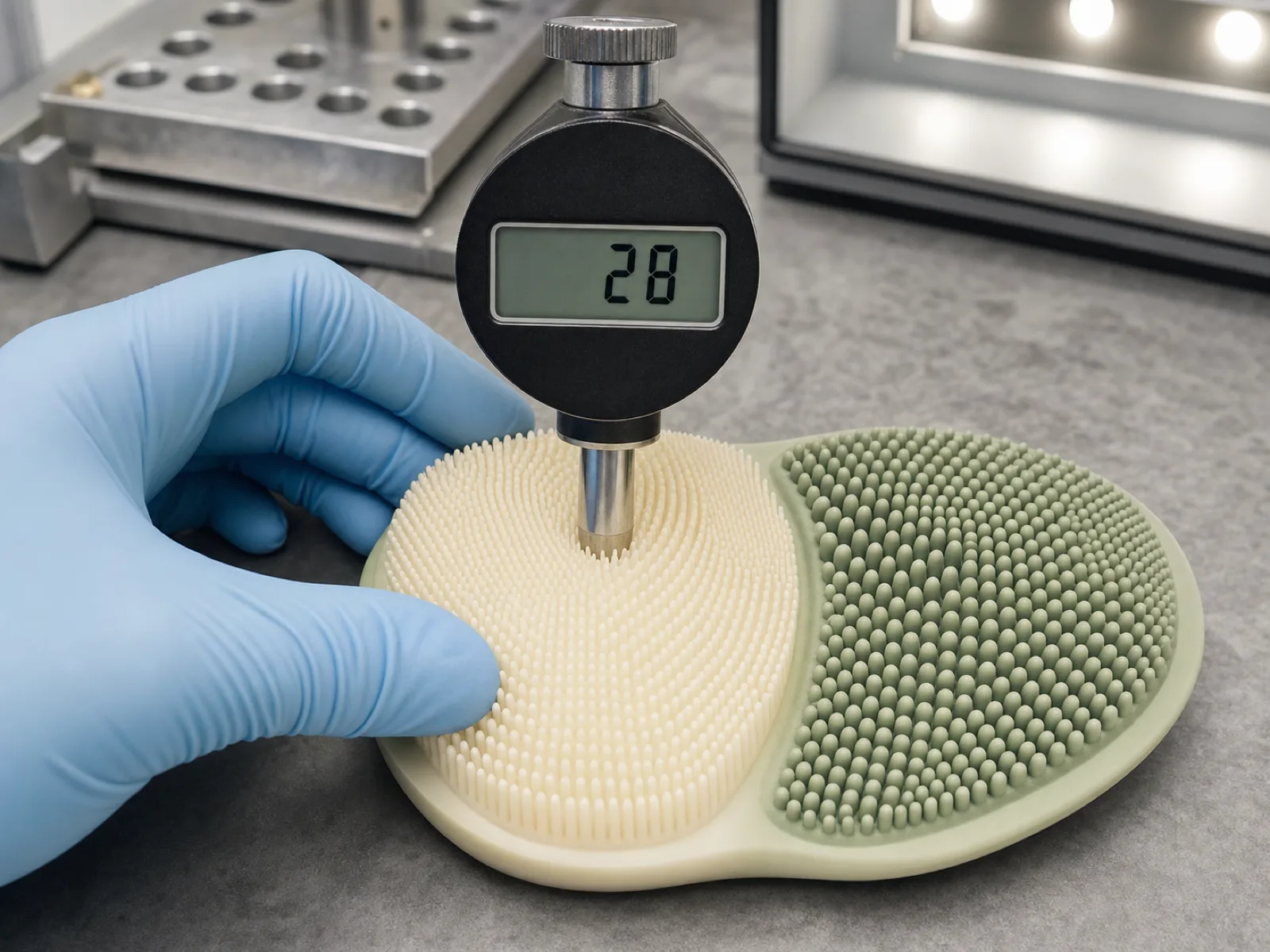
A facial cleansing head is a multi-durometer part mapped to skin sensitivity. Broad cheek and forehead touch points run Shore A 20–35 to stay gentle on delicate and reactive skin; short nose and T-zone nubs run Shore A 35–50 to lift sebum with more resistance. The soft-to-firm gradient is engineered into the cavity or achieved by overmolding, never delivered as one uniform hardness across the face.
Durometer — measured on the Shore A scale per ASTM D2240[^astm-d2240] — is what a user feels the instant the brush touches skin, and it is where cheap cleansing brushes fail. Too firm, and the fingers scratch a sensitive cheek and disrupt the skin barrier; too soft, and they collapse against an oily T-zone and clean nothing. Because facial skin sensitivity varies by zone, the best heads carry a deliberate hardness map:
| Skin zone / finger type | Target Shore A | Why this band |
|---|---|---|
| Cheek / forehead touch points | 20–30 | Gentle on the largest, most-visible skin area |
| Sensitive / reactive-skin variant | 15–25 | Barrier-safe for rosacea and eczema-prone users |
| General-purpose cleansing fingers | 30–40 | Balanced clean for normal-to-combination skin |
| Nose / T-zone exfoliating nubs | 35–50 | Firmer resistance to lift sebum and blackhead debris |
| Handle / structural core | 45–60 | Rigid control and shape retention |
| Overmold bond zone | matched pair | Molecular bond between soft face and firm core |
Delivering multiple hardnesses in one head is where manufacturing skill shows. On a fine multi-zone head the gradient is often achieved by overmolding a softer cleansing face onto a firmer structural core so the bond is molecular rather than glued, or by a graded LSR shot on simpler geometries. A skincare brand should also spec a sensitive-skin variant at the softest end — the single most-requested line extension in the category, and trivial to produce once the base head is tooled, since it is a masterbatch and durometer change on the same mold. A supplier quoting one Shore A number for the whole head has not engineered the part for how facial skin actually varies. The full durometer selection logic across silicone products is in the Shore A hardness chart.
Are silicone face cleansing brushes safe for skin, and which certifications prove it?
Platinum-cured silicone is skin-safe and non-irritating — the same chemistry cleared for infant feeding and medical devices. There is no dedicated "facial-grade" certificate, so compliance rides on material-contact frameworks: an FDA 21 CFR 177.2600 extractables report and, for the EU, LFGB testing on the BfR Recommendation XV basis. A sonic brush adds battery and IPX certification. Buyers must demand a finished-good lab report, not a compound COA.
The most common misconception in this category is that a facial cleansing brush needs a special “facial grade” or “dermatologist grade” certification. It does not — no such single certificate exists, and the FDA regulates cosmetics without pre-approving cosmetic tools[^fda-cosmetics]. Compliance for a skin-contact silicone head is demonstrated through the same repeated-use material frameworks that govern food-contact silicone, because those frameworks set the extractables and biocompatibility bar that matters for skin.
For a silicone face cleansing brush, the documentation packet is:
- Material extractables (US): an FDA 21 CFR 177.2600[^fda-177-2600] migration report — total extractives in n-hexane ≤ 20 mg/in² over 7 hours at 66 °C — from an accredited lab, issued per lot or per quarter.
- Material clearance (EU): LFGB testing on the BfR Recommendation XV[^bfr-xv] technical basis, plus a REACH SVHC screen[^echa-reach] against the current candidate list.
- Battery safety (sonic only): UN 38.3[^un-383] transport testing on the lithium cell, plus the destination-market electrical mark.
- Water ingress (sonic only): an IPX rating tested to IEC 60529[^iec-60529] — IPX7 for a shower-use face tool.
- Business-level: an ISO 9001[^iso-9001] certificate (Wetop is certified since 2008), which underpins the lot traceability that per-batch testing depends on.
The trap first-time buyers fall into: an overseas listing that says “FDA certified” almost always means the base-silicone compound carries 177.2600 clearance from its raw-material supplier — not that the finished head has been lot-tested by an accredited third-party lab. US Customs FDA import review does not accept a compound COA in place of a finished-good migration report. Only platinum-cured (addition-cure) silicone belongs on a skin-contact head: its crosslink reaction is byproduct-free, unlike peroxide cure, which leaves volatile residues that off-gas an odor — the full contrast is in the platinum vs peroxide cure comparison. Whether silicone is genuinely safe for repeated intimate skin contact is treated in depth in the is silicone body-safe guide.
Silicone vs nylon-bristle cleansing brushes — the hygiene and dermatological case
Silicone wins the hygiene argument decisively: the non-porous surface does not absorb water and cleanser the way a nylon bristle tuft does, so it harbors far less bacteria, sheds nothing into pores, and survives boil and alcohol sterilization nylon cannot. Its flexing fingers are gentler on sensitive and acne-prone skin than stiff bristles, whose aggressive abrasion is exactly what dermatologists caution against for reactive skin.
The comparison is not marketing preference — it is a material and hygiene difference that dermatology-literate buyers increasingly understand[^pubmed-cleansing-devices]. Each material fails and excels in a distinct place:
| Attribute | Silicone fingers | Nylon bristles |
|---|---|---|
| Surface | Non-porous, wipes clean | Porous tuft, wicks and holds |
| Bacteria harboring | Very low | High — bristle base is a reservoir |
| Bristle / finger shedding | Zero | Occasional, into pores |
| Gentleness on sensitive skin | High — fingers flex | Low — stiff bristles scratch |
| Sterilization | Boil + 70% alcohol safe | Wash only, degrades with heat |
| Replacement cadence | 6–12+ months | Every 1–3 months |
| Drying | Seconds | Slow, stays damp |
| Cruelty-free / vegan | Yes | Yes (nylon), but hair variants no |
Silicone’s structural advantage is the non-porous surface. A nylon brush head is thousands of tiny channels that wick water and cleanser and stay damp between uses — which is precisely why bristle cleansing tools become bacterial reservoirs that most users never replace on schedule. Silicone holds nothing in its surface, wipes clean in seconds, and dries almost immediately, so the bacterial load stays a fraction of a bristle head’s. It also flexes rather than scratches: the fingers bend against the skin instead of raking it, which is why silicone is the safer recommendation for sensitive, rosacea-prone, and acne-prone skin, where stiff-bristle abrasion can disrupt the barrier and worsen breakouts. The honest limit: a firm nylon brush exfoliates more aggressively, which some oily-skinned users prefer — but that same aggression is the dermatological concern silicone is designed to avoid.
Waterproof rating, IPX testing, and wet-environment durability
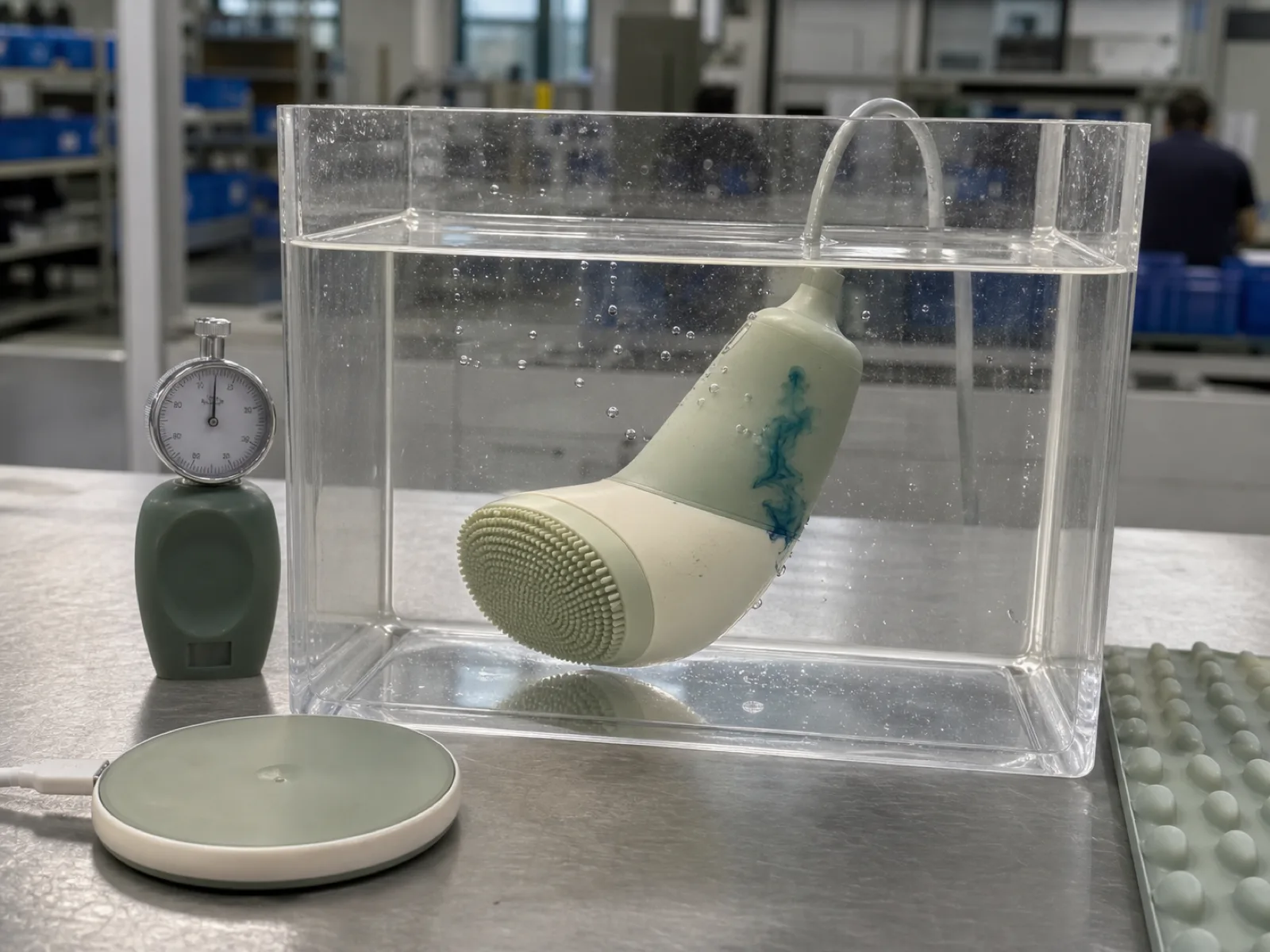
A sonic silicone face cleansing brush must be validated to an IPX water-ingress rating under IEC 60529 — IPX7 (immersion to 1 m for 30 minutes) is the retail standard for a shower-used face tool. Waterproofing comes from an LSR silicone skin overmolded onto the housing, a sealed battery compartment, and contactless inductive charging instead of an open port, then proven by a submersion and dye-penetration test on every design.
Because a face cleansing brush lives in the wettest room in the house, water ingress is the number-one field-failure mode on sonic units, and the IPX rating is the spec that governs it. The IPX scale under IEC 60529[^iec-60529] runs from IPX4 (splash-resistant) through IPX7 (temporary immersion) to IPX8 (continuous immersion). For a face tool used in the shower or over a running sink, IPX7 is the retail floor — anything less invites returns from a device that dies after a month of steam.
Achieving IPX7 on a silicone cleansing brush is a three-layer engineering problem:
- Overmolded silicone skin: the LSR cleansing face is molded directly onto the motor housing, so the waterproof barrier is a continuous molded surface with no glued seam to fatigue and leak. This is the single most important reason a sonic head must be LSR-overmolded rather than glue-assembled.
- Sealed battery compartment: the lithium cell and PCB sit behind a compression gasket or an ultrasonically welded housing joint, not a snap-fit that breathes.
- Contactless charging: an inductive (wireless) charging pad replaces an open USB port — the port is the most common ingress path, so eliminating it is the cleanest route to IPX7.
Validation is not a spec-sheet claim: each design is submerged per the IPX7 protocol and dye-penetration tested, and production carries a sampling submersion check. Durability testing extends to a wet-cycle fatigue run — thousands of on/off actuations under water spray — to confirm the seal holds across the product’s rated life, not just on day one. A supplier that quotes “waterproof” without an IPX number and a test report is describing a hope, not a validated barrier.
MOQ, tooling cost, and the sampling-to-production timeline
Wetop's custom silicone face cleansing brush MOQ starts at 500 pcs/SKU on existing tooling. A new finger-array LSR mold runs USD 5,000–11,000 depending on cavitation and finger-pitch density; a sonic program's electronics push the practical MOQ to 3,000–5,000 pcs. Manual samples ship in 7–15 days on existing tools, new tooling takes 25–35 days, and a sonic build adds 10–20 days for electronics and IPX testing.
MOQ and tooling are the questions competitor pages dodge, and a concrete number is what separates a real factory from a trading desk. The tiering below reflects the tooling reality: a dense finger-array mold is a precision asset, and cavitation — how many heads the mold makes per shot — drives both tooling cost and unit price.
| Program tier | MOQ per SKU | Tooling cost | Unit price band (FOB) | Best for |
|---|---|---|---|---|
| Wetop stock manual head, your color + logo | 500 pcs | USD 0–400 (logo insert) | USD 0.70–2.20 | Category test, value SKU |
| Custom manual head, new LSR mold | 3,000 pcs | USD 5,000–8,000 | USD 0.60–1.80 | Proprietary finger geometry |
| Replaceable head for existing sonic base | 3,000 pcs | USD 4,000–7,000 | USD 0.55–1.60 | Head refresh, no device re-tool |
| Full sonic device — mold + motor + battery + IPX | 3,000–5,000 pcs | USD 12,000–35,000 all-in | USD 3.50–12.00 | Premium retail sonic line |
| High-cavitation manual, volume program | 10,000 pcs | USD 8,000–11,000 | USD 0.45–1.20 | Best unit cost at scale |
Cavitation math: a low-cavity (4–8) mold tools cheaply but produces fewer units per cycle, fitting a 3,000–10,000-unit program; a high-cavity (16–32) mold costs more to cut but slashes per-unit price at 25,000+ units. The engineering desk sizes cavitation to your annual forecast so you neither over-tool a small program nor leave unit cost on the table on a large one.
Timeline, stage by stage:
- DFM review + quote (2–3 days): we review your CAD or physical sample and return a moldability report and firm quote.
- Mold design + cut (18–25 days, new tooling): cavity machining, finger-array engraving, cold-runner or valve-gate build.
- T1 first-article sample (part of the 25–35 day window): first shots off the new mold, dimensional and durometer check.
- Electronics + seal validation (sonic only, +10–20 days): motor and battery sourcing, overmold-seal build, IPX7 submersion test.
- Skin-contact-ready sample approval (7–15 days on existing tooling): color-matched, flash-free, compliance-testable unit.
- Bulk production (15–25 days): after sample sign-off, subject to component sourcing and pack-out.
The full cross-category MOQ and lead-time framework — and why a 500-unit floor is a deliberate engineering choice, not a limitation — is in the MOQ and lead time guide.
What customization and private-label scope is possible?
Wetop matches Pantone solid-coated within ΔE ≤ 1.5 on a D65 light box using platinum-cured masterbatch. Finger length, pitch, cross-section, and the soft-to-firm hardness map are all cut into the cavity; logos are mold-debossed (zero unit-cost adder), laser-etched, or pad-printed. Private-label scope spans color, finger geometry, sonic modes, mount interface, and full retail packaging with cruelty-free and non-porous on-pack claims.
Customization on a face cleansing brush runs deeper than color, because the cleansing performance itself is tooled into the finger array. The controllable variables:
- Color: Pantone-matched masterbatch, ΔE ≤ 1.5, verified on a D65 light box. Muted skincare tones — blush, sage, cream, sand, classic white — hit tolerance cleanly; saturated neons carry a wider ΔE band because silicone pigments are inorganic for heat stability.
- Finger geometry: length, pitch, cross-section, and zone layout are engraved into the cavity — the lever that makes a head gentle-cleansing versus exfoliating, and that carves out a sensitive-skin variant.
- Durometer map: soft cheek zone over firm T-zone, tuned per the table above.
- Sonic behavior (electric builds): vibration frequency, number of speed modes, auto-timer, and battery capacity.
- Mount interface: magnetic, bayonet, or thread mount so a head snaps onto a brand’s existing base or a universal handle.
| Branding method | Surface | Cost | Durability | Best use |
|---|---|---|---|---|
| Deboss (mold-cavity engraved) | Silicone body | USD 150–350 per insert | Unlimited | Best-in-class — logo is a molded feature |
| Laser etch | Silicone / housing | USD 0.05–0.15 per unit | Excellent | Fine monochrome marks |
| Pad print | Silicone body | USD 0.08–0.25 per unit | 40–80 washes | Small color logos |
| Printed housing / packaging | Non-silicone parts | Per component | Excellent | Full-color device and box branding |
Deboss is the durability winner because the mark is molded into the part, not laid on top of it, so it cannot wash off in daily wet use. Silicone’s inherent story also supports the two claims skincare buyers most want on-pack: cruelty-free / vegan (no animal or nylon-hair bristles) and hygienic / non-porous, both factual for a platinum-cured head and defensible in a claims review. The complete branding decision matrix across methods is in the silicone logo and branding guide. Wetop supports the workflow from a napkin sketch or a competitor sample through to a retail-packed, compliance-tested unit, and returns a teardown report on any sample you send — cure system, durometer map, finger geometry, seal quality, and a spec-improvement recommendation before quoting.
How do you tell a real silicone face cleansing brush factory from a trading company?
A real factory holds its own ISO 9001 certificate in its legal name, can livestream its LSR injection and overmolding cells, and answers process-depth questions — how it seals the housing, what durometer split it runs — with specifics. A trading company answers in sales language, cannot show tooling in-house, quotes one Shore A for the whole head, and cannot transfer mold title. Ask for all three signals before tooling.
Because this category mixes silicone molding with electronics, it attracts trading intermediaries who subcontract both and add margin — so vetting matters more here than on a simple molded part. Three signals separate a factory from a desk:
- Certification in the factory’s own name. Ask for the ISO 9001[^iso-9001] certificate and confirm the legal entity on it matches the company you are contracting. A trading company’s cert is either absent or belongs to a mill it does not control.
- A live view of the cells. Request a real-time video walk of the LSR injection and overmolding stations, not a photo gallery. A factory shows you tooling, presses, and QC benches on demand; a trading desk stalls or sends generic catalog stock imagery that never shows the actual floor.
- Process-depth answers. Ask how they seal the motor housing to IPX7, or what durometer split they run across the face. A factory answers with a cure system, a seal method, and a hardness map. A trading company deflects to price and lead time and quotes a single Shore A number for the whole head — the tell that no one there has engineered the part.
A real factory also transfers mold title after amortization, returns a moldability report on your CAD, and names its cure system without prompting. The broader vetting framework — audit signals, red flags, and the questions that expose a middleman — is in the sourcing a silicone factory checklist, and the economics of why a genuine factory sets its MOQ where it does are in real factory MOQ: the math.
What QC and defect-prevention regime should a face-brush program run?
A ship-worthy silicone face cleansing brush clears five checks: a Shore A durometer test across the finger map (spec ± 3 points), a flash and skin-edge inspection under magnification, a color ΔE check on a D65 light box, an IPX7 submersion and dye-penetration test on sonic units, and a scent panel after an oven soak. Any single fail holds the lot; pre-shipment runs at AQL 1.5 with per-cavity traceability.
A face cleansing brush touches sensitive skin daily and, when sonic, wraps a battery in water — so the QC regime is tighter than for a dry cosmetic tool. Each test targets a documented failure mode:
- Shore A durometer across zones — verifies the soft-cheek / firm-T-zone map is on spec. Drift outside ± 3 signals under-cure or a masterbatch shift, both of which change how the brush feels on skin.
- Flash and skin-edge inspection — every finger and skin-contact edge is checked under magnification for parting-line flash. A sharp flash edge is the top comfort complaint on compression-molded heads and the reason LSR is preferred for fine arrays.
- Color ΔE check — measured against the Pantone target on a D65 light box; drift beyond ΔE 1.5 fails the lot, because skincare buyers notice color miss instantly on shelf.
- IPX7 submersion (sonic) — a sampling submersion and dye-penetration check confirms the overmold seal holds; a single dye trace inside the housing fails the batch.
- Scent panel — five blind noses after a 48-hour 60 °C oven soak; any rubber off-note fails, the peroxide-cure tell that has no place on a face tool.
Underpinning all five is per-cavity traceability: each cavity is ID-etched, so a durometer or flash spike traces to one cavity and one masterbatch lot, and the FDA/LFGB migration report attaches to a specific production batch rather than a generic compound claim. A full first-article test package runs USD 900–2,200 in third-party lab fees for a sonic build (material plus IPX plus battery transport), folded into tooling amortization or FOB price by program size. Skipping it saves the fee and loses it many times over on the first customs hold, the first leaked device, or the first “this brush irritated my skin” review escalation.
Ready to run a silicone face cleansing brush program?
Wetop is a founder-led, ISO 9001 silicone factory in Dongguan running platinum-cured LSR injection, overmolding, and compression cells. We build silicone face cleansing brush programs — manual and sonic, standalone and replaceable-head — for skincare brands, contract manufacturers, and private-label buyers at 500-pc to 500,000-pc annual scale, with the durometer mapping, waterproof-seal engineering, skin-contact compliance packet, and per-cavity QC regime built in from the first sample.
If you have a spec sheet, a CAD file, an RFQ, or a competitor brush you want teardown-benchmarked, talk to the engineering desk. We will return a first-pass moldability review, a durometer and seal recommendation, a tooling estimate, and an MOQ / lead-time / FOB unit-price band inside two business days.
FAQ
-
What is the difference between a sonic and a manual silicone face cleansing brush to manufacture?
A manual silicone face cleansing brush is a single molded head, sometimes on a handle — no electronics, fully washable, and the simplest part to tool. A sonic brush adds a vibration motor, a rechargeable battery, a PCB, and a waterproof housing, which turns the project from a molding job into a sealed-electronics assembly. The hard engineering shifts to the silicone-to-housing overmold and the watertight seal, and the certification stack grows to include battery and IPX water-ingress testing. Roughly 80% of the added cost and lead time on a sonic program is the seal and electronics, not the silicone.
-
What Shore A hardness should the fingers on a silicone facial cleansing brush be?
A facial cleansing head is a multi-durometer part. The broad cheek and forehead touch points should run Shore A 20–35 so they are gentle on sensitive skin, while the shorter nose and T-zone nubs run Shore A 35–50 to lift sebum and debris with more resistance. A single-hardness head either drags on delicate skin or is too soft to clean oily zones — the whole point of a good design is mapping finger softness to facial skin sensitivity.
-
How is a sonic silicone face cleansing brush made waterproof?
Waterproofing comes from three layers: an LSR silicone skin overmolded directly onto the motor housing so there is no glued seam to fail, a compression-gasket or ultrasonic-welded seal around the battery compartment, and a sealed charging method — inductive (wireless) pads instead of an open USB port. The finished brush is validated to an IPX rating, IPX7 (immersion to 1 m for 30 minutes) being the retail standard for a face tool used in the shower. Overmolding the silicone onto the housing is what makes the seal reliable, because the waterproof barrier is molecular, not adhesive.
-
Are silicone face cleansing brushes better for skin than nylon-bristle brushes?
For most skin types, yes, on hygiene grounds. The non-porous silicone surface does not absorb water and cleanser the way a nylon bristle tuft does, so it harbors far less bacteria — studies of cleansing tools repeatedly find bristle brushes become bacterial reservoirs, while silicone wipes clean and dries in seconds. Silicone fingers also flex rather than scratch, making them gentler on sensitive and acne-prone skin, and they shed nothing into the pores. Stiff nylon can exfoliate more aggressively, but that abrasion is exactly what dermatologists warn against for reactive skin.
-
What certifications should I require from a silicone face cleansing brush manufacturer?
Require four things: an FDA 21 CFR 177.2600 extractables report on the finished silicone head, LFGB / BfR Recommendation XV testing for the EU, an ISO 9001 quality-system certificate from the factory, and — for a sonic brush — battery safety (UN 38.3 for transport, plus the destination-market mark) and an IPX water-ingress test report. Insist the material report is a finished-good lab test from an accredited lab, not the base-compound supplier's certificate of analysis, because customs review does not accept a compound COA for a skin-contact tool.
-
What is the MOQ and tooling cost for a custom silicone face cleansing brush?
Wetop's MOQ starts at 500 pcs per SKU on existing tooling. A new custom finger-array LSR mold runs USD 5,000–11,000 depending on cavitation and finger-pitch density, and a sonic program's higher assembly cost pushes the practical MOQ to 3,000–5,000 pcs to amortize tooling plus the motor, battery, and PCB setup. A manual brush on a stock head with your color and logo can start at 500–1,000 pcs with only a logo-insert cost.
-
How long does it take to sample and produce a silicone face cleansing brush?
A manual brush on existing tooling samples in 7–15 days and produces in 15–25 days after approval. A new finger-array mold takes 25–35 days to a first-article sample. A sonic brush adds 10–20 days on top for motor and battery sourcing, seal validation, and IPX water-ingress testing before a shippable sample exists — the electronics and waterproofing, not the silicone, drive the sonic timeline.
-
How do I tell a real silicone face cleansing brush factory from a trading company?
Ask for the ISO 9001 certificate in the factory's own legal name, request a live video walk of the LSR injection and overmolding cells, and ask a process-depth question — how they seal the motor housing, or what durometer split they run on the fingers. A trading company answers in vague sales language, cannot show tooling in-house, and quotes a single Shore A number for the whole head. A real factory returns a moldability report, names its cure system, and can transfer mold title after amortization.
-
Can a silicone face cleansing brush be attached to an existing cleansing device or handle?
Yes. Many programs are a replaceable silicone head that snaps or twists onto a brand's existing sonic base or a universal handle, which lowers MOQ and lets a brand refresh head geometry without re-tooling the whole device. Wetop builds heads to a supplied mating interface — bayonet, thread, or magnetic — and validates the fit and pull-off force so the head stays seated in wet use but detaches cleanly for washing.
References
Authoritative sources cited in this guide
- US Food and Drug Administration. 21 CFR 177.2600 — Rubber articles intended for repeated use. https://www.ecfr.gov/current/title-21/chapter-I/subchapter-B/part-177/subpart-C/section-177.2600 — The controlling US extractables limit for repeated-use skin-contact silicone — total extractives in n-hexane ≤ 20 mg/in² over 7 hours at 66 °C — applied to a facial cleansing head.
- US Food and Drug Administration. FDA Authority Over Cosmetics. https://www.fda.gov/cosmetics — Establishes that facial-care tools carry no pre-market 'approval' or dedicated facial-grade certificate — compliance rides on material-contact frameworks instead.
- International Electrotechnical Commission. IEC 60529 — Degrees of protection provided by enclosures (IP Code). https://www.iec.ch/homepage — Defines the IPX water-ingress ratings (IPX4 splash to IPX7 immersion) a sonic cleansing brush must be validated against for shower use.
- International Organization for Standardization. ISO 9001:2015 — Quality Management Systems — Requirements. https://www.iso.org/standard/62085.html — The QMS Wetop is certified against — the documented process discipline behind cavity traceability and lot-release on facial-tool runs.
- ASTM International. ASTM International — Standards & Publications (D2240 durometer hardness). https://www.astm.org/products-services/standards-and-publications/standards.html — Source for the ASTM D2240 Shore A durometer method used to verify the soft-cheek / firm-T-zone finger hardness split.
- German Federal Institute for Risk Assessment (BfR). BfR Recommendations on Food Contact Materials — Recommendation XV, Silicones. https://www.bfr.bund.de/en/bfr_recommendations_on_food_contact_materials-7498.html — The technical basis for LFGB clearance on skin-contact silicone — sets peroxide residual and volatile-matter limits relevant to odor and skin comfort.
- United Nations Economic Commission for Europe (UNECE). UN Manual of Tests and Criteria, Section 38.3 — Lithium batteries. https://unece.org/transport/dangerous-goods — The transport-safety test battery a rechargeable sonic cleansing brush's lithium cell must pass before it can ship internationally.
- US National Library of Medicine (PubMed). Cleansing devices and skin microbiome / barrier — dermatology review literature. https://pubmed.ncbi.nlm.nih.gov/ — Peer-reviewed evidence on mechanical facial cleansing, bristle-brush bacterial load, and barrier disruption underpinning the silicone-vs-nylon hygiene argument.
- European Chemicals Agency (ECHA). REACH Regulation (EC) No 1907/2006 — SVHC Candidate List. https://echa.europa.eu/candidate-list-table — Screening list for any masterbatch, pigment, or processing aid used in a facial cleansing head sold into the EU — updated twice yearly.
Start a custom program
Send a brief. Get an engineer’s reply in one business day.
Every Wetop program is tooled from a customer’s specification. Send a CAD file (STEP · IGES · DWG) or a written brief and we’ll reply with a mold cost estimate, price brackets at MOQ 500 / 1,000 / 5,000, and any engineering questions.