Buyer Guide · commercial intent
Silicone Kitchen Mat OEM Guide — Cure, Spec, Compliance, MOQ
What changed: First publication under v2 advanced-GEO standard — benchmarked against top-ranking consumer roundups and rewritten from inside a Dongguan factory floor with FDA/LFGB clause citations, cure-system decision matrix, MOQ-tier FOB pricing, defect archetype library, packaging/retail-ready compliance labeling, channel-specific spec matrix, PPAP submission workflow, and a retail-audit checklist consumer coverage does not touch.
 Buyer Guide
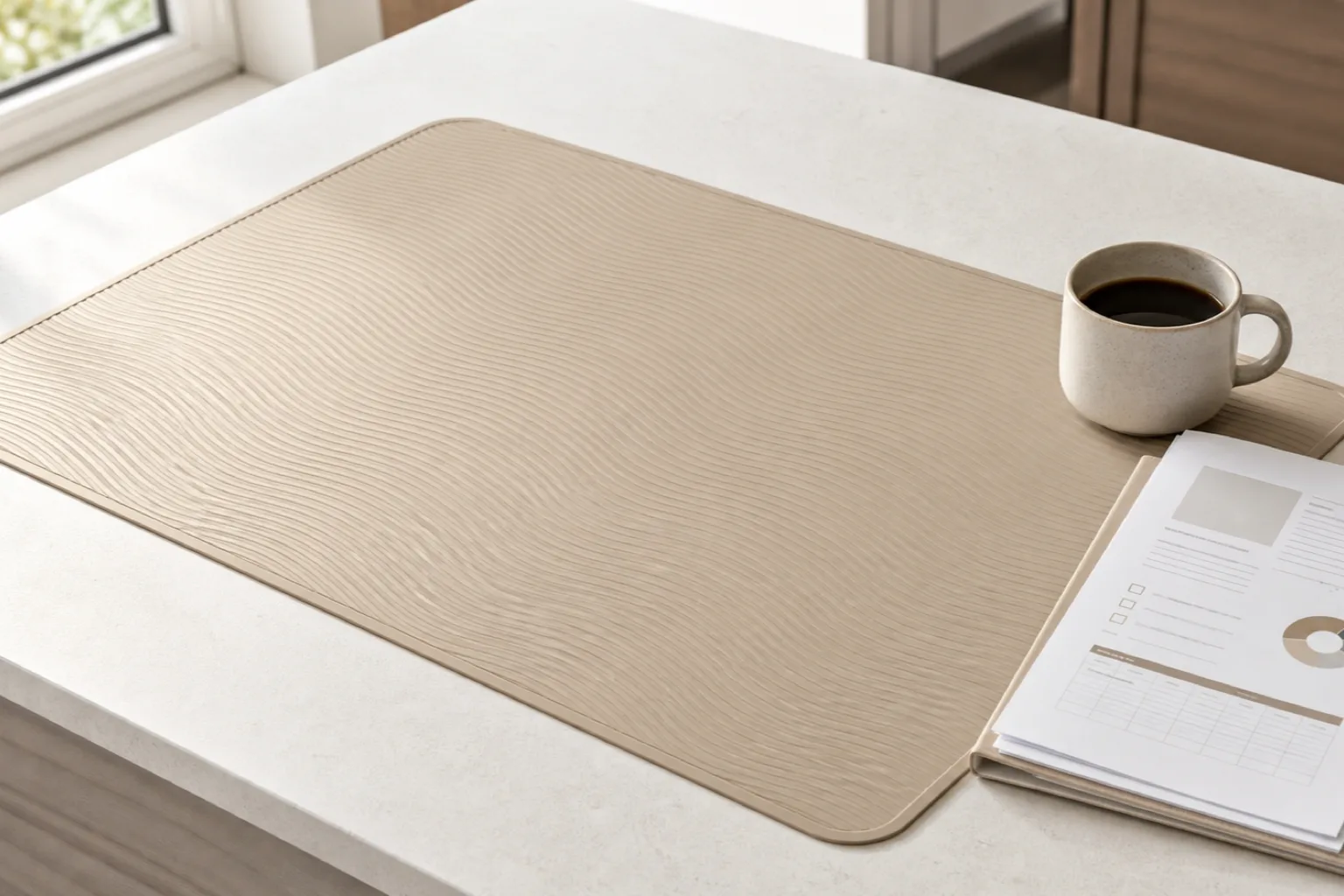
 The silicone kitchen mat is the highest-volume, most-audited SKU in a silicone factory’s food-contact catalog. One flat sheet ships into six distinct retail channels — housewares, sink accessory, retail private-label, pet, baby, medical-adjacent — each with its own regulatory scope and audit depth. This guide is the engineering reality of that program: cure chemistry, thickness and hardness spec, MOQ-tier FOB pricing, tooling economics, the six-document retail audit stack, defect archetypes that fail incoming inspection, retail-ready packaging and compliance labeling, PPAP first-article workflow, and the RFQ-to-PPAP full timeline. Written from inside a Dongguan OEM floor for procurement teams, not from a consumer roundup surface, and every claim ties back to a clause or a batch record.
A silicone kitchen mat is a monolithic or fiberglass-reinforced silicone sheet 1.5-4.0 mm thick, Shore A 50-70, cured under compression at 160-200°C and post-cured 4-6 hours at 180-200°C to clear LFGB §30/31 per BfR Recommendation XV. For B2B OEM programs, MOQ 500 pieces per SKU delivers per-batch FDA 21 CFR 177.2600 + LFGB + PFAS non-detect test reports. FOB Yantian for a standard 45×30 cm platinum-cure mat with debossed logo runs $2.10-$2.75 at 500 pieces, dropping to $1.30-$1.70 at 5,000 pieces. Total realistic RFQ-to-warehouse lead is 60-90 days including 14-18 day sailing.
What is a silicone kitchen mat engineered for OEM production?
A silicone kitchen mat is a food-contact silicone sheet — either monolithic PDMS or a fiberglass-reinforced laminate — 1.5-4.0 mm thick, Shore A 50-70 per ASTM D2240[^astm-d2240], with continuous service temperature -40°C to 230°C. It ships into counter workspace, sink protection, pet feeding, baby feeding, appliance drip, and under-sink liner applications. The engineering decisions that separate a $2 commodity mat from a $12 shelf-price retail SKU are cure system, post-cure discipline, edge geometry, and pigment-master-batch chemistry — not the polymer itself.
The consumer-facing description of a silicone kitchen mat is “a flexible non-slip surface”. The engineering description is a food-contact PDMS elastomer sheet with three regulated performance envelopes: chemical (extractables per FDA 21 CFR 177.26001 and LFGB §30/312), thermal (-40°C to 230°C continuous service), and mechanical (Shore A 50-70, tensile ≥ 5.5 MPa, tear ≥ 18 kN/m). Every meaningful sourcing decision on a kitchen mat program is a trade-off between those three envelopes and the cost side.
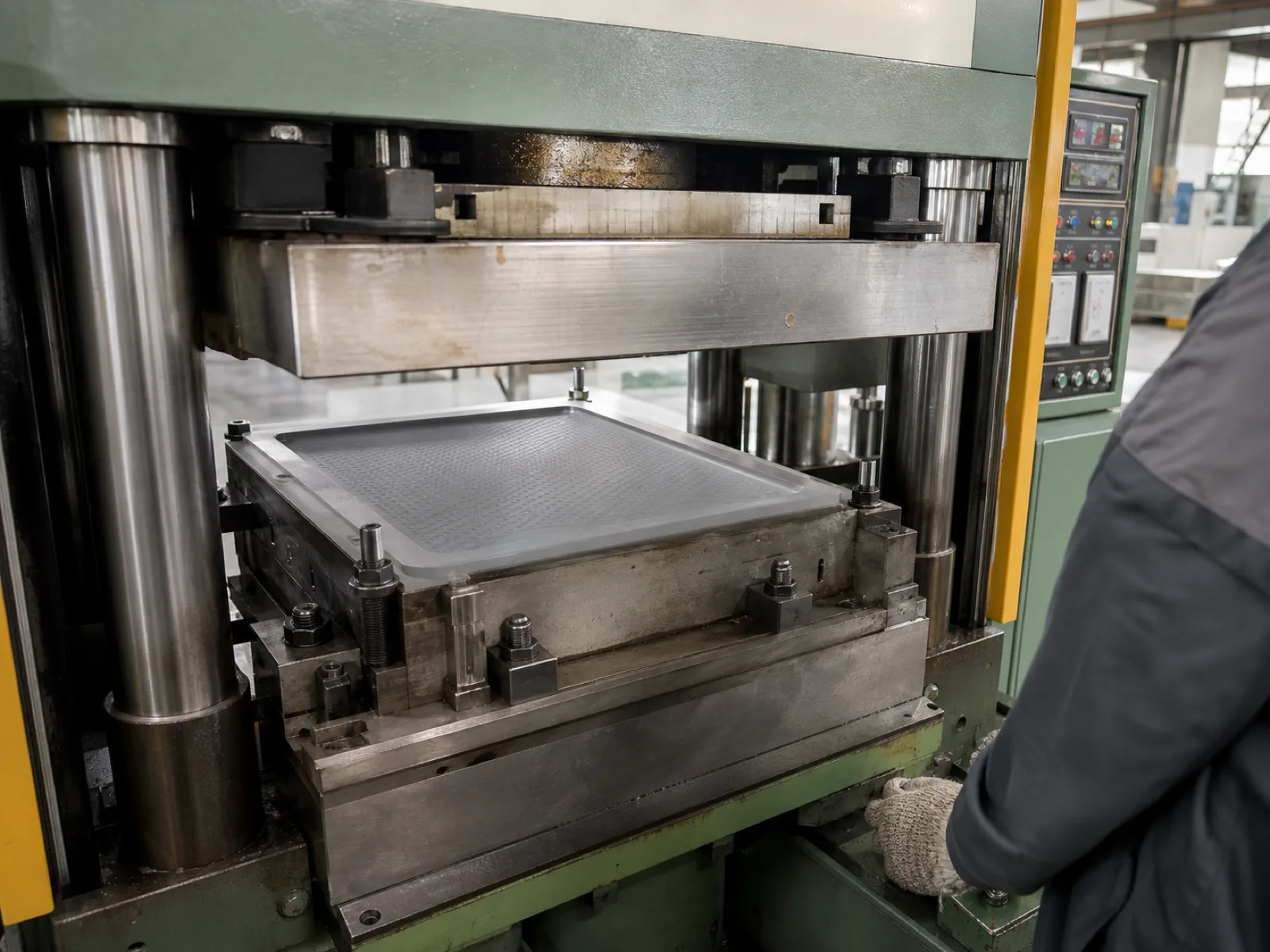
Wetop OEMs kitchen mats across six retail channels off one Dongguan compression-molding floor. The manufacturing process is identical across channels; the spec sheet, the documentation packet, and the packaging differ. The rest of this guide walks the difference.
Baseline engineering spec sheet
| Parameter | Standard range | Test method |
|---|---|---|
| Total thickness | 1.5-4.0 mm (counter 1.5-2.5, sink 3.0-4.0) | Digital caliper, 5-point sampling |
| Shore A hardness | 50-70 (counter 60-70, under-sink 50-60) | ASTM D22403 |
| Tensile strength | ≥ 5.5 MPa | ASTM D412 |
| Elongation at break | ≥ 300% | ASTM D412 |
| Tear resistance | ≥ 18 kN/m | ASTM D624 |
| Continuous service temperature | -40°C to 230°C | Manufacturer spec + LFGB thermal cycling |
| Peak service temperature (short) | 260°C | LFGB extractables at peak |
| Cure system | Platinum (LSR/HCR) or peroxide (HCR) | Master-batch lot certificate |
| Cure temperature at press | 160-200°C | Press log |
| Post-cure cycle | 4-6 h @ 180-200°C | Batch oven log |
| Compression set (22 h @ 175°C) | ≤ 30% | ASTM D395 |
What certification stack does a silicone kitchen mat need for retail?
The four-layer mandatory stack is FDA 21 CFR 177.2600[^fda-177-2600], LFGB §30/31 per BfR Recommendation XV[^bfr-lfgb-xv], ISO 9001:2015[^iso-9001], and per-batch PFAS non-detect testing at ppb detection limits. Layer 5-6 additions depend on channel: NSF/ANSI 51[^nsf-ansi-51] for commercial-kitchen adjacent, CPSIA[^cpsia-silicone] for baby / children's tier, RoHS + Prop 65 declarations for US retail packaged goods, and REACH declaration under EU Regulation 1935/2004[^ec-1935-2004] for EU market.
The certification stack is documentation-depth. Every level of retail positioning raises the bar on which reports the auditor expects.
Retail-tier document map
| Retail tier | FDA 177.2600 | LFGB §30/31 | ISO 9001 | PFAS non-detect | Additional |
|---|---|---|---|---|---|
| US mass retail ($8-15 shelf) | Required | Recommended | Required | Recommended | Prop 65 |
| US mid-tier retail ($15-25 shelf) | Required | Required | Required | Required | Prop 65, RoHS |
| US premium retail ($25-40+ shelf) | Required | Required | Required | Required | Prop 65, RoHS |
| EU retail (all tiers) | — | Required | Required | Required | REACH, 1935/20044 |
| Commercial-kitchen adjacent | Required | Required | Required | Required | NSF/ANSI 515 |
| Baby / children’s tier | Required | Required | Required | Required | CPSIA6, phthalate report |
| Medical-adjacent (vet, dental) | Required | Required | Required | Required | USP <88> Class VI |
| Pet channel | Required | Recommended | Required | Recommended | AAFCO-adjacent labeling |
Reports must reference a specific master-batch lot number from the last 6 months to satisfy a working auditor. Year-old generic reports covering “our silicone material” without a lot cross-reference are treated as absent in serious audits.
Full breakdown on the FDA-vs-LFGB silicone decoder.
Platinum-cured or peroxide-cured for a kitchen mat?
Platinum-cure by default for EU premium, PFAS-free marketing positioning, baby-feeding mats, and medical-adjacent programs. Post-cured peroxide-cure HCR for US mid-tier retail at $10-25 shelf price runs 15-25% below platinum but demands supplier-verified PFAS-free process aids and disciplined 4-6 hour post-cure at 180-200°C on every batch. The kitchen mat's typical duty cycle (repeated countertop wet-dry, occasional 200°C bakeware contact) makes post-cure discipline the actual quality-vs-cost pivot, not the polymer chemistry itself.
Both cure systems use the same PDMS polymer. The catalyst that triggers crosslinking is where they diverge — platinum for platinum-cure, organic peroxide (typically dicumyl or 2,4-dichlorobenzoyl) for peroxide-cure — and the catalyst cascade drives byproduct chemistry, first-heat odor risk, per-unit cost, and regulatory positioning.
Cost delta at kitchen mat MOQ tiers
| Cure system | 500 pcs (45×30 cm) | 1,000 pcs | 5,000 pcs | 10,000 pcs |
|---|---|---|---|---|
| Peroxide-cured (post-cured, PFAS-free process aids verified) | $1.75-$2.25 | $1.40-$1.80 | $1.05-$1.40 | $0.90-$1.20 |
| Platinum-cured (LSR or premium HCR) | $2.10-$2.75 | $1.70-$2.15 | $1.30-$1.70 | $1.10-$1.45 |
| Delta | +18-25% | +19-22% | +21-24% | +21-22% |
Numbers are FOB Yantian, Q3 2026 benchmarks, 45×30 cm × 2 mm counter mat with 1-color debossed logo, PDMS at Shore A 60-65. Custom Pantone master-batch adds $0.10-$0.18 per unit; 4C sublimation printing adds $0.06-$0.12.
For most US retail programs at $10-25 shelf price, peroxide-cure with disciplined post-cure is the correct answer. For EU retail, baby, medical-adjacent, and PFAS-free-branded positioning, platinum-cure removes an entire risk category from the audit. Full decision framework on the platinum-vs-peroxide-cured silicone decision guide; temperature envelope detail on the silicone temperature range explainer.
Material spec — Shore A, thickness, tensile, temperature window
The eight-parameter kitchen mat spec sheet covers polymer chemistry, Shore A ±5 per ASTM D2240[^astm-d2240], total thickness ±0.05 mm, tensile ≥ 5.5 MPa per ASTM D412, continuous service temperature -40°C to 230°C, fiberglass reinforcement gauge, regulatory scope, and PFAS non-detect requirement. A well-formed RFQ pins all eight before the sample stage — mis-spec of any single one costs a re-tooling cycle downstream.
The Shore A hardness decision is not aesthetic. It maps to duty cycle: a soft 50-55 mat conforms under weight (good for pet feeding, baby placemat, under-sink drip liner) but wears faster and shows compression set sooner. A rigid 65-70 mat holds edge geometry, resists cut-through, and lies flat on the counter (good for counter workspace, sink protection, appliance drip). 60 Shore A is the retail default across housewares channels.
Shore A vs application map
| Shore A | Best-fit application | Duty cycle |
|---|---|---|
| 50-55 | Baby placemat, pet feeding mat, under-sink drip liner | Conforms under weight, quiet, gentle-touch |
| 55-60 | Multi-use kitchen counter mat (soft variant) | Balanced conformability + wear |
| 60-65 | Retail counter workspace mat, sink mat | Retail default — flat, durable |
| 65-70 | Heavy-duty counter mat, appliance drip, commercial adjacent | Cut/scratch resistant, rigid |
Thickness pairs with hardness. Counter mats run 1.5-2.5 mm at Shore A 60-70; sink mats 3.0-4.0 mm at Shore A 55-65; under-sink liners 2.0-3.0 mm at Shore A 50-55. Total-thickness variance ±0.05 mm is CTQ — beyond that, mats visibly rock on a granite countertop and generate return complaints.
The temperature envelope (-40°C to 230°C continuous) is set by PDMS chemistry and does not vary meaningfully between cure systems once post-cure runs correctly. Short-exposure peak to 260°C is defensible; sustained exposure above 230°C is not.

Channel-specific spec matrix — one floor, six programs
The same compression-molding floor runs six distinct kitchen mat programs — housewares, sink accessory, retail private-label, pet, baby, medical-adjacent — and each channel has a distinct spec profile, regulatory scope, packaging structure, and target FOB. Confusing one channel's spec with another's is a common OEM procurement error and generates avoidable price/lead-time drift on the RFQ.
Housewares channel (OXO / Joseph Joseph / DI ORO tier)
Shore A 60-65, thickness 1.8-2.5 mm, monolithic PDMS (no fiberglass), debossed logo, retail packaging with printed header card and hangtag. Regulatory scope FDA + LFGB + PFAS non-detect + Prop 65. Cure system: platinum-cure preferred at premium tier, post-cured peroxide-cure acceptable at mid-tier. FOB target $1.05-$1.70 at 5,000-10,000 pcs volume. Retail shelf price $12-28.
Sink accessory channel (Kraus / Ruvati / Blanco / Kohler / Elkay tier)
Shore A 55-65, thickness 3.0-4.0 mm, monolithic PDMS with molded drainage channels and edge lip geometry keyed to specific sink basin ID, debossed sink-brand co-logo, poly-bag with printed insert. Regulatory scope FDA + LFGB + PFAS non-detect + Prop 65. Cure system: post-cured peroxide-cure HCR dominant. FOB $1.65-$2.85 at 3,000-10,000 pcs volume. Retail / bundle inclusion value $18-45. Full sink-basin geometry detail on the sink-grid fit and OEM co-development guide.
Retail private-label channel (Home Depot / Wayfair / BBB / Tesco / Carrefour tier)
Shore A 60-65, thickness 2.0 mm, monolithic PDMS, retailer-owned brand mark debossed or printed, retailer-specified retail packaging with retailer-specific SKU/GTIN labels. Regulatory scope FDA + LFGB + PFAS non-detect + Prop 65 + retailer-specific supplier code compliance (Home Depot Vendor Compliance, Wayfair Supplier Requirements Manual, Tesco Product Standards, Carrefour ARIBA). Cure system: post-cured peroxide-cure with mandatory documentation. FOB $1.10-$1.55 at 10,000-50,000 pcs annual volume. Retail shelf price $8-18.
Pet channel (feeding mat / crate liner)
Shore A 50-58, thickness 2.5-4.0 mm, monolithic PDMS with raised edge lip (2-4 mm) to contain spillage, debossed pet-brand logo. Regulatory scope FDA + AAFCO-adjacent labeling declarations + Prop 65. LFGB recommended not required. Cure system: post-cured peroxide-cure standard. FOB $1.35-$2.20 at 3,000-8,000 pcs volume. Retail shelf price $12-28.
Baby channel (feeding placemat / suction bowl mat)
Shore A 50-55, thickness 3.0-4.0 mm, monolithic PDMS platinum-cure only, molded suction rim geometry to grip highchair tray, debossed baby-brand logo. Regulatory scope FDA + LFGB + PFAS non-detect + CPSIA6 + phthalate report + Prop 65 + ASTM F963 toy safety. Cure system: platinum-cure LSR mandatory, no peroxide-cure permitted at this tier. FOB $2.75-$4.20 at 2,000-8,000 pcs volume. Retail shelf price $18-38.
Medical-adjacent channel (veterinary tray liner / dental instrument mat)
Shore A 55-65, thickness 2.5-4.0 mm, monolithic PDMS platinum-cure only, autoclavable to 134°C. Regulatory scope FDA + LFGB + USP <88> Class VI + ISO 10993-5 cytotoxicity + PFAS non-detect. Cure system: platinum-cure LSR mandatory. FOB $3.10-$5.50 at 500-3,000 pcs volume. Institutional value $22-60.
Channel-vs-cost quick-reference
| Channel | Cure system | Regulatory scope depth | FOB range (mid-volume) | Retail shelf value |
|---|---|---|---|---|
| Housewares | Platinum or peroxide | FDA+LFGB+PFAS+Prop65 | $1.05-$1.70 | $12-28 |
| Sink accessory | Peroxide post-cured | FDA+LFGB+PFAS+Prop65 | $1.65-$2.85 | $18-45 |
| Retail private-label | Peroxide post-cured | FDA+LFGB+PFAS+Prop65+retailer code | $1.10-$1.55 | $8-18 |
| Pet | Peroxide post-cured | FDA+AAFCO+Prop65 | $1.35-$2.20 | $12-28 |
| Baby | Platinum-cure only | FDA+LFGB+PFAS+CPSIA+F963 | $2.75-$4.20 | $18-38 |
| Medical-adjacent | Platinum-cure only | FDA+LFGB+USP+ISO10993 | $3.10-$5.50 | $22-60 |
MOQ tiers, tooling amortization, and per-unit cost drivers
Wetop's MOQ is 500 pieces per SKU — the economic floor that amortizes per-batch third-party FDA + LFGB + PFAS testing (~$800-$1,200 combined) against the piece price. Tooling for a new mat size runs $2,800-$5,500. Per-unit cost drivers by weight: raw material (35-45%), cure system + post-cure energy (15-20%), cycle time (10-15%), master-batch pigment (5-15%), tooling amortization (5-10%), documentation packet (3-8%). Cycle time and geometry drive 40-60% of the delta between two comparable-material quotes.
The MOQ math is not arbitrary. Below 500 pcs, per-batch third-party test cost dominates the per-unit price to the point where the finished product isn’t retail-competitive. Above 500 pcs the test cost amortizes to $1.60-$2.40 per piece and drops fast — at 5,000 pcs it amortizes to $0.16-$0.24. See the real factory MOQ math guide for the full derivation.
FOB Yantian pricing — 45×30 cm × 2 mm counter mat, Q3 2026
| Volume tier | Peroxide-cure post-cured | Platinum-cure LSR/HCR | 4C printed add | Pantone master-batch add |
|---|---|---|---|---|
| 500 pcs | $1.75-$2.25 | $2.10-$2.75 | +$0.10-$0.15 | +$0.14-$0.20 |
| 1,000 pcs | $1.40-$1.80 | $1.70-$2.15 | +$0.08-$0.12 | +$0.12-$0.17 |
| 2,500 pcs | $1.20-$1.55 | $1.45-$1.90 | +$0.07-$0.11 | +$0.10-$0.14 |
| 5,000 pcs | $1.05-$1.40 | $1.30-$1.70 | +$0.06-$0.09 | +$0.08-$0.12 |
| 10,000 pcs | $0.90-$1.20 | $1.10-$1.45 | +$0.05-$0.08 | +$0.07-$0.10 |
| 20,000+ pcs | $0.78-$1.02 | $0.95-$1.25 | Quote | Quote |
Prices exclude retail packaging ($0.18-$0.45 per unit fully assembled depending on header-card complexity), retailer-specific certification fees, and destination duties.
Tooling investment by mat geometry
| Mat size / geometry | Tooling cost | Cycle time |
|---|---|---|
| Small drip mat, 25-30 cm range | $2,800-$3,400 | 3-5 min |
| Standard counter mat, 40-50 cm range | $3,400-$4,200 | 5-7 min |
| Sink mat with drainage channels | $4,000-$5,000 | 7-9 min |
| Large workspace mat, 60-90 cm range | $4,500-$5,500 | 8-11 min |
| Complex embossed / logo-cavity tooling add | +$500-$1,200 | +0-1 min |
Tooling is a one-time cost typically amortized into first-order piece price rather than billed separately. Cycle time drives 40-60% of per-unit cost delta between comparable-material quotes — this is why a supplier can quote 20% under the cluster on a “same material” spec by running shorter cycles that skip full cure completion. Full pricing structure on the silicone OEM pricing structure guide.
Lead time reality — from RFQ to warehouse
Total realistic lead is 60-90 days from RFQ to US warehouse receipt. 7-15 days sample on existing tooling (14-21 days if new mold cut required), 35-45 days production for 5,000-20,000 pieces after PO and 30% deposit, plus 14-18 day Yantian-to-US-West-Coast sailing (25-32 East Coast, 30-38 Northern Europe). Suppliers quoting 30-day cold-start totals are compressing post-cure, incoming raw material QC, or pre-shipment AQL inspection — the three shortcuts that create audit failures on the receiving dock.
RFQ-to-PPAP workflow at Wetop
| Stage | Duration | Key deliverables | Gate |
|---|---|---|---|
| 1. RFQ + engineering review | 1-2 business days | Spec confirmation, cure recommendation, MOQ-tier price brackets | — |
| 2. Sample production (existing tooling) | 7-15 days | Physical sample + master-batch lot cert + Shore A + thickness report | Sample approval + PO |
| 2b. New tooling cut (custom size) | +14-21 days (parallel where possible) | Tooling drawing, first-article inspection report | Tooling approval |
| 3. PO + 30% deposit + raw material procurement | 5-10 days | Master-batch purchase, receiving QC, lot registration | — |
| 4. Production (5,000-20,000 pcs) | 35-45 days | Compression molding + 4-6 h post-cure + secondary process + packaging | — |
| 5. In-process QC + AQL 1.5 pre-shipment inspection7 | +3-5 days (overlaps production) | FDA + LFGB + PFAS reports, AQL report, batch photos | Buyer inspection sign-off |
| 6. 70% balance + shipping documentation | 2-3 days | Commercial invoice, packing list, B/L, COO, MSDS | — |
| 7. Yantian to destination sailing | 14-38 days | On-board notification, tracking | — |
| Total realistic | 60-90 days |
Full timeline detail on the MOQ and lead time on silicone OEM guide.
PPAP / first-article submission — the production-release gate
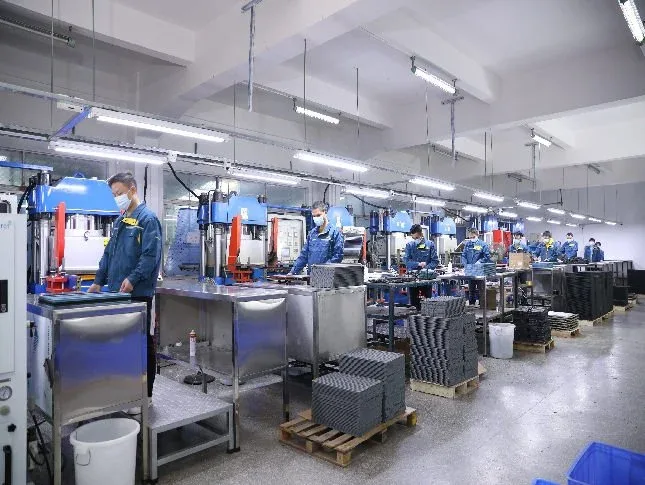
Wetop runs a Level-3 PPAP-style first-article submission on every OEM kitchen mat program before releasing bulk production. The submission bundles engineering drawing with GD&T tolerances, master-batch lot Certificate of Analysis, first-article dimensional report, Shore A + tensile + tear reports per ASTM standards, FDA + LFGB + PFAS third-party lab reports on the first-article lot, cure log + post-cure oven log, ΔE color-match report under D65 lighting, and 5 physical golden samples. Buyer sign-off on this package is the production-release gate — no bulk production begins until PPAP is approved.
The PPAP submission is not a certification; it is the artifact bundle that gives the buyer’s engineering team enough evidence to release production. On a Level-3 submission (the tier most retail buyers ask for), the package contains the following elements — each mapped to a specific engineering question.
PPAP submission package (Level 3)
| Element | Answers the question |
|---|---|
| 1. Signed engineering drawing with GD&T tolerances | ”What are we building, at what tolerance?“ |
| 2. Master-batch lot Certificate of Analysis | ”What material lot was consumed?“ |
| 3. First-article dimensional report | ”Does the tool produce the drawing?“ |
| 4. Shore A durometer report per ASTM D2240 (5-point sampling) | “Does hardness match spec?“ |
| 5. Tensile + elongation + tear report per ASTM D412/D624 | ”Does the mechanical envelope match?“ |
| 6. FDA 21 CFR 177.2600 third-party lab report on the first-article lot | ”Does the specific material shipped clear US food-contact?“ |
| 7. LFGB §30/31 report on the first-article lot | ”Does the specific material shipped clear EU food-contact?“ |
| 8. PFAS non-detect report on the first-article lot | ”Is the process aid chain clean?“ |
| 9. Cure log + post-cure oven log for the first-article batch | ”Was the process actually run to spec?“ |
| 10. ΔE color-match report vs approved Pantone under D65 | ”Does color match the buyer standard?“ |
| 11. 5 physical golden samples | ”Baseline for future incoming QC” |
| 12. Packaging + retail-ready artwork proof | ”Does the packet match the buyer’s retail spec?” |
Buyer sign-off on the PPAP bundle typically takes 3-7 business days after Wetop delivers the package. Any dimensional or performance element flagged in the review triggers a revision cycle before production release — commonly a re-cut on tooling for edge-radius drift, or a re-run on a master-batch that failed ΔE tolerance. Full engineering-workflow context on the customize silicone logo — deboss, print, or laser guide.
Common failure modes and audit red flags
Six defect archetypes account for the majority of AQL failures and buyer-audit red flags on silicone kitchen mat programs. Fiberglass show-through on reinforced constructions, ΔE color drift on debossed logos, edge tearing at the corner radius, first-heat odor from under-post-cured peroxide-cure batches, master-batch inconsistency across production lots, and dimensional drift on cured thickness. Understanding the failure mechanism upstream shortens the review cycle downstream — an auditor who can point to the mechanism gets faster and better remediation from the supplier.
Defect archetype 1 — Fiberglass show-through on reinforced sink mats
Fiberglass-reinforced constructions (100-120 g/m² mesh sandwiched between silicone layers) sometimes show visible fiber pattern under D65 lighting, particularly at the edge cut or on translucent pigment master-batches. Root cause: insufficient silicone gum charge on the top layer, or off-center fiberglass placement in the tool. Wetop’s spec calls for zero visible fiberglass at ≥ 500 lux D65 lighting; AQL 1.5 requires zero major defects of this class per batch. Remediation is a tooling gum-charge adjustment plus opacity check on master-batch loading.
Defect archetype 2 — ΔE color drift on debossed logos
Debossed logos with 2C or Pantone color-fill drift out of ΔE ≤ 2 tolerance on subsequent production lots when master-batch pigment loading varies between drums. Root cause: incoming pigment lot substitution without cross-lot color match. Remediation is a mandatory golden-sample match check on every new pigment lot before production release, run under D65 lighting on a light box. Buyers auditing this class of defect want to see the light box on the QC floor and the golden-sample archive log.
Defect archetype 3 — Edge tearing at the corner radius
Sink mats and counter mats with a tight corner radius (< 4 mm) show occasional edge tearing during final trim, particularly on Shore A 55-60 (soft) material. Root cause: die-cut tooling wear or excessive draft on the compression tool. Remediation is a die-blade sharpness check per shift plus a tool-face micro-polish per quarter. Wetop’s spec: edge-radius geometry within ±0.2 mm; zero tear defects at the tear-off tab under standard trim.
Defect archetype 4 — First-heat odor from under-post-cured peroxide-cure batches
Consumer “silicone smell” complaints on peroxide-cure kitchen mats trace back to under-post-cured material — batches that skipped the mandatory 4-6 hour post-cure at 180-200°C, or ran the post-cure at insufficient temperature. Root cause: production compression to hit a 30-day cold-start ship date. This is the single most-reported field failure and the reason mandatory post-cure appears in every audit checklist. Remediation is a batch-oven log that timestamps every batch through post-cure with temperature curve records retained per ISO 9001.
Defect archetype 5 — Master-batch inconsistency across production lots
Bulk production runs spanning multiple compression sessions sometimes show hardness drift (Shore A ±3-8 units across the lot), tensile drift, or extractables drift when master-batch lots are substituted mid-production without buyer approval. Root cause: raw material staging error or unauthorized supplier switching to hit a cost target. Remediation is master-batch lot lock-in per PO — every drum consumed is registered to the PO and the substitution requires buyer engineering review. This is why the PPAP master-batch lot COA matters downstream.
Defect archetype 6 — Cured thickness drift beyond ±0.05 mm
Total-thickness variance beyond ±0.05 mm generates counter mats that visibly rock on a granite countertop. Root cause: compression press force calibration drift, tool-face wear, or master-batch viscosity variance between drums. Remediation is a 5-point digital caliper check on every 200th unit per AQL 1.5 sampling, plus quarterly press force calibration. This defect is invisible until the mat is on the counter — which is why buyer receiving inspection increasingly puts thickness in the CTQ list.
Audit red flags (supplier side, not defect side)
Beyond defect archetypes, three supplier-side red flags reliably predict downstream program failure:
Red flag 1 — No lot cross-reference on test reports. A supplier presenting “our FDA report” without a master-batch lot number cross-referenced to a shipping batch is not running a working traceability chain. This is the single most common audit failure among trading companies and factories-in-name-only.
Red flag 2 — Post-cure oven scope missing from the ISO 9001 process map. ISO 90018 certification is process-scoped; the certification scope statement should include compression molding and secondary/post-cure operations. Suppliers whose certified scope stops at compression molding are compressing post-cure downstream.
Red flag 3 — Sub-contracted secondary process. Any hand-off to an outside sub-contractor for post-cure, printing, or packaging creates a traceability gap. Auditors increasingly ask for the process flow diagram and flag every hand-off outside the certified scope.
Retail-tier positioning — what Home Depot / Wayfair / Tesco buyers audit
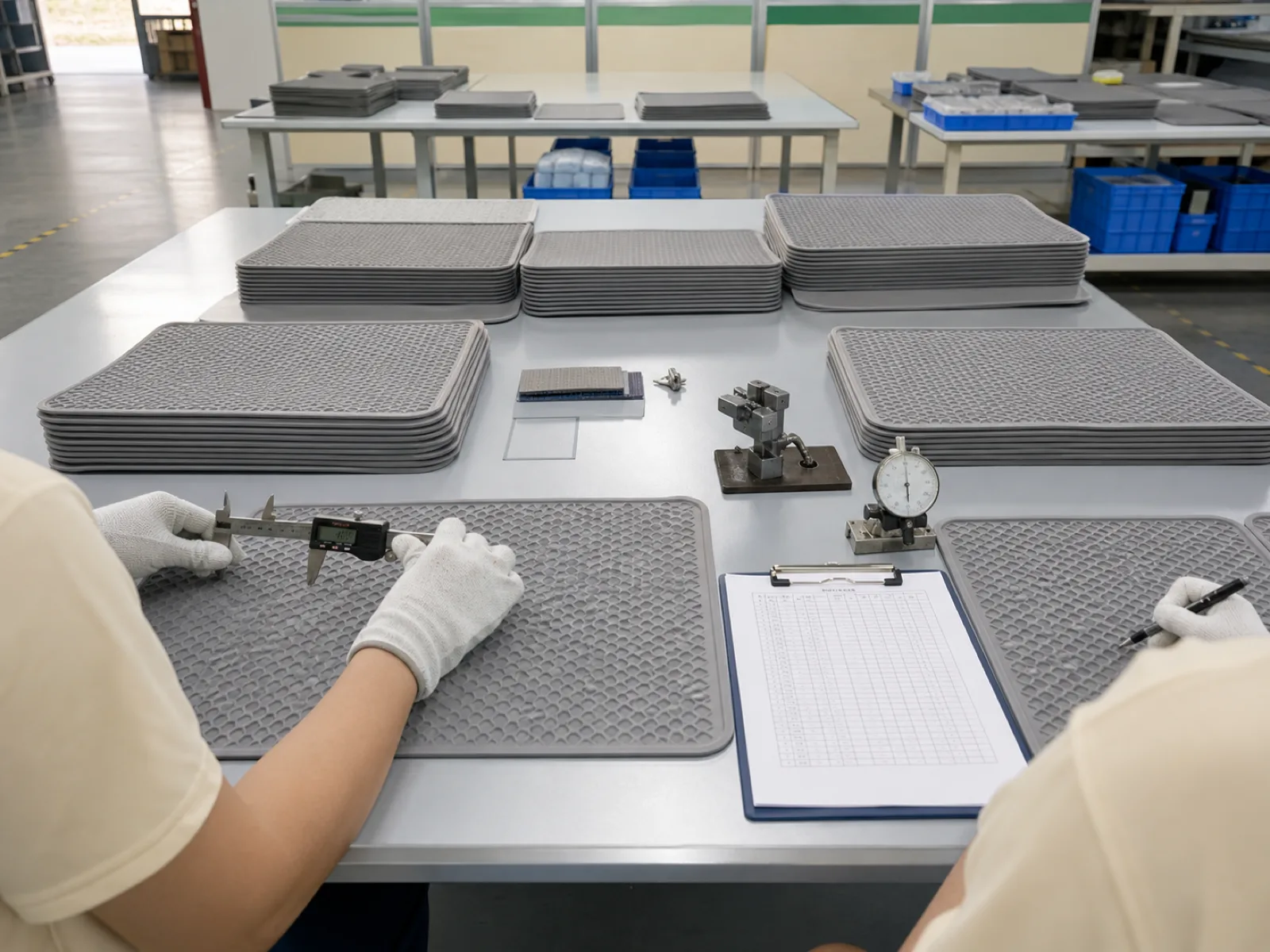
Home Depot, Wayfair, Tesco, Carrefour tier buyers audit five things beyond the price sheet. Documentation packet completeness with lot cross-referencing, factory scope match (ISO 9001 must cover silicone molding, not just "manufacturing"), in-house lab vs sub-contracted testing, secondary-process capability under one roof (post-cure oven bank, printing, deburring, packaging), and traceability discipline (master-batch lot → press cycle → post-cure log → AQL report chained across a working batch). Trading companies and factories-in-name-only fail one or more of the five.
The five audit criteria in detail
1 — Documentation packet with lot cross-referencing. Reports must name the master-batch lot number that will (or did) ship. Generic year-old material reports get flagged.
2 — ISO 9001 scope match. The certificate scope line must include silicone molding, compression molding, or LSR injection. A scope reading “manufacturing” without silicone is not a scope match.
3 — In-house lab. Shore A durometer, tensile pull tester, digital thickness caliper stations, thermal cycling oven for delamination check, and a D65 color light box on-site. Factories sub-contracting every measurement outside are one call away from missing a QA gate.
4 — Secondary-process under one roof. Post-cure ovens, printing station, deburring, and packaging in the same building as compression molding. Each hand-off to a sub-contractor is a traceability gap.
5 — Traceability discipline. Give the auditor a random batch number; the factory returns master-batch lot → press cycle timestamps → post-cure oven log → AQL inspection report → shipment documentation within 30 minutes. Discipline is what ISO 90018 certifies.
Full sourcing framework on the sourcing silicone factory checklist.
Factory audit checklist — six documents plus one video
The remote-audit checklist reduces to six documents plus one video verification. ISO 9001 certificate (current, silicone-molding scope), FDA + LFGB test reports (specific batch, last 6 months), post-cure log (same batch), PFAS non-detect report per batch, business + export license copies, RoHS + Prop 65 declaration for US retail. Plus a 2-3 minute unedited walk-through video with a printed newspaper or shift log showing the current date.
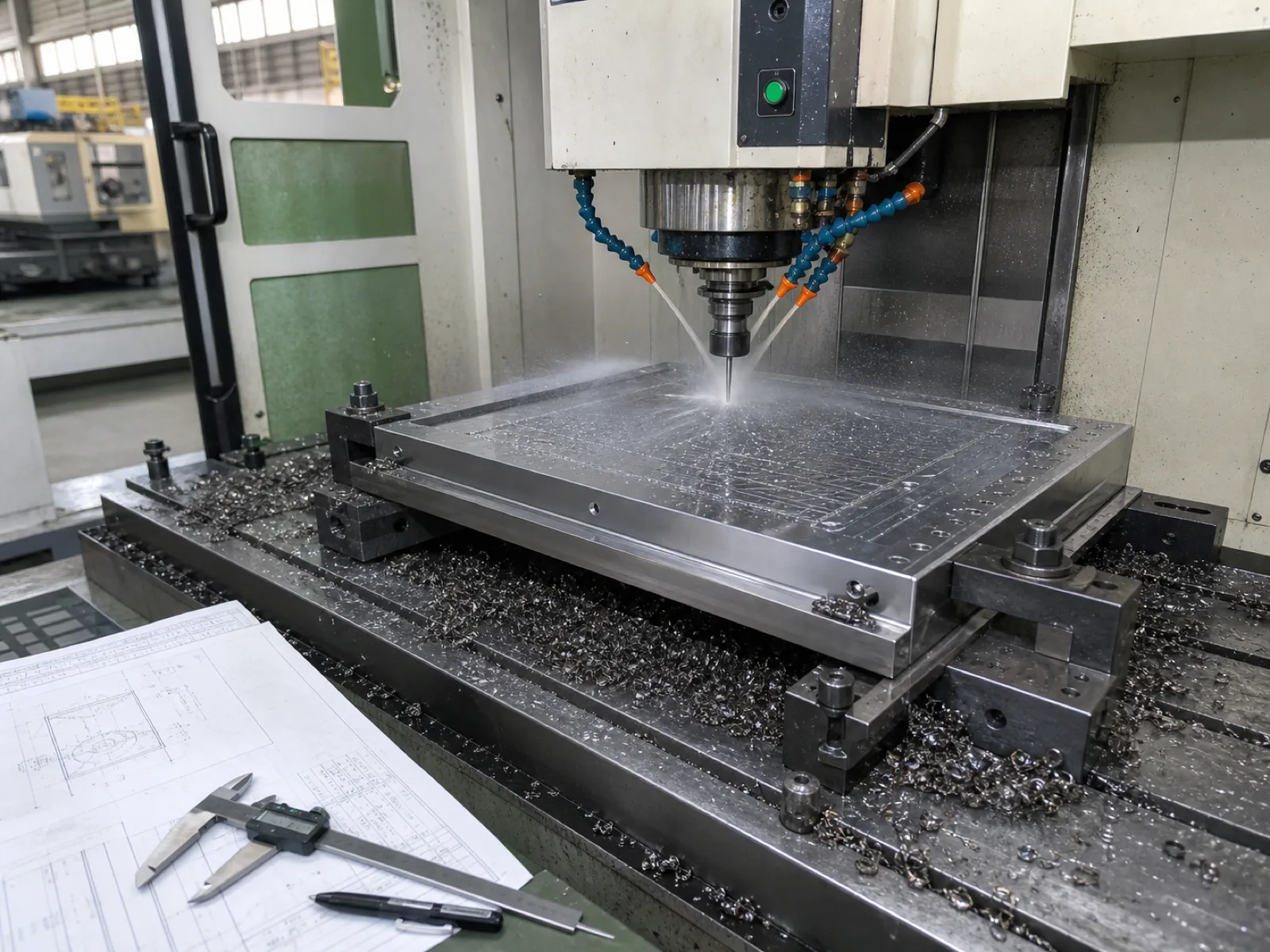
The single video verification worth ten documents
A working silicone kitchen mat factory shows on video:
- 4-12 active compression molding presses (not idle), sized 200-500 tonne
- Post-cure ovens with visible batches inside, temperature displays reading 180-200°C
- Master-batch staging with visible lot labels and receiving-QC stickers
- Secondary process area with printing, deburring, and retail packaging in progress
- QC lab with Shore A durometer, tensile pull tester, digital caliper stations, D65 color box
- Not just a lobby, showroom, or empty warehouse
Packaging and retail-ready compliance labeling
Retail-ready packaging on a silicone kitchen mat program covers six discrete elements — printed header card (2C or 4C offset on 350-400 gsm C1S with matte or soft-touch lamination), UPC/GTIN-12 or EAN-13 barcode with 2 mm quiet zone, country-of-origin marking "Made in China" at ≥ 3 mm text height per US 19 CFR 134 and EU Regulation 952/2013, California Prop 65 warning block with correct triangle symbol at ≥ 6-point type for US retail, retailer-specific SKU / GTIN / vendor labels, and polybag with printed suffocation warning at ≥ 5 mm type. Every element has a compliance-driven minimum spec that a retail receiving dock inspection will check.
Header card and hangtag construction
The retail header card carries the majority of consumer-facing brand information and every mandatory disclosure. Standard Wetop OEM construction: 350-400 gsm C1S (coated one side) stock, 4C offset print with soft-touch or matte lamination on the front face, aqueous coating on the back for durability, die-cut hangtag geometry sized to euro-hook (30 mm × 5 mm slot) or J-hook (25 mm circular hole). Header card die-line templates are pre-built for the four standard mat sizes in Wetop’s tooling library (45×30 cm counter, 60×40 cm sink, 40×30 cm pet feeding, 30×20 cm appliance drip). Retailer-specific header card constructions (Home Depot orange band, Wayfair private-label brand marks, Tesco Value tier stripe) are added at OEM finishing.
Barcode and identification specifications
UPC/GTIN-12 (US) or EAN-13 (EU) barcode must be printed at ≥ 80% magnification of the nominal size with a 2 mm quiet zone left and right, and must scan cleanly at retail POS scanners at Grade C or better per ISO/IEC 15416. Retailer-specific SKU labels sit adjacent to the primary barcode, typically at the header card lower-right or on the polybag back. Wetop’s finishing line runs a barcode verification station on every packaged unit to catch print-drift before shipping.
Country-of-origin marking
US 19 CFR 134 requires country-of-origin marking on every imported article — “Made in China” printed at ≥ 3 mm text height in a conspicuous location, typically on the header card front lower band and/or debossed into the silicone mat itself. EU Regulation 952/2013 mirrors the requirement for EU retail. Direct-debossed COO marking is the most audit-defensible option because it survives header-card removal — Wetop’s default on OEM programs is dual-marking (header card + debossed on the mat back face).
California Proposition 65 warning block
US retail packaged goods sold in California require a Prop 65 warning block using the current OEHHA short-form or long-form text with the yellow triangle symbol, printed at ≥ 6-point type, and positioned “prominently and conspicuously” — typically the header-card back face or a printed insert card behind the header. Wetop’s compliance packet includes a Prop 65 declaration by chemical (usually “no listed chemicals” for silicone at LFGB-clearing extractables levels), which the buyer can use to justify a “no warning required” position, or a warning block if the buyer’s legal team elects the safe-harbor route.
Polybag with suffocation warning
Polybag packaging over 5” (127 mm) on one dimension requires a suffocation warning under ASTM F2033 / state consumer safety statutes. Standard construction: 2-mil clear LDPE polybag with printed warning at ≥ 5 mm type, resealable adhesive strip on the flap, vent holes per ASTM F963 where required (baby channel). Wetop’s baseline polybag is 100% recyclable LDPE; recycled-content PCR polybag is available at +$0.02-$0.05 per unit.
Packaging cost summary
| Package tier | Construction | FOB add per unit |
|---|---|---|
| Polybag only, no header | 2-mil LDPE + suffocation warning | +$0.05-$0.08 |
| Polybag + printed insert card | LDPE + 200 gsm insert | +$0.08-$0.14 |
| Printed header card + polybag | 350 gsm C1S 4C + LDPE polybag | +$0.18-$0.28 |
| Premium retail hangtag + soft-touch header | 400 gsm C1S soft-touch + hangtag | +$0.28-$0.45 |
| Custom retail box (kraft or printed) | E-flute corrugated print box | +$0.55-$1.10 |
Documentation package — what ships with the PO
The documentation packet Wetop ships with every kitchen mat batch covers: FDA 21 CFR 177.2600 Declaration of Conformity + third-party test report referencing the master-batch lot, LFGB §30/31 report per BfR Recommendation XV[^bfr-lfgb-xv], PFAS non-detect report at ppb detection limits, RoHS declaration, California Prop 65 declaration, ISO 9001[^iso-9001] certificate current copy, post-cure oven log for the batch, AQL 1.5 pre-shipment inspection report per ISO 2859-1[^iso-2859-1], Shore A + thickness + tensile in-house test log, and material safety data sheet.
Plus, on request per program: NSF/ANSI 51 audit report (commercial-kitchen adjacent), CPSIA + phthalate report (baby / children’s tier), USP <88> Class VI (medical-adjacent), migration test to EU 10/2011 (EU retail), REACH SVHC screening (EU retail), and mutual NDA scope confirmation for private-label programs. Full workflow on the customize silicone logo — deboss, print, or laser and private-label silicone kitchen products guides.
Sustainability, PFAS-free, and the compliance drift ahead
Silicone kitchen mats displace disposable paper/plastic counter liners over 2-4 year service life — the reusable-durables story is real but only defensible with per-batch PFAS non-detect testing at ppb detection limits and cure-system documentation. Platinum-cure is inherently PFAS-free at the polymer level. Peroxide-cure requires supplier verification that PFAS process aids have been designed out of the compound. ECHA's universal restriction proposal[^echa-pfas-proposal] is accelerating this spec adoption in EU premium retail and, downstream, US West Coast retail. Sourcing decisions in 2026 that lock in PFAS-free process aids protect the program against compliance drift in 2027-2028.
Full detail on the PFAS-free silicone sustainability guide.
What Wetop OEMs on silicone kitchen mats
Wetop runs silicone kitchen mat programs at 500-piece MOQ per SKU across six retail channels (housewares, sink accessory, retail private-label, pet, baby, medical-adjacent) from a 7,500 m² founder-led Dongguan floor. Platinum-cure LSR/HCR for EU premium, PFAS-free positioning, baby, and medical-adjacent. Post-cured peroxide-cure HCR for US mid-tier retail at $10-25 shelf price. Per-batch FDA 21 CFR 177.2600[^fda-177-2600] + LFGB §30/31[^bfr-lfgb-xv] + PFAS non-detect analysis included in every quote. FOB Yantian pricing published above.
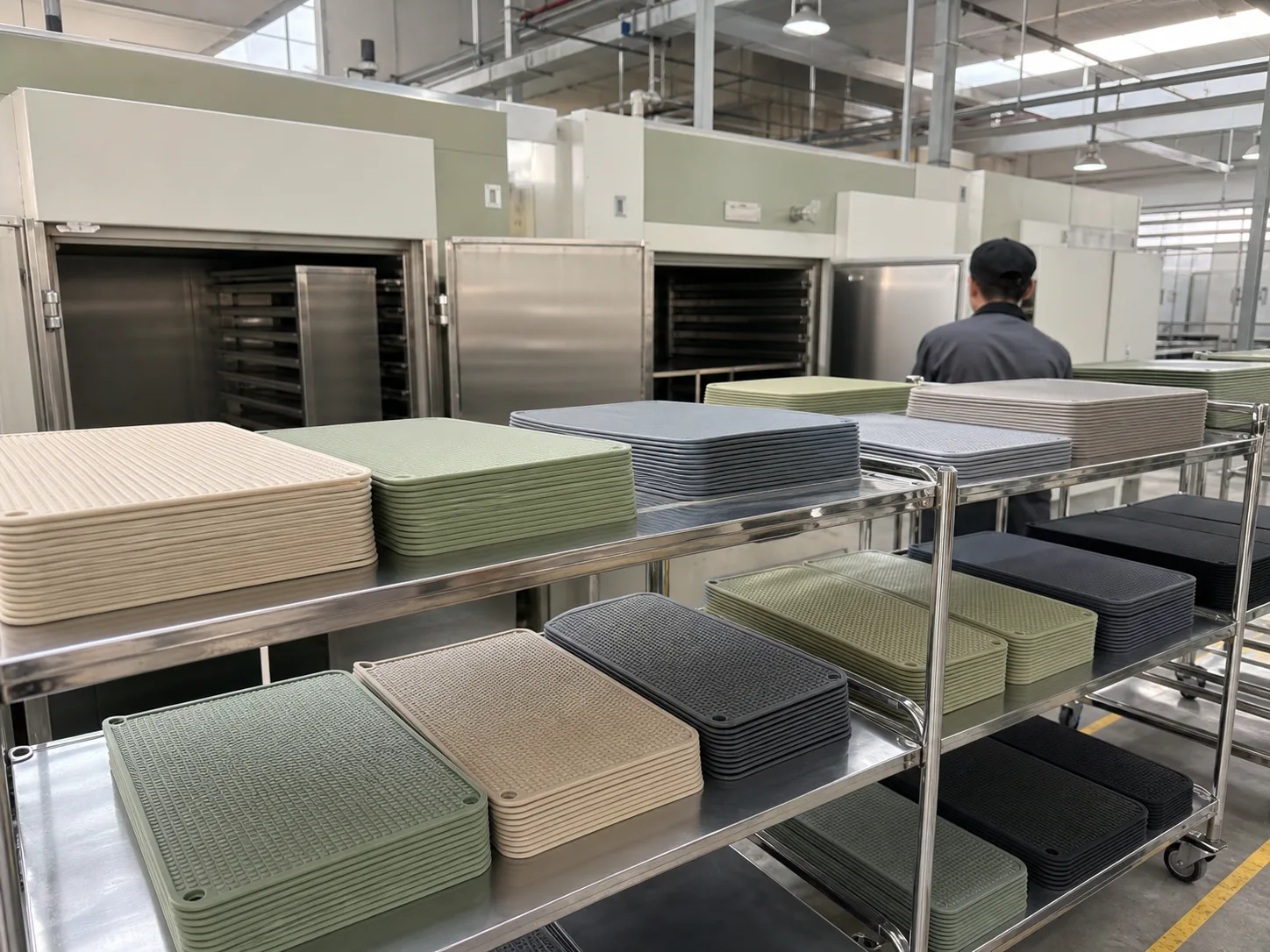
Program defaults:
- Platinum-cure LSR / premium HCR — for EU premium retail, PFAS-free marketing positioning, baby-feeding placemat, medical-adjacent (veterinary, dental instrument tray) programs. USP <88>-adjacent extract testing available on request.
- Post-cured peroxide-cure HCR — for US mass and mid-tier retail counter mats, sink mats, appliance drip mats, and pet feeding mats at $10-25 shelf price, with PFAS-free process aids verified per batch and mandatory 4-6 hour post-cure on every lot.
Tooling library covers 45×30 cm counter mat, 60×40 cm sink mat, 40×30 cm pet feeding mat, 30×20 cm appliance drip mat, and a 90×45 cm workspace mat at private-label MOQ 500 pcs. Custom tooling for OEM programs at $2,800-$5,500 amortized against first order.
Sourcing a silicone kitchen mat program? Email inquiry@wetopsilicone.com with target retail tier, target regulatory scope (US-only, EU-inclusive, medical-adjacent, baby-tier), preferred cure system (or ask for recommendation), and target volume. We return within 2 business days with a cure recommendation, per-batch documentation packet outline, and price brackets at MOQ 500 / 1,000 / 5,000 / 10,000. Mutual NDA available at our NDA page. Full manufacturing detail on the capabilities page; anonymized program archetypes at case studies; direct engineering contact via the contact page.
Footnotes
-
US Food and Drug Administration. 21 CFR 177.2600 — Rubber articles intended for repeated use. https://www.ecfr.gov/current/title-21/chapter-I/subchapter-B/part-177/subpart-C/section-177.2600 — the primary US food-contact regulation Wetop tests every silicone kitchen mat batch against. ↩
-
German Federal Institute for Risk Assessment (BfR). Recommendation XV — Silicones. https://www.bfr.bund.de/en/bfr_recommendations_on_food_contact_materials-7498.html — the technical standard behind LFGB §30/31 organic volatile testing for food-contact silicone. ↩
-
ASTM International. ASTM D2240-15 — Standard Test Method for Rubber Property—Durometer Hardness. https://www.astm.org/d2240-15r21.html — the Shore A hardness measurement standard. ↩
-
European Parliament and Council. Regulation (EC) No 1935/2004 — Materials intended to come into contact with food. https://eur-lex.europa.eu/legal-content/EN/TXT/?uri=CELEX%3A02004R1935-20090807 — the EU framework regulation for food-contact materials. ↩
-
NSF International / ANSI. NSF/ANSI 51 — Food Equipment Materials. https://www.ecfr.gov/current/title-21/chapter-I/subchapter-B/part-177 — required on silicone kitchen mats sold into commercial-kitchen adjacent channels. ↩
-
US Consumer Product Safety Commission. CPSIA — Consumer Product Safety Improvement Act. https://www.ecfr.gov/current/title-16 — the US consumer product safety framework for baby / children’s tier silicone kitchen mat programs. ↩ ↩2
-
International Organization for Standardization. ISO 2859-1:1999 — Sampling procedures for inspection by attributes. https://www.iso.org/standard/1141.html — the sampling standard behind AQL 1.5 pre-shipment inspection. ↩
-
International Organization for Standardization. ISO 9001:2015 — Quality Management Systems — Requirements. https://www.iso.org/standard/62085.html — the quality management standard Wetop is certified against. ↩ ↩2
FAQ
-
What is a silicone kitchen mat and what programs actually source it?
A silicone kitchen mat is a flat food-contact silicone sheet — 1.5-4.0 mm thick, Shore A 50-70, typically 30×40 cm to 60×90 cm — used as a counter workspace, sink mat, pet feeding mat, appliance drip mat, or under-sink liner. B2B programs sourcing this SKU sit across housewares brands (OXO / Joseph Joseph / DI ORO tier), sink brands (Kraus / Ruvati / Blanco / Kohler / Elkay tier accessories), retail private-label (Home Depot / Wayfair / BBB / Tesco / Carrefour), pet channel, baby channel, and medical-adjacent (veterinary, dental instrument trays). Wetop OEMs all six channels off the same 7,500 m² floor at MOQ 500 pcs per SKU.
-
What is the MOQ and what does a custom silicone kitchen mat actually cost?
Wetop's MOQ is 500 pieces per SKU — the economic floor that supports per-batch FDA + LFGB + PFAS third-party testing. FOB Yantian Q3 2026 for a standard 45×30 cm platinum-cure counter mat with 1-color debossed logo: 500 pcs $2.10-$2.75, 1,000 pcs $1.70-$2.15, 5,000 pcs $1.30-$1.70, 10,000 pcs $1.10-$1.45. Peroxide-cure with disciplined post-cure runs 15-25% below platinum. Tooling for a new size runs $2,800-$5,500 amortized against first-order volume. Custom Pantone-matched master-batch adds $0.10-$0.18 per unit; 4C sublimation printing adds $0.06-$0.12.
-
How long is the lead time from PO to warehouse receipt?
7-15 day sample on existing tooling (14-21 days if new mold is cut). 35-45 day production for 5,000-20,000 pieces after PO and 30% deposit. Add 14-18 day Yantian-to-US-West-Coast sailing, 25-32 days East Coast, 30-38 days Northern Europe. Total realistic RFQ-to-warehouse: 60-90 days. Suppliers quoting 30-day cold-start-to-warehouse are compressing a step — usually post-cure, incoming raw material QC, or pre-shipment AQL inspection. All three shortcuts create audit failures downstream.
-
What documents does a retail buyer's audit team actually inspect?
Six documents plus one video verification. (1) ISO 9001:2015 certificate with current validity and silicone-molding scope, issued by SGS / TÜV / Bureau Veritas / DNV. (2) FDA 21 CFR 177.2600 and LFGB §30/31 third-party test reports referencing a specific master-batch lot number from the last 6 months. (3) Post-cure cycle log for the same batch showing 4-6 hours at 180-200°C. (4) PFAS non-detect test report at ppb detection limits per batch. (5) RoHS + Prop 65 declaration for retail packaged goods. (6) Business license + export license copies. Plus a 2-3 minute unedited factory walk-through video with the current date shown.
-
What material spec should I put on the RFQ?
The eight parameters that pin down a kitchen mat program: (1) Base polymer — PDMS platinum-cure LSR/HCR or peroxide-cure HCR. (2) Shore A hardness ±5 per ASTM D2240 — 50-60 for a soft under-sink liner, 60-70 for a rigid counter mat. (3) Total thickness ±0.05 mm — 1.5-2.5 mm for counter mats, 3.0-4.0 mm for heavy-duty sink mats. (4) Tensile ≥ 5.5 MPa per ASTM D412. (5) Continuous service temperature -40°C to 230°C. (6) Fiberglass reinforcement — none / 60-80 g/m² / 100-120 g/m². (7) Regulatory scope — FDA-only / FDA+LFGB / FDA+LFGB+NSF / FDA+LFGB+CPSIA. (8) PFAS non-detect at ppb per batch, yes / no.
-
Private-label, OEM, or ODM — which sourcing model?
Private-label: our existing tooling library (45×30 cm counter, 60×40 cm sink mat, 40×30 cm pet feeding mat, 30×20 cm appliance drip mat), your debossed or printed logo. Fastest, cheapest, no tooling investment, 7-15 day sample. OEM: your CAD or physical reference, we cut new tooling to your spec — custom size, edge geometry, drainage channels, embossed pattern — you own the tool. 21-35 day sample including tooling cut. ODM: we develop the SKU from a brief (target retail tier, price target, feature set), you license or purchase. Wetop runs all three at MOQ 500 pcs off the same floor.
-
What retail-ready packaging and compliance labeling ships with the mat?
Retail-ready packaging includes: printed header card (2C or 4C offset, 350-400 gsm C1S with matte or soft-touch lamination), UPC/GTIN-12 or EAN-13 barcode with 2mm quiet zone, country-of-origin marking 'Made in China' at ≥ 3mm height per US 19 CFR 134 and EU Regulation 952/2013, California Prop 65 warning block for US retail with the correct triangle symbol and 6-point minimum type, retailer-specific SKU / GTIN labels, and polybag with suffocation warning printed at 5mm minimum. Wetop provides dieline templates for header cards, printed insert cards, and hang-tag configurations at 45×30 cm mat footprint; retail-ready packaging runs $0.18-$0.45 per unit fully assembled.
-
What is the PPAP / first-article submission process on a Wetop OEM kitchen mat program?
Wetop runs a Level-3 PPAP-style first-article submission on OEM programs before production release. The submission package includes: signed engineering drawing with GD&T tolerances, master-batch lot Certificate of Analysis, first-article dimensional report (thickness variance, edge radius, embossed depth, overall length/width to ±0.05mm), Shore A durometer report per ASTM D2240 (5-point sampling), tensile + elongation + tear report per ASTM D412/D624, FDA 21 CFR 177.2600 + LFGB §30/31 third-party lab reports on the first-article lot, PFAS non-detect report, cure log + post-cure oven log, ΔE color-match report under D65 lighting, and 5 physical golden samples. Buyer sign-off on the PPAP package is the production-release gate — no bulk production runs until PPAP is approved.
-
How do I spec one silicone kitchen mat platform that ships into housewares, sink-brand accessory, and retail private-label channels off the same tool?
Do not try — the three channels look adjacent on a shelf but diverge on four parameters that force separate tooling or, at minimum, separate cavities. Housewares (OXO / Joseph Joseph / DI ORO caliber) sits at Shore A 60-65, 1.8-2.5 mm thick, 45×30 cm rectangular with a 3-4 mm edge radius, debossed brand logo on the top face, and a printed 4C header card. Sink-brand accessory (Kraus / Ruvati / Blanco / Kohler / Elkay caliber) sits at Shore A 55-65, 3.0-4.0 mm thick, with molded drainage channels and an edge lip geometry keyed to a specific sink basin ID within ±0.5 mm — the basin fit is what the sink brand's accessory-family QA team measures, not the mat itself. Retail private-label (Home Depot / Wayfair / BBB / Tesco / Carrefour caliber) sits at Shore A 60-65, 2.0 mm thick, with a retailer-owned brand mark debossed or 4C printed and retailer-specific SKU/GTIN/vendor labels driving the polybag artwork. A single tool cannot hold three different thicknesses (1.8 / 3.0 / 2.0 mm) or three different edge geometries. The correct decision tree at Wetop's floor is: one tool per thickness class, share master-batch pigment across channels where Pantone permits, and run a common PPAP submission structure to cut engineering-review time by 30-40%. Tooling investment for the three-SKU platform runs $10,200-$14,700 amortized against combined first-order volume across channels. See the [customization page](/customization/) for the full multi-channel tooling framework.
-
How does a silicone kitchen counter mat compare to a cork trivet, cotton pot holder, or a premium-housewares-caliber collapsible silicone bowl for a private-label kitchen-essentials capsule?
For a private-label kitchen-essentials capsule sitting at $12-28 shelf, the four SKUs solve different jobs and carry different OEM economics — treating them as interchangeable is a common assortment-planning error. A silicone kitchen counter mat (45×30 cm × 2 mm, Shore A 60-65, monolithic PDMS, FOB $1.30-$1.70 at 5,000 pcs) covers repeated wet-dry countertop workspace, appliance drip catch, and heat protection to 230°C continuous — 2-4 year service life displacing 40-80 disposable paper liners. A cork trivet (typically 3-5 mm laminated cork on MDF or silicone base) is single-purpose hot-vessel protection, cheaper at $0.60-$1.10 FOB but with a 12-18 month service life before crumb loss and heat scarring; regulatory scope is furniture-tier, not food-contact. A cotton pot holder is thermal-transient hand protection to ~230°C for 15-20 seconds, not a durable-surface product; FOB $0.80-$1.50 with laundering as end-of-life. A premium-housewares-caliber collapsible silicone bowl (400-800 ml, Shore A 50-60 with a rigid ring, FOB $2.40-$3.80 at 5,000 pcs) is portioned food storage — a completely different retail slot. For the capsule, the kitchen mat is the anchor SKU because it carries the highest impressions-per-day in the consumer's kitchen and generates the strongest brand-recall loop. Pair it with a matched-Pantone collapsible bowl and pot holder for a coordinated three-piece capsule at MOQ 500 per SKU. See the [silicone collapsible bowl OEM guide](/guide/silicone-collapsible-bowl-oem-guide/) and [silicone pot holder OEM guide](/guide/silicone-pot-holder-oem-guide/) for full multi-SKU capsule economics.
References
Authoritative sources cited in this guide
- US Food and Drug Administration. 21 CFR 177.2600 — Rubber articles intended for repeated use. https://www.ecfr.gov/current/title-21/chapter-I/subchapter-B/part-177/subpart-C/section-177.2600 — The primary US food-contact regulation Wetop tests every silicone kitchen mat batch against, per master-batch lot at accredited third-party labs.
- German Federal Institute for Risk Assessment. BfR Recommendation XV — Silicones. https://www.bfr.bund.de/en/bfr_recommendations_on_food_contact_materials-7498.html — The technical standard behind LFGB §30/31 organic volatile testing — the reason mandatory post-cure exists in the process.
- International Organization for Standardization. ISO 9001:2015 — Quality Management Systems — Requirements. https://www.iso.org/standard/62085.html — The quality management system Wetop is certified against — governs batch traceability, post-cure records, and audit documentation retention.
- International Organization for Standardization. ISO 2859-1:1999 — Sampling procedures for inspection by attributes. https://www.iso.org/standard/1141.html — The sampling standard behind AQL 1.5 pre-shipment inspection Wetop runs on every silicone kitchen mat batch.
- ASTM International. ASTM D2240-15 — Standard Test Method for Rubber Property—Durometer Hardness. https://www.astm.org/d2240-15r21.html — The measurement standard behind every Shore A hardness spec Wetop quotes on kitchen mat programs.
- European Parliament and Council. Regulation (EC) No 1935/2004 — Materials intended to come into contact with food. https://eur-lex.europa.eu/legal-content/EN/TXT/?uri=CELEX%3A02004R1935-20090807 — The overarching EU framework regulation for food-contact materials — LFGB compliance sits inside this framework.
- European Chemicals Agency. PFAS Universal Restriction Proposal. https://eur-lex.europa.eu/legal-content/EN/TXT/?uri=CELEX%3A32006R1907 — The regulatory action driving PFAS-free specification adoption in EU premium retail and, downstream, US retail.
- NSF International / ANSI. NSF/ANSI 51 — Food Equipment Materials. https://www.ecfr.gov/current/title-21/chapter-I/subchapter-B/part-177 — Required on silicone kitchen mats sold into commercial-kitchen adjacent channels.
- US Consumer Product Safety Commission. CPSIA — Consumer Product Safety Improvement Act. https://www.ecfr.gov/current/title-16 — The US consumer product safety framework any baby / children's tier silicone kitchen mat program must certify against.
Start a custom program
Send a brief. Get an engineer’s reply in one business day.
Every Wetop program is tooled from a customer’s specification. Send a CAD file (STEP · IGES · DWG) or a written brief and we’ll reply with a mold cost estimate, price brackets at MOQ 500 / 1,000 / 5,000, and any engineering questions.